Diagnosing autism in adults isn’t a quick test; it's a comprehensive clinical assessment led by specialists. It involves in-depth interviews digging into your developmental history, careful observation of social communication, and the use of standardised tools like the ADOS-2 to evaluate autistic traits. The whole point is to see if your experiences meet the diagnostic criteria laid out in manuals like the DSM-5 or ICD-11, leading to a formal, recognised conclusion.
Recognizing the Signs of Autism in Adulthood

For a lot of adults, the journey towards an autism diagnosis doesn't start with a single, dramatic event. It often begins with a quiet, persistent feeling of being fundamentally different, a feeling that’s been there for as long as they can remember. It's the culmination of a lifetime of experiences that never quite matched up with those of their peers.
This feeling might be especially clear at work. Do you end a day of meetings feeling completely drained, not because of the work, but because of the sheer effort of performing social niceties? This is a classic example of autistic masking (or camouflaging)—the conscious or subconscious effort to suppress autistic traits to blend in. The long-term price of this performance is often chronic burnout, a deep state of exhaustion that a long weekend just can't fix.
The Overlap with Mental Health and ADHD
This constant internal effort frequently surfaces as other mental health conditions. It’s very common for adults to seek help for anxiety or depression, sometimes for years, only to find that conventional therapies don't quite hit the mark. That’s often because the treatment is targeting the symptom (the anxiety) without getting to the root cause—the relentless stress of navigating a neurotypical world with an autistic brain.
There's also a significant overlap between autism and ADHD. You might struggle with executive functions like planning and organisation, which could point to either. But the ‘why’ behind the struggle can be different. An autistic person might get stuck due to rigid thinking or being overwhelmed by choices, whereas someone with ADHD might struggle more with distractibility and impulsivity. A key part of the diagnostic process is carefully untangling these threads.
For many, an autism diagnosis isn't about finding something 'wrong'. It's about finally getting the right instruction manual for a brain they've had their whole life. It validates their experiences and offers a new framework for self-understanding and compassion.
Camouflaged Traits in Women and High-Achievers
Autistic traits can be particularly hard to see in some people, which is why they can go undiagnosed for decades. Women, for instance, are often socialised from a very young age to be highly attuned to social rules and relationships. This can result in incredibly effective masking, where the internal battles with social communication or sensory overload are completely hidden behind a meticulously crafted exterior.
High-achievers are another group who often fly under the radar. Their intense focus and deep knowledge in specific subjects—a hallmark of autistic special interests—are usually celebrated as talent or dedication. Any social difficulties are easily brushed off as shyness or eccentricity. Internally, however, they might be struggling immensely to manage relationships or cope with any deviation from their routine. To learn more, you can explore the various signs of undiagnosed autism in adults in our detailed guide.
Recognising these patterns in your own life is a huge first step. It's an act of self-awareness that helps make sense of your personal history. Seeking an assessment isn't an admission of weakness; it's a powerful move towards understanding yourself and building a more authentic, sustainable life.
So, you've started to connect the dots and think an autism diagnosis might provide some answers. The next big question is a practical one: how do you actually get an assessment here in the UK?
You essentially have two paths to choose from, each with its own map, timeline, and set of realities. Getting to grips with how they work is the first real step in taking control of your diagnostic journey.
The NHS Pathway: Your First Port of Call
For most people, the journey begins with the National Health Service (NHS). This all starts with a visit to your GP. My best advice? Don't go in cold. Take some time beforehand to jot down a list of your traits, and think of specific, real-life examples of how they impact you at work, at home, and in your social life. The clearer the picture you can paint, the better.
Your GP isn't there to diagnose you. Their role is to listen and decide if there's enough reason to refer you to your local adult autism assessment service. If they agree, they'll make that referral, and you'll officially be in the NHS system.
Facing the Reality of NHS Waiting Times
And this is where we hit the biggest hurdle on the NHS route: the wait. The system is under incredible pressure, and it’s become distressingly common for adults to wait years just to get their first appointment. The scale of the problem is staggering.
As of June 2024, a massive 193,203 people were on the waiting list for an autism assessment referral. This leaves countless adults in a sort of limbo, waiting for clarity that could be life-changing.
While the wait is undeniably tough, an NHS diagnosis is free and is automatically recognised by all public services, from educational support to schemes like Access to Work.
Exploring the Private Assessment Route
If waiting years isn't a viable option, a private assessment offers a much faster path to getting an answer. Going private means you can sidestep the long NHS queues, often getting an assessment within a few weeks or months.
But a word of caution: the quality of private services can be a bit of a minefield. It is absolutely vital that you do your homework and choose a credible, highly-qualified provider. A poorly conducted assessment isn't worth the paper it's printed on.
A proper private assessment must follow the same rigorous standards as the NHS. This means it should be carried out by a multi-disciplinary team, stick to NICE (National Institute for Health and Care Excellence) guidelines, and be overseen by specialists who are on the General Medical Council (GMC) Specialist Register.
When you're researching clinics, here’s what to look for as non-negotiables:
- CQC Regulation: Is the service regulated by the Care Quality Commission (CQC)? This is a key seal of approval for safety and professional standards.
- GMC-Registered Psychiatrists: The assessment should be led by a consultant psychiatrist on the GMC Specialist Register. This clinical leadership is essential for a diagnosis to be taken seriously.
- Gold-Standard Tools: The clinic should use internationally recognised diagnostic tools like the ADOS-2 and ADI-R, but—and this is important—only as part of a comprehensive clinical evaluation.
For a much more detailed breakdown of what a robust assessment looks like, have a look at our complete guide on diagnosing autism in adults in the UK.
Comparing NHS and Private Autism Assessment Pathways
To help you weigh your options, here’s a straightforward comparison of the two main pathways available in the UK.
| Feature | NHS Pathway | Private Pathway |
|---|---|---|
| Cost | Free at the point of use. | Self-funded. Costs typically range from £1,500 to £3,000+. |
| Waiting Time | Extremely long. The average wait time from referral to diagnosis can be several years, depending on the region. | Significantly shorter. An assessment can often be secured within weeks or a few months. |
| Referral Process | Requires a referral from your GP to a local adult autism assessment service. | Self-referral is usually possible, allowing you to contact a clinic directly. |
| Choice of Provider | No choice. You are referred to your local NHS trust's designated service. | You have full choice over which clinic and clinicians you see, allowing you to find specialists who fit your needs. |
| Recognition | Universally recognised by all UK public bodies, including education, DWP, and other NHS services. | A diagnosis from a NICE-compliant, multi-disciplinary team is generally well-recognised, but some NHS services may be reluctant to accept it. |
| Assessment Standard | Must adhere to NICE guidelines. | Reputable providers adhere to NICE guidelines, but quality can vary. Due diligence is essential. |
Ultimately, both the NHS and private routes can lead to a formal diagnosis. The best path for you will depend on your personal circumstances, finances, and how urgently you need answers.
Why a Formal Diagnosis Matters in Official and Legal Situations
Beyond personal understanding, a formal diagnostic report can be a critical document. In an employment tribunal, for example, it serves as the medical evidence needed to prove you’re entitled to reasonable adjustments under the Equality Act 2010. It’s the key that unlocks academic support at university, workplace accommodations, or can provide crucial context in legal proceedings.
Whether you go with the NHS or a private service, the goal is the same: to get a clear, accurate, and helpful understanding of yourself. Each path has its pros and cons, but knowing what they are puts you in the best position to decide.
What to Expect During Your Clinical Assessment
The idea of a formal clinical assessment can be daunting, but knowing what’s involved is often the best way to feel more at ease. When you understand the steps, you can prepare properly and give the clinical team a clear, accurate picture of your life experiences. Think of it less as an interrogation and more as a guided conversation.
A proper, thorough assessment isn't just a quick chat or a single test. It’s a deep dive into who you are, exploring everything from your earliest memories to your current strengths and struggles. This level of detail is absolutely crucial for an accurate diagnosis.
The Core Components of an Adult Autism Evaluation
A high-quality assessment follows a structured, methodical approach and usually has several key parts. The exact sequence might differ slightly from one clinic to another, but the essential components are always there to make sure the evaluation meets NICE guidelines.
It often starts with some initial screening questionnaires. You’ll likely fill these out beforehand—forms like the Autism Spectrum Quotient (AQ) or the Ritvo Autism Asperger Diagnostic Scale (RAADS-R). These give the clinicians a baseline understanding of your traits before you even sit down to talk.
The heart of the evaluation is the clinical and developmental interview. This is a detailed conversation with a specialist—usually a psychiatrist or psychologist—about your entire life story.
- Early Years: They’ll ask about your childhood, touching on developmental milestones, how you played (was it repetitive or more imaginative?), and your first social interactions.
- School Experiences: This part digs into how you handled the social and sensory maze of school, your friendships (or lack thereof), and any particular academic patterns.
- Adulthood: The conversation then moves into your life now—your experiences with work, relationships, and day-to-day living, looking for recurring themes and difficulties.
Throughout the assessment, the clinician will be carefully documenting everything. In many modern clinics, tools like healthcare voice recognition software are used to help capture the conversation accurately and efficiently.
Understanding the Gold-Standard Diagnostic Tools
Alongside the in-depth interview, specialists use internationally recognised, standardised tools to observe and measure specific autistic traits. It's important to know these aren't pass-or-fail tests. They are simply structured ways for the clinician to see your social communication and interaction styles in action.
The two most common "gold-standard" tools you'll hear about are:
- ADOS-2 (Autism Diagnostic Observation Schedule, Second Edition): This is a semi-structured assessment where you'll do a series of activities and have a conversation with the clinician. They’re looking at things like your use of eye contact, gestures, and tone of voice, and how you talk about your own feelings. It’s cleverly designed to create natural social scenarios.
- ADI-R (Autism Diagnostic Interview-Revised): This is a very structured interview, but it’s usually done with a parent or someone else who knew you very well as a young child. It focuses heavily on your developmental history before the age of five, which provides crucial evidence of traits from early on.
Remember, these tools are just one piece of a much larger puzzle. A diagnosis is never based on a score alone. The final conclusion is a blend of information from these assessments, your personal history, and the clinician’s expert judgement.
The Importance of Collaboration and Corroboration
An adult autism assessment is really a team effort, combining the clinician's expertise with your own lived experience. To get the fullest possible picture, they will almost always ask for input from someone who knows you well—a partner, a close friend, or a family member.
This "informant" can offer an outside perspective on your traits, which is incredibly valuable because we often can't see our own patterns objectively. They might share insights about your communication style or routines that you’ve never even noticed yourself. This helps build a rich, three-dimensional view of who you are. If you want to better understand the overall structure of this type of evaluation, you can learn more about what is a psychiatric assessment on our blog.
The flowchart below outlines the key choices you'll face when seeking a diagnosis in the UK, guiding you from the very first step through to choosing either the NHS or a private pathway.
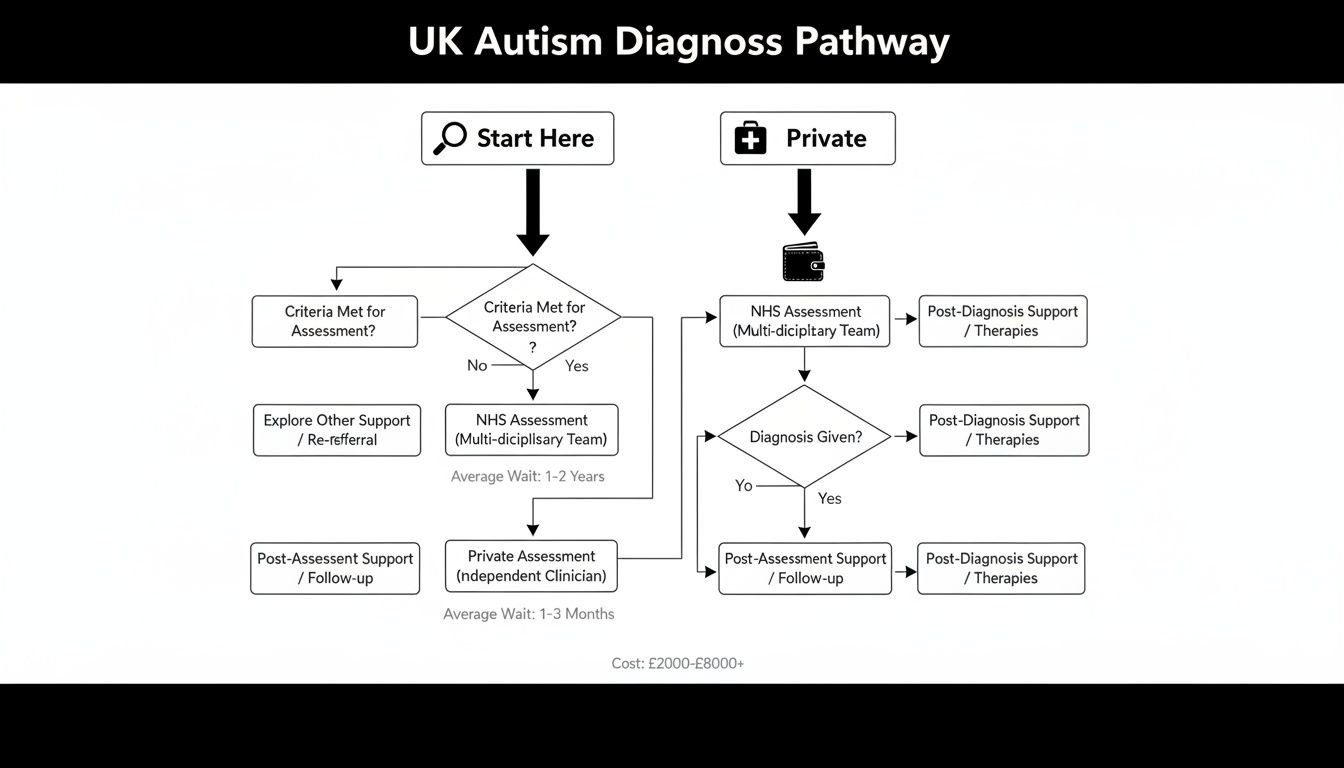
As the visual shows, the two main routes are distinct. Your first major decision is whether to go through the publicly funded NHS service or opt for a self-funded private provider.
The need for this kind of thorough assessment is clearer than ever. In the UK, the recorded incidence of new adult autism diagnoses shot up by an incredible 787% between 1998 and 2018. The increase was especially sharp in women, which points to a long history of under-recognition of how autism can present differently in females, who often become very skilled at masking their traits. Reputable services are now working hard to close this diagnostic gap.
Ultimately, the entire assessment is designed to go far beyond a simple checklist. The goal is to reach a meaningful conclusion that truly reflects you and your unique way of experiencing the world.
Untangling Autism, ADHD, and Mental Health Conditions
One of the most complex parts of any adult autism assessment is something we call differential diagnosis. In simple terms, it’s the clinical detective work of figuring out which condition is causing which trait, especially when they overlap. Many adults who come to us for an autism assessment have already collected a few other diagnoses along the way, making it absolutely crucial to carefully separate the threads.
This isn’t just a box-ticking exercise. Getting it wrong can have real-world consequences. When autistic traits are mistaken for something else, like a personality disorder, it can lead to years of treatment that just doesn't work. This is precisely why a specialist-led, thorough evaluation is the only way to get to the bottom of what’s really going on.
The Intricate Overlap of Autism and ADHD
Autism and ADHD are very often found together. In fact, research shows a huge number of autistic people also meet the criteria for ADHD, and the same is true the other way around. This co-occurrence, which many now refer to as AuDHD, creates a really unique profile of strengths and challenges.
From the inside, it can feel like a constant internal battle. The autistic part of you might crave routine, predictability, and quiet, while the ADHD part is desperately seeking novelty, stimulation, and spontaneity. This can create a confusing cycle of behaviour. You might find yourself meticulously planning a project down to the last detail (a very autistic trait), only to get completely distracted and abandon it for a shiny new idea (a classic ADHD move).
A skilled clinician knows to ask why you do something, not just what you do. For instance:
- Social Challenges: Are they because you miss social cues and find small talk confusing (autism)? Or is it because you tend to interrupt people or find your mind wandering during conversations (ADHD)?
- Executive Functioning: Do you struggle to start a task because you’re paralysed by a fear of getting it wrong (autism)? Or is it because you can’t seem to prioritise or maintain your focus (ADHD)?
- Intense Interests: Is it a deep, lifelong passion for a specific subject (an autistic special interest)? Or is it a series of all-consuming but short-lived hyperfixations (ADHD)?
Making these distinctions is essential. For anyone looking to understand more about attention-related difficulties, exploring common ADHD symptoms in adults can be a good starting point. It’s also useful to clarify related concepts, like the classification of ADHD as a learning disability, to build a fuller picture.
Getting the diagnosis right is crucial because the support strategies for autism and ADHD can be quite different. A strategy that helps with autistic sensory overload might not work for ADHD-related restlessness. Recognising both conditions allows for a more tailored and effective support plan.
Reframing Anxiety and Depression Through an Autistic Lens
It is incredibly common for autistic adults to also live with anxiety and depression. For many, these were the very things that first led them to seek help from a mental health professional, often years before autism was ever considered.
When you look at these experiences through the lens of undiagnosed autism, their origins suddenly make a lot more sense.
Imagine spending every single day in a world that feels too bright, too loud, and socially baffling. Your nervous system would be stuck in a constant state of high alert. That kind of chronic stress is a fast track to developing an anxiety disorder.
By the same token, years of feeling different, being misunderstood, facing social rejection, or simply failing to meet neurotypical expectations can lead to deep-seated feelings of sadness and worthlessness—the very definition of depression. An autism diagnosis doesn't erase that history, but it does reframe it. It helps you see that the anxiety and depression weren't personal failings, but often a completely logical response to the constant friction between your brain and your environment.
This reframing can be incredibly empowering. It shifts the entire focus from "What's wrong with me?" to "How can I adapt my world and find strategies that actually work for my brain?" This is the foundation of good, neuro-affirming support, and getting the right diagnosis is the first and most important step on that path.
Your Report, and Life After Diagnosis
The moment you get your diagnostic report is often a huge, deeply personal experience. For many, it’s the first time they have a clear, evidence-based answer after a lifetime of questions, self-doubt, or feeling out of step with the world. This document isn't just a label—it's a key that unlocks a new way of understanding yourself.
A good report does more than just state the outcome. It should essentially tell your own story back to you, but through a clinical framework. You’ll see how your experiences, from childhood to now, map onto the diagnostic criteria in the DSM-5 or ICD-11. It summarises all the evidence from the assessment, creating a personalised narrative that validates what you've always felt.
But the real power of a diagnosis isn't just about looking back; it’s about moving forward. This is your foundation for building a more authentic life, equipped with the knowledge you need to advocate for yourself.
Turning Your Diagnosis into Practical Support
Once you have your report, you gain access to legal protections and support systems that were likely out of reach before. In the UK, an autism diagnosis is recognised as a disability under the Equality Act 2010. This isn't about being seen as less capable; it’s about establishing your legal right to reasonable adjustments in work and education.
Your report is the tool that makes this happen. For many people, a great first step is applying for Access to Work, a government scheme that can fund changes to make your job more sustainable.
These adjustments aren't one-size-fits-all, but common examples include:
- Sensory support: Noise-cancelling headphones or being able to work in a quieter part of the office.
- Communication changes: Asking for important instructions in writing instead of just verbally.
- Structural adjustments: Flexible working hours to help manage energy and avoid autistic burnout.
This legal backing is so important. For decades, underdiagnosis has been a massive issue in the UK. Some research estimates that a shocking 89-97% of autistic adults over 40 may have been missed, often leading to social isolation and significant mental health struggles. The good news is that support is improving. By 2019, 93% of English authorities had set up adult services, a huge jump from under 50% a decade earlier. To grasp the scale of the problem, you can read more about the research on undiagnosed adults in England.
Finding the Right Mental Health and Wellbeing Path
Your report also acts as a roadmap for finding mental health support that actually works for you. So many autistic adults, especially those who are also navigating ADHD, have had demoralising experiences with standard talking therapies that simply didn't get to the root of their anxiety or depression.
Now, you can seek out therapists who are specifically "neuro-affirming." This is a crucial distinction. A neuro-affirming therapist understands your brain works differently and won't try to force you into neurotypical moulds. Their goal is to help you develop strategies that work with your autistic traits, not against them. This could mean learning to manage sensory overload, unlearning years of masking, or finding ways to socialise that feel genuine and comfortable.
A diagnosis is not the end of your story. It’s the moment you’re handed the vocabulary to start telling it truthfully, giving you the power to ask for what you need and the compassion to forgive yourself for struggles you never understood.
Ultimately, your diagnostic report is a beginning. It's the official recognition that empowers you to reframe your past, reshape your present, and build a future with greater self-awareness and the right support in place. The process of learning how you diagnose autism in adults might end here, but your journey of self-discovery is just getting started.
Your Questions About Adult Autism Diagnosis Answered
Even with a clear roadmap of the diagnostic process, it’s completely normal to have practical questions. Knowing the answers to things like cost, online options, and what happens if you don't get a diagnosis can help you feel more prepared and confident in your decision.
Let’s tackle some of the most common queries we hear from adults in the UK exploring an assessment.
How Much Does a Private Adult Autism Assessment Cost in the UK?
The investment for a private adult autism assessment in the UK generally falls somewhere between £1,500 and £3,000+. That's quite a range, and the price often depends on the clinic's location and reputation, the seniority of the clinicians, and the depth of the assessment itself.
When you're looking at providers, the crucial thing is to ensure they are regulated by the Care Quality Commission (CQC) and that their team includes consultant psychiatrists on the General Medical Council (GMC) Specialist Register. This isn't just a formality; it's your guarantee that the assessment is thorough and that the final diagnosis will be respected by your employer, university, or other official bodies. A good clinic will be upfront about their pricing for a comprehensive, consultant-led evaluation that gives you a detailed report and practical recommendations.
Can I Get a Reliable Autism Diagnosis Online?
Absolutely. A high-quality, credible autism diagnosis can certainly be done entirely online. The key isn't where the assessment takes place, but how it's conducted and by whom. A valid online diagnosis must be carried out by a qualified multi-disciplinary team who are meticulously following the official NICE guidelines for diagnosing autism in adults.
Reputable online clinics use secure video platforms for the clinical interviews and observations. For many people, this is actually a much better fit. It removes the stress and logistics of travelling to a clinic and allows you to be in a comfortable, familiar environment. The diagnostic standards are exactly the same as an in-person assessment; the methods have just been adapted to work effectively online.
A diagnosis is valid because of the clinical rigour and the credentials of the assessors—not whether it happens in-person or on-screen. A NICE-compliant online assessment holds the same weight.
What Happens If the Assessment Shows I Am Not Autistic?
A thorough assessment provides clarity, whatever the outcome. If the conclusion is that you don’t meet the diagnostic criteria for autism, a good clinician won’t just send you away with a simple "no." They'll take the time to explain exactly why.
More importantly, the diagnostic report should give you an alternative clinical perspective on the challenges you've been facing. It will often point towards other possibilities that can have overlapping traits, such as:
- ADHD (Attention Deficit Hyperactivity Disorder)
- Social Anxiety Disorder
- Complex Trauma (C-PTSD)
- Certain personality traits or disorders
The whole point of an assessment is to get answers. Even if autism isn't the right one for you, you should leave with professional insights and a clear, helpful set of recommendations for what to do next. It's about finding the right path forward.
At Insight Diagnostics Global, we provide CQC-regulated, consultant-led online assessments for autism and ADHD, delivering clarity and support with clinical expertise. If you're ready to understand yourself better, explore our services and start your journey today at https://insightdiagnostics.co.uk.