
For many, the journey towards an adult autism diagnosis starts with a nagging feeling—a quiet, persistent sense of being different that has followed you through life. It's a path that begins with piecing together lifelong patterns and then moves towards a formal clinical assessment, which typically involves detailed interviews and specific screening tools. Ultimately, a diagnosis is made by a qualified specialist, such as a psychiatrist, who takes the time to deeply understand your personal history and current struggles, including the complex interplay with conditions like ADHD and mental health.
Recognizing the Signs of Autism in Yourself

If you've spent your life feeling like you’re operating on a different wavelength to everyone else, you’re far from alone. Many adults get to a point where they start wondering if autism could be the missing piece of their puzzle. This moment of realisation often follows years of feeling misunderstood, struggling with anxiety or depression, or just being profoundly exhausted without knowing why.
This process of self-discovery isn't about ticking boxes from childhood stereotypes. In adults, autism often shows up in much more subtle ways, honed by years of learning to adapt to a world that wasn't designed for your way of thinking.
Moving Beyond Common Stereotypes
Adult autism rarely looks like the caricatures often shown in films or on TV. Instead, it’s usually defined by a complex internal world filled with unique processing styles and sophisticated coping mechanisms. Before diving into the specifics, getting a comprehensive definition of autism can help build a solid foundation for your understanding.
For many adults, one of the biggest indicators is the bone-deep exhaustion that comes from masking. This is the conscious or subconscious effort to hide autistic traits to fit in. It could be forcing yourself to make eye contact when it feels intensely unnatural, carefully mimicking the social scripts you see others use, or suppressing the urge to engage in repetitive movements (stimming).
Masking is like constantly running a complex social translation program in the background of your mind. It’s effective for getting by, but it drains your mental energy, often leading to burnout, anxiety, and depression.
Core Areas of Self-Reflection
To get a clearer picture of whether your experiences align with autism, it helps to look back on specific areas of your life, both now and in the past. Think about how you've handled social situations, managed sensory input, and pursued your interests over the years.
- Social and Communication Differences: Do you frequently feel like you've missed the memo on unspoken social rules? Maybe you find small talk baffling and much prefer direct, literal conversations. You might also find it far easier to connect with people when you're talking about a shared, deep interest.
- Need for Routine and Sameness: Do you find immense comfort and security in having a predictable routine? An unexpected change to your schedule, even a small one, might feel deeply unsettling or stressful. This isn't just a preference; it's a way of creating a sense of control in a world that can feel incredibly chaotic.
- Deep, Focused Interests: Have you had lifelong passions or hobbies that are incredibly deep and all-consuming? These aren't just casual pastimes; they're often a core part of your identity and a source of great joy, comfort, and expertise.
- Sensory Sensitivities: Are you highly sensitive to certain sounds, lights, textures, or smells that others don't seem to notice? You might find the buzzing lights and crowds of a supermarket completely overwhelming, or you might be acutely aware of a ticking clock in a quiet room.
The Overlap with ADHD and Mental Health
It’s really important to recognise that many autistic adults also have co-occurring conditions, with Attention-Deficit/Hyperactivity Disorder (ADHD), anxiety, and depression being the most common. The traits can overlap and sometimes even seem to contradict each other, which can create a very complex personal profile. For example, you might crave the stability of a routine (an autistic trait) but struggle with the executive function needed to actually maintain it (an ADHD trait).
This kind of blended experience is completely valid and surprisingly common. Many people first seek an assessment because they're struggling with persistent anxiety or depression, only to discover that these mental health challenges are deeply connected to the underlying stress of navigating the world as an undiagnosed autistic and/or ADHD individual.
To explore this further, you can learn more about the specific signs of undiagnosed autism in adults and how they can show up in daily life. This period of self-reflection is the most crucial first step on the path to clarity.
Getting Ready for Your Autism Assessment

Once you've decided to seek an assessment, the thought of actually preparing for it can feel a bit overwhelming. A common worry I hear is, "What if I can't remember enough from my childhood?" or "How can I possibly explain what it's like inside my head, especially if I also think I have ADHD?"
Let’s reframe this. The goal isn't to build a 'case' for yourself or to prove anything. It's simply about organising your thoughts and memories so you can have a clear, collaborative conversation with the clinician. This way, you can feel confident you're giving them the full picture of who you are, which is crucial for an accurate outcome.
Looking Back: Your Life Story from Childhood to Now
A core part of any adult autism assessment involves tracing patterns of behaviour and experience right back to your early years. Clinicians are looking for evidence of lifelong traits, even if those traits presented differently when you were a child. Creating a personal timeline is a brilliant way to structure this.
I suggest focusing on three key areas: your social world, your sensory experiences, and how you approach routines and interests. The real magic is in the detail—don't just list traits, dig up specific, real-world examples.
- Social Life: Instead of a vague "I've always been awkward," try to recall a specific moment. Maybe it's, "In primary school, I never understood why the other kids would suddenly end a game. I’d keep going and they'd get angry with me." Or perhaps, "At work, I've been told my emails come across as blunt, but I’m just trying to be clear and efficient."
- Sensory World: How do you react to your environment? Think about things like, "I have to cut the labels out of all my clothes because the scratchy feeling is just unbearable." Or, "By lunchtime, the constant hum of the office lights gives me a splitting headache."
- Routines & Interests: Consider your relationship with predictability and passion. An example might be, "I eat the exact same breakfast every single day. If I have to change it, my whole morning feels off." For special interests, you could say, "As a teen, I spent hundreds of hours cataloguing every single song and fact about my favourite band, way more than any of my friends did."
This isn't about finding "proof" that you're autistic. It's about painting a rich, detailed picture of your life so the clinician can truly understand your unique way of experiencing the world.
Bringing in an Outside Perspective
Let’s be honest, remembering your own early childhood clearly is tough. That’s where bringing in a trusted person can be incredibly helpful. A parent, an older sibling, or even a friend you've known for decades can offer an invaluable outside view on your development, social quirks, and any early signs they might have noticed back then.
Old school reports can be an absolute goldmine, too. You might find teacher's comments like "very bright but struggles to work with peers," "is easily distracted," or "excels in their favourite subject but finds it difficult to switch tasks." These are little nuggets of objective evidence that point to lifelong traits of autism and/or ADHD. Just ask the person helping you to be honest about their memories, the good and the challenging.
Pulling It All Together
Once you've gathered all this information, get it organised in a way that works for you. A simple notebook, a timeline on a Word document—whatever makes sense. The key is that you can bring these notes with you to the assessment to jog your memory if you get stuck.
Many people also find it useful to fill out some online self-assessment questionnaires beforehand. Not for self-diagnosis, but because they can provide a useful framework for your thoughts. You might also consider a broader online mental health assessment to get a fuller picture. This can help identify any co-occurring conditions like anxiety, depression, or ADHD, which are very common in autistic people, and prepares you for a really productive conversation with the clinician.
Finding Your Way: Choosing an Autism Assessment Pathway in the UK
So, you've done the hard work of reflecting on your life, gathering your thoughts, and you've decided to seek a formal diagnosis. What's next? In the UK, you're essentially looking at two main routes for an adult autism assessment: going through the National Health Service (NHS) or opting for a private provider.
There's no single "right" answer here. The best path for you will really boil down to your personal situation—how urgently you need answers, your budget, and what kind of service you feel most comfortable with.
For most people, the first port of call is their GP. This is where the evidence you've prepared becomes crucial. You’ll need to clearly explain why you believe you might be autistic, sharing the specific examples and patterns you've noticed. If your GP agrees an assessment is warranted, they’ll refer you to a specialist adult autism team, which officially starts you on the NHS pathway.
The Reality of the NHS Route
The biggest plus of the NHS pathway is, of course, that it's free. The assessments are thorough and follow strict clinical guidelines from the National Institute for Health and Care Excellence (NICE), so you can be confident in the quality of care.
However, there's a significant downside that everyone talks about for a reason: the waiting lists. And we're not talking about a few weeks. The system is under incredible strain. As of September 2024, there were over 204,000 people on the waiting list for an autism assessment, with a staggering 89% waiting longer than the recommended 13 weeks.
For many, this means waiting months, or more realistically, years for an appointment.
That long wait can be incredibly tough. When you’re struggling with your mental health, battling burnout, or facing challenges at work and in relationships, living in limbo without answers just makes everything harder.
Considering a Private Assessment
It’s those long NHS waiting times that lead many adults to look into private options. Yes, it means paying for the service, but for many, the investment is worth it for the speed and clarity it provides. A private assessment can shrink that waiting period from years down to just a few weeks.
If you decide to go private, it is absolutely vital to do your homework. You need to be sure you’re choosing a reputable service that meets the highest clinical standards.
Here’s what to look for:
- Consultant-Led Services: Make sure the assessment is led by a highly qualified clinician, like a psychiatrist on the General Medical Council (GMC) Specialist Register. This is your guarantee that they have the deep expertise needed for complex cases, including differentiating between autism, ADHD, and other mental health conditions.
- CQC Regulation: Check if the provider is regulated by the Care Quality Commission (CQC). The CQC is the independent body that inspects health and social care services in England, and their seal of approval is a key mark of quality and safety.
- A Clear, Transparent Process: A good provider will be upfront about every step. You should know exactly what to expect, from the initial contact to receiving your final report, with no hidden surprises.
How a Private Online Service Works
To give you a practical idea, let's walk through what you can expect from a modern, consultant-led online service. These services are designed to be efficient and convenient while maintaining the same clinical rigour as a face-to-face assessment.
It usually starts with an initial triage call. This is a quick screening with a clinician to go over your reasons for seeking a diagnosis and to see if a full assessment is the right next step. It’s a great way to ensure the service is a good fit before you commit financially.
If you move forward, the core of the process involves in-depth interviews with a specialist. These are structured conversations, typically held over a secure video call, where you'll discuss your childhood, developmental history, current strengths, and challenges. It’s a deep dive, following the same gold-standard clinical protocols you’d find in an NHS clinic.
Once the interviews are complete, the clinician pulls all the information together into a comprehensive diagnostic report. This document doesn't just give you a "yes" or "no." It explains the findings in detail, provides a clear clinical conclusion, and offers practical, personalised recommendations for what to do next.
The turnaround time is often a game-changer. Some services can deliver a full, finalised report within just five working days of your last appointment. If you're curious about the timelines, our article on how long an autism diagnosis takes breaks it down even further.
To help you weigh your options, here’s a straightforward comparison of the two main pathways.
Comparing NHS and Private Autism Assessment Pathways
| Feature | NHS Pathway | Private Online Service (e.g., Insight Diagnostics Global) |
|---|---|---|
| Cost | Free at the point of service. | Paid for by the individual (costs vary). |
| Waiting Time | Extremely long; often 1-3+ years from GP referral to assessment. | Very short; assessment can often begin within a few weeks. |
| Referral Process | Requires a GP referral to a local specialist team. | Self-referral is usually possible, bypassing the GP. |
| Convenience | Assessments are typically in-person at a clinic, which may require travel. | Fully remote, conducted via secure video calls from home. |
| Clinician Quality | High-quality, NICE-compliant assessments by multidisciplinary teams. | High-quality, NICE-compliant assessments led by GMC-registered consultant psychiatrists. |
| Post-Diagnosis Support | Access to local NHS support services, though availability can be limited and have further waits. | The report includes tailored recommendations for autism, ADHD and mental health; access to private support networks and therapists. |
Ultimately, choosing between the NHS and a private service is a deeply personal decision. By understanding what each route involves, you can make an informed choice that feels right for you and your circumstances.
What Happens During a Clinical Assessment?
Stepping into a clinical assessment can feel nerve-wracking, but knowing what’s involved can take a lot of the mystery and anxiety out of the process. It’s important to remember this isn’t a test you can pass or fail. Think of it as a structured, in-depth conversation designed to build a clear picture of who you are, your life story, and how you experience the world. The goal is to gather solid clinical evidence, moving far beyond guesswork.
The journey usually begins with some initial screening. You might be asked to fill out questionnaires before your main appointment, like the Autism Spectrum Quotient (AQ) and ADHD self-report scales. These aren't diagnostic tools by themselves, but they give the clinician a valuable starting point and flag areas to explore more deeply during your sessions.
This flowchart shows the typical routes people take in the UK, whether through the NHS or a private service.
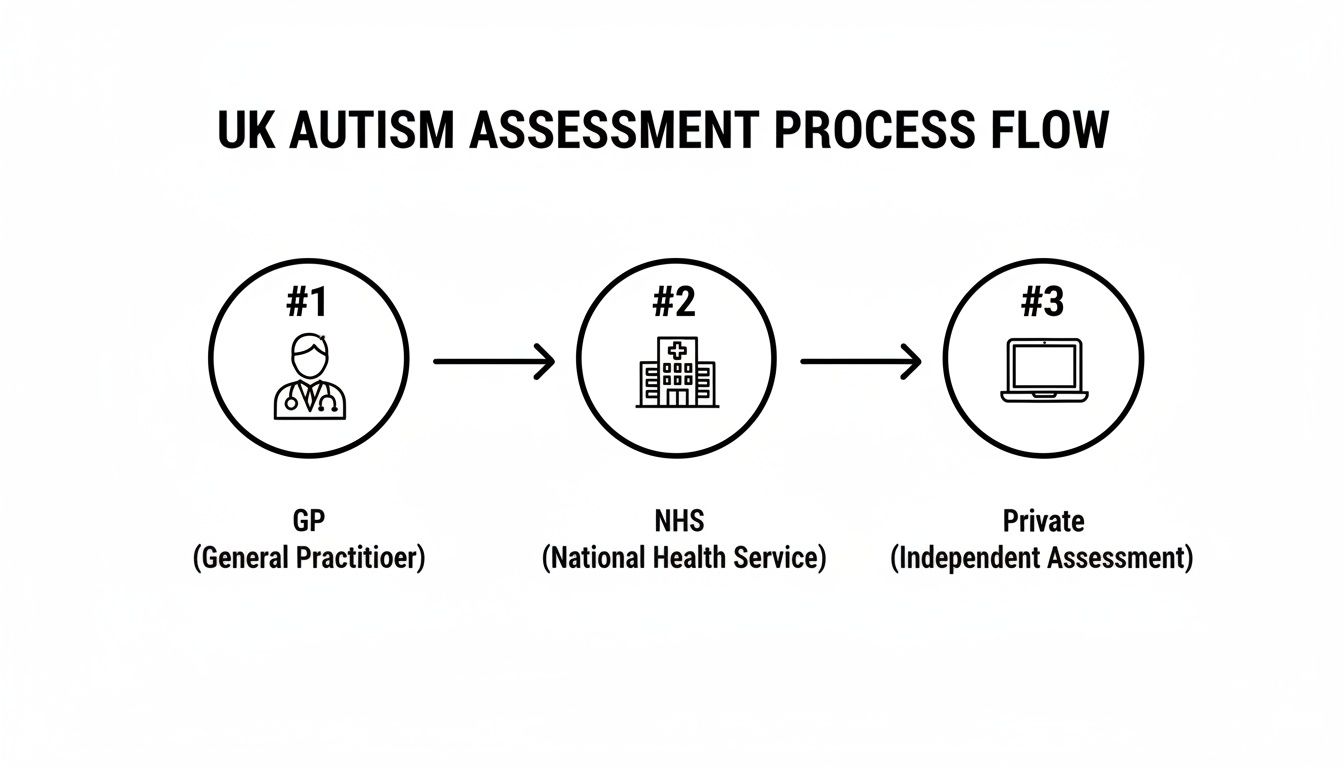
As you can see, both paths lead to a specialist assessment. The main differences are often the waiting times and the specific steps you'll take to get there.
The In-Depth Clinical Interview
The real heart of any good assessment is a series of detailed clinical interviews. This is where a specialist—usually a psychiatrist or clinical psychologist—guides you through a conversation about your life, from your earliest memories right up to today.
They’ll be particularly interested in a few key areas:
- Your Developmental History: They'll ask about childhood friendships, how you played, and your school days. This is where having notes or involving a family member can be incredibly helpful.
- Social Communication: The conversation will delve into how you navigate the social world. For example, how do you find making and keeping friends? Do you find unwritten social rules confusing? Do you prefer people to be direct?
- Routines and Repetitive Behaviours: You’ll be asked about your relationship with routine and predictability. This can cover anything from needing to follow the same route every day to feeling deep distress when plans change unexpectedly.
- Executive Functioning & Attention: Questions will explore your ability to plan, organise, and stay focused. This is a key area for identifying potential ADHD traits alongside autistic ones.
- Sensory Experiences: Expect to talk about your sensory world. This includes sensitivities to light, sound, or textures that feel overwhelming, or, on the flip side, behaviours where you actively seek out certain sensations.
The point of all these questions is to build a comprehensive picture of lifelong traits. A skilled clinician knows that autism in adults often looks very different to how it presents in children, largely because of the sophisticated coping and masking strategies we develop over decades.
Observation and Interaction
While you’re talking, the clinician will also be observing how you communicate. This isn't about judging you; it's a standard part of the diagnostic process. They’ll be paying attention to things like your use of language, non-verbal cues (like gestures or eye contact), and the natural flow of conversation.
This is done respectfully and naturally. It simply provides another layer of information to go alongside the experiences you’ve shared, helping the clinician understand how you process information and interact.
The underdiagnosis of autism in UK adults is a huge issue. Groundbreaking research from King's College London suggests that as many as 90% of autistic individuals in middle and older age might have been missed by the healthcare system. This diagnostic gap can worsen mental health challenges—for instance, the 15% co-occurrence of bipolar disorder in autistic adults—and lead to social isolation and problems with employment.
Specialist online services like Insight Diagnostics Global are working to close this gap by offering thorough, accessible assessments. They effectively complete 98.3% of triage cases, providing a clear path to the answers so many people have been waiting for. You can discover more insights from the King's College London study on their website.
What a Remote Assessment Involves
With the growth of online healthcare, many adult autism assessments now happen remotely over secure video calls. A lot of people wonder if an online assessment can be as thorough as a face-to-face one. The answer is a clear yes.
A high-quality remote assessment follows the exact same clinical standards and uses the same diagnostic manuals (like the DSM-5 or ICD-11) as an in-person appointment. The interview structure, the depth of the questions, and the diagnostic rigour are identical.
In fact, for many adults, being assessed from the comfort of their own home actually reduces anxiety. This often allows for more open and relaxed communication, which can lead to an even more accurate and helpful outcome.
What to Expect From Your Diagnosis and What Comes Next
Finally getting your diagnostic report is a big moment. For some, it’s a huge wave of relief—that lifelong feeling of being ‘different’ suddenly makes sense. For others, it can be a lot to take in. Whatever your first reaction is, remember this report is a tool, one designed to help you understand yourself on a much deeper level.
A good report is far more than a simple yes or no. It should be a comprehensive document that walks you through the clinical evidence gathered during your assessment, connects the dots between your life story and the diagnostic criteria, and gives you personalised recommendations that actually make sense for your life.
Decoding Your Diagnostic Report
At first glance, your report might seem full of dense, clinical jargon. Let’s break down what you should find inside so you can navigate it with confidence.
First, you'll see a clear summary of the evidence that led to the final conclusion. This section should reference specific examples from your interviews and questionnaires, linking them directly to the core characteristics of Autism Spectrum Disorder (ASD). It’s the ‘why’ behind the diagnosis, showing precisely how your experiences with social communication, routines, or sensory processing fit the clinical framework.
The report will then clearly state the conclusion. There are generally a few possible outcomes:
- A Diagnosis of Autism Spectrum Disorder (ASD): This confirms that you meet the full clinical criteria.
- A Dual Diagnosis of Autism and ADHD: It is very common to receive diagnoses for both conditions, acknowledging the complex interplay of traits.
- Identification of Autistic/ADHD Traits: You might show many characteristics but not quite enough to meet the formal diagnostic threshold. This is still an incredibly valuable insight into how your brain works.
- An Alternative or Co-occurring Diagnosis: Sometimes, an assessment uncovers another condition, like an anxiety disorder, that better explains some of your challenges, or exists alongside autism/ADHD.
Your Diagnosis as a Tool for Self-Acceptance
For many people, the most powerful part of a diagnosis is the sheer validation it brings. It’s like getting permission to stop blaming yourself for struggles that are simply a part of your neurology. It reframes past difficulties not as personal failings, but as the natural result of a mismatch between your brain and a world not always built for it.
A diagnosis isn't a label that limits you; it's a guide that helps you understand your own user manual. It can be the key to improving your mental health, building self-compassion, and learning to work with your brain instead of against it.
This new understanding is the bedrock for building a life that truly fits you. It opens the door to getting practical support and making changes that can reduce daily stress, manage your mental health, and help you avoid burnout.
Taking Action and Finding Support
With a formal diagnosis, you have a solid foundation for advocating for yourself, especially at work. You're in a much stronger position to request reasonable adjustments that can make a world of difference to your well-being and productivity.
These aren't huge, complicated changes. They could be things like:
- Environmental tweaks: Asking for a desk in a quieter corner or permission to use noise-cancelling headphones to manage sensory input.
- Communication preferences: Requesting instructions in writing rather than verbally to ensure nothing gets missed.
- Flexible working: Arranging to work from home a couple of days a week to conserve your social energy and reduce sensory overload.
It’s worth noting that many of these accommodations are helpful for colleagues with other conditions, too. You can find more ideas in our guide on reasonable adjustments for ADHD at work, which shows how much overlap there is in creating a more supportive environment for all neurodivergent people.
Connecting with others is also a vital next step. You might find useful resources and guidance through the SupportGPT platform for further assistance. Joining online communities or local support groups can be incredibly affirming—there’s nothing quite like talking to people who just ‘get it’.
Finally, if you ever need legal evidence—for an employment tribunal or a personal injury case, for example—a medico-legal report is what you’ll need. This is a specialised report that translates the clinical findings into a format that meets specific legal standards, providing impartial and authoritative evidence when it matters most.
Your Questions About Adult Diagnosis Answered
Thinking about an autism assessment as an adult can bring up a lot of questions and uncertainties. It's a big step. Here, I'll walk you through some of the most common queries we see, drawing on years of experience guiding people through this exact process.
What if I Didn't Seem Autistic as a Child?
This is incredibly common, and the simple answer is yes, you can absolutely be autistic without having obvious childhood signs. Many autistic people, especially those assigned female at birth, learn to ‘fit in’ by copying the social cues of others around them.
This survival strategy is known as masking. You might have become so good at it that nobody, not even your parents or teachers, suspected anything was different. A good diagnostician knows all about masking and is trained to look for lifelong patterns of experience, not just the stereotypical traits people often associate with autistic children.
Is There Any Point in Getting a Diagnosis So Late?
For the vast majority of people, getting a formal diagnosis later in life is a profoundly positive experience. This isn't about getting a label; it's about finally understanding the fundamental wiring of your brain.
That self-understanding can be life-changing. It often leads to a huge boost in self-esteem, better mental health management, and helps people find strategies that actually work for them, rather than trying to force themselves into neurotypical boxes. It can also help you re-interpret past difficulties without the weight of self-blame and give you the confidence to ask for what you need at work or in your relationships.
Could It Be ADHD or Something Else Instead?
It absolutely could be, and that's a key part of any good assessment. There's a significant overlap between the traits of autism and ADHD, and it's not uncommon for people to have both. Many people who suspect they are autistic also have symptoms of anxiety or depression, which can be a primary condition or a result of living undiagnosed.
A comprehensive, high-quality diagnostic process always includes a differential diagnosis. This means the clinician's job is to carefully explore all possibilities to find the most accurate explanation for your experiences. They might conclude it’s autism, ADHD, a combination of both, or perhaps another mental health condition.
The entire point of an assessment is to get to the truth. It's a collaborative investigation into your life experiences, aiming for the right answer for you, whatever that turns out to be.
How Can an Online Assessment Be as Good as an In-Person One?
This is a fair question, but today's online assessments are a world away from a simple questionnaire. Reputable services adhere to the same gold-standard clinical benchmarks as face-to-face appointments, like the NICE guidance used here in the UK.
The process involves in-depth, structured interviews and clinically validated tools, all conducted by a GMC-registered psychiatrist over a secure video link. In fact, many autistic and ADHD people find this format better. Being in your own home, a familiar and controlled environment, can significantly lower anxiety. This often allows for a more open and authentic conversation, giving the clinician an even clearer picture of your true self. The clinical rigour is identical; the setting is just far more comfortable.
At Insight Diagnostics Global, we provide clear, confidential, and CQC-regulated online assessments for adults seeking answers about autism and ADHD. If you are ready to gain clarity and take the next step, you can explore our assessment services.