
Diagnosing autism in adults isn't about ticking boxes on a simple checklist. It's a comprehensive process that starts with self-awareness, moves through a GP consultation, and culminates in a detailed clinical assessment. This evaluation, typically guided by a specialist psychiatrist or psychologist, delves deep into a person's entire life story, exploring their social communication, sensory experiences, and unique behavioural patterns from childhood to the present day, while carefully considering the interplay with conditions like ADHD and other mental health challenges.
Recognising The Signs of Autism in Adulthood
For many adults, life has been a long-running experience of feeling fundamentally different, like everyone else was handed a social rulebook they never received. The common picture of autism is still heavily skewed towards how it looks in children, which means the more subtle, complex ways it shows up in adults—often overlapping with ADHD or anxiety—go completely unnoticed. This can leave people spending decades feeling confused or misunderstood.
The path to an autism diagnosis in adulthood rarely begins with a single, clear-cut moment. It's more often a slow-dawning realisation that lifelong patterns—the ones that have always set you apart—might actually have a name. It's about finally understanding the bone-deep exhaustion that follows even simple social events, a direct result of something called ‘masking’.
Masking is the conscious or subconscious effort to hide natural autistic traits, such as stimming (self-soothing repetitive movements) or finding direct eye contact uncomfortable, just to blend in with a neurotypical world.
What Undiagnosed Autism Feels Like From The Inside
Masking is so much more than just ‘fitting in’; it's a relentless, mentally draining performance. Think of the professional who excels at their highly technical job but finds the office party or a networking event almost physically unbearable. They’ve likely developed scripts for small talk and a whole catalogue of learned social behaviours, but on the inside, they're constantly on high alert, analysing every word and gesture. It's no wonder it leads to burnout and can exacerbate anxiety.
Beyond the social challenges, several other internal experiences are common:
- A profound need for routine. For many autistic people, structure and predictability aren’t just preferences; they are essential for navigating a world that often feels overwhelmingly chaotic. A last-minute change of plans can be incredibly dysregulating.
- Intense sensory sensitivities. The low buzz of fluorescent lights, the scratchy tag on a new shirt, or the overwhelming noise of a busy café can feel like a full-on assault on the senses, causing genuine distress and a need to escape.
- Difficulties with executive function. This can show up as trouble with planning, organising daily life, or simply getting started on a task. To an outsider, it might look like laziness or disorganisation, but it’s actually rooted in how the brain processes information, and is a significant area of overlap with ADHD.
This is where things get tricky. The overlap with other conditions is one of the main reasons autism gets missed for so long. The exhaustion from socialising can easily be mistaken for social anxiety, while struggles with emotional regulation might get mislabelled as a mood disorder. Before diving into the diagnostic process, getting a clear understanding of what defines autism can provide some much-needed context.
A Hidden Population: The Power of Self-Recognition
The sheer number of undiagnosed autistic adults in the UK is staggering. A landmark 2025 review from King's College London brought this into sharp focus, revealing that somewhere between 89% and 97% of autistic adults over the age of 40 have never been formally diagnosed. This points to a massive, hidden population living without the validation and support a diagnosis can bring, often leading to a higher risk of mental health crises like burnout, severe anxiety, and depression.
The journey always starts with self-recognition. It’s that 'aha' moment when an adult finally connects the dots between their own lifelong challenges and the described experiences of other autistic people. This is what empowers them to seek formal clarity.
This first step is deeply personal. It’s about reframing a lifetime of feeling 'wrong' or 'broken' and starting to see yourself as neurologically different. Recognising these patterns isn’t about chasing a label. It’s about gaining access to self-compassion, finding the right kind of support, and connecting with a community that truly understands.
If these experiences are ringing true for you, a great next step is to explore the detailed signs of undiagnosed autism in adults.
Navigating the UK Diagnostic Pathways
Realising you might be autistic is often a lightbulb moment, but figuring out what to do next can feel like trying to navigate a maze. If you’re considering a formal diagnosis, you'll find there are a couple of different routes you can take in the UK, each with its own timeline and things to consider. Getting a handle on these pathways is the first step to making a choice that feels right for you.
The path from that first flicker of self-recognition to actively seeking a diagnosis is a deeply personal one. It's about connecting the dots of your life's experiences.
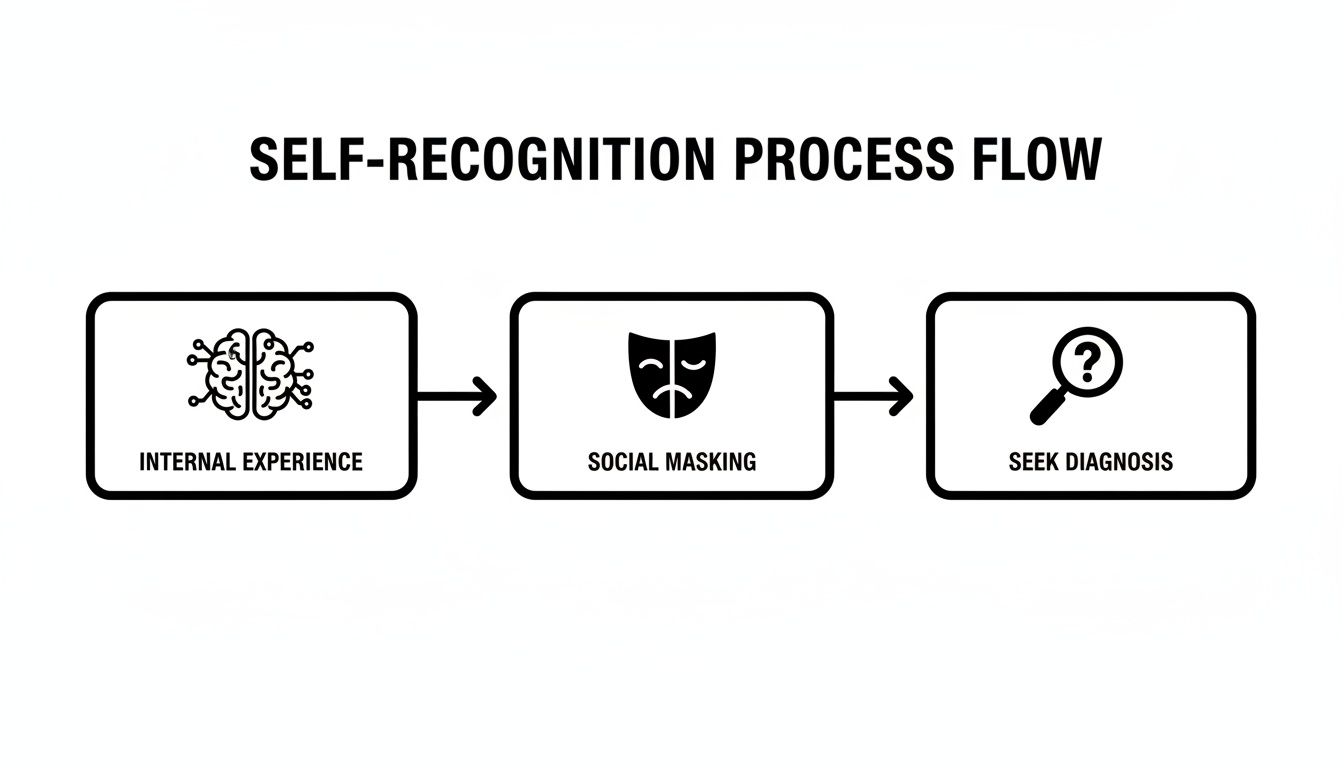
Often, this involves looking back and making sense of years of internal feelings, understanding the social masking that became second nature, and finally deciding you need professional clarity.
Your First Port of Call: The GP Appointment
For most people in the UK looking for an NHS assessment, the journey begins at their GP's surgery. This conversation is the gateway to getting a specialist referral, so a bit of preparation can make all the difference.
Your main goal is to clearly articulate why you believe you might be autistic. You aren't there to diagnose yourself, but to present the patterns and experiences you've recognised in your own life. Mentioning any co-occurring concerns, such as symptoms of ADHD or anxiety, is also crucial.
Before you go, it's incredibly helpful to jot down specific, lifelong examples. Think about categorising them:
- Social Interactions: Think about any persistent difficulties you've had with small talk, reading between the lines in conversations, or forming and keeping friendships.
- Routines & Interests: Make a note of your deep need for routine, how distressing unexpected changes can be, and any intense, all-consuming interests you've had throughout your life.
- Sensory Profile: List any sensitivities to light, sound, textures, or smells that have always been a part of your world.
- Overlapping Traits: Note any challenges with focus, organisation, or impulsivity that might suggest co-occurring ADHD.
Walking in with a list not only stops your mind from going blank, but it also shows your GP that this is a considered, lifelong pattern, not just a passing thought.
The Role of Initial Screening Tools
During your appointment, your GP might use a screening questionnaire, like the Autism Spectrum Quotient (AQ-10). It's really important to understand what these tools are—and what they aren't.
A screening tool is not a diagnosis. Think of it as a preliminary filter, designed to see if a full, in-depth diagnostic assessment is justified. A high score simply flags that a referral is a good idea; it can't confirm or rule out autism by itself.
A proper diagnosis is a far more nuanced and detailed evaluation carried out by a specialist team who can differentiate between autism, ADHD, and other mental health conditions. These initial screeners are just the first checkpoint.
NHS vs Private Pathways: A Key Decision
Once your GP makes a referral, you’ll be added to the NHS waiting list for an adult autism assessment. Here's the difficult part: in many areas of the country, these waiting lists are incredibly long, with waits often stretching to several years. That prolonged period of uncertainty can be a huge source of stress and can worsen mental health.
This is precisely why many adults start to look into the private pathway. Yes, there's a cost involved, but the trade-off is a much, much shorter wait. Choosing a private provider usually means you can be assessed within weeks or a few months, not years, helping you get the answers and support you need so much sooner.
If you decide to go private, it is absolutely vital to do your homework and choose a credible, properly regulated clinic. Look for providers that are:
- Consultant-led: The assessment process must be overseen by a psychiatrist or clinical psychologist on the GMC Specialist Register.
- CQC-Regulated: The Care Quality Commission (CQC) is the independent regulator of health and social care in England. Registration shows the provider meets national standards for quality and safety.
- Experienced in Adult Diagnosis: Autism in adults, especially when it co-occurs with conditions like ADHD and anxiety, presents very differently from how it does in children. You need a team that specialises in this complexity.
UK Autism Diagnostic Pathways: A Comparison
To help you weigh up your options, here’s a straightforward comparison of the two main pathways available in the UK.
| Feature | NHS Pathway | Private Pathway (e.g., Insight Diagnostics Global) |
|---|---|---|
| Referral Process | Requires a GP referral to be placed on a waiting list. | Self-referral is usually possible, bypassing the need for a GP. |
| Waiting Times | Extremely long; often 2-5 years, varying significantly by region. | Much shorter; typically a matter of weeks or a few months from enquiry to diagnosis. |
| Cost | Free at the point of service. | Involves a fee, with costs varying between providers. |
| Choice of Clinician | Little to no choice; you are assigned to the local NHS service. | You can research and choose a specific clinic or consultant based on their expertise. |
| Assessment Flexibility | Appointments are typically in-person during standard clinic hours. | Often offers more flexibility, including online/remote assessments and evening slots. |
| Post-Diagnosis Support | Can be inconsistent and may have further waiting lists for support services. | Often includes a detailed post-diagnostic support plan and follow-up options. |
Ultimately, the right pathway depends on your personal circumstances, including your financial situation and how urgently you need clarity. For many, a consultant-led online assessment is a comfortable and practical alternative, removing the stress of travel and allowing the assessment to happen in a familiar environment.
If you're exploring your options, understanding the specifics of a comprehensive private autism and ADHD diagnosis in adults UK can give you a clearer picture of what a thorough, expert-led process involves.
Inside a Clinical Diagnostic Assessment
A formal autism diagnosis isn't just a questionnaire or a brief chat. It's a deep, structured evaluation designed to understand the rich tapestry of your entire life, carefully distinguishing lifelong autistic traits from other conditions like anxiety or ADHD that might have cropped up along the way. Knowing what’s involved can really demystify the process, and hopefully, reassure you that you'll be seen as a whole person.

This isn’t about ticking boxes. It’s an in-depth exploration aimed at building a complete and nuanced picture of your neurodevelopmental profile. The whole process is handled with empathy and clinical precision, whether you’re meeting a clinician in person or connecting through a secure online platform.
The Cornerstone: Your Developmental History
The most significant part of any assessment is the detailed clinical and developmental interview. This is where a specialist psychiatrist or psychologist will guide you through a comprehensive conversation, covering your life from your earliest memories right up to your current experiences.
Don't worry, this isn't an interrogation. Think of it as a collaborative exploration where the clinician is looking for consistent patterns over time. You can expect to talk about things like:
- Early Childhood: How you used to play (did you line up toys or prefer imaginative games?), your first friendships, and how you communicated your needs before you could speak fluently.
- School Years: We’ll explore your experiences with making and keeping friends, understanding unwritten social rules, navigating playground politics, and coping with the sensory overload of a busy classroom.
- Adult Life: We'll also discuss how you manage relationships, workplace dynamics, executive functioning (like planning and organising), and your internal sensory world now. We will also discuss your mental health history to understand how conditions like anxiety or depression may have developed.
This look back is vital because autism is a lifelong neurodevelopmental condition. The clinician needs to find evidence of these traits being present since childhood, even if they were misunderstood at the time, or if you’ve since developed sophisticated masking strategies to hide them.
Using Standardised Diagnostic Tools
Alongside the developmental interview, clinicians rely on internationally recognised, evidence-based tools to structure their observations. These are often called the 'gold standard' in autism assessment because they provide a consistent framework.
The two most common tools you'll encounter are:
- The Autism Diagnostic Observation Schedule, Second Edition (ADOS-2): This is a semi-structured assessment involving a series of social activities and conversations. For adults, it’s adapted to create scenarios that let the clinician observe social communication, interaction, and creative thinking in real-time.
- The Autism Diagnostic Interview-Revised (ADI-R): This is a very thorough, structured interview, usually conducted with a parent or someone who knew you well as a young child. It systematically covers early development, language, and social behaviours, providing crucial historical context that you might not remember yourself.
It’s really important to realise these tools don't just spit out a 'score' that equals a diagnosis. They are sophisticated instruments that provide valuable data points, which the clinician then integrates with all the other information gathered, including assessments for co-occurring conditions like ADHD. You can learn more about the structure of a comprehensive evaluation by reading our guide on what is a psychiatric assessment.
The Value of Collateral Information
Because so many autistic adults become experts at masking their traits, getting an outside perspective can be incredibly insightful. In a clinical setting, we call this gathering collateral information.
The clinician might ask for your permission to speak with someone who knows you well. This could be:
- A parent or older sibling who can recall your early childhood.
- A current partner or spouse who can share insights into your daily life and routines.
- A close, long-term friend.
This isn’t about checking up on you; it’s about building a richer, three-dimensional picture. A partner might mention your need to decompress in a quiet, dark room after a social event, or a parent might remember your childhood obsession with the London Underground map—details you might have forgotten or simply considered unimportant.
An adult autism assessment is fundamentally about pattern recognition. The clinician's job is to piece together information from your self-report, standardised tools, and collateral interviews to see if the lifelong pattern of strengths and challenges is best explained by an autism diagnosis, while also considering how ADHD or anxiety fit into the picture.
When it comes to the practical side of things, ensuring secure communication and data privacy is absolutely paramount. This is often managed through specialised HIPAA-compliant texting apps to ensure all sensitive information remains confidential. A gold-standard assessment is a thorough, empathetic, and secure process from start to finish.
Untangling Autism, ADHD, and Mental Health
The path to an adult autism diagnosis is rarely a straight line. For many people, the picture is complicated by other conditions, creating a complex web of overlapping traits that can make a clear diagnosis tricky without specialist expertise. The reality is, autism seldom travels alone.
A huge number of autistic individuals also have Attention-Deficit/Hyperactivity Disorder (ADHD), a combination we often refer to as AuDHD. In fact, research suggests that anywhere between 30% to 80% of autistic people also meet the criteria for ADHD. This isn't a coincidence; they are both neurodevelopmental conditions, meaning they originate in how the brain develops, and they frequently co-occur with mental health conditions like anxiety and depression.
The Great Overlap: Autism and ADHD
At first glance, autism and ADHD can look remarkably similar, especially when you're assessing adults. Both can cause significant challenges with executive functioning—those crucial mental processes that help us plan, focus, remember what we're supposed to be doing, and juggle multiple tasks. This often shows up as difficulty with organisation, managing time, and just getting started on things.
Social difficulties are another common area where the lines blur. An autistic person might struggle to read social cues and find interactions completely draining. Someone with ADHD, on the other hand, might interrupt conversations or miss social nuances because their attention has drifted. From the outside, the behaviour can look the same, but the internal experience driving it is often worlds apart.
A skilled clinician’s job is to look beneath these surface-level behaviours to understand the why.
- Executive Function: Is the struggle to start a task due to autistic inertia (that feeling of being 'stuck' or finding it hard to switch gears)? Or is it down to ADHD-related challenges with motivation and focus?
- Social Challenges: Is the social difficulty rooted in a fundamental difference in how the brain processes social information (autism)? Or is it more about impulsivity and inattention (ADHD)?
- Special Interests vs. Hyperfocus: An autistic person’s special interest is typically a deep, enduring passion that forms a core part of their identity. An ADHD hyperfocus can be just as intense, but it often shifts more frequently from one topic to the next.
Carefully teasing these threads apart requires a clinician with deep, practical experience in both conditions. Understanding this interplay is absolutely fundamental to the diagnostic process. For a more detailed look, you can explore our breakdown of ADHD symptoms in adults.
The Impact of a Neurotypical World on Mental Health
Living as an undiagnosed neurodivergent person in a world that wasn't built for you takes a heavy toll. Constantly trying to fit in, masking your natural traits, and coping with sensory or social overwhelm is simply exhausting. It’s no surprise, then, that so many autistic adults also experience co-occurring mental health conditions.
Navigating a lifetime of feeling misunderstood can directly contribute to developing anxiety, depression, or obsessive-compulsive disorder (OCD). These aren't an inherent part of being autistic, but are often a direct response to the chronic stress of trying to exist in an unaccommodating environment.
Anxiety is incredibly common, frequently stemming from the unpredictability of social situations or the threat of sensory overload. Depression can easily set in from years of social isolation and feeling like you're fundamentally "wrong." Even repetitive behaviours, a core autistic trait, can sometimes be misdiagnosed as OCD, though the underlying drivers are very different.
Why a Comprehensive Assessment Is Vital
This complex interplay is precisely why a quick, superficial assessment just won't cut it. A meaningful diagnosis has to account for the complete picture—your neurotype and any co-occurring conditions like ADHD or anxiety. This is the only way to create a support plan that is genuinely effective.
The historical underdiagnosis of autism in adults, particularly in older age groups, really highlights how masking and co-occurring conditions can obscure the core traits. In the UK, the diagnostic landscape shows some stark age disparities. While 2.94% of 10- to 14-year-olds had a recorded diagnosis in 2018, that figure plummets to just 0.02% for those aged 70 and over. This vast difference—a factor of 150—underscores just how many adults have been missed by a system that was, for decades, focused almost entirely on children. In fact, analysis suggests over 90% of autistic individuals in older cohorts may remain undiagnosed, their traits often misinterpreted as mood disorders or personality quirks. You can read the full research about these diagnostic disparities and what it means.
A robust, consultant-led assessment will carefully explore all these facets. It gives you not just a diagnostic label, but a detailed, personalised formulation of your unique neuro-profile and mental health needs. This, in turn, leads to support that addresses the root causes of your challenges, not just the symptoms on the surface.
What to Expect from Your Diagnostic Report
The assessment process doesn't end when you receive a verbal diagnosis. It concludes with a detailed, formal diagnostic report, and this document is so much more than a label. Think of it as a comprehensive, medico-legally sound summary of your life story, a clinical explanation of your neurotype, and a practical roadmap for the future.

Understanding what this report contains and how to use it is a critical part of the journey. A high-quality report provides the defensible clinical opinion you’ll need to unlock support, giving you a solid foundation for moving forward with clarity and confidence.
Deconstructing the Contents of Your Report
While the exact layout might differ slightly between clinics, any robust diagnostic report will be thorough. Its job is to draw together all the different strands of information gathered during your assessment, telling the complete story of how the clinical team arrived at their conclusion.
You'll typically find several key sections:
- Background and Developmental History: This is a summary of the information from your interviews, covering everything from social patterns in early childhood to your current coping mechanisms, mental health history, and sensory experiences.
- Summary of Standardised Assessments: It will break down the results and clinical observations from tools like the ADOS-2 or ADI-R, explaining how your responses contribute to the overall diagnostic picture. It will also include findings from any ADHD or mental health screeners used.
- Collateral Information: Any insights gathered from a partner, parent, or close friend are woven in here, helping to create a more complete and multi-faceted view of your life.
This level of detail is what makes the report such a powerful tool. It lays out the evidence-based reasoning behind the diagnosis, making the conclusion both clear and defensible.
The Clinical Formulation: Your Personalised Profile
The real heart of the report is the clinical formulation. This is the section where the clinician pieces everything together—the interviews, the assessment results, the collateral information—to explain how your unique profile of strengths and challenges aligns with the diagnostic criteria for Autism Spectrum Disorder.
It also addresses any co-occurring conditions, like ADHD or anxiety, and explores how they interact with your autistic traits. This isn't a generic description cut and pasted from a textbook; it's a personalised narrative that should resonate deeply with your own lived experience.
A good clinical formulation doesn't just tell you that you are autistic; it explains how you are autistic. It connects your personal history to the clinical findings, providing a clear and validating explanation of your neurotype and how it interacts with your overall mental health.
For many newly diagnosed adults, this section is often the most empowering part of the entire report. It’s where a lifetime of feeling 'different' is finally put into a context that makes complete sense.
Actionable Recommendations: A Key to Unlocking Support
Perhaps the most practical part of the diagnostic report is the section on personalised recommendations. This isn't a generic list of advice. It’s a set of suggestions tailored specifically to you, based on the challenges and goals you discussed during your assessment. This should include strategies for autism, ADHD, and any mental health concerns identified.
These recommendations act as your key to accessing real-world support. A well-written report can be used to:
- Secure Workplace Accommodations: Give your employer clear, actionable suggestions, like the need for a quieter workspace, flexible hours, or written instructions instead of verbal ones.
- Access the Disabled Students' Allowance (DSA): For those in higher education, the report is the essential evidence needed to apply for funding for specialist equipment, mentoring, and other support.
- Guide Therapeutic Strategies: Inform therapists or coaches about your specific neuro-profile, ensuring any future support for your mental health is genuinely suited to your needs.
The impact of having a formal diagnosis, backed by a detailed report, cannot be overstated. This is especially true given the scale of underdiagnosis in the UK. Data from 2018 showed only about 180,000 adults over 20 in England had a formal diagnosis, yet estimates suggest that up to 1.2 million more could be undiagnosed. This highlights a hidden crisis where services are struggling to keep up. Discover more insights about England's hidden autism crisis on thetransmitter.org. Your report is a crucial first step in being seen, understood, and properly supported.
Your Questions About Adult Autism Diagnosis Answered
Going through the diagnostic process for autism as an adult brings up a whole host of questions. It's a big step, and it's completely natural to feel a mix of apprehension and hope. Let's walk through some of the most common queries we hear from adults who are trying to make sense of their experiences.
Can an Autism Assessment Really Be Done Online?
Yes, it absolutely can. A high-quality, consultant-led online autism assessment is just as clinically valid as one conducted face-to-face. The fundamental pillars of a proper diagnosis—a deep dive into your developmental history, careful clinical observation, and gathering information from people who know you well—are all entirely possible over secure video calls.
The crucial factor is the team behind the screen. You need to look for a CQC-regulated provider with psychiatrists on the GMC Specialist Register. These professionals are trained to use adapted, evidence-based techniques to ensure the online process is just as rigorous and accurate as an in-person one, with the added benefit of being in a comfortable, familiar environment.
What If It’s Not Autism After All?
This is a really common worry, and it’s completely understandable. Remember, the whole point of a diagnostic assessment is to get clarity, no matter what the final answer is. A good evaluation isn't just a checklist for autism; it's a comprehensive look at your overall neurotype and mental health.
If the clinician finds that your experiences are better explained by something else—like ADHD, social anxiety, or OCD—they will walk you through their reasoning. A properly constructed diagnostic report will give you a full clinical formulation and tailored recommendations for support, meaning you'll leave with a clear path forward, whatever the outcome.
A thorough assessment provides answers, not just a label. The real value is gaining a detailed understanding of your own mind, which is powerful information whether it confirms autism or points you towards different support for your mental health and well-being.
How Much Should I Expect a Private Diagnosis to Cost?
The cost for a private adult autism assessment in the UK does vary, but as a ballpark, you should expect it to be somewhere in the range of £1,800 to £2,500. It's so important to make sure you're paying for a robust, consultant-led, multidisciplinary assessment that gives you a medico-legally sound report at the end of it. Some providers may offer a combined Autism and ADHD assessment, which could have a different cost structure, so always clarify this.
Look for providers with completely transparent pricing. A reputable clinic will have a clear breakdown of what's included in their fee—things like the initial screening, all the clinical interviews, the comprehensive report, and a feedback session to discuss the findings. Be wary of anyone with vague or hidden costs.
How Long Will I Be Waiting for a Private Assessment?
Let’s be honest, the main reason most people explore private options is to sidestep the NHS waiting lists, which can be years long in many areas. With a private clinic, the timeframe is dramatically shorter.
While every clinic is different, you can often get an initial consultation booked within a week or two of making an enquiry. From that first appointment, the entire assessment process—from interviews to the final report landing in your hands—is typically completed within four to six weeks. For many people, getting that validation and understanding of their complete neuro-profile so much sooner is life-changing.
At Insight Diagnostics Global, we provide consultant-led, CQC-regulated online assessments for adults seeking clarity on autism, ADHD, and their mental health. Our expert team is committed to delivering a thorough, empathetic, and timely diagnostic experience. If you are ready to take the next step, you can learn more about our services.