If you’ve spent years feeling like you're constantly swimming against the current—battling to focus, stay organised, or quiet a restless mind—you are not alone. Getting an ADHD diagnosis involves a few key stages: self-assessment, a chat with your GP for a referral, and then a full evaluation by a specialist psychiatrist. You can go through the NHS, which is free but often comes with a long wait, or choose a private route for a faster, though more expensive, outcome.
Recognising You Might Need an ADHD Assessment
That first flicker of realisation is a huge step. It's the moment you start to wonder if your lifelong struggles with focus, organisation, or restlessness are more than just personality quirks. It’s about moving past outdated stereotypes of hyperactive kids and seeing how these traits actually show up in grown-ups.
So many adults live with undiagnosed ADHD, blaming themselves for what they see as personal failings. This can really chip away at your self-esteem and overall mental health over the years, leading to a cycle of frustration and self-doubt.
The Subtle Signs of Adult ADHD
In adults, the classic ADHD signs often wear a disguise. Hyperactivity isn't necessarily about bouncing off the walls; it’s more likely to be an internal engine that never switches off. You might fidget constantly, feel antsy, or always need to be doing something. Relaxing, even when you’re bone-tired, can feel impossible.
Inattentiveness is also widely misunderstood. It's not about being unintelligent or lazy—it’s a genuine struggle to regulate your attention.
It often looks like this:
- Difficulty finishing projects: You dive into new things with incredible enthusiasm, only to lose steam halfway through, leaving a trail of incomplete tasks in your wake.
- "Time blindness": You're consistently terrible at judging how long a task will take, which leads to chronic lateness and missed deadlines that you never intended.
- Zoning out during conversations: Your mind wanders off, even when you’re trying your best to listen. This can cause you to miss important information and put a strain on your relationships.
- Chaotic organisation: Your desk or home might be a perpetual mess, and you’re always misplacing essentials like your keys, wallet, or phone.
Getting familiar with the common ADHD symptoms in adults can help you connect the dots and decide if an assessment is the right next step. Recognising these patterns in yourself is a powerful start.
The Overlap with Autism and Other Mental Health Conditions
It's also important to know that ADHD rarely travels alone. It frequently co-occurs with other conditions like anxiety, depression, and especially Autism Spectrum Disorder (ASD). Many people have a blend of traits from both neurodevelopmental conditions, which can make things feel particularly complex. For instance, the social challenges of autism can feel even harder to manage when combined with the impulsivity of ADHD.
Seeking a diagnosis isn't about finding a "problem" or sticking a label on yourself. It's a powerful act of self-discovery. It offers validation for lifelong struggles and opens the door to effective support, new strategies, and genuine self-understanding.
This overlap is precisely why a thorough, professional assessment is so vital. The racing thoughts of anxiety can look a lot like ADHD's internal restlessness. Likewise, the executive dysfunction that comes with depression—like low motivation and poor concentration—is easily mistaken for inattentive ADHD. Similarly, the social difficulties seen in both ADHD and Autism can be hard to untangle without expert insight.
A skilled clinician knows how to carefully untangle these threads to arrive at an accurate diagnosis, considering your entire mental health profile. Acknowledging these connections is a key part of the journey, making sure you get support that truly fits your unique brain.
Your Diagnostic Options: NHS vs Private Assessments
Deciding to get an official ADHD diagnosis is a huge step toward understanding yourself better. Once you've made that call, the next big question is: which path do you take? In the UK, you've got two main routes for an assessment – the National Health Service (NHS) or a private clinic.
Each route has its own set of pros and cons. Honestly, the right choice for you will come down to your personal circumstances: how urgently you need answers, what your financial situation looks like, and what you hope to get out of the process for your overall mental health.
Navigating the NHS Pathway
For a lot of people, the NHS is the natural starting point. This journey always begins with a chat with your GP. It's so important to go into that appointment prepared. Bring along any notes, self-assessment results, or examples you've gathered so you can clearly explain your struggles and why you think an ADHD assessment is needed. If your GP agrees, they'll refer you to a specialist mental health service for the formal evaluation.
This is where you hit the biggest hurdle of the NHS pathway: the waiting times.
The NHS provides a truly vital service, but it's no secret that it’s under enormous pressure, especially when it comes to adult mental health and neurodevelopmental services. After your GP makes the referral, you’re placed on a waiting list, and these lists can be incredibly long. I've heard from people in some parts of the country who have been waiting several years just for their first appointment.
That kind of wait can be absolutely soul-destroying when you're struggling and just need some clarity. The uncertainty makes it worse. There’s no official, unified system for reporting waiting times, so it often feels like a postcode lottery. This long delay can take a real toll on your mental health, your career, and your relationships.
Exploring the Private Assessment Route
For many, waiting years on an NHS list just isn't an option. This is where private clinics offer a much, much faster alternative. When you go private, you can often be seen by a consultant psychiatrist within weeks, not years. It gives you a direct route to getting the answers and support you need for your ADHD, Autism, or other mental health concerns.
If you’re looking at private providers, it's crucial to do your homework and choose a reputable clinic. You'll want to find a service that is:
- Regulated by the Care Quality Commission (CQC): This is the independent regulator for all health and social care in England. CQC registration means the clinic meets fundamental standards of quality and safety.
- Led by Consultant Psychiatrists: Make sure they are on the GMC Specialist Register. This guarantees your assessment is carried out by a highly qualified medical expert who can provide a formal diagnosis.
- Transparent about costs: A good clinic will be upfront about all the fees involved – the assessment itself, the report, and any follow-up care like medication titration.
Many clinics now offer assessments entirely online, which have the same clinical rigour as in-person appointments but with the added convenience of being at home. It's natural to have questions about virtual consultations, but the technology for video conferencing for healthcare is incredibly secure and professional these days, ensuring your appointment is confidential.
Choosing a private path is an investment in your immediate well-being. It’s a way to bypass systemic delays and get the answers you need to start moving forward with your life, armed with a diagnosis and a clear plan for support.
The flowchart below shows the typical journey someone might take when they start thinking about an ADHD assessment.
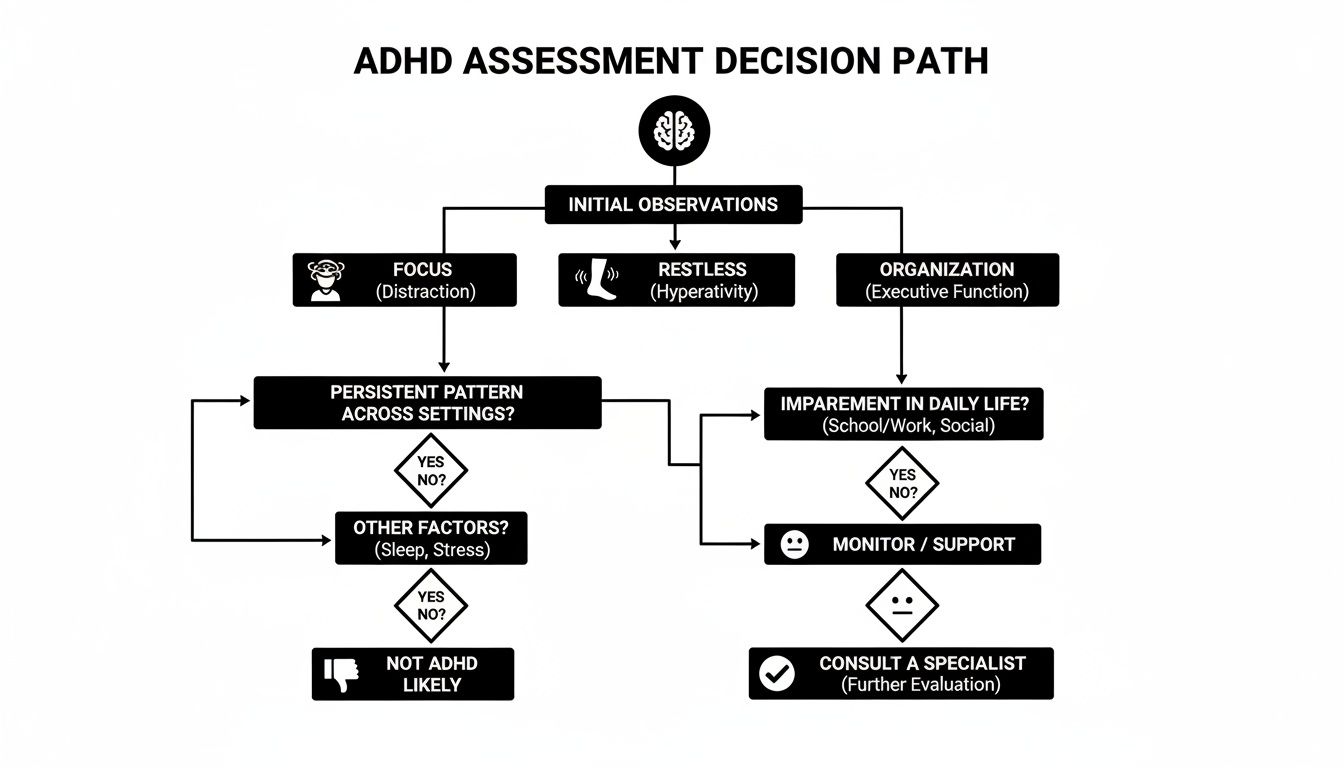
As you can see, it often starts with noticing persistent difficulties with focus, restlessness, or organisation, which then prompts the move towards a specialist consultation.
Making an Informed Decision
To help you weigh your options, here’s a straightforward comparison of the two main pathways.
Comparing NHS and Private ADHD Diagnosis Routes
| Feature | NHS Pathway | Private Pathway (e.g., Insight Diagnostics Global) |
|---|---|---|
| Referral Process | Requires a GP referral to a local mental health service. | Self-referral is usually possible, bypassing the GP. |
| Waiting Times | Extremely long; often 1-5 years depending on location. | Very short; typically a matter of weeks. |
| Cost | Free at the point of use. | Paid service; costs vary but are significant. |
| Choice of Clinician | Little to no choice; assigned by the local trust. | You can choose your clinic and often the specific consultant. |
| Post-Diagnosis Support | Follow-up care (e.g., medication) is covered by the NHS. | Assessment, report, and titration are paid for privately. |
Ultimately, the choice between the NHS and private routes is a deeply personal one. The NHS is free, but it demands a huge amount of patience. The private route costs money but offers speed and certainty.
For a more detailed look into what's involved, you can find great information here on getting a private https://insightdiagnostics.co.uk/adhd-diagnosis-uk/.
It's worth knowing that in the UK, only 0.32% of adults across 9 million GP records have a recorded ADHD diagnosis. With the true population prevalence estimated at 2.8%, this suggests a staggering diagnostic gap. It means over 2 million adults could be struggling without the support they need.
Think about what matters most to you right now, and make the decision that best supports your mental health journey.
Preparing for Your ADHD Assessment

Knowing what to expect can make all the difference, turning what feels like a daunting test into a conversation where you feel heard and understood. It’s not about passing or failing. The entire point is to build an accurate, three-dimensional picture of you and how you experience the world.
Going in prepared helps you tell your story clearly, connecting the dots of what might have been a lifetime of confusing or frustrating experiences. This is your chance to give the clinician the context they need to make a clear diagnosis.
Gathering Your Evidence
Before the main event, you'll likely receive some pre-assessment questionnaires from your provider. Forms like the Adult ADHD Self-Report Scale (ASRS) are a good starting point, screening for common traits. They get the ball rolling.
But don't stop there. It's incredibly helpful to gather your own supporting documents. Think of yourself as a historian of your own life. The more context you can provide, the clearer the picture becomes for the psychiatrist.
Try to pull together things like:
- Old school reports: You're looking for those classic teacher comments: "daydreams in class," "is easily distracted," or "doesn't work to their full potential." These are gold dust for establishing lifelong patterns.
- Work performance reviews: Notes about struggling with deadlines, organisational issues, or challenges with multi-step projects can show how these traits manifest in your adult life.
- A personal symptom diary: For a week or two, jot down specific examples. Instead of just saying "I'm disorganised," you can say, "Last week, I missed three appointments because I forgot to put them in my calendar."
This kind of real-world evidence helps your clinician spot the consistent patterns that are the hallmark of a neurodevelopmental condition.
The Diagnostic Interview Unpacked
The heart of the assessment is a detailed clinical interview with a consultant psychiatrist. This isn’t just a quick chat about symptoms; it's a deep dive into your life story. If you’re new to this, getting a sense of what is a psychiatric assessment can really help demystify the process.
The psychiatrist will guide the conversation, often starting with your early school days and childhood memories. A key diagnostic criterion for ADHD is that the traits have been present since childhood, so they need to establish that timeline.
Be ready to talk about:
- Your developmental history: Your childhood, friendships, and how you got on at school.
- Your current challenges: How symptoms impact your work, home life, relationships, and even your finances.
- Your mental health history: A full picture of any past or present experiences with anxiety, depression, or other conditions is crucial.
- The Co-occurrence of Autism: There’s a significant overlap between ADHD and Autism. The psychiatrist will be listening for this and may ask about social communication, sensory issues, or repetitive behaviours to see if a combined assessment might be necessary.
This comprehensive approach is vital for distinguishing ADHD from other conditions like anxiety or depression, which can sometimes look similar on the surface.
The diagnostic interview is your space to be open and honest. Remember, the psychiatrist isn't there to judge you. They are a medical expert trying to understand how your brain works so they can provide the right support.
Involving Others in Your Assessment
Don't be surprised if your psychiatrist asks to speak with someone who knows you well—a partner, a parent, or even a close friend. This isn't about checking up on you. It's about getting an outside perspective.
Often, other people notice patterns we're too used to seeing ourselves. They might remember childhood stories you've forgotten or describe your daily habits in a way that provides invaluable clinical insight. This kind of "corroborative information" really strengthens the diagnosis, making sure the final report is as accurate as possible.
With remote assessments, this is easily done via a brief video call, ensuring the same clinical rigour you’d get in person.
Making Sense of Your Diagnosis and Next Steps
Getting an ADHD diagnosis can feel like a huge, emotional moment. But it’s not the finish line. Think of it as finally being handed the right instruction manual for your brain—it's the start of figuring out how to build a life that actually works with you, not against you.
The first thing you’ll get is a formal diagnostic report. It might look a bit dense and clinical at first, but this document is your new best friend. It’s a personal roadmap that doesn’t just state the diagnosis; it breaks down the evidence behind it and gives you a clear plan for what comes next.
Demystifying Your Diagnostic Report
A proper diagnostic report is so much more than a label. It's a detailed summary of your entire life, structured to bring clarity to the chaos you might have been feeling for years. It’s your story, just told through a clinical lens.
Inside, you'll usually find a few key sections:
- Your Personal and Developmental History: This is where the clinician pulls together everything you shared about your childhood, school days, and work life to show the consistent, lifelong pattern of your traits.
- Symptom Analysis: Here’s where it clicks. The report will connect your real-life struggles—like constantly losing your keys or zoning out in meetings—to the formal diagnostic criteria from manuals like the DSM-5.
- Differential Diagnosis: This bit is crucial. The psychiatrist will explain how they carefully ruled out other conditions that can look a lot like ADHD, such as anxiety, depression, or Autism, to confirm that ADHD is the primary diagnosis or if co-occurring conditions are present.
- Personalised Recommendations: This is your action plan. It will lay out a mix of support options, from medication to therapy and practical strategies, all based on your specific challenges and goals.
This report is your proof. It's the document you'll need for everything from getting accommodations at work to discussing a shared care plan with your GP, or even just helping your family and friends finally "get it".
Exploring Your Treatment and Support Options
Once the diagnosis is confirmed, the conversation naturally turns to, "Okay, what now?" Your psychiatrist will almost certainly recommend a multi-pronged approach. It’s never about a single fix; it's about building a whole toolkit of strategies that work for you.
For many, medication is a cornerstone of treatment and can be genuinely life-changing. But it's not a magic wand. The goal of medication is to help the executive functions in your brain work more smoothly, making it easier to focus, manage impulses, and untangle your thoughts.
Understanding your diagnosis is the first step. The next is embracing the support available. This isn't about 'fixing' a deficit; it's about providing your brain with the right tools to perform at its best, reducing the daily friction that has held you back.
This journey often begins with a process called titration.
The Medication Titration Journey
Titration is simply the careful, collaborative process of finding the right medication and dose for you. It’s a bit of a trial-and-error period, but a very controlled one, that usually lasts a few weeks. You'll start on a really low dose, and your clinician will check in with you regularly to see how you're getting on.
During this time, you’ll be keeping an eye on:
- Positive effects: Is it suddenly easier to concentrate? Is the background noise in your head quieter?
- Side effects: Are you getting a dry mouth, losing your appetite, or finding it hard to sleep? These are common and often settle down.
- Overall impact: How is it actually affecting your day-to-day life at home and at work?
Your psychiatrist will use your feedback to slowly tweak the dose until you hit that sweet spot: maximum benefits with minimal side effects. Once you're stable and doing well, they'll often arrange a shared care agreement with your GP to handle your prescriptions going forward.
Powerful Non-Medical Strategies
While medication can provide a massive boost, it works best when it's part of a bigger picture. There are so many powerful, non-medical approaches that help you build lasting skills and manage the practical side of ADHD.
Some of the most effective strategies include:
- ADHD Coaching: A good coach is like a personal trainer for your executive functions. They'll help you build real-world systems for managing your time, organising your life, and tackling overwhelming projects.
- Cognitive Behavioural Therapy (CBT): CBT that’s been adapted for ADHD is brilliant for tackling the mental side of things. It helps you unlearn negative self-talk (like "I'm just lazy") and gives you tools to handle emotional dysregulation and rejection sensitivity.
- Practical Life Hacks: This is all about creating an "ADHD-friendly" environment. We're talking visual timers so you can see time passing, noise-cancelling headphones to block out distractions, and using 'body doubling' (working quietly alongside someone else) to stay on task.
Ultimately, getting an ADHD diagnosis is your chance to stop fighting your own brain. It’s the permission you need to finally work with your unique wiring, lean into your strengths, and get the support you deserve.
Using Your Diagnosis for Workplace and Legal Support

Getting a formal ADHD diagnosis isn't just about understanding yourself better—it’s a powerful key that can unlock crucial legal protections and practical support at work. Think of your diagnostic report as the official evidence you need to advocate for yourself. It empowers you to ask for changes so your work environment fits your needs, rather than you having to constantly fight against it.
Under the Equality Act 2010, ADHD can be legally considered a disability if it has a substantial, long-term impact on your ability to handle day-to-day activities. This isn't just a label; it places a legal duty on your employer to make reasonable adjustments. Their responsibility is to ensure you aren't at a disadvantage compared to colleagues who don't have ADHD.
Securing Reasonable Adjustments at Work
So, how does this actually work? It starts with a conversation. Armed with your diagnostic report, you can talk to your manager or HR about simple, effective changes that can make a world of difference to your performance and well-being.
These adjustments are often surprisingly straightforward. Common examples include:
- A quieter workspace or permission to use noise-cancelling headphones to block out distractions in a busy office.
- Flexible start and finish times that work with your body clock or medication schedule.
- Access to helpful tech, like mind-mapping software or text-to-speech tools that support how you process information.
- Getting instructions in writing instead of verbally, or breaking down large projects into smaller, more manageable steps.
These aren't special favours; they are legally recognised tools designed to create a level playing field. If you're wondering what you could ask for, our guide on reasonable adjustments for ADHD has plenty of practical ideas.
When You Need a Medico-Legal Report
Sometimes, a standard diagnostic report isn't quite enough. For more formal situations, like an employment tribunal or other legal proceedings, you may need a medico-legal report.
This is a highly specialised document prepared by a GMC-registered consultant psychiatrist specifically for legal purposes. It’s written to be impartial and court-compliant, providing an expert opinion on how your ADHD directly affects your ability to do your job or contributed to certain workplace incidents. This kind of formal evidence is vital for making sure your rights are protected in a legal setting.
Your diagnosis is a form of empowerment. It provides the official validation needed to request accommodations and ensures that you are supported and protected under the law, transforming your work life from a source of stress into an environment where you can truly thrive.
The difficulty in getting a diagnosis highlights a much bigger problem. It's estimated that 2.5 million adults in England have ADHD, but health records show only one in nine of these cases. This reveals a massive gap in recognition and support. Having that formal report in your hands is a critical step in closing that gap for yourself, giving you the leverage to access the help you're entitled to.
Your Questions on the ADHD Diagnostic Process Answered
Deciding to get an ADHD assessment often brings a flood of questions. It's a big step, and you want to be sure you're making the right choices. This final section is all about giving you straightforward answers to the things people most often ask, from whether online tests are legitimate to how much it all costs.
Think of this as a practical Q&A to clear up any lingering confusion. Getting these answers should help you move forward feeling more confident and prepared for the road ahead.
Are Online ADHD Assessments Legitimate?
Yes, absolutely—as long as you choose the right provider. A consultant-led online ADHD assessment is just as valid as an in-person one, provided it's from a reputable, regulated service.
The key is to look for clinics regulated by the Care Quality Commission (CQC). You also need to ensure their psychiatrists are on the GMC Specialist Register. These services adhere to the exact same NICE guidelines used by the NHS, so a diagnosis from them is widely accepted for things like workplace adjustments and shared care agreements with your GP.
What Is a Shared Care Agreement for Medication?
This is a really important one to understand if you go private. A shared care agreement is basically a partnership between your private psychiatrist and your NHS GP.
Once your private specialist has worked with you to find the right medication and dose (a process called titration), they can propose this agreement to your GP. If your GP accepts, they'll start issuing your prescriptions through the NHS. This makes your ongoing medication much more affordable.
It's always a smart move to have a chat with your GP before you start private treatment to see if they're open to this, as they aren't required to say yes.
Can I Be Assessed for ADHD and Autism Together?
Definitely. ADHD and Autism Spectrum Disorder (ASD) often go hand-in-hand, and it's something specialists see all the time. Many people find they have a mix of traits from both, so a combined assessment can be the most insightful path.
Specialist mental health services offer comprehensive neurodevelopmental assessments that look for both conditions simultaneously. If you think this might be you, it’s crucial to mention it right from your first conversation with a clinic. This approach gives a much clearer, more complete picture of your unique neurotype, which means you get support that actually fits you. To learn more about the specialists involved, you can read about who can diagnose ADHD and related conditions.
It's crucial to understand that co-occurring conditions are common. A comprehensive assessment that considers both ADHD and Autism provides a full picture of your unique neurotype, ensuring that your support plan is truly tailored to you, not just a single diagnosis.
This holistic view is at the heart of good mental health care—it recognises you're a whole person, not just a label.
How Much Does a Private ADHD Assessment Cost in the UK?
You can generally expect a private adult ADHD assessment in the UK to cost somewhere in the region of £700 to £2,000. This fee usually covers the main assessment and the comprehensive diagnostic report you'll receive afterwards.
However, you must check exactly what's included. Be on the lookout for potential extra costs, such as medication titration, follow-up appointments, or the initial private prescriptions needed before a shared care agreement can begin. Good clinics are always upfront about their pricing, so you won't face any surprises. For many, the cost is a worthwhile trade-off for avoiding long NHS waits and getting vital support sooner.
At Insight Diagnostics Global, we provide CQC-regulated, consultant-led online assessments for ADHD, Autism, and a range of mental health conditions. Our expert team is here to guide you with clarity and empathy, from your initial query to your final report and beyond. If you’re ready to take the next step towards understanding your unique mind, explore our services at https://insightdiagnostics.co.uk.