If you're looking to get a mental health assessment in the UK, your journey typically starts in one of two places: speaking to your GP for an NHS referral or reaching out to a private provider directly. For neurodevelopmental conditions like ADHD or Autism, this process is what leads to a formal diagnosis from a specialist, often a consultant psychiatrist, which is the key to unlocking the right support.
Understanding the Mental Health Assessment Journey
That first step—realising you might need some professional support—is often the hardest part. For many adults, it starts with a persistent feeling that something isn't quite right, or nagging questions about certain behaviours or challenges that just won't go away. You might find yourself wondering if an underlying condition like Autism or ADHD could explain what you've been experiencing for years. That curiosity is a perfectly normal, and very common, place to begin.
A formal diagnostic assessment isn’t just about putting a name to things. It’s a structured evaluation by a qualified clinician, like a consultant psychiatrist, designed to understand you better and see if your experiences match the criteria for a specific condition like Autism Spectrum Disorder or ADHD. Think of it as the gateway to getting effective, personalised support, whether that’s therapy, medication, or adjustments at work.

Key Pathways to an Assessment
In the UK, you essentially have two main routes you can go down to get a mental health assessment for conditions like ADHD and Autism.
- The NHS Pathway: This is the traditional route, which usually kicks off with an appointment with your GP. You’ll have a chat about what’s going on, and if they agree it’s necessary, they will refer you to a specialist mental health service for a proper assessment.
- The Private Pathway: This route means you pay for an assessment yourself with an independent provider. This world now includes a lot of highly specialised, consultant-led online services that can offer much quicker access to a diagnosis for ADHD or Autism.
Deciding which way to go really comes down to your own situation—how urgent things feel, what your budget looks like, and the kind of support you think you need. Each path has its own process, waiting times, and things to consider, and we'll break all of that down in this guide.
Sometimes, an assessment can help untangle different mental health challenges that are linked. For example, if you're struggling with something specific like binge eating, getting a professional opinion can be a vital step towards understanding the root cause, as highlighted in resources like How to Stop Binge Eating.
At the end of the day, the goal is to get clarity and a practical plan. Whether you choose the NHS or a private service, understanding how the system works puts you back in the driver's seat. If you are leaning towards private care, a great first step is to find a psychiatrist who has the right expertise for you.
Navigating the NHS Pathway for an Assessment
For most people in the UK, the first port of call for an Autism or ADHD assessment is their local GP surgery. It’s the traditional starting point, and knowing how to approach that initial conversation can make all the difference.

Before you even book the appointment, it’s a good idea to get your thoughts in order. Your GP will need a clear picture of what you’re experiencing and why you think a specialist assessment for ADHD or Autism is the right next step. Essentially, you're building a case for a referral.
Preparing for Your GP Appointment
Vague statements like "I struggle to focus" often don't paint a strong enough picture for a busy GP. You need to back it up with real-world examples. I always advise people to put together a small file or a folder with concrete evidence.
Here’s what you could include:
- A Symptom Diary: Just a simple log where you note down specific examples as they happen. For ADHD, this could be missing deadlines at work. For Autism, it might be struggling in social situations or feeling overwhelmed by noise and light.
- Childhood Evidence: This is gold dust, especially for neurodevelopmental conditions like ADHD and Autism. Dig out any old school reports. If they mention you were "easily distracted," "a daydreamer," or "disruptive," bring them along.
- Screening Questionnaires: You can find trusted screening tools online, like the ASRS for ADHD or the AQ-10 for Autism. Filling one out beforehand shows you've taken this seriously.
- A Note from Someone Close: A few lines from a partner, parent, or trusted friend describing what they see can add a really valuable outside perspective.
Once you’re in the appointment, be clear and direct. Explain that you suspect you might have ADHD or Autism and that you’d like a referral for a formal assessment. Having your notes ready to go helps your GP grasp the full extent of the issue.
It's also worth knowing that for some, the NHS Right to Choose pathway for ADHD is another option. We have a separate guide explaining how to exercise your Right to Choose for an ADHD assessment.
Understanding the Reality of NHS Waiting Times
Now for the difficult part: you need to have realistic expectations about how long this will take. The demand on NHS mental health services is huge, and it’s putting a massive strain on the system.
The numbers are pretty stark. In recent years, services in England have seen a record 5.2 million referrals. This has created a backlog with an estimated 1.7 million people currently on mental health waiting lists. For adult ADHD and Autism assessments, the waits can be particularly long, often stretching into years.
This is the unfortunate reality that leads many to explore other avenues. These lengthy delays aren't just frustrating; they can cause real harm. One report found that about one in three people felt their mental health got worse while they were stuck on a waiting list.
This situation is exactly where private online services have stepped in, offering assessments for Autism and ADHD within weeks rather than years for those who have the means to consider it.
Exploring Private and Online Assessment Options
When you're facing a potential multi-year wait on the NHS for an Autism or ADHD assessment, it can feel incredibly disheartening. For many adults seeking clarity, the private route offers a much faster way to get answers and start moving forward. This path can shrink the timeline for a diagnosis from years down to just a matter of weeks.
The biggest draw for private care is, without a doubt, speed. The NHS provides an essential service, but it’s no secret that its mental health services are stretched incredibly thin, creating long and often stressful delays for neurodevelopmental assessments. Private clinics, especially the growing number of consultant-led online services, are set up to sidestep these queues entirely, giving you direct access to the specialists you need.
The Rise of Consultant-Led Online Services
If you decide to go down the private online route, you’ll find you can often book an appointment and speak with a specialist very quickly. These services are typically run by GMC-registered consultant psychiatrists—exactly the same calibre of expert you'd eventually see on the NHS, but without the long-winded referral process.
One thing you absolutely must check is whether the provider is regulated by the Care Quality Commission (CQC). The CQC is the independent body that inspects and regulates health and social care services in England. Seeing that a clinic is CQC-regulated gives you confidence that it meets fundamental standards for safety and quality. It’s your guarantee of legitimate, professional clinical care for your ADHD or Autism assessment.
A huge advantage of this model is the depth of the assessment itself. Any good private service won’t just give you a diagnosis; they'll provide a comprehensive, structured diagnostic report complete with personalised recommendations for treatment, therapy, and ongoing support for your specific condition.
NHS vs. Private: A Side-by-Side Look
Getting a clear picture of the differences between the two pathways is key to making a decision that feels right for you, your budget, and how urgently you need help. It really comes down to balancing the financial cost against the immediate need for answers and support for potential ADHD or Autism.
If this sounds like an option you want to explore, you can find out more about what a private psychiatric assessment actually involves.
To help you compare, here’s a quick breakdown of what to expect from each route.
NHS vs Private Mental Health Assessments At a Glance
| Feature | NHS Pathway | Private Online Service |
|---|---|---|
| Wait Time | Often months to several years for ADHD/Autism assessments. | Typically a few weeks from booking to assessment. |
| Access | Usually requires a GP referral to join a waiting list. | Direct self-referral for adults is standard practice. |
| Clinician | Assessment by a specialist, often a consultant psychiatrist. | Direct access to a GMC-registered consultant psychiatrist. |
| Cost | Free at the point of use. | Self-funded, with costs ranging from hundreds to thousands of pounds. |
| Report | A diagnostic report is provided. | A detailed, structured report with personalised recommendations is standard. |
Ultimately, choosing a private assessment is a significant financial investment in your wellbeing. But for many people, the relief that comes with a swift, robust diagnosis is invaluable. It empowers them to finally access the right support—be it therapy, workplace adjustments, or medication—without enduring a prolonged and anxious wait.
What Happens During and After Your Assessment
Knowing what to expect on assessment day can make the whole experience feel much less daunting. Whether your appointment is in person or online, the structure is always designed to be thorough. For an ADHD or Autism assessment, this isn't just a quick chat; it's a deep dive into your life, history, and the challenges you're facing, allowing the clinician to get a full and accurate picture.
The Assessment Itself: What to Expect
The heart of any good assessment is a detailed clinical interview. The psychiatrist will guide you through a conversation about your childhood, school life, career, and relationships. They'll also, of course, focus on the specific symptoms that made you seek an assessment for something like ADHD or Autism in the first place. They are essentially piecing together your developmental history to see how certain traits have shown up throughout your life.
Alongside this conversation, you'll almost certainly be asked to fill out several diagnostic questionnaires or rating scales. These are standardised tools used across the field to help quantify your experiences. It's a way of adding a layer of objective data to the personal story you're sharing, comparing your responses to the established diagnostic criteria for ADHD and Autism.
Getting to a Diagnosis
Diagnosing a neurodevelopmental condition isn't a simple tick-box exercise. A skilled consultant psychiatrist is looking for a consistent, lifelong pattern of traits and difficulties that stretch back to childhood. They're also highly trained to spot the subtle differences between conditions that can often look very similar on the surface.
For instance, the kind of inattention you see in ADHD can sometimes be mistaken for the deep, focused interests common in Autism, or even symptoms of anxiety. The clinician’s job is to carefully unravel these threads to reach an accurate conclusion.
This is the point where you've moved past the initial decision-making process.
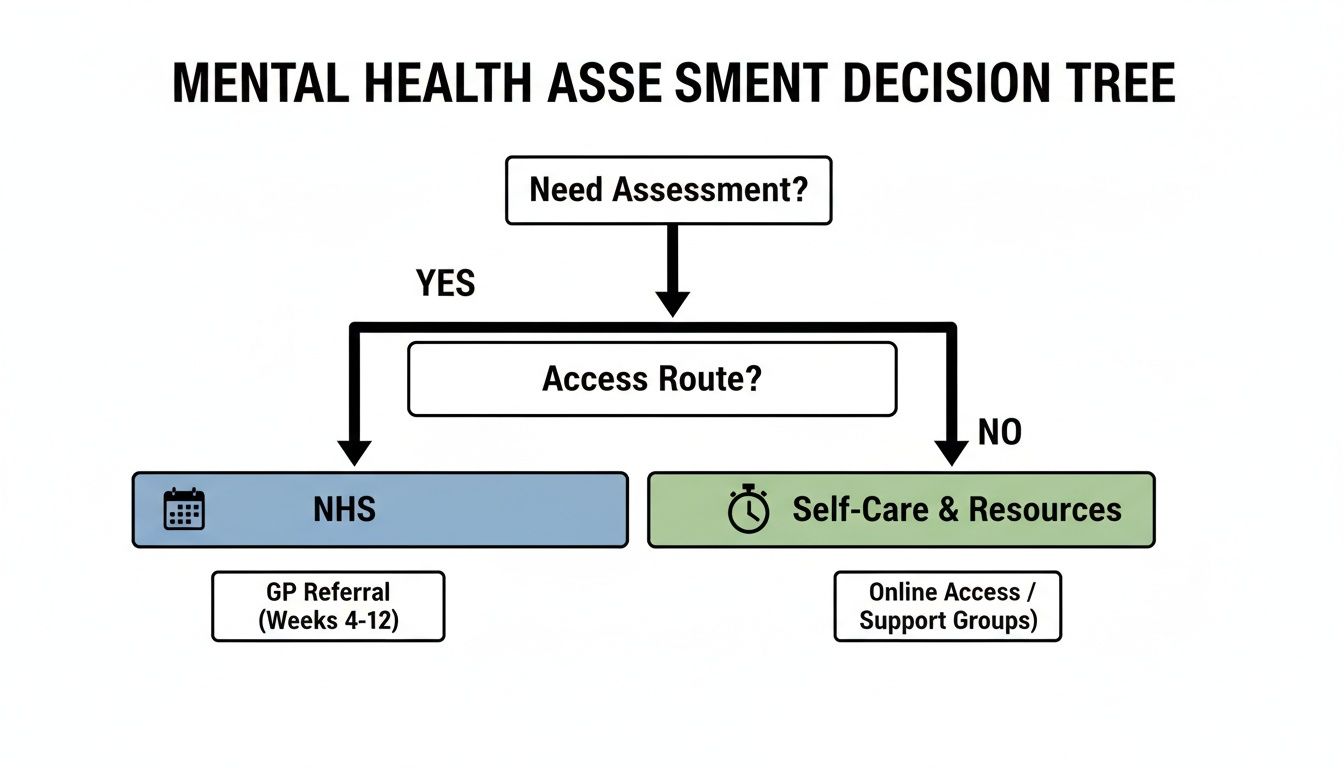
As the decision tree shows, once you've chosen a path—be it NHS or private—you move toward the formal assessment stage we're discussing here.
Your Diagnostic Report: What It Should Contain
Once the session is over, the real work begins for the clinician. They take everything—the interview notes, questionnaire scores, any information from family—and compile it into a comprehensive diagnostic report. This document is so much more than a simple letter; it’s the key that unlocks the next chapter of your support.
A high-quality, genuinely useful report should always include:
- A Clear Diagnostic Conclusion: It will state plainly whether you meet the criteria for a diagnosis, like Autism Spectrum Disorder or ADHD. It might also suggest another condition is a better fit, or even rule out a diagnosis altogether, explaining the reasoning.
- Personalised Recommendations: This is arguably the most important part. The report should offer practical, tailored advice. This could include suggestions for therapy (like CBT), reasonable adjustments for your workplace, or clear information on medication options for ADHD.
- Actionable Next Steps: It should give you a clear path forward, whether that’s sharing the report with your GP, exploring treatment pathways, or connecting with charities and community support groups for ADHD and Autism.
A good diagnostic report doesn't just give you a label. It provides a personalised roadmap, turning a clinical process into practical, life-improving support that helps you understand yourself better and access the help you need.
Using Your Diagnosis for Workplace and Legal Support
Getting a formal diagnosis for a condition like ADHD or Autism isn't just about understanding yourself better. It’s also a practical, powerful tool that unlocks support you're legally entitled to, especially at work. The report from your assessment is the official proof you need to start advocating for yourself.
This validation is a game-changer in the workplace. Thanks to the Equality Act 2010, conditions like Autism and ADHD are often legally considered disabilities. That means your employer has a legal responsibility to make reasonable adjustments, ensuring you’re not at a disadvantage.
Securing Reasonable Adjustments at Work
So, what are "reasonable adjustments"? They're simply changes to your work environment or how things are done to help you thrive in your role. Handing your employer a formal diagnosis from a consultant psychiatrist is the key to starting that conversation.
You could ask for things like:
- Flexible start and finish times to work with your body's natural energy patterns, common for those with ADHD.
- A desk in a quieter corner of the office or permission to use noise-cancelling headphones to manage sensory overload, common in Autism.
- Clear, written instructions for tasks instead of relying on verbal briefings.
- Access to specific software, like a mind-mapping tool or text-to-speech programme.
These aren't about getting special treatment. They’re about levelling the playing field so you can bring your best self to work. We cover this in much more detail in our guide to reasonable adjustments for mental health.
A diagnosis also gives you more standing when you need time off to manage your wellbeing. It can make conversations about mental health days off work feel much more straightforward.
When You Need a Medico-Legal Report
Sometimes, a standard clinical report just won't cut it. If you're involved in a legal situation—like an employment tribunal, a personal injury claim, or family court matters—you’ll likely need a specialised medico-legal report.
These reports are very different. They are written by consultant psychiatrists who have specific training in legal assessments. The document goes far beyond a simple diagnosis of ADHD or Autism, offering an impartial expert opinion on how your condition impacts your life and relates to the specifics of the legal case.
A medico-legal report has to be 'court-compliant'. This means it's written to strict legal standards, providing an objective, evidence-based assessment that will hold up in court. Without it, your mental health might not be properly considered during legal proceedings.
Finding a provider who specialises in this area is crucial. The entire process, from assessment to the final document, is structured for legal purposes and provides the professional weight your case needs to be heard fairly.
Common Questions About Mental Health Assessments
Taking that first step towards a mental health assessment can feel daunting, and it's completely normal to have a lot of questions buzzing around your head. Getting clear, straightforward answers can make the whole process feel less intimidating, especially when you're looking for clarity on conditions like Autism or ADHD.
Let's walk through some of the most common queries we hear.
Do I Need a GP Referral for a Private Assessment?
This is probably one of the biggest questions people have. The short answer is no, for a private assessment for Autism or ADHD, you almost never need a GP referral. Reputable consultant-led online services allow adults to self-refer, which is a huge advantage if you want to bypass long NHS waiting times and get answers sooner.
While you don't need a referral to book, it’s always a good idea to keep your GP in the loop. With your permission, any good private clinic will offer to share your final diagnostic report with your GP. This ensures your medical records are complete and helps coordinate any care you might need down the line.
What’s the Difference Between a Psychiatrist and a Psychologist?
This is a really important one to get your head around, as it affects the kind of support you can get.
Consultant Psychiatrist: A psychiatrist is a medical doctor who has gone on to complete many years of specialist training in psychiatry. They are on the GMC Specialist Register, can formally diagnose conditions like ADHD and Autism, map out a full treatment plan, and legally prescribe medication.
Psychologist: A psychologist typically has a doctorate in psychology. They're experts in psychological testing and talking therapies, but they aren't medical doctors and can't prescribe medication.
For a really solid medical diagnosis of ADHD or Autism – one that will hold weight for things like workplace adjustments or starting medication – an assessment with a consultant psychiatrist is what you need. It’s the gold standard.
Key Takeaway: For peace of mind, an assessment from a GMC-registered consultant psychiatrist working within a CQC-regulated service is your best bet. This ensures the diagnosis follows NICE guidelines and is far more likely to be accepted by other services, including the NHS.
Will the NHS Recognise My Private Diagnosis?
This is a bit of a grey area, as it can vary between different local NHS trusts. A high-quality diagnosis of ADHD or Autism from a CQC-regulated service led by a consultant psychiatrist has the best chance of being accepted.
Be prepared, though; some NHS services may still insist on doing their own assessment before they'll offer you treatment like medication.
Even with that possibility, getting a private diagnosis can be life-changing. It gives you personal clarity and empowers you to ask for reasonable adjustments at work or in education. Crucially, it lets you start private treatment right away, without having to endure a long and stressful wait.
What if I’m in a Mental Health Crisis?
This is absolutely vital to understand: diagnostic assessment services for conditions like ADHD and Autism are not for emergencies. If you are in crisis and feel you are at risk, you need to get help immediately.
You should call 999 or go to your nearest A&E department. If you need urgent advice but it’s not a 999 emergency, you can call NHS 111. If you just need to talk to someone, the Samaritans are always there to listen on 116 123 – it’s free and confidential, 24/7.
At Insight Diagnostics Global, our consultant-led team provides CQC-regulated online assessments for adults seeking clarity on ADHD, Autism, and other mental health conditions. We offer a clear, supportive, and timely path to diagnosis and beyond. To learn more or to book your assessment, please visit us at https://insightdiagnostics.co.uk.