
When a legal case touches on complex mental health issues like Autism or ADHD, it can feel like trying to read a foreign language. This is where medico-legal experts step in, acting as specialist translators for the court. Their job is to take complicated psychiatric information and distill it into clear, unbiased, and evidence-based opinions, ensuring the legal process is fair and informed, especially in cases involving neurodevelopmental conditions.
The Role of Medico Legal Experts in UK Justice

Think of a legal team grappling with the nuances of a condition like ADHD or Autism as trying to solve a puzzle with half the pieces missing. The medico-legal expert is the one who finds those missing pieces. They meticulously analyse intricate medical evidence and present their findings in a format the legal system can understand and use.
Crucially, their duty is to the court, not to either side of a dispute. They provide a completely impartial and objective opinion, serving as an independent guide for judges, solicitors, and juries. This helps everyone navigate the often-misunderstood territory of psychiatric conditions, ensuring decisions are rooted in solid medical fact, not guesswork.
Translating Complexity into Clarity
The translator analogy really is the best way to understand what these experts do. They effectively bridge the communication gap between the worlds of medicine and law, particularly for conditions like Autism and ADHD.
- From Clinic to Courtroom: They take clinical jargon, diagnostic criteria for conditions like ADHD, and the real-world impact of Autism and reframe it all to answer the specific questions posed by the court.
- Objective Analysis, Not Advocacy: An expert isn't there to argue a case. They are there to provide a balanced, factual assessment based on their deep clinical experience and specialist knowledge in mental health.
This impartial translation is essential across many areas of the law. In a personal injury claim, an expert report might be needed to properly quantify the psychological harm caused by an accident. For an employment tribunal, it could clarify why an employee's Autism necessitates reasonable adjustments in the workplace. In fact, understanding their role is key when it comes to maximizing personal injury case settlements and other forms of litigation.
A medico-legal expert's report doesn't just present a diagnosis; it explains the 'so what' for the court. It connects the clinical condition, such as adult ADHD, to the legal questions at hand, including causation, prognosis, and the need for ongoing support.
By bringing this highly specialised knowledge to the table, these professionals play a vital part in securing fair and just outcomes for vulnerable individuals. You can learn more about the specifics of our medico-legal consultancy and see exactly how we support legal professionals.
Why Specialist Mental Health Expertise Is More Crucial Than Ever
The ground is shifting under our feet in the UK's legal world. While you might hear that the total number of personal injury claims is changing, what I'm seeing on the front line is a surging demand for highly specialised medico legal experts uk, particularly in mental health. This is especially noticeable for complex and often misunderstood conditions like Autism and ADHD.
Frankly, the days of a GP's general opinion holding up in court for these kinds of cases are long gone. The legal system now demands a much deeper, more nuanced understanding of how a specific mental health condition has genuinely affected someone's life, from their ability to work to their overall wellbeing. This is precisely where a specialist psychiatrist becomes absolutely essential.
Think about it: a late diagnosis or, even worse, a misdiagnosis of ADHD or Autism can send ripples through a person's entire life. For many, this becomes the foundation of a clinical negligence claim. The whole case hinges on proving a direct line between that medical oversight and the harm that followed. A robust, expert psychiatric report is the only way to build that bridge.
Complexity is Overtaking Volume
This move towards specialism is more than just an observation; you can see it in the market data. Even if the sheer number of cases fluctuates, the value and complexity of claims involving mental health are climbing. The UK medico-legal market has grown to be worth around £677 million, and all signs point to it continuing on that path. A detailed report from Legal Futures actually digs into these dynamics, highlighting how intricate cases, especially in clinical negligence, are fuelling the need for elite expert services.
What this means for solicitors is that they need more than just an expert who can tick a diagnostic box. They need someone who can clearly explain the real-world impact within a legal framework. For instance, how did that missed ADHD diagnosis in adulthood torpedo someone's career path or wreck their finances? In what ways did the failure to recognise Autism contribute to severe psychological distress?
A true specialist medico-legal expert doesn't just confirm a diagnosis. They build a clear, compelling narrative for the court that explains exactly how a specific clinical failure led directly to tangible harm. That narrative is often the key to getting justice for a client.
This focus on deep expertise is also linked to wider problems, like the staggering waiting times for mental health services across the UK. The difficulty people face in getting a timely assessment for conditions like Autism or ADHD can itself become a factor in a legal dispute, which only makes expert input more vital. We've written about this before, and you can get a better sense of the current situation in our article on psychiatry UK waiting times.
At the end of the day, the demand isn't just for any report; it's for quality, depth, and genuine, credible expertise.
What Goes Into a Psychiatric Report for a Legal Case?
When you’re a solicitor dealing with a case involving mental health, a medico-legal report from a psychiatrist is one of your most powerful tools. Think of it as a translator – it takes the complex, often subtle, realities of a client's psychological state and presents them in a structured, objective way that a court can actually use.
But here's the crucial part: one size doesn't fit all. The type of report you need is dictated entirely by the legal questions at hand. Medico legal experts UK don't just write a general summary; they meticulously tailor their investigation to address the specific issues of causation, diagnosis, and long-term prognosis that are central to your case, especially when dealing with conditions like Autism or ADHD.
Reports for Personal Injury Claims
In a personal injury claim – say, after a road traffic accident or an injury at work – the core issue is the psychological fallout. The expert’s job is to assess and quantify the mental harm your client has suffered as a direct result of the incident.
For example, someone involved in a major car crash might develop post-traumatic stress disorder (PTSD). A solid psychiatric report will do more than just diagnose the PTSD. It will draw a clear, evidence-based line (causation) connecting the accident to the psychological injury. It also has to detail the severity of the symptoms, outline the necessary treatment, and provide a professional prognosis. This forecast is absolutely essential for the court to calculate fair damages.
An effective personal injury report paints a clear "before and after" picture of the claimant's mental health. It gives the court a full understanding of the psychological impact and what recovery looks like, laying the groundwork for a just settlement.
Clinical Negligence and the Cost of a Missed Diagnosis
Clinical negligence is a complex and growing area. In fact, recent figures from NHS Resolution show new claims have risen by 4.7%, with the value of settled claims jumping by a significant 26%. This trend highlights just how critical specialist psychiatric evidence has become, particularly for neurodevelopmental conditions.
In these cases, the focus often shifts to the harm caused by a delayed or missed diagnosis, which is a massive issue for adult ADHD and Autism. Imagine an adult who has battled through life with undiagnosed ADHD. For their negligence claim, a medico-legal report would need to:
- Formally diagnose ADHD through a comprehensive, robust assessment.
- Analyse causation, showing precisely how the failure to spot the condition sooner led to tangible harm—things like limited career progression, financial struggles, or secondary mental health problems like anxiety and depression.
- Detail the prognosis, outlining the extensive support and treatment that is now needed to help them manage their life effectively.
Employment Tribunals and Neurodiversity in the Workplace
In the world of employment law, psychiatric reports are often the deciding factor in cases of discrimination, harassment, or disputes over reasonable adjustments. This is especially true for neurodiverse employees, such as those with Autism or ADHD.
Let's say an autistic employee is dismissed for performance issues that are directly tied to their condition and a clear lack of support from their employer. An expert report is essential here. It would explain how autistic traits might have been misunderstood by management and detail the specific, reasonable adjustments that could—and should—have been made. This gives the tribunal the specialist insight it needs to rule on whether the employer's actions were unlawful.
If you're new to this process and want to understand the evaluation itself, our guide on what is a psychiatric assessment offers a great starting point.
To help clarify which report fits which scenario, here’s a quick summary of the most common types and their legal applications.
Types of Medico-Legal Reports for Mental Health
This table breaks down the common reports, the legal situations they're used in, and the key questions they aim to answer.
| Report Type | Legal Context | Primary Focus |
|---|---|---|
| Personal Injury Report | Road traffic accidents, workplace incidents, public liability claims | Establishing a causal link between an event and a psychological injury (e.g., PTSD, anxiety). Assessing severity and prognosis for calculating damages. |
| Clinical Negligence Report | Delayed or missed diagnosis, incorrect treatment, substandard care | Proving that a breach of duty in healthcare caused or worsened a mental health condition. Crucial for ADHD and Autism diagnosis-related claims. |
| Employment Tribunal Report | Unfair dismissal, discrimination, failure to make reasonable adjustments | Providing evidence of a condition like Autism or ADHD and how it impacts workplace functioning. Clarifying what reasonable adjustments are necessary. |
| Fitness to Plead / Stand Trial Report | Criminal proceedings | Assessing a defendant's mental state and their capacity to understand court proceedings, instruct their legal team, and participate in their defence. |
| Sentencing Report | Criminal proceedings (post-conviction) | Providing the court with information about an offender's mental health to inform sentencing decisions, including recommendations for treatment. |
Ultimately, selecting the right type of report is the first step in building a strong, evidence-backed case. It ensures the expert focuses their analysis on the precise questions the court needs answered.
How to Effectively Instruct a Medico-Legal Expert
When it comes to instructing a medico-legal expert, a bit of front-end effort goes a very long way. It’s much more than just firing off an email; you're laying the groundwork for a credible, court-ready report. The simple truth is that the quality of your initial instructions directly dictates the quality of the expert opinion you get back. A hazy or incomplete brief almost always leads to a report that misses the mark, followed by frustrating delays, extra questions, and costs you didn't budget for.
Think of your letter of instruction as a detailed blueprint for the expert. This is your chance to direct their analysis, making sure they zoom in on the specific legal questions your case turns on. This is especially crucial for mental health cases, where complex conditions like adult ADHD or Autism are central to the dispute. A clear brief here can be the difference between a report that clarifies and one that confuses.
Crafting a Precise Letter of Instruction
The first job is to draft a letter that's both thorough and to the point. This document needs to eliminate any guesswork about what’s needed, acting as the definitive terms of reference for the entire assessment.
To make your instructions truly effective, they should always include these three things:
- A Clear Summary of the Case: Briefly set the scene, outlining the background and the key events that brought you here.
- Specific Questions for the Expert: Don't just ask for a "general opinion." Instead, write out direct, numbered questions that connect the person's condition to the legal issues at hand. For example: "To what extent, if any, did the delayed ADHD diagnosis impact the claimant's earning capacity from 2018 to the present day?"
- A Complete Bundle of Medical Records: You must provide all relevant records, ideally organised in chronological order. This means GP notes, hospital letters, and any previous specialist reports. Holding anything back is a huge mistake and can seriously undermine the report’s credibility later on.
This diagram illustrates a typical journey for psychiatric reports in common legal claims.
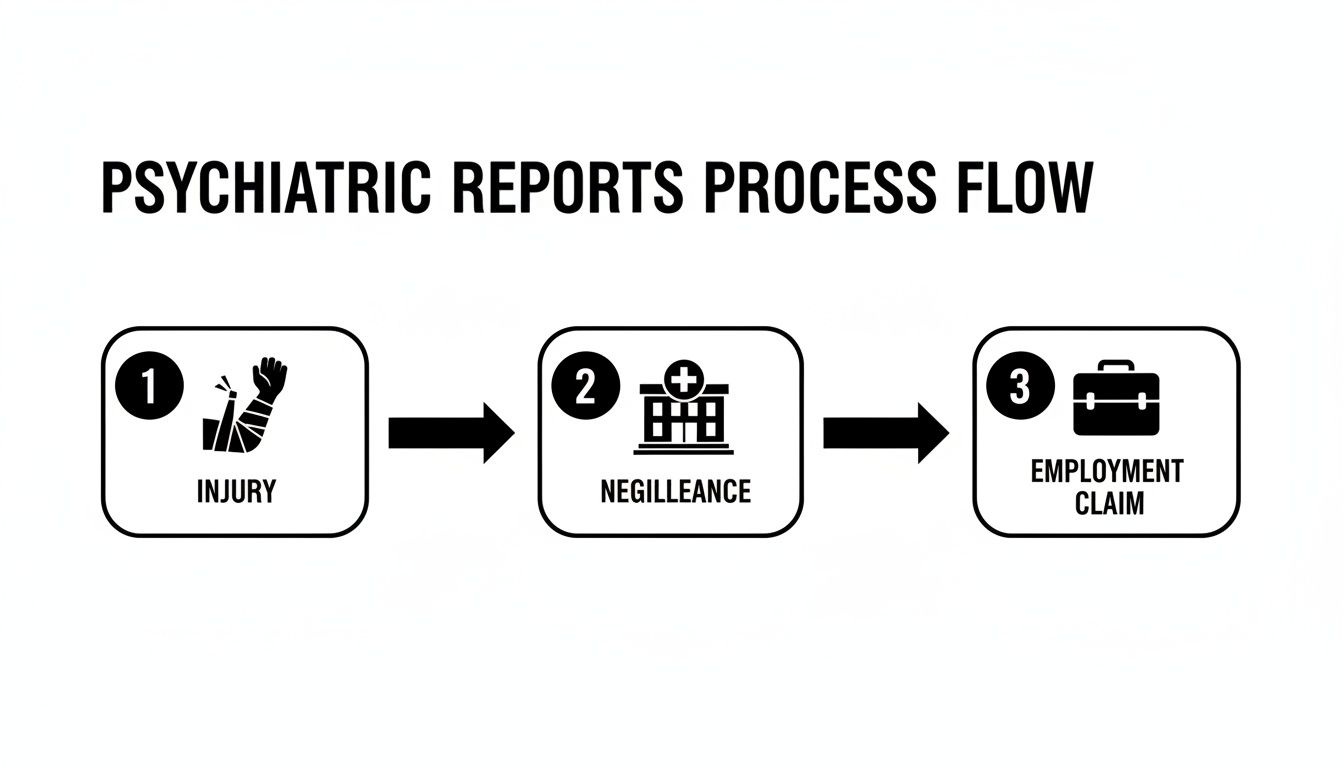
As you can see, an initial event—like an accident or an act of negligence—can trigger the need for expert assessment across different legal settings, from personal injury to employment disputes.
Framing Questions for Mental Health Cases
Getting the questions right is an art form, especially in mental health cases involving Autism or ADHD. The expert isn’t a mind reader; they need to know precisely what information the court needs to make a decision. Vague questions will only ever get you vague answers.
A well-framed question directs the expert's focus to the heart of the matter. For instance, in an employment tribunal concerning Autism, ask: "What specific workplace adjustments would have been reasonable to accommodate the claimant's diagnosed condition?" This is far more effective than asking for a general report on their Autism.
By providing this level of sharp detail, you give the expert the tools they need to produce a focused, relevant, and powerful report that works for your legal strategy. It not only strengthens your case but also shows the court that you’ve done your homework.
If you're looking for the right specialist, you can explore our directory to find a psychiatrist with the specific expertise your case demands. Taking this proactive step is the best way to kick off a successful collaboration with your chosen medico-legal expert.
Choosing the Right Expert for Your Case

Picking the wrong medico-legal expert can do more than just weaken your case; it can shatter it. The expert’s report is often the bedrock of your argument, so if their credibility crumbles under scrutiny, the whole case can come tumbling down with it. This risk is amplified in complex mental health cases, especially those involving nuanced conditions like adult ADHD or Autism, where an expert’s specific authority is everything.
That's why proper due diligence isn't just a procedural step—it's your first line of defence. You're not just looking for a qualified professional; you need someone whose experience is laser-focused on the specific mental health issues at the heart of your case. A well-chosen expert delivers a report that not only withstands cross-examination but adds serious, undeniable weight to your legal position.
Non-Negotiable Qualifications
When you're vetting potential medico-legal experts in the UK, some qualifications are simply non-negotiable. Think of them as the gold standard—the absolute minimum that proves a professional is regulated, accountable, and respected in their field. Without these, you’re gambling with an opinion that could be easily challenged or, worse, thrown out by the court.
Your essential checklist must include:
- GMC Specialist Registration: The expert must be a consultant psychiatrist on the General Medical Council’s (GMC) Specialist Register. This is the top tier, confirming they've undergone years of rigorous, advanced psychiatric training.
- CQC Regulation: The clinic or service they work for should be regulated by the Care Quality Commission (CQC). This is your assurance that they meet national standards for safety, quality, and clinical governance.
- Deep Medico-Legal Experience: Look for a solid history of producing court-compliant reports that strictly adhere to Civil Procedure Rules (CPR) Part 35. A seasoned expert knows their primary duty is to the court, not to the party who instructs them.
Red Flags to Watch Out For
Just as crucial as knowing what to look for is knowing what to run from. Certain warning signs can betray a lack of professionalism, inexperience, or a chaotic process that won’t deliver a credible report when you need it.
An expert’s report is only as strong as their credentials. In a recent high-profile family court case, Re C [2023], the judge specifically highlighted the risks of instructing unregulated individuals, reinforcing the critical need for properly qualified and accountable professionals.
Keep an eye out for these tell-tale signs:
- Vague Credentials: If you can't easily verify their GMC status or find clear details about their specific expertise in Autism or ADHD, treat it as a major red flag.
- Unrealistic Waiting Times: While the best experts are busy, exceptionally long lead times for an assessment or report can put your court deadlines in serious jeopardy.
- Opaque Pricing: Reputable experts offer clear, fixed-fee quotations upfront. If the pricing is vague or based on open-ended hourly rates, you could be in for a nasty surprise.
- Mismatched Expertise: A general psychiatrist, however skilled, might not have the in-depth knowledge needed for a case revolving around adult Autism or ADHD. You need a specialist whose focus perfectly aligns with the case.
To help with this, we've put together a simple checklist for vetting and selecting a medico-legal expert.
Expert Selection Checklist
This table provides a practical framework for solicitors and instructing parties to ensure their chosen mental health expert meets the highest professional and legal standards.
| Criteria | Why It Matters | Gold Standard |
|---|---|---|
| Regulatory Standing | Ensures the expert is accountable to a professional body and adheres to national quality standards. | GMC Specialist Register (Consultant Psychiatrist) and CQC regulated service. |
| Specialist Expertise | A generalist may miss crucial nuances. The expert's specialism must directly match the case's core issues (e.g., Autism). | Demonstrable clinical and medico-legal experience in the specific condition, supported by publications, training, or professional memberships. |
| Report Compliance | Guarantees the report is legally sound and meets court requirements, preventing it from being dismissed on a technicality. | Proven track record of producing reports compliant with CPR Part 35 (or Family Procedure Rules) and an understanding of their duty to the court. |
| Timeliness & Process | Predictability is key. Delays can compromise court timetables and disrupt your entire case strategy. | Clear, published timelines for assessment and report delivery. A transparent and organised administrative process from instruction to completion. |
| Fee Structure | Avoids unexpected costs and budget overruns. Professional services should have clear and upfront pricing. | A fixed-fee quotation provided at the outset, with a clear breakdown of what is included. No hidden charges or vague hourly rates. |
| Testimonials/Reputation | Provides social proof of their reliability, professionalism, and the quality of their work from other legal professionals. | Positive feedback from other solicitors, a strong professional reputation, and a history of their evidence being accepted and valued in court. |
By using this checklist, you can move beyond simply ticking boxes and confidently select an expert who brings genuine authority, credibility, and specialist insight to your legal team. It's a foundational step towards building a resilient and persuasive case.
Partnering with a Specialist Medico-Legal Service
Choosing the right medico-legal expert is a make-or-break decision in any case. But instead of searching for a lone expert, what if you could partner with a dedicated service? For solicitors and their clients, this can be a real game-changer.
Working with a specialist organisation transforms the entire medico-legal process. It swaps the administrative headache and uncertainty for predictable efficiency and a standard of quality you can count on. It’s the difference between hiring a single freelancer and engaging a team backed by a solid framework of clinical governance and professional accountability.
This is especially true in complex cases involving adult ADHD and Autism. A specialist service lives and breathes these neurodevelopmental conditions. That focused understanding is absolutely essential for crafting a compelling, evidence-based legal argument, giving you access to consultant psychiatrists who are not just clinical leaders but also seasoned experts in the unique demands of the UK legal system.
The Value of an Integrated Service
The real advantage here goes far beyond just getting a single expert opinion. A specialist service delivers a seamless, dependable experience from the moment you send the instruction to the delivery of the final, court-ready report.
- Assured Quality and Compliance: You can be confident that every psychiatrist is GMC-registered, and the service itself is CQC regulated. This isn't just a nice-to-have; it's a fundamental guarantee that every assessment and report meets the highest clinical and legal standards, including full compliance with CPR Part 35.
- A Streamlined Process: A dedicated service handles all the logistics—from coordinating appointments and chasing records to managing the paperwork. This frees up your legal team to concentrate on case strategy, knowing the medico-legal side of things is in safe hands.
- Timely and Robust Reporting: Specialist services know that court deadlines are non-negotiable. They are built to deliver impartial, thorough reports for personal injury, clinical negligence, family law, and employment tribunals, all within the agreed timelines.
Partnering with a specialist medico-legal service is about more than just finding an expert; it's about investing in a reliable system. It gives you the confidence that every report is impartial, robust, and produced by a genuine expert in mental health, providing a clear pathway for instructing with certainty.
Ultimately, this kind of partnership is about peace of mind. It guarantees that the psychiatric evidence underpinning your case is built on a foundation of deep expertise, regulatory compliance, and proven efficiency. It’s the kind of support that allows you to advocate for your client with maximum strength and confidence.
Your Questions, Answered
When you're instructing a medico-legal expert, especially for a complex mental health case involving Autism or ADHD, you're bound to have a few practical questions. Getting clear on timelines, costs, and the assessment process is crucial for managing your case and your client's expectations.
What’s the Typical Cost of a Medico-Legal Report for ADHD or Autism?
The price tag for a medico-legal report isn't a one-size-fits-all figure; it really depends on the complexity of the case and exactly what the court needs. Any good provider will give you a transparent, fixed-fee quote once they’ve reviewed your letter of instruction. This way, there are no nasty surprises down the line.
That fee covers a lot—the consultant psychiatrist's time for the comprehensive assessment, the hours they spend poring over the evidence, and the meticulous work of drafting a detailed, court-compliant report.
How Long Does It Take to Get a Medico-Legal Report?
While speed is important, it can't come at the expense of quality. Typically, you can expect the client's assessment to be scheduled within one to two weeks of sending the formal instruction.
After that in-depth evaluation, the full medico-legal report is usually finalised and sent back to you securely within another couple of weeks. We know that legal cases run on tight deadlines, so we work with you to make sure everything lands on time, every time.
It's a balancing act. A report that's rushed out the door can be easily picked apart in court. A thorough, well-reasoned report, delivered on schedule, gives you a rock-solid foundation for your case.
Are Online Assessments Valid for Court Purposes?
Absolutely. Secure online video consultations are now widely accepted for medico-legal assessments in UK courts, including for conditions like Autism and ADHD. As long as the assessment is carried out by a GMC-registered consultant psychiatrist, it meets the same exacting clinical and legal standards as a face-to-face meeting.
The remote process is designed to be just as robust, producing a report that is fully compliant with CPR Part 35. For your client, it’s a more convenient, accessible, and often faster way to be seen by a leading specialist, regardless of where they live.
For a straightforward, expert-led service that delivers court-ready psychiatric reports for Autism, ADHD, and other conditions, you can rely on Insight Diagnostics Global. We provide clear timelines, fixed-fee quotes, and the assurance of CQC-regulated quality. To talk through your case, visit us at https://insightdiagnostics.co.uk.