If you're an adult in the UK wondering if you have ADHD, the thought of getting an assessment can feel like a huge step. For many, it's the first real move towards understanding a lifetime of challenges that often impact mental health. But when you discover the NHS waiting lists can stretch on for years, it’s easy to feel stuck.
That’s why so many people are now looking at private ADHD diagnosis as a way to get answers sooner, especially when they suspect other conditions like Autism might be part of the picture.
Why a Private ADHD Diagnosis Is a Lifeline for So Many
Let's be honest: staring down a multi-year wait for an NHS assessment is incredibly disheartening. While you wait, the daily struggles with focus, staying organised, or managing your emotions don't just disappear. They can seriously impact your job, your relationships, and your overall mental health, leaving you in a frustrating state of limbo that can worsen conditions like anxiety and depression.
This isn't just an inconvenience; for many, it's a critical gap in healthcare. Waiting years for a diagnosis can mean years of unnecessary self-doubt, unmanaged symptoms, and declining mental wellbeing. It’s no wonder thousands of people across the UK are deciding to go private to get the clarity they need.
The Overlap Between ADHD, Autism, and Mental Health
It's also becoming clearer that ADHD and Autism Spectrum Disorder (ASD) often go hand-in-hand. You might be dealing with the executive function struggles of ADHD right alongside the social and sensory differences that come with autism. This combination, often called AuDHD, creates a unique profile that requires a nuanced understanding. A good private assessment can look at this overlap right from the start, giving you a much fuller picture of how your brain is wired and how it impacts your mental health.
Going private to explore this connection has some real advantages:
- A Joined-Up Approach: Many private clinics have experts who can assess for both ADHD and autism, sometimes even in the same process. This provides a holistic view that is essential for proper support.
- The Full Picture: A dual diagnosis can explain so much more about your life experiences, including social anxiety or sensory overload, than a single diagnosis ever could. It connects the dots in a way that is profoundly validating.
- The Right Kind of Help: Knowing how both conditions affect you means you can find strategies, therapies (like CBT adapted for neurodiversity), and medication plans that are actually designed for you and your unique neurotype.
A private diagnosis isn't just a label. It's the key that can unlock self-understanding, get you the right support at work, and open the door to therapies and mental health support that make a real, tangible difference.
The decision to seek a private ADHD diagnosis in the UK is often born from a simple need for timely, expert care that sees you as a whole person. This is especially important when you realise how many people are missed by the public system. One analysis of 9 million UK GP records found only about 0.32% had an ADHD diagnosis noted down. That's a world away from the estimated 2.8% of the population thought to have the condition.
Think about that for a second. It suggests that for every nine people with ADHD, only one has been officially diagnosed through the NHS. This staggering gap is what pushes so many to find another way. You can dig deeper into these ADHD statistics and what they mean.
Your Step-by-Step Guide to a Private ADHD Assessment
Thinking about a private ADHD assessment can feel like stepping into the unknown, but it's actually a very structured process designed to get you clear, reliable answers. Let's walk through it together, breaking down the entire journey so you know exactly what to expect at every turn.
Knowing the roadmap from your first enquiry to the final conversation about your diagnosis helps you feel prepared and more in control of the process.
Step 1: Making the Initial Enquiry
The first move is yours. It all starts when you research and reach out to a private clinic. A massive advantage here is that you don't need a GP referral like you do with the NHS; you can refer yourself directly. For many, this is the main reason they go private in the first place.
Most clinics make this super easy with a simple online form or a phone number to call. This first chat is usually a no-obligation step to see if their service is the right fit. You'll give some basic info and a quick summary of why you're seeking an assessment. It’s also your chance to ask questions about costs, waiting times, and the team's expertise, especially if you think other conditions like autism or anxiety might be involved.
Step 2: Completing the Pre-Assessment Paperwork
Once you've decided to go ahead, the clinic will send over a set of pre-assessment questionnaires. Think of this as the groundwork – it’s how you start building a comprehensive picture of your life for the clinician before you even speak to them.
This paperwork is pretty thorough and usually includes:
- Symptom Checklists: You’ll be asked to rate how often you experience different ADHD traits, both as an adult and looking back at your childhood. Some may also include screeners for autism and common mental health conditions.
- Observer Reports: This is a crucial piece of the puzzle. A partner, parent, or close friend will be asked to fill out a similar form, offering an outside perspective on your behaviours.
- Background History: You’ll share details about your childhood development, medical history, mental health journey, and family background to help rule out other possible causes for your difficulties.
This infographic lays out the common journey people take when they decide to go down the private route.
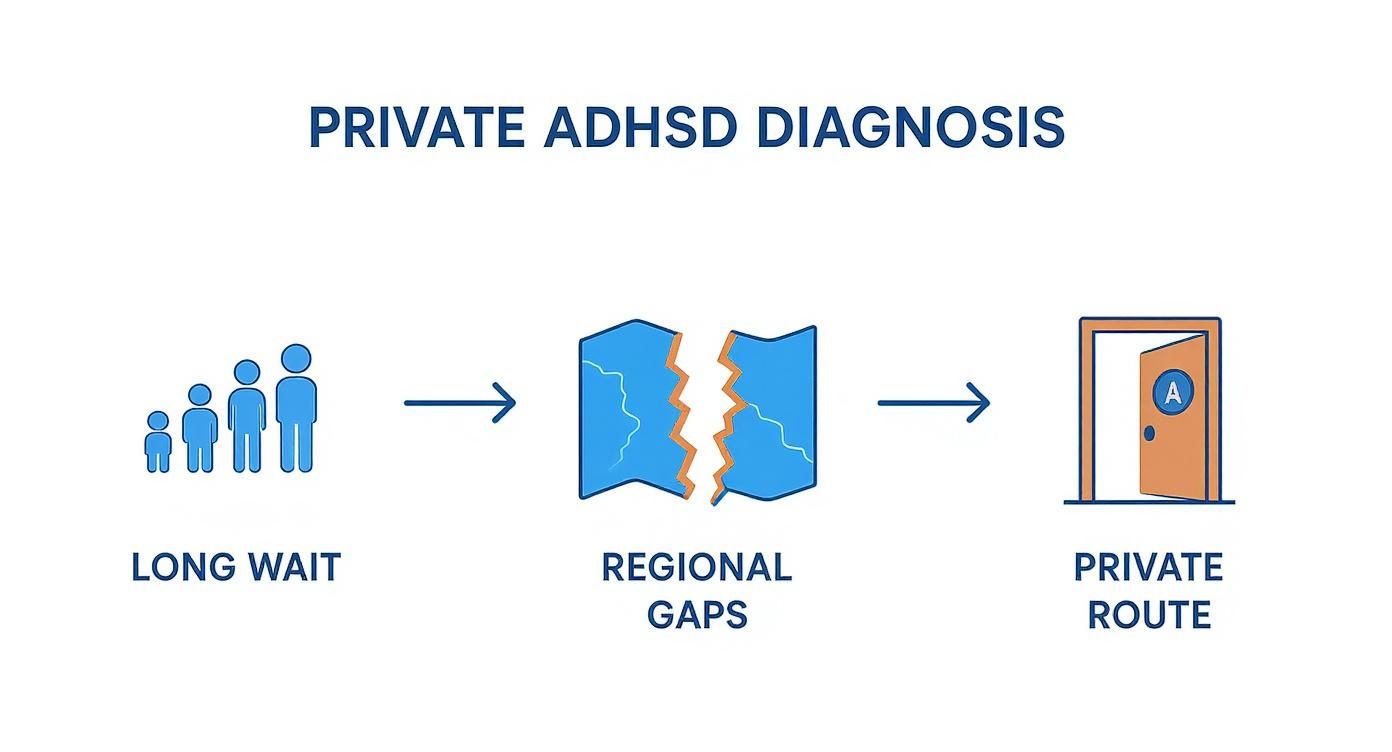
As you can see, long NHS waits and gaps in regional services often make the direct, self-referral private path a much more practical way to get timely answers.
Step 3: Gathering Supporting Evidence
To give your assessment real-world context, it’s a great idea to gather any supporting evidence you can find. It’s not a requirement, but it can make a big difference in painting a complete picture for the clinician.
Digging out old school reports, work performance reviews, or even emails that mention struggles with deadlines and organisation can provide invaluable, real-world context for the assessing psychiatrist.
This kind of evidence helps show that your symptoms have been a consistent part of your life across different settings – a key part of the diagnostic criteria for both ADHD and Autism. It’s about demonstrating, not just telling, the clinician how these traits have shaped your experiences.
Step 4: The Diagnostic Interview
This is the main event: the clinical interview itself. It’s a detailed, structured conversation with a specialist – usually a consultant psychiatrist or a clinical psychologist with deep expertise in adult ADHD and neurodevelopmental conditions. Expect it to last anywhere from 90 minutes to three hours.
During this session, the clinician will:
- Dive deeper into the answers you gave on your pre-assessment forms.
- Ask you about your experiences at work, in education, in relationships, and at home.
- Screen for other common co-occurring conditions, like anxiety, depression, or autism, which often go hand-in-hand with ADHD and are crucial for a complete mental health picture.
The entire conversation is designed to understand your symptoms and their impact according to established diagnostic criteria like the DSM-5. It can feel a bit intense, but remember, they are there to understand and help you. To get a feel for what a full evaluation involves, you can learn more about what a mental health assessment online covers. This ensures every part of your wellbeing is considered, which is the key to an accurate and genuinely helpful diagnosis.
NHS vs Private: Which ADHD Diagnosis Route Is Right for You?
Deciding whether to go through the NHS or a private clinic for an ADHD assessment is a huge step. It’s essentially a trade-off: the thorough, cost-free public system versus the speed and convenience of private healthcare. There’s no single right answer, and the best choice really comes down to your personal situation, finances, and how urgently you need support for your mental health.
The elephant in the room for many is time. The NHS provides an incredible service, but it's no secret that it’s stretched thin. This pressure is a major reason why seeking a private ADHD diagnosis in the UK has become such a common alternative, especially when you hear about NHS waiting lists stretching from a few months to, in some areas, several years.
The difference can be staggering. NHS wait times can be as "short" as 12 weeks in places like Dorset or as long as an unbelievable 550 weeks (that's over 10 years!) in Herefordshire and Worcestershire. Private clinics, on the other hand, typically have you seen in around 43 days. For a deeper dive into how these wait times vary by region, it's worth taking a look at this guide on NHS vs private ADHD assessments.
Getting Your Foot in the Door
How you even start the process is one of the first big differences you'll notice. Each path has a completely different entry point.
-
The NHS Route: Your journey here begins at your GP's surgery. You'll need an appointment to discuss your symptoms and get your doctor to agree that an assessment is warranted. Once they're on board, they can refer you to the local adult ADHD service.
-
The Private Route: This way is much more straightforward. You can self-refer, which means you pick up the phone or fill out a form on a clinic's website yourself. Bypassing the need for a GP referral removes a major hurdle and gets the ball rolling much faster.
The Cost Factor
This is where the decision gets real for most people. It boils down to a simple question: are you paying with your time or with your money?
Going through the NHS is, of course, completely free. The assessment, the diagnosis, and any treatment that follows—including medication—are all covered. For many, this makes it the only realistic option.
A private diagnosis, however, is a serious financial commitment. The cost can be anywhere from several hundred to well over a thousand pounds, depending on the clinic. This fee usually covers the main assessment and your diagnostic report, but be aware that follow-up appointments and getting your medication right (titration) almost always cost extra.
While the upfront cost of going private is steep, many people see it as an investment in their mental health. Getting clarity and support quickly can make a world of difference, preventing months or even years of struggling at work, in your relationships, and with your own self-worth.
NHS vs Private ADHD Diagnosis: A Quick Comparison
To lay it all out clearly, let's compare the two pathways side-by-side. This table gives you a simple, at-a-glance look at what to expect from each.
| Feature | NHS Pathway | Private Pathway |
|---|---|---|
| Referral | A GP referral is mandatory. | You can self-refer directly to the clinic. |
| Wait Time | Often very long, from months to several years. | Typically short, often just a matter of weeks. |
| Cost | Free at the point of care. | Involves a significant financial cost. |
| Choice of Specialist | You're assigned a clinician by the service. | You can research and choose your specialist or clinic. |
| Flexibility | Appointment times and dates are less flexible. | Offers much greater flexibility for scheduling. |
| Co-occurring Conditions | Will assess for linked conditions like autism. | Can often provide integrated, holistic assessments. |
Ultimately, both paths lead to the same goal: getting a proper assessment from a qualified professional. The key is to weigh these factors and choose the one that aligns best with your needs and resources.
Decoding the Costs of a Private ADHD Assessment

Let’s get straight to the point: money. Going for a private ADHD diagnosis in the UK is a significant financial decision, but it's also a serious investment in your wellbeing. To avoid any nasty surprises down the line, it’s vital to understand exactly what you’re paying for.
The price tag you see advertised is rarely the final figure. It’s usually for a specific package of services, so you need to look closely at what’s included and, just as importantly, what’s not.
What Does a Standard Assessment Package Cover?
Typically, the initial fee you pay covers the core diagnostic work-up. This is what pays for the clinician's time and expertise to get you a clear answer.
Most standard packages will bundle together the essentials:
- The Main Diagnostic Interview: This is the deep-dive conversation with a specialist psychiatrist, which can often take a few hours.
- Review of Pre-Assessment Forms: Before you even speak, the clinician spends time carefully going through all the questionnaires and forms you (and maybe a partner or parent) filled out.
- The Diagnostic Report: You’ll receive a formal document that lays out the clinical findings, confirms whether you meet the criteria for an ADHD diagnosis, and provides some initial recommendations.
But that initial cost, which can be anything from £400 to over £2,000, is often just the beginning. The final price depends a lot on the clinic's reputation, location, and how complex your situation is – especially if other conditions like autism might be at play, requiring a more in-depth mental health evaluation.
Uncovering the Additional Costs
The diagnostic report is a crucial first step, but it’s not the end of the road. To get the real-world benefits of a diagnosis, you’ll need to budget for the follow-up stages, which almost always come with their own price tags.
This is where the findings from your assessment are turned into a practical plan to help you move forward.
It's easy to focus on the assessment fee, but the real, ongoing support comes from what happens next. Budgeting for follow-up care like medication titration and therapy is just as important as the diagnosis itself for long-term mental health.
Here are the key expenses you should plan for:
- Follow-Up Consultations: These are appointments to discuss your report in detail, talk through treatment options, and build a personalised plan. Expect to pay between £150 and £400 per session.
- Medication Titration: If medication is the right path for you, this is the careful process of finding the right drug and dosage. It’s not a one-off prescription; it involves regular check-ins and adjustments, often sold as a package that can cost several hundred pounds.
- Private Prescriptions: The cost of the actual medication isn't included. You'll be paying for private prescriptions until your GP agrees to a 'shared care' agreement, which can take time.
- Extra Administrative Fees: Need a letter for your employer or university? Some clinics will charge extra for tasks like this, so it’s always worth asking about administrative fees upfront.
Getting a clear picture of all these potential costs from the start allows you to make a decision you’re comfortable with. For a more detailed breakdown, you can explore our full guide to the private ADHD assessment cost to see how all the pieces fit together. Understanding the complete financial journey is the first step to confidently investing in yourself.
Life After Diagnosis: Your Report and Next Steps
Getting an official diagnosis after going through a private ADHD assessment is a huge moment. For many, it's not just the end of a long period of uncertainty; it's the beginning of a new chapter in understanding their mental health. Finally, armed with a proper understanding of how your brain works, you can start building strategies that actually work for you.
This next phase is all about turning that diagnosis into positive, practical action. It all starts with the detailed diagnostic report from your clinician, which essentially becomes the roadmap for your support moving forward.
Understanding Your Diagnostic Report
Your private ADHD diagnosis report is much more than a single piece of paper with a conclusion on it. Think of it as a comprehensive clinical document that lays out the entire assessment journey, explaining exactly how the clinician reached their diagnosis.
It will summarise your symptoms, your personal history, and the real-world impact ADHD has on different areas of your life. Most importantly, it will offer personalised recommendations for treatment and support. These might include:
- Medication: Specific suggestions for which types of ADHD medication could be helpful.
- Therapeutic Support: Recommendations for things like Cognitive Behavioural Therapy (CBT) or specialist ADHD and Autism coaching.
- Workplace Adjustments: Formal recommendations for reasonable adjustments you can ask your employer to make.
This report is the key that unlocks the right kind of help, both medically and in your professional life.
Navigating Medication and Titration
If medication is part of your recommended plan, the next step is a process called titration. This isn’t a one-and-done prescription. Instead, it’s a careful, collaborative period where you and your psychiatrist work closely together to find the right medication and the most effective dose for you.
The process involves regular check-ins to see how things are going, manage any side effects, and make sure the treatment is fine-tuned to your specific needs. Once your medication is stabilised and working well, you can look into managing private prescriptions online to continue your treatment smoothly.
The rise of private ADHD services in the UK is a direct response to the immense pressures on the NHS. An independent ADHD Taskforce, commissioned by NHS England itself, found that ADHD is still widely under-recognised and undertreated. Their report confirmed that NHS services simply can't meet the current demand, resulting in enormous waiting lists and a postcode lottery for care. This gap has pushed more and more people towards private assessments, creating a two-tier system where getting timely help often depends on whether you can afford to pay. You can read more from the ADHD Taskforce report on the NHS website.
Building Your Support Network
A diagnosis can stir up a whole mix of emotions—from profound relief and validation to a sense of grief for past struggles. It’s so important to have a solid support system in place as you begin to process everything. This is particularly true if you're also navigating a potential autism diagnosis, as understanding how the two conditions interact is crucial for your overall mental wellbeing.
A diagnosis isn't a label that defines you; it's a tool that empowers you. It gives you the language to understand your past and the framework to build a more supportive future for yourself.
Look into connecting with ADHD and autism support groups, whether online or in your local community. Just hearing from others with similar lived experiences can be incredibly validating and a fantastic source of practical tips. Therapies like CBT or working with an ADHD coach can also give you essential tools to manage executive function challenges and develop healthier coping strategies. It’s this blend of medical treatment and personal support that creates a strong foundation for you to truly thrive.
A Few Common Questions About Private ADHD Diagnosis
Even after getting to grips with the assessment process, the costs, and what happens after a diagnosis, you'll likely still have some practical questions buzzing around. It's completely normal. Let's tackle some of the most common queries we see time and time again.
Think of this as a handy FAQ to clear up any final bits of uncertainty you might have.
Will the NHS Actually Accept a Private Diagnosis?
This is probably the number one question on everyone's mind, and the honest answer is: it's complicated. A diagnosis from a legitimate private clinic, carried out by a GMC-registered psychiatrist who follows all the official NICE guidelines, is absolutely valid from a clinical standpoint.
However, whether your local NHS trust accepts it is another matter. Many GPs are perfectly willing to set up a 'shared care agreement' to take over your prescriptions once you're on a stable dose. But some local NHS bodies have their own rules that insist on a full NHS assessment before they'll prescribe anything. The best thing you can do is have a chat with your GP before you start the private process to see where they stand.
How Can I Tell if a Private Clinic Is Legit?
This is a big one. Choosing the right clinic is essential—your peace of mind and the validity of your diagnosis depend on it. You need to know you're in safe, professional hands.
Here’s what to look for as a bare minimum:
- CQC Registration: The clinic absolutely must be registered with and regulated by the Care Quality Commission (CQC). This is the official seal of approval for quality and safety in England.
- Properly Qualified Clinicians: Make sure the assessments are being done by Consultant Psychiatrists who are listed on the GMC Specialist Register and have experience with adult ADHD, Autism and co-occurring mental health conditions.
- A Transparent Process: A good clinic will be upfront about their process, their pricing, and exactly what you're getting for your money. No hidden surprises.
A proper diagnosis has to be based on established clinical criteria, like the DSM-5, and involves a really thorough look at your personal history. If a clinic is promising a quick diagnosis with very little input from you, that's a massive red flag.
Is It Possible to Get Assessed for Autism at the Same Time?
Yes, it often is, and this can be one of the huge advantages of going private. Many top private clinics have experts who are well-versed in assessing for both ADHD and Autism Spectrum Disorder (ASD). Since the two conditions often show up together, getting a combined assessment can give you a much richer, more accurate picture of how your brain is wired and its impact on your mental health.
This kind of integrated approach helps create a support plan that truly fits you, looking at the whole picture rather than just a collection of isolated symptoms. Opting for a private ADHD diagnosis in the UK that also screens for autism can be a powerful step towards really understanding yourself.
At Insight Diagnostics Global, we provide CQC-regulated, consultant-led online assessments for adults seeking clarity on ADHD, Autism, and a range of mental health conditions. Our experienced GMC-registered psychiatrists offer thorough, empathetic evaluations and clear, actionable reports to guide your next steps. Find out how we can support your journey at https://insightdiagnostics.co.uk.