A private autism assessment for adults provides a direct, timely route to getting a diagnosis, letting you skip the long NHS waiting lists. For many people, it's the first real step toward understanding lifelong challenges, improving their mental health, and finally getting the right support for conditions like autism, ADHD, and co-occurring mental health conditions.
Why More Adults Are Seeking Private Autism Assessments
For so many adults across the UK, the path to understanding themselves often starts with a nagging feeling of being different. They've spent years navigating social events, careers, and relationships feeling like they're on the outside looking in, but without ever knowing why. This quiet, personal struggle, often complicated by anxiety or what feels like treatment-resistant depression, is what’s now leading a growing number of people to wonder if they might be autistic.
A massive driver behind this is the incredible strain on our public healthcare system. The thought of facing an NHS waiting list that can stretch on for years is, frankly, demoralising. As of June 2025, the situation has become critical, with 236,225 people in England waiting for an autism assessment. With the average wait time now over 17 months, most have been waiting far longer than the 13-week maximum suggested by NICE guidelines. This limbo is emotionally exhausting, leaving people feeling stuck without answers or support for their mental health.
The Toll of Autistic Masking and Burnout
Many adults who come forward for a diagnosis have spent their entire lives autistic masking without even realising it. Masking is the constant, subconscious effort to hide autistic traits to try and fit in with a neurotypical world. It can mean forcing eye contact when it feels intensely uncomfortable, copying the social cues of others, or stopping yourself from stimming (repetitive movements) when it would actually bring you comfort.
Think of it like constantly performing a version of yourself that isn't real. It's mentally draining. After years of this, it often leads to autistic burnout—a state of total physical, mental, and emotional exhaustion that often gets misdiagnosed as severe depression or anxiety.
This burnout is often the tipping point that finally pushes someone to seek help. The relentless pressure of masking can cause or worsen a whole host of mental health issues, including:
- Chronic anxiety and depression: Constantly trying to navigate a world that isn't built for your brain is a recipe for persistent mental health challenges.
- Low self-esteem: Without knowing there's a neurological reason for your struggles, it's easy to internalise them and think you're somehow failing.
- Co-occurring conditions like ADHD: There's a big overlap between autism and ADHD. The combined effort of managing both undiagnosed can significantly impact mental health. A proper assessment can untangle how these might be interacting.
Seeking Clarity and Validation
At the end of the day, getting a private autism assessment is about so much more than just getting a label. It's about taking control and finally understanding your unique neurotype. A diagnosis can completely reframe your life experiences, explaining not just social difficulties but also the root of ongoing mental health struggles. It replaces confusion with clarity and years of self-blame with self-compassion.
For many, it's the key that unlocks the right mental health support, reasonable adjustments at work, and a community of people who just get it. If these experiences resonate with you, you might find our guide on the signs of undiagnosed autism in adults helpful. That feeling of validation is often the first step toward building a life that feels more authentic and less exhausting.
Navigating Your Options: NHS vs. Private Assessment
Deciding between an NHS or a private autism assessment is one of the biggest choices you'll face on this journey. There's no single "right" answer; it really boils down to your personal circumstances—your finances, your emotional capacity to wait, and just how urgently you feel you need clarity for your mental well-being.
Let's be upfront: the single biggest factor for most people is time.
The NHS provides an essential, free service, but the waiting lists are notoriously long. We're not talking weeks or months; it's often years. This isn't just a minor inconvenience. Living in that state of uncertainty can take a heavy toll on your mental health, often making anxiety, depression, or self-doubt a constant companion. For many, this long wait can make things worse, leaving you feeling unsupported while navigating daily life.
This is where a private autism assessment in the UK offers an alternative. It's a way to sidestep the queue and get a clear picture of your neurodivergence—including potential co-occurring ADHD—much, much faster.
Understanding the Key Differences
The differences go deeper than just cost and waiting times. The way you get a referral, what the assessment involves, and even how the final report is viewed can all vary. It's worth taking a moment to properly weigh up these points.
Here’s a head-to-head comparison to help you see the differences more clearly.
Private vs. NHS Autism Assessment: A Head-to-Head Comparison
This table breaks down the main factors you'll need to consider when choosing which path is right for you.
| Factor | Private Assessment | NHS Assessment |
|---|---|---|
| Waiting Time | Typically a few weeks to a few months. | Extremely long, often 1-3+ years. |
| Cost | A significant investment. Costs range from £800 to over £2,000. | Free at the point of service. |
| Referral Process | You can usually self-refer, giving you direct control. | Requires a GP referral, which can sometimes be a hurdle. |
| Choice of Provider | You can research and choose a clinic or clinician you trust. | You are allocated to your local NHS service. |
| Assessment Quality | Varies. Reputable providers follow NICE guidelines. | Standardised and follows national (NICE) guidelines. |
| Report Recognition | A NICE-compliant report is widely accepted by employers/education. | Universally recognised and accepted. |
| Post-Diagnosis Support | Does not guarantee access to NHS support services. | Directly links you into local NHS support pathways (if available). |
As you can see, the choice involves a trade-off. The private route offers speed and control at a significant financial cost, while the NHS path is free but comes with a long, often difficult, wait.
Will My Private Diagnosis Be Recognised?
This is a really common and completely valid question. The good news is that a diagnosis from a reputable private provider who follows National Institute for Health and Care Excellence (NICE) guidelines carries the same clinical weight as one from the NHS.
A well-written, thorough report is the key. It should be robust enough to support you in requesting workplace adjustments under the Equality Act 2010 or accommodations in education.
One important thing to remember, though, is that a private diagnosis doesn't automatically unlock NHS-funded support services. Your GP should add the diagnosis to your medical records, but access to local support can depend on the specific policies of your regional health authority.
Choosing your path requires balancing the immediate need for answers against the financial cost. For many, the value of a faster diagnosis through a private autism assessment is immeasurable for their mental health, as it allows them to move forward with self-understanding and find the right support sooner.
To get a broader perspective on what's available, this comprehensive guide to autism care options in the UK is a great resource. Ultimately, whether you choose the NHS or a private route, the goal is the same: gaining the clarity you need to live a more authentic and supported life.
What to Expect from Your Private Assessment Journey
Deciding to get a private autism assessment can feel like a huge step. It’s completely normal to feel a mix of hope, nervousness, and maybe a bit of apprehension. Knowing what the process actually looks like can take a lot of that uncertainty away, making the whole thing feel much more manageable.
Think of it less like a single, scary test and more like a collaborative exploration. The goal isn't to put you under a microscope but for clinical experts to piece together a full, accurate picture of who you are, including how autism, ADHD, and your mental health may intersect. They'll gather information from different parts of your life to truly understand your unique way of seeing and interacting with the world, both now and throughout your childhood.
This visual gives you a bird's-eye view of the typical journey, from that first enquiry right through to getting your results.
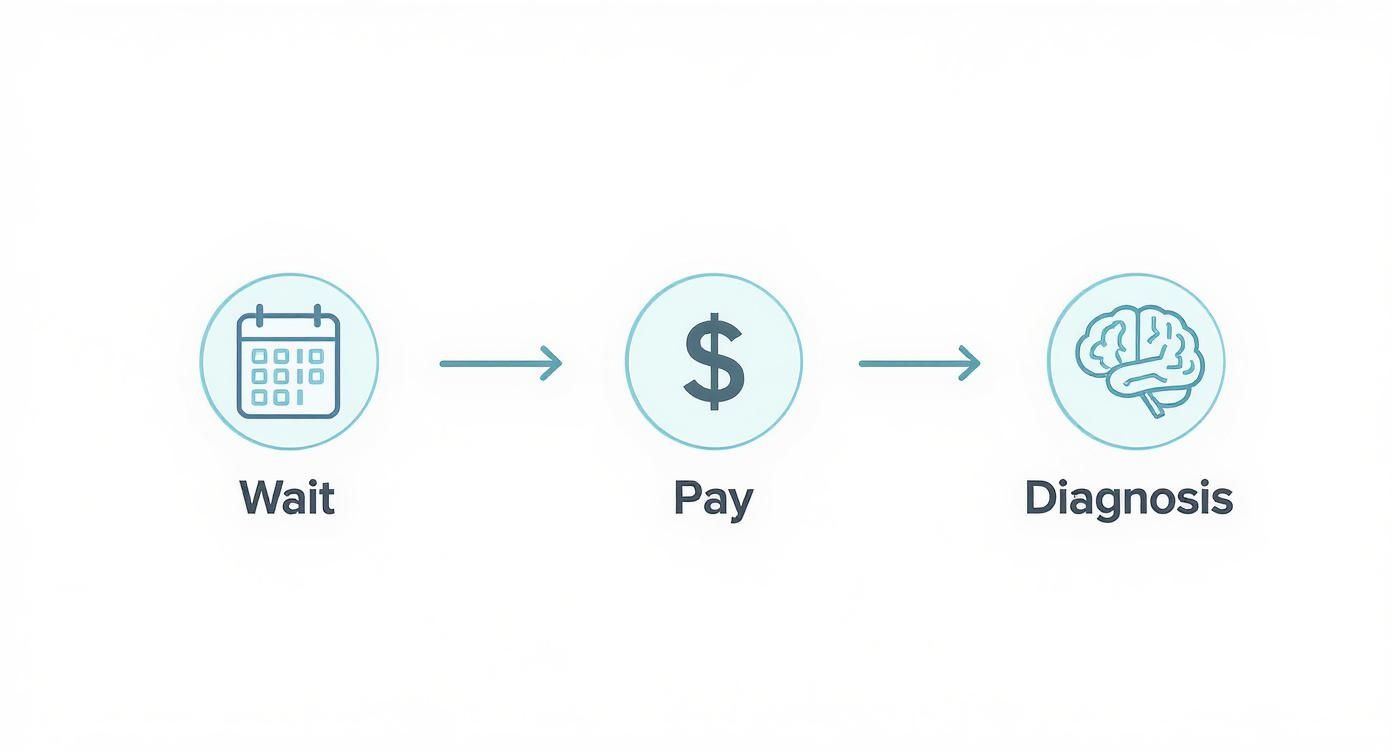
As you can see, the private route is a direct path to getting the clarity you need, without the long delays that can often come with other options.
The Initial Steps: Enquiry and Triage
Your journey really begins the moment you first get in touch with a clinic. This usually kicks off with an initial enquiry, which is then followed by a triage or screening call. It's important to know this isn't the formal assessment itself, but it's a vital first hurdle.
During this conversation, a clinician will want to hear about what led you to seek an assessment and the kinds of challenges you're experiencing. It’s their chance to make sure a full assessment is the right path for you, and your chance to ask any immediate questions. They'll also likely send you some pre-assessment questionnaires to fill out in your own time.
This initial phase is all about setting the scene. The more open you can be about your experiences—including any related mental health struggles like anxiety, depression, or suspected ADHD—the better prepared the clinical team will be to conduct a thorough evaluation.
The Core: Clinical and Diagnostic Interviews
The real heart of the assessment is made up of in-depth clinical interviews and recognised diagnostic evaluations. These sessions are carefully designed to gather detailed information about your communication style, social interactions, and your patterns of behaviour and interests.
Reputable providers will always use what are known as "gold-standard" assessment tools, which are recognised and respected across the world. The two you’ll almost certainly encounter are:
- Autism Diagnostic Observation Schedule, Second Edition (ADOS-2): This is a series of activities and conversations that let the clinician see your social and communication behaviours in a natural, unscripted way. It's not a test with right or wrong answers; it's more of a guided interaction.
- Autism Diagnostic Interview-Revised (ADI-R): This is a very thorough interview that focuses on your developmental history. For this part, the clinician will usually want to speak with someone who knew you well as a child, like a parent, carer or older sibling, to help build a clear picture of your early years.
These tools give the clinical team solid, objective data, which they then piece together with everything you’ve shared about your own life experiences.
The Bigger Picture: Autism, ADHD, and Mental Health
It’s incredibly common for adults who suspect they are autistic to also wonder about Attention-Deficit/Hyperactivity Disorder (ADHD). The traits can overlap so much that it's often tough to tell them apart without an expert eye. In fact, research shows a huge rate of co-occurrence, with some studies suggesting that 30-80% of autistic people also have ADHD.
Because of this, many private clinics now offer combined autism and ADHD assessments. Taking this integrated approach is a massive advantage because it gives you a complete, holistic view of your neurodivergent profile. Trying to assess just one condition without considering the other can easily lead to an incomplete or even inaccurate conclusion.
A good combined assessment also takes your wider mental health into account. Masking autistic traits for years can take its toll, often contributing to chronic anxiety, depression, and burnout. Understanding how all these different elements fit together is essential for getting the right support after your diagnosis. If you'd like to read more on this, our guide on getting a mental health assessment online is a great place to start.
The Final Steps: Your Feedback and Report
The last stage of the process is the feedback session. This is where the lead clinician sits down with you to talk through their findings in a clear, compassionate, and collaborative way. It's your dedicated time to ask any questions you have and really understand the reasoning behind their diagnostic conclusion.
After this meeting, you’ll receive a detailed written report. This document is so much more than a simple yes-or-no answer. It's a comprehensive summary of your personal history, your unique strengths, and your specific challenges, all backed up with personalised recommendations for support for your autism, potential ADHD, and overall mental health. A well-written, NICE-compliant report is a powerful tool for self-understanding, and it's what you'll need to access support or accommodations at work or in education.
How to Choose a Qualified and Reputable Provider
Stepping into the world of private autism assessments can feel like a huge leap. With so many clinics and specialists out there, how do you know who to trust with something so personal? Making the right choice is crucial to ensure your time and money lead to a diagnosis that is valid, meaningful, and respected by others.
The truth is, the quality of private providers varies massively, so a bit of homework is essential. You're looking for a service that isn't just clinically skilled, but also ethical, compassionate, and completely transparent about its process. Think of it as looking for 'green flags'—clear signals of quality—while also keeping an eye out for warning signs that should give you pause.
This is especially important when you consider how many adults have lived for decades without answers. A recent review highlighted that a staggering 89% of autistic adults aged 40 to 59 might be undiagnosed, a figure that climbs to 97% for those over 60. These numbers really drive home the need for trustworthy and accessible diagnostic services for adults.
Green Flags: Essential Credentials to Look For
When you start shortlisting providers, there are a few non-negotiable standards they absolutely must meet. These credentials are your proof that the clinicians are properly qualified, regulated, and sticking to the highest professional standards here in the UK.
-
Professional Registration: Anyone involved in your assessment must be registered with a UK statutory body. For psychiatrists, that’s the General Medical Council (GMC). For clinical psychologists, it's the Health and Care Professions Council (HPC). This registration is your guarantee of their qualifications and professional accountability.
-
Adherence to NICE Guidelines: Any good provider will make it clear that their assessment process follows the guidelines from the National Institute for Health and Care Excellence (NICE). This is the same high standard the NHS works to, and it ensures the diagnosis will be robust and widely recognised.
-
Multi-Disciplinary Team (MDT) Approach: The gold standard for an autism assessment involves a team of professionals, not just one person's opinion. This usually means a combination of experts like a psychiatrist and a clinical psychologist, or perhaps a speech and language therapist. This team-based approach gives a much more balanced and accurate diagnostic picture, especially when considering co-occurring ADHD and mental health.
Red Flags: Warning Signs to Avoid
Just as you need to know what to look for, it's vital to recognise what to steer clear of. Some practices can be a sign that a provider is more interested in making a profit than in your wellbeing. If you see any of these red flags, proceed with caution.
A diagnosis is a clinical conclusion, not a product you can buy. Any provider who implies a guaranteed outcome or pressures you into a quick decision should be avoided. An ethical assessment is an impartial investigation, not a transaction.
Here are some of the biggest warning signs:
- Guaranteed Diagnosis: No ethical professional can ever guarantee a particular outcome before they’ve even started a full assessment.
- Lack of Transparency on Costs: The pricing should be clear, detailed, and provided upfront. To get a feel for what’s reasonable, check out our guide on private autism assessment costs.
- Overly Simplistic Process: A proper assessment is thorough and takes time. Be wary of any service that promises a diagnosis from just a short questionnaire or a quick chat.
- No Mention of NICE Guidelines: If a provider doesn't mention following NICE guidelines, their report might not be accepted by your GP, employer, or university.
Finally, when choosing a provider, especially for online assessments, it’s wise to think about data security. Inquiring about their use of secure systems like HIPAA-compliant video conferencing platforms can give you extra peace of mind. Finding a provider who ticks all the right boxes means you can feel confident that your journey towards clarity is in safe, professional hands.
Understanding Your Diagnosis and Planning What's Next
Getting your diagnostic report is a big moment. For so many people, it’s this huge wave of relief—a lifetime of feeling different finally clicks into place and makes sense. It’s validation. But it's also a starting point for figuring out how to take the clinical insights in that document and make them work for you in your actual life.
At first glance, the report can look a bit daunting, packed with clinical language and detailed observations. Don't let that put you off. A well-written, NICE-compliant report is designed to be your user manual. It should clearly explain the diagnostic conclusion—how your experiences match the criteria for Autism Spectrum Disorder (ASD) and potentially ADHD—but more importantly, it's a personalised roadmap for your mental health and well-being.
From Diagnosis to Practical Action
The recommendations section is often the most powerful part of the entire report. This shouldn't be a copy-and-paste list; it should be tailored specifically to you, your strengths, and the things you find difficult. Think of it as your guide to building a life that feels more supportive and authentic.
You might find practical strategies for handling sensory overwhelm, ideas for communicating more effectively in your relationships, or pointers for making your work environment less draining. It’s the bridge between knowing you’re autistic and knowing what to do about it. The diagnosis gives you the 'why,' and the recommendations give you the 'how.'
For a lot of autistic people, mental health is a huge piece of the puzzle. Trying to get by in a neurotypical world without a diagnosis, often masking your autistic traits, is a recipe for chronic anxiety, depression, and burnout. It's also really common for autistic adults to have co-occurring ADHD, and a thorough assessment will have looked into this.
"Receiving an autism diagnosis isn’t a limitation—it’s a tool for navigating life with greater confidence and understanding, transforming uncertainty into actionable insights and fostering personal growth."
Understanding how these things connect is key. Your report can be the first step in finding therapists who are genuinely neurodiversity-affirming. These are professionals who won’t try to 'fix' you, but will help you build coping strategies that work with your autistic brain and ADHD traits. That kind of support can be life-changing.
Practical Next Steps After Your Assessment
With your report in hand, you finally have a powerful tool for self-advocacy. This clarity allows you to be proactive about getting the support and adjustments you need to do more than just survive—to actually thrive. Here are a few key things to consider:
- Workplace Accommodations: Under the Equality Act 2010, autism is considered a disability, which gives you legal protections. This means you are entitled to "reasonable adjustments" at work, and your report is the formal evidence you need to start that conversation.
- Connecting with Community: Finding other autistic people is incredibly powerful. There are so many autistic-led peer support groups out there, both online and locally. Sharing experiences with people who just get it can do wonders for that feeling of isolation.
- Informing Your GP: It’s a good idea to ask your GP to add your diagnosis to your medical records. While a private diagnosis doesn’t automatically unlock NHS-funded services, having it officially on file is an important step for your ongoing healthcare.
Making these changes can feel like a big deal, but it’s all about creating an environment that works with your brain, not against it.
Finding the Right Support
The path forward looks different for everyone, but it almost always involves building a solid support network. This is usually a mix of professional help and community connection.
- Therapy and Coaching: Look for counsellors, therapists, or coaches who specialise in working with autistic adults, particularly those who understand ADHD and mental health. They can help with everything from executive function challenges to navigating social dynamics and recovering from autistic burnout.
- Support Groups: Organisations like the National Autistic Society and smaller, local autistic-led groups offer safe spaces to connect and learn from the experiences of others.
- Self-Education: So many autistic advocates share brilliant insights through blogs, books, and social media. Learning directly from the community is one of the most empowering things you can do post-diagnosis.
Think of your private autism assessment not as an endpoint, but as the beginning. It's the start of a journey toward understanding yourself better, looking after your mental health, and finally living a life that feels right for you.
Common Questions About Private Adult Assessments
Going down the route of a private autism assessment naturally brings up a lot of practical questions. Getting your head around the costs, what happens with the diagnosis, and the possible outcomes is a huge part of feeling prepared and confident. Here are some straightforward answers to the questions we hear most often.
How Much Does a Private Autism Assessment Actually Cost in the UK?
Let’s talk numbers. This is often the first thing people need to know, and it's important to be realistic. For a comprehensive private autism assessment for an adult in the UK, you should expect to budget somewhere in the region of £1,800 to over £3,000. That might sound like a lot, but that figure reflects the sheer depth of clinical time and expertise that goes into a high-quality, thorough diagnostic process.
What causes that price to vary? A few things. If your personal history is quite complex—for example, if it's tricky to distinguish between potential autistic traits, ADHD, and longstanding mental health conditions—it simply takes more clinical hours to unpick. The biggest factor, though, is often whether you’re also being assessed for other co-occurring conditions.
A combined autism and ADHD assessment, for instance, will cost more than one for autism alone. But, it's almost always more cost-effective to do them together rather than starting from scratch with a second assessment later on. The best advice is to always ask for a clear, itemised breakdown of all costs before you commit to anything.
Will My GP or Employer Actually Accept a Private Diagnosis?
This is a really important, and completely valid, concern. The short answer is: yes, they absolutely should. A diagnosis from a reputable, qualified private clinic that follows official NICE (National Institute for Health and Care Excellence) guidelines is designed to be recognised by the NHS, employers, and universities.
The real key here is the quality of the assessment report itself. A proper diagnosis isn't just a one-page letter with a label. It's a highly detailed, evidence-based clinical document. When your GP receives a robust, NICE-compliant report, they have everything they need to add the diagnosis to your medical records.
This same report is also the formal evidence you need to request "reasonable adjustments" at work under the Equality Act 2010. It gives your employer the clinical validation required to implement supportive changes, like altering your workspace or finding better ways to communicate. This is precisely why choosing a provider with a solid clinical reputation is non-negotiable—it ensures your diagnosis has the authority it needs.
Can I Get Assessed for Both Autism and ADHD at the Same Time?
Yes, you can, and honestly, it’s often the best way to do it. The traits of autism and ADHD overlap so much that it can be incredibly difficult for anyone—even the person living with them—to tell where one ends and the other begins. Things like executive function, social energy, and sensory sensitivities are affected by both.
A combined assessment for autism and ADHD gives you a much more complete and accurate picture of how your brain is wired. It helps clarify how these two distinct but related neurodevelopmental profiles interact, providing a far more useful understanding of your personal strengths and challenges.
By looking at everything together, clinicians can avoid "diagnostic overshadowing," where the more obvious traits of one condition might hide the other. On a practical level, it’s also much more efficient and usually cheaper than going through two completely separate, lengthy assessment processes. It results in a single, unified set of recommendations that takes your whole profile into account, including the impact on your mental health.
What Happens If the Assessment Says I’m Not Autistic?
It's completely understandable to feel disappointed, confused, or even a bit lost if the outcome is that you don't meet the diagnostic criteria for autism. This is especially true if you’ve identified with the autistic experience for a long time. The most important thing is to give yourself the space to process that feeling. But it's crucial to know that this is not a dead end.
A high-quality assessment is never just about getting a 'yes' or 'no' answer. The process itself is an incredibly valuable deep dive into your unique cognitive and emotional makeup. The detailed report will still give you a huge amount of insight into why you experience the world in your particular way, even if the label isn't "autism."
The findings will highlight your personal strengths and get to the root cause of your challenges, which might point towards other things like social anxiety, complex trauma, ADHD, or a different neurodevelopmental profile entirely. Most importantly, the report will still provide personalised, actionable recommendations for support for your mental health, helping you find the right path forward. It’s a journey of discovery, and any outcome moves you closer to genuine self-understanding.
At Insight Diagnostics Global, we provide CQC-regulated, NICE-compliant online assessments for adults seeking clarity about autism, ADHD, and their mental health. Our consultant-led team is committed to delivering a clear, supportive, and conclusive diagnostic experience. Find out how we can help you on your journey by visiting us at https://insightdiagnostics.co.uk.