Waiting for an NHS autism assessment can often feel like being stuck in an endless queue, leaving you and your family in limbo. A private autism assessment in the UK offers a much faster, though admittedly more expensive, way to get the answers and support you need. This guide is here to walk you through that alternative path, giving you the clarity to make what is a very big decision.
Why Are So Many Families Turning to Private Autism Assessments?
Staring down a multi-year NHS waiting list is an incredibly daunting prospect, especially when you or your child are struggling and desperately need answers. This long, uncertain delay is the single biggest reason countless people across the UK are now looking at private diagnostic services. The impact of these waits goes far beyond just being inconvenient—they can take a serious toll on mental health, hold up access to vital support for co-occurring conditions like ADHD, and leave people feeling completely stuck.
It helps to think of the NHS pathway as a long, scenic country road. You'll get there in the end, but the journey can be slow and full of unexpected stops. A private assessment, on the other hand, is like taking the motorway. It costs you, but it gets you directly to the clarity and validation a formal diagnosis can bring, which is often crucial for mental wellbeing.
The Sheer Demand on Public Services
The simple truth is that our public health services are swamped. In recent years, awareness around autism has shot up, which is a good thing, but it's meant far more people are seeking assessments. Unfortunately, NHS resources just haven't been able to keep up with this surge in demand.
The numbers really tell the story. As of June 2024, a jaw-dropping 193,203 people in England were on the waiting list for an autism assessment. In the 2023/24 period, a staggering 89% of people waited longer than the recommended 13 weeks to be seen. That figure represents a 96% increase in just two years. It's clear the system is under enormous pressure, and for many, going private has become less of a choice and more of a necessity to protect their mental health.
"For many, waiting years for a diagnosis is not just an inconvenience; it's a critical delay in accessing educational adjustments, workplace support, and mental health interventions that can transform a person's quality of life."
The Connection Between Autism, ADHD and Mental Health
Adding another layer of complexity is the fact that autism and ADHD often go hand-in-hand. Many people who suspect they might be autistic also have traits of ADHD, but a standard assessment might not look for both. This is where a private autism assessment UK provider can really help by offering a more joined-up approach, evaluating for multiple neurodivergent conditions at the same time.
Getting this complete picture is so important. Undiagnosed co-occurring conditions can seriously affect mental health, leading to anxiety, depression, or burnout. For adults in particular, recognising the signs of undiagnosed autism can be the first step to making sense of a lifetime of challenges that have impacted their wellbeing. A thorough private assessment gives a full picture of your neurotype, which is the best possible foundation for building effective, targeted support for both your neurodivergence and your mental health. If you want to get a better handle on the basics, this guide on Understanding Autism (ASD) is a great starting point.
Navigating the Private Assessment Process Step by Step
The thought of any clinical assessment can be a bit daunting, but knowing what’s involved can make a world of difference. A private autism assessment in the UK isn't a one-off appointment; it's a carefully structured journey with clear stages, all designed to build a complete picture of your unique strengths, challenges, and needs.
Think of it less as a test and more as a guided exploration of your life experiences. Each part of the process adds a crucial piece to the puzzle, aiming to provide a meaningful profile that truly explains who you are.
The Initial Consultation and Screening
It all starts with an initial chat or enquiry. This is your chance to ask any burning questions and get a feel for the provider. They'll want to understand why you're seeking a private autism assessment UK based, listening to your concerns and gathering some preliminary details.
From there, you’ll usually be sent a set of screening questionnaires. These forms are completed by you (and often a parent or partner who can provide insight into your early years) before the main assessment gets underway. It's important to remember these aren't tests you can pass or fail. They simply give the clinical team a solid foundation to work from, covering everything from social communication and sensory experiences to patterns of behaviour, and often including screeners for conditions like ADHD and anxiety. This initial step helps confirm that a full assessment is the right path and allows the clinicians to tailor the upcoming sessions to you.
The infographic below highlights how the private route offers a much more direct journey compared to the often-prolonged NHS pathway.
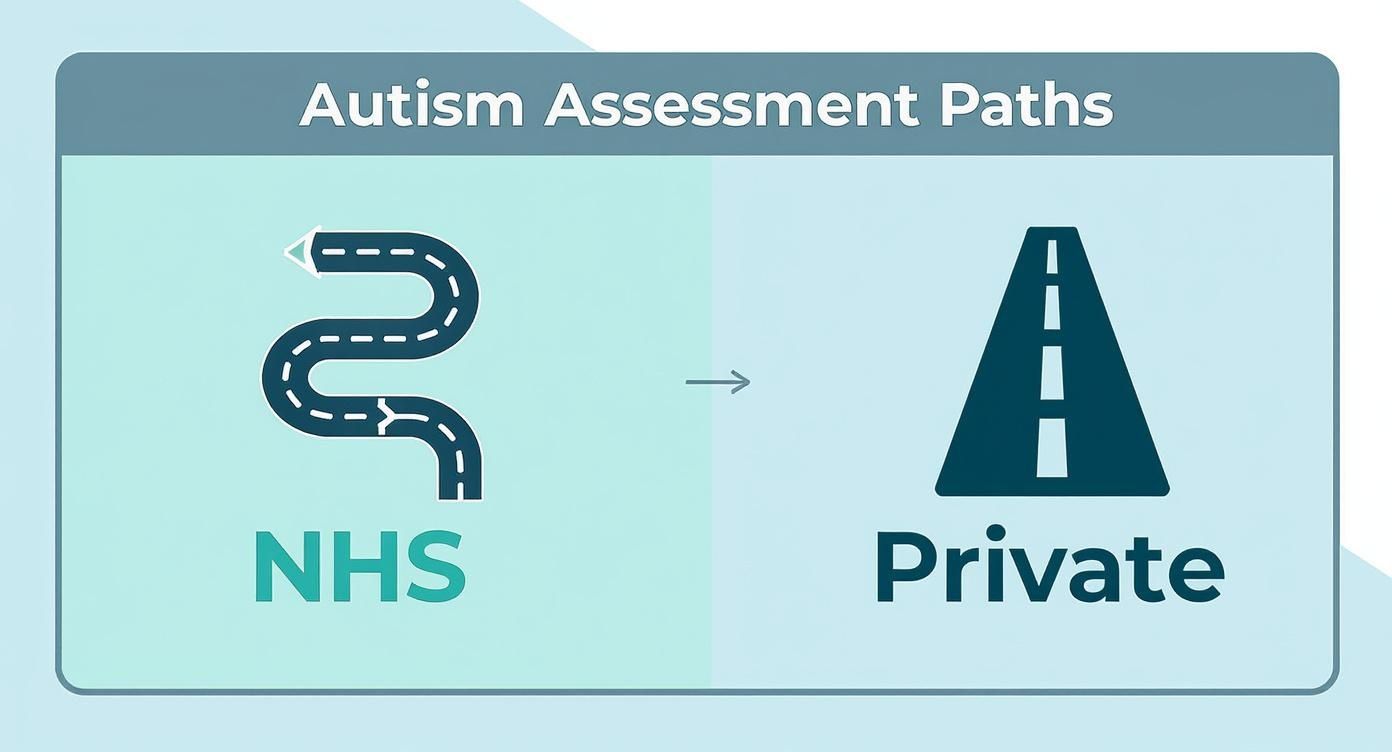
As you can see, going private is designed to be quicker and more direct, helping you avoid the systemic delays that can take a toll on mental health and put essential support on hold.
The Core Diagnostic Assessment
This is the heart of the matter. The core assessment usually involves several hours of direct interaction with clinicians. A high-quality assessment that follows NICE (National Institute for Health and Care Excellence) guidelines will always be multi-disciplinary. This is key—it means your case is considered by a team of different specialists, not just one person.
Your assessment team might include professionals like:
- A Clinical Psychologist or Psychiatrist: They typically lead the assessment, consider co-occurring conditions like ADHD or anxiety, and make the final diagnostic conclusion.
- A Speech and Language Therapist: They evaluate the nuances of your communication and social interaction.
- An Occupational Therapist: They can assess how sensory processing affects your day-to-day life.
This team-based approach is considered the gold standard because it ensures the final outcome is both thorough and reliable. The assessment itself will use internationally recognised "gold-standard" diagnostic tools.
For a robust autism assessment, two tools are absolutely essential: the ADOS-2 (Autism Diagnostic Observation Schedule, Second Edition) and the ADI-R (Autism Diagnostic Interview-Revised). They are designed to be used together to create a comprehensive diagnostic picture.
The ADOS-2 is a semi-structured assessment that feels more like a conversation or a series of activities than a test. The clinician guides you through different social scenarios and tasks designed to observe your communication style, social responses, and any repetitive behaviours in a natural-feeling setting.
The ADI-R, on the other hand, is a very detailed developmental interview. It’s usually conducted with a parent or someone who knew you well as a young child. This interview systematically maps out your developmental history, providing crucial evidence of lifelong traits—a cornerstone of an autism diagnosis.
The Final Report and Feedback Session
Once all the sessions are finished, the clinical team gets together to analyse every piece of information they've gathered. They’ll review the screening forms, the ADOS-2 observations, the ADI-R interview, and any other reports you’ve provided. It’s a collaborative discussion where they reach a consensus on whether you meet the diagnostic criteria for Autism Spectrum Disorder (ASD), and often, consider other presentations like ADHD.
The final stage is receiving your detailed diagnostic report. This is much more than a simple letter with a yes or no answer. It’s a comprehensive document that outlines your history, explains the assessment findings, details the clinical conclusion, and provides a set of personalised recommendations for support that often address mental health needs too.
You'll then have a feedback session with a lead clinician to walk you through the report. This is dedicated time for you to ask questions, understand the reasoning behind the outcome, and talk about the vital next steps—whether for home, university, or work. This conversation is what turns a clinical label into a practical tool for self-understanding and empowerment.
Understanding the Cost of a Private Diagnosis

Let's get straight to the point: the cost. Choosing a private autism assessment is a major decision, and figuring out the financial side is a huge part of that. The price tag isn't just a number plucked from thin air; it’s a reflection of deep clinical expertise, the hours involved, and the quality of the entire diagnostic process.
Think of it like getting a full structural survey on a house. You could get a cheap, quick look-over, but a detailed report from a seasoned expert costs more because it gives you a much clearer, more reliable picture of what’s really going on. It’s an investment in certainty, giving you the solid ground you need to make decisions for the future.
What Is the Typical Price Range?
So, what should you expect to pay? In the UK, a private autism assessment has become a crucial alternative for those facing long NHS waits. As of 2025, you’ll find that prices typically fall somewhere between £1,800 and £3,500. In London, that average tends to be around £2,344.
This isn't arbitrary. The cost reflects the complexity and specialised training needed to use the 'gold-standard' diagnostic tools, like the ADOS-2 and ADI-R interviews. We break this down further on our dedicated page about private autism assessment costs.
This table gives a clearer idea of what you might expect to pay.
Estimated Costs for Private Autism Assessments in the UK
| Assessment Type | Typical Cost Range (£) | Notes |
|---|---|---|
| Child/Adolescent Assessment | £2,200 – £3,500 | Often includes school observations or input from other professionals, which can add to the cost. |
| Adult Assessment | £1,800 – £2,800 | Generally more straightforward, but can increase if co-occurring conditions like ADHD are also being explored. |
| London-Based Clinics | £2,300 – £3,500+ | Higher overheads in the capital mean prices are typically at the upper end of the scale. |
Ultimately, the final quote you receive will depend on a few key factors.
Key Factors That Influence the Cost
No two assessments are exactly the same, and the price will reflect that. It’s a bit like buying a car—the final cost depends on the model, the engine size, and any extras you choose. Diagnostic services are tailored to the individual, which naturally affects the price.
Here are the main things that determine the final figure:
- Geographical Location: It's a simple reality that clinics in major cities, particularly London, have higher running costs, which often translates to higher prices.
- Clinician Expertise: An assessment led by a Consultant Psychiatrist or a highly experienced Clinical Psychologist with years of neurodevelopmental training will cost more than one with less experienced staff. You're paying for that depth of knowledge.
- Complexity of the Assessment: A straightforward adult assessment is different from a more complex case. For instance, if there's a need to look into co-occurring conditions like ADHD or complex mental health presentations, the process becomes longer and more involved, increasing the cost.
- Multi-Disciplinary Team (MDT) Involvement: The best assessments follow NICE guidelines and involve a team of specialists, perhaps including a speech and language therapist. This team-based approach is more robust and reliable—and yes, it costs more.
It’s crucial to see the cost as an investment in clinical certainty. A rock-bottom price might look tempting, but if it means cutting corners, the report you get might not be recognised by schools, universities, or employers. That’s a false economy.
What Should Be Included in the Fee?
When you get a quote, you need to know exactly what you’re paying for. A transparent, reputable provider will give you a single, comprehensive fee that covers the entire journey, with no nasty surprises down the line.
A good all-inclusive package for a private autism assessment UK service should cover everything from start to finish, including:
- Initial Triage and Consultation: The first calls and the clinical review of your screening forms.
- Core Assessment Appointments: All the time spent with clinicians for the main assessments, like the ADOS-2 and ADI-R sessions.
- Multi-Disciplinary Team Discussion: The crucial time when the clinical team gets together to review all the evidence and agree on a diagnostic outcome.
- A Comprehensive Diagnostic Report: Not just a letter, but a detailed, multi-page document explaining the findings, the conclusion, and practical, personalised recommendations.
- The Feedback Session: A dedicated appointment with a clinician to go through the report with you, answer all your questions, and talk about what comes next.
Knowing what's included helps you see where the value lies. It’s an investment in a clear, actionable, and genuinely life-changing understanding of yourself or your loved one.
Private Assessment vs. NHS: What’s the Right Path for You?
Deciding whether to wait for an NHS assessment or pay for a private one is a tough, personal choice. It’s a decision many families and individuals grapple with. On the surface, it seems like a simple trade-off between time and money, but the differences run much deeper than that.
Let's move past the obvious and look at what each path really means for you or your child, from who you'll see to what kind of report you'll get at the end. Understanding these nuances will help you figure out which route genuinely fits your family's situation, finances, and immediate needs.
The Reality of the Waiting List
Let's be blunt: the single biggest reason people look into a private autism assessment in the UK is the waiting time. The NHS is an incredible institution, but right now, it's stretched to its limits, and neurodevelopmental services are feeling the strain more than most.
The numbers paint a stark picture. As of March 2025, a shocking 4.5% of people referred for an autism assessment were actually seen within the official 13-week target. It’s become a postcode lottery. In one part of the country, you might wait 54 days; in another, it could be a soul-destroying 1,063 days. That’s nearly three years. You can see the full breakdown of these regional waits in this detailed report on UK autism assessment times.
This isn't just an inconvenience. For a child struggling at school or an adult whose mental health is deteriorating due to the uncertainty and lack of support, waiting years for answers can be devastating. A private assessment, on the other hand, can usually be arranged in a matter of weeks. That speed can be a lifeline, unlocking the support needed to get things back on track.
Private Assessment vs NHS Pathway: A Comparison
So, what are the other key differences? This table breaks down what you can expect from each route, giving you a clear, side-by-side view.
| Feature | Private Assessment | NHS Assessment |
|---|---|---|
| Waiting Time | Weeks to a few months | Often 1 to 3+ years |
| Cost | Significant financial cost (£1,800 – £3,500+) | Free at the point of service |
| Choice of Clinician | You can research and choose your provider and specialists | You are assigned to the local NHS neurodevelopmental team |
| Assessment Scope | Can often include integrated ADHD or mental health screening | May focus solely on autism, requiring a separate referral for ADHD |
| Report Detail | Tends to be extremely detailed with personalised recommendations | Can vary in depth depending on local service capacity |
As you can see, the private route offers speed and control, but it comes at a price. The NHS pathway is a right, accessible to everyone, but the long, often anxious wait can take a real toll on a person's wellbeing and family life.
The Big Question: Will a Private Diagnosis Be Recognised?
This is probably the most important question people ask, and it's a valid one. The short answer is yes, a diagnosis from a reputable private clinic should be accepted by schools, universities, and local authorities.
The key word there is reputable.
For a private diagnosis to hold weight, it must come from a multi-disciplinary team of qualified professionals—think clinical psychologists, psychiatrists, and speech and language therapists, all registered with bodies like the GMC or HCPC. Crucially, their process must follow the national NICE (National Institute for Health and Care Excellence) guidelines to the letter.
When a private clinic ticks all these boxes, their diagnostic report is just as clinically valid as one from the NHS. You can use it to apply for an Education, Health and Care Plan (EHCP), ask for reasonable adjustments at work under the Equality Act 2010, and access other support.
Even so, it’s always a good idea to check in with your local authority or school about their policies beforehand. And for that extra layer of confidence, look for a provider that is regulated by the CQC—it’s a clear sign that you’re dealing with a high-quality, recognised service.
How to Find a Reputable Assessment Provider
The demand for private neurodevelopmental assessments has exploded recently, but it's crucial to understand that the market isn't consistently regulated. This means the quality of a private autism assessment in the UK can differ wildly from one clinic to the next. Choosing the right provider isn’t just a minor detail; it's the most important step you'll take to ensure your time and money result in a credible, helpful, and officially recognised outcome.
Think of it like choosing a specialist surgeon. You wouldn't just go for the cheapest option or the one with the slickest website. You’d dig into their credentials, their experience, and their track record. That same level of care is vital here, because a poor-quality assessment can do more harm than good, impacting your mental health and delaying access to the support you actually need.
Your Non-Negotiable Checklist
When you're looking into a potential clinic, there are a few core standards they simply must meet. These aren't just 'nice-to-haves'; they are the absolute baseline for a high-quality, ethical service. Any good provider will be completely open and proud to share this information with you.
Make sure you tick off these essentials:
- CQC Registration: The Care Quality Commission (CQC) is the independent regulator for health and social care in England. If a clinic is CQC-regulated, it means they are inspected and held to high standards for safety and quality. It’s a powerful stamp of legitimacy.
- Clinician Credentials: The professionals doing the assessment must be registered with the right official bodies. This means psychiatrists need to be on the General Medical Council (GMC) Specialist Register, and clinical psychologists must be registered with the Health and Care Professions Council (HCPC).
- NICE Guidelines Compliance: The National Institute for Health and Care Excellence (NICE) sets the official clinical guidelines for diagnosing autism. Any credible assessment has to follow these. This involves a multi-disciplinary team and using 'gold-standard' diagnostic tools like the ADOS-2 and ADI-R.
A diagnosis is only as credible as the process behind it. Insisting on a NICE-compliant, multi-disciplinary assessment isn't just about ticking boxes; it's about ensuring the outcome will be respected by schools, employers, and other official bodies.
Spotting the Red Flags
Knowing what to look for is one thing, but knowing what to avoid is just as important. Some providers cut corners to offer lower prices or quicker turnarounds, but this almost always compromises clinical accuracy and ethical standards. Being able to spot the warning signs will protect both your finances and your well-being.
Keep an eye out for these major red flags:
- Guaranteed Diagnosis: No ethical clinician can ever guarantee a particular diagnosis before an assessment has even begun. Promising an outcome is a serious professional breach and suggests they care more about business than your health.
- Suspiciously Low Prices: A proper, multi-disciplinary assessment involves many hours of highly specialised clinical work. If a price seems too good to be true—well below the £1,800 market minimum—it almost certainly is. This could signal they aren't using a full team or are rushing through the process.
- Lack of Transparency: Good providers are upfront about their team, their assessment process, and their pricing. If a clinic is cagey about who will be assessing you or what the process involves, that’s a clear warning. You have every right to know the qualifications of the person you're trusting.
Finding the right service can feel like a huge task, but a structured approach makes it much more manageable. For practical advice on finding qualified local professionals, looking into resources for an autism diagnosis near you can point you towards reputable options that meet these high standards.
Life After Diagnosis: Planning Your Next Steps
Getting an autism diagnosis isn't the end of the road; it’s really the beginning of a new chapter. Think of your diagnostic report as more than just a confirmation—it's a personalised instruction manual for you or your loved one.
This document is your most powerful tool for advocacy. It takes what might have been years of unexplained struggles, which may have impacted your mental health, and turns them into clear, actionable points. You can use it to ask for the right kind of support at school, at work, and in your day-to-day life. It’s the formal evidence you need to unlock help that truly makes a difference.
Turning Your Report into Action
The real power of your diagnostic report is in how you use it. For parents, this document is the cornerstone of an application for an Education, Health and Care Plan (EHCP) from your local authority. It provides the official evidence needed to detail your child’s specific needs and secure the right support in the classroom.
For adults, the report is just as crucial. It's what you'll use to request reasonable adjustments at work through the government's Access to Work scheme. This could mean getting noise-cancelling headphones, arranging for flexible working hours, or establishing clearer communication with your manager. These are practical changes that can have a huge impact on your wellbeing and ability to thrive at work.
A diagnosis doesn't change who you are; it gives you a framework to finally understand yourself. It equips you with the language to explain your needs and the confidence to seek support for your autism, ADHD, and mental health without feeling like you have to apologise for it.
Building Your Support Network
One of the most important things to remember is that you don't have to figure all this out on your own. Connecting with people who just get it because they've been there too can be incredibly validating.
There are some fantastic organisations that offer resources and a real sense of community:
- The National Autistic Society: This is the go-to place for extensive information, local support groups, and advice lines for autistic people and their families all over the UK.
- ADHD UK: If you have a co-occurring ADHD diagnosis, this charity provides brilliant support and resources to help you navigate the complexities of both conditions and their impact on your mental health.
Finding the right communication tools can also be a game-changer. For some, exploring digital aids is a great next step; there are many excellent apps for autism communication in the UK designed to help with social interaction and self-expression. By tapping into these resources and communities, you can start moving forward with a newfound sense of confidence.
Your Questions Answered
When you're looking into a private autism assessment in the UK, it’s completely normal to have a lot of questions. Let's walk through some of the most common ones we hear from adults and families starting this journey.
Can I Get a Private Assessment If I’m on an NHS Waiting List?
Yes, you absolutely can. Being on an NHS waiting list doesn't prevent you from exploring private options at the same time. In fact, many people do just that to get clarity and support much sooner, especially when the long wait starts to take a toll on their mental health.
If you do go private and receive a diagnosis, it’s a good idea to let your GP know. They can add it to your medical records, which helps ensure all your healthcare is joined up.
Will My Child's School Accept a Private Autism Diagnosis?
In most cases, yes. Schools and Local Authorities have a duty to consider evidence from credible private professionals, particularly when they’re making decisions about support like an Education, Health and Care Plan (EHCP).
The key here is credibility. The diagnosis must come from a qualified, multi-disciplinary team who have followed the official NICE guidelines. This is exactly why it’s so critical to choose a reputable, well-regulated provider—it ensures the report carries the weight it needs to.
A robust, NICE-compliant diagnostic report is a powerful advocacy tool. It provides the official evidence needed to ensure that reasonable adjustments are made, whether in education or the workplace, supporting better mental health and overall wellbeing.
Do Private Assessments Also Screen for ADHD?
Many specialist private clinics can and do. It’s quite common to find providers offering combined neurodevelopmental assessments that explore both autism and ADHD together. This is incredibly helpful, as the two conditions often go hand-in-hand, and their overlapping traits can create complex challenges for a person's mental health.
It isn't always standard practice, though, so make sure to ask the provider beforehand if you think both conditions might be a factor. A combined assessment is not only more holistic but can often be more cost-effective than booking two separate evaluations.
What Happens If the Assessment Says I’m Not Autistic?
A good assessment provides clarity, whatever the outcome. If the conclusion is that you don't meet the criteria for an autism diagnosis, the comprehensive report you receive should still be immensely valuable for understanding yourself and your mental health better.
The report will detail the clinical reasoning for the outcome. More importantly, it should offer other possible explanations or ‘formulations’ for your experiences, perhaps pointing towards support for things like anxiety, trauma, or other neurodevelopmental differences like ADHD that were identified during the process. Your feedback session is the perfect time to talk through these findings and figure out what to do next.
At Insight Diagnostics Global, we provide CQC-regulated, consultant-led online assessments for adults seeking clarity on autism, ADHD, and a range of mental health conditions. Our experienced, GMC-registered psychiatrists deliver NICE-compliant evaluations to help you find the answers you need. Book your free 15-minute consultation to discuss your next steps.