
It's an overwhelming time when you're facing a potential mental health diagnosis like Autism or ADHD. But often, the thing that adds a whole new layer of frustration is the reality of the psychiatry UK waiting time. For too many people seeking support for their mental health, this period is a long, uncertain, and isolating road, with timelines stretching out for months or even, in some cases, several years.
This isn't just an inconvenience. For someone struggling with the daily challenges of undiagnosed ADHD or Autism, this wait is a genuine barrier that stands between them and the support, understanding, and treatment that could make all the difference to their mental health.
The Reality of Waiting for Mental Health Support
If you're currently staring down the barrel of a long wait for an Autism or ADHD assessment, the most important thing to know is that you are far from alone. It's an incredibly common experience for those seeking mental health support, but that doesn't make it any less personal or discouraging.
You’ve probably heard it called a 'postcode lottery', and that’s exactly what it feels like. Where you live in the UK can have a huge impact on how quickly you get to see a specialist for an ADHD or Autism assessment. Some areas have better-funded mental health trusts and more available experts, while others are stretched incredibly thin, leading to massive differences in wait times.
This difficult situation often forces people to make a tough choice: wait for the publicly funded NHS or explore the faster, but more expensive, private options for their mental health care. The contrast is stark. While the NHS provides vital care at no direct cost, its resources are under enormous pressure. Private services can offer a shortcut to an ADHD or Autism diagnosis, but that path comes with a significant price tag.
Why Do Wait Times Vary So Much?
So, what's really going on here? At its heart, the problem is a simple case of supply and demand. More people than ever are seeking assessments for neurodevelopmental conditions like ADHD and Autism, which is a positive step for mental health awareness. The problem is, the number of qualified psychiatrists and specialist teams simply hasn't grown at the same rate.
This mismatch creates a massive bottleneck in the system. As of 2025, it was estimated that a staggering 1.6 million people in the United Kingdom were on NHS waiting lists for some form of mental health support, including many awaiting ADHD and Autism assessments. That number paints a clear picture of a system under critical strain.
This pressure shows up in the regional data. For instance, you might wait an average of 12 to 18 weeks for an initial therapy appointment in London, but that same appointment could take 20 to 30 weeks in Northern Ireland. For more detailed statistics, you can explore data on the UK's mental health waitlist crisis at wecovr.com.
The waiting period isn't just a pause; it's a challenging journey in its own right, especially when dealing with the mental health impact of suspected ADHD or Autism. Understanding the landscape is the first step towards navigating it effectively.
Our goal is to give you a clear roadmap. We'll walk you through the different paths available for an Autism or ADHD assessment and shed some light on what’s causing these delays. By arming you with this knowledge, we hope to help you feel more in control as you move towards getting the mental health support you need.
Demystifying the NHS Pathway for Diagnosis
Trying to get an Autism or ADHD assessment through the NHS can often feel like you're navigating a labyrinth. It’s a process with quite a few stages, and getting a clear picture of the journey ahead is the best way to feel a bit more in control while facing the long psychiatry UK waiting times for mental health services.
Your first port of call is always your GP. This is a non-negotiable step, as they hold the key to getting you referred to a specialist. You’ll need to book an appointment to discuss your concerns and symptoms related to Autism or ADHD, and if your GP agrees that an assessment is warranted, they will make the referral for you.
This referral isn’t just sent off to the local hospital. It goes to a highly specialised team. For children and teenagers, that's usually a Child and Adolescent Mental Health Service (CAMHS) team. For adults, it’s typically a local adult neurodevelopmental service or a similar mental health team focused on conditions like ADHD and Autism.
Understanding the Referral Journey
Once your GP has sent that referral, you're officially on the list. But this is where the real waiting game starts. You should get a letter or an email to confirm your referral has been accepted and that you've been added to their waiting list. Unfortunately, assessments for conditions like ADHD and Autism are almost always categorised as 'routine', not 'urgent', which makes a huge difference to how long you’ll be waiting.
The pressure on these mental health services is simply enormous. To give you some perspective, the number of young people needing support from CAMHS has shot up by nearly five times since April 2016. This incredible surge in demand for mental health support, particularly for ADHD and Autism, is a major reason for the delays. Official data shows that only 79% of routine cases are seen within the nationally recommended time frames. The BMA's analysis of mental health data paints a very clear picture of just how stretched these services are.
The diagram below gives you a visual idea of the different paths you can take.
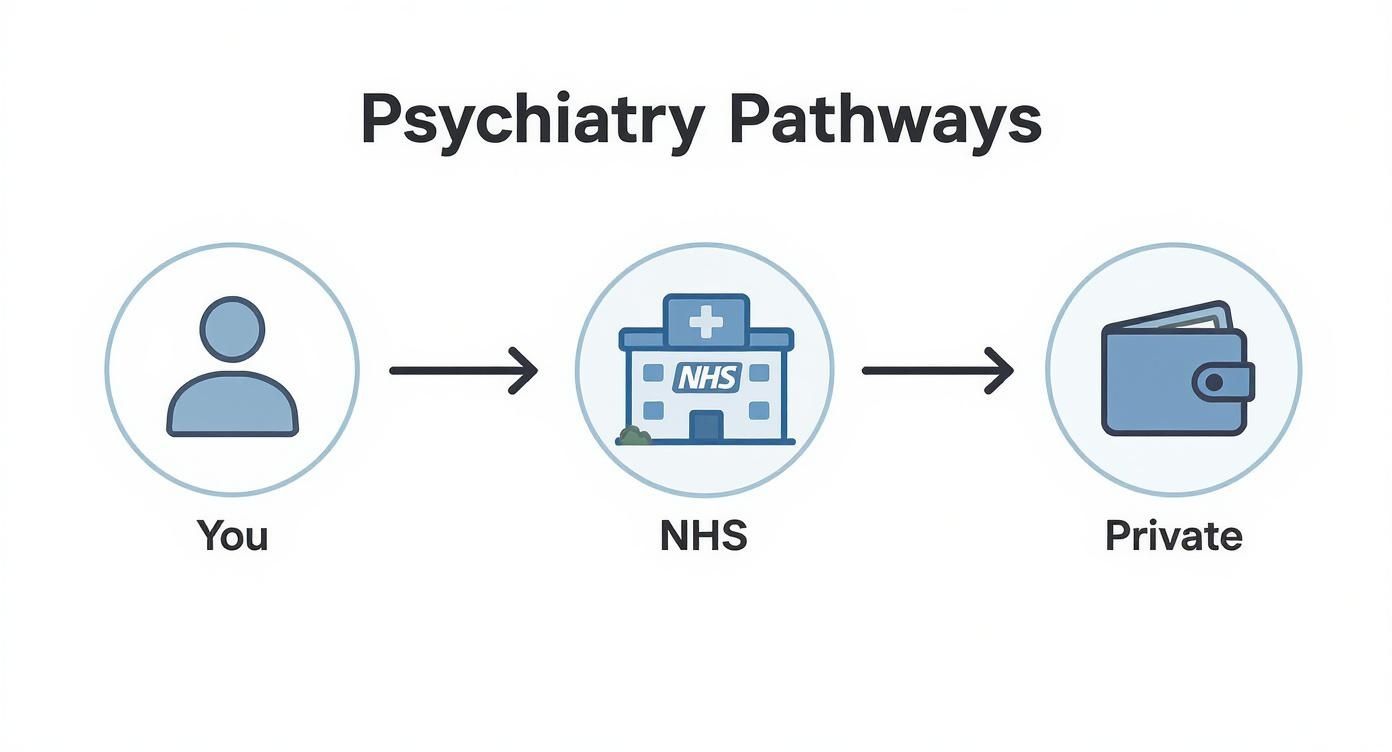
As you can see, you reach a crossroads where you have to decide between the standard, often very long, NHS route for your ADHD or Autism assessment and the faster, but more expensive, private alternative.
A Potential Alternative Route: Right to Choose
There is another option that can be a real game-changer, but only for those living in England: 'Right to Choose'. This piece of NHS legislation gives you the right to choose which provider you are referred to for your assessment, provided they hold an existing NHS contract.
What this means in practice is that you might be able to find a provider with a much shorter waiting list for an ADHD or Autism assessment, and it will still be fully funded by the NHS. It does take a bit of research on your part and a clear conversation with your GP, but it can be an excellent way to reduce your wait without having to pay privately. For many people, especially when it comes to the nuances of diagnosing autism in adults in the UK, exploring every available option like this is absolutely crucial for their mental health.
Why Is the Wait for Mental Health Support So Long?
If you feel like you’re stuck in an endless queue for mental health support, you’re not alone. It’s crucial to understand that the system itself is stretched to its absolute limit. This isn't a personal delay; it's a systemic issue affecting hundreds of thousands across the country, particularly those seeking help for conditions like ADHD and Autism.
Think of the UK's mental health service as a single-lane country road, originally built for light, occasional traffic. Over the past decade, and especially since the pandemic, that quiet road has become a major motorway at rush hour. The sheer volume of people needing help for conditions like ADHD and Autism has created a traffic jam of epic proportions.
This gridlock is the result of several critical factors all hitting at once.
The Key Causes of the Bottleneck
For years, chronic underfunding has meant mental health services have been playing catch-up compared to physical healthcare. This gap in investment translates directly into fewer resources, outdated infrastructure, and a crippling inability to expand services to meet today’s demand for specialist care for ADHD and Autism.
At the same time, we're facing a critical shortage of qualified professionals. A major driver behind these long delays is the widespread problem of staff shortages, often made worse by the challenges of burnout in the medical profession. Without enough psychiatrists, clinical psychologists, and specialist nurses, the 'road' simply can't handle the volume of 'traffic' for mental health assessments.
Finally, there's been a huge—and very welcome—increase in public awareness around mental health conditions like ADHD and Autism. While breaking down stigma is a massive step forward, it has also led to an unprecedented surge in referrals, piling even more pressure onto an already overburdened system. This perfect storm is why the psychiatry UK waiting time has become such a significant hurdle for mental health care.
The current waiting times aren't a reflection of your individual case, but a symptom of a system facing immense demand for ADHD and Autism services, limited resources, and critical workforce shortages. Understanding this is key to navigating your mental health journey.
The difference is stark when you compare wait times directly. Data from early 2025 showed that the average wait for mental health treatment had stretched to nearly two years—a staggering 658 days. That's more than double the 299 days recorded for elective physical health procedures.
And while the government has targets for an 18-week wait for many treatments, these standards often don't apply to mental health services like ADHD and Autism assessments, leaving many people feeling forgotten.
Exploring Faster Private and Online Options
When the long NHS psychiatry waiting time feels like an impossible hurdle for your mental health, turning to the private sector can offer a much faster, though more expensive, path forward. For many people trying to get an ADHD or Autism assessment, this route provides a welcome sense of control and progress when the public system is gridlocked.

The biggest difference with the private pathway is that you can refer yourself. You don’t need to go through your GP to get the ball rolling. You can contact a clinic or a specialist directly, book an appointment for an ADHD or Autism assessment, and often be seen within weeks instead of months or even years. Some providers, like Insight Diagnostics Global, can even schedule initial assessments within just seven working days.
This speed is what draws most people in, transforming a long, drawn-out period of uncertainty about their mental health into a clear, manageable process. The cost for an ADHD or Autism assessment can vary quite a bit, usually ranging from several hundred to over a thousand pounds, so it’s really important to get a clear picture of the full financial commitment from the start.
Traditional Clinics vs Online Services
As you look into private care for ADHD and Autism, you'll mainly find two types of setup: traditional, in-person clinics and newer, fully online services. Traditional clinics offer face-to-face consultations, which some people find better for building a personal connection. The downside is that they are tied to a specific location and might still have a waiting list, even if it's much shorter than the NHS.
Online-only services have really taken off, conducting assessments over video calls. This approach gives you far more flexibility and means you can access specialists for your mental health needs from anywhere in the UK, often with even quicker appointment times. This convenience makes it much easier to schedule things around your work or family life. You can find out more about how a comprehensive mental health assessment online works and what to expect.
Critical Questions to Ask Before Choosing a Provider
Deciding to go private isn't a small step, and it requires some careful thought to make sure you're getting high-quality, legitimate mental health care. Before you commit to any service for an ADHD or Autism assessment, asking the right questions is vital to protect both your health and your wallet.
Choosing a private provider isn't just about speed; it's about ensuring the quality, legitimacy, and long-term viability of your mental health care. Due diligence at this stage is non-negotiable for a successful outcome.
To make a confident decision, always check the following:
- GMC Registration: Is the psychiatrist on the General Medical Council's (GMC) Specialist Register? This is the absolute bare minimum and confirms they are a fully qualified specialist doctor.
- Provider Reputation: What are past clients saying in reviews and testimonials? Look for feedback on their communication, how thorough the ADHD or Autism assessment felt, and what kind of support they offer after a diagnosis.
- Shared Care Agreements: This one is crucial. Ask if your GP is likely to accept a 'Shared Care Agreement' for any medication. This is an arrangement where your GP takes over prescribing once your condition has been stabilised by the specialist. Without it, you could be stuck paying for expensive private prescriptions long-term. It's always a good idea to have this conversation with your GP before you book a private assessment.
How to Take Control While You Wait
Hearing you’ve been placed on a long waiting list can leave you feeling completely powerless. But the time between your referral and your assessment doesn’t have to be a passive, frustrating wait. If you’re facing a lengthy UK psychiatry waiting time for an ADHD or Autism assessment, you can actually use this period to get organised, gather information, and feel more in control of your mental health journey.

Think of it as laying the groundwork. By taking a few proactive steps, you can turn a period of uncertainty into one of genuine preparation. When your appointment for your ADHD or Autism assessment finally comes around, you’ll be in the best possible position to make the most of it.
Create Your Action Plan
Taking charge begins with a simple checklist. These small administrative tasks can give you a real sense of agency and help make sure nothing important falls through the cracks on your mental health journey.
- Confirm Your Referral: Give your GP surgery a ring a few weeks after your appointment. Just ask them to confirm that the referral was definitely sent and has been received by the specialist service. It’s a quick check that can save you from months of delay due to a simple admin slip-up.
- Follow Up Politely: It's completely reasonable to contact the provider's admin team every few months for a quick update. Keep it brief and friendly – you’re just checking in on where you are on the list for your ADHD or Autism assessment.
- Start a Symptom Journal: This is a big one. Start making notes of your daily experiences. Jot down specific examples of when you struggle with focus, organisation, social cues, or sensory issues. This journal will be an incredibly powerful tool when you finally speak to the psychiatrist.
Gather Your Evidence
Your psychiatrist needs to understand the whole picture of your life, not just a snapshot of how you feel today. The more information you can bring, the smoother and more accurate your assessment will be. This is especially vital for conditions like ADHD and Autism, which are rooted in early development and have a lifelong impact on mental health.
A thorough assessment for ADHD or Autism relies on a developmental history. Gathering evidence from your past helps the clinician connect your current struggles with lifelong patterns, which is essential for an accurate diagnosis.
Start digging out any documents that could be relevant. Old school reports are absolute gold; they often have comments from teachers about your focus, behaviour, or social skills that you might have forgotten. Performance reviews from jobs or even anecdotes from family members who’ve known you since you were little can also add crucial context.
Find Interim Support Systems
You don’t have to wait for a formal diagnosis to start getting mental health support. There are countless organisations out there offering fantastic resources that can help you manage your ADHD or Autism symptoms and feel less alone.
Charities like Mind, ADHD UK, and the National Autistic Society are packed with useful information, from coping strategies to community forums. Finding a local or online peer support group can also be incredibly validating. It helps to connect with people who just get it. If you're a student, get in touch with your university's disability or wellness service, as they can often provide support while you wait.
It's also a great time to learn about different coping strategies. For some practical ideas you can use right away, check out our guide on how to manage ADHD without medication.
Navigating Medico-Legal and HR Assessments
When a psychiatric assessment is needed for a legal case or a workplace issue, the usual patient pathways just don't cut it. The standard routes for getting an ADHD or Autism diagnosis are built for clinical treatment and improving a patient's mental health. Medico-legal and HR assessments, on the other hand, serve a completely different purpose. They demand speed, meticulous detail, and a specific structure designed to hold up under scrutiny.
These aren't your typical appointments. We're often talking about high-stakes situations like employment tribunals, complex occupational health cases, or other legal disputes where someone's mental health, particularly in relation to ADHD or Autism, is a central issue. A standard clinical report simply isn't fit for purpose here. What you need is a robust, evidence-based medico-legal report put together by a specialist.
The Distinct Process for Formal Reports
Unlike a journey that starts with a patient seeking help, a medico-legal assessment kicks off with a formal instruction from a solicitor, HR manager, or employer. This isn't a casual request; it lays out the specific questions the psychiatric expert needs to answer about the individual's mental health, making sure the final report is laser-focused on the matter at hand.
The document that comes out of this process is worlds away from a standard diagnostic letter for ADHD or Autism. It has to be impartial, incredibly thorough, and compliant with all the relevant legal standards, like the Civil Procedure Rules. This is what makes the findings clear, defensible, and genuinely useful for a court case or a major corporate decision.
In legal and HR contexts, a psychiatric report is not just a diagnosis—it's a critical piece of evidence. Its purpose is to provide objective, expert opinion on a person's mental health to inform tribunal decisions or workplace adjustments, making specialist preparation essential.
The costs and timelines are also in a different league. While private clinical assessments offer a faster alternative to the NHS, medico-legal services are priced according to the case's complexity and the sheer amount of work needed to produce a court-compliant report. For any organisation needing this level of expertise, working with a dedicated service is non-negotiable.
As people face long waits for mental health support for ADHD and Autism, the knock-on effect on their work life can be huge. That's why understanding strategies for Reducing Mental Health Absence in the Workplace is becoming so important for both employees and employers trying to manage these challenging situations.
Your Questions Answered
When you're trying to get help for ADHD or Autism, a lot of questions pop up about your mental health journey, especially when you're faced with long waits. Let's clear up some of the most common ones.
Can my GP just diagnose me to get things moving faster?
In short, no. While your GP is your crucial first stop on the NHS pathway, they aren't equipped to give a formal diagnosis for complex mental health conditions like ADHD or Autism.
Think of them as the gatekeeper. Their job is to listen to your concerns, assess the situation, and then refer you to the right specialist—usually a psychiatrist or a dedicated neurodevelopmental team. The actual diagnosis for ADHD or Autism has to come from them.
If I go private, will the NHS accept the diagnosis?
This is a real grey area, and honestly, it depends. While a diagnosis for ADHD or Autism from a GMC-registered psychiatrist is clinically 100% valid, the NHS isn't automatically obliged to accept it for ongoing treatment or medication.
Some GPs are open to what’s called a 'Shared Care Agreement', where they take over prescribing your medication after you've been stabilised by a private specialist. However, this is completely at their discretion. It's really important to have this conversation with your GP before you book a private assessment if you're hoping to move your mental health care back to the NHS later on.
A Crucial Point to Remember: Paying for a private assessment isn't about buying a diagnosis for ADHD or Autism. It's about paying for an expert's time to conduct a thorough, timely evaluation of your mental health. The outcome isn't guaranteed, but the quality and speed of the assessment is.
At Insight Diagnostics Global, we offer clear, comprehensive, and timely online assessments for adults seeking help with their mental health, including for ADHD and Autism. If the long waiting lists are a barrier for you, see how our CQC-regulated service could be the answer.
Learn more about our approach at https://insightdiagnostics.co.uk.