
For many adults, life feels like a constant effort to navigate a world where everyone else seems to have been given a rulebook they never received. This can manifest as a lifetime of social missteps, sensory overload, and an unshakeable feeling of being fundamentally 'different', often leading to chronic anxiety, depression, and burnout. These persistent challenges are frequently misattributed to other mental health conditions or personality quirks, leaving the underlying neurotype—undiagnosed autism—unaddressed. The significant overlap with ADHD further complicates the picture, as executive function struggles and emotional dysregulation are common to both, making an accurate self-understanding feel impossible.
This guide is designed to provide clarity by exploring eight key signs of undiagnosed autism in adults. We will delve into both the commonly discussed traits and the more subtle indicators that are often missed, particularly in individuals who have developed sophisticated masking or coping strategies. Our focus will be on how these signs present in adulthood, with a specific lens on the significant overlap with Attention-Deficit Hyperactivity Disorder (ADHD) and co-occurring mental health conditions.
Recognising these patterns is more than just applying a label; it is the critical first step towards profound self-understanding and validation. This article will provide a comprehensive roundup of these signs, complete with real-world examples and practical insights. By understanding this hidden landscape, you can begin to access the right support, seek a formal assessment if needed, and finally find a way to understand your experiences that truly fits.
1. Social Communication Difficulties and Literal Interpretation
One of the most defining, yet often misunderstood, signs of undiagnosed autism in adults involves persistent challenges with social communication. This isn't about shyness or being introverted; it's a fundamental difference in how communication is processed. Autistic adults often have a very logical, literal, and direct communication style, which can clash with the nuanced, indirect, and emotionally driven communication common in neurotypical social interactions. They may struggle to read between the lines, interpret body language, or grasp the unspoken rules that govern conversation, leading to significant social anxiety.
This can lead to frequent misunderstandings and mental exhaustion. A polite, non-committal phrase like, "we must get coffee sometime," might be interpreted as a concrete plan, leading to confusion when no invitation follows. Sarcasm, idioms, and figurative language can also be perplexing, as the autistic brain prioritises the literal meaning of words. Consequently, an autistic individual might unintentionally come across as blunt or rude, not from a place of malice, but from a place of honesty and directness. For instance, they might tell a colleague their presentation was "boring" as a factual observation, not realising the social implication that this is considered impolite. The resulting negative feedback can contribute to social withdrawal and feelings of isolation, impacting mental health.
Common Manifestations
- Literal Interpretation: Taking phrases like "break a leg" or "it's raining cats and dogs" at face value.
- Difficulty with Implied Meaning: Missing sarcasm, jokes, or the underlying emotional tone in a conversation. An individual may not detect a partner's distress from their tone of voice alone.
- Misunderstanding Social Hierarchy: Speaking to a manager with the same directness and informality as a close friend, which can be perceived as insubordination.
- Challenges with Nonverbal Cues: Difficulty interpreting facial expressions, body language, and gestures, leading to missed social signals and chronic social anxiety.
Practical Strategies and Insights
If you recognise these communication patterns in yourself, it can be helpful to develop conscious strategies to navigate social settings. You might consider treating social rules as a system to be learned, much like studying a new language or a technical skill. For a deeper understanding of how these traits present in adult autism, you can learn more about what Autism Spectrum Disorder is in adults.
Here are some actionable tips:
- Ask for Clarity: Don't be afraid to ask, "Do you mean that literally?" or "I'm not sure I understand the tone you're using, could you explain?"
- Use Explicit Communication: Whenever possible, rely on written communication like emails or texts where meaning is clearer and less ambiguous.
- Seek Social Skills Coaching: A therapist specialising in autism can provide structured coaching on navigating complex social scenarios in a way that feels authentic to you.
- Leverage Technology: Use apps designed to help recognise facial expressions and emotions to practise these skills in a low-pressure environment.
2. Intense, Focused Special Interests and Hyperfocus
Another core sign of undiagnosed autism in adults is the presence of intense, highly focused interests, often referred to as "special interests". These are far deeper and more consuming than a typical hobby; they are a passionate pursuit that provides immense structure, joy, and a sense of expertise. An autistic adult may dedicate countless hours to researching, collecting, or engaging with their subject, achieving an expert level of knowledge that can seem encyclopaedic to others.

This intense focus, known as hyperfocus, allows for an extraordinary ability to concentrate on the interest for extended periods, often to the exclusion of all else. While hyperfocus is a defining trait of autism, it is also a key feature of ADHD, though its manifestation can differ. In autism, it's often driven by a deep, systematic interest, while in ADHD it can be triggered by novelty and immediate engagement. This state can be a powerful asset but can also create challenges. Conversations may frequently pivot back to the special interest, and the deep absorption can lead to neglecting other life responsibilities, which in turn can cause stress and impact relationships. For many, these interests are a vital tool for emotional regulation, providing a safe and predictable escape from an overwhelming world.
Common Manifestations
- Profound Expertise: Possessing an incredibly detailed knowledge of a specific niche, such as the complete history of a video game series, the taxonomy of fungi, or the engineering of 19th-century locomotives.
- Time Blindness during Hyperfocus: Spending six or more hours absorbed in an activity related to the interest without noticing the passage of time, often neglecting to eat or sleep.
- Serial Interests: Rotating through different, equally intense interests over the years. An individual might be obsessed with dinosaurs for three years, then architecture, followed by a deep dive into plant biology.
- Central Role in Life: The special interest often forms a core part of the person's identity and is a primary source of regulation and stress relief.
Practical Strategies and Insights
Recognising that a special interest is a fundamental part of your neurology, not just a quirky hobby, is a crucial step. Rather than suppressing it, the goal is to integrate it into your life in a balanced and healthy way. When managed well, these passions can become incredible strengths, leading to fulfilling careers and meaningful connections.
Here are some actionable tips:
- Leverage Interests Professionally: Channel your deep knowledge and focus into a career. A passion for patterns could lead to a job in data analysis, or an interest in systems could translate to software engineering.
- Set Time Boundaries: Use timers or schedules to allocate specific blocks of time for your special interest. This helps ensure other important life tasks, like work or family commitments, are not neglected.
- Find Your Community: Seek out online forums, clubs, or local groups where you can connect with others who share your passion. This provides a social outlet where your expertise is valued and understood.
- Use Interests as Motivation: Frame your interest as a reward. For example, allow yourself an hour to research your topic after you have completed a less desirable task like household chores or administrative work.
3. Sensory Sensitivities and Overwhelm
One of the most profound yet commonly overlooked signs of undiagnosed autism in adults is a different sensory processing experience. This isn't just about personal preference or being "picky"; it's a neurological distinction where the brain processes sensory information – such as sounds, lights, textures, and smells – with greater intensity. For an autistic adult, the hum of fluorescent lights can be a painful distraction, the texture of a specific fabric can feel abrasive, and the combined noises of a busy café can quickly become an overwhelming cacophony, leading to sensory overload.
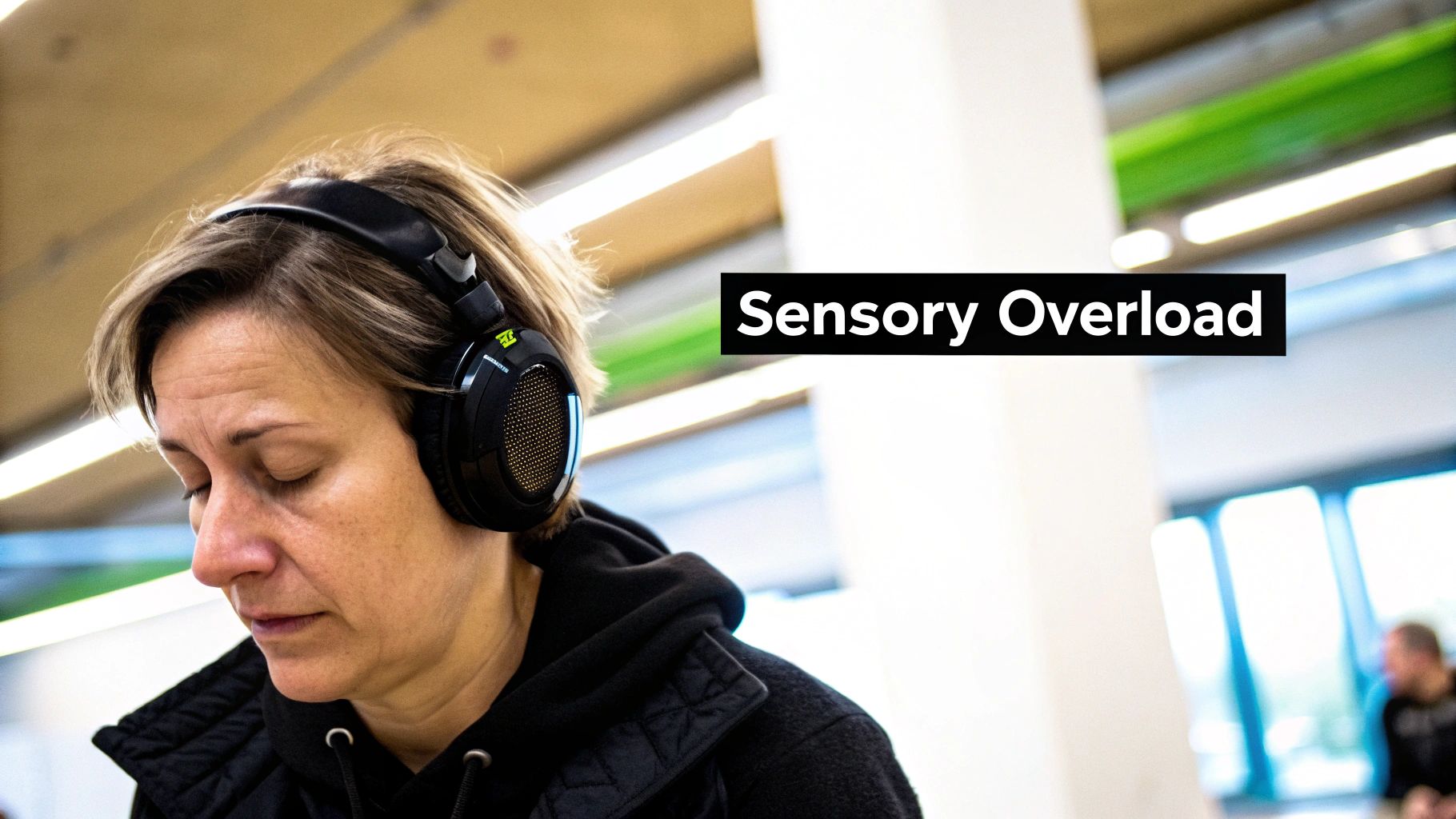
This heightened sensitivity significantly shapes an individual's life, dictating choices in food, clothing, and social environments, and is a major contributor to anxiety. An autistic person might develop complex routines or "rules" to minimise exposure to distressing stimuli, which can be misconstrued by others as rigid or controlling behaviour. For example, a professional might insist on working by a window not out of preference, but because the natural light prevents the physical pain and headaches caused by overhead office lighting. While sensory issues are a hallmark of autism, they are also present in ADHD, often manifesting as a low tolerance for frustration or a need for constant stimulation (sensory-seeking) rather than avoidance. The constant effort to manage a hostile sensory world is mentally draining and a primary driver of burnout.
Common Manifestations
- Auditory Sensitivity: Becoming easily overwhelmed or distressed by loud, sudden, or layered sounds like those in shopping centres, pubs, or open-plan offices.
- Visual Sensitivity: Experiencing discomfort or pain from bright lights, fluorescent lighting, flickering screens, or visually "busy" patterns and environments.
- Tactile Sensitivity: A strong aversion to certain textures, such as scratchy clothing labels, specific food textures (e.g., mushy or slimy), or light, unexpected touch.
- Smell and Taste Sensitivity: Being highly sensitive to smells or flavours that others may not notice, leading to a restricted diet or avoidance of certain places like perfume counters.
Practical Strategies and Insights
Recognising that these sensitivities are a core part of your neurology is the first step toward managing them effectively. Rather than trying to "tough it out," which often leads to burnout and meltdowns, the goal is to create an environment that accommodates your sensory needs. For many, understanding this aspect of themselves is a key part of exploring the signs of undiagnosed autism in adults and can be a powerful motivator for seeking a formal diagnosis for clarity and support.
Here are some actionable tips:
- Identify and Mitigate Triggers: Keep a log of what environments or stimuli cause you distress. Once you know your triggers, you can proactively manage them.
- Use Sensory Tools: Invest in high-fidelity earplugs or noise-cancelling headphones. Wear sunglasses indoors if needed, or use screen filters to reduce blue light.
- Create a "Sensory Haven": Designate a space in your home with muted colours, soft textures, and controlled lighting where you can decompress after a sensorily demanding day.
- Adapt Your Wardrobe: Cut all tags out of clothing. Choose soft, natural fabrics and prioritise comfort over fashion trends.
- Plan for Recovery Time: After attending a loud concert or a busy social event, schedule a quiet day with minimal sensory input to allow your nervous system to recover.
4. Difficulty with Executive Function and Organisation
A significant yet often internalised sign of undiagnosed autism in adults involves profound difficulties with executive function. This isn't a matter of being lazy or unmotivated; it is a neurological challenge related to the brain's "management system." These skills, which include planning, organising, initiating tasks, and managing time, are crucial for navigating daily adult life. This is a key area of overlap with ADHD, and many autistic individuals have co-occurring ADHD (AuDHD). Autistic adults may find themselves feeling perpetually overwhelmed, unable to start tasks even when they know the consequences, a state often referred to as 'autistic inertia'.

This can manifest in a seemingly contradictory way. A highly intelligent individual with a university degree might be unable to hold down a job due to chronic lateness or missed deadlines. Another person may avoid an important two-hour task for weeks but can effortlessly dedicate eight uninterrupted hours to a special interest. The autistic brain struggles with "task inertia," making it difficult to switch from one activity to another or to break down large, undefined projects into manageable steps. This creates a cycle of procrastination, anxiety, and self-criticism that can severely impact mental health and self-esteem, often leading to a misdiagnosis of depression or an anxiety disorder.
Common Manifestations
- Task Paralysis: Feeling completely unable to start a task, even a simple one, due to feeling overwhelmed by the steps involved.
- Time Blindness: Consistently underestimating how long tasks will take, leading to being late or missing appointments.
- Difficulty with Prioritisation: Struggling to identify which tasks are most important and should be completed first.
- Inconsistent Organisation: Having periods of intense organisation followed by a complete collapse of systems, leading to a messy home or workspace.
Practical Strategies and Insights
Recognising that these challenges stem from neurological differences, not character flaws, is the first step. Because executive dysfunction is also a core feature of ADHD, there is significant overlap, and many autistic individuals also have co-occurring ADHD. To learn more about this overlap, it's useful to understand the common ADHD symptoms in adults.
Here are some actionable tips:
- Externalise Everything: Use alarms, timers, written schedules, and visual reminders like sticky notes to create an external structure your brain can rely on.
- Break It Down: Deconstruct large tasks into the smallest possible concrete steps. For example, "clean the kitchen" becomes "1. Put dishes in the dishwasher. 2. Wipe the counter," and so on.
- Try Time-Blocking: Allocate specific blocks of time in your calendar for specific tasks to reduce decision fatigue about what to do next.
- Use a "Done" List: Instead of a to-do list that can feel overwhelming, keep a "done" list to track your accomplishments, which can boost motivation.
5. Anxiety, Depression, and Emotional Regulation Challenges
For many undiagnosed autistic adults, life is accompanied by a persistent undercurrent of anxiety or depression. These mental health challenges are often treated as standalone conditions for years, with limited success, because the underlying neurodevelopmental cause is missed. The constant effort of navigating a neurotypical world, combined with sensory sensitivities and social confusion, creates a significant emotional burden that can manifest as chronic anxiety, treatment-resistant depression, and profound difficulties with emotional regulation. This is one of the most common, yet frequently misinterpreted, signs of undiagnosed autism in adults.
The experience of emotions can be different for autistic individuals. Some experience emotions with overwhelming intensity, leading to meltdowns or shutdowns when they feel too much—a trait shared with ADHD, often termed 'rejection sensitive dysphoria' (RSD) in that context. Others may struggle to identify their feelings at all, a condition known as alexithymia. The continuous mental energy required to 'mask' or suppress autistic traits to fit in is emotionally exhausting and a direct pathway to burnout. This isn't just feeling tired; it's a state of profound exhaustion that can lead to losing skills and being unable to function, often mimicking a severe depressive episode.
Common Manifestations
- Treatment-Resistant Mental Health Conditions: A long history of anxiety or depression that doesn't respond well to standard therapies or medications. A 45-year-old woman, diagnosed with an anxiety disorder for 20 years, finally finds relief after her autism diagnosis reframes her experiences.
- Intense Emotional Responses: Experiencing emotions that feel disproportionately large for the situation, leading to rapid shifts from calm to overwhelmed or distressed.
- Chronic Burnout: Reaching a point of complete mental, emotional, and physical exhaustion from the demands of masking, often forcing a withdrawal from work or social life despite a desire to participate.
- Difficulty Identifying Emotions (Alexithymia): Being aware of physical sensations (like a racing heart or tense stomach) but unable to connect them to a specific emotion like fear or excitement.
Practical Strategies and Insights
Recognising that these mental health struggles may stem from being autistic is the first step toward effective management. The focus shifts from simply treating the anxiety to accommodating the underlying neurotype. Instead of forcing neurotypical coping mechanisms, strategies can be tailored to an autistic person's needs for predictability, sensory regulation, and recovery time. Understanding this link is a key part of the journey towards a formal diagnosis.
Here are some actionable tips:
- Seek Neurodivergent-Affirming Therapy: Look for therapists who specialise in autism and ADHD. The goal isn't to "cure" anxiety but to build coping strategies that honour your autistic identity.
- Learn to Unmask: Intentionally reduce the demands of masking in safe environments (at home or with trusted friends) to conserve mental energy and reduce depressive symptoms.
- Schedule Recovery Time: Proactively build rest periods into your schedule, especially after socially or sensorily demanding events, to prevent burnout.
- Use Emotion Wheels: Use tools like an emotion wheel or journaling apps to practise connecting physical sensations to emotional labels, improving self-awareness and regulation.
6. Motor Skills Inconsistencies and Coordination Challenges
One of the less discussed but significant signs of undiagnosed autism in adults is a distinct pattern of inconsistent motor skills and coordination challenges. This isn't simple clumsiness; it's a neurological difference in how the brain plans and executes movements. An autistic adult might exhibit a surprising mix of grace and awkwardness, excelling in a specific physical activity while struggling with seemingly basic everyday tasks. This phenomenon, often linked to co-occurring dyspraxia (a motor planning disorder), creates a profile of uneven motor abilities that is frequently misunderstood.
These challenges stem from differences in proprioception (the sense of where your body is in space) and motor planning. An adult might be a highly skilled pianist, demonstrating incredible fine motor control, yet find tying shoelaces or buttoning a shirt frustratingly difficult. Similarly, someone might have an awkward or stiff gait but be remarkably agile when rock climbing or dancing. This inconsistency can be a source of personal frustration and anxiety, as the individual's physical capabilities don't always align with their intentions, leading to them being unfairly labelled as "uncoordinated" or "lazy" throughout their life.
Common Manifestations
- Uneven Skill Profile: Being highly proficient in a specific, practised motor skill (like typing or playing an instrument) but clumsy in general daily movements like navigating a crowded room.
- Poor Handwriting: Dysgraphia, or significant difficulty with handwriting, is very common. The handwriting may be messy, slow, and physically painful to produce, despite proficiency with a keyboard.
- Fine Motor Difficulties: Struggling with tasks requiring dexterity, such as using cutlery, shaving, applying makeup, or doing DIY projects.
- Gross Motor Challenges: Issues with balance, having an unusual gait, or difficulty coordinating limbs for activities like catching a ball or learning to drive.
Practical Strategies and Insights
Recognising that these physical challenges are part of a neurological profile, rather than a personal failing, is the first step. With this understanding, you can develop compassionate and effective strategies to work with your body's natural abilities, not against them. Many adults find that seeking an occupational therapy assessment can provide tailored support for improving motor skills and adapting daily tasks.
Here are some actionable tips:
- Leverage Your Strengths: If you have poor handwriting but type quickly, embrace technology. Use keyboards, voice-to-text software, and digital notes to bypass the challenge.
- Break Down Movements: For complex tasks, consciously break the sequence into smaller, manageable steps. Mentally rehearse the sequence before performing it.
- Ergonomic Adjustments: Adapt your environment to support your motor needs. This could mean using ergonomic cutlery, a specialised computer mouse, or wearing slip-on shoes.
- Choose Suitable Activities: Engage in physical activities that align with your motor strengths. If team sports feel chaotic, you might thrive in individual pursuits like swimming, yoga, or weightlifting where movements are more predictable and self-paced.
7. Need for Routine, Inflexibility, and Difficulty with Change
A profound need for predictability and routine is a core, yet often internalised, sign of undiagnosed autism in adults. This goes far beyond a simple preference for organisation or a dislike of surprises. For an autistic individual, routines provide a crucial sense of safety and predictability in a world that can feel overwhelming and chaotic. Deviations from these established patterns, even minor ones, can trigger intense anxiety, stress, and dysregulation. This isn't a matter of stubbornness or being difficult; it's a neurological coping mechanism to manage sensory input and reduce the cognitive load that fuels anxiety and mental exhaustion.
When an unexpected event, like a last-minute change of plans or a traffic diversion, disrupts a planned sequence, the autistic brain has to work significantly harder to process the new information and re-calculate the entire day. This can be exhausting and distressing, sometimes leading to a shutdown or meltdown. While ADHD is often associated with a craving for novelty, many with ADHD also rely on routines to manage executive function deficits. However, the emotional distress caused by a broken routine is typically more pronounced in autism. The comfort found in sameness frees up mental energy that would otherwise be spent navigating unpredictability, allowing the individual to function more effectively in other areas of life.
Common Manifestations
- Rigid Daily Schedules: Following the same morning or evening routine in a precise order and feeling distressed if it's interrupted. For example, if a morning routine is altered by just 15 minutes, it may feel as though the entire day is ruined.
- Environmental Sameness: Needing objects to be in a specific place and becoming upset when they are moved. This can also manifest as intense anxiety when visiting new or unfamiliar places.
- Difficulty with Transitions: Struggling to shift focus from one task to another without a clear, pre-planned transition period.
- Distress Over Unexpected Changes: Experiencing significant anxiety when plans are altered, even if the new plan is objectively positive. A road closure on a familiar commute, for instance, can be a source of major distress.
Practical Strategies and Insights
Recognising this need for structure as a valid neurological difference is the first step towards managing it effectively. Instead of fighting against it, you can learn to work with it by building systems that support your need for predictability while also gently building tolerance for change. Understanding this aspect of your neurology can be a key part of the adult autism assessment process, as it provides clear evidence of the challenges faced in daily life.
Here are some actionable tips:
- Plan for Change: When possible, prepare for upcoming changes in advance. Discussing a new plan, looking at pictures of a new location, or writing down the new schedule can significantly reduce anxiety.
- Use Visual Aids: Employ calendars, planners, or apps to visually map out your day or week. This makes the routine tangible and easier to follow.
- Create Transition Rituals: Establish small, consistent rituals to signal a shift from one activity to another, such as making a cup of tea before starting a new work task.
- Build Flexibility Incrementally: Introduce very small, low-stakes changes into your routine to gradually build your capacity to handle unpredictability. Start with something minor, like trying a different brand of coffee.
8. Pattern Recognition, Systemizing, and Detail-Focused Thinking
A significant, yet often overlooked, indicator of undiagnosed autism in adults is a distinct cognitive style geared towards logic, patterns, and systems. This isn't just about being good at puzzles; it's a fundamental way of processing the world. Autistic adults often possess a remarkable ability to identify patterns, notice minute details, and understand the mechanics of a system, whether it's a piece of software, a musical composition, or a social structure. This way of thinking, often called ‘systemizing’, prioritises logic and rules over intuition.
This detail-focused approach is a powerful strength, allowing for deep concentration and expertise in specific areas. It's why many autistic individuals excel in fields like engineering, data analysis, research, and programming, where precision and spotting inconsistencies are paramount. For example, a researcher might identify a subtle but crucial pattern in a dataset that others have missed, leading to a new discovery. However, this intense focus on the components can sometimes make it challenging to see the ‘bigger picture’ or grasp the overall context. This can create social and professional difficulties, contributing to feelings of being misunderstood and increasing anxiety when executive demands require broader, more strategic thinking.
Common Manifestations
- Exceptional Detail Recall: Remembering specific, often obscure, facts, dates, or details about a topic of interest that others would easily forget.
- System-Based Thinking: Naturally organising information into categories, hierarchies, or logical frameworks. An individual might create complex spreadsheets to manage their hobbies or daily routines.
- Strong Pattern Recognition: Quickly spotting patterns, sequences, or irregularities in visual information, numbers, or sound. This can manifest as an affinity for mathematics, music, or coding.
- Difficulty with Ambiguity: A preference for clear, rule-based systems and discomfort with situations that are open-ended, subjective, or lack defined parameters.
Practical Strategies and Insights
If this cognitive style resonates with you, learning to harness it can be transformative for both your career and personal life. The key is to find environments where your strengths are valued while also developing strategies to manage potential challenges. Understanding this trait is a core part of exploring the signs of undiagnosed autism in adults.
Here are some actionable tips:
- Align Career with Strengths: Pursue roles in quality assurance, data science, editing, or technical fields that reward a meticulous, detail-oriented approach.
- Create Personal Systems: Apply your systemizing skills to your personal life. Use apps, planners, or create routines to manage daily tasks, reducing cognitive load and anxiety.
- Practise ‘Zooming Out’: Consciously set aside time to consider the overall goal or context of a project. Ask colleagues for their perspective on the bigger picture to balance your detail-focus.
- Communicate Your Process: Explain your thought process to others. Saying "I'm focusing on the specific details here to ensure accuracy" can help neurotypical colleagues understand your approach.
8-Point Comparison: Signs of Undiagnosed Autism in Adults
| Trait / Sign | Implementation Complexity 🔄 | Resource Requirements ⚡ | Expected Outcomes ⭐ | Ideal Use Cases 📊 | Key Advantages & Tips 💡 |
|---|---|---|---|---|---|
| Social Communication Difficulties and Literal Interpretation | High — sustained training and practice to reinterpret implicit cues. | Moderate — speech/social skills therapy, coaching, written supports. | Improved pragmatic language and fewer misunderstandings; variable generalization. | Interpersonal situations, workplace interactions, relationship coaching. | Honest/direct communication can be a strength; tip: use explicit phrasing and ask clarifying questions. |
| Intense, Focused Special Interests and Hyperfocus | Low–Moderate — redirecting focus and setting boundaries is manageable. | Low–Moderate — time-management tools, mentoring, community groups. | High potential for expertise and productivity when aligned with goals. | Career specialization, research, creative projects, therapeutic engagement. | Produces deep expertise; tip: set time limits and leverage interests as rewards. |
| Sensory Sensitivities and Overwhelm | Moderate — requires environmental changes and coping strategies. | Moderate — noise-cancelling devices, lighting adjustments, sensory tools. | Significant reduction in distress and improved functioning with accommodations. | Workplace design, public spaces, scheduling to avoid overload. | Enhanced perceptual detail; tip: identify triggers and create sensory-friendly spaces. |
| Difficulty with Executive Function and Organization | Moderate–High — needs consistent external scaffolding and habit-building. | Moderate — apps, timers, coaches, structured routines, body-doubling. | Better task initiation/completion and reduced stress with scaffolds. | Task management, academic/work supports, daily planning. | Can hyperfocus when engaged; tip: break tasks into very small concrete steps. |
| Anxiety, Depression, and Emotional Regulation Challenges | High — often requires autism-informed, long-term mental health care. | High — specialized therapists, medication review, workplace accommodations. | Improved emotional stability and reduced burnout when autism is recognized in treatment. | Mental health treatment planning, crisis prevention, work adjustments. | Strong motivation for self-improvement; tip: reduce masking and use neurodivergent-affirming therapy. |
| Motor Skills Inconsistencies and Coordination Challenges | Moderate — targeted OT and practice can yield measurable gains. | Moderate — occupational therapy, assistive tools, practice time. | Improved coordination, independence, and task safety with intervention. | Daily living supports, ergonomics at work, skill training. | Can excel in specific activities; tip: use technology (typing) and break motor sequences into steps. |
| Need for Routine, Inflexibility, and Difficulty with Change | Low–Moderate — establishing routines is straightforward but must be consistent. | Low — visual schedules, advance notice, predictable structures. | Reduced anxiety and smoother transitions when routine is respected. | Scheduling, workplace accommodations, family/home routines. | Highly reliable and consistent; tip: provide advance notice and introduce change gradually. |
| Pattern Recognition, Systemizing, and Detail-Focused Thinking | Low — leveraging strength requires appropriate role alignment. | Low — role fit, tools for integrating details into broader context. | High-quality, accurate outcomes in detail-oriented tasks and systems work. | STEM, QA, analytics, research, systems design. | Exceptional accuracy and system understanding; tip: pair with collaborators for big-picture framing. |
From Recognition to Action: Your Next Steps Towards Clarity
Navigating this list of potential signs of undiagnosed autism in adults may have been an illuminating, perhaps even emotional, journey. You might have seen echoes of your own life in the descriptions of social communication nuances, the deep dive into special interests, or the daily challenges of sensory overload and executive function. Recognising these patterns is not about applying a label for its own sake; it's about finding a coherent narrative for a lifetime of experiences that may have previously felt confusing or isolating, especially if you also suspect co-occurring ADHD or have struggled with your mental health.
Many adults who identify with these signs have spent years, or even decades, feeling like they were somehow 'wrong' or 'broken'. They may have received diagnoses for related conditions like anxiety, depression, or even ADHD, yet felt that these didn't capture the full picture of their internal world. Understanding that these experiences could be linked to autism offers a profound shift in perspective. It reframes challenges not as personal failings, but as a mismatch between your inherent way of processing the world and the expectations of a predominantly neurotypical society.
Key Takeaways: A New Framework for Self-Understanding
Reflecting on the signs discussed throughout this article, several core themes emerge that are crucial for adults considering this path of self-discovery:
- It's a Spectrum, Not a Stereotype: Autism presents in vastly different ways. The quiet, detail-focused analyst in an IT department and the passionate, socially-driven artist can both be autistic. Forget the outdated, one-dimensional portrayals; your unique combination of traits is valid.
- Masking is Exhausting: Many undiagnosed autistic adults develop sophisticated 'masks' to fit in. This constant performance is a significant contributor to burnout, anxiety, and mental health strain. Realising this can be the first step towards giving yourself permission to be more authentic.
- Co-occurring Conditions are Common: The interplay between autism and conditions like ADHD, anxiety, and depression is significant. Sensory overwhelm can trigger anxiety, and the executive function difficulties common in both autism and ADHD can lead to feelings of inadequacy and depression. A thorough assessment must consider this complex interplay.
Your Actionable Path Forward: From Suspicion to Certainty
If you see yourself in these descriptions, the question becomes: "What do I do now?" The journey from recognition to formal action is a personal one, but a structured approach can make it feel less daunting.
1. Document Your Experiences: Before seeking a professional opinion, take time to gather your thoughts. Use the points in this article as a guide. Write down specific, real-world examples from your childhood, adolescence, and adult life that align with the signs of undiagnosed autism in adults. Note any experiences related to anxiety, depression, and potential ADHD traits as well.
2. Seek a Specialist Assessment: Self-identification is a valid and important part of the process, but a formal diagnosis is often necessary to access support, workplace adjustments, and tailored therapeutic strategies. It is vital to seek an assessment from a multidisciplinary team of clinicians, including consultant psychiatrists, who specialise in adult neurodevelopmental conditions. They will have the expertise to differentiate between autism, ADHD, and other mental health conditions, ensuring an accurate and comprehensive evaluation.
3. Prepare for the Evaluation: An adult autism assessment is not a test you can pass or fail. It is a collaborative diagnostic process. It typically involves detailed interviews about your developmental history, current challenges, and strengths. You may be asked to complete questionnaires and engage in specific structured activities. Being open and honest about your struggles with mental health and executive function is key to getting a clear picture.
A formal diagnosis can be a transformative tool. It provides a non-judgemental language to understand and communicate your needs. It opens doors to specialised therapies, coaching, and support groups, connecting you with a community that shares similar experiences. This validation can be the catalyst for rebuilding self-esteem and creating a life that honours, rather than fights, your neurotype.
Ready to take the next step towards clarity and validation? Insight Diagnostics Global offers CQC-regulated, consultant-led online assessments for adults, specialising in diagnosing autism and co-occurring conditions like ADHD. Our GMC-registered psychiatric specialists provide timely, robust, and court-compliant evaluations to help you understand your unique neurotype and access the support you deserve. Visit Insight Diagnostics Global to learn more about our assessment process and begin your journey.