
A proper test for ADHD isn’t just some quick online quiz. It's a comprehensive clinical process, guided by a specialist like a consultant psychiatrist, to see if your struggles line up with the official criteria for a diagnosis and to check for any other mental health conditions, like autism or anxiety, that might be in the mix.
Starting Your ADHD Diagnosis Journey

The moment you start wondering if you have Attention Deficit Hyperactivity Disorder (ADHD) usually comes after a long time of feeling like something is just… off. Maybe you've always struggled to get organised, found it impossible to stay focused at work, or felt like your emotions were all over the place. That little voice in your head asking "Could this be ADHD?" is the very first step toward getting some real answers for your mental health.
Figuring out what's really going on can feel a bit overwhelming, especially since ADHD symptoms can look a lot like other conditions. For many neurodivergent people, the lines between ADHD and autism can blur, creating a confusing picture. On top of that, things like anxiety or depression can either hide ADHD symptoms or be mistaken for them.
It's crucial to remember that these conditions often exist together. A good assessment won't just hunt for ADHD in isolation; it will look at your entire mental health profile, including potential co-occurring autism, to deliver a diagnosis that's both accurate and genuinely helpful.
This isn't just about getting a label. It's about validating what you've been going through and finally understanding the 'why' behind your challenges, so you can stop struggling in the dark.
Understanding Your Options in the UK
If you’re in the UK, you have two main routes to get a formal diagnosis. They both have different timelines and processes, so it's worth knowing what you're getting into.
- Going through the NHS: The usual starting point is a chat with your GP, who can then refer you to a specialist mental health service. This route is obviously covered by the health service, but the trade-off is often an incredibly long wait, sometimes stretching over several years.
- Seeking a private assessment: Choosing this path means you can get seen much, much faster. Specialist clinics can often book you in with a consultant psychiatrist in a matter of weeks, giving you a thorough evaluation without the long delay.
For many adults, the wait for an NHS appointment is just too long, making a private evaluation a more practical option. You can find out more about what’s involved in a private adult ADHD assessment to decide if it feels like the right fit for you.
What to Expect Emotionally
Making the decision to get an assessment is a pretty big deal, and it's completely normal to feel a whole mix of emotions. You might feel hopeful, but also anxious or even a bit sceptical. It's common to worry about what a diagnosis might mean for your life or just feel incredibly impatient after so many years of confusion.
Try to remember that this is a hugely positive step for your mental health. You're being proactive and taking control, moving towards understanding yourself better and finding support that actually works. It's all about learning how to build a life that plays to your brain's strengths, instead of constantly fighting against its wiring. This guide is here to walk you through what comes next, hopefully making the whole journey feel a lot less daunting.
ADHD Screening Tools vs Formal Diagnosis
If you’re starting to wonder whether you might have ADHD, your first stop has probably been an online quiz. It's a common and understandable starting point. But while these quick self-assessments can be helpful, it’s crucial to know what they are—and what they aren’t. There’s a world of difference between a 10-minute online screener and a formal, clinical diagnosis.
Think of an online screening tool as a preliminary check. It asks about common ADHD traits—like trouble focusing, feeling restless, or acting on impulse—and gives you a score. Its real job is to help you notice patterns in your own life that might suggest it’s worth talking to a professional. They're a signpost, not the destination itself.
A high score on one of these quizzes doesn't automatically mean you have ADHD. Just as importantly, a low score doesn't rule it out. These tools just can't see the full picture. They don't know your personal history, they can't tell if another condition is causing your symptoms, and they don't understand the real-world impact on your life. Symptoms of anxiety, depression, trauma, and even autism can look a lot like ADHD on the surface.
What a Formal Diagnosis Really Involves
A formal diagnosis is a whole different ball game. This is a comprehensive medical evaluation carried out by a highly trained specialist, like a consultant psychiatrist. It’s not about ticking boxes; it’s a deep dive into your entire life story to build a truly accurate understanding of your mental health.
This clinical assessment is the only path to a medically recognised diagnosis. It goes far beyond a simple questionnaire.
Here’s a quick breakdown of how different these two approaches are.
ADHD Screening Tools vs Formal Diagnostic Assessment
| Feature | Online Screening Tools | Formal Diagnostic Assessment |
|---|---|---|
| Purpose | To provide a preliminary indication of ADHD traits for self-reflection. | To provide a conclusive, medically recognised diagnosis. |
| Conducted By | Usually self-administered online. | A qualified clinician (e.g., consultant psychiatrist). |
| Accuracy | Indicative only; cannot diagnose or rule out ADHD. Prone to false positives/negatives. | High accuracy, based on established clinical criteria (DSM-5/ICD-11). |
| Scope | Limited to a set of common symptom-based questions. | In-depth review of developmental, medical, educational, and personal history. |
| Differential Diagnosis | Cannot distinguish ADHD from other conditions with similar symptoms (e.g., anxiety, autism). | A core component is to rule out or identify co-occurring conditions like autism and other mental health concerns. |
| Outcome | A score or suggestion to speak with a professional. | A formal diagnosis, a detailed report, and recommendations for treatment/support. |
As you can see, one is a starting point, while the other is a complete, professional evaluation.
From Self-Assessment to Clinical Certainty
Using an online tool can be a great first move. It often gives people the confidence and the vocabulary they need to seek professional help. Before booking a formal assessment, some people find it useful to complete an initial self-assessment quiz to get their thoughts in order and prepare for a conversation with a clinician.
Once you have that starting point, the only way to get a reliable answer is through a proper clinical evaluation. The online quiz might point you in the right direction, but only a specialist can give you the clarity and validation of a formal diagnosis.
A formal assessment provides certainty. It distinguishes between ADHD and other conditions like autism that might present with similar symptoms, ensuring that any support or mental health treatment plan you receive is genuinely right for you.
If you’re ready to move past the guesswork and get a clear, professional opinion, exploring a dedicated online ADHD test led by a consultant is the logical next step.
Ultimately, screening tools are for self-reflection. A formal diagnosis is for getting the right help, treatment, and understanding you deserve.
What Actually Happens During an ADHD Assessment?
The idea of a formal assessment for ADHD can be pretty daunting, especially if you’ve spent years wondering what’s going on. Knowing what to expect can take a lot of that worry away. It’s not a single, high-pressure test; think of it more as a structured, collaborative process designed to build a complete picture of you.
The journey from filling out the first form to getting a final report follows a clear, step-by-step path. This visual guide breaks down the typical flow.
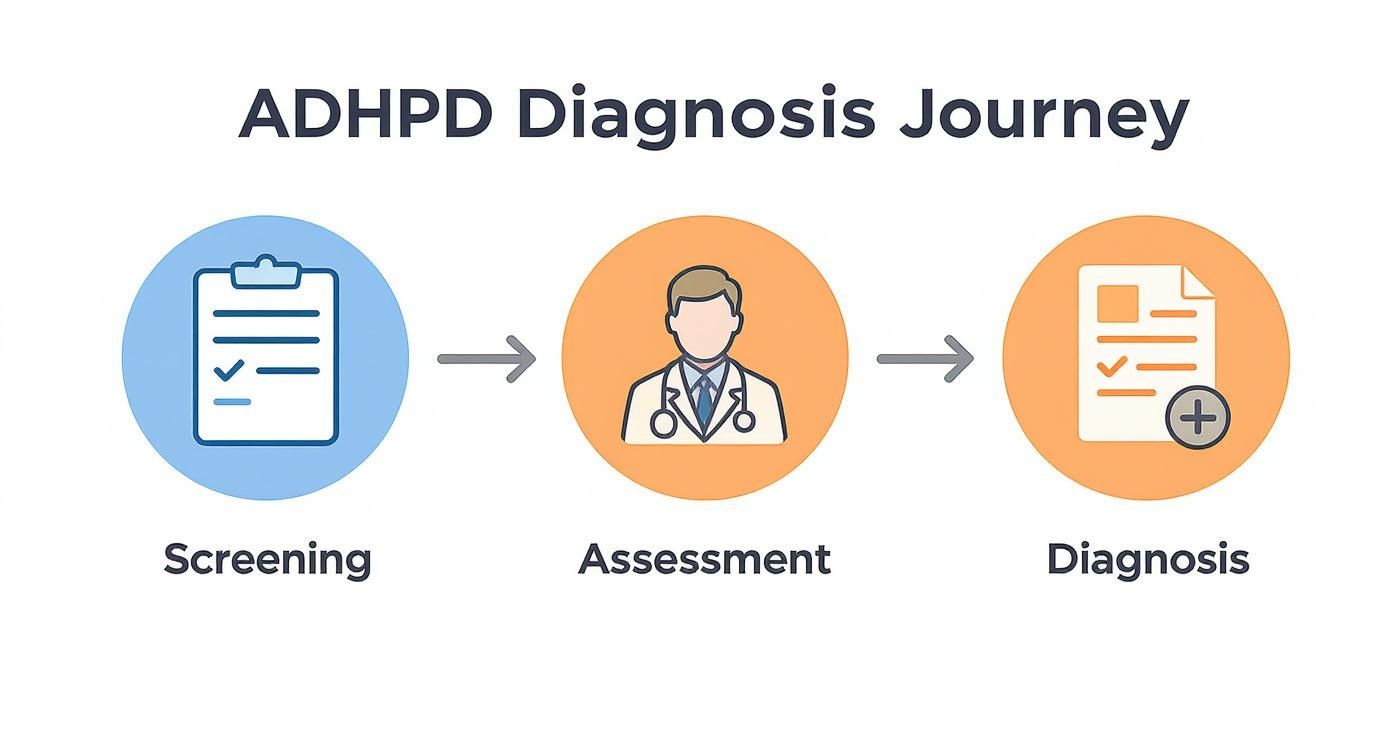
As you can see, the process moves logically. It starts with your own reflections, moves into a detailed clinical evaluation, and ends with a clear, professional conclusion.
The Pre-Assessment Stage
Before you even speak to a clinician, you’ll do some important groundwork. We send out detailed questionnaires for you to complete in your own time. These aren't just tick-box exercises; they’re designed to gather a rich, historical context about your life.
You’ll be asked about your childhood, your school days, your career path, and your relationships. These questions help the clinician trace how potential ADHD traits might have shown up at different points in your life. After all, it’s this long-term pattern of challenges, not just a recent feeling of being distracted, that points towards a diagnosis.
This stage also takes a look at your wider mental health. We'll ask about your mood, anxiety levels, and how you find social communication. This helps the clinician screen for other conditions that can either co-exist with or look a lot like ADHD, such as autism, depression, or an anxiety disorder. Being thorough here gives the specialist a huge head start before your live interview.
The Clinical Interview
The main event of your assessment is the clinical interview itself. This is a structured, in-depth conversation with a consultant psychiatrist, usually lasting between two to three hours. Try to think of it less like an interrogation and more like a guided discussion about your life story.
The clinician will use your questionnaire answers as a launchpad, diving deeper to understand the real-world impact of your challenges. They’ll want to hear specific examples of how symptoms affect your daily life, both now and in the past.
One of the most important goals here is differential diagnosis. The specialist is trained to tease apart ADHD from other conditions with similar symptoms. This is crucial for making sure your diagnosis is accurate and that any treatment plan addresses the whole picture of your mental health, not just one piece of it.
For example, they might ask about your social interactions and sensory sensitivities. This helps them explore the possibility of co-occurring autism, which is a common reality for many neurodivergent people.
Gathering Collateral Information
To build the most reliable picture, clinicians often need to look beyond what you tell them. This is where "collateral information" comes in. It’s simply a formal way of saying we get input from someone who knows you well—a partner, a parent, or even a close friend. Their perspective on your behaviours and struggles can be incredibly valuable.
Old school reports can also be a goldmine. Comments from teachers about you being "daydreamy," "disruptive," or "not living up to your potential" can provide objective evidence of symptoms being present since childhood, which is a core part of the diagnostic criteria. This kind of supporting evidence helps confirm that the challenges you're facing are long-standing.
Finalising the Diagnosis
Once the interview is over, the clinician's work continues behind the scenes. They’ll sit down and synthesise all the information they've gathered:
- Your pre-assessment questionnaires.
- The detailed notes from the clinical interview.
- Any collateral information from a family member or friend.
- Supporting documents like old school reports.
The specialist carefully analyses all this data against the official diagnostic criteria in manuals like the DSM-5 or ICD-11. This methodical process ensures the final conclusion is based on solid clinical evidence. Whether you're seeking an ADHD assessment in London or elsewhere in the UK, this is the rigorous standard you should expect.
The outcome is a comprehensive diagnostic report. It will clearly explain the findings, give a definite diagnosis (or rule one out), and provide personalised recommendations for your next steps.
Why Are So Many UK Adults Living with Undiagnosed ADHD?
Have you spent years feeling like you're somehow out of sync with everyone else? Maybe you’ve wrestled with staying focused, felt your emotions more intensely than others, or just struggled to get things done. If that sounds familiar, you are far from alone.
The truth is, millions of adults across the UK are likely living with undiagnosed ADHD, facing these challenges every single day without knowing why. This isn't some personal failing. It's the reality of a healthcare system that simply hasn't caught up with the scale of the issue.
The gap between those who likely have ADHD and those who actually have a diagnosis is staggering. Recent estimates suggest around 2.5 million people in England might have the condition. Yet, if you look at the official numbers from a study of 9 million UK GP records, only a tiny fraction—just 0.32%—had a recorded ADHD diagnosis. This chasm points to a massive bottleneck in testing and diagnosis, leaving millions of people without answers. You can read more about ADHD prevalence from The Priory Group.
This situation leaves countless people feeling frustrated, misunderstood, and questioning themselves. So, why is getting a straight answer so hard? A few deep-rooted problems are making the journey to get a test for adhd feel like an uphill battle.
Systemic Barriers and Agonising Waits
For many, the biggest obstacle is the sheer length of the NHS waiting lists. It’s not an exaggeration to say that an adult might wait years just to see a specialist after their initial GP referral.
Life, of course, doesn't pause during that wait. The struggles at work, in relationships, and with your own mental well-being can get worse, leaving you to fend for yourself without any real support. This isn't just an inconvenience; it can have profound consequences, delaying access to treatments and strategies that could genuinely change your life. For a lot of people, going private isn't a luxury—it's the only way to get help in a timely manner.
Think about it: for an adult who has struggled their entire life, being told they have to wait several more years for a diagnosis can be crushing. That delay can feed feelings of hopelessness and make co-occurring conditions like anxiety and depression even harder to manage.
Outdated Stereotypes and Hidden Complexities
Another huge problem is the old-fashioned, stereotypical image of ADHD that still lingers. When people think of ADHD, they often picture a hyperactive young boy who can't sit still in class.
This narrow view means many adults get missed entirely. This is especially true for women, whose symptoms often present more internally as inattentiveness, racing thoughts, or emotional dysregulation rather than obvious hyperactivity. Their lifelong struggles are frequently misdiagnosed as anxiety or depression. While they may get treatment for those conditions, the root cause—the ADHD—is never addressed.
On top of that, there's a significant overlap with other neurodevelopmental conditions like autism, which can make diagnosis tricky.
- Shared Traits: Both ADHD and autism can affect executive function, emotional regulation, and social communication. The reasons why are different, but the outward signs can look similar.
- Masking: Many neurodivergent people learn to "mask" or camouflage their traits to fit in. This coping mechanism can make it incredibly difficult for a non-specialist to see what's really going on.
- Expertise is Crucial: It takes a clinician with deep, specialist knowledge of both conditions to accurately tell them apart or diagnose them when they occur together.
A proper assessment has to go beyond a simple checklist. It needs to look at the whole person, their history, and the nuances of their experience. This is precisely why a thorough, consultant-led evaluation is so vital for getting an accurate diagnosis and, finally, the right support.
Life After Your ADHD Diagnosis

Getting an ADHD diagnosis is a huge moment. For most people, it’s not the end of the road but the beginning of a whole new chapter—one where you finally have the instruction manual for your brain. This is where the confusion starts to clear, and you can begin building a life that works with your neurology, not against it.
The first thing you’ll do is go through your diagnostic report. Think of it less as a label and more as a personalised guide to your mental health. It’ll break down how your symptoms fit the clinical picture, offer insights into your unique challenges, and lay out a clear roadmap for what comes next.
This roadmap will suggest a mix of treatment and support, and it’s important to remember that this is a team effort. You’re in the driver's seat, deciding which support feels right for you.
Exploring Your Treatment Pathways
Your report will detail different options, which typically fall into two main camps: medication (pharmacological) and other therapies (non-pharmacological). For many, the sweet spot is a combination of both. This kind of balanced approach tackles the neurobiology of ADHD while also building the practical skills needed to handle day-to-day life.
Your consultant will talk you through all of this, making sure any plan is tailored to your specific needs, your lifestyle, and any other conditions you might have, like anxiety or autism.
A diagnosis opens the door to effective support. It's about finding the right combination of tools—whether that's medication, therapy, coaching, or all of the above—to help you manage challenges and unlock your potential.
Let’s take a closer look at what these pathways involve.
Pharmacological Support: Medication
For many adults, medication can feel like putting on glasses for the first time. Stimulant and non-stimulant options work by helping to regulate the brain's chemical messengers, which can dramatically improve focus, dial down impulsivity, and quieten that constant internal chatter.
- The Titration Process: If you decide to try medication, you’ll start a process called titration. This is a carefully monitored period where your clinician works with you to find the right medication and the best dose. You'll start low and go slow, with regular check-ins to see how things are going.
- Shared Care Agreements: Once your dose is stable and working well, your specialist can set up a Shared Care Agreement with your GP. This lets your GP take over issuing your prescriptions on the NHS, making it much easier and more affordable to manage long-term.
It’s completely normal to have questions about medication. Getting informed is the best first step, and our guide on the common ADHD medication side effects is a great place to start.
Non-Pharmacological Support: Building Skills and Strategies
Medication can be a powerful tool, but it’s rarely the whole picture. That’s where non-pharmacological support comes in. It’s all about building the practical skills and coping strategies you need for long-term success, helping you manage the parts of ADHD that pills alone don't fix.
This kind of support can look like:
- ADHD-Focused Therapy: Cognitive Behavioural Therapy (CBT) that’s been specifically adapted for ADHD can help you challenge unhelpful thought patterns, get a better handle on emotional ups and downs, and develop real-world strategies for things like procrastination.
- Practical Coaching: An ADHD coach is like a personal trainer for your executive functions. They work with you to create organisational systems, set achievable goals, and tackle challenges at home or work.
- Workplace Adjustments: Under the Equality Act 2010, your diagnosis means you can ask for reasonable adjustments at work. This could be anything from noise-cancelling headphones and flexible hours to software that helps with planning.
Processing the Emotions of a Diagnosis
Beyond the practical steps, it’s so important to give yourself space to process the emotions that come with a diagnosis. There’s no right or wrong way to feel.
For many, the biggest feeling is relief. An enormous, soul-deep sense of relief. After years, maybe even decades, of struggling, you finally have an explanation. That validation alone can be incredibly healing, lifting a lifetime's worth of self-blame. It changes the story from "I'm lazy" to "My brain works differently."
At the same time, you might feel grief or anger. It's okay to mourn the person you might have been with earlier support, or to feel angry at the teachers, doctors, or family members who missed it. Let yourself feel it all. Connecting with others in the ADHD and autism communities can be a huge help here; you’ll quickly realise you’re not alone.
Ultimately, a diagnosis is a powerful tool for self-compassion. It gives you a new lens to look at your life through, paving the way for a future built on genuine self-understanding and support.
Common Questions About ADHD Testing
It’s completely normal to have a lot of questions when you start looking into an ADHD diagnosis. Knowing what to expect – from how long it all takes to what happens after you get an answer – can make the whole process feel much less daunting. Let’s walk through some of the most common queries we hear from people just like you.
How Long Does an ADHD Assessment Take in the UK?
This is often the first question people ask, and the answer really depends on which path you take.
If you go through the NHS, the waiting times can be a real challenge. After getting a referral from your GP, you could be waiting for many months, or in some areas, even a few years to see a specialist. That long delay can be incredibly frustrating when you’re struggling and just want clarity.
A private assessment, on the other hand, is a much quicker route. Typically, the entire journey from your first contact with us to holding your final diagnostic report in your hands takes just a few weeks. This includes the time needed to fill out the pre-assessment questionnaires, the detailed clinical interview (which itself usually lasts 2-3 hours), and the time for your clinician to analyse everything and write up their findings.
Is an Online ADHD Test as Good as in Person?
Absolutely, as long as it’s done properly by a qualified expert. A remote assessment led by a consultant psychiatrist that follows the official NICE (National Institute for Health and Care Excellence) guidelines is just as clinically sound as a face-to-face appointment. It's now a standard and trusted practice across the UK.
Think about it this way: diagnosing ADHD isn't about a physical exam. It’s all about a deep, structured conversation and gathering the right information. The process hinges on:
- Structured clinical interviews to get a clear picture of your life and current struggles.
- A deep dive into your developmental history, tracing patterns from childhood right up to today.
- Careful analysis of detailed questionnaires filled out by you (and sometimes a parent or partner).
All of these crucial elements work perfectly well over a secure video call. It gives you the same diagnostic accuracy but with far more convenience and accessibility.
How Does a Diagnosis Affect My Mental Health?
For most people, getting an ADHD diagnosis is a profound, and often overwhelmingly positive, moment. It’s a huge relief. Suddenly, a lifetime of challenges and frustrations can be seen through a new lens—not as personal failings, but as the result of a brain that’s wired differently.
This shift in perspective can be life-changing. It often melts away years of shame and self-blame, helping to rebuild self-esteem and encourage self-compassion.
A diagnosis is often the first step towards untangling co-occurring conditions. Anxiety and depression are incredibly common in adults with undiagnosed ADHD, and a clear diagnosis allows for treatment that addresses the root cause, not just the symptoms. It's the same for co-occurring autism; understanding how both conditions interact is key to effective support.
It gives you the language to understand yourself and explain your needs to others, unlocking access to the right kind of support. For many, it truly marks the start of a more authentic and understood life.
What if I’m Diagnosed But Don’t Want Medication?
That is entirely your choice. An ADHD diagnosis is about gaining understanding and options, not about being forced onto a single treatment path. Deciding on treatment is always a collaborative conversation between you and your clinician.
Your diagnostic report won't just be a conclusion; it will be a personalised roadmap. It will outline a range of non-medication strategies that can make a huge difference, either on their own or alongside medication if you choose that route later.
These powerful tools often include:
- ADHD-Focused Cognitive Behavioural Therapy (CBT) to help manage emotional regulation and challenge unhelpful thinking patterns.
- ADHD Coaching to build practical, real-world skills in organisation, time management, and achieving your goals.
- Lifestyle adjustments and advice on workplace accommodations to help create an environment where you can thrive.
The whole point is to empower you with a toolkit of strategies. The diagnosis opens the door to these resources, but you are always in the driver's seat.
At Insight Diagnostics Global, we provide clear, consultant-led assessments to give you the answers you deserve. If you're ready to move forward with confidence, learn more about our comprehensive online mental health services. Find out more about our services