
Autism Spectrum Disorder (ASD) is a lifelong neurodevelopmental difference that fundamentally shapes how a person perceives and interacts with the world. Think of it like having a different operating system for your brain—it’s not a bug or a virus, it’s just a unique way of processing information, social cues, and sensory input compared to the neurotypical majority.
What Autism Looks Like in Adulthood
When most people picture autism, they often think of children. But what does autism spectrum disorder look like in an adult? The presentation is often quite different, shaped by decades of lived experience and conscious strategies developed to navigate a world not always designed for an autistic mind. It’s important to remember that autism isn’t an illness to be cured; it’s an intrinsic part of who a person is.
One of the most common experiences for autistic adults is a phenomenon called masking or camouflaging. This is where someone learns, either consciously or not, to suppress their natural autistic traits to fit in. They might force themselves to make eye contact despite it feeling overwhelming, meticulously rehearse conversations, or hold back repetitive movements (stims) that actually help them self-soothe. While masking can be an effective survival tool, it’s also incredibly draining. This constant effort is a key reason many adults—especially women and those with co-occurring ADHD—go undiagnosed until much later in life.
Recognising the Spectrum
The word 'spectrum' is incredibly important here. It isn't a straight line from 'a little bit autistic' to 'very autistic'. A much better analogy is a constellation of different traits, strengths, and challenges. You could meet two autistic adults who seem completely different from one another. One might be a leading expert in their field because of their intense focus, yet find casual office chit-chat utterly baffling. Another might be a brilliant public speaker but become overwhelmed by the sensory chaos of a supermarket.
"Receiving a diagnosis later in life often brings a profound sense of self-understanding. It's not about finding something 'wrong,' but about finally getting the right user manual for your brain."
Figuring out what this all means for you is a personal journey. Getting a clear picture often involves a comprehensive evaluation, and a professional online mental health assessment can be a valuable step in understanding your own unique neurological makeup.
To give you a clearer idea, let's break down the core areas where autistic traits often show up in adulthood. The table below offers a quick snapshot.
Core Areas of Autistic Experience in Adults
| Domain | Common Adult Manifestations |
|---|---|
| Social Communication | Finding small talk confusing or pointless; taking things very literally; difficulties interpreting body language or tone of voice. |
| Social Interaction | Feeling a need to 'script' conversations; preferring solitude to recharge; finding social events exhausting or overwhelming. |
| Sensory Processing | Heightened sensitivity to sounds, lights, or textures; being under-sensitive to pain or temperature; feeling easily overwhelmed in busy environments. |
| Routines & Interests | Finding deep comfort in predictable routines; experiencing intense distress when plans change unexpectedly; having deep, passionate interests in specific subjects. |
These examples are just a starting point, as every autistic person's experience is unique. However, they highlight the common threads that can connect these varied experiences.
What You Might Recognise in Yourself
Let's move away from the clinical jargon for a moment and talk about what autism can actually feel like in day-to-day adult life. These aren't just items on a checklist; they're often lifelong patterns and experiences that only start to make sense when you see them all together. Think of it as a thread running through the way you connect with others, process the world, and create a sense of order.
For many autistic adults, social situations can feel like you've walked into a play where everyone else got a script but you. Small talk might feel pointless and physically draining, or you might struggle to follow the rapid, unwritten rules of a group chat. It’s that familiar feeling of missing the joke or taking a figure of speech literally, only for the real meaning to click into place a few moments too late.
This isn't about a lack of empathy—in fact, it's often the complete opposite. Many autistic people feel things incredibly deeply but might find it hard to read the subtle cues in body language or tone of voice that others use to signal their feelings. This can lead to frequent misunderstandings and a persistent sense of being out of sync with the people around you.
How You Experience the World
Another huge piece of the puzzle is how you process sensory information. Imagine someone turned the volume of the world up to eleven. The low hum of an office light becomes a deafening buzz, the seam on a sock feels like sandpaper, and the clatter and chatter of a supermarket can feel like a full-blown assault on your senses. This is a daily reality for many, who often develop clever ways to cope, like always having headphones handy or preferring to shop at quieter times.
This heightened sensory awareness is closely linked to finding comfort in routine and predictability.
A predictable routine isn't about being rigid for the sake of it. It’s a powerful tool that helps you manage a world that often feels intensely chaotic. It frees up mental energy by creating a stable, reliable framework for your day.
When something disrupts that routine—a friend cancelling plans at the last minute or an unexpected detour on your commute—it can be genuinely distressing. It’s more than a minor annoyance; it can feel as though your entire day has been thrown off its axis, requiring a massive effort to get back on track.
Passions, Masking, and the Gender Gap
One of the most defining and often joyful aspects of being autistic is having what are known as special interests. These go far beyond simple hobbies. They are deep, passionate areas of focus that provide immense pleasure, structure, and a chance to build real expertise. An autistic person might spend countless hours diving into the history of a favourite film franchise, memorising bird migration patterns, or mastering the intricate mechanics of a video game. These interests are a source of profound satisfaction and purpose.
It's also incredibly important to understand that these traits can look very different from person to person, especially between genders. This has led to generations of women and girls being missed by the diagnostic process. Autistic women are often masters of masking—the conscious or subconscious practice of mimicking the social behaviours of their non-autistic peers to blend in. This might involve forcing eye contact even when it’s uncomfortable or rehearsing social scripts before a phone call, all of which is utterly exhausting.
Because they can be so successful at masking, their internal experiences and struggles often go completely unnoticed. This frequently leads to a much later diagnosis, or worse, a misdiagnosis of a condition like anxiety or depression. The internal reality, however, remains one of being autistic.
This historic oversight is clearly visible in the data. Recent census figures from Northern Ireland, for example, showed that while 5.25% of children aged 0–14 had a formal autism diagnosis, the figure dropped to just 0.32% for adults aged 40–64. That’s a huge gap, pointing to a large number of adults who grew up without the language or awareness to understand their own neurology. You can explore more of these autism statistics and what they mean.
Exploring the Autism and ADHD Overlap
If you’ve been looking into what autism spectrum disorder is in adults, you might have noticed that many of the traits also sound a lot like another neurodevelopmental condition: Attention-Deficit/Hyperactivity Disorder (ADHD). It’s actually incredibly common for these two to show up together, creating a unique profile of strengths and challenges often called AuDHD.
For a long time, the diagnostic rule was that you couldn’t have both autism and ADHD. We now know that’s completely wrong. Not only can they coexist, but the overlap is massive—some studies suggest that anywhere from 30% to 80% of autistic people also meet the criteria for ADHD.
Spotting this overlap is vital because one condition can easily mask or change how the other one looks. This can make getting a clear diagnosis and the right kind of support much more complicated.
Think of your brain's executive functions—the skills that help you plan, focus, and get things done—as a mission control centre. For an adult with ADHD, the console might seem to have a flickering power supply, making it hard to launch a task or stay focused unless it's something incredibly interesting. For an autistic adult, the console might be extremely powerful but hard-wired for very specific procedures and routines, causing real distress when the flight plan changes unexpectedly.
When you have both, it can feel like a constant internal tug-of-war. The autistic need for predictable structure is often at odds with the ADHD brain's relentless search for something new and stimulating.
Shared Traits, Different Wiring
On the surface, many traits of autism and ADHD can look almost identical. Both can create challenges with executive function, sensory processing, and navigating social situations. The key difference, however, lies in why those challenges are happening.
For example, take a busy party. An autistic person might struggle because they feel totally overwhelmed by the noise, the lights, and the unspoken social rules everyone else seems to know. Someone with ADHD might also struggle, but for different reasons—they might find it hard to pay attention to one conversation, impulsively interrupt people, or just get bored and restless.
This diagram helps to visualise the core areas where autistic traits typically show up in adults, touching on social, sensory, and routine-based experiences.
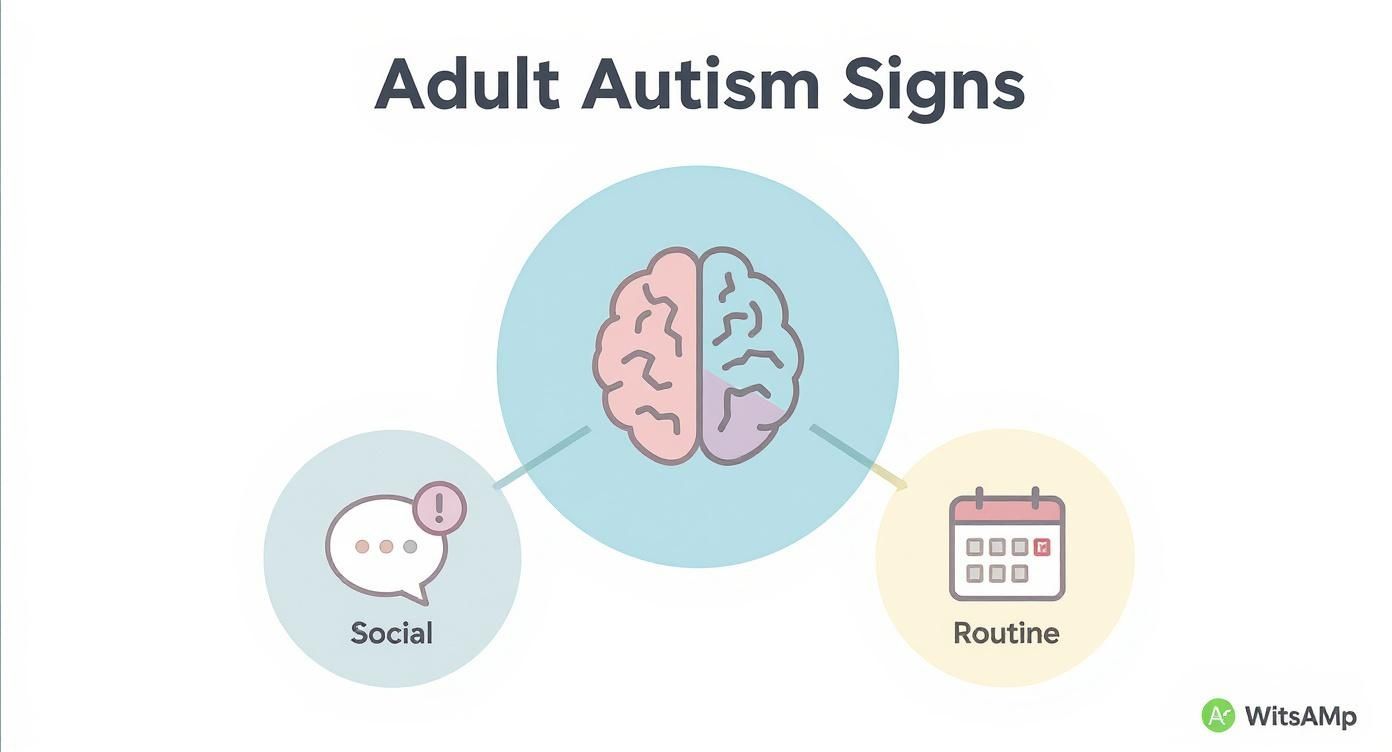
As you can see, these areas are all interconnected. A challenge in one domain, like sensory processing, can directly affect how you experience social situations and why you might rely so heavily on routine.
Having AuDHD means navigating a unique internal landscape where the need for predictable order meets a mind that constantly seeks new stimuli. It is not a contradiction; it is a distinct neurotype with its own set of experiences.
Getting to grips with these distinctions is the first step in untangling what's really going on inside. To help with that, it’s useful to see how some common traits can present differently depending on which neurotype is in the driver's seat.
Comparing Adult Traits in Autism and ADHD
The table below offers a side-by-side look at some overlapping challenges, highlighting the different internal experiences that often drive the behaviour in autism versus ADHD.
| Trait or Challenge | Typical Presentation in Autism (ASD) | Typical Presentation in ADHD |
|---|---|---|
| Focus Patterns | Deep, sustained hyperfocus on special interests; difficulty shifting attention away from these topics. | Interest-driven focus that shifts rapidly; can hyperfocus on novel or highly stimulating tasks but struggles with mundane ones. |
| Social Motivation | May desire social connection but find the mechanics of it confusing or exhausting; often prefers solitude or small, quiet groups. | Often craves social interaction and can be very talkative but may struggle with impulsivity, listening, or maintaining friendships. |
| Need for Routine | Finds deep comfort in predictability and sameness; change can cause significant distress or anxiety. | Struggles to maintain routines and can become easily bored with them; often craves novelty and spontaneity. |
| Sensory Issues | Often experiences hypersensitivity (overwhelmed by lights, sounds, textures) or hyposensitivity (under-responsive to stimuli). | Often seeks sensory input (sensation-seeking) due to an under-stimulated brain; may fidget, need background noise, or enjoy intense physical activity. |
For any adult wondering if they might have traits of both, this hopefully brings some clarity. It's a powerful confirmation that you don't have to fit neatly into one box. Understanding the interplay between autism and ADHD is the starting point for finding strategies that work with, not against, your unique brain wiring.
Navigating the Path to an Adult Diagnosis in the UK
So, you’ve been exploring what autism looks like in adults, and it’s starting to resonate. You might be wondering, "What next?" If you're considering a formal assessment, this section will walk you through what that journey actually looks like. It’s a big step, but understanding the process can make it feel far less daunting.
In the UK, you essentially have two main roads you can go down.
The first option is to go through the National Health Service (NHS), and the second is to seek a private assessment. Each route has its own map, timeline, and things to consider. The best choice for you will likely come down to your personal circumstances and how urgently you feel you need some answers.
This decision is becoming more common as awareness of adult autism grows, but getting a diagnosis isn't always straightforward. A major review by King's College London revealed a startling gap, estimating that a staggering 89% to 97% of autistic adults over 40 are still undiagnosed. That figure alone shows just how crucial it is to understand your options for getting the clarity and support you might need. You can read more about the research into undiagnosed autistic adults and see the scale of the issue for yourself.
The NHS Assessment Pathway
For most people, the journey towards an NHS diagnosis starts with a conversation with their General Practitioner (GP). This is your first official step to discuss what you've been experiencing and ask for a referral to a specialist diagnostic service.
It’s a really good idea to prepare for this appointment. Try to jot down some notes about the autistic traits you see in yourself, and if you suspect ADHD, mention those traits as well. Think about examples from your childhood and your adult life – this gives your GP a much clearer picture of why you’re seeking a referral.
Once the GP agrees and sends off the referral, you’ll be put on a waiting list. This is where a bit of patience is needed. Honestly, the wait times for adult autism assessments on the NHS can be incredibly long, often stretching from several months to, in some areas, a few years.
An NHS diagnosis is completely free and is recognised by all public services. The downside, however, is that the long wait can be a real emotional and practical hurdle when you're just trying to get some clarity.
When your turn finally comes, the assessment itself is very thorough. It's usually carried out by a multi-disciplinary team – which might include a psychiatrist, a clinical psychologist, and a speech and language therapist – to make sure it meets the strict NICE (National Institute for Health and Care Excellence) guidelines.
The Private Assessment Route
If the long NHS waiting lists just don't feel manageable for you, a private assessment is another option. The biggest advantage here is speed. You can often get an appointment and a diagnosis within weeks, not years, which can be a massive relief if you're struggling and need to know what's going on to move forward.
But, and this is a big but, you absolutely must do your homework when choosing a private provider. It's vital to ensure their service is credible and that the diagnosis they provide will be officially recognised.
Here are the key things to check for in any private service:
- NICE Guideline Compliance: The assessment process must follow the exact same high standards set by NICE that the NHS adheres to.
- Multi-Disciplinary Team: A proper, robust assessment isn’t just one person’s opinion. It should involve specialists from different fields, like a psychiatrist and a psychologist.
- A Comprehensive Process: The evaluation should be in-depth, involving detailed interviews about your life history, current difficulties, and often includes questionnaires for you and maybe someone who knows you well.
A good private assessment gives you a way to understand your neurology without the agonising wait. If you’re weighing up your options, our guide on getting an autism diagnosis for adults in the UK breaks down what a high-quality assessment should involve. Ultimately, deciding which path to take is a personal choice, but having all the information empowers you to take that next step with confidence.
Building Your Life After a Diagnosis
Getting an autism diagnosis as an adult isn't the end of the road; it’s really just the beginning of a new one. For many, it's a moment of profound validation where a lifetime of feeling 'different' suddenly makes sense. This new perspective allows you to look back at past experiences with a much kinder, more understanding lens.
It's completely normal for this time to be a whirlwind of emotions. You might feel relief, but also grief for past struggles, and even a little bit of excitement for what comes next. The most important thing is to give yourself the grace and time to process it all. You're not just learning about a condition; you're finally finding the language to describe who you've been all along.
Finding Your Footing and Your Community
One of the most powerful things you can do is connect with other autistic adults. Finding a community of people who just get it can be genuinely life-changing. Suddenly, you're surrounded by people who understand sensory overload, the sheer exhaustion of masking, and the pure joy of a special interest without you having to explain a thing.
Peer support groups, whether they're online or meet up in person, offer a safe space to swap strategies and feel truly understood. This connection is a brilliant antidote to the isolation so many undiagnosed autistic people experience, helping you build a support network with people who have walked a similar path.
Another crucial piece of the puzzle is getting a handle on your energy levels. Many autistic adults find the ‘Spoon Theory’ to be a helpful way to think about this. The idea is that you start each day with a set number of spoons, and every single task—from having a shower to making small talk—costs you one or more of them.
"The Spoon Theory helps to visualise your finite daily energy. By recognising what drains your 'spoons' and what recharges them, you can start making conscious choices to avoid burnout and protect your well-being."
This simple concept makes it easier to prioritise what really matters and, just as importantly, gives you permission to rest when you're running low, helping to break the debilitating cycle of autistic burnout.
Creating an Environment Where You Can Thrive
Building a life that works for you is all about making practical, intentional changes to your daily world. It’s about learning to work with your autistic brain instead of constantly fighting against it. The goal is to shape an environment that feels less overwhelming and far more supportive.
You can start small by putting personalised strategies in place:
- Sensory Management: Figure out what your sensory triggers are and find ways to dial them down. This could be as simple as wearing noise-cancelling headphones at the supermarket, popping on sunglasses indoors to deal with harsh lighting, or only buying clothes made from fabrics that feel good on your skin.
- Leveraging Your Strengths: Autism often comes with incredible strengths, like an ability to focus deeply, a knack for spotting patterns, and a truly unique way of looking at the world. Pinpoint what these are for you and find ways to lean into them at work, in your hobbies, and in your personal life.
- Honouring Your Needs: Give yourself permission to stim (self-stimulatory behaviours like fidgeting or rocking) to help you regulate your emotions. Block out downtime after social events, and never feel guilty for needing solitude to recharge.
For many people, neurodivergence isn't a one-off diagnosis. If you also have ADHD, the challenge is to create structure while also accommodating your brain's need for stimulation. You can find some great ideas in our guide on how to manage ADHD without medication, which has strategies that can sit alongside your post-diagnosis plan. By building this supportive framework for yourself, you can finally move from just coping to genuinely thriving.
Understanding Your Rights in the Workplace
Navigating your career as an autistic adult can feel like a minefield, but it's crucial to know you have solid legal protections on your side. In the UK, Autism Spectrum Disorder is recognised as a disability under the Equality Act 2010. ADHD is also covered by this act. This isn't just a label; it's a powerful legal tool that ensures you get a fair shot at thriving in your job.
This law puts the responsibility squarely on employers to make sure autistic employees aren’t at a disadvantage. They have a legal duty to make what are called 'reasonable adjustments'. Think of these as practical, common-sense changes to your role or environment that dismantle the barriers you might face due to your autistic traits.
The key word is ‘reasonable’. This means the changes shouldn't place a massive burden on the company, but they absolutely must be effective in helping you. This framework is your foundation for building a work life that plays to your strengths.

What Do Reasonable Adjustments Look Like?
So, what does this actually mean day-to-day? Reasonable adjustments aren't a one-size-fits-all solution; they’re tailored to what you need. They can be surprisingly simple tweaks that make a world of difference to your focus, comfort, and ability to do your best work.
Here are a few common examples:
- Communication Adjustments: Asking for important instructions or feedback in writing, like an email, to avoid the ambiguity of verbal conversations.
- Environmental Changes: Moving your desk to a quieter corner of the office, or getting permission to wear noise-cancelling headphones to manage sensory overload.
- Scheduling Flexibility: Having flexible start and finish times to dodge the stress of rush hour, or the option to work from home a couple of days a week.
- Altering Job Duties: Modifying a few minor tasks you find especially draining, freeing you up to concentrate on the core responsibilities where you truly shine.
These are just starting points. The real goal is to start a conversation with your employer to find solutions that support you and benefit the business.
"Disclosing your diagnosis is a personal choice. It is also the gateway to receiving legal protections and practical support that can transform your work life from a source of stress into a place of achievement."
The Decision to Disclose Your Diagnosis
This brings us to a big, personal decision: should you tell your employer you're autistic? There's no law saying you have to. But, and it's a big but, you can't access the protections and reasonable adjustments under the Equality Act without disclosing it.
It's a balance. The obvious pro is getting the support you're entitled to. On the other hand, many people worry about facing stigma or being misunderstood by their manager or colleagues.
These concerns are valid, and a truly supportive work environment can still be hard to find. The statistics paint a stark picture: only about 30% of autistic adults in the UK are in any kind of paid employment. This figure really drives home the barriers that still exist and why knowing your rights is so vital. You can find more detail in the employment statistics for autistic adults.
By understanding what you're entitled to, you can advocate for yourself with confidence and carve out a successful, sustainable career on your own terms.
Your Questions About Adult Autism, Answered
As more adults start to explore whether autism might explain their lifelong experiences, a lot of questions come up. It's a journey of discovery, and it's completely natural to seek clarity. Here are some straightforward answers to the questions we hear most often from people just like you.
Can I Be Autistic If I Have a Job and a Family?
Yes, absolutely. One of the most persistent myths about autism is that it’s a barrier to a successful, fulfilling life. The reality is that countless autistic adults thrive in their careers, build loving relationships, and raise wonderful families.
Autism is a spectrum, and how it presents varies hugely from person to person. For many, the challenges are less about what they can achieve on the outside and more about their internal experience. A proper diagnostic assessment looks beyond your accomplishments to understand your developmental history and your core ways of thinking and processing information. Many autistic adults become masters of masking—consciously or unconsciously hiding their autistic traits to fit in—which can be effective but also utterly exhausting.
Is It Worth Getting a Diagnosis Later in Life?
For most people who pursue it, the answer is a powerful yes. Receiving a diagnosis in adulthood can feel like finding the right instruction manual for your own brain after a lifetime of feeling out of sync. It’s not about labelling a problem; it’s about gaining a framework that finally makes sense of your experiences.
This self-understanding is life-changing on its own, but a formal diagnosis also opens doors to practical support. This can include things like:
- Legal protections at work, ensuring you get reasonable adjustments under the Equality Act 2010.
- Access to therapies and coping strategies that are actually designed for your neurotype.
- Finding a community of other autistic people, which can be incredibly validating and helps reduce the isolation so many have felt for so long.
A diagnosis can reframe your past, empower your present, and help you build a future that truly honours your needs and strengths.
How Much Does a Private Autism Assessment Cost in the UK?
The cost for a private adult autism assessment in the UK does vary, but you can generally expect the price to fall somewhere between £1,500 and £3,000. If you are also seeking an ADHD assessment, this may be a separate cost or part of a combined package, so it's important to clarify with the provider. While it’s a significant financial consideration, going private is often a much faster path to getting answers than the NHS, where waiting lists can be very long.
If you decide to go down the private route, it's vital to do your homework. Make sure the assessment is thorough, conducted by a multi-disciplinary team, and strictly follows the NICE (National Institute for Health and Care Excellence) guidelines. This is what ensures your diagnosis will be officially recognised and respected by employers, universities, and other services.
What Is Autistic Burnout?
Autistic burnout is a state of intense physical, mental, and emotional exhaustion that many autistic people experience. It's far more than just feeling tired; it often involves losing skills you usually have, like the ability to socialise or manage daily tasks.
It’s the result of the cumulative stress of trying to operate in a world that isn't designed for your neurology. Think of it as the consequence of constantly masking, processing overwhelming sensory input, and pushing yourself to meet neurotypical expectations day after day. For those with co-occurring ADHD, the constant internal push-and-pull between the need for routine and the craving for novelty can accelerate this burnout. Recovering from burnout isn't quick—it demands serious rest, a drastic reduction in pressure, and time spent in an environment that minimises sensory and social demands.
If these questions resonate with you, remember you don't have to figure this all out on your own. Insight Diagnostics Global offers consultant-led online assessments for adults that fully comply with NICE guidelines, providing a clear and supportive path to understanding yourself better.