

If you’re an adult in the UK and you’ve found yourself searching for an “autism diagnosis near me,” the first step usually starts with your GP. This initial chat is more than just a formality; it's the gateway to an NHS referral or a signpost towards private options, and it really sets the tone for the entire journey ahead, especially if you also suspect you might have ADHD.
Starting Your Journey to an Autism and ADHD Diagnosis
The moment it clicks that you might be autistic can be a huge relief, especially if you’ve spent a lifetime feeling like you just don't quite fit in. For many adults, this realisation comes after their own child is diagnosed, or they stumble across an article describing experiences that feel uncannily familiar. This often sparks a deep dive into research, and it’s here that the lines between autism and ADHD can start to look pretty blurry.
It's actually incredibly common for autistic traits and ADHD symptoms to show up together. In fact, research points to a significant overlap, and many people end up with a diagnosis for both (sometimes called AuDHD). It’s worth having this on your radar from the start, as it might shape the kind of assessment you decide to go for.
The Overlap Between Autism and ADHD
Getting your head around the connection between these two neurotypes can make so much sense of your experiences. For instance, you might have the deep, focused interests typical of autism but also grapple with the executive dysfunction and attention struggles that come with ADHD.
Think about these common crossover experiences:
- Social Hurdles: An autistic person might struggle to read social cues or unwritten rules. Someone with ADHD might find themselves interrupting people or zoning out during conversations. If you have both, these challenges can feel magnified.
- Emotional Regulation: Both autistic people and those with ADHD can feel emotions very intensely. The trigger might be different—sensory overload causing an autistic meltdown, for example, versus the emotional impulsivity that can come with ADHD.
- Executive Functioning: This is a massive area of overlap. Difficulties with planning, organising, managing time, and just getting started on tasks are classic signs of ADHD, but they're also incredibly common for autistic people.
Preparing for Your First GP Appointment
That first conversation with a GP can feel really intimidating. You’re essentially trying to condense a lifetime of nuanced experiences into a standard 10-minute appointment slot. The secret to making it a productive discussion, rather than a dismissive one, is to go in prepared.
Walking in and just saying, "I think I might be autistic and have ADHD," often doesn't cut it. Instead, you need to build a clear case for why you need a referral. Start by jotting down specific examples from your life, covering your childhood right through to today. Think about social communication, sensory sensitivities, your relationship with routine, and your special interests, but also include details about attention, impulsivity, and organisation.
A great tip is to frame your experiences around the impact they have on your day-to-day life. For example, instead of just saying "I don't like parties," try explaining it like this: "Large social gatherings leave me feeling physically drained and unable to speak for days afterwards, which affects my ability to work and look after my family."
Bringing some structured notes can make all the difference. You could even categorise them to help keep the conversation on track.
Example Note Structure:
- Social & Communication (Autism Traits): "I've always found it hard to keep friends and often feel like I’m performing a role. I rehearse conversations in my head but still seem to say the wrong thing."
- Routines & Sensory Issues (Autism Traits): "I eat the exact same lunch every single day and feel a huge amount of anxiety if my schedule is disrupted. The fluorescent lights and background noise in a supermarket are physically painful."
- Inattention & Executive Function (ADHD Traits): "I find it impossible to focus on admin tasks, I'm constantly losing my keys, and my mind jumps from one topic to the next during conversations."
- Hyperactivity & Impulsivity (ADHD Traits): "I often make impulsive decisions that I regret later on, struggle to sit still through meetings, and frequently interrupt people without meaning to."
This level of detail gives your GP concrete information to include in their referral letter. It transforms the conversation from being about a vague feeling to a clear set of challenges that warrant a proper investigation, getting you one step closer to the answers you're looking for.
Choosing Your Path: NHS vs. Private Assessment
So, you’ve spoken with your GP. Now you’re at a real fork in the road on your journey to an adult autism and ADHD diagnosis: do you wait for the NHS, or do you look into going private? This isn't just a simple choice; it’s one that will shape your timeline, the cost, and how much say you have in the whole process.
There's no single "right" answer here. The best path for you really comes down to your own situation—how urgently you need answers, what your budget looks like, and what you hope a formal diagnosis will bring. Let's break down what each route actually looks like in practice.
Navigating the NHS Pathway
The traditional route starts with that GP referral. If the referral is accepted, you’ll be put on a waiting list for an assessment with your local NHS mental health trust or a service they’ve commissioned. The biggest, and for many, the only, reason to go this route is that it’s free at the point of care.
The downside? The waiting times. And we’re not just talking long—we’re talking years, for both autism and ADHD assessments. It’s a systemic problem, really, a simple case of overwhelming demand and not nearly enough resources to meet it.
It’s hard to overstate how difficult these waits can be. An official diagnosis is often the key that unlocks workplace adjustments, benefits, and the right kind of support. Being stuck in limbo for years can take a serious toll on your mental health and overall quality of life.
The numbers really don't lie. As of June 2025, an incredible 236,225 people were waiting for an autism assessment in England. That's a 53% increase from just two years earlier. Perhaps more shockingly, nearly 89% of them had been waiting longer than the 13 weeks recommended by NICE guidelines. The average wait has now ballooned to over 17 months, which is a lifetime when you’re waiting for crucial support.
Considering a Private Assessment
Faced with these kinds of delays, it’s no surprise that many people start searching online for a private "autism diagnosis near me." The biggest draw of the private sector is, without a doubt, speed. You can often get an assessment booked within a few weeks instead of waiting years, which can be a complete game-changer if you’re struggling or need a diagnosis for work or university.
Going private also gives you more control. You get to choose the clinic or even the specific clinician. This means you can find someone who specialises in adult autism, has experience with co-occurring conditions like ADHD, or is known for their work with specific presentations, like autism in women or older adults.
The major hurdle, of course, is the cost. A proper, NICE-compliant assessment is a specialist medical service delivered by highly qualified professionals, and the price tag reflects that. It's really important to get a clear picture of the private autism assessment cost and understand exactly what you’re paying for before you commit.
This decision tree gives you a visual of those first steps.
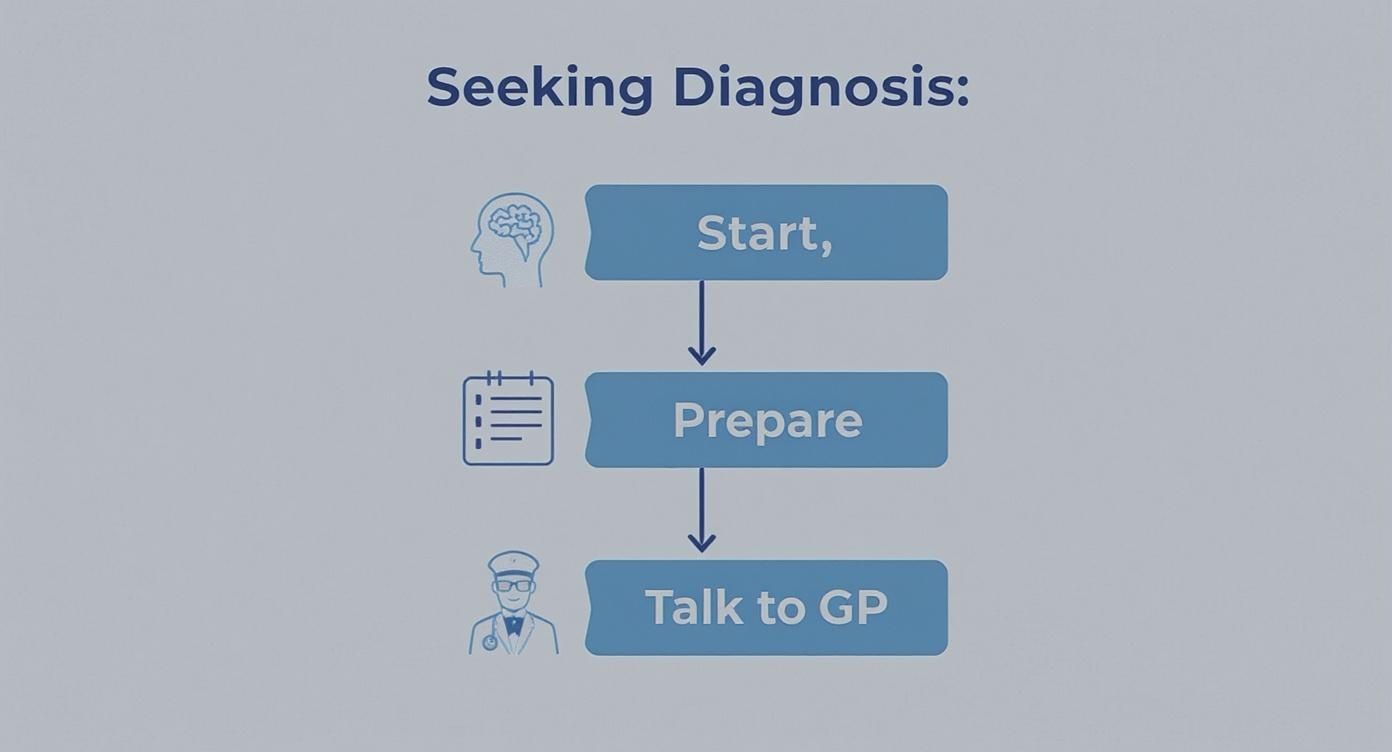
As you can see, no matter which path you end up taking, the journey always starts with a bit of self-reflection and a chat with a GP you trust.
Making an Informed Choice
So, how do you decide? It really comes down to a trade-off between time, money, and your personal needs. The NHS offers a reliable, no-cost service, but it requires a huge amount of patience. The private route gets you answers quickly and with more choice, but it comes with a significant financial cost.
To help you weigh it all up, here’s a quick side-by-side comparison.
NHS vs Private Autism Assessment at a Glance
| Factor | NHS Pathway | Private Pathway |
|---|---|---|
| Cost | Free at the point of service. | Typically costs between £1,500 – £3,000+. |
| Waiting Time | Extremely long; often 1-3 years, sometimes longer. | Much shorter; usually a matter of weeks to a few months. |
| Choice of Provider | You are assigned to a local NHS trust or commissioned service. | You can research and choose your own clinic and clinician. |
| Specialisation | Varies by trust; may be harder to find specialists. | Easier to find clinicians with specific expertise (e.g., adult women, AuDHD). |
| Process Control | Limited control; you follow the set NHS process. | More control over scheduling and choice of assessor. |
| Acceptance | Universally accepted by all UK public bodies (NHS, DWP, etc.). | Reports from reputable, NICE-compliant providers are widely accepted. |
Ultimately, choosing between the NHS and a private assessment is a big decision, and only you can make it. By understanding the real-world pros and cons of both systems, you can make a choice that feels right for you and gets you on the path to clarity.
Finding a Reputable Diagnosis Provider

Whether you’re on an NHS waiting list or going down the private route, making sure the people who assess you are properly qualified is a crucial step. The quality of your assessment has a huge impact on the reliability of the diagnosis. A thorough, well-conducted assessment gives you a powerful tool for self-understanding and getting support; a poor one, however, can cause more confusion and might be rejected by other services.
Not all providers are created equal. When you search for an "autism diagnosis near me," you'll be met with a massive range of clinics and individual practitioners. It's your job to vet them properly to find a service that's not just legitimate, but also the right fit for you, especially if you think ADHD might be part of the picture.
Non-Negotiable Credentials and Standards
Before you even start looking at a clinic's approach or reviews, you need to check their professional credentials. In the UK, there are very clear standards that any reputable provider has to meet.
Here’s what you absolutely must look for:
- NICE Guideline Compliance: Any credible assessment must follow the clinical guidelines from the National Institute for Health and Care Excellence (NICE). If a provider doesn't mention this on their website, treat it as a major red flag.
- HCPC Registration: Clinicians like clinical psychologists or occupational therapists involved in the diagnosis must be registered with the Health and Care Professions Council (HCPC). This is a legal requirement, confirming they meet national standards for their training and professionalism.
- GMC Specialist Register: If a psychiatrist is involved (common for ADHD evaluations), they must be on the General Medical Council's (GMC) Specialist Register.
These aren't just bureaucratic boxes to tick—they're your guarantee of quality and safety. A diagnosis from an unqualified or non-compliant provider simply won't be recognised by your GP, the NHS, or even some employers.
Key Questions to Ask a Potential Provider
Once you've confirmed a provider has the right credentials, it’s time to dig a bit deeper. A good clinic will always be transparent about their process and happy to answer your questions. Think of it as an interview; you're deciding if they are the right team to handle something so important.
It's also worth knowing that the path to diagnosis isn't the same for everyone. Official UK government statistics show big differences depending on where you live and your background. For example, boys are diagnosed 3 to 4 times more often than girls, a gap often linked to different presentations of autism. Factors like your ethnicity and socioeconomic background can also create barriers, making it even more important to find a provider who gets these nuances. You can dive into the data on these diagnostic disparities on the GOV.UK website.
With that in mind, here are the essential questions to bring to the table.
Do They Offer Combined Autism and ADHD Assessments?
There's a massive overlap between autism and ADHD, so many adults find a combined assessment incredibly helpful. It's far more efficient—and clinically effective—to look at both possibilities at the same time rather than going through two separate, long-winded evaluations.
A combined assessment, often for 'AuDHD', gives a much fuller picture of your neurotype. It helps make sense of why you might experience a mix of traits, like intense focus alongside chronic disorganisation, or sensory sensitivities next to impulsivity.
Ask any potential clinic if they offer this integrated approach. A provider experienced in both will understand how traits can interact, mask, or influence one another, which leads to a far more accurate and genuinely useful outcome.
What Is Their Experience with Your Profile?
Autism looks different in different people. You need to make sure a provider’s experience matches your own circumstances. If you're a woman, for instance, it's vital to ask about their experience diagnosing autism in adult women, who often have more internalised traits and a long history of camouflaging (or 'masking').
The same goes for older adults, people from specific cultural backgrounds, or anyone with a complex mental health history. A clinician who mainly assesses children is very likely to miss the subtle signs in an adult who has spent decades building up coping strategies.
What Diagnostic Tools Do They Use?
A proper assessment is so much more than a chat. It should be a structured, multi-part process that uses recognised diagnostic tools. Don't be afraid to ask a provider what specific instruments they use.
You’re looking for 'gold-standard' tools like these:
- ADOS-2 (Autism Diagnostic Observation Schedule, Second Edition): This is an observational assessment where activities and conversation let the clinician see social communication and interaction in a standardised way.
- ADI-R (Autism Diagnostic Interview-Revised): This is a detailed, structured interview with someone who knew you well as a child (like a parent or older sibling) to build a full developmental history.
- For ADHD: Look for tools like the DIVA-5 (Diagnostic Interview for ADHD in Adults) or the Conners' Adult ADHD Rating Scales (CAARS).
- Structured Clinical Interviews: These are in-depth conversations directly with you about your experiences, thoughts, and feelings across your entire life.
If a provider seems to rely only on questionnaires or a quick interview, they aren't following best practice. By asking these direct questions upfront, you put yourself in a position to choose a high-quality service that will deliver a diagnosis you can actually trust.
What to Expect During Your Assessment

Knowing what an autism and ADHD assessment actually involves can make the whole thing feel a lot less daunting. It’s not a single test you pass or fail; think of it more as a detailed, multi-part process designed to build a complete picture of who you are. Let's break down the steps so you can feel more prepared and in control.
The journey often begins long before you speak to anyone. You'll likely receive a set of pre-assessment forms and questionnaires to fill out. These aren't just admin hoops to jump through—they're a crucial first step for gathering information about your life experiences, traits, and challenges related to both autism and ADHD.
This initial paperwork gives the clinical team a solid foundation before you even meet, making sure your time together is used as effectively as possible.
The Clinical Interview and Your Life Story
A core part of your assessment will be at least one in-depth clinical interview with a specialist. This isn't a formal interrogation. It's really a guided conversation about your life, from your earliest memories right up to the present day.
The clinician will be interested in your childhood, what school was like, friendships, relationships, and your work history. This ‘developmental history’ is vital because autism and ADHD are lifelong neurotypes, so they need to see evidence of traits and difficulties across different stages of your life.
You'll talk about sensory experiences, routines, and interests (for autism), as well as attention, impulsivity, and restlessness (for ADHD).
The Role of an Informant
To get a well-rounded view, the assessment team will often want to speak with someone who knew you well as a child. This person is called an informant—usually a parent, older sibling, or another close relative.
Their input helps to corroborate your own memories and offers an outside perspective on your early development. Clinicians know that finding an informant isn't always possible, but if you can, their contribution adds valuable depth.
It’s important to remember that an informant’s role is to provide context, not to validate or invalidate your experiences. Your own account of your life is the most important piece of evidence in the entire process.
If you don't have an informant, don't worry. The clinical team will simply rely more heavily on your own recall and other information, like old school reports if you happen to have them.
Combined Assessments for Autism and ADHD
Many adults looking for an "autism diagnosis near me" also suspect they might have ADHD. A combined assessment is specifically designed to explore both conditions at the same time. This is a really efficient approach, especially because the traits of autism and ADHD can overlap and sometimes mask one another.
During a combined assessment, the clinician will ask questions aimed at untangling the two.
- Executive Function: They'll explore whether your challenges with organisation are more about ADHD-style difficulties with focus and getting started, or an autistic need for predictable structure.
- Social Difficulties: The goal here is to understand if social challenges come from missing social cues (more typical of autism) or from impulsivity and inattention (more typical of ADHD).
- Observational Tasks: The assessment might include specific tasks designed to observe things like attention, hyperactivity, social communication, and imaginative thinking in real-time.
This integrated approach leads to a much more accurate and useful diagnostic outcome, giving you a full picture of your neurotype. Whether you opt for an in-person or online assessment, the fundamental clinical parts—interviews, questionnaires, and structured observation—will remain the same, ensuring a thorough and reliable evaluation.
Life After Diagnosis: Your Report and Next Steps
Getting your diagnostic report in your hands is a massive moment. After everything it takes to even get to this point—all the searching, waiting, and wondering—you finally have a document that holds some real answers. But it's important to remember this isn't the finish line; it's the start of a whole new chapter.
What you’ll receive is a detailed, multi-page document. It won't just give you a simple 'yes' or 'no'. Instead, it will lay out a full diagnostic formulation—a story, really—explaining how the clinicians connected your life experiences to the formal criteria for Autism Spectrum Disorder (ASD) and/or ADHD. The report is designed to give a complete picture, detailing both your strengths and the areas where you face challenges.
Making Sense of Your Diagnostic Report
The most valuable part of the report is almost always the recommendations section. This is where the clinical jargon gets translated into practical, real-world advice that you can actually use. Think of it as a personalised user manual for your brain.
You can expect to find suggestions like:
- Workplace Adjustments: Concrete ideas for your employer, like allowing noise-cancelling headphones, providing instructions in writing, or offering more flexible hours.
- ADHD Medication: If ADHD is diagnosed, the report will often include recommendations for medication to help with focus and emotional regulation.
- Therapeutic Support: Pointers towards specific therapies, such as speech and language therapy to help with social communication, or occupational therapy to tackle sensory or executive functioning difficulties.
It's worth saying that getting a diagnosis as an adult can stir up a whole cocktail of emotions. Relief is a big one—that feeling of validation, that your struggles were real all along. But you might also feel grief for the person you could have been with earlier support, anger at the years you spent misunderstood, or anxiety about the future. Whatever you feel, it's normal and completely valid.
Processing This New Part of Your Identity
Give yourself time. Seriously. You need the space to process this new layer of who you are. For many people, a late diagnosis completely reframes their entire life story, finally making sense of past struggles and social missteps.
This is where connecting with the autistic and ADHD communities can be an absolute lifeline. Finding other people who just get it can dissolve feelings of isolation and offer a powerful sense of belonging you may have never felt before.
You're not alone on this journey. While it's estimated that over 700,000 people in the UK are autistic, a huge number of adults have never been formally diagnosed. In fact, research from King's College London suggests that a staggering 89% to 97% of autistic adults over 40 remain undiagnosed. They've navigated most of their lives without any official recognition or support.
Taking Practical Next Steps
Once you've had some time to sit with the news, you can start using your diagnosis as a tool for empowerment. That report is official documentation, and you can use it to advocate for yourself in all sorts of situations.
A brilliant next step for many is applying for Access to Work. This is a government-funded scheme in the UK that gives practical and financial support to help you manage work-related barriers. It could cover the cost of specialist equipment, a workplace coach, or even a support worker.
If your assessment also confirmed an ADHD diagnosis, the report will include recommendations for medication. Getting this prescribed through the NHS can be a slow process, but some private clinics can help bridge that gap. For instance, you can look into how to get private prescriptions online, which is often a much faster way to start treatment. Your diagnosis is the key that unlocks these support systems, helping you build a life that truly works for you.
Common Questions About Adult Autism Diagnosis
Working your way towards an adult autism diagnosis brings up a lot of practical questions. As you get closer to finding the clarity you’re looking for, it’s completely natural to wonder about the nuts and bolts of the process—especially when it comes to cost, validity, and how conditions like ADHD fit into the picture. Let’s tackle some of the most common queries.
How Much Does a Private Diagnosis Cost?
One of the first things people want to know when searching for a private "autism diagnosis near me" is the financial side of things. In the UK, you can expect a comprehensive private assessment for adult autism to cost somewhere between £1,500 and £3,000.
Of course, this price isn't set in stone. It can shift depending on the clinic's location, the seniority of the clinicians, and whether you're also being assessed for ADHD at the same time. A combined AuDHD assessment may cost more than a single-condition one, but it is typically more cost-effective than two separate evaluations. My advice is to always ask for a full breakdown of what’s included before you commit.
Will the NHS Accept My Private Diagnosis?
This is a really important question, and for good reason. Broadly speaking, yes, your GP and the NHS should accept a private diagnosis, but with one crucial caveat: it must come from a qualified, multidisciplinary team that has rigorously followed NICE guidelines.
That said, acceptance isn't always a given for every single service. While your GP should update your medical records with the diagnosis, trying to get NHS-funded support or an NHS prescription for ADHD medication based on a private report alone can sometimes be tricky. It may require a 'shared care agreement' or even trigger a request for an additional NHS review. It's always a good idea to have a frank chat with your GP about this possibility beforehand.
Is an Online Assessment as Good as In-Person?
At their core, both online and in-person assessments use the same structured interviews and gold-standard diagnostic tools. An in-person assessment gives the clinician a chance to observe you directly in a formal clinical environment.
On the other hand, online assessments provide huge benefits in terms of accessibility and comfort. This can be a game-changer if you find social situations stressful or have mobility challenges. As long as they are carried out by experienced professionals using secure video platforms, they are considered just as valid and effective for both autism and ADHD. The best choice really boils down to your personal comfort and the availability of good providers.
A key benefit of a thorough assessment, whether online or in-person, is the clinician's ability to tell apart overlapping conditions. For example, what might seem like social difficulty could be down to autistic processing styles or it could be related to ADHD-driven inattention. You can learn more about how clinicians navigate these differential diagnoses to understand the differences and reach an accurate conclusion.
Can I Get Diagnosed Without Childhood Evidence?
Yes, absolutely. A diagnosis is still possible even if you can’t dig out old school reports or don't have a parent who can provide information. A developmental history is certainly a key part of the assessment, but clinicians are well-practised in working with adults whose childhood records are long gone or whose family members’ memories are a bit hazy.
They are skilled at piecing together the evidence they need through deep, structured interviews with you. They’re looking for consistent patterns of behaviour, experiences, and challenges that have been a part of your life story, not just a paper trail from your early years. Your own detailed account is the most powerful tool in the whole process.
At Insight Diagnostics Global, our consultant-led team delivers NICE-compliant online assessments for adults seeking answers about Autism and ADHD. We provide a clear, supportive pathway to understanding your neurotype, with assessments often available within seven working days.
Begin your journey to clarity with an assessment from Insight Diagnostics Global.