

Supporting someone who is autistic isn't about trying to 'fix' them. It's about a fundamental shift in perspective – moving from a one-size-fits-all mentality to one of genuine partnership, active listening, and respect for who they are. This is the only way to offer support that truly makes a difference, especially when considering the complex interplay with ADHD and mental health.
Building a Foundation of Compassionate Support
Before we get into the practical, day-to-day strategies, it's crucial to get the mindset right. This entire guide is grounded in the idea of neurodiversity. This simply means we see autism not as a problem to be solved, but as a natural and valid way for a brain to be wired. The goal isn’t to change the person, but to help them thrive as themselves.
It’s also vital to remember that every autistic person is just that – a person. Their experience is completely unique, shaped by their personality, their life, and any other conditions they might have.
The Overlap of Autism, ADHD, and Mental Health
One of the biggest mistakes you can make is viewing autism in a vacuum. The reality is often far more complex, and truly effective support means understanding how different conditions can interact.
- ADHD: The combination of autism and ADHD (often called AuDHD) brings its own set of challenges. Executive functions – things like planning, staying organised, and managing emotions – can be particularly tough. Supporting someone with AuDHD means being mindful of both neurological profiles at once.
- Anxiety and Depression: It’s a stark fact that autistic people experience anxiety and depression at much higher rates. This isn’t a coincidence. It's often the result of the constant stress that comes from navigating a world not built for them, dealing with sensory overload, and the exhaustion of social 'masking'.
- Mental Health: Being a good ally for their mental health means creating a safe, non-judgemental space. It also means helping them find therapists or counsellors who are neurodiversity-affirming and actually understand the autistic experience, including its connection with ADHD and anxiety.
Supporting an autistic person effectively means seeing the whole person. Acknowledging the interplay between their autism, potential ADHD, and mental health is not just helpful—it’s fundamental to providing compassionate and effective care.
A Partnership Approach
At its heart, supporting an autistic adult is a team effort. It’s not about taking charge or making decisions for them; it’s about empowerment. The single most important thing you can do is ask what they need instead of assuming you know best. Respect their autonomy and always validate their experiences.
Your role is to be an ally. This might mean adjusting your communication to be more direct and clear, or changing social plans to avoid a sensory nightmare for them. It's about adapting the environment, not the person. For a deeper dive into the condition itself, you can learn more about what autism spectrum disorder is in adults.
Throughout this guide, we'll be focusing on practical, respectful strategies that put the individual first, empowering them to navigate the world with confidence.
Practical Strategies for Communication and Daily Life
Knowing the theory is one thing, but putting it into practice day-to-day is where real support happens. The most meaningful help often comes from small, consistent adjustments that dial down the stress and create a more predictable, comfortable world. This isn't about walking on eggshells; it’s about building a shared space where everyone feels genuinely safe and understood.
For many autistic people, the sheer unpredictability of daily life can be a huge source of anxiety. What seems like a minor change to a neurotypical person can feel like a seismic shift, draining mental and emotional energy that's already running low. This is where you can make a tangible, everyday difference.
This process isn't a one-and-done fix. It's a continuous cycle of understanding their unique perspective, adapting your approach, and, most importantly, listening to what they actually need.
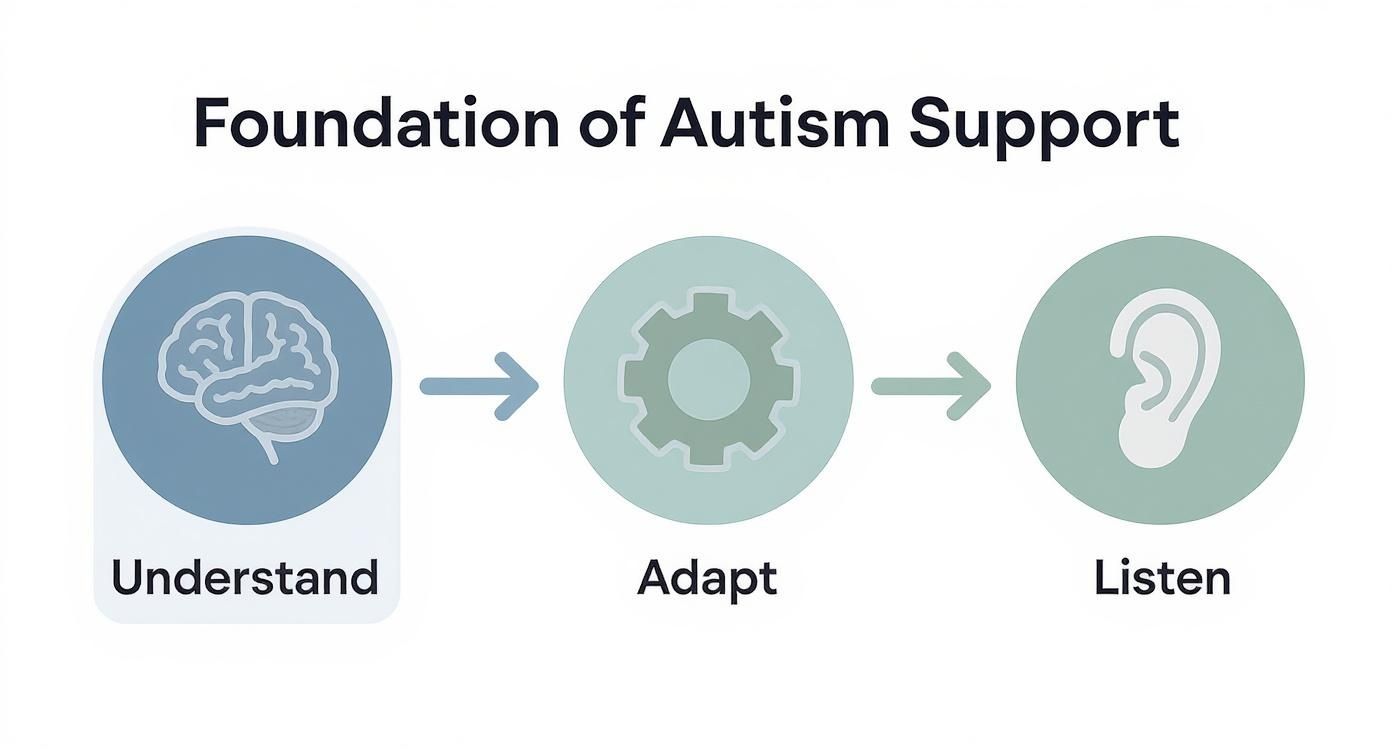
As the graphic shows, support is an ongoing loop. You learn, you adjust, and you keep listening.
Creating Sensory-Friendly Spaces
The world can feel like a constant sensory assault for an autistic person. What you might register as simple background noise could feel like a blaring alarm to them. One of the most powerful things you can do is help create a sensory-friendly home—a sanctuary where their nervous system can truly rest and recharge.
This doesn't mean you need a complete renovation. Small, thoughtful changes can have a massive impact:
- Lighting: Swap out harsh fluorescent or bright white bulbs for warmer, softer lighting. Even better, install dimmer switches or just rely on lamps instead of overhead lights.
- Sound: Be mindful of sudden, loud noises. Closing windows to muffle traffic, fixing a rattling fan, or simply asking before you turn on loud music can make a real difference. Noise-cancelling headphones are an essential tool, not a sign of someone being antisocial.
- Clutter: Visual chaos can be just as overwhelming as noise. For someone who also has ADHD, a disorganised space can throw their executive function completely off-kilter. Keeping areas tidy and organised helps reduce that mental load.
To help manage sensory input and support self-regulation, you might want to look into a guide to sensory tools for autism. Things like weighted blankets or fidget tools aren't just toys; they can be invaluable for meeting sensory needs.
Communicating with Clarity and Kindness
Misunderstandings are a major source of stress in any relationship, but they can be especially draining when supporting an autistic person. Many autistic individuals process language literally and can find it difficult to interpret sarcasm, idioms, or vague requests. Being direct and unambiguous in your communication is a true gift.
It's helpful to see the difference between common communication habits and a more effective approach.
Effective Communication for Supporting an Autistic Person
This table contrasts some common communication pitfalls with more effective, autism-friendly alternatives that promote clarity and reduce the chances of a misunderstanding.
| Common Misstep | Why It Can Be Challenging | Effective Alternative |
|---|---|---|
| "Could you tidy up a bit later?" | "A bit" and "later" are vague terms that create uncertainty about what is expected and when. | "Could you please put the books on the shelf before we have dinner?" |
| Using sarcasm, like "Oh, great, it’s raining again." | This may be interpreted literally as you being genuinely happy about the rain, causing confusion. | "I'm disappointed it's raining; I was hoping we could go for a walk." |
| Asking open-ended questions like "How was your day?" | This can be too broad and overwhelming to answer, especially after a long, tiring day. | "What was the best part of your work meeting today?" |
| Making assumptions about their feelings or intentions. | Autistic body language and facial expressions may not always align with neurotypical norms. | "I noticed you're quiet. Is everything okay, or do you just need some space?" |
This style of clear communication isn’t about being blunt or robotic. It's about removing the guesswork, which in turn reduces anxiety and builds a foundation of trust.
Preventing Autistic Burnout
Autistic burnout is a state of profound physical, mental, and emotional exhaustion. It’s often caused by the cumulative effect of trying to navigate a world that wasn't built for autistic neurology. This is far more than just stress; it’s a complete shutdown resulting from chronic overload.
Autistic burnout is the result of being asked to be someone you're not for too long. It's the consequence of a lifetime of masking, social exertion, and sensory overload without adequate time for recovery.
Helping someone avoid burnout means being proactive about conserving their energy. This involves encouraging them to schedule proper downtime, respecting their need for solitude to recharge, and helping them identify and minimise their triggers. It might mean leaving a party early, choosing a quieter restaurant, or advocating for accommodations at work. This is especially crucial for individuals also managing ADHD, as the constant demand on executive functions can accelerate the path to burnout.
Navigating Diagnosis and Healthcare Advocacy
Supporting someone through an autism diagnosis as an adult is a massive, often emotional, undertaking. Your role isn't to take charge, but to be a steady, validating presence while they navigate the practical and personal hurdles of finding answers. This process is so much more than just getting a label—it’s about finally making sense of a lifetime of experiences and opening the door to self-understanding and the right kind of support.
The journey to an official diagnosis can be long and honestly, pretty draining. For many, just deciding to get tested is a monumental step, often tangled up with feelings of anxiety, hope, and even impostor syndrome. Your support can be the anchor that keeps them grounded through it all.
Preparing for the Assessment
One of the most practical things you can do is help them prepare for their assessment. Executive functioning skills—the ability to plan, organise, and get things done—can be a real challenge for autistic people, especially if they also have ADHD. This is where you can make a huge difference.
You could offer to help them:
- Piece together a life history: Help them create a timeline or a simple list of key experiences from childhood, school, work, and relationships that seem relevant to their autistic traits. This might mean digging out old school reports or, with their permission, chatting with family members.
- Document current challenges: Sit with them and make notes on the difficulties they face right now. Think about sensory processing, social communication, daily routines, and managing tasks. Include how these challenges may overlap with symptoms of ADHD or impact their mental health.
- Organise their questions: It’s so easy to forget what you wanted to ask when you're in a stressful assessment. Helping them jot down a list of questions for the clinician beforehand can be a game-changer.
The point of all this isn't to build a 'case' for them, but simply to help them present a clear and full picture of their life. For a deeper dive into what’s involved, our guide on how to get tested for autism breaks down the entire process.
Managing the Wait and Advocating for Needs
The wait for an assessment can be one of the toughest parts. With the NHS under immense strain, the delays have become incredibly long. In England, there are currently 193,203 patients with an open referral for suspected autism. Recent figures showed over 204,000 people were waiting, and a staggering 89% were waiting more than 13 weeks—a number that has climbed sharply in recent years. You can read more about these statistics on autism diagnosis wait times.
During this time, your emotional support is invaluable. Let them vent about the frustration and anxiety. This period of being in limbo is incredibly difficult, and just having someone who listens without judgement makes a world of difference.
When the healthcare system is slow to respond, your consistent validation can be a lifeline. Reminding someone that their experiences are real, regardless of a formal diagnosis, is a powerful form of support.
Once they're in the healthcare system, your help in advocating for their needs can be crucial. Medical appointments can be overwhelming environments—full of bright lights, confusing questions, and unspoken social rules.
Here's how you can help:
- Attend appointments with them: Offer to go along, not to speak for them, but to act as a second pair of ears and a source of calm.
- Take notes: Help them keep track of important information, recommendations, or any follow-up actions discussed during the meeting.
- Gently prompt them: If they get flustered and forget to mention a key point from their prepared list, you can give them a gentle reminder.
Finding Neurodiversity-Affirming Care
A diagnosis is just the beginning. The next step is often finding mental health support from someone who actually gets autism, ADHD, and how they often overlap with things like anxiety and depression. This is where finding a neurodiversity-affirming therapist becomes essential.
This kind of professional sees autism as a different way of being, not a disorder that needs to be fixed. They won't focus on teaching someone to mask their traits or force them into neurotypical social norms. Instead, they’ll help the person understand their own brain, develop coping strategies that actually work for them, and build a life that feels authentic. Helping them research and vet potential therapists can be an enormous help in finding the right person for their ongoing journey.
Understanding Autism, ADHD, and Mental Health
When you’re supporting an autistic person, you’re supporting the whole person. And quite often, that bigger picture includes more than just autism. The reality is that many autistic people also live with co-occurring conditions like ADHD, anxiety, and depression. Getting your head around this complex interplay isn't just a nice-to-have—it’s absolutely essential if you want to provide support that genuinely makes a difference.
It's easy to fall into the trap of seeing these as separate, siloed issues. But in real life, they're often deeply tangled, with one condition shaping how another one shows up. For instance, the executive function challenges that come with ADHD can pour fuel on the fire of stress an autistic person feels trying to manage daily routines. This can easily spiral into heightened anxiety or even complete burnout.

The Intricate Overlap of AuDHD
When autism and ADHD show up together—a combination often called AuDHD—the kind of support needed becomes much more layered and nuanced. Someone with AuDHD might deeply crave the predictable structure and routine that helps their autistic brain feel calm, yet find it almost impossible to create or stick to that routine because of the executive dysfunction that’s a hallmark of ADHD.
You can imagine how incredibly frustrating that internal conflict must be. Think about wanting, more than anything, to organise your day down to the minute, but feeling completely paralysed when it comes to taking that very first step. This isn't about a lack of willpower; it’s a constant neurological tug-of-war. Being able to spot the signs of this dual experience is key, and you can get a clearer picture from our guide on ADHD symptoms in adults.
Differentiating Meltdowns, Shutdowns, and Panic Attacks
For friends, family, and colleagues, one of the trickiest things is telling the difference between various types of overwhelming emotional responses. From the outside, an autistic meltdown, a shutdown, and a panic attack can look pretty similar. But what’s happening on the inside—and the support needed in that moment—is worlds apart.
- Autistic Meltdown: This is a powerful, often outward reaction to being completely overloaded by sensory or emotional input. It’s not a tantrum or a choice; it’s an involuntary neurological "short-circuit" when the brain just can't process any more.
- Autistic Shutdown: Think of this as the internalised version of a meltdown. Instead of an outward explosion, the person might become completely non-verbal, withdraw, and seem to ‘go away’. They're still overloaded, but the response is directed inwards.
- Panic Attack: This is a sudden, terrifying wave of fear or anxiety, often with intense physical symptoms like a racing heart, struggling to breathe, and dizziness. While autistic people can definitely have panic attacks, they are a specific response to fear, not necessarily sensory overload.
Learning to recognise the triggers and early warning signs helps you respond in the most helpful way—like reducing sensory input during a meltdown versus offering grounding techniques for a panic attack.
Masking and Misdiagnosis
Many autistic people, especially those who only get their diagnosis later in life, have become masters of masking. This means they consciously or unconsciously hide their autistic traits to try and fit in with neurotypical social expectations. It can be an effective survival strategy, but it comes at a huge cost, often leading to deep exhaustion, burnout, and a much higher risk of mental health issues.
Masking can also throw a real spanner in the works when it comes to getting an accurate diagnosis. Autistic characteristics can easily be mistaken for symptoms of social anxiety, borderline personality disorder, or other conditions. For example, struggling with social cues might be chalked up to social anxiety, while their deep and passionate special interests could be mislabelled as obsessive behaviour.
"Understanding the difference between an autistic trait and a mental health symptom is crucial. One is a core part of who they are; the other is a state of distress that requires compassionate care. Confusing the two can lead to invalidating their experience."
One of the most powerful things you can do is create a safe space where they feel they can finally take the mask off without fear of judgement. This allows them to conserve so much precious energy and just be themselves. It's also vital to remember that alongside autism-specific support, many will be dealing with common mental health challenges. You can find excellent tips and strategies for supporting someone with depression that can be adapted through a neurodivergent lens.
Socioeconomic Factors and Support Access
It's a stark reality that access to diagnosis and support isn't a level playing field. Research often points to significant disparities linked to socioeconomic factors. For instance, in Northern Ireland, the estimated prevalence of autism in school-aged children was recently recorded at 5.9%. What’s critical is that children in the most deprived areas had a 38% higher prevalence rate than the regional average. This suggests a complex link between deprivation, the ability to access diagnostic services, and the support systems available.
This really highlights how important it can be to act as an advocate. Your role might involve helping the person you support to navigate systems that have inherent biases or barriers. This could mean helping them find the right resources, filling out complex forms, or simply being a source of encouragement when pursuing a diagnosis or therapy feels like an uphill battle. Understanding these wider societal challenges allows you to offer more informed, practical, and truly empathetic support.
Empowering Independence at Home and Work
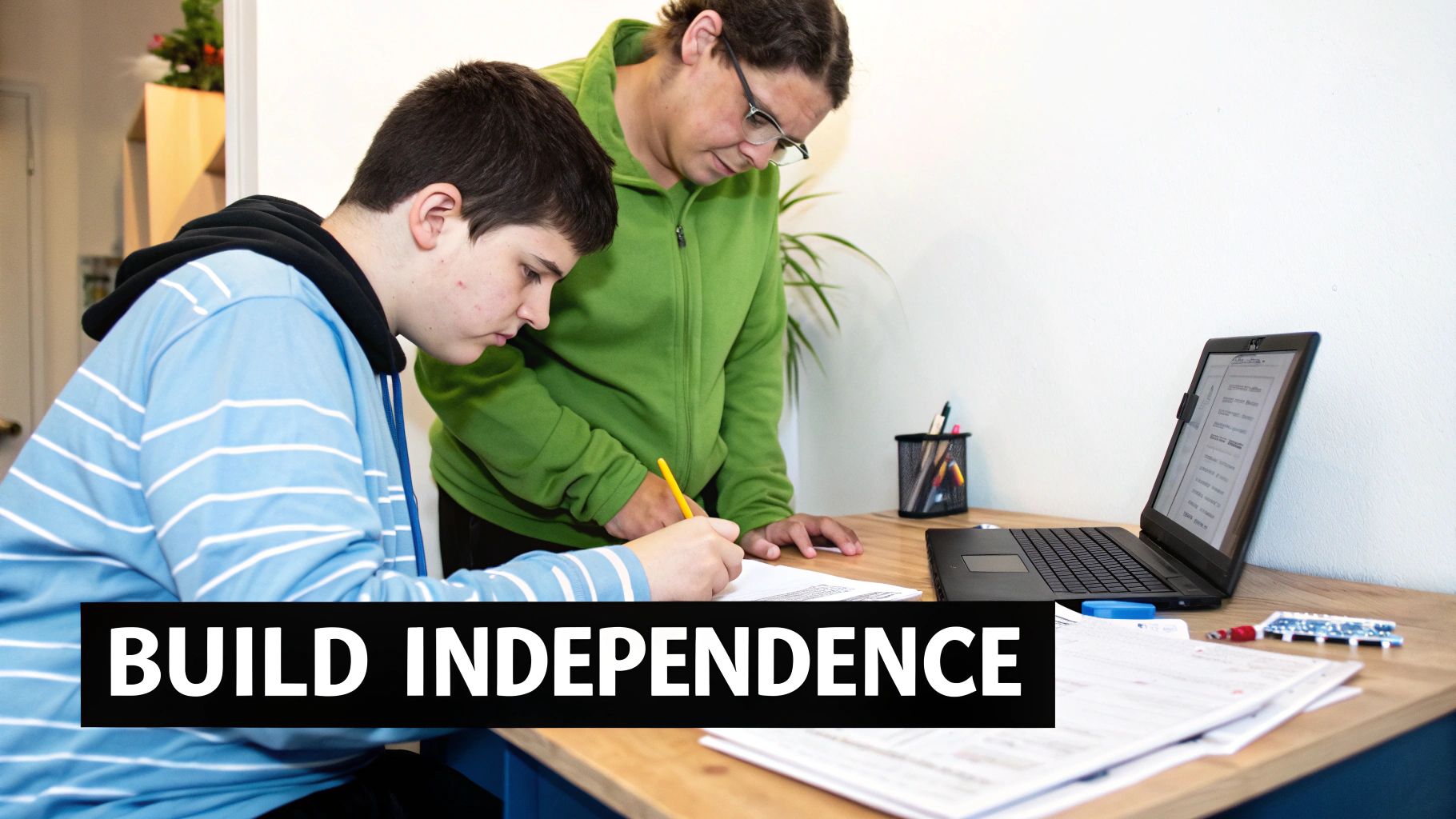
One of the most meaningful ways to support an autistic person is to champion their independence. The real goal isn't to do things for them, but to empower them with the skills and confidence to navigate life on their own terms. It’s a delicate balance, knowing when to step in and when to step back, both at home and in the workplace.
Think of your support like scaffolding around a new building. It’s there to provide structure and safety during construction, but it's always meant to be temporary. The aim is for the building to eventually stand strong on its own. If we over-support, we can accidentally send the message that we don’t believe they can manage, which can really knock their confidence.
Building Practical Life Skills at Home
At home, empowerment often means breaking down those big, daunting "adult" responsibilities into smaller, more manageable pieces. Executive function challenges, which are common in both autism and ADHD, can make everyday tasks like budgeting or meal planning feel completely overwhelming. The key is to work alongside them, not take over.
- Handling finances: Instead of just handing over cash, why not sit down together and map out a visual budget? Using an app or a simple spreadsheet can make tracking expenses much clearer. Setting up direct debits for bills is another great way to reduce the mental load.
- Managing the household: A vague instruction like "clean the kitchen" can be a recipe for overwhelm. A clear, written checklist with smaller steps ("wipe counters," "load dishwasher," "sweep floor") makes the task feel far more achievable and provides a great sense of accomplishment when ticked off.
- Navigating problems: When a problem pops up, our first instinct might be to fix it. Try to resist. A better approach is to ask guiding questions like, "What do you think the first step could be?" or "What are our options here?" This collaborative way of thinking builds their own problem-solving muscles.
Ultimately, this is about being a coach, not a manager. It means patiently teaching the skills needed for independent living, celebrating the small wins, and creating a safe space where it’s okay to make mistakes and learn from them.
Championing Success in the Workplace
The workplace can feel like a minefield of unwritten social rules, sensory overload, and vague communication. It’s a tough environment for many autistic people to navigate. Your support here can be absolutely vital, helping them not just to cope, but to genuinely thrive. This might mean acting as a sounding board, an advocate, or a coach as they figure out what they need to succeed.
True empowerment at work isn't about lowering expectations. It’s about removing the unnecessary barriers so an autistic person's skills and talents can properly shine through.
Many workplace adjustments are surprisingly simple and low-cost, yet they can make a world of difference. You can help the person identify what they need and then practise how to ask for it clearly and confidently.
Examples of Reasonable Adjustments:
- Flexible Hours: Starting and finishing a little earlier or later can help avoid the sensory chaos of a rush-hour commute.
- Clear, Written Instructions: A simple request for verbal instructions to be followed up in an email provides a concrete reference point and avoids misunderstandings.
- A Quieter Workspace: Asking for a desk away from busy walkways or getting permission to use noise-cancelling headphones can dramatically reduce auditory distractions.
- Structured Feedback: Helping a manager understand that feedback is most effective when it's direct, specific, and focuses on behaviour, not vague personality traits.
A Case Study in Empowerment
Let’s imagine you're helping a friend prepare for a job interview. Instead of just telling them what to say, you can empower them by demystifying the whole process.
You could role-play the interview, tackling those tricky, ambiguous questions. For example, a question like "Tell me about yourself" can be terrifyingly open-ended. You could work together to break it down: "Let's build a two-minute answer that covers your relevant experience, one key skill, and exactly why you want this job."
By doing this, you're not just feeding them a script. You're teaching them the hidden formula behind a confusing social ritual. You're giving them a tool they can adapt and use on their own for any interview in the future. That’s what building lasting independence is all about.
Frequently Asked Questions About Autism Support
Even with the best intentions, navigating the world of autism support can throw up specific questions that don't always have obvious answers. I've put together this section to tackle some of the most common and sensitive situations people ask me about, offering practical advice for those moments when you're just not sure what to do.
How Can I Help During a Meltdown or Shutdown?
The single most important thing to remember is that a meltdown or shutdown is an involuntary neurological response. It’s not a tantrum or a behavioural issue; it’s a sign that the person's brain is completely overwhelmed. Trying to reason with them or talk them through it will only add more fuel to the fire. Your priority is to reduce all demands and help them feel safe.
When you see a meltdown – an external response like crying, shouting, or physical signs of distress – your job is to become a calm, quiet anchor.
- If you can, guide them to a space with less stimulation, like a quiet room with dim lighting.
- Keep your own words to a minimum. If you do speak, use a soft, gentle tone.
- Remove any obvious sensory triggers. Turn off the music, ask other people to step away, and give them space.
A shutdown is the flip side of the coin. It’s an internal response where the person might go quiet, stop responding, or seem to completely "zone out." It’s just as distressing for them, but much less visible to others.
- Let them have their space, but stay nearby so they know you haven’t abandoned them.
- Resist any urge to pressure them into talking or engaging.
- You could quietly offer a comforting object, like a weighted blanket, if you know it helps them.
Whatever the response, the goal is the same: create a safe, low-demand environment so their nervous system can slowly reset. Recovery takes time. Much later, once they are fully themselves again, you can gently talk about what might have led to the overload, without any judgement.
What Is the Best Way to Give a Gift to an Autistic Person?
For many autistic people, surprises are a source of anxiety, not joy. The uncertainty of it all can be incredibly stressful. So, when it comes to gift-giving, being direct is often the kindest and most thoughtful approach you can take.
Instead of trying to guess, just ask! Find out if there’s something specific they want, maybe related to one of their special interests. I’ve found that many autistic people really appreciate practical gifts they can actually use, rather than sentimental items that might not work for their sensory needs. That beautifully hand-knitted jumper might have an unbearable texture, or a scented candle could be an overwhelming assault on their sense of smell.
The best gift you can give is one that proves you’ve been listening. It shows you care about their specific needs and passions, which is far more meaningful than any surprise could ever be.
This same logic applies to events. Please, never assume a surprise party is a good idea. A quiet, planned celebration that centres on their interests will almost always be more cherished and enjoyable.
How Should I Interpret Their Need for Alone Time?
It's so important to reframe what "alone time" means. When an autistic person needs to be by themselves, it is almost never a rejection of you. Think of it as a non-negotiable part of their wellbeing, like charging a phone. It's how they regulate their nervous system and recover from the constant sensory and social processing that daily life demands.
Socialising, navigating noisy environments, and even just masking autistic traits to fit in can drain a person's energy battery at an alarming rate. Solitude is how they plug in and recharge. Without it, they're on a fast track to exhaustion and, eventually, autistic burnout.
To stop yourself from feeling hurt or rejected, have an open chat about it. You can work together to find a rhythm that builds predictable "recharge time" into your shared life. Honestly, respecting this need is one of the most powerful and loving things you can do. It means that when you are together, they have the energy to be present and genuinely connect.
What Is Stimming and Should I Try to Stop It?
Stimming, which is short for self-stimulatory behaviour, is any kind of repetitive action, sound, or movement. You might see someone flapping their hands, rocking, humming, or fiddling with an object. It’s a completely natural and vital self-regulation tool for many autistic people.
Stimming isn't random; it serves several crucial purposes:
- Managing senses: It can help filter out overwhelming sensory information or, conversely, provide a sensory input that's calming and needed.
- Regulating emotions: It's a way to soothe anxiety, process big feelings (both good and bad!), or express overwhelming joy.
- Boosting focus: For many autistic people, especially those who also have ADHD, a repetitive motion can actually help them concentrate.
You should never try to stop stimming unless it’s causing physical harm. It’s a healthy and necessary coping mechanism. Telling someone to stop or shaming them for it can cause real distress, effectively taking away one of their main tools for navigating the world. Accepting stimming as a fundamental part of who they are is a cornerstone of genuine support.
At Insight Diagnostics Global, we understand that seeking clarity is the first step toward effective support. Our consultant-led online service provides robust, CQC-regulated assessments for adults who suspect they may be autistic or have ADHD, offering the validation and guidance needed to move forward with confidence. If you or someone you care about is looking for answers, learn more about our autism and ADHD assessment process.