
In the UK, a private prescription is simply a prescription written by a private healthcare professional that you pay for out-of-pocket at the pharmacy. Unlike NHS prescriptions which have a set charge, the price you pay covers the actual cost of the medicine plus the pharmacy's dispensing fee. People often go down this route to get quicker access to specialist medications, especially for mental health conditions like ADHD and Autism.
Why Are So Many People Turning to Private Prescriptions?

Being stuck on a long NHS waiting list for an ADHD or Autism assessment can feel like your life is on pause. For so many people, this delay is more than just a frustration—it’s a real barrier to getting the understanding, support, and treatment needed to make a genuine difference. It’s no surprise, then, that many are now looking into UK private prescriptions as a practical way forward.
The path to getting a mental health or neurodevelopmental diagnosis is a deeply personal and often draining one. When you suspect that you or someone you love might have a condition like ADHD or Autism, you need clear answers and a plan, not an endless wait. This is where the private healthcare system can step in, offering a more direct route to the specialist care you need without the long queues.
The Need for a Timely Diagnosis and Support
At its heart, the main reason people opt for private care is speed. Waiting for months—or even years—for an NHS assessment for conditions like ADHD and Autism can mean prolonged difficulties at school, work, and in your personal life. When it comes to mental health, getting help sooner rather than later is absolutely crucial.
Going private for a consultation typically offers:
- Faster Access to Specialists: You can often book an appointment with a qualified psychiatrist or specialist in ADHD and Autism within a few weeks, not months.
- A Quicker Diagnosis: A faster diagnostic process means you can begin to understand your condition and put the right support in place much sooner.
- Immediate Treatment Options: If medication is part of the plan for a condition like ADHD, a private prescription can be issued right after your assessment, letting you start treatment straight away.
This move towards private care is happening while the NHS is under immense pressure. It's now handling a record volume of prescriptions—in England alone, a staggering 1.16 billion items were dispensed by community pharmacies in 2024/2025. That's a 16% increase in just ten years. This incredible demand naturally strains the system, which makes private healthcare a vital lifeline for those who can't afford to wait.
The choice to go private often comes from a simple desire for control and clarity. It’s about taking action to manage your mental health when the standard route feels too slow and uncertain.
Think of this guide as your roadmap. We’ll break down the entire process of getting a private prescription for ADHD, Autism, and other mental health conditions, giving you the information you need to make the best decision for you or your family. You can learn more about the challenges of securing a diagnosis by reading our article on psychiatry UK waiting times.
How Private Prescriptions Differ from the NHS
When you're looking into support for ADHD, Autism, or other mental health conditions, one of the first things you'll encounter is the choice between the NHS and private healthcare. It helps to understand the fundamental differences between these two routes for getting medication in the UK.
Think of it this way: the NHS is a bit like a well-organised public library. It has a vast collection and is accessible to everyone, but you might have to wait for the popular new releases. The private route is more like a specialist bookshop—you can walk in, get expert advice, and walk out with exactly what you need right away, but you pay the full price for it. Both systems exist side-by-side, and figuring out which one suits your mental health needs best is key.
Cost: The Fundamental Difference
The most obvious difference between an NHS and a private prescription is the cost. If you get a prescription through the NHS in England, you pay a standard, government-set fee for each item. This fee is the same whether the medicine inside the box costs the NHS £2 or £200. It's heavily subsidised.
With a UK private prescription, the financial model is completely different. You're responsible for paying the actual cost of the medicine, plus a dispensing fee that the pharmacy charges for its service. For specialised medications, like those often used to manage ADHD, this can be a significant outlay, often running between £80 to £120 per month, sometimes more.
Speed and Access to Specialists
For anyone waiting for an ADHD or Autism assessment, time is a huge factor. This is where the two systems really diverge. Going through the NHS can involve long waiting lists, first to get an initial assessment with a specialist, and then another wait for the titration process to begin (that’s the careful process of finding the right medication and dosage for you).
The private sector, on the other hand, offers speed. You can often book an appointment with a psychiatrist specializing in ADHD or mental health within weeks, not months or years. If medication is part of your recommended treatment plan, you can get that first private prescription almost immediately after your diagnosis. For many people, skipping the long queues is the single biggest reason for choosing to go private.
A private prescription represents a direct investment in immediate care. While it costs more financially, it can save invaluable time and reduce the prolonged stress of waiting for essential mental health treatment and support.
This parallel system allows private healthcare to step in where the NHS is overstretched. In fact, private spending now accounts for approximately 14% of the UK's total prescription expenditure. While the NHS still handles the vast majority of prescriptions, the private market offers a vital alternative when speed and choice are critical for mental health care.
Choice and Treatment Flexibility
The NHS works from a "formulary"—basically, a pre-approved list of medicines that have been reviewed for both clinical and cost-effectiveness. It's a comprehensive list, but it doesn't include every single medication on the market for conditions like ADHD.
A private specialist often has the freedom to prescribe from a much wider palette of treatments. This can include newer medicines that haven't made it onto the NHS formulary yet, or alternative options for people who haven't had success with the standard first-line treatments for their ADHD or other mental health conditions. This flexibility can be a game-changer, opening up new avenues for managing a condition effectively.
If you are considering this path, it's helpful to understand what's involved in the diagnostic process. You can learn more about this by reading our detailed guide on diagnosing autism in adults in the UK. Ultimately, having more choice allows for a treatment plan that is genuinely tailored to your specific situation.
To make things even clearer, let's break down the key differences in a simple table.
NHS vs Private Prescriptions at a Glance
This table highlights the main trade-offs you'll consider when deciding which path is right for your mental health journey.
| Feature | NHS Prescription | Private Prescription |
|---|---|---|
| Cost | Fixed, subsidised charge per item (or free with exemptions). | Full cost of the medicine plus a pharmacy dispensing fee. |
| Speed & Access | Often involves long waiting lists for specialist appointments. | Quick access to specialists and immediate start to treatment. |
| Choice of Medication | Limited to an approved list (formulary). | Greater flexibility to prescribe a wider range of medications. |
| Initial Assessment | Can take months or even years to see a specialist for ADHD/Autism. | Typically available within weeks. |
| Convenience | Integrated within the NHS system you're familiar with. | Direct, fast-tracked process managed by your private clinic. |
Each route has its own distinct advantages. While the NHS provides an incredible, low-cost service, the private option offers a valuable alternative for those who need faster access and a broader range of treatment options for their mental health.
Your Step-by-Step Guide to Getting a Private Prescription
Thinking about going private for an ADHD or Autism diagnosis can feel daunting. I get it. But when you break it down into a few clear stages, the path becomes much simpler to follow. Think of this as your practical roadmap, guiding you from that first bit of research right through to picking up your first prescription.
The process for getting UK private prescriptions isn't a free-for-all; it’s a well-structured journey. Every step is there for a reason—to make sure your diagnosis is spot-on and that any treatment you receive is safe, effective, and right for you.
Step 1: Finding the Right Specialist
First things first, you need to find the right expert. This is probably the most important decision you'll make. For conditions like ADHD and Autism, you’re looking for a consultant psychiatrist who genuinely specialises in neurodevelopmental disorders. Not every psychiatrist does, so a little bit of digging here will pay off massively down the line.
As you start your search, keep an eye out for clinics or practitioners who tick these boxes:
- GMC Registered: This is non-negotiable. The psychiatrist must be on the General Medical Council's (GMC) Specialist Register. It’s the gold standard for quality and safety.
- CQC Regulated: In England, the clinic itself should be regulated by the Care Quality Commission (CQC). This shows they meet essential standards of care.
- Transparent About Fees: Any reputable provider will be completely upfront about their costs. You should know exactly what you'll be paying for assessments, follow-ups, and prescription fees before you commit.
Once you’ve got a shortlist, you can often directly book your private consultations through their websites. It’s a simple way to handle the admin so you can concentrate on getting ready for your appointment.
Step 2: The Diagnostic Assessment
Your first appointment is the deep dive: the diagnostic assessment. This isn't just a quick chat. It’s a thorough evaluation designed to build a complete picture of your life, from your early years right up to the challenges you're facing now. To get a better feel for what’s involved, it’s worth reading about what happens during a private psychiatric assessment in the UK.
During the assessment for ADHD or Autism, your psychiatrist will likely:
- Go through your developmental history, from childhood to today.
- Ask about your experiences at school, at work, and with friends and family.
- Use standard diagnostic tools and questionnaires to measure your symptoms against the official clinical criteria.
Being open and honest here is key. The more detailed the picture you can provide, the more accurate the diagnosis will be, which is the bedrock of any good treatment plan.
The flowchart below shows the key differences between the NHS and private routes.
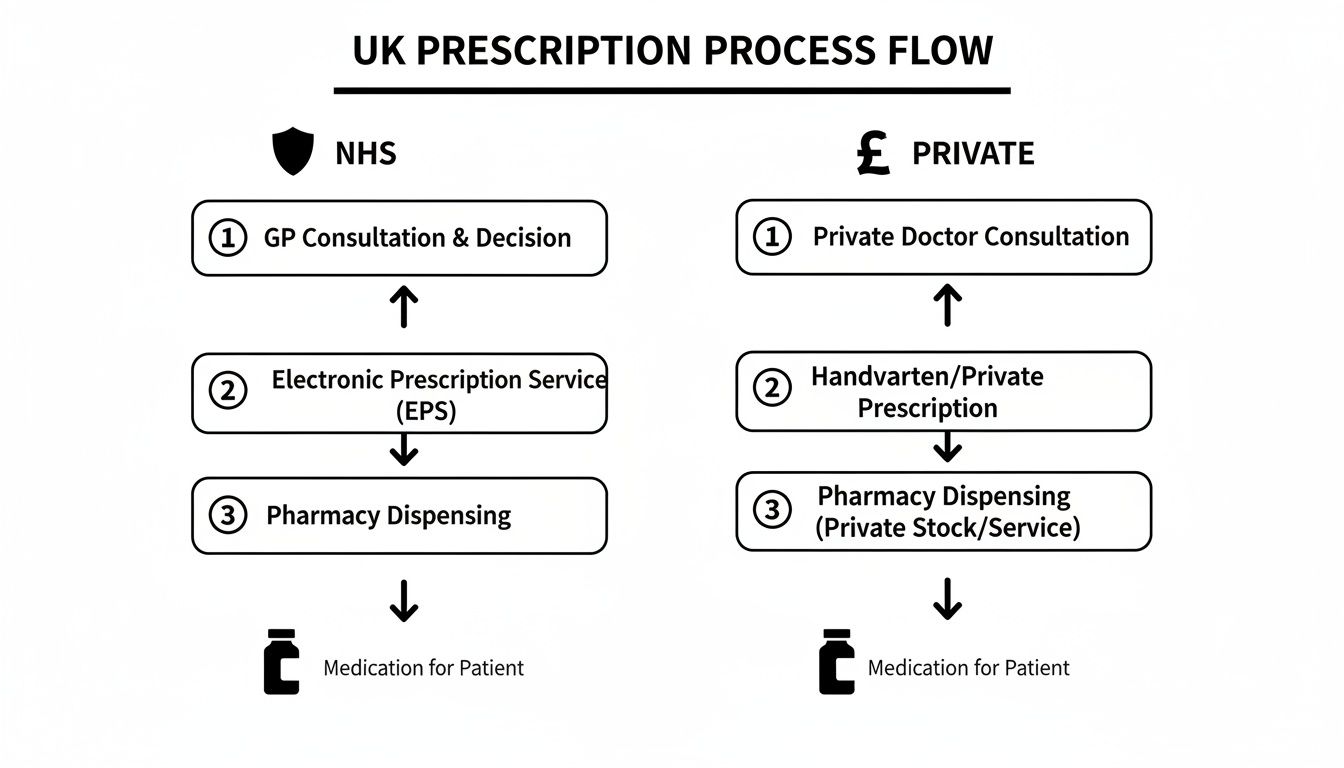
As you can see, the private path is often a much more direct route from seeing a specialist to starting your medication.
Step 3: Receiving Your First Prescription
If medication is the right path forward, your specialist will talk you through the options. For ADHD, this usually kicks off with a process called titration. It’s a careful, methodical approach where you start on a very low dose, which is then gradually increased. The goal is to find that sweet spot—the perfect dose that manages your symptoms without causing difficult side effects.
The titration phase can take a few weeks or sometimes a couple of months. It’s a highly personal journey, and you'll have regular check-ins with your specialist to see how you're getting on and to make any necessary tweaks. It’s worth noting that even privately, there can be a wait to start titration, sometimes up to several months if a clinic is particularly busy. While Autism is not primarily treated with medication, co-occurring conditions like anxiety or depression might be, and a psychiatrist can manage these prescriptions too.
A private prescription is more than just a piece of paper; it represents the start of an active, specialist-led treatment plan. The goal is to stabilise your condition safely before considering long-term care options.
Once you and your specialist are happy that you're on a stable and effective dose, they'll issue your first official private prescription.
Step 4: Getting Your Prescription Dispensed
The final piece of the puzzle is taking that prescription to a pharmacy. The good news is that pretty much any registered pharmacy in the UK can handle it—from big high-street chains to your local independent chemist or an online pharmacy. You’ll just need to pay for the full cost of the medication yourself, plus a small dispensing fee from the pharmacy.
Here's a tip: it's always a good idea to ring the pharmacy beforehand to make sure they have your specific medication in stock. This is especially true for more specialised ADHD treatments. Once your prescription is filled, you've done it—you've successfully navigated the private system to begin your treatment.
Understanding Controlled Drugs for ADHD Treatment
If you've recently been diagnosed with ADHD, you'll probably hear your medication—whether it's Elvanse, Concerta, or Ritalin—referred to as a ‘controlled drug’. That term can sound a bit alarming, but it’s really just a legal category. It’s designed to make sure these powerful and effective medications are managed with the care they deserve.
It doesn’t mean the medication is inherently dangerous when taken as prescribed. It just means there are a few more safeguards in place. Think of it less as a warning sign and more as a high-security system for your treatment, ensuring everything is handled safely and correctly. These rules exist because stimulant medications, while life-changing for many, have a potential for misuse. The regulations are simply a safety net.
One of the most important rules you’ll encounter is the lifespan of your prescription. A UK private prescription for a controlled ADHD medication is only valid for 28 days from the date it's signed by your specialist. This is a strict deadline, unlike a standard prescription which is usually valid for six months.
It's absolutely crucial to get your prescription to the pharmacy and have your medication dispensed within that 28-day window. If you miss it, the prescription becomes legally invalid. You'll have to go back to your specialist for a new one, which can unfortunately lead to delays in getting your medication.
Why Are Regular Health Checks So Important?
Starting ADHD medication isn’t a one-off event; it's the beginning of an ongoing journey with your clinician. Regular monitoring is a fundamental part of private treatment to ensure the medication is not only working for you, but is also completely safe.
Your specialist will check a few key health metrics before you even start, and will continue to do so throughout your treatment. These are routine checks, purely for your wellbeing.
Here’s what they’ll keep an eye on:
- Blood Pressure and Heart Rate: Stimulants can sometimes cause a slight increase in blood pressure or heart rate, so monitoring these is essential to make sure they remain in a healthy range.
- Weight Monitoring: Some ADHD medications can suppress appetite. Tracking your weight helps ensure there are no significant or unhealthy changes.
- General Wellbeing: Your clinician will also want to know how you’re feeling overall. They’ll ask about your mood, sleep, and general wellness to get a complete picture.
This collaborative process ensures your physical health is always the top priority while you and your specialist work together to find the right dose to manage your ADHD symptoms.
Practical Steps at the Pharmacy
The extra safety rules for controlled drugs also apply when you get to the chemist. When you hand over your private prescription for ADHD medication, don’t be surprised if the pharmacist asks to see some photo ID, like a passport or driving licence.
This is a standard procedure to verify your identity before dispensing a controlled medication. It’s just one more layer of the safety protocol designed to protect you.
The growth in UK private prescriptions isn’t limited to mental health. The private sector often steps in to meet specific needs that aren’t a primary focus for the public system. For example, while the NHS manages massive volumes of common medications, private prescriptions for medical cannabis have jumped by a staggering 262% since 2022. This highlights how private healthcare is meeting the demand for specific, highly regulated treatments. You can explore more data about prescription trends to see these patterns for yourself.
At the end of the day, all these rules—the 28-day validity, the health checks, the ID at the pharmacy—are there to make your treatment as safe and effective as possible. Understanding the 'why' behind them helps demystify the process, letting you focus on the positive changes your treatment can bring.
Managing Costs and Seeking a Shared Care Agreement
Going private for an ADHD or Autism diagnosis gives you the speed and specialist expertise that’s often so desperately needed. But it's vital to be realistic about the financial side of things. The initial assessment is just the first step; the ongoing cost of private medication is a major factor you'll need to plan for.
For most people, the end goal is to blend the speed of the private sector with the affordability of the NHS. This is where a Shared Care Agreement comes in. It’s the crucial bridge between the two systems, creating a pathway to affordable, long-term treatment.
Understanding the Full Cost of Private Treatment
When you go down the private route for mental health support, you pay for every part of your care directly. This makes budgeting straightforward, but it also underlines why a long-term plan is so important. The costs stack up across several key stages.
Here's what your financial journey will likely look like:
- Initial Assessment Fee: This is the one-off payment for your in-depth diagnostic assessment with a consultant psychiatrist for ADHD or Autism.
- Titration Period Costs: This is the phase where your specialist fine-tunes your medication and dosage. It involves follow-up appointments and several private prescriptions as your dose is adjusted.
- Ongoing Private Prescriptions: Once you're on a stable dose, you'll need a new UK private prescription every month. You pay the full price for this, which can easily be £80 to £120 per month for ADHD medication, sometimes more.
- Annual Review Fees: Good private clinics insist on at least one check-up a year to see how you're doing and continue your prescription. This comes with its own consultation fee.
This commitment can really add up, particularly over many months or years. For a more detailed breakdown, have a look at our guide on the cost of ADHD medications. It’s this financial reality that makes securing a Shared Care Agreement a top priority for most people.
What Is a Shared Care Agreement?
A Shared Care Agreement (SCA) is exactly what it sounds like: a formal arrangement between your private specialist, your NHS GP, and you. It’s a three-way partnership built to keep your care consistent and safe. Put simply, your private specialist stays in charge of your overall treatment plan, but your GP agrees to handle the routine task of prescribing.
Think of a Shared Care Agreement as a formal handover. Your private specialist has expertly designed the blueprint for your care, and your GP agrees to handle the ongoing construction work, issuing your monthly prescriptions on the NHS.
With a successful SCA in place, your medication costs plummet from the full private price to the standard NHS prescription charge. For many families, this is what makes long-term ADHD treatment possible. It's crucial to remember, though, that getting one isn't an automatic right.
How to Approach Your GP for an Agreement
Starting the conversation about shared care needs a proactive and collaborative mindset. Your GP isn't obligated to say yes, so the way you approach it can make all the difference.
Follow these steps for the best chance of success:
- Inform Your GP Early: Let your GP know from the outset that you're seeking a private assessment for ADHD or Autism. Being transparent builds trust and keeps them in the loop.
- Choose a Reputable Specialist: GPs are far more likely to agree to shared care with a GMC-registered specialist from a CQC-regulated clinic. A thorough, high-quality diagnostic report is non-negotiable.
- Wait Until You're Stable: Don't jump the gun. A shared care request should only be made after your specialist has finished the titration process and found a stable, effective dose for you. Your GP will not take over prescribing while your medication is still being adjusted.
- The Formal Request: Your private specialist will handle this. They will write to your GP with the full diagnostic report, details of your stable medication plan, and a formal request to enter into a Shared Care Agreement.
- Schedule a Discussion: Book an appointment with your GP to talk about the letter. Be ready to chat about your diagnosis and how the medication has helped you. Just as importantly, listen to any questions or concerns they might have.
Unfortunately, this is where some people hit a roadblock. We’ve heard from clients who, after finally getting a diagnosis and completing titration for their ADHD, have had their GP refuse an SCA. This can leave them in a terrible position, forced to either keep paying privately or stop taking their medication. It really highlights how vital a supportive GP relationship is. The agreement needs everyone to consent, and a GP might decline if they feel it’s outside their clinical expertise or have concerns about the private provider.
Your Questions Answered
When you're dealing with private healthcare for conditions like ADHD, Autism, or other mental health needs, it's only natural to have a few practical questions. Let's run through some of the most common queries people have about handling their UK private prescriptions.
Can I Take My Private Prescription to Any Chemist?
Yes, absolutely. You can take a private prescription to almost any registered pharmacy in the UK. Whether it's a big high-street name like Boots or LloydsPharmacy, your trusted local independent chemist, or even an online pharmacy, they can all dispense it for you.
This gives you the freedom to shop around for the best price, as the cost of the medication itself can differ quite a bit from one pharmacy to another. It’s always a smart move to ring them up first, particularly if you've been prescribed a controlled drug for ADHD, just to make sure they have it in stock. Don't forget to bring your photo ID, as the pharmacist will need to check it before handing over these types of medicines.
Do I Have to Tell My NHS GP About My Private Treatment?
Keeping your GP in the loop isn't just a good idea – it's crucial for your safety. Any credible private specialist will make it standard practice to communicate with your NHS GP right from the start of your ADHD or Autism assessment process.
Once you’ve had your assessment and received a diagnosis, your specialist will send a comprehensive letter to your GP. This will cover the diagnosis, the treatment plan they recommend, and the details of any medication prescribed. This ensures your NHS medical record is complete, which is vital for your long-term health and is the first step towards setting up a potential Shared Care Agreement down the line.
Think of it like this: your private specialist and NHS GP are two key players on your healthcare team. Open communication means everyone has the full picture, ensuring your care is joined-up and safe.
What Happens if My GP Says No to a Shared Care Agreement?
It's a tough situation to be in. You've been through the whole diagnosis and medication titration process, only for your GP to decline a Shared Care Agreement. It can feel really disappointing, but it's important to know that GPs are not required to accept them.
Their refusal is rarely personal. It often comes down to a few key reasons:
- Lack of Experience: The GP might not feel confident managing the specific medication, especially specialist ADHD treatments.
- Clinical Responsibility: They may feel the complex monitoring required is best left in the hands of a specialist.
- Practice Policy: Some surgeries simply have a blanket policy not to enter into shared care arrangements with private providers.
Your first move should be to book an appointment with the GP to have a calm chat about their reasons. If they can't be persuaded, your options are to continue paying for your prescriptions privately or, in some cases, you might consider registering with a different GP practice that is more open to these agreements.
How Long Do I Have to Use a Prescription for Controlled Drugs?
This is one rule you really can't forget. For controlled drugs – which covers most stimulant medications for ADHD – a private prescription is only valid for 28 days from the date your specialist wrote it.
You have to get the prescription filled at a pharmacy within that 28-day period. If you miss the deadline, the prescription is legally void. The pharmacy won't be able to dispense it, and you'll have to go back to your private clinic for a new one, which often means delays and extra costs. Pop a reminder in your phone – it’s a simple trick to make sure you never get caught out.
At Insight Diagnostics Global, we provide clear, expert-led assessments for adults with ADHD, Autism, and other mental health conditions. If you're ready to get the answers you need from CQC-regulated specialists, find out more about our services at https://insightdiagnostics.co.uk.