

If you're an adult in the UK wondering if you might be autistic, you're not alone. Figuring out how to get an assessment can feel overwhelming, but it boils down to two main routes: going through the NHS or seeking a private assessment. This guide is designed to help you navigate this complex journey, with a special focus on the common overlaps between autism, ADHD, and mental health.
Why More Adults Are Seeking an Autism Diagnosis
Have you ever felt like you're operating on a different wavelength from everyone else? For many, this quiet sense of being out of sync has been a lifelong companion. A growing awareness of neurodiversity means more people are connecting their experiences—from social exhaustion after work to having deep, specific interests—to the possibility of being autistic.
This realisation often sparks a powerful need for clarity. An official diagnosis can feel like finding the missing piece of a puzzle you didn't even know you were solving. It offers a framework for understanding past struggles and present challenges, validating that your experiences are real and often linked to your mental health. For most, it’s not about getting a label; it's about finally having the language to describe their inner world.
Understanding Your Diagnostic Options in the UK
When it comes to getting an adult autism assessment, you have two primary pathways in the UK. The NHS provides this service free of charge, but the waiting lists can be incredibly long—sometimes stretching on for years. The private route is much faster, but it comes with a significant financial cost.
Deciding which path to take is a personal choice based on your circumstances, like how urgently you need answers, your budget, and the impact the uncertainty is having on your mental health.
This decision aid flowchart can help you visualise the main choices you'll face.
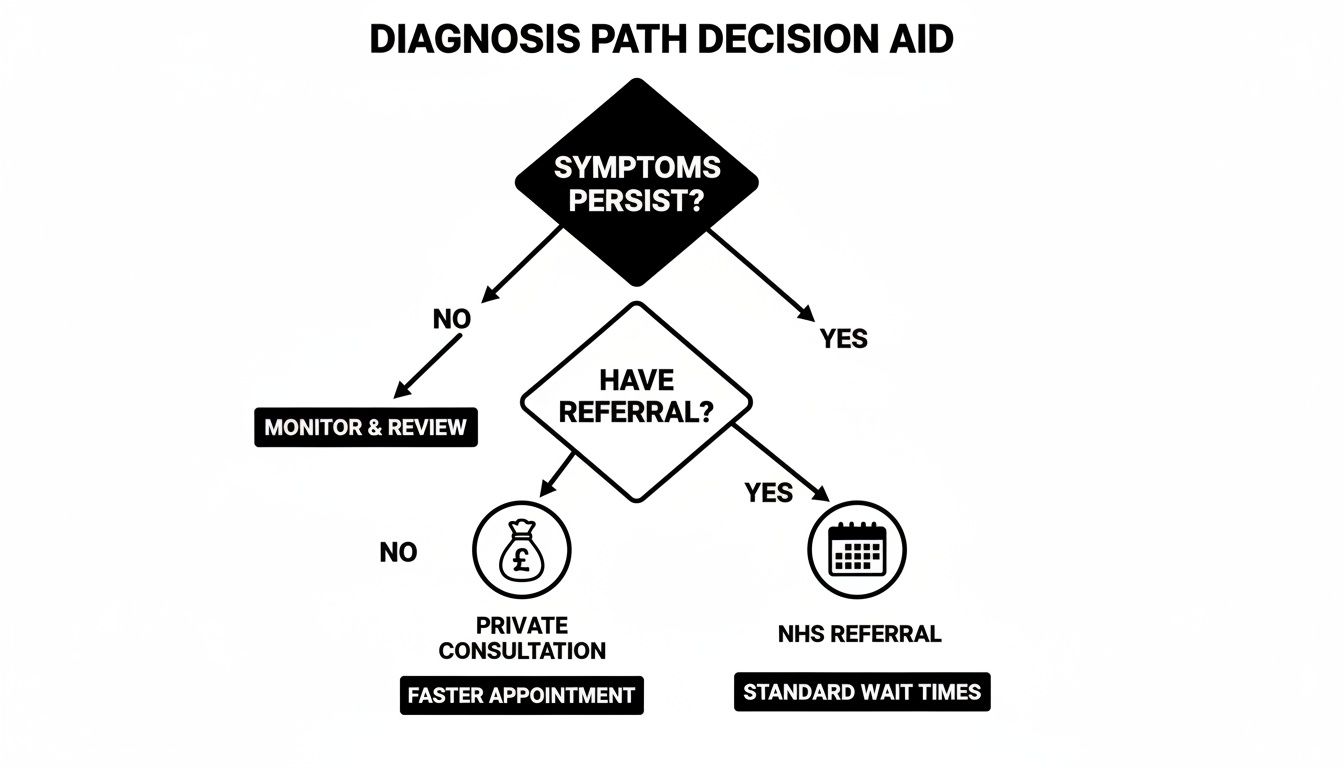
The flowchart shows how the NHS route (represented by the calendar) prioritises free access but demands patience, while the private option (the money icon) offers speed for those who can afford it.
To help you weigh the pros and cons, here's a quick side-by-side comparison.
NHS vs Private Adult Autism Assessments at a Glance
| Factor | NHS Pathway | Private Pathway |
|---|---|---|
| Cost | Free at the point of service | Typically costs £1,500 – £3,000+ |
| Wait Times | Very long; often 2-5+ years | Much shorter; typically a few weeks to 6 months |
| Referral Process | Requires a GP referral to a local NHS service | Can often self-refer directly to the clinic |
| Choice of Clinician | Little to no choice; assigned by the local service | You can choose your provider based on expertise/reviews |
| Report Recognition | Universally accepted by NHS, DWP, and education | Acceptance can vary; most reputable clinics are recognised |
| Post-Diagnosis Support | Varies widely by region; can be limited or slow | Often offer integrated post-diagnostic support (at a cost) |
Ultimately, the right choice depends on what you value most: cost-free access or a faster, more controlled process.
The Overlap with ADHD and Mental Health
It's crucial to recognise that autism rarely exists in a vacuum. There's a significant overlap with other conditions, particularly ADHD, anxiety, and depression. In fact, many autistic adults also have ADHD—a combination sometimes referred to as AuDHD.
Years of "masking"—consciously or unconsciously trying to fit into neurotypical standards—can take a heavy toll on mental health, often leading to burnout, anxiety, depression, or misdiagnoses of other conditions. The chronic stress of navigating a world not built for your brain is a key reason many seek a diagnosis in the first place.
A thorough, high-quality assessment should always explore these co-occurring conditions. A skilled clinician understands that anxiety or depression might not be separate issues, but a direct result of living as an undiagnosed autistic and/or ADHD person.
As you start this journey, exploring the signs of undiagnosed autism in adults can give you more confidence and clarity. This self-knowledge is the vital first step toward seeking an assessment that can finally provide answers.
Pursuing a Diagnosis Through the NHS
Going down the NHS route for an adult autism diagnosis is often a test of endurance. It's completely free, which makes it the only realistic path for most people, but you'll need to arm yourself with a good deal of patience and do your homework beforehand. The whole process kicks off with a single, vital conversation: a chat with your GP.
This first appointment is your gateway to getting a referral. Before you even book it, it’s a smart move to get all your thoughts and experiences in order. GPs are almost always short on time, so being clear, concise, and prepared will make that brief window far more effective. Your aim is to give them a clear picture of why you believe an autism assessment is the right next step for you, especially highlighting the impact on your mental health.
Preparing for Your GP Appointment
Walking into that appointment with a well-thought-out case can genuinely make or break your chances of getting a referral. Simply saying, "I think I might be autistic," probably won't be enough. What works better is providing real, tangible examples of how your traits show up in your day-to-day life—at work, in your relationships, and how they connect to any mental health challenges you're facing.
A lot of people find it incredibly helpful to put together a list or even a short personal summary. This shouldn't just be a catalogue of struggles; it's also about highlighting your unique ways of thinking and any strengths you've noticed.
Here are a few practical things you can do to build your case:
- Jot Down Your Traits: Make a list of specific examples, stretching back to childhood if you can, that you feel align with autism. Think about things like social interactions, any sensory sensitivities you have (to light, sound, textures), how much you rely on routine, or any deep, intense interests. Also, note any signs that might point to co-occurring ADHD.
- Try Some Self-Assessment Tools: While they can't diagnose you, online screeners like the AQ-10 or RAADS-R are great for organising your thoughts. Printing out your results and bringing them along can give your request more weight.
- Bring in a Trusted Voice: If you can, ask a parent, a long-term partner, or a close friend for their take. Their memories of your childhood or observations of your social patterns can add valuable context that a GP will find useful.
This prep work shows your GP that you’ve seriously considered this and that your concerns are based on lifelong patterns, not just a passing thought. It also helps to underline the real-world impact these traits are having on your life and mental health.
The Referral and Triage Process
If your GP is convinced that an assessment is needed, they’ll put in a referral to your local NHS adult autism assessment service. It's really important to realise that this isn't a golden ticket for an immediate assessment. It's simply the starting pistol for another waiting game.
Once the service gets your referral, it goes into what's called triage. A clinical team will review all the notes from your GP to decide if there’s enough there to move forward. It’s pretty common for them to send you more questionnaires at this stage to get a more detailed picture, often asking about mental health and other neurodevelopmental conditions.
Think of it like this: your referral has just been placed in a very long queue. The triage team's job is to make sure an autism assessment is actually the right path for you and to prioritise people based on clinical need.
This is a make-or-break point. If the referral packet is thin on detail or doesn't strongly suggest autism, it might get rejected. This is exactly why putting in that effort before your GP appointment is so crucial—that initial information is the foundation for everything that follows.
Understanding and Managing the Wait
Once your referral is officially accepted, you enter what is often the most frustrating part of the NHS journey: the wait itself. The path to getting an autism diagnosis through adult NHS services has slowed to a crawl in recent years. The caseloads are enormous and the waits are just getting longer.
As of June 2025, official NHS data showed a staggering 236,225 people in England were on the waiting list for a suspected autism assessment. Of those, nearly nine in ten (211,104, or 89%) had already been waiting longer than the 13 weeks recommended by NICE guidelines. The average wait time has now stretched to over 17 months.
This kind of prolonged uncertainty can be incredibly tough, especially when you’re desperate for answers to help your mental health. Finding ways to cope during this limbo period is vital.
Here are a few things you can do to stay proactive:
- Get Other Support in Place: Don't put your mental health on hold. If you're dealing with anxiety or depression, talk to your GP now about getting access to therapy or other NHS mental health services. Managing these conditions can be beneficial regardless of a diagnosis.
- Find Your People: Connecting with online communities or local peer support groups for autistic and AuDHD adults can be a lifeline. The validation and practical tips from people who just get it can be immense.
- Become Your Own Expert: Use the time to learn. Read books, listen to podcasts, and watch videos made by other autistic people. It can help you understand yourself better and start figuring out coping strategies that work for you, formal diagnosis or not.
The key is to keep moving forward. The system may be slow, but you can use this time to learn, connect, and look after yourself. Getting a clearer idea of how long an autism diagnosis takes across different pathways can also help set realistic expectations.
Choosing the Private Assessment Pathway
For many, the thought of waiting years for an NHS assessment just isn't an option. When you're grappling with your mental health, struggling at work, and desperately seeking answers about who you are, a private assessment offers a much faster route to clarity. It puts you back in the driver's seat, but it does mean you need to do your homework to make sure you’re investing in a diagnosis that's both credible and genuinely helpful.
Going private is a significant financial commitment. You can expect assessment costs to range anywhere from £1,500 to over £3,000, so it’s vital to understand exactly what your money is getting you. A reputable clinic will always provide a clear breakdown of costs, which should cover a comprehensive diagnostic process that also screens for co-occurring conditions like ADHD.

Typically, that fee includes pre-assessment questionnaires, an in-depth clinical interview, a follow-up feedback session, and a detailed diagnostic report. Getting to grips with what a private autism assessment in the UK actually entails will empower you to compare providers and choose wisely.
Finding a Reputable Clinician
Let's be clear: not all private services are created equal. The quality and legitimacy of your diagnosis hinge entirely on the credentials and experience of the clinician you choose. As you research your options, there are a few non-negotiable standards you need to look for.
First and foremost, check the clinician's professional registration. In the UK, anyone diagnosing autism must be registered with a statutory body like the Health and Care Professions Council (HCPC) for psychologists or the General Medical Council (GMC) for doctors. This is your guarantee that they meet national standards for training, professional skills, and ethical conduct.
But basic credentials aren't enough. You need a specialist who truly understands how autism presents in adults, which is a world away from diagnosing children.
- Experience with Masking: Look for clinicians who specifically mention their expertise in assessing high-masking individuals. Many autistic adults, especially women and non-binary people, have spent a lifetime learning to camouflage their traits. A practitioner who isn’t familiar with masking won’t be able to see beyond the performance.
- Knowledge of Co-occurring Conditions: This is non-negotiable. It's incredibly common for autism, ADHD, and anxiety to be intertwined. A skilled clinician will be able to untangle these conditions and understand how they influence one another, rather than misattributing traits.
- Adherence to NICE Guidelines: Make sure the assessment process follows the National Institute for Health and Care Excellence (NICE) guidelines. This is the gold standard in the UK and ensures your diagnostic report will be recognised by employers, universities, and other institutions when you request reasonable adjustments.
The Importance of a Specialist in Co-occurring Conditions
The overlap between autism and ADHD is so common that the community has coined the term "AuDHD" to describe the experience of having both. This is why finding a clinician who is an expert in both conditions can be a game-changer. An integrated assessment explores all facets of your neurotype at once, saving you from having to seek out separate, costly evaluations later on.
When you start looking, you'll find clinics that specialise in these co-occurring presentations. For example, an Audhd Psychiatry clinic might offer diagnostic services for both conditions, which is ideal for adults who suspect they might be dealing with more than one thing. This approach ensures that traits like executive dysfunction or sensory sensitivities are correctly attributed, leading to a much more accurate and useful outcome.
A diagnosis is more than just a label; it's a key that unlocks self-understanding and appropriate support. Choosing a clinician who understands the complex interplay of autism, ADHD, and mental health ensures that your key fits perfectly.
Ultimately, investing in a private assessment is an investment in yourself. By doing the research and selecting a highly qualified, specialist clinician, you're taking a powerful step toward gaining the clarity and validation you need to move forward with your life.
What to Expect During Your Diagnostic Assessment
Knowing what’s actually involved in an autism assessment can take a huge weight off your shoulders. Whether you’re going through the NHS or a private clinic, the nuts and bolts of a proper, high-quality evaluation are pretty much the same. The goal is to build a detailed, lifelong picture of who you are, from your earliest memories to your experiences today.
This isn't a simple pop quiz or a checklist exercise. Think of it more as a deep dive into how your brain is wired. Clinicians are looking for consistent patterns that fit the diagnostic criteria for Autism Spectrum Disorder (ASD), paying close attention to your social communication, how you interact with others, and any specific, intense interests or repetitive behaviours you might have, while also considering how these may overlap with ADHD or anxiety.
The Core Parts of an Assessment
A robust adult autism assessment isn’t just one thing; it's a multi-layered process designed to get the most accurate result possible. You can expect a mix of in-depth interviews, questionnaires, and sometimes specific observational tasks.
You’ll often hear about two "gold standard" assessment tools:
- ADOS-2 (Autism Diagnostic Observation Schedule, Second Edition): This is a series of activities and conversations that a clinician guides you through. It’s designed to let them see your social communication and interaction styles in real-time, rather than just hearing you talk about them.
- ADI-R (Autism Diagnostic Interview-Revised): This is a long, structured interview, usually done with a parent, carer, or someone who knew you well as a child. Its whole purpose is to gather a detailed picture of your early development, because a key part of an autism diagnosis is showing that traits were there from childhood.
That said, not every clinic uses these exact tools. Some excellent, more modern conversational approaches work just as well for adults. The most important thing is that the assessment is thorough, looks at your entire life story, and considers co-occurring conditions.
Gathering Your Supporting Information
Believe it or not, your personal history is the single most important piece of evidence. The clinicians need to understand your experiences right from childhood, and the more detail you can give them, the clearer everything becomes. It’s a brilliant idea to start pulling this information together before you even have an appointment.
Think of yourself as the lead detective in the story of your life. What clues can you dig up?
- Old school reports: These are often a goldmine. Teachers’ comments about you struggling with group work, having an all-consuming interest in one topic, or finding unstructured playtime difficult can be incredibly telling. Comments about being "dreamy" or "distracted" could also point to co-occurring ADHD.
- Personal journals or diaries: Your own words from the past can offer raw, unfiltered insights into your inner world, social anxieties, and sensory sensitivities.
- Input from someone you trust: Ask a parent, an older sibling, or a long-term partner for their honest memories and observations. They might recall details you've long forgotten or notice patterns in your behaviour that you're too close to see.
Your lived experience is the central piece of this puzzle. The aim isn’t to "prove" you’re autistic, but to give the clinician an honest and comprehensive account of your life so they can make an accurate, informed decision.
This screenshot from the official NICE guidelines outlines what a comprehensive assessment should cover.
As you can see, the guidelines emphasise the need for a multi-disciplinary team, looking at co-occurring conditions, and basing the final conclusion on a full developmental history.
Preparing for the Clinical Interview
The heart of your assessment will be a long, detailed conversation with the clinician. This is your chance to be completely open about your challenges, your strengths, and what it’s really like to be you. Many autistic adults, especially those who also have ADHD or anxiety, are masters of masking their traits. It's so important to talk about the sheer effort that goes into that performance.
Try to explain the why and the how behind your actions, not just what people see on the surface.
- Instead of just saying, "I'm fine at parties," try something like, "I can handle a party for about an hour if I have to. I use a mental script for small talk, but afterwards I’m so exhausted I need a full day to recover."
- Rather than, "I do well at work," you could explain, "I always hit my deadlines, but only because I’ve built complex systems of lists and reminders to manage my executive dysfunction. If my routine gets interrupted, I feel incredibly distressed."
Being this vulnerable is tough, but it's crucial for getting an accurate outcome. The clinician is there to understand, not to judge. This detailed process is also why official waiting times are so often missed. The UK’s clinical guideline for autism assessment, produced by NICE, says the process should take no more than 13 weeks from referral. In reality, national reports show this is rarely met, with average waits in late 2024 and early 2025 hitting 16–17 months—a far cry from the standard. You can read more about these autism assessment waiting times and the reasons behind them.
Life After Diagnosis: Navigating Your Next Steps
Getting a diagnosis can feel like a seismic shift. For many, it's the first time a lifetime of feeling 'different' finally clicks into place—a moment of profound, sometimes overwhelming, validation. This new understanding is an incredible tool, but it's also the start of learning to see yourself and the world from a completely new perspective.
The most important thing to do first? Just breathe. Give yourself the time and space to process it all. There’s no right or wrong way to feel; relief, grief for a past you didn't understand, excitement, and confusion can all show up at once. Think of your diagnostic report not as a label, but as a long-overdue user manual for your own brain.
Making Sense of Your Diagnostic Report
You'll receive a detailed document that summarises your developmental history, the clinician's observations, and how your traits map onto the formal criteria for Autism Spectrum Disorder (ASD). If co-occurring conditions like ADHD were assessed, this will be covered too. It’s written to be a practical, useful document.
It will likely point out your unique strengths alongside the areas where you face challenges. Take your time with it. See how the clinical language connects back to your actual, lived experiences. This report is your official key to unlocking support and making your life work better for you.
Finding Post-Diagnostic Support
A diagnosis opens doors that were likely closed before. It's a chance to stop just "coping" and start building a life that actually fits your neurology, rather than constantly fighting against it.
Here are a few places to start:
- Specialist Therapy or Coaching: Find therapists or coaches who genuinely specialise in working with neurodivergent adults. They can provide practical strategies for managing sensory overwhelm, executive dysfunction, and recovering from autistic burnout.
- Peer Support Groups: Honestly, this is a game-changer. Connecting with other autistic or AuDHD adults is one of the most validating things you can do. Finding your community means you can share experiences with people who just get it without a long explanation.
- Mental Health Support: It's so important to address co-occurring conditions like anxiety, depression, or ADHD. An autism diagnosis often reframes these issues, showing how they can be linked to the chronic stress of trying to fit into a neurotypical world. A diagnosis can help you access more appropriate and effective mental health care.
After a diagnosis, putting your well-being first with some solid mental health self-care tips is crucial. This is your time to unlearn years of self-criticism and start being kinder to yourself.
Accessing Practical Support and Accommodations
Your diagnostic report is more than just a piece of paper; it’s official documentation of your neurotype. This is what gives you legal protection and access to tangible support, turning personal insight into real-world change.
Under the Equality Act 2010, autism is considered a disability. This gives you the right to request reasonable adjustments at work or in education to ensure you’re not put at a disadvantage.
Your diagnosis empowers you to advocate for your needs. It’s not about asking for special treatment; it’s about creating an environment where you can thrive, just like everyone else.
So, what does that look like in practice?
- At Work: This could mean asking for a desk in a quieter part of the office, getting instructions in writing instead of verbally, having flexible hours to avoid a stressful commute, or simply being able to wear noise-cancelling headphones.
- At University: You might request extra time in exams, access to a note-taker so you can focus on the lecture, or the option to present to a smaller group instead of a full lecture hall.
Since many autistic adults also have ADHD, their support needs can overlap or be distinct. Our guide on securing reasonable adjustments for ADHD offers more specific ideas you might find helpful.
Reframing Your Identity and Future
Living without a diagnosis means you are one of an enormous, unseen group. Several UK analyses estimate that hundreds of thousands of adults are autistic without knowing it; one report suggested somewhere between 150,000 and 500,000 people aged 20–49 in England alone could be autistic and undiagnosed. To discover more insights about these figures, you can read the full report here.
Receiving your diagnosis is your chance to step out of that statistic and into a place of self-knowledge. It lets you look back at your life through a new lens, finally understanding that past struggles with anxiety, depression, or social difficulties weren’t a personal failing, but the result of a mismatch between your brain and your environment.
This is the beginning of a journey—one of self-acceptance, empowerment, and building a life that truly, authentically works for you.
Your Questions About Adult Autism Diagnosis Answered
Going through the process of an adult autism assessment often brings up more questions than answers at first. It’s completely normal to feel a bit overwhelmed. Here, I'll tackle some of the most common queries I hear, drawing on years of experience guiding adults through this journey.
Can I Be Autistic if I’m Successful and Good at Masking?
Yes, absolutely. This is one of the biggest and most damaging myths surrounding autism in adults. Many autistic people, especially those assigned female at birth, become incredibly skilled at masking—that’s the conscious or subconscious effort to hide autistic traits to better fit into neurotypical society.
A good clinician knows that surface-level success doesn't tell the whole story. They’ll dig deeper, asking about the hidden costs of that success. Think about the crushing social burnout you feel after a day of meetings, the sensory overwhelm of a busy office, or the sheer exhaustion from 'performing' normality all day long. This chronic effort is a major contributor to anxiety and burnout, which are significant mental health issues in the autistic community.
What Should I Do if My GP Won’t Refer Me?
This is a tough spot to be in, and sadly, it’s a common roadblock. If your GP is hesitant or dismissive, the first practical step is to book an appointment with a different doctor at the same surgery. Sometimes a fresh perspective is all it takes.
When you go, be prepared. Don’t just describe your feelings; show your workings. Bring a clear, structured list of your traits and how they affect you, and if you can, link them back to the official diagnostic criteria. Including the results of any online self-assessment tools can also add weight to your case.
It can be powerful to mention NICE guideline CG142, which is the official guidance for the NHS on referring adults for autism assessment. If you're still met with a 'no', you have every right to ask about the practice's formal complaints procedure.
Is a Private Diagnosis Accepted by the NHS?
For the most part, yes. A diagnosis from a reputable private clinic that follows NICE guidelines is valid and will almost always be accepted by employers, universities, and the DWP for things like reasonable adjustments or benefits. The tricky part comes when you try to access post-diagnostic support through the NHS.
Some local NHS trusts will happily accept a private report to get you into their support services. Others, however, may insist you join their own waiting list for a full NHS assessment before you can access their services. It’s a bit of a postcode lottery.
I always advise people to check the policy of their local integrated care board (ICB) or mental health trust beforehand. This can be a major deciding factor when you're weighing up the NHS vs private route, particularly if ongoing NHS support is a priority.
What’s the Difference Between Autism and ADHD Assessments?
It's a great question, especially since the two conditions so often go hand-in-hand. While there’s a big overlap in traits like executive dysfunction, emotional dysregulation, and sensory sensitivities, the core focus of each assessment is very different.
- An autism assessment looks for lifelong patterns in social communication, social interaction, and what are known as restricted or repetitive behaviours and interests.
- An ADHD assessment hones in on patterns of inattention, hyperactivity, and impulsivity that significantly affect your day-to-day life.
With an estimated 30-80% of autistic people also having ADHD, many adults benefit from a combined assessment. If you can, finding a clinician who specialises in both gives you the best chance of getting a complete picture of your neurotype. It ensures the support you get is right for your unique brain. The journey of figuring out how to get an autism diagnosis as an adult is often one of self-discovery, and understanding these distinctions is a huge part of that.
At Insight Diagnostics Global, we provide consultant-led, CQC-regulated online assessments for adults seeking clarity on autism, ADHD, and other mental health conditions. Our experienced psychiatrists deliver robust, NICE-guideline-compliant diagnostic reports to help you understand your neurotype and access the support you need. Learn more about our services at https://insightdiagnostics.co.uk.