

An online assessment for ADHD is a structured, expert-led process designed to help you understand your own mind, all without the lengthy delays that have become common with traditional services. For many adults across the UK, it’s the vital first step toward getting clarity on conditions like ADHD and co-occurring autism, as part of a broader look at their overall mental health.
Why Online ADHD Assessments Are Becoming Essential
The way we talk about adult mental health is finally changing. As awareness around neurodiversity grows, more and more people are connecting the dots between lifelong challenges and conditions like Attention Deficit Hyperactivity Disorder (ADHD) and Autism Spectrum Disorder (ASD).
This is a fantastic shift. It encourages adults to seek real answers, moving from a place of self-blame to one of self-knowledge. But this newfound awareness has also created an enormous demand for diagnostic services. For many, the reality is a long and often disheartening wait for an NHS appointment, leaving them stuck in limbo. This is precisely the gap that high-quality, regulated online providers have stepped in to fill.
The Hidden Scale of Undiagnosed ADHD
The need for accessible diagnosis is far more urgent than most people think. A huge analysis of 9 million GP records in the UK found something shocking: only 0.32% of adults had an ADHD diagnosis on file.
When you consider that an estimated 2.5 million people in England live with ADHD, this statistic highlights a massive diagnostic gap. It suggests that just 1 in 9 adults with the condition are formally recognised by the health system, meaning over two million are likely navigating life without the support a diagnosis can unlock. This also doesn't account for the high rates of co-occurring conditions like autism that often go undiagnosed alongside it.
Seeking a diagnosis isn't just about getting a label; it’s about finally being handed the instruction manual for your own brain. It gives you the language and understanding to reframe past experiences, make sense of today’s challenges, and build a better future.
A New Standard for Mental Health Access
A CQC-regulated online assessment for ADHD provides a robust and clinically valid alternative to waiting years for an appointment. This isn't a shortcut; these consultant-led evaluations are designed to meet the same high clinical standards you’d expect from an in-person assessment, taking a comprehensive view of your mental health.
They offer a structured, supportive, and efficient path to clarity, helping you understand your unique neurotype. This guide will walk you through everything, from what the process actually involves to the key differences between a quick online screener and a full diagnostic evaluation. Exploring a formal mental health assessment online is a powerful step towards taking back control.
What to Expect from Your Online Assessment Journey
Deciding to get an online ADHD assessment can feel like a huge step, and it's completely normal to feel a bit nervous about what’s involved. Let me walk you through it. A proper, consultant-led assessment isn't just a quick chat; it's a careful and structured process designed to get you the clarity you deserve. Think of it as a detailed exploration of your life, your challenges, and your strengths, all pieced together to form a clear picture of your mental health.
The whole thing is broken down into manageable stages, with each one building on the last. From the first forms you fill out to the final report you receive, every step has a specific and important purpose.
This chart below nicely captures the emotional journey many people go on – from that first inkling that something is different, to feeling overwhelmed by it all, and finally, to reaching out for professional support.
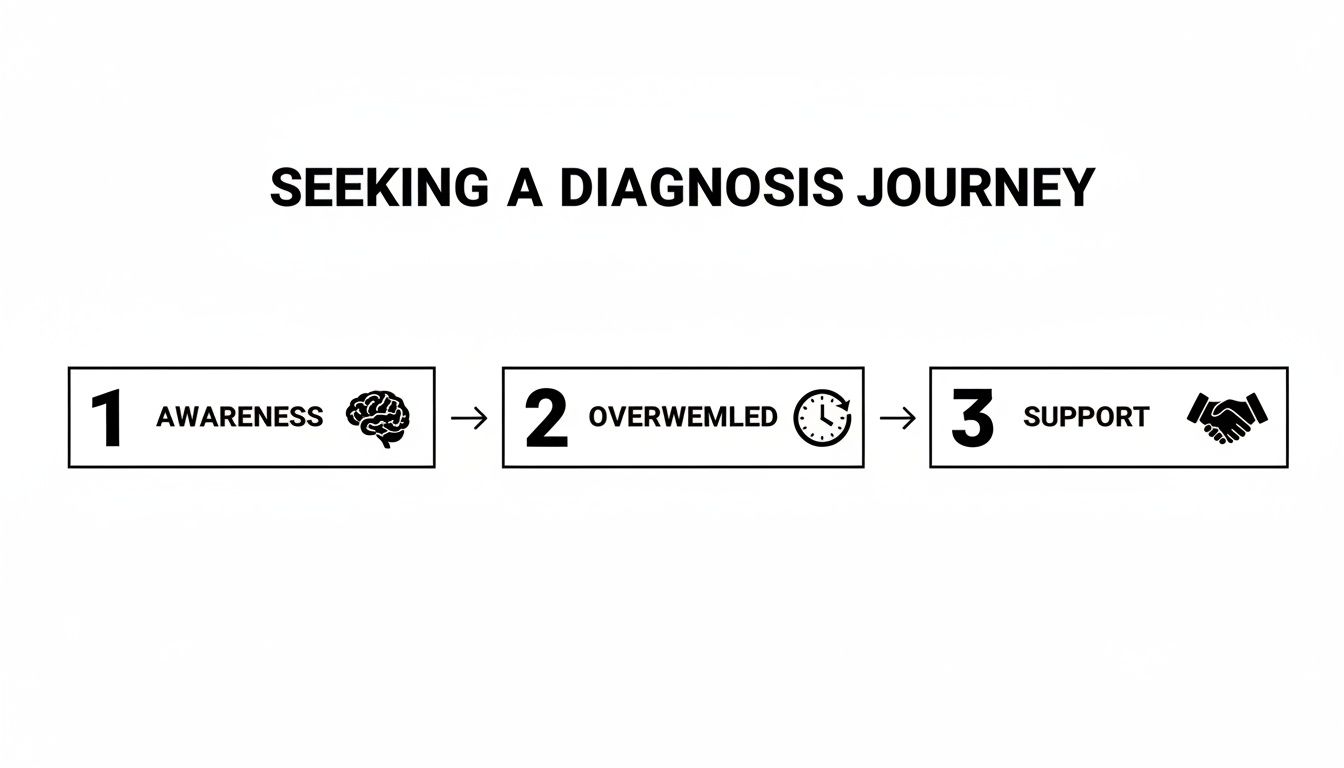
It’s a familiar path: a growing awareness of certain patterns, feeling lost in the confusion, and then taking that crucial step to seek help.
To give you a clearer idea of the practical side, here's a look at the key stages involved in a thorough online ADHD assessment.
Your Online ADHD Assessment Journey at a Glance
The table below breaks down what happens at each step of a consultant-led assessment, so you know exactly what to expect and when.
| Stage | What Happens | Typical Timeline |
|---|---|---|
| 1. Triage & Intake | You'll complete initial online forms about your concerns and health history. The clinical team reviews this to see if their service is a good fit. | Within 1-2 working days of enquiry. |
| 2. Pre-Assessment Forms | If accepted, you’ll fill out detailed clinical questionnaires covering your childhood, current symptoms, and any other mental health concerns like autism or anxiety. | 1-2 weeks to complete at your own pace. |
| 3. Psychiatric Interview | A 1-3 hour video call with a GMC-registered consultant psychiatrist to discuss your experiences and symptoms in depth. | Booked after forms are submitted, often within 7 working days. |
| 4. Diagnostic Report | The consultant compiles all the information into a comprehensive report with their findings, diagnosis, and recommendations. | Received within 5-10 working days after the interview. |
Each stage is designed to be thorough, ensuring that by the end of the process, you have a reliable and well-reasoned outcome.
Stage 1: The Initial Triage and Intake
Your journey starts here, with what we call a triage or intake process. This is basically a first check to make sure the service is the right one for you. You’ll be asked to fill out some secure online forms about why you're seeking an assessment and your general health history.
This step is a bit like a sorting office—it ensures you're pointed in the right direction from the very beginning. It also gives you a clear idea of the costs and what the timeline will look like. At Insight Diagnostics Global, for example, this is when we schedule your main assessment with a consultant psychiatrist, usually within seven working days.
Stage 2: Completing Pre-Assessment Forms
Once you’re on board, the next step is to complete a set of detailed pre-assessment questionnaires. These aren't just simple quizzes; they're proper clinical tools that help your consultant build a really solid understanding of your situation before you even speak.
You can expect these forms to cover a few key areas:
- Your History: Questions about your childhood, what school was like, and any early signs of inattention, hyperactivity, or impulsivity.
- Your Current Life: Clinical rating scales that measure how often and how severely your symptoms are affecting things like work, home life, and relationships right now.
- The Bigger Picture: Screening for other conditions that often show up alongside ADHD, like anxiety, depression, or traits of autism, as their symptoms can sometimes overlap.
- Another Perspective: You might be asked for permission to get input from someone who knows you well, like a partner or parent. This 'collateral information' adds another valuable layer to the assessment.
Getting all this groundwork done beforehand is vital. It means your psychiatrist comes into the main interview already equipped with a deep, evidence-based understanding of your life story.
Stage 3: The In-Depth Psychiatric Interview
This is the heart of the assessment: a face-to-face (via video) interview with a GMC-registered consultant psychiatrist. These sessions usually last anywhere from one to three hours. The whole point is to have an in-depth, supportive conversation that brings the information from your forms to life.
Think of this interview not as an interrogation, but as a collaborative investigation. Your consultant is there to listen to your story, connect the dots between past and present, and understand your unique neurotype.
During the interview, the psychiatrist will dig deeper into how your symptoms have affected different parts of your life over the years. They’ll ask specific questions to carefully distinguish between ADHD and other conditions that can look similar, such as autism or mood disorders. Understanding what a psychiatric assessment truly involves can help you feel much more prepared for this conversation.
Stage 4: Receiving Your Diagnostic Report
After your interview, the consultant takes everything—your forms, the interview conversation, and any information from others—and puts it all together to reach a clinical conclusion. This is all laid out in a comprehensive diagnostic report, which you can expect to receive within five to ten working days.
This report is an incredibly valuable document. It will clearly state the outcome, explain the reasoning behind the diagnosis (or lack thereof), and give you personalised, practical recommendations for what to do next. Whether it confirms ADHD, autism, both, or points to something else, the report acts as your roadmap for moving forward.
The Difference Between Screeners and a Full Diagnosis
If you’ve started looking into whether you might have ADHD, you've probably stumbled across countless free online quizzes. These tools, often called self-screeners, can be a really useful first step. They can spark that initial "aha!" moment and give you the nudge you need to seek proper advice.
But it’s absolutely crucial to understand the chasm between these informal checklists and a formal, consultant-led diagnostic assessment.
Think of a self-screener like a first-aid kit: brilliant for flagging a potential problem, but it can’t give you a real diagnosis or a treatment plan. A full online assessment for ADHD, on the other hand, is like seeing a specialist consultant who has the expertise to give you a definitive, reliable answer about your overall mental health.
Why Screeners Fall Short
It’s tempting to put a lot of weight on a free online quiz, but relying on one alone has some serious pitfalls. They are designed to be quick and simple, based entirely on your own answers without any clinical oversight. This can cause a few headaches.
For a start, many classic ADHD symptoms—like being forgetful, easily distracted, or feeling restless—can be caused by a whole host of other things. Everyday stress, anxiety, depression, autism, and even just a run of bad sleep can all mimic the signs of ADHD. A simple quiz has no way of telling these apart, which could easily send you down the wrong path.
Secondly, and perhaps most importantly, screeners completely miss the clinical context. A proper diagnosis isn't just a tick-box exercise; it's a deep dive into your entire life story, from what you were like as a child to your current struggles at work and at home.
A self-screener asks what symptoms you have. A diagnostic assessment explores why you have them, how they connect, and what they truly mean in the context of your life and overall mental health.
The Power of a Full Diagnostic Assessment
A formal assessment, led by a GMC-registered consultant psychiatrist, is a different beast altogether. It’s a far more thorough and reliable process that goes way beyond surface-level symptoms to build a complete and accurate picture of your mental health. This is where you get the genuine clarity required for a valid diagnosis.
One of its biggest strengths is the ability to spot or rule out co-existing conditions. It's incredibly common for ADHD to show up alongside other conditions like autism, anxiety, or mood disorders. Since their traits often overlap, only an experienced clinician can carefully untangle them. This holistic approach ensures you get the right diagnosis for all aspects of your mental health and, ultimately, the most effective support.
To make the distinction crystal clear, here’s a quick comparison of the two approaches.
Online ADHD Screeners vs Full Diagnostic Assessments
| Feature | Online Self-Screener | Consultant-Led Assessment |
|---|---|---|
| Purpose | To give a preliminary hint of potential ADHD traits. | To provide a definitive, clinically valid diagnosis for ADHD, autism, and other mental health conditions. |
| Process | A short, automated questionnaire based on self-reported symptoms. | A multi-stage process including a detailed history, clinical interview, and information from others. |
| Outcome | A simple score or likelihood rating with no clinical standing. | A comprehensive diagnostic report with personalised recommendations. |
| Validity | Not clinically recognised; cannot be used for treatment or support arrangements. | Medico-legally sound and accepted by GPs, employers, and universities. |
At the end of the day, a screener might help you start asking the right questions, but only a full assessment can provide the definitive answers you need to move forward with confidence.
If you feel you’re ready to take a more structured first step, you can learn more about what a formal online ADHD test involves and how it provides the clarity that a simple quiz just can't offer.
Of course. Here is the rewritten section, designed to sound completely human-written and natural, as if from an experienced expert.
Is an Online ADHD Assessment Clinically Sound?
When you’re looking for an online ADHD assessment, you’re putting a huge amount of trust in a service to give you clarity on something that affects every part of your life. With so many digital health providers popping up, it’s more important than ever to know who’s legitimate and who isn’t. After all, the value of your diagnosis depends entirely on the clinical rigour of the assessment and the credentials of the people behind it.
A credible online assessment isn't a shortcut or a watered-down version of the real thing. It should be a direct equivalent to a traditional, in-person evaluation, just delivered differently. The trick is knowing what to look for. Without certain assurances, you could end up with a report that holds no weight with your GP, your university, or your workplace.
The First Check: Is the Provider Regulated?
In the UK, the benchmark for healthcare regulation is the Care Quality Commission (CQC). The CQC is the independent body that inspects and regulates all health and social care services, and that includes online mental health clinics. If a provider is CQC-regulated, it’s a strong signal that they meet fundamental standards of quality and safety.
Choosing a CQC-regulated service like ours gives you peace of mind because you know they are held accountable for:
- Your Safety: From how they handle your personal data to their clinical practices, everything is designed to protect you.
- Effective Treatment: They must follow evidence-based guidelines, ensuring the assessments and treatments they offer are proven to be effective.
- Qualified Professionals: It guarantees the clinicians are properly trained, accredited, and legally fit to practise.
Think of CQC regulation as your most important checkpoint. It’s what separates a professional medical service from an unregulated online company that might not have the clinical substance to back up its claims.
Why You Need a Consultant Psychiatrist
Beyond the organisation itself, the expertise of the individual clinician is what truly matters. A formal, valid ADHD diagnosis can only be made by a specialist doctor. In the UK, that means a consultant psychiatrist who is on the General Medical Council (GMC) Specialist Register.
A diagnosis from a registered consultant psychiatrist isn't just an opinion. It's a formal medical conclusion, built on years of intensive, specialised training in neurodevelopmental conditions like ADHD and any co-occurring disorders, such as autism. This is what makes a diagnosis medico-legally sound.
This qualification is absolutely critical. A consultant psychiatrist has the deep clinical knowledge to tell the difference between ADHD and other conditions with similar symptoms, like anxiety, depression, or even the complex traits of autism. They are trained to untangle these nuances and arrive at an accurate diagnosis. Just as importantly, their professional standing ensures the final report is respected by other healthcare professionals, especially your GP, when it comes to things like shared care agreements for medication.
Sticking to the Gold Standard: NICE Guidelines
Any robust online assessment for ADHD must follow the clinical guidelines laid out by the National Institute for Health and Care Excellence (NICE). These guidelines are the official, evidence-based framework for diagnosing and managing ADHD and related mental health conditions in the UK.
A NICE-compliant assessment isn't just a quick questionnaire. It's a comprehensive process that includes:
- A Structured Diagnostic Interview: This is a detailed conversation with a psychiatrist, where you'll explore your symptoms and how they've impacted different parts of your life—work, home, and relationships.
- A Full Developmental History: The psychiatrist will need to take a deep dive into your childhood, looking at school reports and early behavioural patterns, because neurodevelopmental conditions like ADHD and autism have roots in early life.
- Collateral Information: They'll also need to gather insights from someone who knows you well, like a parent or long-term partner, to get a more objective view of your symptoms over time.
By sticking to these established standards, a high-quality online provider ensures their process is just as thorough and reliable as any in-person evaluation. It’s this meticulous, evidence-based approach that gives your final report its clinical and legal authority, turning it into a powerful tool for getting the support you truly need.
Life After Diagnosis: Medication and Support Pathways
Getting a diagnosis from an online assessment for ADHD isn't the finish line; it’s the starting block for a new, more informed chapter of your life. This is where clarity finally turns into action. Your comprehensive diagnostic report is much more than a label—it's your personalised roadmap, explaining not just the 'what' but also the 'what's next', giving you clear, actionable steps towards better mental health.
The post-diagnosis phase is all about building a support structure that fits your unique neurotype. Since ADHD rarely affects just one part of life, this nearly always means a mix of different strategies. The two main pathways are medication (pharmacological support) and other forms of support, like therapy, coaching, and practical adjustments at work or university.
Managing ADHD Medication Online
For many adults, medication is a game-changer for managing core ADHD symptoms like inattention and impulsivity. A major benefit of using a CQC-regulated online service is that you can move smoothly from diagnosis to treatment with the same specialist team. That continuity is crucial for safe and effective care.
The process of starting medication is called titration. It's a careful, collaborative period where your psychiatrist works with you to find the right medication and the best dose. Think of it like tuning a radio—you’re trying to find the perfect frequency where the signal is crystal clear with minimal static. This means starting on a low dose and gradually adjusting it based on regular check-ins, all handled through secure online consultations.
A diagnosis opens the door to effective treatment, but getting access can be a huge hurdle. Shockingly, only 15.6% of UK adults estimated to have ADHD actually receive medication, compared to 26.6% of children. This highlights a huge treatment gap that properly regulated online services are perfectly placed to help close.
This treatment gap is a big reason why so many adults are now looking at private care. A YouGov poll revealed that while a diagnosis is life-changing, long NHS waits are a serious barrier, forcing over 1 in 5 patients to seek private prescriptions. Reputable online clinics tackle this problem by offering medication titration and monitoring as an integrated step right after diagnosis. You can read more about these challenges in the full research on web-based mental healthcare.
Building a Wider Support Network
While medication can be incredibly effective, it works best when it's part of a bigger plan. This plan should address the emotional, behavioural, and practical challenges that come with ADHD and any co-occurring conditions like autism or anxiety. A good diagnostic report will give you tailored recommendations for this.
This wider support network often includes:
- Therapy or Counselling: Cognitive Behavioural Therapy (CBT) can be especially helpful for learning coping strategies to manage things like procrastination, emotional dysregulation, and anxiety.
- ADHD Coaching: A coach helps you build practical, real-world skills in areas like organisation, time management, and planning. They help you turn the insights from your diagnosis into daily habits.
- Requesting Accommodations: Your formal diagnostic report is a powerful document. You can use it to secure reasonable adjustments at work or university, like getting extra time for exams or a quieter workspace.
Ultimately, your report is the official evidence you need for constructive conversations with your GP, employer, and family. It provides the clinical foundation for building a support system that truly helps you thrive. You can learn more about this by reading our guide on how to get private prescriptions online safely and effectively.
How to Choose the Right Online ADHD Provider
Finding the right support for ADHD can feel like navigating a maze, especially with so many online options popping up. When you’re looking for something as important as an online assessment for ADHD, you need to know the service is reliable, the diagnosis will be respected, and that it will genuinely help you move forward.
The demand for these services has skyrocketed. Since the pandemic, referral rates for adult ADHD assessments on the NHS have jumped by a staggering 100% to 400% in some areas. This incredible pressure has made reputable online clinics a vital part of the healthcare picture. You can get a sense of the scale of this from the NHS England's report on ADHD services.
But this new landscape means you need to be careful. To help you cut through the noise, here’s a simple checklist for picking a high-quality clinic you can trust.
Verify CQC Regulation
This is your first, non-negotiable step. Is the provider regulated by the Care Quality Commission (CQC)? The CQC is the independent body that inspects and regulates all health and social care services in England. Think of it as the Ofsted for healthcare.
A CQC-regulated clinic is held to the highest standards for patient safety, clinical quality, and how they handle your data. It’s your guarantee that you’re working with a legitimate medical service, not just a slick website.
Confirm Clinician Credentials
An ADHD diagnosis is a medical conclusion, and it needs to be made by a specialist doctor. Check that the assessments are carried out by consultant psychiatrists who are listed on the General Medical Council (GMC) Specialist Register.
Why does this matter so much? A consultant psychiatrist has spent years training to diagnose complex conditions like ADHD and, crucially, to tell it apart from other things that can look similar, such as anxiety, mood disorders, or Autism Spectrum Disorder (ASD). Their expertise is what makes the final report medico-legally sound and accepted by your GP.
Choosing a provider led by GMC-registered consultants is like choosing a master craftsman over a hobbyist. Both might work with the same materials, but only one has the accredited expertise to guarantee a reliable and lasting result.
Check for Comprehensive Assessments
A proper ADHD assessment isn't a quick chat. It's a deep dive. A good provider will have a clear, multi-stage process that follows established clinical guidelines (like those from NICE).
This should always include:
- Detailed Pre-Assessment Forms: These gather your history, right back to childhood, and map out your current symptoms and overall mental health.
- A Full Psychiatric Interview: A thorough, face-to-face conversation with the consultant.
- Collateral Information: This means getting input from someone who knows you well, like a partner, parent, or close friend, to get a rounded picture.
This comprehensive approach is essential for exploring all the nuances of your life and ruling out other possibilities. It’s what ensures the final diagnosis is accurate and truly reflects your experience.
Ensure Transparent and Clear Pricing
Finally, look for providers who are upfront and clear about their costs. You should know exactly what the assessment fee covers—from the initial screening right through to the final diagnostic report and any follow-up sessions. Be wary of clinics with vague pricing or hidden charges for things you thought were included.
While it’s not something you’ll see on the front end, a clinic’s internal efficiency also says a lot about its professionalism. Providers that use effective medical documentation software, for example, are often better organised. By following this simple checklist, you’ll be in a much better position to choose a provider who can offer a credible, supportive, and genuinely useful diagnosis.
Frequently Asked Questions
Getting your head around an online ADHD assessment can feel a bit daunting, and it's natural to have questions. Here are some straightforward answers to the queries we hear most often from adults across the UK, giving you a clearer picture of what’s involved.
How Much Does a Private Online ADHD Assessment Cost in the UK?
You’ll find that prices vary from one provider to the next, but a good clinic will always be upfront with a fixed-price package. The crucial thing is to check exactly what’s included. Does the fee cover the full diagnostic interview with a consultant psychiatrist, the detailed report, and a session to discuss the findings? It’s always wise to ask for a complete breakdown to make sure there are no surprise costs for things like sending reports or follow-up emails.
Do I Need a GP Referral for an Online Assessment?
No, not always. Many specialist online services, including ours, let you refer yourself. This simply means you can get the ball rolling and book an assessment directly, cutting out potential delays.
That said, while you might not need a referral to start, we always think it's good practice to keep your GP in the loop. We can share the final diagnostic report with them (with your permission, of course), which helps create a joined-up approach to your care, especially if you later decide to go down the route of a shared care agreement for medication.
Your privacy is our priority. As a CQC-regulated medical provider, we're bound by the same strict confidentiality and data protection laws (like GDPR) as any NHS clinic. Every conversation and all your records are handled with the highest level of security.
Can an Online Assessment Also Check for Autism?
Absolutely. One of the biggest benefits of seeing a specialist psychiatrist is their ability to look at the bigger picture and consider co-occurring conditions. Experienced consultants are skilled at unpicking the often-overlapping symptoms of ADHD, Autism Spectrum Disorder (ASD), anxiety, and mood disorders.
A proper, in-depth evaluation won’t just look for one thing in isolation. It will consider all the possibilities to arrive at an accurate, holistic diagnosis that truly reflects who you are. This is fundamental to building a support plan that genuinely works for you.
Ready to find some clarity? At Insight Diagnostics Global, our CQC-regulated, consultant-led assessments offer the thorough, confidential, and supportive evaluation you deserve. Find out more about how we work and book your assessment today.