

A private psychiatric assessment is, at its heart, a detailed and structured conversation with a specialist consultant psychiatrist. It's designed to get to the bottom of what's going on with your mental health, especially if you suspect an underlying condition like ADHD or Autism. Think of it less like a test you can pass or fail, and more like a collaborative investigation into your life experiences, leading to a clear diagnosis and a solid plan for support.
Demystifying the Private Assessment Journey

It’s easy to see a psychiatric assessment as some sort of intimidating medical procedure, but it's really just an empowering first step toward getting clarity on your mental health. You're essentially hiring a detective for your mind—an expert who can meticulously piece together your symptoms, challenges, and personal history to reveal the full picture of your mental wellbeing.
This is an especially powerful route for adults who suspect they might have a neurodevelopmental condition like Attention Deficit Hyperactivity Disorder (ADHD) or Autism Spectrum Disorder (ASD). It's not uncommon for adults to go decades feeling misunderstood or facing hurdles with their mental health, work, and relationships without ever knowing the underlying reason why.
Why More Adults Are Choosing Private Care for Mental Health
The decision to go private often comes down to one thing: getting faster, more definitive answers for mental health concerns, including ADHD and Autism. Public health services are under incredible strain. In just one recent month, the NHS registered a staggering 500,000 mental health referrals, with over 1.46 million adults already receiving support. This immense demand naturally leads to long, often frustrating, waiting lists.
When it comes to specialist assessments for conditions like adult ADHD and Autism, the wait can feel even longer. That delay means putting off access to support, treatment, and workplace accommodations that could make a world of difference to someone's quality of life and overall mental wellbeing.
A private assessment cuts through the waiting game. It offers a direct and timely path to getting that crucial understanding in a dedicated space, where an expert is focused entirely on you and your unique story.
What to Expect from the Process
The whole journey is designed to be as clear and supportive as possible, taking away the uncertainty that often comes with seeking mental health support. It goes far beyond ticking boxes on a checklist to really explore the subtleties of your experience. The aim isn't just to give you a diagnostic label for a condition like Autism or ADHD, but to provide a profound sense of validation and a practical roadmap for what comes next.
You can learn more about the step-by-step details in our guide on what a psychiatric assessment is.
Ultimately, the goal is to help you:
- Gain Clarity: Walk away with a formal, evidence-based diagnosis from a qualified consultant psychiatrist.
- Understand Yourself: Finally connect the dots and learn how a condition like ADHD or Autism impacts your day-to-day life and mental health.
- Access Support: Receive a comprehensive report filled with actionable recommendations for therapy, treatment, and adjustments.
- Feel Empowered: Move forward with confidence, armed with the knowledge you need to manage your mental health effectively.
Navigating Your Options: Private Care vs. The NHS for Mental Health
When you’re looking for answers about your mental health, especially for conditions like ADHD or Autism, deciding between a private assessment and going through the NHS can feel like a huge decision. Both are valid paths, but they offer vastly different experiences when it comes to speed, cost, and how much say you have in the process.
Let's be clear: the NHS provides fantastic, essential mental health care. The challenge isn't the quality of care, but the overwhelming demand it's facing right now. This pressure creates the single biggest hurdle for most people: the waiting time. And for many, this isn't just a delay; it's a long, difficult period of uncertainty that can take a real toll on work, relationships, and well-being.
The Reality of NHS Waiting Lists for Mental Health
Public mental health services are stretched incredibly thin. To put it in perspective, NHS services received a staggering 5.2 million referrals in just one year—that’s a 37.9% increase since 2019. The need for mental health support, including for Autism and ADHD, is growing far faster than the system's capacity to meet it, leaving a lot of people stuck in limbo.
This strain is even more acute for specialist mental health care. It's quite shocking to learn that 16,522 people have been waiting over 18 months for this kind of support. With one in three people reporting that their mental health gets worse while they wait, it’s no wonder the private route has become such a vital alternative for so many.
The Private Pathway: A Direct Route to Mental Health Answers
In stark contrast, a private psychiatric assessment offers a much more direct and faster path to getting a diagnosis and the right support. A key reason people choose this option, especially when struggling with the daily hurdles of suspected ADHD or Autism, is the speed. Providers like us can often schedule an initial assessment within a week, with a full report ready not long after.
But it’s not just about getting seen quickly. The private route also gives you more choice. You can often select a consultant psychiatrist who has deep expertise in adult neurodevelopmental conditions, ensuring you’re speaking with someone who truly understands the nuances of your mental health and what you're experiencing. If you're curious about the general process, this guide explains how to request a medical test in the UK, including NHS and private options.
The core benefit of a private assessment is the combination of speed, specialist choice, and detailed reporting. It puts you in control of the timeline, allowing you to move from uncertainty to action without a lengthy delay.
Ultimately, the best path forward really depends on your personal situation and priorities. For a deeper dive into the wait times, our guide on psychiatry waiting times in the UK offers more context.
To help you see the differences more clearly, here’s a straightforward comparison.
Private Psychiatric Assessment vs NHS At a Glance
This table breaks down the main differences between the two pathways, helping you weigh up what matters most to you for your mental health journey.
| Feature | Private Assessment (e.g., Insight Diagnostics Global) | NHS Assessment |
|---|---|---|
| Waiting Time | Typically very short, with assessments often available within 1-2 weeks. | Can be extensive, often ranging from many months to over a year or more. |
| Cost | Self-funded, with transparent package pricing for the assessment and report. | Free at the point of use, covered by the National Health Service. |
| Choice of Specialist | You can often research and choose a specific consultant psychiatrist. | You are usually assigned to the next available specialist within your local trust. |
| Report Detail | Reports are generally highly detailed, comprehensive, and tailored to you. | The level of detail can vary depending on the service and its resources. |
| Referral Process | Self-referral is usually possible, allowing you to initiate the process directly. | Requires a referral from your GP, which starts the waiting list process. |
Seeing the options side-by-side can make it easier to decide which route feels right for your circumstances.
Your Private Assessment Journey: A Step-by-Step Guide
Taking the first step towards a private psychiatric assessment can feel like a big decision, but understanding exactly what happens can demystify the process and make it feel much more manageable. Think of it as a clear, structured, and supportive path designed to get you the answers you need for your mental health, moving you logically from your initial contact to a comprehensive, helpful report.
It all begins the moment you get in touch. This first contact isn't a deep dive; it's a straightforward conversation to get a handle on your main concerns. This is where the clinical team gets a brief overview of what you're going through, whether it's focus issues that suggest ADHD, social challenges that might point to Autism, or persistent anxiety. This initial screening, often just a quick call or a simple form, is all about making sure you’re matched with the right specialist from the very start.
This diagram shows how your own needs shape the entire assessment from beginning to end.
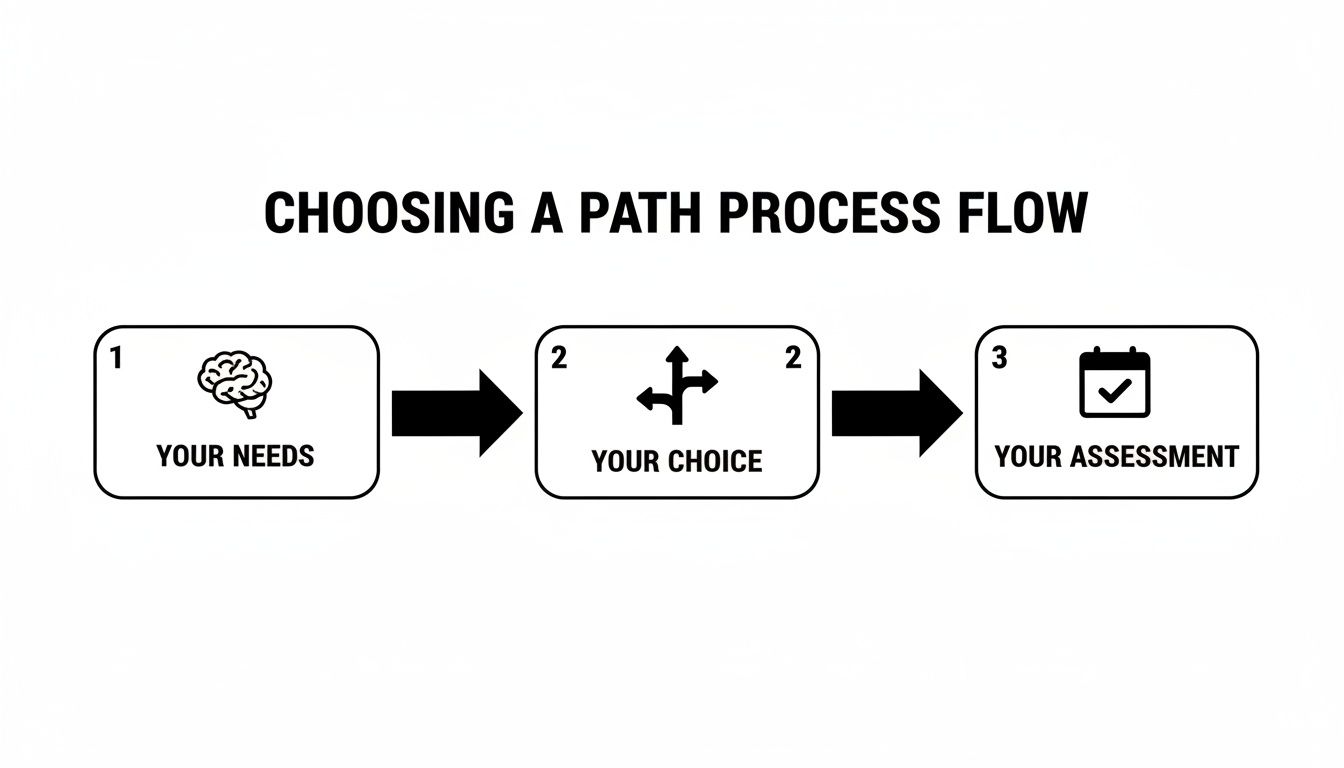
As you can see, the whole process is centred on you. It starts with your unique circumstances and leads to an evaluation built around your personal story.
The Comprehensive Psychiatric Interview
The heart of your assessment is the comprehensive psychiatric interview. This is an in-depth, one-to-one session with a consultant psychiatrist, usually lasting somewhere between one and two hours. It's a completely confidential space for you to share your story, in your own words. The psychiatrist will guide the conversation, asking about your current difficulties, your personal history right back to childhood, your family background, and your general health.
Imagine this interview as building a detailed map of your life. Every piece of information—from your experiences at school to challenges at work—helps the specialist see the patterns and symptoms that are so crucial for an accurate diagnosis. For conditions like adult ADHD or Autism, this look back in time is especially important, as many of the signs will have been there long before you became an adult.
The Role of Psychometric Questionnaires
In addition to the interview, you'll almost certainly be asked to fill out several psychometric questionnaires. These aren't just any forms; they are standardised, evidence-based tools carefully designed to measure specific symptoms and traits linked to different mental health conditions, including ADHD and Autism.
These questionnaires are used for two key reasons:
- They provide objective data: While your personal story is absolutely vital, these tools add a layer of objective measurement to back up what's discussed in the interview.
- They uncover deeper insights: They can bring specific areas of difficulty to light, like executive dysfunction in ADHD or sensory sensitivities in Autism, that might not come up naturally in conversation.
This blend of qualitative discussion (your story) and quantitative data (the scores) is what makes your evaluation so thorough and reliable. The psychiatrist uses these tools to complete the clinical picture, not to replace their expert judgement.
The Final Diagnostic Report
Once the interview is complete and your questionnaires have been analysed, the final step is the creation of your diagnostic report. This isn’t a one-page summary with a label on it. It’s a detailed, multi-page document that explains the entire assessment process and presents the findings in a clear, accessible way. It’s the final piece of the puzzle, turning clinical observations into a practical guide for your future mental health.
Your report is a personal blueprint for understanding your mental health. It provides a formal diagnosis that validates your experiences and offers a clear, actionable plan for moving forward.
A typical report will include:
- A summary of your personal, developmental, and medical history.
- The results from any psychometric tests, along with a professional interpretation.
- A clear diagnostic conclusion based on internationally recognised criteria (like DSM-5 or ICD-11).
- Personalised insights that explain how the diagnosis connects to the specific challenges in your life.
- A list of practical, actionable recommendations for treatment, therapy, workplace adjustments, or other support services.
The entire process is designed for clarity, and that includes the financial side of things. For a full breakdown, you can read our guide to private mental health assessment cost. Our goal is to make sure you feel informed and empowered at every single stage of your journey.
Specialised Assessments for Adult ADHD and Autism
While a general mental health check-up has its place, neurodevelopmental conditions like ADHD and Autism demand a far more specialised approach, especially in adulthood. These aren't conditions that just show up one day. They’ve been there since childhood, often hiding in plain sight or misdiagnosed as something else, like chronic anxiety or depression, which can significantly impact your mental health over a lifetime.
A standard evaluation might easily miss the subtle, lifelong patterns that an expert in neurodiversity is trained to recognise. That's why a private psychiatric assessment with a consultant who truly understands adult ADHD and Autism is so important. They know these conditions look very different in adults compared to children. The classic image of a hyperactive little boy simply doesn't reflect the reality of a woman wrestling with executive dysfunction, or a man completely exhausted by social demands.
The bigger picture of mental health in the UK only reinforces this need for dedicated care. The Big Mental Health Report 2025 found that one in four adults in the UK struggles with their mental health each year. More specifically, 24.2% of women and 25.8% of 16-24-year-olds are living with a common disorder. With NHS waiting lists stretching on, going private is often the only way to get a timely and expert diagnosis. You can read more about these findings on the Centre for Mental Health's website.
The Nuances of an Adult ADHD Assessment
When assessing an adult for potential ADHD, the conversation moves way beyond just hyperactivity. The real focus is on a deep dive into your executive functions—think of this as your brain's project manager, in charge of planning, organising your thoughts, and keeping impulses in check. This directly impacts mental health, often leading to anxiety and low self-esteem.
A specialist will be searching for consistent patterns throughout your life in areas like:
- Time Management: A long history of putting things off, missing deadlines, or being notoriously bad at guessing how long tasks will take.
- Emotional Regulation: A tendency to get frustrated easily, react impulsively, or experience intense and rapid mood swings.
- Attention Control: Finding it hard to stay focused in meetings, getting sidetracked easily, or, on the flip side, getting so absorbed in something that you lose all track of time (hyperfocus).
- Working Memory: Constantly forgetting instructions, misplacing keys and wallets, or struggling to hold a thought long enough to act on it.
A skilled ADHD assessment is like an archaeological dig into your personal history. The psychiatrist pieces together evidence from old school reports, past job experiences, and relationships to build a complete picture of how your brain has always been wired, finally giving context to years of mental health struggle.
Uncovering Autism in Adulthood
Diagnosing Autism in adults, particularly in women, requires an even more refined perspective. Many autistic adults who weren't identified as children have spent a lifetime developing incredibly sophisticated strategies to navigate a world that wasn't built for them. This is what's known as masking or camouflaging, a process that can be mentally exhausting.
A specialist assessment goes beyond surface-level social skills to understand your internal world. This means carefully exploring:
- Social Communication: It’s not about if you can make small talk, but how much mental energy it costs you. The focus is on difficulties with understanding sarcasm, navigating unwritten social rules, or feeling utterly drained after being around people.
- Sensory Processing: Being overly sensitive (or under-sensitive) to sounds, lights, textures, or smells, which can lead to feeling overwhelmed or actively seeking out certain sensory inputs.
- Repetitive Behaviours and Special Interests: A deep-seated need for routine and predictability to feel safe, or a history of passionate, all-consuming interests in very specific topics.
For many people, getting a diagnosis later in life is a profoundly validating moment for their mental health. It isn’t about being given a label; it’s about finally being handed the user manual to your own brain. Our guide on how to get an adult Autism diagnosis walks through this journey in more detail.
Ultimately, a specialist private psychiatric assessment offers the expertise needed to see past the mask and recognise the authentic autistic experience, opening the door to self-understanding and the right kind of support for your mental health.
Understanding Your Report and Planning What's Next
Getting your diagnostic report is a big moment. After weeks, months, or even years of questioning your mental health, you finally have some clarity. But it's crucial to see this report not as the finish line, but as the starting line for a new, better-informed chapter.
Think of it less as a clinical summary and more as a personalised user manual for your brain. It takes all the psychiatrist's findings and translates them into your real-world experiences, explaining how a diagnosis like ADHD or Autism connects to the specific struggles you've faced at work, in relationships, or just getting through the day.
Making Sense of the Diagnostic Report
At first glance, the report might look a bit intimidating with all its clinical terminology, but it’s designed to be a practical tool for your mental health journey. You'll typically find a section on your personal history, a breakdown of the diagnostic criteria that were met, and a clear conclusion. The most important part, though, is the recommendations section—this is your action plan.
For clinicians, ensuring this section is meticulously detailed is paramount. Many now use tools like voice recognition software for medical transcription to capture every nuance of the assessment, which helps create the precise, detailed record that forms the basis of your plan.
Your diagnostic report is a form of validation. It’s the professional acknowledgement that the mental health difficulties you’ve faced are real, giving you a framework to understand them and, crucially, the power to seek the right support.
It explains the 'why' behind so many of your experiences and, most importantly, lays out some concrete suggestions for what to do next.
From Recommendations to Real-World Action
This is where the true value of your assessment shines through. The recommendations section offers a structured path forward, built around your specific diagnosis and individual needs. Your plan will likely include a mix of different strategies to support your mental health.
For an ADHD diagnosis, this often involves:
- Medication Titration: This is a carefully managed process where you and your psychiatrist work together to find the right type and dose of medication. The goal is to manage core symptoms like inattention and impulsivity effectively.
- ADHD Coaching: You’ll work with a specialist coach to build practical, real-world skills for things like organisation, time management, and tackling executive dysfunction.
- Therapy: Cognitive Behavioural Therapy (CBT) can be a huge help in unpacking the anxiety or low self-esteem that so often comes with a later-in-life ADHD diagnosis.
For an Autism diagnosis, the focus might be more on:
- Specialist Therapy: Finding therapists who truly understand neurodiversity is key. They can help with social communication, managing sensory sensitivities, or processing past experiences through a neuro-affirming lens.
- Workplace Accommodations: Your report is the key to formally requesting reasonable adjustments at work. This could mean asking for a quieter desk, clearer written instructions, or more flexible hours.
- Community Support: Connecting with autistic-led groups and communities can be life-changing, offering peer support and a powerful sense of belonging.
No matter the diagnosis, the aim is always the same: to give you the tools, knowledge, and support network you need to thrive. This plan isn't rigid; it’s a living document that will evolve as you learn more about yourself. Your follow-up appointments are the perfect time to discuss the plan, ask questions, and fine-tune your next steps with your psychiatrist.
Your Questions Answered: Navigating a Private Assessment
Deciding to pursue a private psychiatric assessment is a big step, and it’s completely normal to have a few practical questions. Thinking about the process for conditions like ADHD and Autism often brings up concerns about cost, working with your GP, and how to prepare. Let's clear up some of the most common queries so you can feel confident moving forward on your mental health journey.
How Much Does a Private Psychiatric Assessment Cost in the UK?
The cost is often the first thing on people’s minds, and rightly so. The price of a private assessment depends on what kind of evaluation you need (for example, for ADHD or Autism) and which clinic you choose.
We believe in being completely transparent from the start. That’s why we offer clear, upfront package pricing – no hidden fees or nasty surprises later on. The best way to get an exact figure is to get in touch with our team, and we can provide a detailed quote based on your specific situation.
Will My GP Accept a Private Diagnosis for ADHD or Autism?
This is a really important question. The good news is that diagnoses from CQC-regulated clinics, with reports signed off by GMC-registered consultant psychiatrists, are widely respected within the NHS.
For conditions like ADHD, many GPs are happy to enter into a 'shared care' agreement after you've received a private diagnosis. This simply means they can take over prescribing your medication, making things much smoother for you. While individual GP practice policies can vary, we arm you with a comprehensive, evidence-based report that gives your doctor everything they need to understand the diagnosis and support your ongoing mental health care.
How Should I Prepare for My Online Assessment?
Preparing for your assessment doesn't need to be stressful. The most important thing is to find a quiet, private space for the video call where you won’t be disturbed and can speak freely about your mental health.
A great tip is to spend a little time beforehand jotting down some notes. Think about the main symptoms or challenges you're facing, maybe a few specific examples from childhood and now, and any questions you have for the psychiatrist. It’s easy to forget things in the moment, and this helps keep you on track.
You'll also receive some pre-assessment forms from us to fill out, which play a key part in the process. Above all, remember this is a supportive conversation. Just come ready to talk openly about what you've been experiencing.
Are Online Assessments as Effective as In-Person Ones?
Absolutely. For mental health conditions like ADHD and Autism, online assessments carried out via a secure video link are just as valid and effective as face-to-face appointments. It's a method that's been thoroughly tested and proven.
As a CQC-regulated service, we follow the same strict clinical guidelines for all our assessments, whether online or in person. This ensures you receive a thorough and accurate evaluation while offering the convenience of being in a comfortable, familiar space like your own home.
Ready to take the next step towards clarity and support for your mental health? The team at Insight Diagnostics Global is here to guide you through a CQC-regulated, consultant-led private psychiatric assessment for ADHD, Autism and other mental health conditions. Find out more about our services and book your initial consultation today.