

If you're looking into a private ADHD assessment in the UK, you'll find prices can range anywhere from £500 to over £2,300. On average, you can expect to pay around £1,200.
While an assessment through the NHS is technically free, it comes with a different kind of cost: time. Many people find themselves waiting years for a diagnosis for ADHD or Autism, a delay that can take a heavy toll on their mental health, career, and relationships.
Navigating the Cost of an Adult ADHD and Autism Assessment
When you suspect you might have a neurodevelopmental condition like ADHD or Autism, the journey to getting answers can feel pretty daunting. One of the first major hurdles is the decision between going through the NHS or seeking a private diagnosis. This choice isn't just about the money; it's about weighing up how long you can afford to wait for the clarity and support you need for your mental health.
For countless adults, the lengthy waiting lists on the NHS are a significant barrier to getting help. This reality is why so many start looking into private healthcare. The private route is much faster, but it's essential to first get your head around the cost of an ADHD assessment. The final price tag can vary quite a bit, depending on things like the clinic's location, the experience of the clinicians, and how thorough the assessment is.
NHS vs Private: The Main Differences
Ultimately, the choice often boils down to a trade-off: money versus time.
An NHS diagnosis is fully recognised and doesn't cost you anything directly, but the wait can be incredibly long. On the other hand, paying for a private assessment is an investment in yourself and your mental wellbeing, giving you quick access to specialists and a detailed report. This means you can begin to explore treatment, find support, and learn effective strategies much, much sooner.
"For many adults struggling with undiagnosed ADHD or Autism, the delay in receiving an official diagnosis can worsen comorbid conditions like anxiety and depression. A timely assessment isn't just about getting a label; it's about preventing further harm to your mental health and starting a journey toward effective management and self-acceptance."
This image really drives home the key differences between the two paths, especially when it comes to the cost and the waiting times involved.
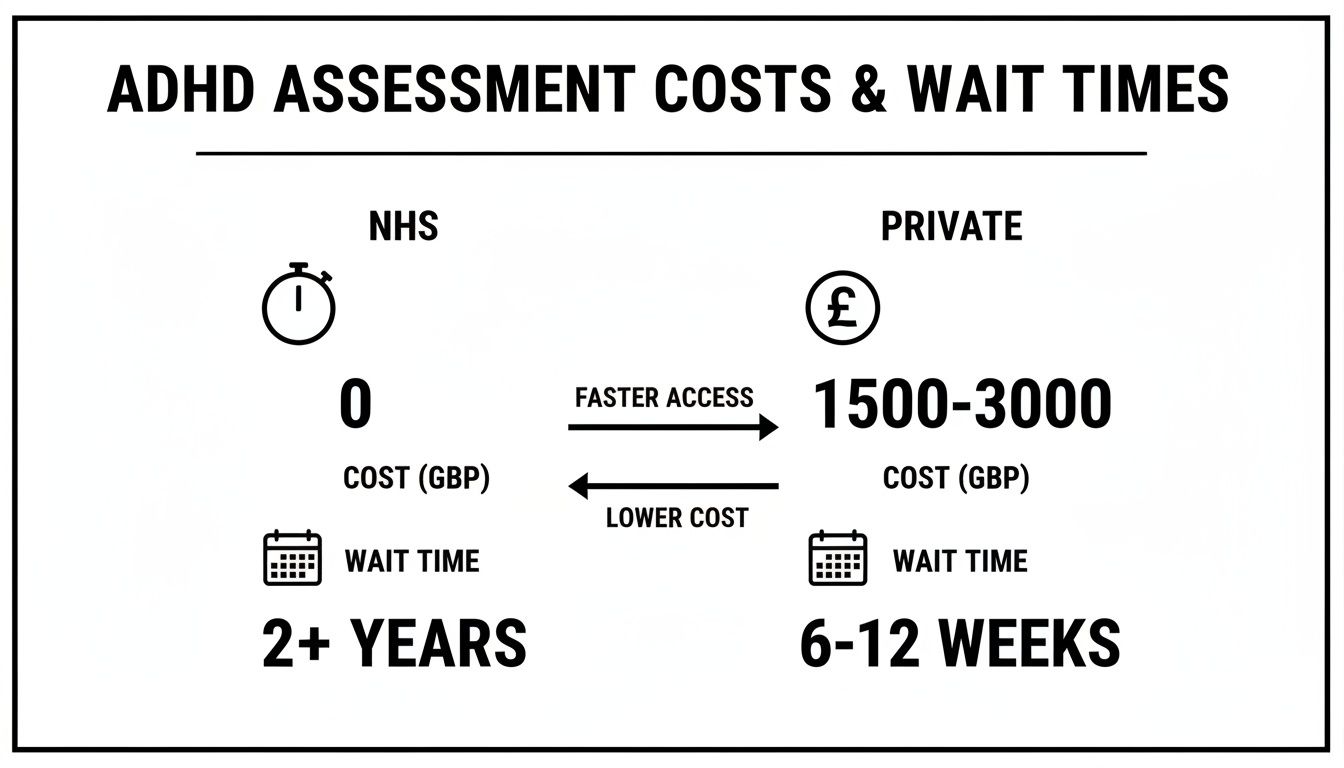
It’s a stark visual reminder of the immediate financial cost of going private versus the long, drawn-out timeline you can expect with the NHS.
To give you a clearer idea of what to expect, the table below breaks down the main points of comparison.
NHS vs Private ADHD Assessment At a Glance
| Factor | NHS Pathway | Private Pathway |
|---|---|---|
| Cost | Free at the point of service | Typically £500 – £2,300+ |
| Waiting Time | Often 2-7 years from referral to diagnosis | Usually 6-12 weeks from enquiry to diagnosis |
| Referral Process | Requires a GP referral | Self-referral is often possible |
| Choice of Clinician | Little to no choice of who you see | You can research and choose your specialist/clinic |
| Follow-up Care | Can involve long waits for titration and medication reviews | Quicker access to follow-up, titration, and therapy |
As you can see, the private route offers speed and flexibility that the public system, unfortunately, just can't match right now.
Getting to Grips with the Numbers
So, where do these figures come from? A comprehensive survey of 401 private UK clinics found the average cost for a private ADHD assessment was £1,267. For adults specifically, the average was £1,200, with assessments for children being a little more expensive.
Keep in mind, this is just an average. Prices started as low as £530 and went up to over £2,300, often influenced by whether the assessment was conducted online or in person. Knowing what a thorough ADHD assessment for adults should include can help you feel more confident that it's a worthwhile investment in your mental health.
What Your Investment in a Private Assessment Actually Covers

When you first see the price for a private ADHD assessment, it’s completely understandable to wonder where that money actually goes. It’s not just a fee for a label; you’re investing in a detailed, multi-stage diagnostic process for your mental health. A good way to think about it is like commissioning an architect to draw up a blueprint of your brain—each stage is carefully planned to build a complete and accurate picture of how you’re wired.
Getting this right is absolutely critical. A rushed or incomplete diagnosis can lead to the wrong treatment, months or years of continued struggle, and even unsuitable medication. A proper, structured assessment ensures the final report is robust and will be accepted by your GP, university, or employer.
The Initial Clinical Screening
The journey starts long before you sit down with a psychiatrist. The first step involves a series of detailed clinical screenings and questionnaires. These aren't just simple online quizzes; they are properly validated tools designed to gather crucial information about your symptoms, your history, and the challenges you face every day.
This initial groundwork is vital for a couple of key reasons:
- It checks if it’s the right path: This step helps the clinical team confirm that a full ADHD or Autism assessment is the most appropriate next move for you.
- It makes the consultation count: By collecting all the foundational data upfront, the psychiatrist can use their time with you to dig into the nuances of your experience, rather than just ticking off basic facts.
This stage lays the foundation for everything that follows, making sure the entire process is focused and relevant. It helps to filter out situations where symptoms might actually point towards other conditions, like anxiety or depression, ensuring you're guided down the correct diagnostic route from the very beginning.
The Core Diagnostic Interview
The heart of the entire assessment is the in-depth diagnostic interview. This is a one-on-one consultation with a highly qualified specialist, typically a GMC-registered consultant psychiatrist, that often lasts between 60 and 90 minutes. This isn't just a casual chat; it's a structured clinical evaluation guided by established diagnostic criteria, such as those laid out in the DSM-5.
During this session, the psychiatrist will want to explore:
- Your developmental history: They'll ask about what you were like as a child and teenager, because conditions like ADHD and Autism are neurodevelopmental and start early in life.
- Current symptoms and their impact: You’ll talk through how things like inattention, hyperactivity, or social communication difficulties really affect your work, relationships, and day-to-day life.
- Co-occurring conditions: The psychiatrist will also carefully screen for other mental health conditions that often go hand-in-hand with ADHD and Autism, such as anxiety, depression, or OCD.
A significant portion of the cost is for this expert’s time. You're paying for their years of medical training, their specialisation in neurodiversity, and the sharp clinical judgement needed to make a life-changing diagnosis accurately.
Gathering Collateral History and Creating the Report
A reliable diagnosis is rarely based on just one person's account. That's why clinicians gather what’s known as collateral history—this is simply supporting information from someone who knows you well, like a partner, a parent, or a close friend. It provides a valuable outside perspective on your symptoms and behaviours, adding another layer of objective evidence to the picture.
Once all the information from the screening, the interview, and the collateral history has been brought together, the final, crucial step is creating the diagnostic report. This isn't just a one-page summary. It's a comprehensive, legally recognised medical document that:
- Details all the evidence that was gathered.
- Explains exactly how the diagnostic conclusion was reached.
- Provides personalised, practical recommendations for treatment and support.
This report is the key that can unlock access to medication, workplace adjustments, or academic support. A huge part of your investment also goes towards the assurance of quality and trust, often reflected in the positive comments and patient feedback clinicians receive. Understanding what really goes into a private ADHD assessment helps to clarify why this detailed document is so incredibly valuable.
The Hidden Costs of Waiting for an NHS Diagnosis
On paper, an NHS assessment costs you nothing. But in reality, the price of waiting is measured in something far more valuable: your quality of life. Sitting on a long waitlist isn't just a passive pause; it's an active, daily struggle where the challenges of undiagnosed ADHD or Autism can quietly escalate, touching every corner of your world.
This long delay often means grappling with symptoms you can't name and others can't understand. What might look like laziness to a boss is actually executive dysfunction. What a partner sees as carelessness could be chronic inattention. Without the clarity of a diagnosis, it’s all too easy to fall into a cycle of self-blame, anxiety, and depression, severely impacting your mental health.
The numbers paint a stark picture. By late 2023, Freedom of Information requests revealed that NHS ADHD assessment waitlists had swelled to an incredible 177,404 people. Yet, during that same year, the system only managed to deliver 21,011 diagnoses. With waits stretching up to five years in some parts of the UK, it’s no surprise so many are looking for private options that can provide answers in just a few weeks.
The Impact on Your Career and Finances
For many adults, the workplace is where the cost of waiting really hits home. Undiagnosed ADHD can make it a constant battle to meet deadlines, stay organised, or juggle complex projects. Similarly, undiagnosed Autism can lead to challenges with social communication and sensory overwhelm in an office environment. This often translates into missed promotions, frustrating performance reviews, and even job instability.
The financial strain goes beyond your career path, too. Impulsive spending, a common ADHD trait, can make budgeting feel like an impossible task. Forgotten bills lead to late fees, and the general difficulty of managing finances creates a constant hum of money-related stress.
The Strain on Mental Health and Relationships
Living with untreated ADHD or Autism takes a huge toll on mental health. That persistent feeling of underachieving or letting people down can chip away at your self-esteem, feeding anxiety and depression. The longer you wait for answers, the more these negative thought patterns can take hold.
The waiting period for a diagnosis is often a silent battle. It's a time when you can feel completely isolated, watching your personal and professional life unravel without knowing why. A timely diagnosis isn't just about getting treatment; it's about validating a lifetime of experience and preventing further harm to your mental health.
This strain naturally spills over into relationships. Partners can feel ignored, friends might not understand your inconsistent communication, and family dynamics can become tense. Without the framework of a diagnosis, these interpersonal struggles are often chalked up to personal failings instead of symptoms of a neurodevelopmental condition. When you look at the wider clinical picture, understanding the patient journey can illuminate these impacts and show just how deeply these delays affect a person's wellbeing.
Reframing the Decision to Go Private
When you consider these profound consequences, the choice to go private starts to look less like an extravagance and more like a necessity. It becomes a proactive step to reclaim control over your life and mental health when the public system simply can’t keep up. In this light, investing in a diagnosis is really an investment in your mental health, career stability, and personal relationships.
By getting answers sooner, you can start to turn things around:
- Access Support: You can begin learning effective strategies, find the right therapy, or consider medication to manage your symptoms.
- Request Accommodations: A formal diagnosis is the key to getting reasonable adjustments at work or university.
- Improve Relationships: Finally understanding your ADHD or Autism helps both you and your loved ones navigate challenges with far more empathy and clarity.
The decision is deeply personal, of course. But it’s crucial to weigh the one-off financial cost against the ongoing, hidden costs of waiting. As the stress of long Psychiatry UK waiting times continues to grow, having all the facts helps you make the best choice for your health and future.
Why Assessment Prices Vary Across the UK

If you've started looking into a private ADHD or Autism assessment, you’ve probably noticed that the price can feel a bit like a postcode lottery. A clinic in central London might quote you one figure, while another in Manchester offers something completely different. Online providers often have their own pricing structure, too.
This isn't random. There are solid, understandable reasons behind these variations, and getting to grips with them is the first step toward making a confident choice. It helps you compare providers not just on price, but on the actual value and quality of care you’re getting for your money.
The Clinician’s Level of Expertise
One of the biggest drivers of cost is the seniority and specialism of the professional conducting the assessment. A diagnosis from a Consultant Psychiatrist who is on the GMC Specialist Register will naturally command a higher fee, but it also carries the most clinical weight.
It’s a bit like hiring a barrister. You could get advice from a junior paralegal or a King's Counsel—both work in law, but the KC’s depth of experience and authority comes at a premium. In the same way, a consultant psychiatrist is equipped to handle complex cases, spot co-occurring mental health conditions like anxiety or depression alongside ADHD or Autism, and can prescribe medication right away. That comprehensive expertise is what you're investing in.
In-Person Clinics vs Online Services
The 'where' of your assessment has a massive impact on the final bill. Traditional, brick-and-mortar clinics have significant overheads. Think rent for a clinical space, salaries for administrative staff, insurance, and utilities. These costs are baked into the price you pay, especially in major hubs like London or Edinburgh where commercial rent is sky-high.
Online clinics, on the other hand, run a much leaner operation. By cutting out the need for a physical office, they reduce those overheads dramatically and can often pass those savings directly on to you. This model has made high-quality, specialist-led assessments far more accessible and affordable without cutting corners on clinical standards.
Choosing between an online or in-person assessment really comes down to balancing cost with personal preference. Online services offer fantastic convenience and value, but some people simply feel more comfortable in a face-to-face setting. The crucial thing is that whichever route you choose, the provider must be CQC-regulated and use GMC-registered specialists.
The Depth of the Diagnostic Package
Finally, you need to look closely at what’s actually included in the assessment package. A lower headline price can be tempting, but it might only cover the initial diagnostic interview, leaving you with extra costs later on.
A truly thorough, robust assessment is a multi-stage process. A comprehensive package should look something like this:
- Initial Triage: Detailed screening questionnaires before you even book to make sure an ADHD or Autism assessment is the right next step.
- Diagnostic Interview: An in-depth, structured conversation with a consultant psychiatrist.
- Collateral History: Gathering valuable insights from a partner, parent, or someone who knows you well.
- Detailed Report: A comprehensive diagnostic report running to several pages, complete with personalised recommendations for moving forward.
Some providers will bundle things like follow-up appointments or the initial medication consultation into their main package, while others will charge for them as separate items. Always ask for a clear breakdown so you know exactly what you’re paying for and can compare like for like.
To give you a clearer picture, here's a look at how costs can differ across the UK.
Typical Private ADHD Assessment Costs by UK Region and Provider
The price for a private ADHD assessment can range from as low as £530 to over £2,300. Research has shown that fully online services can be 9-15% cheaper than their in-person equivalents, which is a significant saving.
This table shows some indicative costs to illustrate the variation you might encounter.
| Region / Provider | Average Adult Assessment Cost |
|---|---|
| London (In-Person) | £1,500 – £2,300+ |
| Major UK Cities (Outside London) | £1,200 – £1,800 |
| Nationwide (Online Provider) | £700 – £1,200 |
| Psychiatry-UK (Online) | £950 (includes report and a free follow-up) |
| ADHD 360 (Online) | Packages start from £1,700 (often includes medication titration) |
| The Priory Group (In-Person) | Varies by location, typically starting from £1,500 upwards |
As you can see, the differences are stark. A provider like Psychiatry-UK offers clear, structured fees—charging £950 for an initial adult assessment that bundles in the report and a follow-up, which shows how all-inclusive packages can provide better value and transparency. If you'd like to see their full fee schedule, you can find out more about service fees from Psychiatry-UK.
Planning for Costs Beyond the Initial Diagnosis
Getting an ADHD or Autism diagnosis is a huge moment, but it’s really the start of the journey, not the finish line. The assessment fee is the first big step, but understanding what comes next is key to making a proper plan and avoiding any financial shocks down the road.
These follow-up costs aren't hidden fees; they’re for specific, essential services that make sure your treatment is safe, effective, and right for you. Budgeting for this next phase helps you move smoothly from diagnosis to actually managing your condition, so you can really benefit from this new understanding of yourself and your mental health.
Understanding Medication Titration
If medication is part of your treatment plan for ADHD, the first thing you'll go through is a process called medication titration. The best way to think of it is like tuning a guitar. It's a careful, gradual process to find the exact medication and dose that clicks with your unique brain chemistry, all while keeping side effects to a minimum.
This isn’t just a single appointment. Titration is an intensive period of care that usually lasts several weeks. It involves:
- Initial Prescription: You'll start on a low dose of a specific medication chosen by your clinician.
- Regular Monitoring: Expect weekly or fortnightly check-ins with your psychiatrist or a specialist nurse. They'll monitor how you're feeling, check things like your blood pressure and pulse, and talk through any side effects.
- Gradual Adjustments: Based on your feedback, your clinician will slowly adjust the dose or perhaps try a different medication until you hit that sweet spot.
This meticulous process is a separate service simply because of the significant clinical time and close monitoring it demands. The cost, which often falls between £200 and £800, covers all those consultations and the specialist oversight needed to get your treatment dialled in perfectly.
The Role of Follow-Up Consultations
Once your medication is stabilised, you're not just left to it. Regular follow-up appointments are a crucial part of long-term ADHD management. These check-ins, usually scheduled every six to twelve months, are there to review your progress, make any necessary tweaks to your treatment, and ensure your overall mental health and well-being is on track.
These consultations are standard practice in private healthcare and are vital for keeping your health stable. Each follow-up appointment has its own fee, so it's a good idea to factor this into your long-term healthcare budget.
A diagnosis opens the door to understanding, but ongoing care is what allows you to build a better future. Budgeting for titration and follow-ups is an investment in sustained mental well-being, not just an initial answer.
Achieving a Shared Care Agreement
For most people managing their ADHD privately, the long-term goal is to set up a Shared Care Agreement with their NHS GP. This is a formal arrangement where, once your treatment is stable, your private psychiatrist hands over the prescribing and monitoring of your medication to your GP.
When this agreement is in place, you can get your prescriptions through the NHS, which means you’ll only pay the standard NHS prescription charge instead of the much higher private cost. You can learn more about the specific cost of ADHD medications and how the pricing differs in our detailed guide.
Getting this agreement sorted, however, depends on your medication being fully stabilised and your GP being happy to take on the arrangement. Until that happens, you'll need to cover the cost of private prescriptions yourself, which is another important expense to plan for in the months right after your diagnosis.
Why a CQC-Regulated Assessment Is Non-Negotiable

With private mental health services booming, particularly for ADHD and Autism, it’s easy to get lost in all the options. When you’re comparing the cost of an ADHD assessment, you’ll undoubtedly come across some providers offering what look like fantastic deals.
But here’s something that should be completely non-negotiable for your own safety and the legitimacy of your diagnosis: Care Quality Commission (CQC) regulation.
Think of the CQC as the Ofsted for healthcare. They're the independent regulator for all health and social care services in England, and their job is to make sure providers meet fundamental standards of quality and safety. Choosing a CQC-regulated provider is your assurance that the clinic is accountable for its clinical work, staff training, and how it protects its patients.
The Dangers of Unregulated Providers
Going for a cheaper, unregulated assessment might feel like a savvy way to save a bit of cash, but it’s a gamble with some serious risks. A diagnosis from an unregulated source might not be worth the paper it’s written on. You could pour time and money into the process, only to end up with a report that other healthcare professionals or institutions simply won't accept.
This can cause a whole host of new problems. Here’s what can happen:
- GP Rejection: Your GP could refuse to enter into a Shared Care Agreement, which would leave you footing the bill for private prescriptions indefinitely.
- University Refusal: Educational institutions might not recognise the report, blocking you from getting academic accommodations or Disabled Students' Allowance (DSA).
- Employer Disregard: Your workplace could dismiss the diagnosis, which means you might not get the reasonable adjustments you're entitled to under the Equality Act.
In short, a cut-price report from an unregulated source can become a very expensive dead end. It can lock you out of the very support you were trying to access.
"A valid diagnosis is the key that unlocks support. CQC regulation ensures that the key is cut correctly and will actually open the doors to medication, workplace adjustments, and academic help. Without it, you're just holding a piece of metal."
CQC Regulation Guarantees Clinical Standards
When you choose a CQC-regulated provider like Insight Diagnostics Global, you’re not just paying for a report. You're investing in a process that is rigorously monitored for quality from start to finish. CQC registration means the service is committed to keeping its standards high across the board.
This covers several critical areas:
- Qualified Staff: The service must use clinicians who are properly registered and qualified, like psychiatrists on the GMC Specialist Register.
- Safe Practices: There are strict rules for everything, from protecting your personal data to safe prescribing and medication monitoring.
- Accountability: If something does go wrong, there's a clear, official complaints procedure and an independent body you can report to.
This framework is precisely what gives your diagnostic report its credibility and authority. It’s the peace of mind that comes from knowing the cost of your ADHD assessment covers a robust medical evaluation that will be respected by the NHS and other official bodies. Investing in a regulated service is an investment in a diagnosis that works for you, not against you.
Your ADHD Assessment Cost Questions Answered
Once you’ve decided to get an assessment, the practical questions start to surface. It’s completely normal to wonder about the logistics and costs, and getting clear answers is the best way to feel confident about investing in your mental health.
Let's walk through some of the most common queries we hear about paying for a private ADHD diagnosis.
Can I Use Private Health Insurance for My Assessment?
This is probably the number one question we get asked, and the answer, unfortunately, is usually no. Most major private health insurance policies in the UK specifically exclude cover for neurodevelopmental conditions like ADHD and Autism.
Some plans might cover an initial chat about anxiety or depression, but the in-depth diagnostic process for ADHD almost always falls outside of standard coverage. It’s always worth double-checking the small print of your policy or calling your provider directly, but it’s best to assume that the assessment will be a self-funded expense.
How Does Right to Choose Work in England?
The 'Right to Choose' (RTC) pathway is a game-changer for adults in England. It lets you pick a qualified private provider for your ADHD or Autism assessment, but the NHS picks up the bill. This can be a fantastic way to sidestep long local waiting lists without paying the full private fee.
To go down this route, you need to:
- Be registered with a GP in England.
- Ask your GP for a referral to an RTC provider with an NHS contract (like Psychiatry-UK or ADHD 360).
- Be accepted by the provider for an assessment based on their clinical criteria.
Right to Choose is a brilliant option, but it’s become so popular that the waiting times for these services have also grown quite a bit. Even so, they are still typically much shorter than waiting for a local NHS appointment.
What if My GP Won’t Accept My Private Diagnosis?
This is a very real worry for many people, but it’s much less likely to happen if you choose a reputable, CQC-regulated provider. A GP’s reluctance usually comes down to one thing: a lack of confidence in the quality of the assessment. They might rightly question a report from an unregulated clinic or a practitioner who isn't a specialist.
On the other hand, a thorough diagnostic report from a GMC-registered consultant psychiatrist working within a CQC-regulated service carries real clinical weight. If you sense any hesitation from your GP, you can:
- Share the consultant's credentials and the clinic’s CQC registration details.
- Offer to book a follow-up appointment to talk through the report’s findings.
- Point out that the entire assessment was conducted according to NICE (National Institute for Health and Care Excellence) guidelines.
By investing in a high-quality, regulated assessment, you’re giving your GP a professional medical document they can trust. This builds the foundation for a strong partnership and a successful Shared Care Agreement.
At Insight Diagnostics Global, we provide CQC-regulated, consultant-led online assessments for ADHD and Autism, ensuring your diagnosis is respected and actionable. Take the next step towards clarity by exploring our ADHD assessment services.