

If you've spent your life feeling like you're operating on a different wavelength to everyone else, you're far from alone. Deciding to explore an autism diagnosis as an adult in the UK is a huge step, one that often leads to a profound sense of clarity and self-understanding. For many, it finally provides the missing answers to lifelong questions about their mental health and social experiences.
This guide is here to walk you through that process with compassion, focusing on the crucial interplay between autism, ADHD, and mental health to give you a clear picture of what this journey really looks like.
Why More Adults Are Seeking an Autism Diagnosis
For a growing number of adults in the UK, the journey towards an autism diagnosis starts with a deep, persistent feeling of being out of step with the world. This isn't about chasing a label. It's about finally getting the instruction manual for your own brain, making sense of lifelong patterns, and understanding the roots of ongoing mental health challenges like anxiety or burnout. It's a path people often take after decades of navigating these difficulties without ever understanding the 'why' behind them.
This rise in awareness shines a light on a major gap in how autism used to be understood. Landmark research now suggests there are over 1.2 million autistic people in England alone—that's nearly double the government's previous estimate for the entire UK. It also means a shocking 750,000 adults aged 20 and over could be undiagnosed, left to cope with unmet needs and face significant hurdles in everything from healthcare and mental health support to employment.
The Connection Between Autism, ADHD, and Mental Health
It’s really important to understand that autism rarely travels alone. Many adults who suspect they might be autistic are also navigating symptoms of other conditions, creating a complex picture that needs a skilled, expert eye to unravel. Getting to grips with these overlaps is vital for an accurate diagnosis and, more importantly, for effective mental health support.
A huge number of autistic adults also have Attention-Deficit/Hyperactivity Disorder (ADHD). The two conditions share quite a few traits, like challenges with executive function (the brain’s management system), emotional regulation, and social fatigue, which can make diagnosis tricky. This is exactly why a comprehensive, dual assessment is so important—it can carefully distinguish between the two or identify when both are present, which is key to finding the right strategies for your brain.
On top of this, living as an undiagnosed autistic person in a world that isn't built for you can take a serious toll on your mental health. It’s no surprise that this often leads to co-occurring conditions, including:
- Anxiety Disorders: The constant mental effort of masking autistic traits, navigating confusing social situations, and dealing with sensory overload is a direct pathway to chronic anxiety and social anxiety.
- Depression: Feelings of being misunderstood, isolated, and simply burnt out from the effort of 'fitting in' are common experiences that can pave the way for long-term depression.
A good adult autism diagnosis looks at this entire picture. The aim is to see the whole person, not just to give a name to their experiences, but to offer a clear, supportive path forward for managing their overall wellbeing, including their mental health and any co-occurring ADHD.
For a great overview of the whole process, from the first steps to what comes next, have a look at this practical guide to autism testing for adults. The timeline can vary quite a bit, so you might also find it helpful to read about how long an autism diagnosis takes here: https://insightdiagnostics.co.uk/how-long-does-autism-diagnosis-take/
Recognising Autistic Traits in Adulthood
Figuring out you might be autistic as an adult isn't really about ticking boxes on a clinical checklist. It's more of a slow-dawning realisation that your entire life has been shaped by a pattern of experiences that others don’t seem to share. It’s that feeling when you realise everyday situations that seem simple for everyone else require an intense amount of mental energy and often lead to significant anxiety.
This often comes from a fundamental difference in how your brain processes the world, from the subtleties of a conversation to the background hum of a refrigerator. These traits have always been part of you, but it's only in adulthood—after years of feeling 'different' without a name for it—that the puzzle pieces start to fit. It’s less of a diagnosis and more of a re-framing of your own history, mental health, and social challenges through a new, much kinder lens.
The Inner Experience of Autistic Adulthood
To get a real sense of what being autistic feels like, we need to look past the stereotypes. The best way is to imagine the internal monologue and the sheer emotional effort it takes to get through the day in a world that wasn't built for your brain—an effort that often leads to burnout, anxiety, and depression.
Think of it like being in a country where you don't speak the language fluently. In social situations, you're constantly translating. You have to manually decode body language, interpret vocal tone, and figure out the unwritten social rules that seem to be second nature for everyone else. This constant mental gymnastics is exhausting, often leaving you feeling completely drained after what others would call a simple chat.
Some of the most common internal experiences for autistic adults include:
- A Deep Need for Routine: A predictable day isn't just a preference; it’s a non-negotiable tool for managing anxiety and saving precious mental energy. An unexpected change to the plan can feel genuinely distressing, not just inconvenient.
- Intense, Joyful Interests: You might find immense satisfaction and focus by diving headfirst into specific subjects. These aren't just hobbies; they're a source of comfort, expertise, and a way to regulate a stressed nervous system.
- Sensory Overwhelm: Everyday sounds, sights, and textures can be overwhelming or even physically painful. The flicker of fluorescent lights, the scratchy tag in a shirt, or the clatter of a busy cafe can feel like a full-on sensory assault, triggering anxiety and a desire to escape.
- Deeply Felt Emotions: Autistic people often feel things with incredible intensity. The catch is that they may struggle to identify or show these feelings in a way that others easily recognise, which can be mistakenly seen as being cold or unemotional, leading to feelings of isolation.
Masking: The Exhausting Art of Fitting In
One of the most defining—and invisible—experiences for many undiagnosed autistic adults is masking, sometimes called camouflaging. It's the often subconscious effort to hide or tone down your natural autistic traits just to blend in with your neurotypical peers. It's a survival tactic, learned over a lifetime of social trial and error.
Masking is like being a method actor who never gets to go home. You’re constantly performing a version of yourself you think is socially acceptable, which burns through an immense amount of energy and can leave you feeling completely disconnected from who you really are.
This relentless performance is a direct route to burnout, anxiety, and depression, because your authentic self is never given the chance to just be. Learning about the common signs of undiagnosed autism in adults is often the first step people take in spotting these lifelong patterns.
The Overlap with ADHD and Mental Health
Autism rarely travels alone. It frequently co-occurs with other conditions, which is why getting the full picture is so crucial for an accurate diagnosis and effective mental health support.
For instance, a huge number of autistic adults also have ADHD. The two conditions can look similar on the surface, with shared challenges in executive function (things like planning, organising, and starting tasks) and regulating emotions, which can sometimes muddy the diagnostic waters. An expert assessment is needed to untangle whether your struggles stem from autistic inertia, ADHD paralysis, or both.
On top of that, the chronic stress of navigating a neurotypical world while undiagnosed often leads to other mental health struggles. Many adults, particularly those who have their "lightbulb moment" later in life, also deal with social anxiety. Finding effective strategies for coping with social anxiety can be a vital part of feeling better post-diagnosis.
The hidden reality is that countless older adults are juggling these interconnected challenges with no formal recognition. A landmark review revealed a shocking statistic: in the UK, an estimated 89-97% of autistic adults aged 40 and over are undiagnosed. These individuals often face higher rates of anxiety, depression, and significant barriers to work, highlighting just how urgently we need better, more accessible diagnostic pathways for adults. You can read more in the full King's College London review about this critical diagnostic gap.
Comparing NHS and Private Diagnosis Pathways
If you’re an adult in the UK considering an autism assessment, you’re essentially at a fork in the road. You can go down the NHS route or you can explore private options. They both lead to the same destination—a formal diagnosis—but the journey, timescale, and cost are worlds apart. Knowing what to expect from each path is key to figuring out what's right for you and your mental health.
The NHS pathway is where most people start, and it always begins with a chat with your GP. This is your first hurdle. You’ll need to clearly explain your experiences—including the impact on your mental health and any suspected ADHD symptoms—and why you feel you might be autistic. If your GP agrees an assessment is needed, they’ll put in a referral to your local NHS autism service.
This is where you hit the biggest roadblock on the NHS route: the waiting list. The demand for adult autism assessments has absolutely skyrocketed, and the system is struggling to keep up.
The Reality of NHS Waiting Times
To put it bluntly, the queues are staggering. Recent figures show that over 204,000 people in England are currently on the waiting list for an autism assessment. That’s a massive 25% jump in just one year. What's even more concerning is that 89% of these individuals have been waiting longer than the official 13-week target. For many, this isn't just a wait; it's a long, agonising limbo that can make anxiety, depression, and other mental health struggles so much worse.
This seemingly endless wait is often the very reason people start looking into private diagnosis. While an NHS assessment is free, the toll that years of uncertainty can take on your mental well-being is a heavy price to pay.
The whole cycle of recognising your traits, trying to mask them to fit in, and then hitting burnout can be incredibly draining. The infographic below shows just how that internal process often plays out.
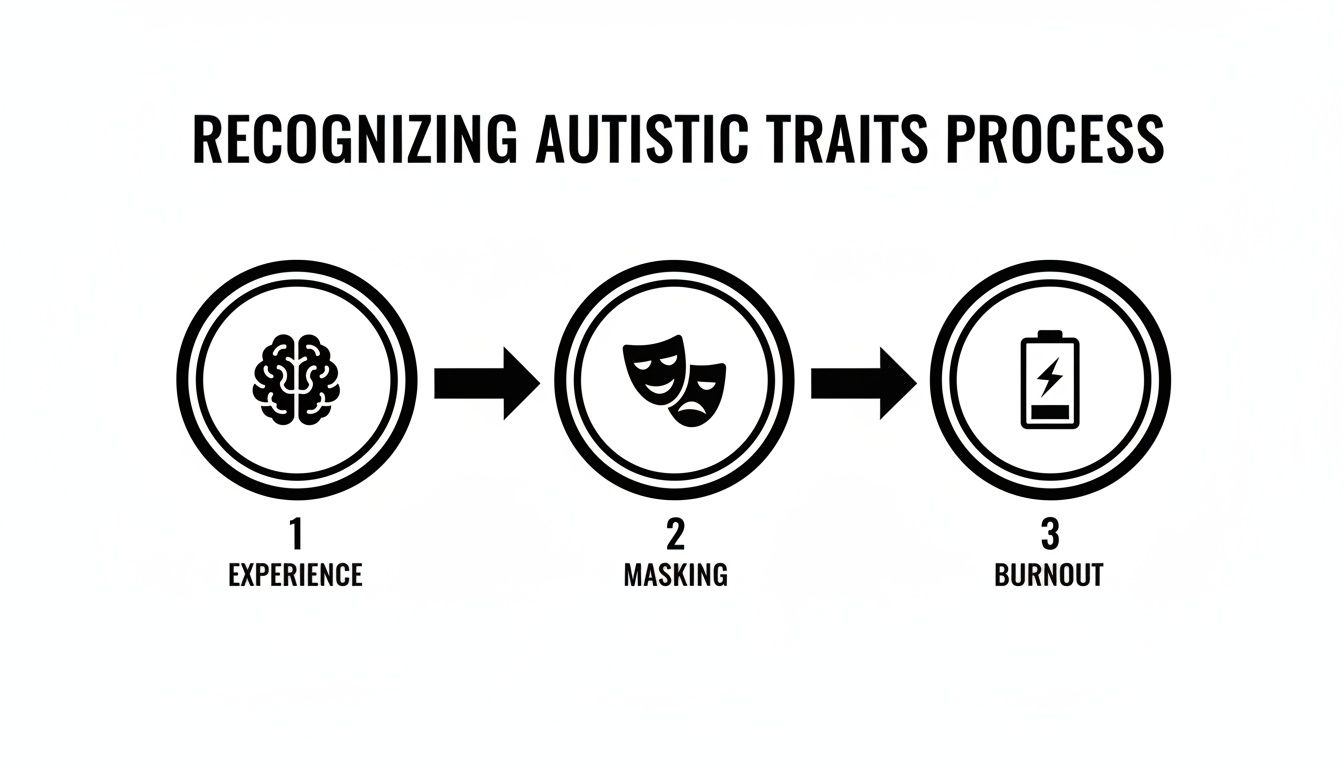
When you're stuck on a waiting list, this cycle can feel like it's on a loop, making the very challenges that pushed you to seek help even more intense.
Exploring the Private Pathway
For those who can’t endure the long wait, the private route offers a much faster way forward. By going private, you can completely sidestep the NHS queues and often get a diagnosis within weeks, not years. This speed can be a lifeline, especially if the uncertainty is seriously affecting your mental health or you suspect co-occurring ADHD that requires timely support. You can find out more about what a private autism assessment in the UK actually entails.
Of course, the major hurdle with private assessments is the cost, which typically falls somewhere between £1,500 and £3,000. If you decide to go down this route, it's absolutely vital to do your homework and choose a reputable provider. A credible, trustworthy clinic should be:
- Regulated by the CQC (Care Quality Commission).
- Run by GMC-registered psychiatrists or clinical psychologists who are specialists in neurodevelopmental conditions like autism and ADHD.
- Using assessment tools that follow NICE guidelines, like the ADOS-2 and ADI-R. These are the gold-standard tools used by the NHS.
It's a common misconception that a private diagnosis is somehow "less valid". A diagnosis from a reputable private service is a legitimate medical document. It is widely accepted by employers for getting reasonable adjustments under the Equality Act 2010 and can be used to access support schemes like Access to Work.
Key Differences at a Glance
Choosing between the NHS and a private service really comes down to weighing up your personal priorities. Is getting a fast, detailed assessment for both autism and ADHD your main goal, or is avoiding the cost the most important factor? This table breaks down the main differences to help you decide which path might be the better fit for your situation.
Comparing NHS and Private Autism Diagnosis Pathways
| Factor | NHS Pathway | Private Pathway |
|---|---|---|
| Cost | Free at the point of service. | Costs typically range from £1,500 to £3,000+. |
| Waiting Time | Extremely long; often 1-5 years or more. | Much shorter; typically 4-12 weeks from enquiry to diagnosis. |
| Referral Process | Requires a GP referral, which may not always be granted. | Self-referral is usually possible, giving you more control. |
| Choice of Clinician | You are assigned to the next available clinician in your local service. | You can research and choose your own specialist or clinic. |
| Assessment Quality | High-quality and NICE-guideline compliant, but can feel rushed. | High-quality and NICE-guideline compliant with reputable providers. |
| Report Validity | Universally accepted by all public services, employers, and education. | Widely accepted, but check that the provider meets NHS standards. |
Ultimately, there's no right or wrong answer. It’s about finding the route that best serves your needs, whether that means patiently waiting for the free NHS service or investing in a private assessment to get clarity and support for your autism, ADHD, and overall mental health much sooner.
How to Prepare for Your Autism Assessment
The idea of an autism assessment can feel huge, and it's completely normal to feel a bit intimidated. The best way to approach it is to see it less as a test you can pass or fail, and more as a chance to get some clarity. You're essentially building a detailed, honest portfolio of your life—including your mental health journey—to give the clinician a clear window into your world.

This isn't about trying to "prove" you’re autistic. It’s simply about gathering the evidence of your lived experience so you can tell your story properly. When you're in the assessment itself, it's easy for your mind to go blank, so having things written down ensures nothing important gets missed. For many people, just going through this process brings a surprising sense of validation.
Documenting Your Life Experiences
Your memories are the most powerful tool you have. The main challenge? After years of adapting, masking, and just getting by, it can be tough to pull out specific examples on the spot. A great way to start is by keeping a journal or even just a simple document on your computer.
The goal is to spot the patterns that have shown up across different times in your life. Don't stress about writing perfectly—bullet points, short notes, or even voice memos work just as well.
It can help to organise your thoughts around these key areas:
- Childhood and School Life: What were friendships like? Did you struggle to fit in? Did teachers ever comment on your focus, social interactions, or struggles with school rules? (These can point to early signs of both autism and ADHD).
- Work and Career: Think about your experiences in the workplace. Have you found office politics baffling? Do you struggle with vague instructions or procrastination? Are open-plan offices a sensory nightmare? Do you have a history of burnout?
- Social and Romantic Relationships: How do you handle social events? Do you leave feeling completely drained? Do you rely on a "script" to get through conversations, leading to social anxiety? Reflect on your experiences with friendships and partners.
- Routines and Special Interests: Make a list of the routines that keep you grounded and the intense interests that bring you real joy. How do you feel when they get disrupted?
The Role of Co-occurring Conditions
When you're preparing, it's so important to think about the whole picture of your mental health. Many adults seeking an autism diagnosis in the UK are also dealing with ADHD, anxiety, or depression. These things don't exist in neat little boxes; they all interact with and influence each other.
It's incredibly common for the chronic stress of masking autistic traits to lead to anxiety, or for executive function challenges to overlap with ADHD. Documenting these experiences gives the clinician vital context for an accurate diagnosis.
Jot down notes on your mental health history, including any previous diagnoses or treatments you’ve had. For instance, have you battled what feels like social anxiety your entire life? Do you find it impossible to start tasks, even for things you enjoy (a potential ADHD trait)? Do you experience emotional highs and lows that feel overwhelming? This information helps the clinician see the full picture and differentiate between—or identify—co-occurring conditions like autism and ADHD. For a deeper dive into the assessment itself, you can learn more about how to get tested for autism in our comprehensive guide.
Gathering Supporting Information
While your own account is the most critical piece of the puzzle, other sources can help paint a more complete picture, especially when it comes to your early development. You don't need to turn up with a mountain of paperwork, but if you can get hold of any of the following, they can be really useful:
- Old School Reports: These are gold dust. Teachers’ comments about your social skills, concentration, or rigid adherence to routines can provide invaluable, objective insights into both autistic and ADHD traits.
- Input from a Trusted Person: If you can, chat with a parent, an older sibling, or a lifelong friend. Ask them what they remember about you as a child. They might recall details you've completely forgotten that point to early neurodivergent traits.
- Previous Medical or Mental Health Records: If you've been treated for anxiety, depression, or anything else, having a summary of this can provide helpful context for the clinician.
Remember, this is a collaborative process. By taking the time to gather your thoughts and evidence, you’re not just preparing for an appointment—you're empowering yourself to be a full partner in the process, ensuring the outcome truly reflects you.
What to Expect During and After Your Assessment
Heading into a diagnostic assessment can feel like a huge, nerve-wracking moment. It’s completely normal to feel a mix of hope and anxiety. The best way to approach it is to remember this isn't a test you can pass or fail. There's no revision needed. Think of it more as a structured conversation about you, with you.
You are the world’s leading expert on your own life. The clinician's job is simply to bring their professional framework to the table, guiding the discussion to see how your life story fits with the formal diagnostic criteria for Autism Spectrum Disorder and potentially ADHD. It's a team effort, and your personal experiences are the most important part of the puzzle.
The Clinical Interview: A Guided Conversation
The heart of any adult autism assessment is the clinical interview. This is a detailed chat, usually lasting a few hours, led by a specialist like a psychiatrist or clinical psychologist. They’ll ask you about your whole life, right from your earliest memories and school days through to your career, relationships, and how you get by day-to-day.
They’ll be particularly interested in a few key areas:
- Your childhood and school years: What were you like as a child? How did you play? How did you find making friends?
- Social communication: They’ll want to understand how you handle conversations, pick up on social cues, and build relationships with others.
- Routines and passions: They'll explore the importance of routine and predictability in your life, along with any deep, special interests you have.
- Your sensory world: How do you experience sound, light, touch, taste, and smell?
This is also where the clinician will carefully untangle the threads between autism, ADHD, and your mental health. They'll ask about things like your attention span, focus, impulsivity and energy levels to see if ADHD might be a factor. They’ll also want to hear about your experiences with anxiety or depression, as these often go hand-in-hand with being an undiagnosed neurodivergent person navigating a neurotypical world.
Your Diagnostic Report: More Than Just a Label
After the assessment is finished, you’ll receive a detailed diagnostic report. This document is so much more than a simple ‘yes’ or ‘no’. A good report should offer clarity and validation, acting as a personal user manual that helps you make sense of your past and plan for your future.
A good diagnostic report doesn't just give you a label; it gives you a language. It provides a structured way to understand yourself, your mental health, and explain your needs to others, from your family to your employer.
Whether it comes from the NHS or a trusted private service, a solid report will be a multi-page document. It's an official piece of medical evidence and needs to be detailed enough to be genuinely helpful.
What to Look For in a Quality Report
Think of your report as your primary tool for self-advocacy and understanding. It should be broken down into clear sections that paint a complete picture of who you are and what support will help you thrive.
Here are the essential ingredients of a high-quality report:
- The Diagnostic Conclusion: Right at the start, it should state clearly whether you meet the criteria for an autism diagnosis, referencing the official standards used (like the DSM-5 or ICD-11). If you were also assessed for other conditions, it will confirm any co-occurring diagnoses like ADHD here.
- A Summary of the Evidence: This is the ‘why’. The report should walk you through the evidence gathered from your interview, questionnaires, and any documents you provided. Crucially, it will connect your specific life experiences directly back to the diagnostic criteria for autism and ADHD.
- Your Strengths and Challenges: A balanced report never focuses solely on the difficulties. It should also highlight your autistic strengths—things like sharp analytical thinking, intense loyalty, unwavering honesty, or a deep expertise in your passions.
- Personalised Recommendations: This is arguably the most important section. It provides practical, actionable advice tailored specifically to you. This could include reasonable adjustments for your workplace under the Equality Act 2010, tips for managing sensory overwhelm, or strategies for executive dysfunction.
- Mental Health and Support: Finally, the report must address any co-occurring mental health conditions. It might suggest specific types of therapy (like CBT adapted for autistic people), practical ways to manage anxiety, or a plan for exploring medication if an ADHD diagnosis was also confirmed.
This document is your starting point. It provides the validation for your past, the explanation for your present, and a clear, evidence-based plan to help you build a more supportive and authentic future.
Life After Diagnosis: What Happens Next?
Getting an autism diagnosis as an adult isn't really an ending. It’s more like being handed a user manual for your own brain after a lifetime of trying to figure it out on your own. Your diagnostic report gives you the vocabulary to make sense of past struggles, mental health challenges, and strengths, but the real journey starts now—turning that insight into practical changes that genuinely improve your life.

Everyone’s reaction is different, and that's okay. For some, the news brings an instant wave of relief—a powerful sense of validation. For others, it takes time to sit with the information and figure out what it means for their identity. The most important thing is to give yourself grace and start building a support system that works for you, not against you.
Practical Support at Work
One of the most immediate and tangible benefits of a formal diagnosis is the legal footing it gives you. It’s the key that unlocks proper support at work, helping to turn a challenging environment into a place where you can actually do your best work.
Under the Equality Act 2010, being autistic (and having ADHD) means you are protected from discrimination, and your employer has a legal duty to make ‘reasonable adjustments’. This isn't about asking for special favours; it’s about creating a level playing field. Your diagnostic report is the official document you need to begin that conversation.
So, what does this look like in practice?
- Flexible Working: Maybe you could adjust your start and finish times to miss the sensory chaos of rush hour.
- A Better Workspace: This could be as simple as getting noise-cancelling headphones or moving to a desk away from the noisy kitchen or main walkway.
- Clear Communication: Asking for instructions and feedback to be put in an email can make a world of difference, removing ambiguity and giving you time to process.
- Fairer Interviews: You can even request interview questions in advance, allowing you to give thoughtful answers rather than being put on the spot.
Finding the Right Mental Health Support
A diagnosis can be a huge turning point for your mental health, often allowing you to finally be kinder to yourself. But it's vital to find a therapist who genuinely gets it. Many standard therapeutic models just don't click for autistic or ADHD brains.
When looking for a counsellor, search for professionals who specifically mention experience with autism, ADHD, and neurodiversity. They’ll be better equipped to help you with:
- Making sense of the diagnosis: Talking through the complex cocktail of emotions that often comes with finding out later in life.
- Tackling co-occurring conditions: Finding strategies for anxiety or depression that are tailored to how an autistic brain works.
- Deconstructing the mask: Learning to slowly let go of the exhausting persona you might have been maintaining for years, and discovering who you are underneath.
Finding your people—connecting with the autistic and ADHD communities online or in person—can be one of the most powerful and affirming things you do. There's nothing quite like sharing your experiences with someone who just gets it without you having to explain a thing.
Juggling Autism and ADHD
It’s incredibly common for adults to be diagnosed with both autism and ADHD. If this is you, you'll need a support plan that acknowledges how these two very different neurotypes interact. They can sometimes feel like they’re pulling you in opposite directions—the autistic part of you might crave routine and predictability, while the ADHD part is desperately seeking novelty and stimulation.
The trick is to find a middle ground that supports your overall mental health. This might look like creating a structured weekly plan but building in pockets of time for spontaneous activities. Or using visual planners to help with executive functioning while allowing for flexibility. If you're considering ADHD medication, it's crucial to work with a psychiatrist who also understands autism, as they can monitor how it affects things like your sensory sensitivities or anxiety levels.
Ultimately, life after an autism diagnosis in the UK is about empowerment. It’s about taking this new self-knowledge and using it to advocate for yourself, build a supportive community, and design a life that isn’t just about coping, but about thriving.
Your Questions Answered
The path to getting an adult autism diagnosis in the UK can feel like navigating a maze. It’s only natural to have a lot of questions. Here, I’ll tackle some of the most common ones that come up, especially around how autism diagnosis works alongside ADHD and mental health.
Will a Private Diagnosis Be Recognised by My Employer or the NHS?
Yes, it will. A diagnosis from a properly regulated private clinic is carried out by GMC-registered specialists who use the exact same diagnostic criteria as the NHS. These are serious, robust reports that employers must acknowledge for making reasonable adjustments under the Equality Act 2010.
While it's true that the NHS might sometimes prefer to do its own assessment before offering specific services, your private report is still a valid medical document. It gives you powerful, credible evidence to advocate for yourself and can get the ball rolling on support for your mental health much more quickly.
Can I Be Assessed for Autism and ADHD at the Same Time?
You can, and honestly, it’s often the best way to do it. Autism and ADHD are close cousins and frequently show up together. Their traits can overlap so much that trying to diagnose them one at a time can become a confusing and drawn-out process.
A good specialist service will be able to assess for both conditions in one go. This gives you a much clearer, more complete picture of what's going on, which is vital for building a support plan that actually works—whether that involves therapy, considering ADHD medication, or getting the right help at work.
This integrated approach is so important for understanding your mental health as a whole. It helps figure out if focus issues are down to ADHD, autistic burnout, anxiety, or a mix of everything, which means you get strategies that genuinely help you feel better.
What If I Can’t Find My Old School Reports?
Don't worry, this is an incredibly common situation and it won't stop you from getting a diagnosis. For many people, especially those seeking a diagnosis later in life, those old documents are long gone.
While they can be a helpful piece of the puzzle, they are by no means essential. A skilled clinician knows how to build a picture of your developmental history by talking with you. They'll guide you through your memories of school, friendships, and family life. Your lived experience and your current mental health struggles are the most important evidence there is.
At Insight Diagnostics Global, we provide comprehensive, CQC-regulated online assessments for adults, conducted by specialist psychiatrists. If you're seeking clarity on autism, ADHD, or your mental health, you can learn more about our online diagnostic services.