

For many adults, the path to an autism diagnosis doesn’t start in a clinic. It begins with a quiet, nagging feeling of being different, a sense that you've spent your entire life operating on a slightly different frequency to everyone else. This isn't about a single moment of clarity; it's the culmination of years of experiences that, when viewed through a new lens, suddenly start to make sense.
Recognising the Signs of Autism in Adulthood
If you’ve ever felt exhausted by social situations that others seem to navigate with ease, or found immense comfort in deep-diving into a specific interest, you're not alone. The journey often starts with this kind of self-reflection, connecting your personal history with the lived experiences of other autistic adults.
The classic, often stereotypical, portrayals of autism rarely do justice to the reality of an autistic adult. Many have spent decades developing sophisticated coping strategies to fit in—a process known as masking or camouflaging. This involves consciously (or unconsciously) mimicking the social behaviours of non-autistic people. It’s a survival skill, but an incredibly draining one that often leads to burnout and significant mental health challenges.
Beyond the Stereotypes
Adult autism often presents in ways that are easily missed or misinterpreted. What might look like shyness or introversion could actually be profound social exhaustion. A half-hour team meeting or a quick trip to the supermarket might feel like running a marathon, leaving you needing hours of quiet solitude to recover. This isn’t an overreaction; it's your brain working overtime to process social cues, filter out sensory overload, and run a constant internal script for how to act 'normally'.
Think about whether any of these internal experiences sound familiar:
- Sensory Sensitivities: Do you cut the tags out of all your clothes? Does the hum of a refrigerator feel impossibly loud, or do certain food textures make you recoil? Many autistic adults have senses that are either heightened or dulled, making everyday environments feel like a constant assault on the nervous system.
- Intense Special Interests: Do you have hobbies that you are completely absorbed by? These "special interests" are far more than just a pastime; they are a source of deep joy, comfort, and expertise, and a fundamental part of the autistic experience.
- A Deep Need for Routine: Do you feel a profound sense of calm when your day follows a predictable rhythm, and a surge of anxiety when plans suddenly change? This isn't about being rigid; it's a vital way to manage a world that often feels overwhelmingly chaotic and unpredictable.
For many, the realisation dawns not from a single event, but from a lifetime of collected moments—the unexplained exhaustion after socialising, the intense comfort found in solitude and routine, and the feeling of performing a role rather than simply being.
The Overlap with ADHD and Mental Health
It’s incredibly common for autism to exist alongside other conditions, particularly ADHD and mental health struggles like anxiety and depression. In fact, it’s estimated that between 30-80% of autistic individuals also have ADHD. This combination, often called AuDHD, creates a unique and sometimes confusing profile. You might have the autistic need for a predictable routine clashing directly with the ADHD craving for novelty and stimulation.
This overlap frequently leads to misdiagnosis or incomplete diagnosis. Many adults who seek help for their mental health are diagnosed with anxiety, depression, or even personality disorders first. While those conditions are very real, they are often a direct result of the chronic stress of trying to navigate a neurotypical world without the right support or self-understanding. An undiagnosed neurodivergence is often the root cause of the mental health symptoms.
Recognising that your anxiety might be rooted in sensory overwhelm or social burnout is a game-changing perspective. For a deeper look at these subtle indicators, our detailed guide explores the common signs of undiagnosed autism in adults.
Connecting the dots in your own life isn't about self-diagnosing. It's about gathering information and validating your experiences. Seeing your own story reflected in the patterns of adult autism is often the crucial first step toward seeking a formal assessment—and with it, a path to profound self-understanding and acceptance.
Navigating the Assessment Pathways: NHS vs. Private
So, you’ve decided to seek a formal assessment. The next big question is how to go about it. In the UK, you essentially have two main roads you can take: the National Health Service (NHS) or a private provider.
Each path has its own map, with different timelines, costs, and processes. Figuring out which one is right for you really comes down to your individual circumstances, like how urgently you need answers to support your mental health and what your budget looks like.
The NHS Pathway: Starting with Your GP
For most people, the journey through the NHS begins at their local GP surgery. This first appointment is crucial, so it pays to be prepared.
I always advise people to go in with clear notes. Jot down your lifelong experiences that you feel point towards autism, bring along any self-screening questionnaires you've filled out, and have a few concrete examples of how these difficulties impact your day-to-day life, especially your mental health, work, or relationships. Your GP's job is to listen and, if they agree an assessment seems appropriate, they'll refer you to the local adult autism assessment service.
Once that referral is made, you'll join a waiting list. You might also be sent more screening forms to complete while you wait. And this is where the biggest hurdle lies: the wait itself. Unfortunately, the waiting times on the NHS have become a real crisis.
The reality of getting an autism diagnosis as an adult in the UK often means facing waiting lists that stretch on for years. As of June 2025, a record 236,225 people in England were waiting for an autism assessment—a 15% jump in just one year. To make matters worse, a staggering 89% of them have been waiting longer than the 13-week target set by NICE, with average waits now creeping past 17 months. You can learn more about the latest waiting time statistics on Autism.org.uk.
This long period of limbo is precisely why so many adults start looking into private options. The emotional toll of waiting for years, all while struggling with your mental health and feeling misunderstood, can be absolutely immense.
The Private Assessment Route
Opting for a private assessment is a completely different experience. It’s a much faster and more direct alternative. Yes, it requires a financial investment, but for many, the certainty and speed make it worthwhile, especially when their mental well-being is at stake. Reputable private clinics, especially those regulated by the CQC and run by experienced clinicians, offer a clear, efficient, and supportive process.
So, what are the main draws of going private?
- Speed: This is the big one. You can often be seen within a few weeks, not years. That quick access to clarity can be a massive relief, empowering you to finally move forward and access the right support for your mental health.
- Direct Access to Specialists: You get to work directly with clinicians who have a deep specialism in adult autism, often alongside co-occurring conditions like ADHD.
- Convenience: Many modern practices now offer assessments entirely online. This removes any travel headaches and means you can go through the whole process from your own home, which can feel much more comfortable.
- In-Depth Reports: You’ll receive a comprehensive diagnostic report that explains the findings in detail. This is the document you can use to request reasonable adjustments at work or university.
A typical private journey might start with an initial triage call to make sure their service is a good fit. This is usually followed by the core assessment, which involves structured clinical interviews and completing gold-standard diagnostic tools. The whole thing is designed to be straightforward and clear. If you want to see what that looks like in more detail, you can read about a typical private autism assessment for adults here.
Comparing NHS and Private Autism Assessment Pathways
To help you weigh things up, here’s a straightforward comparison of the two routes.
| Feature | NHS Pathway | Private Pathway (e.g., Insight Diagnostics Global) |
|---|---|---|
| Cost | Free at the point of service. | Involves a fee, typically ranging from £1,500 to £3,000+. |
| Waiting Times | Extremely long, often 1-5+ years from GP referral to assessment. | Very short, typically a few weeks to a few months. |
| Referral Process | Requires a GP referral to a local NHS autism service. | Self-referral is usually possible, allowing you to bypass the GP. |
| Choice of Provider | Limited or no choice; you are referred to your local commissioned service. | You can choose your provider based on their specialism, reviews, and approach. |
| Assessment Format | Varies by trust; may be in-person, online, or a mix. | Often flexible, with many reputable providers offering fully remote/online assessments for convenience. |
| Report & Follow-Up | A diagnostic report is provided, but post-diagnostic support can be inconsistent and hard to access. | A highly detailed report is provided, often with clearer recommendations. Some clinics offer integrated post-diagnostic support sessions or signposting as part of the package. |
Ultimately, choosing between the NHS and a private service is a deeply personal decision.
If cost is the biggest barrier and your situation isn't critical, the NHS route is a perfectly valid choice, as long as you're prepared for the long wait. But if you're really struggling and need clarity to protect your mental health or keep your job, then the speed and focused expertise of a private assessment can be invaluable. It's really about weighing the financial cost against the personal cost of waiting.
What to Expect During Your Autism Assessment
The idea of a formal autism assessment can feel pretty intimidating, but knowing what the process actually involves can make a world of difference. It's crucial to remember that a good quality assessment isn't a test you can pass or fail. Think of it as a collaborative process, a deep dive into building an accurate picture of who you are and how you experience the world. This is about understanding your unique neurotype, not just ticking off a list of deficits.
At its heart, the assessment is a series of structured conversations, usually held over one or two appointments. You'll be talking with a specialist clinician, typically a psychiatrist or psychologist with deep experience in neurodevelopmental conditions. Their job is to listen, to understand your life story, and to see how your experiences line up with the established diagnostic criteria for autism.
This diagram lays out the two main routes you can take to get there: going through the NHS or opting for a private assessment.
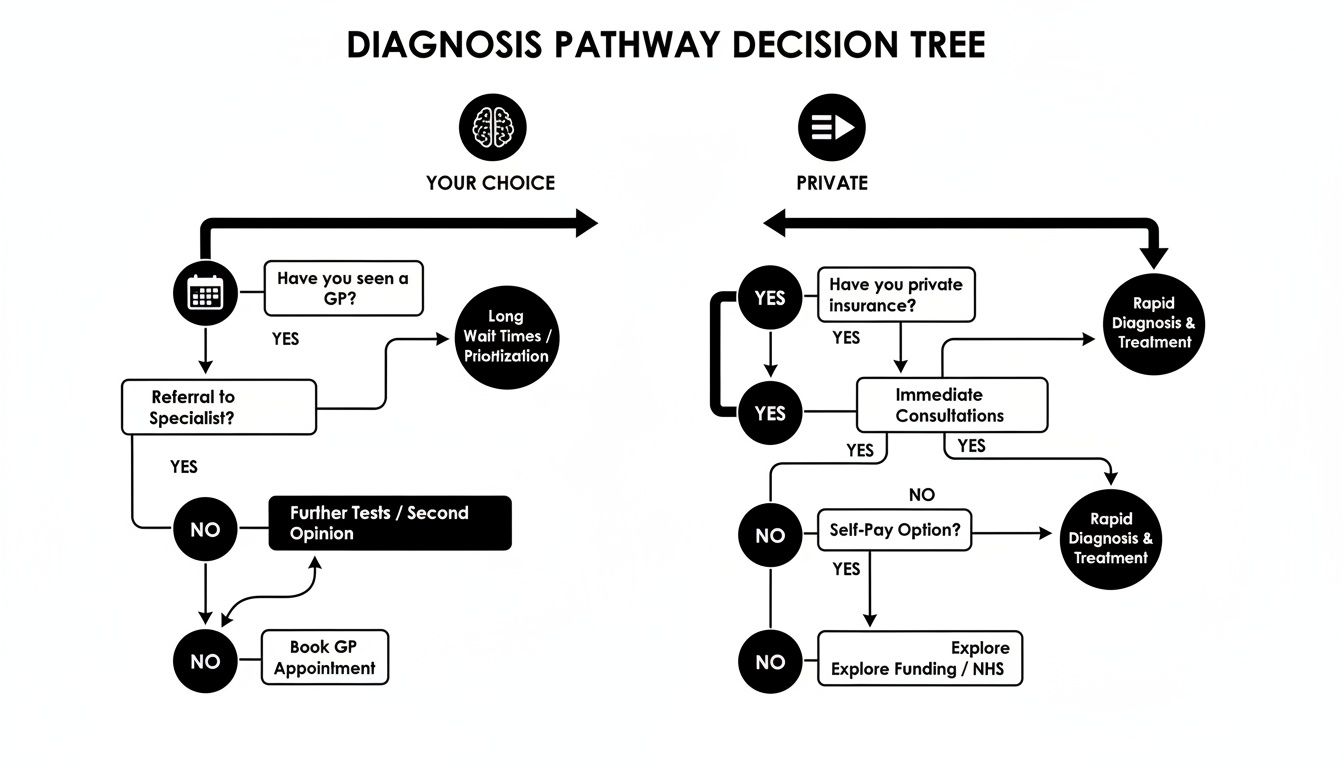
As you can see, a major factor in this decision often comes down to weighing up the cost against the waiting time. It’s one of the first practical considerations on this journey.
The Clinical Interview and Developmental History
The cornerstone of any assessment is the clinical interview. This is where you get to talk about your life right now – your job, relationships, hobbies, and the specific difficulties that prompted you to explore a diagnosis in the first place. The clinician will ask open-ended questions to get a feel for your social communication style, your sensory world, and how you navigate the demands of daily life.
From there, the conversation will shift to your developmental history. Because autism is a lifelong neurotype, the clinician needs to see evidence that autistic traits were there in your childhood. They'll ask about your early years. What was making friends like at school? What were you passionate about? Did you rely on routines or have strong sensory reactions as a kid? Piecing this together helps build a consistent picture across your entire life.
Using Gold-Standard Diagnostic Tools
To make sure the evaluation is robust and objective, clinicians rely on specialised, evidence-based tools. You'll likely hear about the ADOS-2 and the ADI-R, which are considered the gold standard in the field.
- ADOS-2 (Autism Diagnostic Observation Schedule, Second Edition): This is a semi-structured assessment based on activities and conversation. The clinician might ask you to describe a story from a picture book or chat about your feelings. It's designed to create natural social scenarios so they can observe your communication and social interaction in the moment.
- ADI-R (Autism Diagnostic Interview-Revised): This is a very detailed, structured interview, usually conducted with a parent, an older relative, or someone else who knew you well when you were young. It focuses squarely on your developmental history, covering communication, social skills, and repetitive behaviours before the age of five.
It’s so important to realise that these tools aren't the whole story. They are just instruments. They help the clinician gather evidence, but your own account of your lived experience is still the most critical piece of the puzzle.
The Role of an Informant
Bringing an "informant" into the process – someone like a parent, sibling, or long-term partner – can be incredibly helpful. They can offer an outside perspective and might remember details from your childhood that you've forgotten or never saw as significant. Their input adds another layer of detail, helping to create a more complete and robust diagnostic picture.
Differentiating Autism from ADHD and Other Conditions
One of the most important jobs for an experienced clinician is to carefully unpick the overlapping traits between autism, ADHD, and other mental health conditions like anxiety or complex PTSD. For example, is your difficulty concentrating in a meeting due to ADHD-related inattention, or is it sensory overload from the flickering lights and constant chatter, which is more aligned with autism?
A skilled assessor will dig into the why behind your behaviours. They are trained to tell the difference between the social communication patterns of autism and the social anxiety that can sometimes result from them. This careful, nuanced approach, which you can read more about in a full adult autism assessment, is vital for ensuring you get the most accurate and holistic diagnosis possible.
From the first chat to the final feedback session, the whole process is designed to give you clarity. By understanding these steps, you can walk into your assessment feeling prepared and empowered, ready to move forward on your journey.
How to Prepare for Your Assessment
Walking into an autism assessment can feel intimidating, but a bit of preparation can make all the difference. This isn't about studying for an exam; it's about making sure you can give the clinician a clear, accurate picture of who you are. When you're prepared, you’re less likely to forget important details under pressure, helping you to explain your experiences more confidently.
The main goal here is to pull together the evidence of your traits and challenges throughout your entire life. Because autism is a developmental condition, the assessment will look at both your childhood and your present-day difficulties, including your mental health history. It sounds like a big task, but breaking it down makes it completely manageable.
Getting this right is more important than ever. While autism diagnoses in UK adults have shot up, there are still huge numbers of people—potentially 150,000 to 500,000 in England between the ages of 20-49—who are undiagnosed. This is happening against a backdrop of a massive 787% increase in diagnoses between 1998 and 2018, largely because we're all more aware and getting better at spotting how autism can look in adults. You can dig into more of the numbers in these autism statistics from the Priory Group.
Gather Your Personal History
Your life story is the single most important piece of the puzzle. A great place to start is by digging out any documents that offer a window into your past. Old school reports are often goldmines, filled with teacher comments about social difficulties, an intense focus on certain subjects, or struggling with unstructured time like break times.
It’s not just school, either. Performance reviews from work, old letters, or even personal diaries can hold valuable clues. You’re looking for recurring themes or patterns, such as:
- Social interactions: Any notes about being a "loner," finding group work a struggle, or misreading social cues.
- Communication: Comments about taking things very literally or having a formal, almost "professor-like" way of speaking as a child.
- Routines and interests: Mentions of becoming distressed by changes in routine or having an all-consuming passion for a specific topic.
Document Your Lived Experiences
The clinician will be looking for real-world examples that map onto the formal diagnostic criteria. It really helps to have your own notes ready, organised around these key areas. You don’t need to use clinical jargon – just describe things as they happened, in your own words.
The most powerful thing you can bring to an assessment is your authentic story. Examples are more valuable than labels. Instead of saying, "I have social anxiety," describe the bone-deep exhaustion you feel after a 10-minute video call or how you mentally rehearse conversations before they happen.
Think about specific moments from your life. For instance, a term like 'social-emotional reciprocity' might sound clinical, but it could simply be your experience of finding it hard to get a conversational rally going, or feeling like you're constantly a beat behind everyone else in a group. Similarly, 'restricted, repetitive behaviours' could be anything from a lifelong habit of pacing while you think to the deep comfort you get from re-watching the same film over and over.
Understanding Masking and Co-occurring Conditions
Many adults, and women in particular, have spent their entire lives learning to hide or ‘mask’ their autistic traits. This is often called masking or camouflaging, and it’s absolutely vital to talk about this with your clinician. You might come across as socially skilled, but you need to explain the sheer amount of energy and internal effort that performance takes, and the burnout and chronic anxiety that follows.
Also, be ready to talk about any other conditions you have, like ADHD or anxiety. Autistic and ADHD traits can overlap significantly, creating a very specific personal profile. Try to explain how these things interact for you. For example, does your autistic need for a predictable routine clash with your ADHD brain's constant search for something new? Giving the assessor this context is crucial for them to untangle everything and reach the most accurate conclusion about your entire neurotype.
Taking these steps helps you advocate for yourself and communicate your reality clearly, setting the stage for a much more insightful and helpful assessment.
Life After Diagnosis: Interpreting Your Report and What Comes Next
Finally getting your diagnostic report is a huge moment. It's often the last step in a long, personal journey of questioning and self-discovery. For most people, it brings a real mix of feelings—relief, validation, and maybe a bit of nervousness about the future.
This document is so much more than a simple confirmation. Think of it as a personalised manual for understanding yourself and your mental health. Give yourself time to sit with it and process the information. It’s completely normal to feel a wave of different emotions as you read a clinical summary of experiences you've lived your entire life.
Understanding Your Diagnostic Report
A good diagnostic report won't just give you a conclusion; it will show you the "why." It tells the story of how the clinical team arrived at their findings, giving you a solid, evidence-based foundation for whatever you choose to do next.
While formats vary, you can expect to find a few key sections:
- Background and Developmental History: This is where you’ll see the information you and your informant shared about your childhood, school years, relationships, and work life all pieced together.
- Summary of Evidence: Here, the clinician connects the dots. They'll detail how your specific experiences and traits align with the diagnostic criteria for Autism Spectrum Disorder, often using the very examples you shared.
- Formal Diagnosis: This is the direct clinical conclusion, confirming whether you meet the criteria for autism based on official frameworks like the DSM-5 or ICD-11. This section should also confirm or comment on any co-occurring conditions like ADHD.
- Personalised Recommendations: This is arguably the most valuable part of the whole report. It should offer practical, tailored suggestions for support in areas like work, relationships, managing sensory overload, or executive functioning, taking into account your full neurodivergent profile.
For many adults, a late diagnosis is the key that unlocks a lifetime of self-understanding. It’s not about changing who you are, but about finally having the language and framework to understand and advocate for the person you have always been.
Practical Next Steps After Your Diagnosis
With your report in hand, you now have a powerful tool for self-advocacy. One of the first places this becomes incredibly useful is at work.
Your diagnosis is protected under the Equality Act 2010, which means your employer has a legal duty to make reasonable adjustments. These aren't about getting special treatment; they're about removing the barriers that might be holding you back, allowing you to do your job to the best of your ability.
For example, you could request:
- Sensory Adjustments: Permission to wear noise-cancelling headphones, a desk move to a quieter area, or adjustments to harsh office lighting.
- Communication Preferences: Asking for important instructions to be put in writing, or for meeting agendas to be sent out in advance.
- Flexible Working: Shifting your start and end times to avoid the sensory hell of a rush-hour commute.
This is especially important if you have a co-occurring condition like ADHD. Knowing your combined needs is key, and many of the same principles apply. You can learn more about your rights in our guide on reasonable adjustments for ADHD.
Managing Co-occurring Conditions and Finding Support
Autism rarely travels alone. It's incredibly common for autistic adults to also have conditions like ADHD, anxiety, or depression. Your report should offer some insight into how these conditions might interact, giving you a much clearer picture of your overall mental health.
This new level of understanding can help you find support that actually works. You could look for a therapist who specialises in working with neurodivergent adults—someone who can help you navigate autistic burnout or tackle social anxiety from an autistic perspective, not a neurotypical one. They can provide strategies that work with your brain, not against it.
Joining peer support groups, whether online or locally, can also be a game-changer. There's nothing quite like connecting with people who just get it.
This is especially critical when you consider how many adults have lived for decades without this knowledge. An astonishing 89-97% of autistic adults aged 40 and over remain undiagnosed. This includes 89% of those in the 40-59 age group and a staggering 97% for those 60 and over, highlighting a massive gap in recognition for generations who have navigated life without support. You can discover more insights about these findings from King's College London. A diagnosis, no matter your age, is the first step toward changing that.
Common Questions About Adult Autism Diagnosis
Going down the path towards an assessment naturally brings up a lot of questions. Whether you're just starting to wonder or you’ve got a date in your diary, getting some straight answers can make a world of difference. It helps calm the nerves and gives you a bit more confidence in what’s ahead.
Let's walk through some of the most common things people ask when they get in touch with us.
What Is the Difference Between Autism and ADHD?
This is a big one, and for good reason—the two often go hand in hand, and many adults have both. While both are neurodevelopmental conditions, they show up in quite different ways, especially when it comes to focus, social interaction, and emotional regulation.
It can be helpful to think of them as two different internal operating systems. Autism often involves a strong need for routine, the ability to focus intensely on specific interests (often called monotropism), sensory sensitivities, and a unique way of processing social information. On the other hand, ADHD is mainly about challenges with executive functions like attention regulation, impulsivity, and hyperactivity, which can create a constant need for new stimulation.
When someone has both (AuDHD), it can feel like a constant internal tug-of-war. For instance, the autistic part of you might crave a perfectly planned-out day, while the ADHD part is desperately looking for something new and exciting to break up the monotony. This internal conflict is a common source of anxiety and burnout.
A skilled clinician's job is to look past the surface behaviours and understand the why. Are you struggling in meetings because the fluorescent lights and background chatter are overwhelming (more of an autistic trait)? Or is it because your mind has wandered off to a more engaging topic (a classic ADHD trait)? Getting to the root of these experiences is crucial for an accurate diagnosis.
Are Online Autism Tests Accurate?
Chances are you’ve seen plenty of free quizzes online claiming they can tell you if you’re autistic. Screening tools like the AQ or CAT-Q can be a great first step and help you put words to your experiences, but they’re absolutely not a replacement for a proper diagnostic assessment.
Think of them as a way to gather your thoughts and evidence. They can be a really useful jumping-off point for a conversation with a professional, but they can't see the full picture of your life, differentiate between autism, ADHD, and anxiety, or rule out other possibilities. For things like getting legal protections and reasonable adjustments at work, you'll need a formal diagnosis from a qualified specialist.
What if I Disagree with the Assessment Outcome?
It’s a tough situation. You’ve put a lot of emotional energy into the process, only to be told something that just doesn’t feel right. If this happens, you do have options.
First, don't be afraid to ask for a really detailed breakdown of how the clinician reached their conclusion. A good diagnostic report should be transparent, laying out the evidence and connecting it clearly to the diagnostic criteria.
If you’ve reviewed it and still feel they’ve missed key aspects of your experience—perhaps they weren't familiar with how autism presents in women, or the complexities of masking and its impact on mental health—you are entitled to seek a second opinion. This usually means finding another provider, maybe one who specialises in the area you feel was overlooked, like the AuDHD profile or complex presentations with co-occurring mental health conditions.
At Insight Diagnostics Global, our consultant-led team of psychiatrists specialises in adult autism and ADHD assessments. We provide a clear, supportive, and entirely online process to help you get the answers you need for your mental health and well-being. Find out more about our CQC-regulated services.