

Even though Rejection Sensitive Dysphoria (RSD) isn't a formal diagnosis you can receive through the NHS, it is a profoundly real and challenging aspect of mental health, particularly for adults in the UK living with ADHD and Autism. The standard path to support involves speaking with your GP about the core neurodivergent condition—such as ADHD or Autism—which can unlock access to specialist mental health services equipped to help with the emotional dysregulation that defines RSD.
Understanding Rejection Sensitive Dysphoria
Imagine having an emotional sunburn. Even the gentlest, most well-intentioned touch can feel excruciating. This is perhaps the closest analogy for Rejection Sensitive Dysphoria (RSD)—an overwhelming and intensely painful emotional response to the perception of being rejected, criticised, or failing.
Of course, nobody enjoys rejection. But for individuals with RSD, the experience is on a different plane of existence. It is a sudden, gut-wrenching pain that can instantly derail one's mood, often in a way that seems completely disproportionate to the trigger. This isn't just sensitivity; it's a severe mental health challenge.
It's crucial to understand that RSD is not a standalone medical condition within the NHS framework. Instead, it is widely recognised as a common, and often debilitating, feature of neurodivergence, most notably linked to Attention-Deficit/Hyperactivity Disorder (ADHD) and Autism.
The Connection to ADHD and Autism
So, why is RSD so deeply intertwined with ADHD and Autism? The answer lies in emotional dysregulation, a core characteristic for many with these neurodevelopmental conditions. The brains of autistic and ADHD individuals are wired differently, affecting how they process, experience, and regulate emotions. This neurological difference makes them far more vulnerable to the intense sting of perceived criticism or rejection.
For someone with ADHD or Autism, this profound mental health challenge can manifest in several ways:
- Sudden, intense mood swings: One moment they're fine, the next they're engulfed by rage, despair, or crushing anxiety, all triggered by a minor comment or interaction.
- Chronic people-pleasing: They might go to extreme lengths to gain approval and avoid any hint of disapproval, often at the expense of their own needs and mental wellbeing.
- Crippling perfectionism: This becomes a defence mechanism—if they can be flawless, they believe they can avoid the agonising pain of criticism or failure.
- Social withdrawal: To protect themselves, they may start avoiding any situation where rejection is a possibility, leading to profound loneliness and isolation.
The cumulative effect of RSD on mental health is enormous. It strains relationships, hinders career progression, and erodes a person's self-worth. It is a constant, invisible weight that influences every choice and shapes their perception of the world.
Because the emotional pain is so severe, it's easy for someone with RSD to internalise the belief that they are fundamentally flawed or unlovable. This creates a vicious cycle of self-criticism, fear, and deteriorating mental health.
Why RSD Is More Than Just Sensitivity
Recognising RSD is vital for anyone navigating their mental health journey with ADHD or Autism. For some, the experience is so powerful and distressing that it becomes the single most impairing aspect of their condition.
In fact, data from a study of over 6,000 UK adults with ADHD revealed that a full one-third considered RSD their most debilitating symptom. This underscores that RSD is far more than being "a bit sensitive." The reactions can be so extreme they are often misdiagnosed as other mental health conditions, such as social anxiety, bipolar disorder, or Borderline Personality Disorder.
Learning to identify these patterns is the first step toward finding appropriate support. If you are concerned about your emotional reactions, understanding the signs of emotional dysregulation is crucial. Our emotional dysregulation test can be a useful starting point for self-reflection.
How RSD Shows Up in Daily Life
Rejection Sensitive Dysphoria isn't just feeling a bit disappointed or sad. It's a sudden, overwhelming emotional response that feels more like a tidal wave than a ripple. For many adults with ADHD and Autism, this intense sensitivity to what they perceive as criticism or rejection can deeply affect everything from their career to their closest relationships.
Let’s put it into a real-world context. Imagine an employee getting some gentle, well-intentioned feedback from their boss. A neurotypical colleague might take a moment to think it over and then get on with their day. But for someone with RSD, that same feedback can trigger an internal catastrophe. Their mind can instantly spiral, convinced they’re incompetent, on the verge of being fired, and a total failure.
This isn’t a choice or an overreaction. It's an involuntary and genuinely painful neurological response. People often describe the emotional pain as feeling like a physical blow, leaving them feeling wounded and completely dysregulated for hours, sometimes even days.
Recognising the Key Signs
Because RSD isn't a formal diagnosis, its symptoms often get misread as something else. Learning to spot its unique patterns is a huge first step for neurodivergent adults trying to make sense of their emotional world. The signs go way beyond just feeling upset after a difficult conversation.
You’ll often see three core patterns emerge:
- Sudden and Severe Mood Shifts: The change in mood is almost instantaneous. A completely neutral comment or a slightly off-kilter look from someone can be enough to trigger a nosedive into deep sadness, a flash of white-hot anger, or suffocating anxiety.
- Obsessive Rumination: The person gets stuck replaying a seemingly minor interaction on a loop. They can spend hours dissecting someone’s tone of voice or facial expression, hunting for any shred of evidence that proves they were disapproved of.
- Perfectionism as a Shield: They might develop a crippling need to be flawless in everything they do—their work, their appearance, their behaviour. This isn't about healthy ambition; it’s a desperate attempt to build a fortress around themselves to ward off any possibility of criticism.
In relationships, this can look like a constant need for reassurance. A partner with RSD might repeatedly ask, "Are you upset with me?" or misinterpret a quiet moment as a sign of abandonment. Naturally, this can create a very stressful dynamic for everyone involved.
The heart of the RSD experience is the perception of rejection. The trigger doesn't have to be real or even intentional to cause profound emotional pain. A friend being too busy to text back can feel just as devastating as a direct, personal insult.
Distinguishing RSD from Similar Conditions
It's all too easy to mistake the outward signs of RSD for other mental health conditions, like social anxiety or depression. While they can certainly exist alongside each other, their root causes and the way they feel are quite different. Getting this distinction right is vital when you're looking for support, especially when navigating the rejection sensitive dysphoria NHS pathways where clear communication is essential.
For instance, someone with social anxiety might avoid a party because they’re terrified of being judged negatively in the future. In contrast, a person with RSD might go to the party, have a great time, but then spiral into despair afterwards, absolutely convinced that one slightly awkward conversation means everyone there now secretly dislikes them.
To help clear things up, it can be useful to see them side-by-side.
Comparing RSD with Social Anxiety and Depression
This table breaks down some of the key differences to help you get a clearer picture of what makes each condition distinct.
| Symptom / Trigger | Rejection Sensitive Dysphoria (RSD) | Social Anxiety | Depression |
|---|---|---|---|
| Primary Trigger | The real or perceived withdrawal of approval, love, or respect. | Fear of future scrutiny or negative judgement in social situations. | Often lacks a specific, immediate trigger; it's a persistent low mood. |
| Onset of Emotion | The emotional shift is typically sudden, intense, and immediate. | Anxiety builds in anticipation of a social event. | Mood is consistently low and pervasive over a longer period. |
| Dominant Feeling | An excruciating, unbearable sense of emotional pain and personal failure. | A persistent feeling of fear, dread, and self-consciousness. | Overwhelming sadness, hopelessness, and a loss of interest or pleasure. |
| Focus of Thoughts | Rumination on a past event, internalising it as proof of being flawed. | Worrying about what might happen and how others will perceive them. | Negative thoughts are often broad, focusing on self, the world, and the future. |
Ultimately, while the feelings might sometimes look similar from the outside, the internal experience is what sets them apart. Recognising whether the pain is a sudden, sharp reaction to perceived rejection (RSD) or a more constant state of dread (anxiety) or hopelessness (depression) is the key to finding the right path forward.
Navigating the NHS for RSD Support
Trying to get help for Rejection Sensitive Dysphoria on the NHS can sometimes feel like you've been given a map where the place you need to go isn't actually marked. That's because rejection sensitive dysphoria isn't a condition the NHS has a direct diagnostic pathway for. Instead, the journey to support almost always starts with looking at the conditions it's so tightly woven with, like ADHD or Autism.
Your first port of call, and the most important one, is your GP. They hold the key to getting you referred to specialist mental health services, but how you prepare for that initial chat can make all the difference. You have to be your own best advocate here.
It's also worth remembering that your GP might not have even heard of "Rejection Sensitive Dysphoria." The goal isn't to walk in and ask for an RSD diagnosis. It’s to paint a really clear picture of your symptoms – the extreme emotional pain, the sudden shifts in mood – and explain how you think they might be linked to ADHD or Autism.
Preparing for Your GP Appointment
It’s completely normal to feel a bit daunted about talking to a doctor about your mental health. To make it less stressful and a lot more productive, it pays to do a bit of prep work. Pulling together your thoughts and some concrete examples helps your GP grasp just how much this is affecting you.
Here’s what you could bring along:
- A Symptom Diary: For a week or two, make a quick note every time you have an intense emotional reaction. What was the trigger? What did it feel like, physically and emotionally? How long did the feeling last?
- Impact Statement: Write down a few sentences about how these reactions are impacting your day-to-day life. Think about your job, your relationships, and just your general sense of wellbeing.
- Screening Tools: If you've done any of those ADHD or Autism self-assessment quizzes online (from a reputable source!), print out the results and bring them with you.
This flowchart shows how a simple trigger, like feeling criticised, can spiral into very different but equally painful emotional reactions.
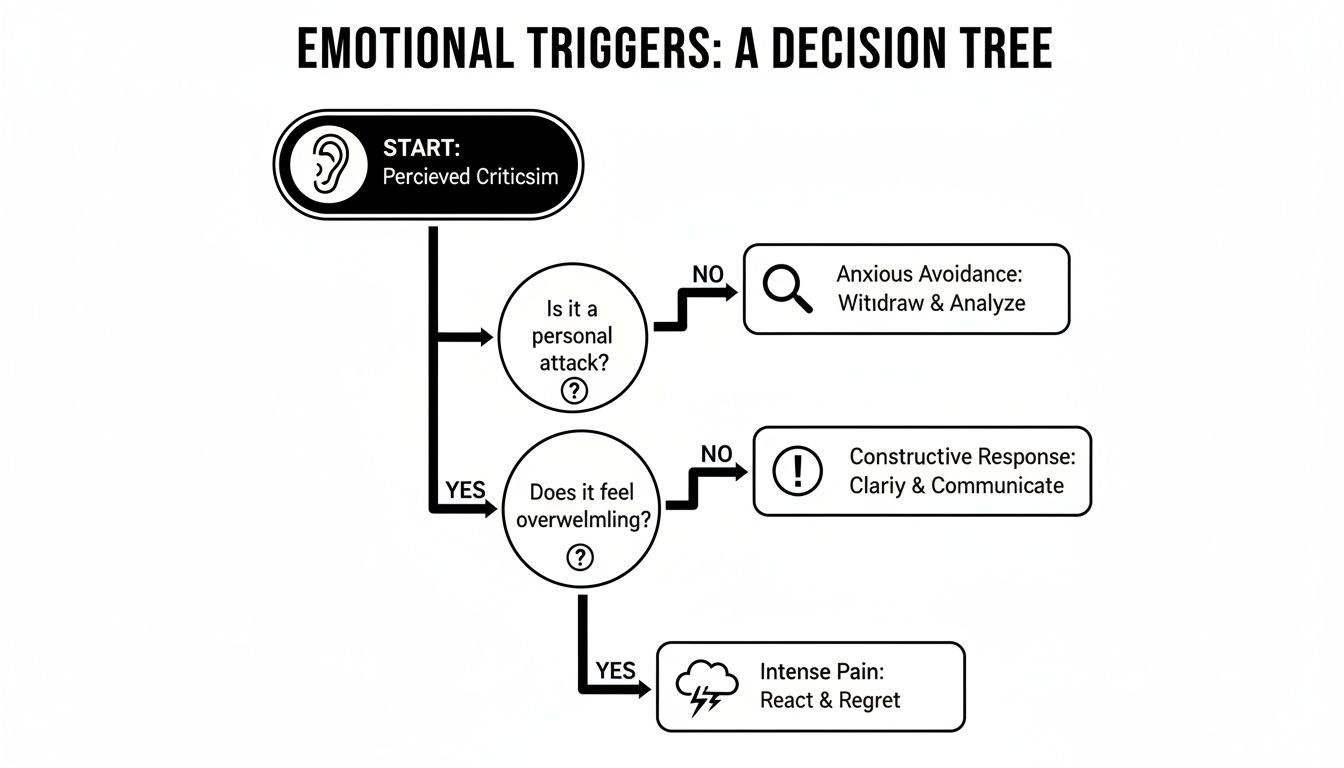
As you can see, that one moment of perceived rejection can lead down two very different paths: one of intense internal pain, and another of anxious avoidance. This fork in the road is a classic part of the RSD experience.
What to Expect from an NHS Referral
If your GP agrees that your symptoms need a closer look, they'll refer you to the local Adult ADHD or Autism assessment service. This is where you’ll likely run into the reality of NHS waiting lists. Depending on where you live, these lists can be incredibly long – we’re talking months, and sometimes even years.
It’s really important to manage your expectations here. Getting the referral is a huge step forward, but the wait can be tough. It’s a good time to start looking into self-help strategies and leaning on your support network.
In the UK, it’s estimated that ADHD affects somewhere between 2.5 to 4 percent of adults. RSD is a common experience within this group, but because it's not an official diagnosis, it often gets missed. This, coupled with the long waits, is why a lot of adults over 18 start exploring private, online psychiatrist-led services to get clarity sooner. You can learn more about the complexities of seeking a diagnosis from various UK sources.
When your appointment finally comes through, the assessment will be comprehensive. It usually involves in-depth conversations, filling out questionnaires, and sometimes they'll want to speak to a partner or family member. For a more detailed breakdown of what to expect, our guide on who can diagnose ADHD walks you through the entire professional assessment process. For those wanting to dig into the evidence base, using specialised AI tools for academic research can help you sift through the latest studies and guidelines.
Exploring Private ADHD and Autism Assessments
When you’re facing the reality of a long NHS wait for an ADHD or autism assessment, it’s completely understandable to start looking for another way. For many people in the UK, a private assessment isn't a luxury; it's a lifeline, especially when the emotional weight of something like Rejection Sensitive Dysphoria (RSD) is making everyday life a struggle.
The biggest reason people go private? Speed. Getting clarity sooner rather than later can be the key to unlocking support at work or university. More than that, it can bring an incredible sense of personal peace after years of feeling lost and misunderstood. A timely diagnosis is like finally being handed the right map.
But this path isn’t just about getting a diagnosis quickly. It’s also about the quality and depth of the assessment. Private services often have the time and resources to go deeper, exploring complex traits like emotional dysregulation to give you a truly complete picture of who you are.
The Benefits of a Private Assessment
Deciding to go private brings some very real advantages. The most obvious one is the drastically shorter waiting time—we’re often talking weeks instead of the months, or even years, you might face with the NHS. When your mental health is suffering, that speed can change everything.
You also get far more choice and control over the process. You can take your time to research and find a clinic or a consultant psychiatrist who specialises in your specific areas of concern. This helps ensure you feel heard and properly understood right from the start.
To put it simply, the main benefits are:
- Faster Access to Diagnosis: You get the answers you need to move forward with your life, without the agonising wait.
- Comprehensive Evaluation: Private assessments often provide a much deeper dive into all of your experiences, including the emotional elements like RSD that can sometimes be overlooked.
- Personalised Care: You typically have better access to the clinician who diagnosed you for any follow-up questions, leading to a more personal and supportive care plan.
How Private Assessments Work with the NHS
One of the most common questions we hear is, "How does a private diagnosis actually connect with the NHS?" It’s easy to think of them as two separate worlds, but that's not quite right. A high-quality private report can actually serve as a powerful bridge between the two.
When you get a diagnosis from a reputable, CQC-regulated service run by consultant psychiatrists, you’ll receive a comprehensive diagnostic report. This isn't just a simple letter; it’s a detailed document that outlines the entire assessment process, confirms the diagnosis, and gives clear, personalised recommendations for treatment and support.
This report is more than just a piece of paper; it's a powerful tool for communication. It is designed to be shared with your NHS GP, providing them with clear, expert clinical guidance on your condition and potential next steps for your care.
This is where something called a shared care agreement comes into play. Your GP can take the clinical recommendations from your report and use them to guide their decisions, whether that’s prescribing medication or referring you to other NHS services. While it’s true that not every GP will agree to shared care, a thorough report from a trusted provider makes a collaborative approach much more likely.
This pathway allows you to get the speed and detail of a private assessment while still having the possibility of accessing ongoing treatment through the NHS. If you're looking into this, understanding what a private ADHD assessment involves can show you what a quality service should offer. It’s about creating a smooth transition and ensuring you get continuous care, no matter where it starts.
Effective Treatment and Management Strategies

Tackling Rejection Sensitive Dysphoria effectively means using a multi-layered approach. We're not just dealing with the intense emotional fallout, but also the underlying neurodivergence that fuels it. Because RSD isn't a standalone diagnosis, the focus is on managing the core symptoms of ADHD or Autism while building specific skills to handle emotional dysregulation. For most people, a combination of medical support, therapy, and practical self-help techniques delivers the best results.
This isn't just about surviving emotional triggers. It's about learning to thrive by building genuine resilience and self-understanding. The aim is to turn down the volume on the pain and shorten the recovery time after a perceived slight, ultimately giving you back control over your emotional wellbeing.
For many, the first step is finding ways to regulate the nervous system, making it less prone to the extreme peaks and troughs that define RSD. This creates a stable foundation, allowing the deeper, more meaningful therapeutic work to begin.
Medical Options for RSD
While no medication is specifically licensed for RSD, some medications prescribed for ADHD can make a world of difference. They work by targeting the brain's neurotransmitter systems, which not only helps with focus and impulse control but can also stabilise emotional responses.
The most common medical routes include:
- Stimulant Medications: Often the first port of call for ADHD treatment, stimulants can significantly improve emotional regulation, which in turn can soften the blow of RSD episodes.
- Non-Stimulant Medications: Certain non-stimulants, like the alpha-agonists Guanfacine and Clonidine, can be particularly helpful for RSD. They work by calming the 'fight or flight' response, which helps dial down that immediate, overwhelming emotional reaction to perceived rejection.
It’s vital to have this conversation with a qualified psychiatrist who truly understands the nuances of ADHD and its emotional challenges. They can help figure out the right medical path for you. That said, medication isn't the only option, and many people find great success exploring how to treat ADHD without drugs through therapy and lifestyle changes.
Therapeutic Support and Building Resilience
Therapy gives you the practical tools to navigate the often-stormy internal world of RSD. It's all about learning to spot, challenge, and reframe the painful thought patterns that rejection kicks into gear.
Two of the most effective therapeutic approaches are:
- Cognitive Behavioural Therapy (CBT): This therapy helps you catch the automatic negative thoughts that fire off during an RSD episode—things like, "They all hate me," or "I'm a complete failure." From there, you learn practical techniques to challenge these thoughts and cultivate more balanced, realistic perspectives.
- Dialectical Behaviour Therapy (DBT): DBT is especially good for managing intense emotional dysregulation. It teaches crucial skills in mindfulness, distress tolerance, and interpersonal effectiveness, helping you sit with painful emotions without letting them completely take over.
The intense emotional pain driven by perceived rejection is a core feature of the condition. For many UK ADHD patients, this pain is described as 'devastating' or 'unbearable,' with research suggesting that up to 99 percent of people with ADHD experience it to some degree. This experience is distinct from general sensitivity because it involves brain areas related to both attention and emotion, amplifying minor critiques into profound distress. Learn more about the deep emotional impact of RSD in ADHD.
The goal of therapy isn’t to stop feeling emotions, but to learn how to manage them. It’s like learning to surf; you can't stop the waves, but you can learn how to ride them without wiping out.
Actionable Self-Help Techniques
Alongside professional support, developing your own personal coping strategies is absolutely essential for managing RSD day-to-day. These techniques empower you to become an active participant in your own emotional regulation.
- Mindfulness and Grounding: Simply practising mindfulness can create a vital gap between a trigger and your reaction. Grounding techniques, like focusing on the feeling of your feet on the floor, can pull you back into the present moment when your mind starts to spiral.
- Journaling to Identify Triggers: Keep a simple log of when RSD hits. Note down what happened, who was involved, and how you felt. Over time, you’ll start to see patterns, which helps you anticipate and prepare for potentially tricky situations.
- Practising Self-Compassion: RSD often travels with a very harsh inner critic. Actively practising self-compassion—treating yourself with the same kindness you’d offer a good friend—can start to counteract those deep-seated feelings of shame and inadequacy. This is how you build a stronger, more resilient sense of self-worth.
A Few Common Questions
When you're trying to make sense of Rejection Sensitive Dysphoria, ADHD, and Autism, it's natural to have a lot of questions. Let's tackle some of the most common practical concerns that come up when people are looking for support in the UK, both through the NHS and other avenues.
Should I Tell My Employer About My Diagnosis?
This is a big question, and the answer is entirely personal. There's no legal requirement for you to tell your employer about an ADHD or Autism diagnosis. However, being open about it is the only way to get legal protection and reasonable adjustments under the Equality Act 2010.
If you find that RSD or emotional dysregulation is affecting your work, starting a conversation about your diagnosis can be the first step towards getting the right support. This could mean simple but effective changes, like getting feedback in writing rather than face-to-face, having more regular check-ins to reduce uncertainty, or even just having a quieter place to work so you can focus and regulate your emotions.
Before you say anything, take a moment to think about your workplace culture. If you trust your manager and feel supported, the chat will likely go well. If you're not so sure, it might be a good idea to get some advice first from an organisation like ACAS or your trade union.
Can My GP Prescribe Medication for RSD?
This is a really common point of confusion. A GP can't prescribe medication specifically for RSD because it isn't a formal medical diagnosis in its own right. But that doesn't mean they aren't a vital part of your care.
The medications that help with the intense emotional reactions linked to RSD are usually prescribed as part of an ADHD treatment plan. This typically happens in one of two ways:
- After an NHS diagnosis: You'll be assessed by an NHS psychiatrist who will create a treatment plan, which might include starting medication. Once you're on a stable dose, they can set up a 'shared care agreement' with your GP, who then takes over issuing the repeat prescriptions.
- After a private diagnosis: A private consultant can also diagnose you and recommend medication. Your GP can then agree to a shared care arrangement based on that private report, allowing them to handle your prescriptions on the NHS.
It's worth remembering that the final say always lies with your GP. They have to feel comfortable and confident in taking on that responsibility.
Is RSD Officially Recognised by the NHS?
Right now, no. Rejection Sensitive Dysphoria isn't an officially recognised condition within the NHS, nor will you find it listed in the main diagnostic manuals like the DSM-5. So, you won't find a dedicated pathway for "rejection sensitive dysphoria NHS" support.
But this absolutely does not mean the symptoms are dismissed. The underlying concept of emotional dysregulation is very well recognised as a key part of both ADHD and Autism Spectrum Disorder.
When you're talking to your GP or a specialist, the best approach is to focus on these recognised symptoms. Describing things like extreme emotional sensitivity, sudden and intense mood shifts, or struggling to manage your emotional reactions is the clearest way to explain what you're going through and get the right help.
While the term RSD might not be on the official paperwork, the experience it describes is a real and often debilitating part of life for many neurodivergent people. The clinical focus will simply be on treating the underlying condition that causes these emotional challenges.
Can Therapy Help Manage RSD Symptoms?
Yes, absolutely. Therapy is one of the best tools available for dealing with the fallout from RSD. While medication can help calm your nervous system, therapy gives you the practical, hands-on skills to change how you relate to your thoughts and feelings.
Two therapies have proven particularly helpful:
- Cognitive Behavioural Therapy (CBT): This approach helps you spot and challenge the automatic negative thoughts that pop up when you feel rejected. It's about learning to step back and reframe a situation more realistically.
- Dialectical Behaviour Therapy (DBT): DBT is brilliant for anyone dealing with very intense emotions. It teaches essential skills in mindfulness, tolerating distress, and regulating your emotions so you can get through painful moments without feeling totally swamped by them.
The key is to find a therapist who really understands adult ADHD and Autism. They'll get the 'why' behind your emotional responses and can adapt their methods to help you build genuine, lasting resilience and self-compassion.
At Insight Diagnostics Global, we provide a clear path to understanding your mental health. Our fully online, consultant-led service offers comprehensive assessments for ADHD and Autism for adults, delivered by CQC-regulated psychiatrists. If you are ready to get the clarity you deserve, explore our services at https://insightdiagnostics.co.uk.