

That lingering sense of being overwhelmed, struggling to focus, or acting on impulse might be more than just a personality quirk. If any of this sounds painfully familiar, figuring out how to get tested for ADHD is a massive first step towards understanding your mental health and getting some answers.
In the UK, you've got two main routes to an assessment: going through the NHS or opting for a much quicker diagnosis with a private provider.
Recognising the Signs and Knowing Your Options
If you’re thinking about an ADHD assessment, you're definitely not alone. So many adults spend years wrestling with symptoms they can't quite put a name to, often leading to a cycle of frustration and feeling like they're just not trying hard enough. The thing is, adult ADHD rarely looks like the classic picture of a hyperactive child bouncing off the walls.
Instead, it can show up in ways that are much more subtle, like:
- Constant procrastination and an inability to finish projects, especially at work.
- Feeling completely swamped by simple daily tasks like paying bills or tidying up.
- Intense emotional reactions, like getting frustrated in a flash or experiencing big mood swings.
- A habit of "zoning out" during conversations, even when you’re desperately trying to pay attention.
ADHD, Autism and Co-occurring Conditions
It’s crucial to understand that ADHD often doesn't travel alone. Many people who suspect they have ADHD also have traits of Autism Spectrum Disorder (ASD), anxiety, or depression. This overlap between neurodevelopmental conditions and mental health challenges can make everything feel much more complicated. For example, the social difficulties that can come with autism might be amplified by the impulsivity of ADHD, while the constant struggle of living with undiagnosed ADHD can directly contribute to anxiety and depression.
A proper, thorough assessment will always look at the bigger picture of your mental health to make sure any diagnosis truly reflects what you're going through. For a deeper dive, this adult ADHD symptoms checklist is a really helpful starting point.
The scale of undiagnosed ADHD in the UK is genuinely shocking. Consider this: out of an estimated 2.5 million people in England thought to have ADHD, a huge number of them are undiagnosed. In fact, as of early 2025, just 0.32% of over 9 million UK GP records showed a formal ADHD diagnosis. That leaves millions of people trying to navigate life without the clarity and mental health support they deserve.
Choosing Your Assessment Pathway
Once you decide it's time to get some answers, you’re faced with a big choice: the NHS or the private route. There’s no right or wrong answer here – it all comes down to what works for you, your budget, and how urgently you feel you need a diagnosis for your mental well-being.
This flowchart breaks down the decision-making process, showing you what each path looks like.
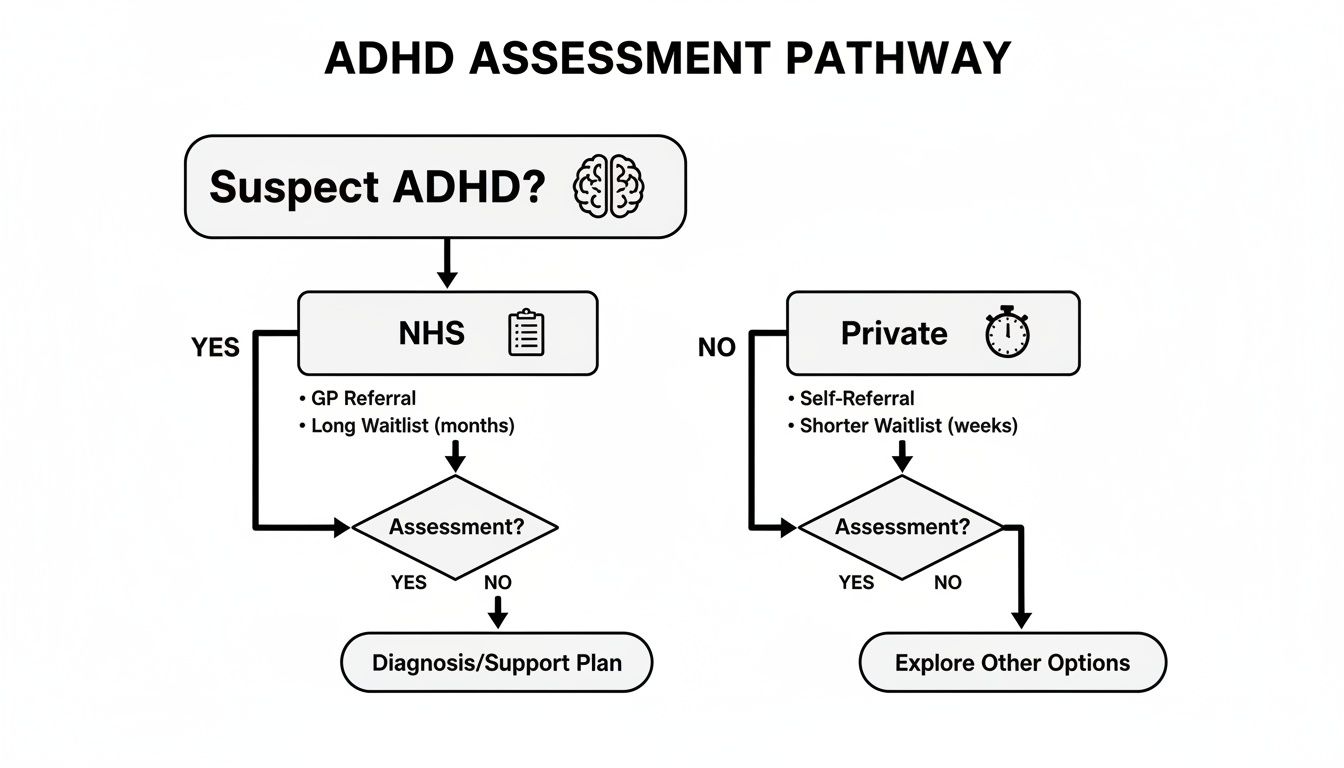
As you can see, there's a clear trade-off. You've got the cost-free (but very slow) NHS pathway on one side, and the speed and direct access of private clinics on the other. Your decision will probably boil down to whether you can afford to wait potentially years for an assessment or if you need answers sooner to start getting the right support.
UK ADHD Assessment Pathways at a Glance
To make the choice a bit clearer, here’s a straightforward comparison of the two main routes for an adult ADHD assessment in the UK. This table highlights the key differences to help you decide which path feels right for your situation.
| Feature | NHS Pathway | Private Pathway (e.g., Online Clinic) |
|---|---|---|
| Referral Process | Requires a GP referral | Usually self-referral, no GP needed |
| Wait Times | Extremely long, often 2-5+ years | Much shorter, typically a few weeks to months |
| Cost | Free at the point of service | Varies, typically £700 – £1,500+ for assessment |
| Choice of Provider | Limited; assigned by local trust | You can choose your preferred clinic/specialist |
| Medication Costs | NHS prescription charges apply | Private prescription costs are higher |
| Follow-Up Care | Managed within the NHS system | Often requires a Shared Care Agreement with your GP |
Ultimately, weighing the pros and cons of time versus cost is the central decision. Both pathways lead to a formal diagnosis, but the journey to get there looks very different.
Navigating the NHS for Your ADHD Assessment
For many, the NHS is the natural starting point when considering an ADHD assessment. It’s a route that’s free at the point of care, which is a massive plus. But, and it’s a big but, it’s a path that demands a lot of patience and some solid preparation on your part. Knowing what to expect can make all the difference between a frustrating dead-end and getting the ball rolling.

Everything kicks off with your GP. Think of them as the gatekeeper to any specialist services, so the main goal of that first appointment is simple: to walk out with a referral to your local adult ADHD service.
That sounds straightforward, but it isn't always. Some GPs aren’t as familiar with how ADHD presents in adults, and they might suggest your symptoms point to more common mental health issues like anxiety or depression first, without considering they could be co-occurring or even caused by underlying ADHD. This is where coming prepared is your secret weapon.
Preparing for Your GP Appointment
Walking into your appointment organised is the best way to advocate for yourself. Just saying, "I think I have ADHD," probably won't cut it. You need to build a compelling case that shows how these symptoms are genuinely getting in the way of your life.
Start by documenting everything. And I mean everything. Jot down specific, real-world examples of where you're struggling. Think about it in terms of different life areas:
- At Work: Are you constantly missing deadlines? Making silly mistakes you know you shouldn't? Finding it impossible to focus during meetings?
- At Home: Is your house a mess? Do you struggle to stay on top of chores, pay bills on time, or even remember your dentist appointment?
- In Relationships: Does your mind wander during conversations? Do you find yourself interrupting people constantly, causing friction with your partner, friends, or family?
Beyond what’s happening now, any evidence from your childhood is pure gold. ADHD is a neurodevelopmental condition, which means the signs have been there since you were young. If you can, dig out old school reports. Those comments like "a classic daydreamer," "very disorganised," or "fails to live up to their potential" are incredibly powerful.
The key thing to remember: Your GP needs to see a persistent pattern of behaviour that’s been affecting you for years, not just a recent rough patch. Old school reports, comments from past managers, and even stories from your parents can help paint that full, lifelong picture.
The Realities of NHS Waiting Lists
So, your GP agrees to refer you. Fantastic! Now comes the hardest part: the wait. There's no sugar-coating this—waiting lists for adult ADHD assessments on the NHS are notoriously long. We're talking between two and five years in many parts of the UK, and sometimes even longer.
That delay can feel agonising when you're desperate for answers and your mental health is suffering. It's crucial to manage your expectations and understand this is a system-wide problem caused by huge demand and not enough resources. While you're on the list, your GP can still help with related issues like anxiety or depression.
Understanding Your Right to Choose
If the thought of waiting years feels unbearable, you might have another option. The 'Right to Choose' policy in England gives you the power to select where your NHS-funded assessment and treatment happen. This means you can ask to be referred to a different NHS-approved provider—including some private clinics with NHS contracts—that might have a much shorter queue.
Using Right to Choose involves a bit of research on your end to find a qualified provider. You then have to specifically ask your GP to refer you there. It takes a little extra effort, but it could potentially cut your wait time from years down to a few months. It's definitely an alternative worth looking into.
Exploring the Private Route for Faster Answers
When you're faced with the prospect of waiting years for an ADHD assessment on the NHS, the thought can be completely overwhelming. That’s where going private comes in. For many, this isn’t about jumping the queue; it's about getting urgent answers to lifelong questions that are impacting work, relationships, and their overall mental health right now.
The good news is that modern, fully online services have made this option far more accessible. It’s a credible and efficient way to get clarity, often starting with a simple self-referral that puts you in control from day one, no GP appointment necessary.

Researching Reputable Online Clinics
Doing a bit of homework here is crucial. The key to a trustworthy diagnosis is choosing a reputable provider, because not all online services are created equal. You need to be sure you're engaging with a genuine medical service, not just a questionnaire-filling exercise.
Here’s what to look for when you're vetting your options:
- CQC Regulation: Is the clinic regulated by the Care Quality Commission (CQC)? This is the independent regulator for health and social care in England, and their stamp of approval is a non-negotiable mark of quality and safety.
- GMC-Registered Psychiatrists: Check that the assessments are actually carried out by consultant psychiatrists who are on the General Medical Council’s (GMC) Specialist Register. This is your guarantee that you’re being seen by a highly qualified medical doctor with real expertise.
- Specialisation in Neurodiversity: Look for clinics that really understand adult ADHD and its common companions, like autism and other mental health conditions. An expert grasp of how these conditions can overlap is essential for getting an accurate, nuanced diagnosis.
A proper private ADHD assessment will always centre around a comprehensive clinical interview with a specialist, not just a series of online forms.
What to Expect From a Private Online Assessment
Once you’ve found a clinic you trust, the process is usually pretty straightforward. It typically kicks off with you filling out some initial screening questionnaires and providing a detailed personal history. This isn't just admin; it’s the foundation for your assessment, giving the psychiatrist vital context about your life experiences, from childhood right up to today.
The heart of the process is the video assessment. This is a detailed clinical interview, usually lasting between one and two hours, with a consultant psychiatrist.
During this conversation, they will:
- Dig deep into your symptoms and how they show up in different areas of your life.
- Explore your developmental history, looking for signs and patterns from your childhood.
- Talk about any other mental health conditions, like anxiety, depression, or traits of autism, to get the full picture.
- Use structured diagnostic tools and rating scales to measure your symptoms against the established clinical criteria.
The goal is to build a complete, 360-degree view of your life. The psychiatrist is looking for a persistent pattern of challenges that can't be better explained by another condition. This is why your honest and detailed personal and mental health history is so incredibly important.
Let’s be honest: for UK adults, getting tested requires being proactive. While you can go through your GP for an NHS referral, the waits are often incredibly long, and the quality of service can be a postcode lottery. This is where modern, accessible online services have become so important. Some CQC-regulated, psychiatrist-led online clinics can schedule an assessment within seven days and deliver a full report in just five.
The Benefits of Speed and Certainty
The biggest, most obvious benefit of going private is time. Slashing the wait from several years to just a few weeks can be genuinely life-changing. It means you can finally stop wondering and start understanding. You get a clear diagnosis and a plan to move forward with your mental health.
After the assessment, you’ll receive a comprehensive diagnostic report. This document breaks down the clinical findings, confirms the diagnosis (if one is made), and provides personalised recommendations. This could include medication, therapy, or coaching. Think of this report as your personal blueprint for the next steps, empowering you with the information you need to finally manage your symptoms effectively.
How to Prepare for Your Assessment Session
Going into your ADHD assessment, whether you’re going through the NHS or a private clinic, can feel a bit daunting. But a little bit of preparation can make a world of difference. It helps you get your thoughts straight so you can clearly explain what you've been going through. This isn’t about passing a test; it's about giving the clinician a genuine window into your world.
Your main job here is to move beyond a simple list of symptoms. You need to paint a clear picture of how these challenges actually show up in your day-to-day life. Clinicians are looking for a consistent, persistent pattern, so a vague statement like "I'm disorganised" isn't nearly as powerful as a specific, real-life example.
Gathering Your Evidence and Examples
Think of yourself as building a case file, but for your own life. The more tangible examples and detailed memories you can pull together, the clearer the picture will be for the person assessing you. The goal is to create a timeline that shows these difficulties have been a long-term feature of your life, not just a recent problem.
Start by jotting down specific instances from all corners of your life. Don't worry about writing perfect paragraphs—bullet points are your friend here.
- Work & Career: Have you had feedback from managers about careless mistakes, constantly missed deadlines, or struggling to follow a project through to the end? Maybe you’ve hopped between jobs frequently, driven by boredom or frustration.
- Finances: Think about any history of impulse buys that you later regretted, late fees on bills you simply forgot about, or the struggle to save money even when you’re earning enough.
- Relationships: Has friction been caused because you tend to interrupt people, find yourself zoning out during important conversations, or forget significant dates like birthdays and anniversaries?
- Home Life: Is your living space in a constant state of ‘organised chaos’ (or just chaos)? Do you find it incredibly hard to keep on top of basic chores, laundry, or even planning what to eat for dinner?
Old school reports are absolute gold dust. Dig them out if you can. Comments from teachers like “bright but doesn’t apply himself,” “easily distracted,” or “struggles with organisation” are powerful evidence. They show that the signs were there long before the pressures of adult life kicked in.
Being Open About Your Mental Health
It’s really important to be open about your mental health as a whole. ADHD rarely travels alone; it often brings friends like anxiety, depression, and sometimes autism along for the ride. A good assessor needs the full story to make an accurate diagnosis and to figure out what’s what.
For instance, you could explain how the constant struggle to keep up might be making you feel anxious, or how years of feeling like you're failing have chipped away at your self-esteem. If you also suspect you might be autistic, bring up examples of any social communication challenges or sensory sensitivities you experience. This context is vital for helping the clinician untangle overlapping symptoms.
Your assessment isn't just a test for ADHD; it's a look at you as a whole person. Being honest about struggles with anxiety, low mood, or potential autism doesn't weaken your case—it actually strengthens it by giving the clinician the complete, nuanced information they need.
Questions to Ask Your Assessor
Remember, this is a two-way conversation. You're also figuring out if this clinician is the right person to help you, especially if your situation feels complicated. Having a few questions ready shows that you’re taking an active role in your own health.
You might want to ask things like:
- How much experience do you have with adult ADHD, especially when it presents alongside conditions like autism or anxiety?
- What does your diagnostic process look like beyond this first meeting?
- If I am diagnosed, what are the next steps for treatment and support here?
- Could you walk me through how medication titration and monitoring works at this clinic?
- What kind of non-medical support, like therapy or coaching, do you usually recommend?
Walking in with this preparation changes the dynamic entirely. It helps you advocate for yourself and ensures that you walk out feeling like you’ve been properly heard, whatever the outcome might be.
Life After Diagnosis: Your Treatment and Support Plan
Getting an ADHD diagnosis isn’t the finish line; it’s the starting block. For many, it’s the moment years of unexplained struggles finally click into place. This can bring a massive sense of relief, but it can also feel a bit daunting. What now? Think of your diagnosis as the first step into a more informed, supported chapter of your life.
The first thing you’ll get is a detailed diagnostic report. This isn't just a piece of paper with a label on it. It’s a personalised blueprint, breaking down the clinical findings and mapping out a clear path for managing your symptoms.

This report is the bedrock of your treatment plan, which nearly always combines medication with other practical, real-world support.
The Role of Medication and Titration
For most adults with ADHD, medication is a game-changer. It doesn't "cure" anything, but it can turn down the volume on the constant mental static. This often leads to better focus, less impulsivity, and a calmer mind, which makes it far easier to actually implement other strategies like therapy or coaching.
Finding the right medication isn't as simple as picking one off a shelf. You'll go through a carefully managed period called titration. During this time, you'll work very closely with your psychiatrist to find the exact right medicine and dose for your unique brain chemistry. It’s a slow and steady process, usually starting on a low dose and gradually increasing it while you both monitor the effects—both good and bad. Your feedback here is absolutely crucial.
It's a common myth that ADHD medication will change your personality. The real goal of titration is to find a dose that helps you feel more like yourself—the focused, capable version that isn't constantly fighting distraction. It lets your own skills shine through.
If you want to get a head start, it’s worth reading up on the different options. You can learn more about the https://insightdiagnostics.co.uk/best-adhd-medication-for-adults/ so you can have a more informed chat with your clinician.
Beyond Medication: Essential Support Systems
While medication is a powerful tool, a truly effective plan tackles your mental health from all angles. This is especially important if you have other co-occurring conditions, like anxiety or autism, which need their own targeted support.
Your diagnostic report will probably suggest a mix of strategies, including things like:
- Cognitive Behavioural Therapy (CBT): There are specific forms of CBT designed for the ADHD brain. It’s less about deep-diving into your past and more about building practical, in-the-moment skills for managing time, getting organised, and handling emotional ups and downs.
- ADHD Coaching: A coach is like a project manager for your life. They help you set goals—both personal and professional—and then provide the accountability and structure to help you actually reach them, building habits that stick.
- Reasonable Adjustments at Work: Your diagnosis is a protected characteristic under the Equality Act 2010. This gives you the legal footing to ask for support at work. This could mean simple things like noise-cancelling headphones, permission to work from a quieter space, or having more flexible hours.
Navigating Shared Care with Your GP
Once your medication type and dosage are stable, the next practical step is often arranging a Shared Care Agreement with your NHS GP. This is a formal plan where your GP agrees to take over writing your prescriptions on the NHS, which makes your medication much more affordable long-term.
Your private psychiatrist handles all the admin, providing your GP with a comprehensive handover and guidelines for ongoing monitoring. This collaboration between private and public healthcare is designed to give you continuous, safe, and sustainable care for the long haul.
Common Questions About Adult ADHD Testing in the UK
Thinking about getting an ADHD assessment can bring up a lot of questions. It's completely normal to wonder about the costs, the reliability of online options, and what the whole process actually involves. Let's walk through some of the most common queries I hear, especially when it comes to the crossover between ADHD, autism, and other mental health challenges.
How Much Does a Private ADHD Assessment Cost in the UK?
Going private is a big financial decision, and the truth is, costs can swing quite a bit from one clinic to another. As a general ballpark, you should probably budget somewhere between £600 to £1,500 for the initial diagnostic package.
That fee typically gets you the comprehensive consultation with a psychiatrist, the full diagnostic process itself, and the detailed report at the end. But – and this is a big but – you need to check what’s not included.
Follow-up appointments and, crucially, the medication titration process are almost always billed separately. Titration is where your specialist carefully works with you to find the right medication and dosage. This phase alone can add several hundred pounds to your total bill, and that’s before you even factor in the cost of the private prescriptions themselves. This continues until you can, hopefully, get a shared care agreement sorted with your NHS GP.
Are Online ADHD Assessments as Reliable as In-Person Ones?
Yes, they absolutely are – provided you go with a reputable provider. When an assessment is carried out by a CQC-regulated clinic using GMC-registered consultant psychiatrists, an online evaluation is considered just as valid as a face-to-face one.
Why? Because the heart of a solid ADHD diagnosis isn't about being in the same room; it's about the depth of the clinical interview.
Good online clinics follow the exact same NICE guidelines and use the same evidence-based diagnostic tools as an in-person service. It all happens over a secure video call, which still allows for a really thorough and personal assessment. The huge upsides are that it opens up access to specialists for people all over the UK and cuts down waiting times dramatically, making it a brilliant option for adults who just want clarity on their mental health.
The credibility of an online assessment hinges entirely on the provider's credentials. Always check that the clinic is regulated by the Care Quality Commission (CQC) and that your assessment will be with a specialist consultant psychiatrist.
How Is an ADHD Assessment Different from an Autism Assessment?
This is a great question, especially since ADHD and Autism are both neurodevelopmental conditions and can share some overlapping traits, like social challenges or getting intensely focused on certain things. But their core diagnostic criteria are very different.
An assessment for ADHD is going to be looking for a lifelong pattern of:
- Inattention: Things like struggling to hold focus, being disorganised, and chronic forgetfulness.
- Hyperactivity & Impulsivity: Feeling restless, talking a mile a minute, or acting on impulse without thinking it through.
An Autism (ASD) assessment, on the other hand, is centred on a different set of criteria:
- Social Communication: Persistent difficulties with social back-and-forth and interpreting non-verbal cues.
- Repetitive Behaviours: Having very specific interests, needing strict routines, and sensory sensitivities.
It's actually not uncommon for someone to have both ADHD and Autism (sometimes called AuDHD). This is why it’s so important to be seen by a clinician who truly specialises in adult neurodiversity. They have the experience to carefully untangle the symptoms and give you a clear, nuanced diagnosis that reflects who you are. This is vital for making sure any support or treatment plan actually hits the mark.
What Happens if My GP Rejects My Diagnosis or Referral?
This is a tough and frustrating situation, but don't lose hope. You have options.
If your GP seems reluctant to refer you to an ADHD service in the first place, preparation is your best friend. Walk into that appointment with a written list of your symptoms and, crucially, specific real-life examples of how they affect you. It doesn't hurt to mention the official NICE guidelines for adult ADHD, either. If they still say no, you are perfectly within your rights to ask for a second opinion from another doctor in the practice.
When it comes to a private diagnosis, most GPs are willing to enter a 'Shared Care Agreement' for medication, but it's important to know they aren't obligated to. To give yourself the best chance of a smooth handover, choose a well-regarded, UK-based clinic for your assessment. A smart move is to have a chat with your GP before you go private. Just let them know your plans and ask if they are generally open to shared care with reputable providers. It can save a lot of stress down the line.
At Insight Diagnostics Global, we provide clear, expert-led online assessments for adults, helping you get the answers you deserve without the long waits. Our CQC-regulated service is delivered by GMC-registered consultant psychiatrists specialising in adult ADHD, Autism, and mental health. If you're ready to take the next step, you can learn more about our assessment process.