

For many adults, the path to an autism assessment doesn't start in a doctor's surgery. It begins with a quiet, lifelong feeling of being out of step with the rest of the world—a sense that you missed the day they handed out the social instruction manual. This often crystallises when you first read or hear about autism and see your own life reflected back at you.
We're seeing a growing wave of adults who are finally seeking answers after decades of trying to make sense of their own social, sensory, and communication styles. It’s a journey of self-discovery, and it often involves unravelling a history of other diagnoses first.
For example, it's not uncommon for conditions like anxiety or depression to be identified long before autism. In many cases, these mental health challenges are a direct result of the immense stress of navigating a neurotypical world without the right support or self-understanding. There's also a significant overlap between autism and ADHD, which can mean traits get misinterpreted or masked, delaying a clear diagnosis for years.
The Exhausting Work of Masking
Many adults who grew up without a diagnosis have become masters of what's known as masking or camouflaging. This is the conscious (or sometimes unconscious) effort to suppress natural autistic behaviours to fit in socially.
Think of it as constantly "performing" neurotypical. It might mean forcing eye contact that feels painful, mimicking the social chit-chat of others, or hiding the urge to stim (repetitive movements that help regulate emotions). While it can be a useful survival strategy, masking is incredibly draining and often leads to burnout, anxiety, and a shaky sense of identity.
This is why autistic traits in adults are so often missed, even by well-meaning healthcare professionals.
- An intense, specialised interest might just look like a quirky hobby.
- Sensory sensitivities could be brushed off as being "fussy" or "overly dramatic."
- A need for direct, clear communication might be misinterpreted as rudeness.
Getting to grips with these patterns is a crucial first step. If this sounds familiar, you might find it helpful to explore the common signs of undiagnosed autism in adults in our detailed guide.
The infographic below offers a simplified look at how this journey often unfolds, from initial self-awareness to getting the right support.
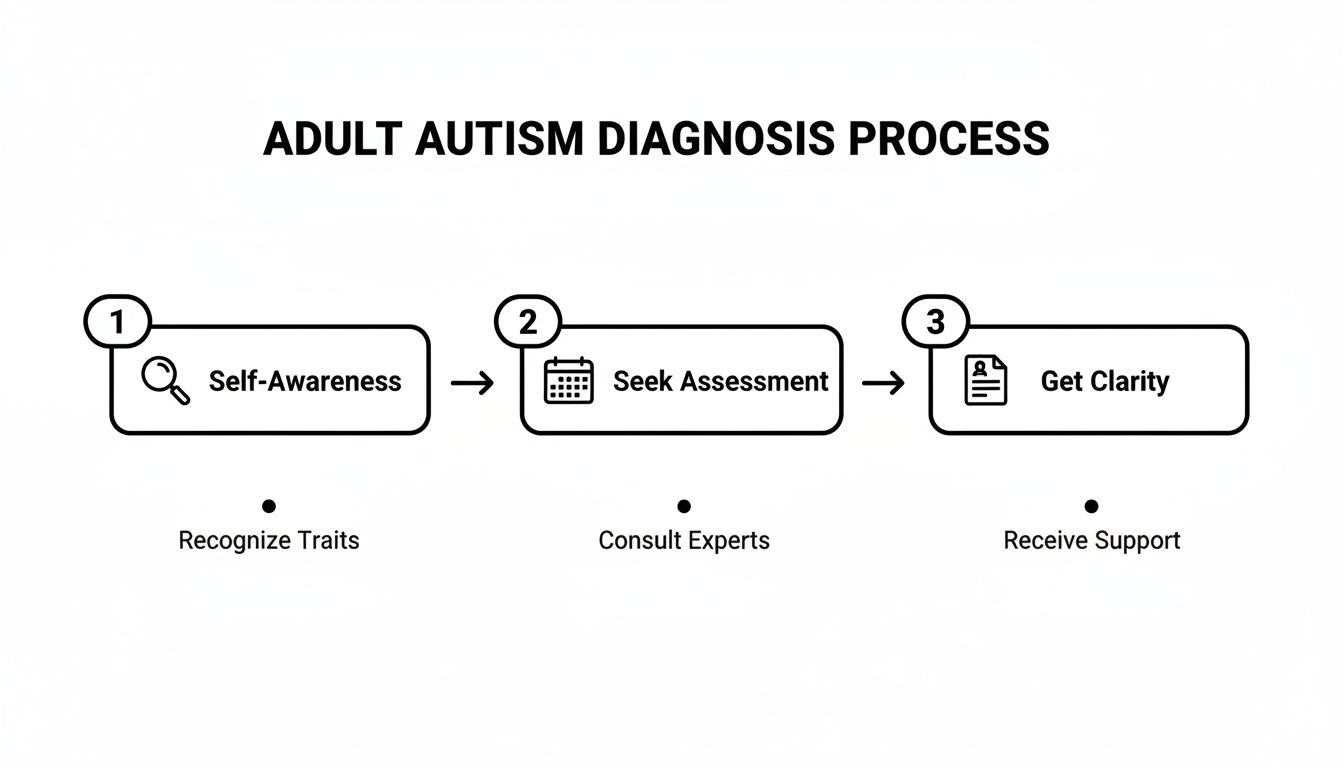
As this shows, the process is really about moving from that internal lightbulb moment towards a structured, professional assessment that provides the clarity you need to move forward.
A Pathway to Self-Understanding
Getting a formal diagnosis isn't just about getting a label. For most, it’s a profound moment of validation and the beginning of true self-understanding. It provides a new lens through which to look back at past struggles and gives you the tools to build a better future.
The need for this is huge. Recent research suggests there could be over 750,000 undiagnosed autistic adults in England alone, potentially doubling previous official estimates. This shows just how many people are living without the answers they deserve. You can read more about this on the UCL website, where they discuss the underdiagnosis of autism in adults.
Seeking a diagnosis is an act of self-advocacy. It's about finally getting the instruction manual for your own brain, empowering you to build a life that aligns with your neurotype rather than fighting against it.
Whether you go through the NHS or a specialist private clinic, the goal is the same: to gain clarity, find the right support, and embrace your identity with confidence.
How to Prepare for Your Autism Assessment

Heading into an autism assessment is a big deal, so it’s completely normal to want to feel prepared. The aim here isn't to "pass" a test, but to help the clinician see the full, detailed picture of your life. Good preparation helps you marshal your thoughts so you don’t forget important details, especially if you’re feeling nervous on the day.
Think of it as pulling together a personal archive. You're collecting the evidence and stories that show how you’ve navigated the world, right from childhood up to today. This is incredibly important because an adult autism diagnosis hinges on understanding your developmental history.
It’s also common for adults exploring an autism diagnosis to have questions about ADHD or other conditions like anxiety. Your prep should include these experiences as well. Showing how these different challenges might overlap gives the diagnosing clinician a much richer context to work with.
Building Your Developmental History
A clinician needs to get a real sense of who you were as a child and a teenager. Memories can be hazy, so gathering actual evidence from your past is one of the most useful things you can do. It gives us an objective look back that isn't filtered through your current understanding of yourself.
Start digging for things like:
- Old School Reports: These are often a goldmine. Look for those repeated comments about social skills, focus, or classroom behaviour. Phrases like "a quiet dreamer," "very bright but doesn't apply themself," or "struggles to work in groups" can be incredibly revealing, especially when considering co-occurring ADHD.
- Family Memories: Chat with parents, older siblings, or any relatives who knew you well back then. Ask them specific questions about your early milestones, how you made friends, any particular routines you had, or unusual habits and intense interests.
- Personal Journals or Diaries: If you kept a diary, it offers a raw, unfiltered window into your thoughts and feelings at different points in your life. It’s a real-time account of your social and emotional world, which can highlight long-standing patterns of anxiety or depression.
A clinician isn't just ticking off a list of "autistic traits." They are piecing together a timeline to see if there's a consistent pattern of developmental differences that has been there all along. That lifelong persistence is a cornerstone of the diagnostic criteria.
Documenting Your Current Experiences
While your history is vital, your life right now is the other half of the puzzle. The day-to-day strengths and struggles you're facing are what led you to seek an assessment in the first place. I often suggest keeping a dedicated notebook or a digital document to jot things down in the weeks before your appointment.
Try to focus on these key areas:
- Work and Daily Functioning: How do you cope at work? Make a note of challenges with executive functions (like planning projects or just getting started on a task), navigating office small talk, or dealing with sensory overload from bright lights or background noise. Executive function difficulties are a hallmark of both ADHD and autism.
- Relationships and Socialising: Think about your friendships and romantic relationships. Do you find social events exhausting? Do you often feel like you're missing the point of a conversation or have to consciously "perform" to fit in? Note down if this leads to anxiety.
- Sensory Sensitivities: Make a list of your sensory experiences. Are you particularly sensitive to certain sounds, lights, textures, or smells? Or do you find yourself seeking out strong sensory feelings?
- Routines and Interests: Describe your relationship with structure and routine. Do you need things to be predictable to feel settled? What are your special interests, and how much of your time and energy do they occupy?
Using Self-Assessment Tools Wisely
You’ve probably seen plenty of online autism screening quizzes. It’s important to remember that these can never give you a diagnosis, but they can be surprisingly helpful for preparation. The structured questions they ask can prompt you to reflect on your own traits and start organising your thoughts.
Completing a screener like the AQ-10 or RAADS-R can help you pinpoint specific examples from your life that relate to the questions. Don't just bring the final score to your appointment; bring the notes you made. This gives the clinician concrete examples we can talk through together.
If you're looking for a clear rundown of the entire assessment journey, this guide on how to get tested for autism in the UK is a great starting point. By doing this prep work, you ensure your own lived experience remains at the very heart of the assessment, which is the key to a truly accurate and meaningful outcome.
What Happens During the Clinical Assessment

Walking into a formal diagnostic assessment can feel pretty nerve-wracking, but knowing what’s involved can make a huge difference. First things first: this isn't a test with a pass or fail grade. Think of it as a collaborative process, a structured conversation where you and the clinician work together to build a complete picture of who you are.
We're essentially going on a deep dive into your life story, exploring everything from your earliest childhood memories to what your life looks like today. A skilled psychiatrist will guide the conversation, creating a safe and non-judgemental space for you to share your experiences, including how potential autism, ADHD, and mental health symptoms may interact. The goal is simply to understand your unique way of seeing and interacting with the world, and to see how that aligns with the diagnostic criteria for autism.
The Structure of the Clinical Interview
The heart of any assessment is the diagnostic clinical interview. This is a detailed conversation that weaves together your developmental history with your current day-to-day functioning. The clinician won't just fire questions at you; they'll use open-ended prompts to explore the key areas associated with autism.
You can expect the conversation to touch on a few core themes:
- Social Communication and Interaction: This could involve talking about how you made friends as a kid, how you manage conversations now, or whether you feel like you have to consciously “script” your way through social situations.
- Restricted and Repetitive Behaviours: We’ll likely discuss any intense, focused interests you've had over the years, how you feel about routine and change, and any repetitive movements (stimming) you might use to soothe yourself.
- Sensory Experiences: The clinician will want to understand your sensory world. Are you particularly sensitive to certain sounds, lights, or textures? Or do you find yourself seeking out strong sensory feelings?
- Co-occurring Conditions: A thorough interview will also explore symptoms of ADHD, anxiety, and depression to understand how these conditions might be present and influencing your life.
It’s important to realise the interview is more than just a Q&A. The clinician is also observing things like your communication style and use of language. This all contributes to the overall diagnostic picture. You can get a broader feel for these kinds of evaluations by reading about what is a psychiatric assessment.
Using Standardised Assessment Tools
Alongside the main interview, clinicians often use specific, well-researched tools to gather extra information in a structured way. These aren't definitive tests, but they help ensure the assessment is thorough and consistent. They are never used on their own to make a diagnosis.
One of the most well-known tools is the Autism Diagnostic Observation Schedule, Second Edition (ADOS-2). This is a semi-structured assessment where you’ll do various activities and have conversations with the assessor. For an adult, this might involve something like telling a story based on a picture book or doing a creative task. The idea is to observe your social communication and interaction in a standardised setting.
Other tools might be brought in as well:
- Diagnostic Interviews: Something like the Autism Diagnostic Interview-Revised (ADI-R) is often used. This is typically a conversation with a parent or someone who knew you very well as a young child to get a detailed developmental history.
- Self-Report Questionnaires: You might be asked to fill out scales about your personal traits, social experiences, or sensory preferences, as well as screeners for ADHD and mood disorders.
It's crucial to remember that these tools are just one part of the puzzle. A final diagnosis is always based on the clinician's expert judgement, bringing together everything from the interview, any standardised measures, and the personal history you've shared.
The Role of an Informant
Getting input from someone who knows you well—often called an 'informant'—can be incredibly helpful. This is usually a parent, an older sibling, or a long-term partner who can offer an outside perspective on your development and behaviours, especially from childhood.
Their memories can help fill in gaps and provide examples that might not occur to you. For instance, a parent might recall specific details about how you first started talking, your style of play as a toddler, or social difficulties you had in school. This historical context is vital for piecing together the lifelong pattern of traits needed for an autism diagnosis.
When it comes to documenting all this sensitive information, patient confidentiality is paramount. For clinicians gathering and storing this detailed patient history, using HIPAA compliant transcription services is a great way to ensure the highest standards of data protection are met.
Ultimately, the whole assessment process is designed to be a careful and respectful exploration. It's a chance to have your story heard and understood through a neurodivergent-affirming lens, hopefully leading to the clarity and validation you're looking for.
Untangling Autism, ADHD, and Mental Health
Diagnosing autism in adulthood is rarely a straight line. Many people who come forward for an assessment already have a history of other diagnoses, most commonly ADHD, anxiety, or depression. These conditions don't just run parallel to autism; their symptoms often overlap and weave together, creating a complex clinical picture that requires a very skilled hand to unravel.
This diagnostic puzzle is a huge reason why so many autistic adults fly under the radar for years. While UK surveys suggest autism prevalence is steady at around one in 100 adults, the number of people with a formal diagnosis is far lower. Research from King's College London even suggests that most autistic adults are unknown to services, highlighting a massive gap in recognition and support. You can read more about the findings on under-diagnosis in the UK from King's College London.
This gap often comes down to that tricky symptom overlap. For instance, the deep, intense focus common in autism can easily be mistaken for ADHD hyperfocus. At the same time, the executive functioning struggles that define ADHD can look a lot like autistic inertia or burnout. Teasing these nuances apart is a job for a specialist.
The Intricate Dance of Autism and ADHD
Autism and ADHD are very frequent companions. A significant number of autistic people also meet the criteria for ADHD, and the same is true the other way around. This co-occurrence, which many now refer to as AuDHD, creates a unique profile of strengths and challenges that can be baffling for both the individual and any clinician who isn't well-versed in both conditions.
Think about someone who deeply craves routine and predictability (a classic autistic trait) but constantly struggles with the executive function needed to plan and maintain it (a classic ADHD trait). Or consider a person with profound, specialised interests who finds it almost impossible to direct their focus towards them when they need to. This kind of internal push-and-pull is a hallmark of the AuDHD experience.
Without an expert eye, one condition can completely mask the other. It's common for someone to be diagnosed with ADHD because of their visible restlessness and inattention, while their underlying autistic traits—like sensory sensitivities and a need for structure—are missed entirely. This is precisely why a meticulous developmental history is so crucial for untangling the two. You can dive deeper into the specifics of ADHD symptoms in adults to see just how closely their presentations can align with autism.
Differentiating Social Challenges
Another major point of confusion is social difficulty. Is someone avoiding parties and gatherings because of the overwhelming sensory input and the stress of unpredictable social rules (autism)? Or are they avoiding them because they have an intense fear of being scrutinised and negatively judged (social anxiety)? The outward behaviour—avoidance—is identical, but the internal driver is completely different.
A skilled clinician knows to probe beneath the surface behaviour, asking questions designed to get to the 'why'.
- An autistic person might explain they skip parties because the music is physically painful and they can't keep up with the unwritten rules of conversation.
- Someone with social anxiety might say they’re terrified of saying the wrong thing and being seen as awkward or foolish.
- An individual with ADHD might struggle with impulsively interrupting others or losing the thread of a conversation, leading to social missteps that make them want to avoid similar situations in the future.
The core of differential diagnosis isn't just about what you do; it's about why you do it. Understanding the internal experience is the key to an accurate diagnosis and, more importantly, the right support.
Disentangling these overlapping symptoms is a critical part of the assessment. The table below illustrates how a single behaviour can manifest differently depending on the underlying cause.
Symptom Overlap: Autism, ADHD, and Social Anxiety
| Symptom / Behaviour | Typical Presentation in Autism | Typical Presentation in ADHD | Typical Presentation in Social Anxiety |
|---|---|---|---|
| Social Avoidance | Stems from sensory overload, difficulty with social cues, or a preference for solitude. The 'social battery' drains quickly. | May stem from past negative experiences due to impulsivity (e.g., interrupting), inattention, or rejection sensitivity. | Driven by an intense fear of judgement, scrutiny, or embarrassment in social situations. |
| Eye Contact | Often found uncomfortable or overwhelming; may feel unnatural or too intense. Avoidance is about regulating sensory input. | Can be inconsistent due to distractibility and difficulty sustaining focus, not necessarily due to discomfort. | Avoided due to fear of scrutiny or being negatively perceived by others. It's a self-conscious act. |
| Repetitive Behaviours | Self-soothing/regulating movements (stimming), adherence to routines, or repetition of words/phrases (echolalia). | Fidgeting or restlessness to maintain focus or release excess energy. The purpose is often stimulation-seeking. | Nervous habits like hair-twirling or foot-tapping, driven by anxiety in a specific situation. |
| Special Interests | Intense, deep, and often lifelong passions. The interest itself is the primary source of joy and regulation. | Hyperfocus on novel and highly stimulating topics, but interests may shift more frequently as the novelty wears off. | Focus may be on researching social situations or ways to avoid perceived threats, but it lacks the joyful passion of an autistic special interest. |
This table is a simplified guide, but it shows why a surface-level assessment can so easily miss the mark. A thorough evaluation will always dig deeper into the personal experience behind the behaviours.
Building the Complete Diagnostic Picture
A truly comprehensive assessment never looks for one condition in a vacuum. It works to understand how different neurotypes and mental health challenges interact and influence one another. This is why a multi-disciplinary team, or at least a clinician with broad expertise, is essential—especially for someone who already carries an ADHD or mental health diagnosis.
For instance, years of unconsciously masking autistic traits is a direct pathway to developing anxiety and depression. The sheer exhaustion of constantly performing 'neurotypicality' leads to burnout and a fractured sense of self. In this case, the anxiety isn't some separate, random issue; it's a direct consequence of being an unsupported autistic person in a world not built for them.
An accurate diagnostic process honours this complexity. It provides not just a label, but a coherent narrative that finally makes sense of a lifetime of experiences. It untangles all the different threads to reveal the complete, and ultimately validating, picture of who you are.
Understanding Your Diagnostic Report and What Comes Next
Getting your diagnostic report is a huge moment. After a lifetime of wondering and the intense self-reflection that comes with an assessment, this document finally holds the clarity you’ve been searching for. It’s so much more than a simple confirmation; think of it as a detailed, personalised user manual for your brain. It's the foundation for everything that follows.
The report itself can look quite formal and clinical, but its real job is to be a practical tool. It’s there to validate your experiences and give a clear, evidence-based reason for why you see and interact with the world in the way you do. Learning how to read and use it is the first step.
When your diagnostic report is ready, making sure it’s handled securely is crucial. This Data Protection Guide for HIPAA compliant internet fax offers some solid advice on protecting sensitive information when it's shared electronically.
Decoding Your Diagnostic Report
A good diagnostic report is a thorough piece of work. It won’t just give you a conclusion; it will show you the ‘working out’, connecting the dots between the information you shared and the formal diagnostic criteria.
You can usually expect to see a few key sections:
- Background Information: This is a summary of your personal, medical, and developmental history—everything you discussed during the assessment.
- Assessment Process: This part outlines the specific tools that were used, like the ADOS-2 or structured interviews, and notes who else might have contributed, such as a parent or partner.
- Clinical Findings: Here’s the core of the report. The clinician pulls all the evidence together, explaining how your experiences with social communication, your deep interests, and your sensory needs line up with the criteria for Autism Spectrum Disorder.
- Diagnostic Conclusion: This is a clear, direct statement confirming whether you meet the criteria for an autism diagnosis. It will also mention any co-occurring conditions that were spotted, like ADHD or anxiety.
- Personalised Recommendations: For many, this is the most valuable part. It’s filled with actionable advice tailored to your specific strengths and challenges, taking into account your full profile, including any ADHD or mental health needs.
This report is your official documentation. It’s the key that can unlock workplace adjustments, access to support services, and a deeper level of understanding from the people in your life. It essentially translates your lived experience into a language that systems and organisations can understand.
Navigating Life After an Autism Diagnosis
Receiving a diagnosis can bring on a real mix of emotions. It's incredibly common to feel a wave of relief and validation—that "aha!" moment where your entire life suddenly makes sense. But you might also feel a sense of grief for the past and the struggles you went through without knowing why. All of these feelings are completely normal and part of the journey.
This new understanding gives you the power to start building a life that actually works with your neurotype, not against it. The recommendations in your report are the perfect place to start.
This might look like:
- Seeking Workplace Adjustments: You can now formally request ‘reasonable adjustments’ under the Equality Act 2010. This could be anything from asking for noise-cancelling headphones to getting instructions in writing or having a more flexible work schedule.
- Accessing Support Services: Your diagnosis can open doors to post-diagnostic support groups, mentoring, and therapies that are specifically designed for autistic people, such as neurodiversity-affirming counselling. This is especially important for managing related mental health challenges like anxiety.
- Informing Friends and Family: You are in complete control of who you tell and when. For many, sharing their diagnosis helps loved ones finally understand their needs, leading to stronger, more authentic relationships.
The path to getting a diagnosis can be incredibly long, especially in the UK. The autism assessment crisis in England is stark, with over 204,000 people waiting for an NHS diagnosis as of September 2024. This massive backlog really highlights why having clear post-diagnostic support is so important.
In the end, a diagnosis isn’t the final destination. It’s the beginning of a new chapter—one where you can be guided by self-compassion, make informed choices, and have the freedom to be your authentic self.
Your Questions Answered: Navigating an Adult Autism Diagnosis
It's completely normal to have a lot of questions when you're thinking about an autism assessment. The whole process can feel a bit daunting. Here, I'll walk you through some of the most common queries we hear from adults in the UK, especially when trying to figure out how autism might fit in with other things like ADHD or anxiety.
How Long Does an Adult Autism Assessment Take in the UK?
Honestly, this is a "how long is a piece of string?" question, and it almost entirely depends on whether you go through the NHS or a private service.
If you're going the NHS route, the reality is that the waiting lists can be incredibly long. We're often talking many months, and in some areas, it can stretch into several years. It's a significant bottleneck that can leave people feeling stuck in limbo.
Opting for a specialist private service changes the timeline dramatically. You can usually get an initial consultation booked within a few weeks. From that first appointment to holding your final diagnostic report, the entire process is much, much faster. The main difference isn't the assessment itself, but how long you have to wait to start it.
Can I Get an Autism Diagnosis if I Also Have ADHD or Anxiety?
Yes, absolutely. In fact, it's incredibly common for autism to exist alongside other conditions.
Clinical research shows a massive overlap between autism and ADHD in particular. It’s also very frequent for autistic people to struggle with anxiety and depression. A truly thorough assessment isn't about finding a single label; it's about building a complete and accurate picture of who you are.
A skilled clinician knows how to carefully tease apart the different symptoms to understand how they influence each other. This is precisely why it’s vital to see someone with deep experience in assessing co-occurring conditions. They can make sense of the complexity and give you an outcome that truly reflects your lived experience.
A diagnosis isn't about fitting you into one neat box. For many people, an accurate diagnostic profile includes autism and ADHD or other mental health conditions. It’s often the first time a lifetime of experiences finally makes sense.
What Happens if I Don't Receive an Autism Diagnosis?
A good assessment provides clarity, whatever the outcome. If it turns out you don't meet the clinical criteria for Autism Spectrum Disorder, a high-quality diagnostic report is still an incredibly valuable tool. It won’t just be a dead end.
A proper report will explain why autism was ruled out and explore what else might be behind the challenges you're facing. The clinician might identify another condition, like ADHD, a specific anxiety disorder, or something else entirely. Most importantly, the report should give you personalised recommendations for support based on those findings, providing a clear and helpful path forward.
Is an Online Autism Assessment as Valid as an In-Person One?
Yes, provided it's done properly by a reputable service. An online assessment conducted by a provider regulated by the Care Quality Commission (CQC) is just as valid and reliable as a face-to-face one.
These services use secure video platforms to conduct the exact same structured, in-depth clinical interviews you'd have in a clinic. They are bound by the same NICE (National Institute for Health and Care Excellence) guidelines, ensuring everything is done to the highest clinical standard.
The final diagnostic report you receive is robust and officially recognised. You can use it to request workplace adjustments or access support services. At the end of the day, the quality of an assessment comes down to the clinician’s expertise, not whether you're in the same room.
At Insight Diagnostics Global, we provide CQC-regulated, consultant-led online assessments for adults seeking clarity on autism, ADHD, and their mental health. Our expert psychiatrists deliver timely, robust diagnostic reports to help you understand your unique profile and access the right support. Find out more about our services at https://insightdiagnostics.co.uk.