

When you’re asking, “how long does ADHD medication take to work?”, the answer really hinges on which type you’ve been prescribed. The difference can be stark: fast-acting stimulants often kick in within an hour, while non-stimulants like atomoxetine build up their effects gradually over several weeks.
Let’s break down what you can realistically expect on your treatment journey, especially when considering co-occurring conditions like autism and other mental health challenges.
What to Expect When Starting ADHD Medication
Starting ADHD medication is a major step towards getting a handle on your symptoms and making day-to-day life feel more manageable. It’s important to realise this isn't like flicking a switch. A better analogy is tuning a sensitive instrument; it takes time and small adjustments to find the perfect harmony for your unique brain chemistry and overall mental health.
This initial adjustment period is called titration. You'll typically start on a very low dose, which is then carefully and slowly increased. The goal isn't a quick fix or a sudden jolt of focus, but to find a sustainable, long-term solution that keeps your symptoms in check without negatively impacting your mental well-being. Before diving into the medications themselves, it’s always helpful to have a solid grasp of the condition. You can explore a comprehensive guide to understanding adult ADHD for a deeper look.
The Journey to Finding the Right Fit
There’s no one-size-fits-all timeline for how quickly medication works, and what works wonders for one person might not be right for another. If you have co-occurring conditions, like autism, anxiety, or depression, the process needs even more careful thought to make sure the treatment plan is a good fit for your entire neurotype. The key ingredients here are patience and clear, honest communication with your clinician about your entire mental health picture.
Finding the right medication is a collaborative process between you and your healthcare professional. The aim is to find the lowest effective dose that provides maximum symptom relief with the fewest side effects, a principle that guides safe and personalised care.
Fast-Acting vs Gradual Onset
To get a clearer picture, it helps to think of two main pathways for medication effectiveness: the sprinters and the marathon runners. Some offer immediate relief, while others have a slower, more cumulative effect.
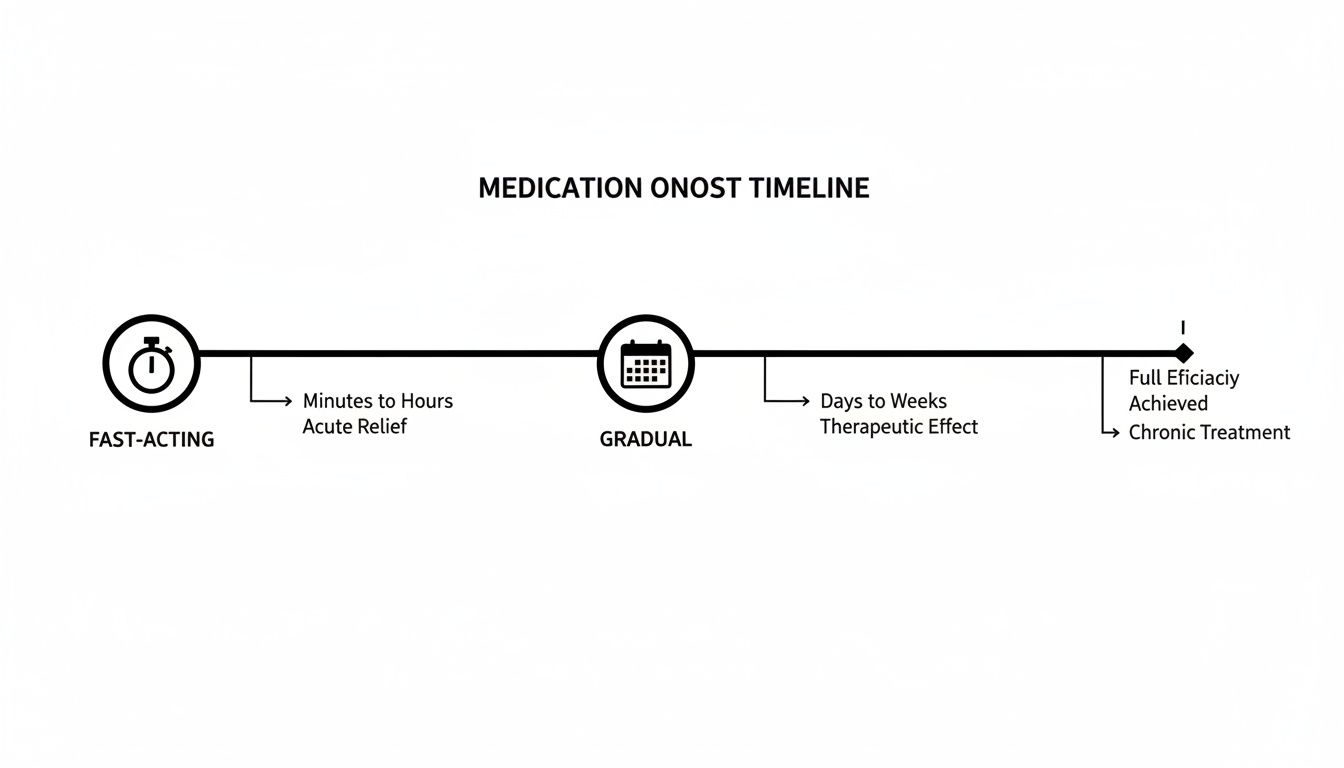
As you can see, stimulants tend to get to work very quickly, whereas non-stimulants need a bit of a run-up before they hit their stride. Knowing which path you're on helps set the right expectations from day one. If you want to learn more about the specific treatments, have a look at our overview of ADHD medication for adults in the UK. This first phase is all about observing, adjusting, and finding what truly clicks for you.
Stimulants vs Non-Stimulants: Understanding the Difference
When you first start exploring ADHD medication, one of the first things you'll hear about are the two main types: stimulants and non-stimulants. The question of how quickly they work really comes down to which of these paths you and your clinician decide on. It’s not a one-size-fits-all situation; the right choice depends on your specific symptoms, your medical history, and whether you're also managing conditions like anxiety or autism.
These two types of medication couldn't be more different in how they operate, and their impact on your overall mental health can vary significantly.
Think of stimulants as taking the motorway – they offer a direct route to managing symptoms. As the first-line treatment for ADHD in the UK, they work by quickly increasing the levels of key brain chemicals, especially dopamine and noradrenaline. These neurotransmitters are the brain’s project managers, responsible for keeping you focused, attentive, and in control of your impulses.
The link between dopamine and motivation is a huge piece of the puzzle. By boosting these neurotransmitters, stimulants can make it easier to start tasks, stick with them, and build better habits.
The Stimulant Approach: Fast and Focused
Stimulant medications such as methylphenidate (found in Ritalin and Concerta) and lisdexamfetamine (Elvanse) get to work incredibly quickly. Their whole purpose is to enhance the communication signals between your brain cells, which often leads to a noticeable improvement in ADHD symptoms within an hour of taking the first dose.
They generally come in two formats:
- Immediate-Release (IR): These act fast and give you a concentrated burst of support that typically lasts for 3–5 hours. They’re great for specific situations, like getting through a big exam or a demanding work meeting.
- Extended-Release (ER): These are clever capsules designed to release the medication gradually over the day. This provides a much smoother, more consistent level of symptom relief that can last for 8–12 hours.
It’s this rapid effect that gives so many people that first, almost immediate feeling of mental clarity. The constant 'brain chatter' finally quietens down, and you can think straight.
For many, trying a stimulant is the first time they experience what a focused mind actually feels like. The goal isn't to feel buzzed or artificially energised; it's to find a sense of baseline calm that allows your executive functions to finally come online.
The Non-Stimulant Approach: Slow and Steady
If stimulants are the sprinters, non-stimulants are the marathon runners. Medications like atomoxetine (Strattera) and guanfacine (Intuniv) take a much more gradual, long-term approach to symptom management. Instead of giving neurotransmitters a direct and immediate boost, they work behind the scenes to fine-tune the brain's chemistry over time.
This means you won’t feel much of anything on day one. Non-stimulants need time to build up in your system to a level where they can be effective, a process that can take anywhere from four to eight weeks.
It definitely requires patience, but this slow-and-steady method has its own unique benefits, particularly for those managing both ADHD and other mental health conditions. Once they’re working, non-stimulants provide seamless, 24/7 coverage without the 'ups and downs' that some people can feel with stimulants. This makes them an excellent alternative for anyone who doesn't tolerate stimulants well, or who also has anxiety, tic disorders, or is autistic and finds stimulants over-arousing.
You can learn more about these different options in our guide to the best ADHD medication for adults, which dives deeper into the pros and cons of each.
The Immediate Impact of Stimulant Medications
For many people starting stimulant medication, it’s the first time they’ve ever truly felt what a focused mind is like. So, how long does ADHD medication take to work? With this type of treatment, the answer is often surprisingly fast, bringing a tangible sense of change that can be both profound and reassuring.

Unlike non-stimulant medications that can take weeks to build up in your system, stimulants get straight to work. They directly increase the levels of key brain chemicals, like dopamine, which are crucial for attention, focus, and managing impulses.
Typical Onset Times for Stimulants
How quickly you feel the effects really comes down to which type your clinician prescribes. Each formulation is designed with a specific goal in mind, offering different durations of symptom relief.
- Immediate-Release (IR) Formulas: These get to work very quickly, usually within 30 to 60 minutes of taking them. They’re designed to provide a concentrated period of relief that typically lasts for a few hours.
- Extended-Release (ER) Formulas: Built for all-day coverage, these have a slightly slower start. You can expect them to kick in around the 60 to 90-minute mark, but they release the medication steadily to last a full school or workday.
This rapid action is a big reason why stimulants are often the first port of call for treatment. They give you and your doctor immediate feedback, making it much easier to figure out the right dose during the initial adjustment period. Of course, this speed can have its downsides, so it’s always a good idea to be aware of the common ADHD medication side effects that might show up at the beginning.
What It Feels Like vs. What It Looks Like
When a stimulant medication starts working, the experience is often more subtle than people expect. It’s not about getting a sudden jolt of energy. In fact, for a lot of people, particularly those with ADHD, the main feeling is one of calm.
Many people describe the effect as their brain finally going quiet. That constant chatter of distracting thoughts just fades into the background, allowing them to follow a single train of thought from start to finish.
This newfound internal quietness quickly translates into real, measurable improvements in day-to-day life.
Picture an adult with ADHD in a team meeting. Before medication, their mind might be bouncing from what the speaker is saying to their weekend plans, to an email they forgot to send, all while restlessly tapping their foot. On the right dose of a stimulant, they might find they can actually follow the entire conversation, offer relevant ideas, and sit still without that overwhelming urge to move.
It’s all about enabling consistency. The medication doesn’t magically give you new skills, but it clears away the mental fog, letting you finally access and use the organisational and planning skills you already possess. This immediate effect provides a powerful foundation for building better habits and long-term strategies for success.
The Slow and Steady Path of Non-Stimulant Medications
If your clinician suggests a non-stimulant medication, the first thing to know is that patience is key. The answer to "how long does ADHD medication take to work?" is completely different for this group of treatments. Unlike stimulants, this isn't about immediate relief; it's about building a solid, long-term foundation for managing your symptoms.
Non-stimulants, like atomoxetine or guanfacine, work on an entirely different schedule. They don't give you that instant switch-on feeling because their job is to gradually rebalance your brain's chemistry over time.
Think of it like tending to a garden. You don't see a flower shoot up the second you water it. Instead, consistent, daily care allows the roots to grow deep and strong, leading to slow, steady growth. In the same way, non-stimulant medications need to be taken consistently every day to build up in your system.
Building Up to a Therapeutic Level
This initial build-up period is absolutely essential for the medication to start working properly. You won’t feel a significant change on day one, or probably even in the first week. For most people, it takes anywhere from four to eight weeks of consistent daily use to reach what we call a ‘therapeutic level’—the point where you and your doctor can truly see the full benefits.
It’s completely normal to feel a bit discouraged during this time, wondering if the treatment is even doing anything. But this gradual start is exactly how these medications are designed to function. The lack of an immediate ‘kick’ isn’t a sign of failure; it’s a core feature of this approach.
The slow-and-steady nature of non-stimulants is precisely what makes them an ideal choice for certain individuals. Their gentle, cumulative effect offers a different kind of stability that can be highly beneficial, especially for those with co-occurring autism or anxiety.
This methodical build-up makes non-stimulants a fantastic option for several groups of people:
- Individuals with Co-occurring Anxiety: Stimulants can sometimes amplify feelings of anxiety or being on-edge. The smoother action of non-stimulants often manages ADHD symptoms effectively without making anxiety worse.
- Those Needing 24/7 Coverage: Because they maintain a constant level in your system, non-stimulants provide round-the-clock symptom control. This is a game-changer for issues that don't just happen during work or school, like managing emotions in the evening or struggling to get going in the morning.
- Autistic Individuals with ADHD: Many autistic people find the rapid onset of stimulants jarring or overstimulating. Non-stimulants offer a gentler path to symptom management that can feel more integrated and less disruptive to their sensory system.
Ultimately, choosing a non-stimulant is a strategic decision. It’s about playing the long game, prioritising consistent, stable symptom relief over the peaks and troughs that can sometimes come with faster-acting options. It requires trusting the process and keeping an open dialogue with your clinician as you wait for the full, foundational benefits to emerge.
Personal Factors That Affect Your Medication Response
Figuring out how quickly ADHD medication will work isn't as simple as just looking at the type of pill you're taking. Your own unique biology and personal circumstances play a massive part in how effective your treatment will be. It’s a bit like getting a suit made to measure versus buying one off the rack; the treatment plan has to be fitted to you perfectly to get the best results.
All sorts of personal factors can shift your response to medication, from how fast your body processes things to your overall mental health, including if you are also autistic.

This is precisely why that initial titration phase is so crucial. Your clinician isn’t just handing you a prescription; they’re carefully watching how your body reacts, making small tweaks to find the exact dose and timing that suits your individual needs and daily life.
Your Unique Body Chemistry
No two bodies process substances in exactly the same way, and ADHD medication is a perfect example of this. A few key biological factors can either speed up or slow down how quickly the effects kick in and how long they stick around.
- Metabolism: Your metabolic rate is the engine that breaks down the medication. If you have a faster metabolism, you might burn through a dose more quickly, which could mean you need a different formulation or a more frequent dose.
- Body Weight and Composition: While it’s not the only factor, your body mass can influence how a certain dose impacts you. Clinicians always take this into account when deciding on a starting dose.
- Genetics: We're learning more and more about how our genes can predict our response to specific ADHD medications. Your genetic profile can affect not only how well a drug works but also whether you’re likely to experience side effects.
Even something as simple as what you’ve eaten can make a difference. For example, taking some stimulants with a high-fat meal can actually slow down their absorption, delaying the moment you start to feel the benefits.
The Impact of Co-occurring Conditions
It's incredibly common for people with ADHD to also have other conditions like anxiety, depression, or autism. This complete picture of a person's neurotype is absolutely critical when thinking about how medication will work and feel.
Understanding the interplay between ADHD and co-occurring conditions like autism or anxiety is vital. The goal of medication is to support the whole person, not just treat one set of symptoms in isolation. This requires a careful, considered approach from a clinician experienced in complex presentations.
For instance, stimulants can be fantastic at quieting the 'noise' of an ADHD brain, but for someone already prone to anxiety, they could potentially heighten it. Autistic individuals may find they are more sensitive to side effects and require a much slower titration process. On the other hand, many people find that once their ADHD symptoms are well-managed, their feelings of anxiety and emotional dysregulation reduce significantly. You can explore the link between ADHD and emotions in our detailed guide.
With more adults than ever seeking support, this personalised approach is essential. As prescriptions rise across the UK, the focus must stay firmly on individualised care, not a 'one-size-fits-all' solution. Understanding these personal variables is the first step in having productive conversations with your clinician and making sure your treatment is tuned perfectly to you.
Got Questions About Starting ADHD Meds? You're Not Alone.
Starting any new treatment can feel a bit daunting, and it's completely normal to have a long list of questions. Let's walk through some of the most common ones that come up when people first begin their journey with ADHD medication. Think of this as a practical Q&A to help you feel more prepared and in control.
Getting to grips with what to expect in the early days makes a world of difference. It helps you set realistic expectations and have more productive conversations with your clinician, particularly when discussing your broader mental health.
What’s This “Titration” I Keep Hearing About?
You’ll hear your clinician mention the word titration a lot, and for good reason—it's a cornerstone of good ADHD treatment. In simple terms, titration is the process of carefully and gradually finding the medication dose that’s just right for you.
Instead of starting you on a standard or high dose, we begin with a very small one. Then, over a period of days or weeks, we slowly increase it. This "start low, go slow" approach gives your body time to adjust, which is key to minimising side effects. The goal is to find your 'sweet spot': the lowest possible dose that provides the most benefit with the fewest, if any, side effects. It’s how we safely personalise your treatment.
How Will I Actually Know If It’s Working?
Figuring out if the medication is working isn't always about a sudden 'aha!' moment. With stimulants, some people notice a distinct difference quite quickly—perhaps a newfound ability to focus or a feeling of inner quiet within the first few days. For non-stimulants, the changes are far more subtle and build up gradually over several weeks.
A much better way to gauge effectiveness is to track specific, tangible changes rather than just relying on a general feeling.
- Are you finding it easier to stay on task at work?
- Do you notice you're interrupting people less often?
- Have you stopped misplacing your keys, wallet, or phone quite so much?
Keeping a simple daily log of these small victories provides you and your doctor with concrete evidence. This kind of real-world feedback is incredibly valuable for fine-tuning your treatment and seeing how it's truly impacting your day-to-day life.
I’m Autistic Too – How Does That Change Things?
It's incredibly common for people to be both autistic and have ADHD. If this is you, it's worth knowing how this might influence your experience with medication. ADHD treatments are designed to target ADHD symptoms—like focus, restlessness, and impulse control—and they can still be very effective at doing just that.
What they won't do is change your core autistic traits. It's also true that some autistic people find they are more sensitive to medication side effects. This is precisely why a careful, slow titration process is even more critical. A thorough assessment that properly understands both diagnoses is essential for building a treatment plan that supports you as a whole person, respecting the unique interplay of your neurodivergent traits.
What If I Accidentally Miss a Dose?
This is a common concern, and the best advice is always to follow the specific instructions from your clinician. But generally speaking, it depends on the type of medication you’re on. If you miss a dose of a stimulant, you'll likely just notice your ADHD symptoms returning for that period, but you can usually take your next dose as scheduled.
With non-stimulants, it's a bit different. Because they work by building up to a steady level in your system, missing a dose can disrupt that balance and make them less effective. If you find you're regularly forgetting to take your medication, bring it up with your doctor. They can help you with strategies or even discuss other options, like longer-acting formulas that are easier to manage.
Navigating the path to an accurate diagnosis and effective treatment can feel complex, but you don't have to do it alone. The team at Insight Diagnostics Global provides consultant-led, CQC-regulated assessments and medication management for adults with ADHD and autism. To learn more about our online services and how we can support you, please visit our website.