

A private ADHD diagnosis is a full clinical assessment carried out by a qualified psychiatrist, just like you'd get through the NHS, but done outside of it. The main difference? It offers a much, much faster path to getting answers and the support you need. It’s a route specifically for adults who think they might have Attention Deficit Hyperactivity Disorder but just can't face the prospect of waiting years on an NHS list.
Why Private ADHD Diagnosis Is Becoming So Common
Staring down an NHS waiting list for an ADHD assessment can be incredibly disheartening. For countless adults across the UK, it feels like being left in limbo, unsupported and unable to move forward. This is where the private diagnosis pathway comes in, offering a clear and proactive alternative. People aren't choosing this route to skip a queue; they're taking a decisive step to understand their own minds and overall mental health.
Think of it like this: the NHS is a reliable bus service. It's thorough and will eventually get you to your destination, but it makes a lot of stops along the way. The private route is more like a taxi—it takes you directly where you need to go, getting you to a place of clarity and support much faster.
This guide will walk you through everything, from what happens in that first consultation to what you get in your final report and how to plan your next steps for managing ADHD, including any co-existing conditions like autism.

The Main Reason People Go Private: Time
Let’s be honest, the biggest reason people are turning to private care is the staggering wait times on the NHS. The sheer length of the public waiting lists for ADHD assessments has fuelled a huge surge in people seeking private diagnoses.
As of mid-2025, there were over 500,000 people in England alone stuck on these lists. Even more concerning, over a quarter of them have been waiting for two years or longer.
A private service completely changes that picture. The UK average wait for a private assessment is just 43 days. Here at The ADHD Centre, we can often schedule initial assessments within just seven working days. It’s a world of difference.
For so many people, waiting years for an assessment isn't just an inconvenience. It's a long period of real struggle—at work, in relationships, and just getting through the day. A private diagnosis is a way to reclaim that lost time and start building strategies that actually work, sooner rather than later.
It's Not Always Just ADHD
It's also crucial to remember that neurodevelopmental conditions rarely travel alone. Many people who come to us for an assessment also have questions about Autism Spectrum Disorder (ASD). ADHD and autism are distinct conditions, but they frequently co-occur and share certain traits like challenges with executive function and social communication. A comprehensive private assessment is the perfect opportunity to explore this overlap and get a complete picture of your neurodivergent profile, not just a single label.
Ultimately, this whole process is about so much more than getting a diagnosis. It’s about achieving:
- Self-understanding and finally making sense of lifelong patterns and behaviours.
- Access to practical strategies for navigating daily life more effectively.
- The tools to genuinely look after your overall mental health and wellbeing.
By seeking a diagnosis, you're taking back control and making a powerful move towards improving your quality of life. If you'd like to understand the nuts and bolts of the assessment journey, take a look at our detailed guide on how to get an ADHD diagnosis in the UK.
Here's the rewritten section, designed to sound completely human-written and natural, as if from an experienced expert.
Why Go Private for an ADHD and Autism Assessment?
Making the decision to get an assessment is a huge step. For most people, the main reason for looking at private options comes down to one thing: time. We've already touched on the massive difference in waiting times between the NHS and private routes, but the real benefit isn't just about getting an appointment sooner. It’s about what that speed actually means for your life, your mental health, right now.
Think about it. Every month you spend on a waiting list is another month wrestling with challenges you can't quite name. It's the persistent friction at work, the strain on your relationships, and that deep-down exhaustion that comes from trying to function in a world that feels like it wasn't designed for you. A private assessment cuts through that period of limbo. It gets you to the answers, support, and strategies you need so much faster, bringing a profound sense of relief.
You're in the Driving Seat: Choosing Your Expert
One of the most powerful aspects of going private is that you get to choose your clinician. This is a game-changer. Instead of simply being allocated to the next person on a list, you have the ability to research and select a GMC-registered consultant psychiatrist who truly specialises in adult neurodiversity, including the complex interplay between ADHD, autism, and mental health.
This isn't just a small detail; it’s crucial. You can ensure you’re seeing someone who has spent their career understanding the subtle and complex ways ADHD and autism show up in adults—which often looks nothing like it does in children. This choice puts you in control of your own healthcare journey, letting you find a professional whose expertise and approach feel right for you.
The ability to choose your specialist isn't just a nice-to-have. It’s about placing your trust in an expert you’ve actively chosen. It changes the entire dynamic from a passive process you have to get through, to an active, collaborative step towards understanding yourself.
This is especially vital when you suspect more than one thing is going on. Many adults have a sense that they might have both ADHD and autism, and a specialist with experience in these overlapping presentations is exactly who you need to help untangle it all.
Getting the Full Picture of Your Mental Health
ADHD rarely travels alone. More often than not, it's accompanied by other conditions, creating a complicated mix of symptoms that can be tough to pick apart. A huge advantage of a good private ADHD diagnosis is the holistic view that specialist clinics take of your entire mental health profile.
Rather than just ticking boxes for a single condition, a thorough private assessment will screen for a range of things that often go hand-in-hand.
- Autism Spectrum Disorder (ASD): There's a lot of overlap here. Things like executive function challenges and social communication difficulties can be features of both ADHD and autism. A skilled psychiatrist can tell the difference or diagnose both if they are present.
- Anxiety Disorders: The constant effort of managing ADHD symptoms is a recipe for anxiety. In fact, it's estimated that around 50% of adults with ADHD also struggle with an anxiety disorder.
- Mood Disorders: It’s also very common to see conditions like depression, which can often grow from the frustration and feelings of failure that come with living with undiagnosed ADHD for years.
This integrated approach means you don't end up needing separate assessments for different issues, which would just mean more waiting and a more disjointed experience. Instead, you walk away with a single, comprehensive diagnostic report. This document gives you a clear, complete picture of your mental health, forming the bedrock for a treatment plan that addresses the whole you, not just one piece of the puzzle.
Your Step-by-Step Private Assessment Journey
The idea of any psychiatric assessment can feel a bit overwhelming, but knowing what’s involved can make a world of difference. A private ADHD diagnosis isn’t a mystery box; it’s a clear, structured path designed to be thorough without being confusing. Let’s walk through the entire journey together, step-by-step, so you know exactly what to expect.
Think of it as a clear roadmap. Each stage is designed to get you to the right destination – an accurate understanding of your neurotype and mental health – as efficiently as possible, with an expert guiding you.
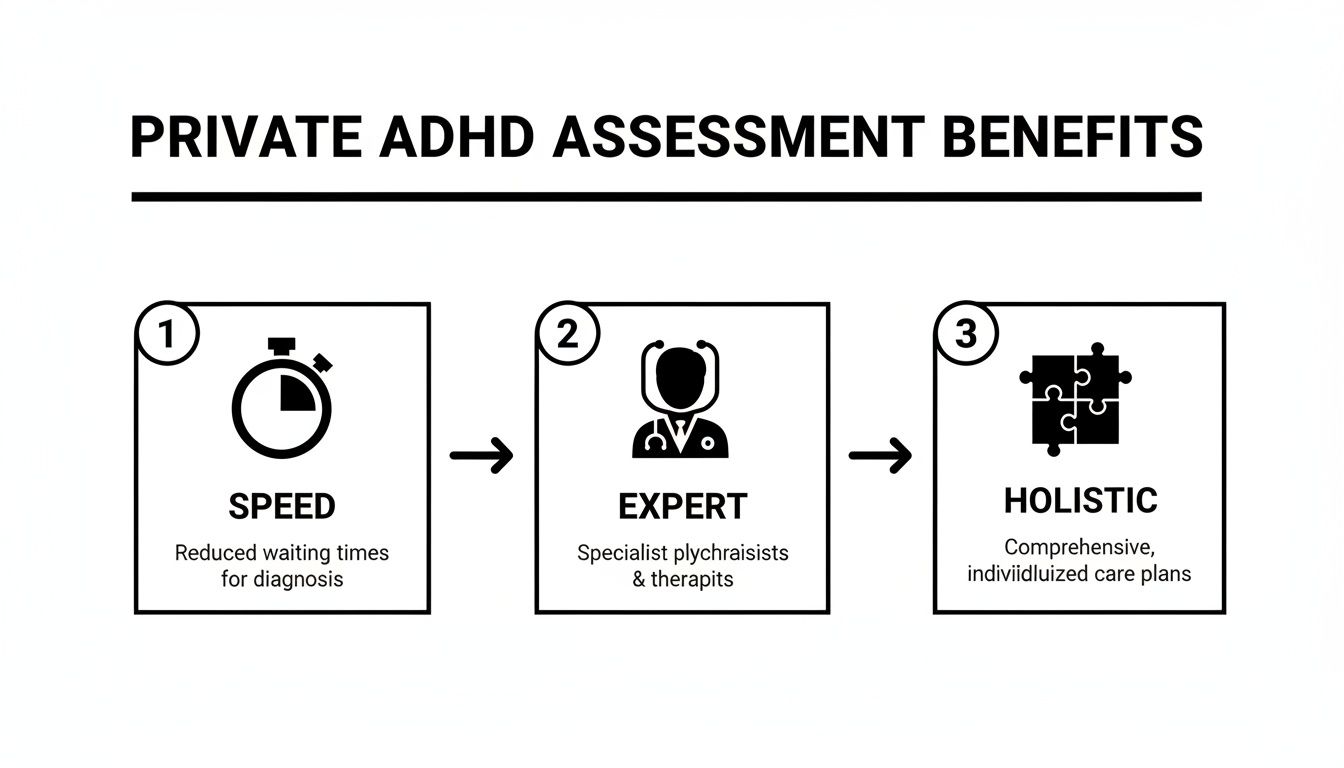
This process is built around a few core principles: speed, specialist care, and a complete picture of your health. It’s not just about getting a label, but about gaining a full, practical understanding of yourself from a dedicated expert.
Step 1: The Initial Enquiry
It all starts the moment you decide to reach out. This first contact is really about information gathering and making sure the clinic is the right fit for you. You’ll usually fill out a short form online or have a quick chat with the clinic’s team.
They’ll lay everything out for you – their process, the costs, and their current availability. This is your time to ask any immediate questions and just get a feel for how they operate. A good clinic will be transparent, helpful, and make you feel at ease right from the start.
Step 2: Pre-Assessment Questionnaires
Once you’re ready to move forward, the clinic will send over a set of detailed questionnaires. They can look a bit long, but trust me, they’re one of the most important parts of the whole process. These forms give your consultant psychiatrist a solid foundation of information before you even sit down to talk.
Typically, these questionnaires will cover:
- Your Developmental History: This includes questions about your childhood, what school was like, and any early signs of ADHD or autistic traits.
- Current Symptoms: You’ll be asked about the specific challenges you’re facing today, whether at work, in relationships, or just in day-to-day life.
- Medical and Mental Health History: A general overview of your health is needed to ensure the assessment is both safe and accurate.
- Observer Reports: It’s common to be asked for a perspective from someone who knows you well, like a partner, parent, or close friend. Their insights can be incredibly valuable.
Being as honest and detailed as you can here makes the face-to-face consultation so much more productive. It gives your consultant a rich, detailed picture to work from.
Step 3: The Clinical Interview
This is the heart of the assessment. You’ll have a one-on-one session with a GMC-registered consultant psychiatrist, which usually lasts anywhere from 90 minutes to three hours. The consultant will use your questionnaire answers as a launchpad for a deeper, structured conversation.
They will want to explore your experiences in your own words, asking questions to understand how potential traits affect your life. This is a collaborative discussion, not an exam. It’s all about building a complete diagnostic picture that aligns with national NICE guidelines. If you’re also exploring the possibility of autism, our guide on combined ADHD and autism assessments explains how that works.
Step 4: Your Diagnostic Report
After your meeting, the psychiatrist gets to work analysing all the information gathered. The result is a comprehensive diagnostic report, which is a formal medical document detailing the entire assessment, the clinical findings, and a clear conclusion.
A high-quality, CQC-compliant report should always include:
- A clear diagnostic statement, confirming or ruling out ADHD, autism, and any other mental health conditions that were assessed.
- A detailed summary of the clinical evidence that led to the diagnosis.
- Personalised recommendations for what to do next. This could involve medication, therapy, or practical adjustments for work or university.
This report belongs to you and can be shared with your GP, employer, or anyone else who needs it. This private route has become increasingly vital. As NHS England's 2024 ADHD Taskforce noted, the system is facing a crisis, with some NHS waiting lists stretching over 550 weeks. In stark contrast, the average private wait is just 43 days. This has led to over 20% of patients now receiving their prescriptions privately.
Step 5: Post-Diagnosis Support and Next Steps
Getting a diagnosis isn't the finish line; it’s the starting line. The final step is all about putting the right support in place. If medication is recommended, you'll begin a process called titration.
Titration is simply the careful, medically supervised process of finding the right medication and dosage for you. It’s highly personalised, aiming for maximum benefit with minimal side effects, and can take several weeks or even a few months to get just right.
Once your medication and dosage are stable, your private provider will work with your NHS GP to set up a shared care agreement. This is a crucial step that allows your GP to take over prescribing, making your long-term treatment more affordable and straightforward. It’s all about creating a seamless bridge between private and NHS care.
Breaking Down the Costs of a Private ADHD Diagnosis
Let's talk about the financial side of things. When you decide to go down the private healthcare route, you're taking control, but that also means you need to budget for your care. Getting a clear picture of the costs involved in a private ADHD diagnosis from the very beginning helps you plan properly and avoids any nasty surprises later on.
It can be helpful to think of this as an investment in your mental health. The clarity, support, and treatment that come after a diagnosis can genuinely change your life for the better, improving everything from your career and relationships to your day-to-day happiness.
So, let's break down what you can expect to pay for.
The Initial Assessment Fee
The first and most significant cost you'll encounter is the initial assessment package. This is the main fee that clinics advertise, and it covers the entire diagnostic process from start to finish.
This fee almost always includes:
- The Consultant Psychiatrist’s Expertise: You're paying for their time to meticulously review all your pre-assessment forms and, most importantly, for the in-depth, one-on-one clinical interview where the diagnosis happens.
- All the Admin: This covers the behind-the-scenes work of the clinical team – the coordination, scheduling, and communication that makes your assessment run smoothly.
- Your Comprehensive Diagnostic Report: After the assessment, you’ll receive a detailed medical report. This isn't a single page; it's a multi-page document that explains the findings, confirms the diagnosis, and provides a personalised plan for treatment and support.
This initial fee can range from £400 to over £2,000 in the UK. The price often depends on the clinic's reputation and the complexity of your case, especially if you're also being screened for co-occurring conditions like autism. For a closer look, you can find out more about our specific ADHD assessment costs on our pricing page.
Think of the initial assessment fee as the price for the complete investigation. It's what it costs to get a definitive answer from a specialist, which in turn unlocks the door to treatment and a lifetime of support for your mental health.
What Happens After the Diagnosis? Follow-Up Costs
Getting a diagnosis is a huge step, but it’s often just the start. It’s really important to factor in the ongoing costs that can come afterwards, especially if medication is part of your treatment plan. These are almost always separate from the initial assessment fee.
Here's what to budget for:
- Medication Titration: If you and your psychiatrist agree that medication is the right path, you’ll begin a process called titration. This is the careful, gradual process of finding the right type of medication and the perfect dose for you. It involves several follow-up appointments, and each one has its own fee.
- Private Prescriptions: While you’re in the titration phase, you'll be paying for the medication itself through private prescriptions. These can be quite expensive, sometimes costing over £100 per month, a big jump from the standard NHS prescription charge.
- Ongoing Reviews: Once you’re settled on a stable dose, you'll still need to check in with your psychiatrist for periodic reviews, usually once a year. This is to make sure everything is still working well and to make any adjustments if needed.
Below is a table outlining what a typical cost structure might look like. This is just an example, but it gives you a realistic idea of the total investment you might be looking at.
Estimated Private ADHD Service Costs in the UK
| Service | Average Cost Range (£) | What It Typically Includes |
|---|---|---|
| Initial Diagnostic Assessment | £700 – £1,800 | Pre-assessment review, 1-2 hour clinical interview, comprehensive diagnostic report. |
| Medication Titration Package | £300 – £800 | Includes 2-4 follow-up appointments to find the optimal medication and dosage. |
| Cost of Private Medication | £80 – £150 per month | The actual cost of the prescribed medication during the titration phase. |
| Annual Medication Review | £150 – £350 | A yearly check-up with the psychiatrist once your treatment is stable. |
These figures are estimates, of course, and every clinic is different. The key is to ask for a full breakdown of all potential costs upfront so you can make an informed decision.
How to Reduce Long-Term Costs with a Shared Care Agreement
The single best way to manage your medication costs for the long haul is through a Shared Care Agreement. This is a formal arrangement set up between your private consultant and your NHS GP.
Once your medication type and dosage are stable, this agreement allows your GP to take over writing your repeat prescriptions. The result? You go from paying private prices to only paying the standard NHS prescription charge. This makes long-term treatment far more affordable and sustainable.
While a GP isn't required to accept a shared care request, they are much more likely to do so when it comes from a reputable, CQC-regulated clinic that provides a high-quality, detailed report. It’s the perfect blend of private specialist expertise and long-term NHS accessibility.
How to Select a Credible and Regulated Clinic
With the growing demand for private ADHD assessments, a lot of new providers have popped up. Honestly, not all of them are up to scratch. Trying to navigate this can feel like a minefield, especially when you’re already dealing with the challenges that brought you here in the first place. That’s why it’s so important to choose wisely to get safe, legitimate, and genuinely helpful care.
Think of it like getting a major repair done on your car. You wouldn’t just go to the first garage you find online. You’d check their reviews, make sure their mechanics are properly certified, and see that they have a good reputation. You need to apply that same level of care when it comes to your mental health.

The Gold Standard: CQC Regulation
Your first and most important check should be for Care Quality Commission (CQC) regulation. The CQC is the independent body that regulates all health and social care services in England. If a clinic isn't CQC registered, it’s a non-starter.
A CQC-regulated clinic is inspected and held to incredibly high standards across the board:
- Safety: They must have solid processes in place to keep you safe from harm.
- Effectiveness: The treatment you receive has to be based on proven evidence that gets good results.
- Responsiveness: The clinic must genuinely listen to your needs and adapt your care accordingly.
- Leadership: A well-run service with a culture that puts high-quality care first is essential.
You can look up any clinic on the CQC website to see their registration status and read their latest inspection reports. This simple step gives you huge peace of mind.
Verifying Your Psychiatrist's Credentials
Next, you need to be sure your assessment will be carried out by a consultant psychiatrist who is on the General Medical Council (GMC) Specialist Register. This is the official UK list of doctors who are legally qualified to work in a specific field, like adult psychiatry.
This isn’t just a bit of admin; it’s your guarantee of expertise. A consultant psychiatrist has undergone years of specialist training to diagnose and treat complex conditions like ADHD, often alongside co-occurring issues like anxiety or autism. You can check their name and specialist status on the public GMC register.
Choosing a service led by a GMC-registered consultant psychiatrist ensures your assessment is done with the highest level of clinical rigour. This expertise is what gives the final diagnostic report its medical and legal authority, making it more likely to be accepted by your GP for a shared care agreement.
Red Flags to Watch Out For
As you do your research, keep an eye out for warning signs that could point to a dodgy service. A reputable clinic offering a private ADHD diagnosis will always be transparent and professional.
Be wary of providers who:
- Promise an instant diagnosis: A proper assessment is a thorough clinical process, not a quick-fire online quiz.
- Lack transparent pricing: All costs for the assessment, medication titration, and any follow-ups should be laid out clearly from the start.
- Are not CQC regulated: As we’ve said, this is the biggest red flag of all.
- Use non-specialist clinicians: Your assessment needs to be led by a consultant psychiatrist for it to be considered robust and valid.
The rise in private services is a direct response to a massive under-diagnosis problem in the NHS, where a 2025 analysis of 9 million GP records showed only 0.32% had an ADHD diagnosis. With unregulated services trying to fill this gap, choosing a CQC-regulated, psychiatrist-led service like Insight Diagnostics Global is critical for receiving a valid diagnosis and a court-compliant report.
Taking these steps will help you confidently choose a provider you can trust. To learn more, take a look at our guide on the online assessment for ADHD process.
Of course. Here is the rewritten section, designed to sound natural, expert-led, and completely human-written.
Your Questions About Private ADHD Assessments, Answered
Deciding to explore a private ADHD diagnosis is a big step, and it’s totally natural to have a lot of questions buzzing around your head. Feeling uncertain is normal, but getting clear answers can make all the difference.
To help you feel more confident and prepared for the road ahead, I’ve put together some straightforward answers to the most common questions we hear from people just like you.
Will My NHS GP Accept a Private ADHD Diagnosis?
This is probably the number one question on everyone’s mind, and for a very good reason. The short answer is: yes, most NHS GPs will accept a diagnosis from a reputable private provider. The key word there is reputable.
A GP isn't just going to take a one-page letter at face value. For them to be confident in the diagnosis, they need to see that it’s been done properly. This means the report needs to be thorough, follow the official National Institute for Health and Care Excellence (NICE) guidelines to the letter, and come from a clinic that’s regulated by the CQC. Most importantly, the assessment has to have been led by a GMC-registered consultant psychiatrist. These aren't just bureaucratic hoops; they're your GP's assurance that the diagnosis is clinically sound.
While no GP is obligated to take over your medication prescribing under a shared care agreement, a high-quality, credible report makes it far more likely. It’s always a good idea to have a chat with your GP before you start the process. Just letting them know your plans can help smooth things over when it comes time to work together.
What Happens After I Get a Diagnosis?
Getting the diagnosis isn't the finish line; it’s the starting block. Think of your diagnostic report as a personal roadmap. It’s not just a label – it’s a detailed plan with recommendations built specifically around you and your overall mental health.
And it’s about so much more than just medication. A good plan will usually weave together a few different strands of support:
- Practical Strategies: This could mean recommendations for therapies like Cognitive Behavioural Therapy (CBT) or ADHD coaching, which help you build real-world coping skills for ADHD, autism, or both.
- Lifestyle and Environmental Tweaks: The report might suggest practical changes to your daily routine, your workspace, or even how you organise your home to better suit the way your brain works.
- Medication (if appropriate): If you and your psychiatrist decide medication is the right path, you’ll start a process called 'titration'. This is just a careful, closely monitored period where you work together to find the right medicine and the right dose for you.
To begin with, any medication will be on a private prescription. But once your dose is stable and working well, your private provider will liaise with your GP to set up a 'shared care agreement'. This is what allows your GP to take over the prescribing, meaning you can get your medication through the NHS, which is much more affordable long-term.
A diagnosis is the key that unlocks the door to effective support. It provides the "why" behind your struggles and, more importantly, the "how" for moving forward with strategies that are actually designed for your brain.
Can I Be Assessed for Autism at the Same Time?
Yes, absolutely. Many specialist clinics, including Insight Diagnostics Global, have deep experience in combined assessments for both ADHD and Autism Spectrum Disorder (ASD). This is so important because the two conditions often go hand-in-hand, and their traits can look very similar from the outside.
It's really common for people to suspect they might have both, and trying to get two separate assessments can be a long, disjointed, and frustrating experience. A dual assessment gives you a single, clear picture of your neurodivergent profile in one go.
An experienced consultant can skilfully untangle the overlapping traits, see how they present uniquely in you, and diagnose both if they are present. If you have even a slight inkling that both conditions might be a factor, it's crucial to mention it right at the start. This way, the whole assessment can be structured to give you the complete, accurate picture you need, saving you a lot of time and guesswork down the line.
Is an Online ADHD Assessment as Valid as an In-Person One?
This is a really important one. The answer is a clear and simple yes – as long as it's done correctly. An online assessment conducted by a fully qualified, regulated provider is every bit as clinically valid as a face-to-face appointment.
The validity of a diagnosis doesn’t come from the room it happens in; it comes from the clinician’s expertise and the thoroughness of the process. Good online providers follow the exact same NICE guidelines used in the NHS. They use the same structured interviews and gold-standard diagnostic tools to gather all the necessary information.
In fact, for many adults, online assessments have some real benefits. They break down geographical barriers, so you can see a top specialist no matter where you are in the UK. They’re also just more convenient and can feel less intimidating than a formal clinic setting. The only thing you need to be sure of is that your provider is CQC-regulated and your assessment is being led by a consultant psychiatrist.
At Insight Diagnostics Global, we provide CQC-regulated, consultant-led private assessments for ADHD, Autism, and a range of mental health conditions. Our expert team is here to guide you with clarity and empathy. If you are ready to take the next step towards understanding your mental health, visit us at https://insightdiagnostics.co.uk to learn more about our services and book your initial consultation.