

When you’re staring down the barrel of a multi-year NHS waiting list for an ADHD or Autism assessment, it’s easy to feel defeated. It’s no wonder so many people are turning to private specialists in adhd for a faster path to clarity and support for their neurodevelopmental and mental health.
These specialists are almost always consultant psychiatrists listed on the GMC Specialist Register. That means they’re fully qualified not just to provide a formal diagnosis for ADHD and Autism, but also to oversee the broader mental health support that often needs to follow.
The Reality of Waiting for an ADHD Diagnosis in the UK

For what feels like millions of undiagnosed adults, the journey from suspecting you might have ADHD or Autism to getting actual, tangible support can feel impossibly long. The frustration is real, and it’s rooted in a system buckling under immense pressure, where huge delays have become the norm for neurodevelopmental assessments.
The scale of the problem is genuinely staggering. A recent study of 9 million GP records found that only 0.32% had a recorded ADHD diagnosis. This suggests that as few as 1 in 9 people actually living with the condition have been formally recognised. You can dig into Priory Group's ADHD statistics analysis for a deeper look at these figures.
This isn’t just about numbers; it's about people. Millions are left unsupported, often wrestling with their overall mental health and struggling in their daily lives without ever understanding the 'why' behind it all. The bottleneck is the overwhelming NHS waiting lists, with some people reporting waits of over two years just for an initial assessment for ADHD or Autism.
Navigating the Path to a Diagnosis
Given these difficult realities, looking into private options has become a practical, often necessary, step for many. It offers a much quicker, yet still properly regulated, alternative to years spent in a queue. A good starting point is to look at a private healthcare comparison UK guide to get a feel for what’s out there.
The most important thing is to make sure you’re dealing with genuine specialists. Look for a CQC-regulated provider that employs consultant psychiatrists. This ensures your assessment for ADHD or Autism, diagnosis, and any subsequent mental health treatment plan will be robust and compliant with NICE guidelines.
By getting to grips with the challenges and the solutions available, you can map out a clear path forward. Once you see the full picture of the NHS waiting times, it becomes obvious why consultant-led online services are such a credible and efficient alternative for neurodevelopmental and mental health care.
Getting to Know Your Neurodevelopmental Care Team
Trying to understand the world of neurodevelopmental health can feel a bit overwhelming, almost like you're learning a new language. When you start looking for support with ADHD or Autism, you'll come across a team of specialists, and knowing who does what is the first, crucial step toward getting the right help for your mental health.
Think of a Consultant Psychiatrist as the lead investigator for your diagnostic journey. These are medical doctors who have gone through years of specialised training in mental health. Critically, in the UK, you'll find their name on the GMC Specialist Register—this is the official mark of their high-level expertise and qualifications.
It’s this medical training that really makes the difference. A psychiatrist is uniquely qualified to diagnose ADHD and Autism in adults. They can also look at the bigger picture and spot any co-occurring mental health conditions like anxiety or depression, which often go hand-in-hand with neurodevelopmental differences.
The Key Players on Your Team
A psychiatrist isn't always working alone. The most thorough assessments for ADHD and Autism come from a multidisciplinary team, where different experts bring their unique skills together to build a complete and accurate picture of your neurodevelopmental and mental health.
- Consultant Psychiatrist: This is the clinical lead. They have the final say on your diagnosis, can prescribe and manage medication (like during the titration process for ADHD), and write legally sound reports that GPs, employers, and courts will recognise.
- Clinical Psychologist: These are the experts in human behaviour and mental health. They often carry out detailed psychological tests and can offer therapy, giving valuable insights into your thinking patterns and emotional wellbeing that add depth to a psychiatric assessment.
- Specialist Nurse: Highly trained in specific fields like ADHD, Autism, or mental health, these nurses are a vital part of the support system. They might help with taking your medical history, keeping an eye on how you're doing with medication, and offering practical, day-to-day support.
A diagnosis isn't just a label; it's a guide to understanding how your mind is wired. A good team makes sure that guide is accurate, opening up the right path to both medical treatment and psychological support for your overall mental health.
Each of these ADHD and Autism specialists brings an essential piece of the puzzle to the table. The psychiatrist handles the medical diagnosis and treatment, the psychologist delves into cognitive and behavioural aspects, and the specialist nurse provides that crucial support all the way through.
This team-based approach ensures you get well-rounded care that looks at more than just the core symptoms of ADHD or Autism—it considers your overall mental wellbeing. For a deeper dive into the process, you can find out more about who diagnoses ADHD and what their qualifications really mean. Knowing these roles helps you ask the right questions and gives you the confidence that you're in safe hands.
Your Assessment Journey: From First Click to Final Report
Taking the first step towards an online ADHD or Autism assessment can feel like a big deal, but knowing what's involved helps take the mystery out of it. Think of it less as a test and more as a structured conversation, carefully designed by specialists to build a complete picture of you and your experiences over a lifetime. It’s a path toward clarity for your mental health.
It all starts the moment you get in touch. The first thing you'll likely do is fill out some initial screening questionnaires. This isn’t just paperwork; it’s a vital first step that gives the clinical team a sense of your main challenges and helps them decide if a full assessment is the right next move. This initial triage makes sure you’re pointed towards the right specialists in adhd or autism care from day one.
From there, you’ll move on to the heart of the assessment: a detailed clinical interview with a consultant psychiatrist. This is a deep-dive, but it's a supportive conversation, not an interrogation. The specialist will guide you through your life story, from childhood right up to the present day, looking for the consistent patterns of behaviour that match up with diagnostic criteria for ADHD and Autism, like the DSM-5.
What Happens During the Diagnostic Process?
To get the diagnosis right, specialists need to look at things from a few different angles. This usually means bringing in other sources of information. They might ask to speak with someone who knew you well as a child—a parent or an older sibling, for example—or look at old school reports if you have them. This historical context is crucial because neurodevelopmental conditions like ADHD and Autism have been there since you were young, even if no one realised it back then.
The following image shows the kind of team structure you can expect, with a lead psychiatrist overseeing the entire diagnostic journey for neurodevelopmental and mental health conditions.
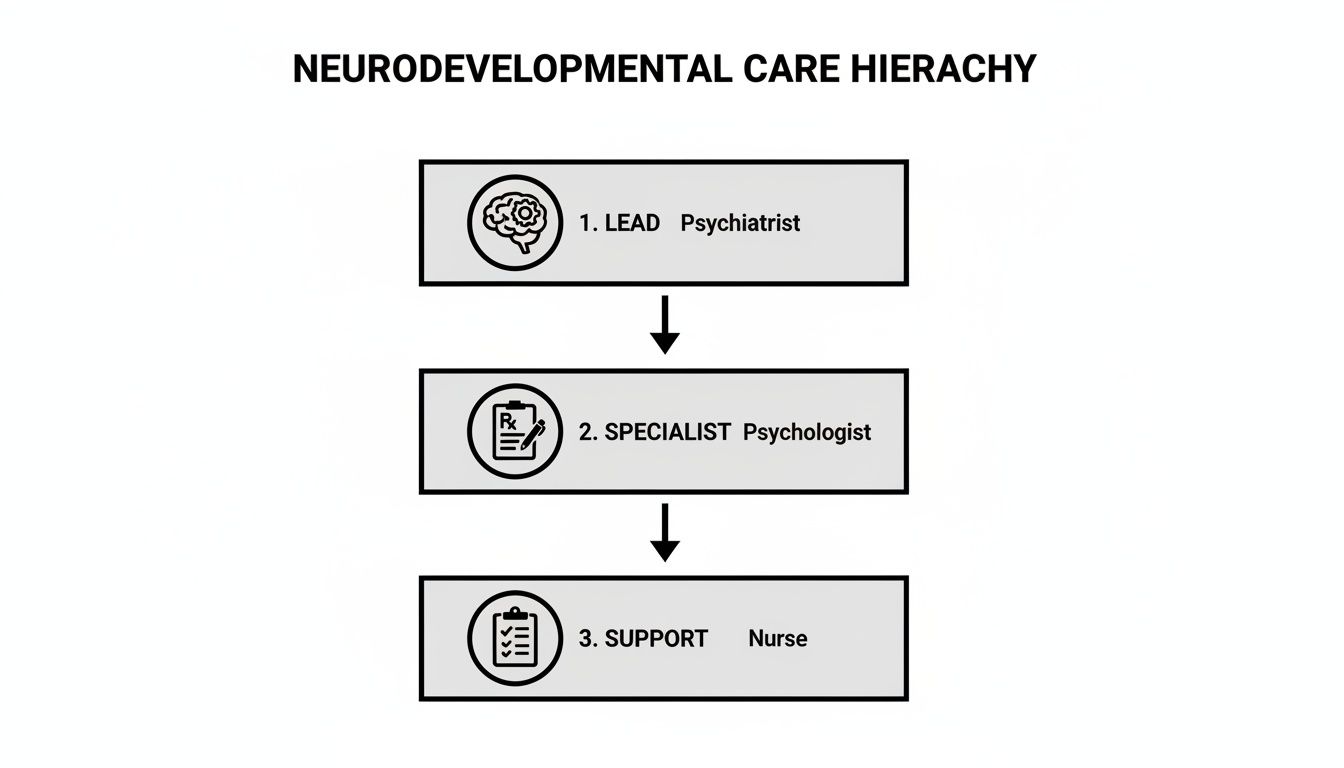
As you can see, a consultant psychiatrist typically leads the team, working alongside psychologists and specialist nurses to provide a comprehensive assessment. To get a better feel for the specifics, you can learn more about how an online assessment for ADHD is put together.
Your Report Is Your Personalised Manual
The whole process culminates in your diagnostic report. This document is so much more than a simple diagnostic label; it’s better to think of it as your own personal user manual. A good report from a true specialist will do more than just confirm a diagnosis for ADHD or Autism. It will clearly lay out all the evidence and, most importantly, give you practical, tailored recommendations for managing your mental health and navigating daily life.
Your report becomes a powerful tool. It's the key to unlocking support, whether that’s asking for reasonable adjustments at work, getting extra help at university, or simply giving your therapist a better understanding of how your brain works.
Ultimately, the report isn’t an ending—it’s a beginning. It offers a new framework for understanding yourself, validates experiences you may have struggled with for years, and gives you an expert-led roadmap to move forward with real confidence.
Decoding Your Diagnosis and Planning What's Next
Getting a diagnosis for ADHD or Autism isn't the finish line. In many ways, it's the real starting point – the beginning of a new chapter where you finally have the right map. That diagnostic report is your map, and learning how to read it is the key to moving forward with clarity and confidence.
A proper report from a genuine specialist in adhd is so much more than a label. It's a comprehensive document that lays out all the clinical evidence from your assessment, explains exactly how your life experiences match up with the diagnostic criteria, and gives you a clear diagnosis. Crucially, it should also offer practical, personalised recommendations for what to do next for your mental health.
Making Sense of Your Diagnostic Report
Think of your report as a personal user manual for your brain. A good one will always have several key sections that make it a genuinely useful tool for you, your GP, and even your HR department at work.
It’s easy to feel overwhelmed by a long clinical document, but a well-structured report guides you through the findings logically. It should build a clear picture of why you are who you are, linking your past experiences to your present challenges and strengths, within the context of your overall mental health.
To make sure your report is up to scratch, it's worth knowing what a truly comprehensive one contains. We've broken down the essential components you should look for.
Key Components of a Comprehensive Diagnostic Report
A high-quality diagnostic report is the foundation for all your future support. Here’s a breakdown of what to look for to ensure it’s thorough, useful, and meets clinical standards.
| Component | What It Is | Why It's Important |
|---|---|---|
| Clinical Evidence | A detailed summary of all information gathered, from your developmental history and old school reports to the results of structured clinical interviews and psychometric tests. | This demonstrates the rigour of the assessment. It shows that the conclusion wasn't reached lightly but is based on a robust evidence base. |
| Diagnostic Formulation | This is where the specialist connects the dots. They explain how the evidence gathered leads to a specific diagnosis, ruling out other possibilities and considering any co-occurring mental health conditions like anxiety or depression. | It provides the "why" behind the diagnosis, making it easier for you and others (like your GP) to understand the clinical reasoning. |
| Personalised Recommendations | Actionable, tailored suggestions for your next steps. This could include therapy (like CBT for ADHD), coaching, specific workplace adjustments, or a discussion about medication options for your ADHD or wider mental health. | This is the most practical part of the report. It turns the diagnosis into a concrete plan for improving your daily life, work, and wellbeing. |
| Functional Impact Statement | An explanation of how your ADHD/Autism affects you in different areas of life, such as work, education, relationships, and daily tasks. | This is vital for accessing support like Reasonable Adjustments at work under the Equality Act 2010 or Disabled Students' Allowance (DSA) at university. |
This document essentially becomes the blueprint for your future care, ensuring that any help you get is perfectly matched to your unique profile of strengths and challenges.
A good diagnostic report does more than just diagnose; it validates your experiences and transforms them into a practical plan. It gives you the language and the evidence to advocate for yourself and get the right support.
The ADHD Medication Titration Process
For many people with ADHD, medication can be a game-changer. But finding the right type and dose isn't a quick fix; it's a careful, collaborative process called titration, which is always managed by a specialist psychiatrist or a qualified non-medical prescriber.
Titration is definitely not a one-size-fits-all approach. It’s a methodical process where you start on a very low dose of a prescribed medication, and it's increased slowly over several weeks.
Throughout this period, you’ll be in regular contact with your specialist to monitor how you're feeling, how effective the medication is, and whether you're experiencing any side effects. The whole point is to find the ‘sweet spot’ – the optimal dose that gives you the maximum benefit with minimum side effects.
This close monitoring is absolutely essential for your safety and well-being. Your specialist will keep an eye on things like your blood pressure and heart rate, as well as your general mood and mental health, to make sure the treatment is working as intended.
Once you and your psychiatrist have landed on a dose that feels stable and effective, the goal is often to set up a shared care agreement with your GP. This allows your GP to take over the day-to-day prescribing on the NHS, which makes getting your medication much more convenient and affordable in the long run. The specialist then stays in the background, available for check-ins and annual reviews.
How to Choose a Credible and Safe Specialist Provider

The world of online mental health can feel a bit like the Wild West, especially when you’re looking for help with something as important as ADHD or Autism. Picking the right provider is a huge decision. You wouldn't hire an uncertified builder to work on your house, and your mental health deserves that same level of scrutiny and care.
Finding trustworthy specialists in adhd is about more than just a slick website. It's about looking under the bonnet, verifying their credentials, and making sure the service is properly regulated, safe, and open about what they do. This is the only way to ensure the diagnosis and support you receive for your ADHD, Autism, or other mental health concerns is clinically robust and genuinely helpful.
Verifying Credentials and Regulation
First things first: you need to check the provider's regulatory status and the qualifications of the clinicians. In the UK, there are two absolute must-haves you should confirm before you even think about booking an appointment.
These checks are your safety net. They prove the service is held to the highest clinical and safety standards required by law in the UK.
CQC Regulation: The Care Quality Commission (CQC) is the independent watchdog for all health and social care in England. If a provider is CQC-regulated, it means they've been inspected and meet strict standards for quality and safety. You should be able to find their CQC registration details somewhere on their website.
GMC Specialist Register: The consultant psychiatrist who will be leading your assessment absolutely must be on the General Medical Council's (GMC) Specialist Register. This is the official list of UK doctors who have completed the highest possible level of training in their speciality. It’s your proof that they are fully qualified to diagnose complex conditions like ADHD and Autism in adults.
Think of it this way: CQC regulation is like an MOT for the whole clinic, ensuring it's safe and well-run. The GMC Specialist Register is the individual clinician’s advanced driving licence, proving they have the expert skills needed for your specific journey.
Key Questions to Ask Any Provider
Once you've ticked off those essential checks, it’s time to ask some direct questions. Any good provider will be happy to answer them clearly and without fuss. Use this list to get a feel for a service and make sure they’re the right fit for you.
- What is the total cost? Get them to break down the entire price. This should include the assessment itself, any follow-up appointments, and the whole medication titration process. A transparent provider will be completely upfront about all costs, so there are no nasty surprises later.
- What are your timelines? Ask about the current waiting list for an initial assessment. It’s also wise to ask how long it usually takes to get your final diagnostic report in your hands after the appointment.
- Who will I be speaking with? You need to confirm that your assessment will be with a consultant psychiatrist who is on the GMC Specialist Register. This is especially critical for an adult ADHD or Autism diagnosis.
- What does your aftercare include? A diagnosis is just the beginning. Ask what their process is for managing medication, what kind of follow-up support they offer for your mental health, and how they’ll communicate with your GP. You can learn more about what a comprehensive private psychiatric assessment should cover.
- How is my data protected? Make sure they use secure, GDPR-compliant systems for both the video consultations and for storing your sensitive personal information.
Asking these questions puts you in control. It gives you the power to make a properly informed decision and choose a service that is safe, professional, and will genuinely support you.
Your Questions About Specialist Assessments, Answered
It's completely normal to have a lot of practical questions when you start looking into private assessments for ADHD or Autism. Getting clear, straightforward answers is the best way to reduce any anxiety and feel confident about taking the next step.
Do I Need a GP Referral for a Private Specialist?
Technically, you can often go directly to a private specialist without a GP referral. However, I’d always recommend involving your GP if you can.
A referral letter gives the specialist your relevant medical history, which is incredibly helpful for any mental health assessment. More importantly, it keeps your doctor in the loop. If you're diagnosed with ADHD and decide to try medication, having your GP on board from the start is crucial for setting up what’s called a 'shared care' agreement later on.
How Much Will a Private Assessment Cost?
This is a big question, and the answer is that costs really do vary from one provider to another. That's why transparency is non-negotiable.
A reputable service will be completely upfront about their pricing. Always ask for a full breakdown that covers the assessment, the final report, and any separate costs for things like medication titration or follow-up consultations. This is the only way to avoid any nasty surprises down the line.
When you're looking for specialists in ADHD, it helps to think of a quality assessment as an investment in your long-term well-being and mental health. Making sure the service is properly regulated and led by a consultant psychiatrist ensures the diagnosis is solid and will be recognised by others.
Are Online Assessments as Valid as In-Person Ones?
Yes, absolutely. As long as they are carried out by qualified specialists in adhd who are on the GMC Specialist Register and stick to the official NICE guidelines, online assessments are just as credible and effective.
Regulated clinics use secure video platforms to conduct the exact same structured clinical interviews and validated screening tools that they would in a face-to-face appointment. This approach simply makes expert care for conditions like Autism and ADHD much more accessible, without ever cutting corners on clinical quality or mental health standards.
Ready to get the clarity you need to move forward? At Insight Diagnostics Global, our CQC-regulated, consultant-led team provides expert online assessments for ADHD, Autism, and a range of mental health conditions. Book your assessment today and get the answers you deserve.