
When you're looking into ADHD medication in the UK, the biggest factor influencing the cost is which route you take: the NHS or private healthcare.
Put simply, the NHS is by far the most affordable long-term solution, as you’ll typically only pay the standard prescription charge. On the flip side, going private gets you seen much faster, but you’ll be looking at costs that can run into hundreds of pounds every month just for the medication itself.
Unpacking the Costs of ADHD Medication in the UK

Figuring out the cost of ADHD medication isn't as simple as checking a price list. It's a real balancing act between speed, access, and what you can afford in the long run. For many adults, especially those also navigating the complexities of Autism and other mental health conditions, getting the right support means making some tough financial choices.
The journey often starts at a crossroads: do you endure a long, low-cost wait on the NHS, or do you pay for a swift but expensive private assessment to get the ball rolling on your mental health treatment?
This dilemma is becoming more and more common. As awareness of neurodivergent conditions like ADHD and Autism grows, public resources are feeling the strain. To give you an idea of the scale, in the second quarter of 2025/2026, the NHS spent an eye-watering £45 million on CNS stimulants and ADHD drugs. This figure, which you can explore in the full NHS data on prescribing trends, really highlights the sheer volume of support needed for mental health.
Why Cost is Such a Big Deal for Neurodivergent Adults
For an adult with ADHD, especially with co-occurring conditions like Autism, just managing day-to-day life can be a struggle. Challenges with executive functions—things like planning, organising, and impulse control—are common to both ADHD and Autism and can make managing finances feel particularly stressful.
Adding the burden of a complex and expensive healthcare system into the mix can feel completely overwhelming for anyone trying to manage their mental health.
Here are the key financial hurdles people often face:
- Initial Diagnosis Fees: A private assessment for ADHD or Autism is a major upfront cost, but for many, it's the only way to sidestep the long NHS waiting lists.
- Titration Period Costs: This is the critical phase where you and your specialist find the right medication and dose. It involves several appointments and prescription tweaks, all of which add up quickly in the private sector.
- Ongoing Medication Expenses: Once you're on a stable dose, the monthly cost of a private prescription becomes a significant, recurring bill.
- The Emotional Toll: Let's not forget the stress of juggling these costs. It adds another layer of mental load when you're already feeling stretched by your ADHD or Autism symptoms.
For so many, this decision isn't just about the money; it’s about reclaiming your quality of life. Getting access to treatment that helps you manage your symptoms can be genuinely priceless. It can mean performing better at work, having healthier relationships, and simply feeling more in control of your mental health.
This guide is here to demystify the financial side of things and give you a clear map of the potential ADHD medication cost landscape. By understanding the different pathways and what they involve, you can make a decision that feels right for both your immediate mental health needs and your long-term financial stability.
Decoding the Price: What Influences Your Final Cost?

The final figure on your pharmacy bill isn't just a random number; several key factors come together to determine what you'll pay. Getting your head around these variables is essential for anyone managing their mental health, particularly when conditions like ADHD and co-occurring Autism require consistent, long-term treatment.
It’s less of a fixed price tag and more like a puzzle where each piece—from the type of drug to its brand name—affects the total cost. The first major fork in the road is the specific medication your specialist prescribes.
Stimulants vs. Non-Stimulants
The most common ADHD medications fall into two main camps, and their price points can be worlds apart.
- Stimulants: These are typically the first port of call for ADHD. Drugs like Methylphenidate (the active ingredient in Ritalin and Concerta) and Lisdexamfetamine (Elvanse) work by boosting certain chemicals in the brain. While they're highly effective for many people, they can be more expensive, especially the long-acting formulations designed to last all day.
- Non-Stimulants: If stimulants aren't a good fit—perhaps due to side effects or co-occurring mental health conditions—non-stimulant options like Atomoxetine (Strattera) offer a great alternative. They work in a different way to manage symptoms, and their costs can vary, providing another pathway for effective treatment.
Of course, this decision is always a clinical one, made between you and your psychiatrist to find what works best for your brain, your body, and your overall mental health profile.
Brand Name vs. Generic Medications
Think of it like shopping at the supermarket—you can buy the famous brand or the store's own-label version. The same principle applies to medication, and it has a massive impact on the price.
When a company develops a new drug, they patent it, giving them the sole right to sell it for several years. This is when they need to make back the millions spent on research and development, which is why brand-name medications like Elvanse often come with a premium price tag.
But once that patent runs out, other manufacturers can produce the same drug with the same active ingredient. This is what we call a generic version. It's medically identical and works in exactly the same way but costs far less because the new manufacturer didn't have all those initial research expenses. This is often the single biggest way to reduce your long-term ADHD medication cost.
The difference can be stark. A brand-name drug might cost over £100 for a month's supply, whereas its generic equivalent could be less than half that price. It's always worth asking your specialist if a generic option is available and suitable for your mental health needs.
The Critical Role of Titration
Finally, there's a crucial—and often misunderstood—part of the process that has its own costs: titration. This isn't just about being handed a prescription. It's a careful, collaborative period where you and your psychiatrist work together to find the exact right dose for you.
Imagine tuning a guitar. You have to make tiny adjustments to each string to get the perfect sound. Titration is just like that; your specialist makes small changes to your dose to find that sweet spot where your symptoms are managed with minimal side effects. This initial phase involves regular check-ins and prescription tweaks, which is why it often costs more, especially when you go private.
While it might seem like a hefty upfront expense, this investment is absolutely vital for your mental health. Getting the titration right ensures your treatment is both safe and effective for the long haul, laying a strong foundation for your well-being. The overall cost of an ADHD assessment in the private sector will nearly always factor in this essential stage.
The Private Pathway: Investing in Faster ADHD Care
For many adults in the UK, the thought of waiting years for an NHS ADHD assessment is more than just frustrating. When your career, relationships, and mental health are on the line, a long delay can feel like a roadblock to living a full life, especially if you're also navigating the complexities of Autism.
This is exactly why so many people look into the private pathway. It’s a deliberate choice to invest in your own well-being, swapping a higher upfront cost for immediate access to specialist mental health care. Going private means you get to skip the agonisingly long queues and start getting the support you need, right when you need it.
Understanding the Upfront Investment
When you go private, you’re paying for a complete care package designed for speed and expert attention. It's helpful to understand that the costs are broken down into distinct stages, so you know exactly what you're paying for and when.
The journey typically has three main financial milestones:
- The Initial Assessment Fee: This is the first, and usually largest, one-off cost. It covers the in-depth diagnostic evaluation with a specialist consultant for ADHD and often co-occurring conditions like Autism.
- Titration and Monitoring Fees: After a diagnosis, this is the critical period of finding the right medication and dose for you. It involves a series of follow-up appointments to get things just right.
- Ongoing Private Prescription Costs: This is the monthly cost of the medication itself, which you'll cover until your care can hopefully be transferred to your GP under a Shared Care Agreement.
These costs are usually laid out clearly, which helps you plan your budget. You can learn more about the details of getting private prescriptions in the UK and what the process involves from start to finish.
A Transparent Breakdown of Private ADHD Costs
So, what kind of numbers are we actually talking about? While every clinic is different, any reputable, CQC-regulated provider will be completely upfront about their fee structure. This transparency is key to making an informed decision about your mental health.
Here’s a rough guide to what a typical private ADHD pathway might cost:
- Assessment: The initial diagnostic assessment usually falls somewhere between £1,000 and £2,000. More complex cases, such as those involving potential Autism, can sometimes cost more.
- Titration Appointments: Each follow-up appointment during the medication adjustment phase can range from £150 to £400. You’ll likely need a few of these to stabilise your treatment.
- Monthly Medication: The cost for a private prescription is typically between £80 and £150 per month, though this varies depending on the specific drug and dosage prescribed.
When you add it all up, the total investment for a private diagnosis and getting your medication sorted can range from £1,500 to £3,500. It's a significant amount, but it reflects the cost of getting swift, expert-led mental health care that can genuinely change the life of an adult struggling with untreated ADHD or Autism.
The Value of Timely Intervention
The higher cost of the private route is a direct trade-off for one thing: speed. With NHS waiting lists for adults often stretching beyond two years, private clinics offer a lifeline. Some CQC-regulated services, for example, can get you an assessment within just seven working days, with a full diagnostic report not long after. For an adult over 18, that difference is enormous.
Ultimately, it’s a personal decision. You have to weigh the immediate financial cost against the long-term mental health benefits of getting a diagnosis and treatment without delay. For many, investing in private care is an investment in themselves—a way to reclaim control and start building a more stable, focused future, today.
The NHS Route: A Patient’s Guide to the Process
For most people in the UK, the NHS is the go-to for any long-term health concern, and ADHD is no different. It’s seen as the most affordable and sustainable route for mental health care. The journey always starts in the same place: a chat with your GP about your symptoms and asking for that all-important referral to a specialist.
The biggest draw of the NHS pathway is, without a doubt, the cost. Once you’re diagnosed and settled on a medication plan, the ADHD medication cost becomes incredibly manageable. In England, you'll typically only pay the standard NHS prescription charge, which is currently £9.65 per item. Many people are also exempt from this charge, meaning their medication is completely free.
This makes the NHS a fantastic option for the long haul. But there's a catch, and it's a big one.
The Reality of NHS Waiting Lists
The main hurdle you'll face on the NHS pathway is time. A lot of it. After your GP refers you, your name goes onto a waiting list for an assessment. For adults, these lists for mental health services, particularly for ADHD and Autism, can be shockingly long.
We're not talking weeks or months here. It's not uncommon for the wait to stretch on for several years. This kind of delay is more than just an inconvenience; it can be devastating when symptoms are wreaking havoc on your job, studies, and relationships. It forces a tough decision: wait indefinitely for affordable care or find the money for a faster private alternative. If you're weighing up your options, it's worth understanding exactly how to get assessed for ADHD through both routes.
Navigating the NHS system requires a huge amount of patience. The long-term financial benefits are crystal clear, but the wait for that initial diagnosis can feel like an eternity when you desperately need mental health support.
What the NHS Journey Involves
Once you finally get that appointment, the process itself is comprehensive and follows strict clinical guidelines.
- Initial Assessment: You'll have an in-depth evaluation with a psychiatrist or a specialist nurse to see if you meet the criteria for a diagnosis. They will also consider co-occurring conditions like Autism.
- Treatment Plan: If you are diagnosed, the specialist will talk you through the different treatment options, which could be medication, therapy, or a combination of both to support your overall mental health.
- Titration Period: If you decide to try medication, you'll go through a titration phase. This is where the clinical team works closely with you to adjust the dose, finding the sweet spot that works best with the fewest side effects.
- Ongoing Care: After you're on a stable dose, your care might continue with the specialist team or be transferred back to your GP, who will handle your ongoing prescriptions.
To give you a clearer picture of how the two paths differ, let’s compare them side-by-side. The table below breaks down the typical timeline and costs, showing just how different the journey can be.
Timeline and Cost Comparison: NHS vs Private ADHD Pathway
| Stage | NHS Pathway | Private Pathway (e.g., Insight Diagnostics Global) |
|---|---|---|
| Initial Referral | GP appointment (Free) | Self-referral or GP referral (Free) |
| Waiting Time | Can be 2-5+ years for an initial assessment | Typically 2-4 weeks for an initial assessment |
| Assessment | Included, no direct cost | £600 – £950 for a comprehensive diagnostic assessment |
| Titration | Included, but wait to start can be long | £150 – £250 per month, usually lasting 2-3 months |
| Medication Cost | £9.65 per item (or free if exempt) | £50 – £150 per month (depending on medication and dosage) |
| Ongoing Reviews | Included, but appointments can be infrequent | £150 – £300 for follow-up consultations until stable |
| Long-Term | Stable care often transferred to GP for NHS prescriptions | A Shared Care Agreement can be requested to move prescriptions to the NHS |
As you can see, the private route offers speed at a significant upfront cost, while the NHS path is financially much lighter but requires a long, often difficult, waiting period.
The flowchart below visualises the private ADHD care journey, which really helps in comparing it against the much longer NHS timeline.
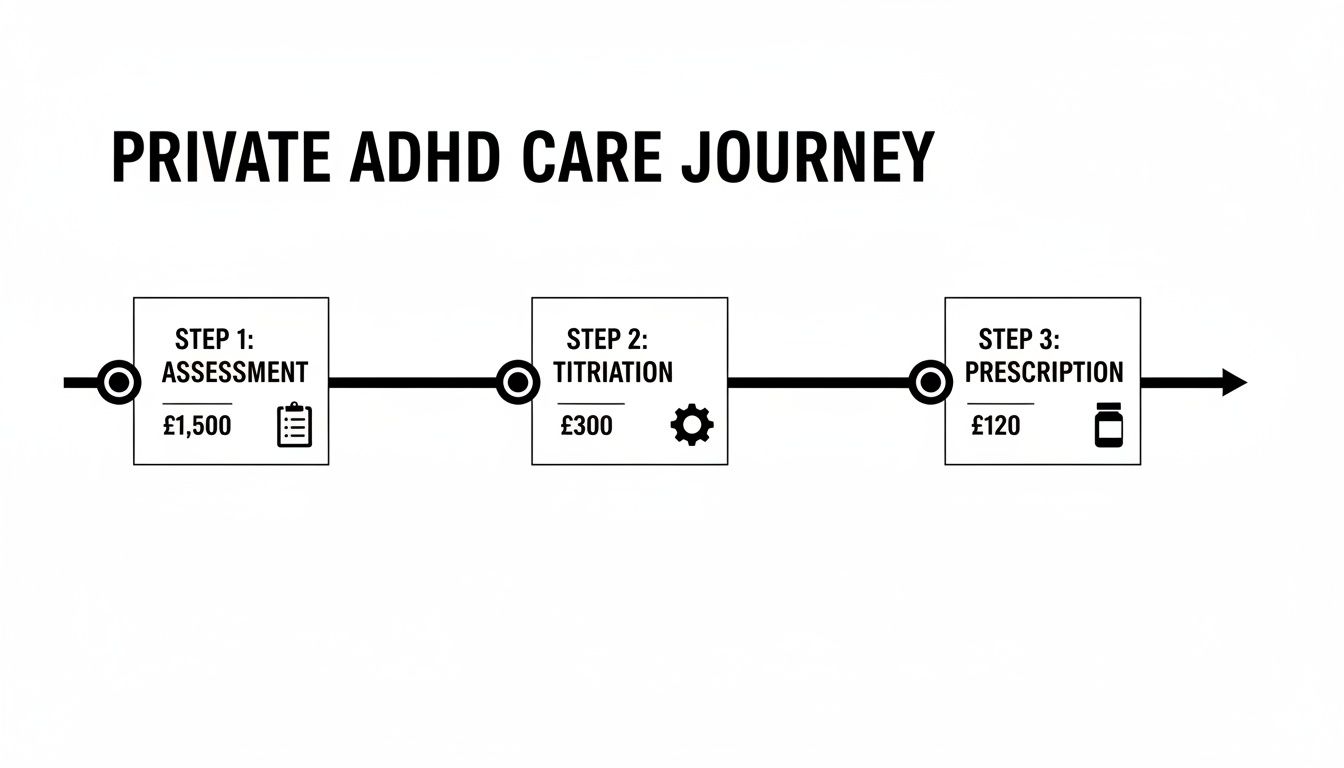
This visual shows how private care compresses the entire process into just a few weeks or months. It’s a stark contrast to the NHS route, where you face that lengthy wait before these crucial first steps for your mental health can even begin.
How a Shared Care Agreement Can Slash Your Costs
Getting started with a private clinic is often the fastest way to get an ADHD diagnosis and treatment, but the long-term cost of private prescriptions can really sting. This is where a Shared Care Agreement (SCA) comes in – it’s a crucial step that connects the speed of private care with the affordability of the NHS.
Think of it as a formal handover. An SCA is an arrangement between your private psychiatrist and your local NHS GP. The specialist gets you started, finds the right medication and dose for you (a process called titration), and once everything is stable, your GP agrees to take over the prescribing.
For you, this is the best of both worlds. You get the fast-track assessment and expert mental health care from a private consultant, but you don't have to keep paying private prices for your medication indefinitely. Once the SCA is in place, your ADHD medication cost plummets to the standard NHS prescription fee.
How Do You Set Up a Shared Care Agreement?
Putting a Shared Care Agreement in place isn't automatic; it’s a collaborative effort that needs clear communication between you, your private clinic, and your GP.
Here’s a breakdown of how it usually works:
- Have an Early Chat with Your GP: This is a big one. Before you even book a private assessment, it’s a smart move to talk to your GP. Explain that you're seeking a private ADHD diagnosis and ask if they would, in principle, be open to a shared care arrangement if you're diagnosed and need medication.
- Get Your Diagnosis and Find Your Dose: You'll go through the assessment with your private consultant. If you receive a diagnosis, you'll work together to find the right medication and a stable dose that works for you.
- The Formal Request is Made: Once you're on a steady dose, your psychiatrist will send a detailed report and a formal letter to your GP. This will cover your diagnosis, treatment plan, and current medication, and it will officially ask your GP to take over the prescribing under an SCA.
- Your GP Reviews the Request: Your GP will need to look over all the documentation. They have to be confident in the diagnosis and the proposed plan before they can agree to take responsibility for your prescriptions.
- You Move to NHS Prescribing: If your GP agrees, they'll add the medication to your NHS patient record. From then on, you’ll be able to get your repeat prescriptions from your local surgery, just like any other NHS medication.
Why Might a GP Say No?
It's really important to know that a GP doesn't have to accept a Shared Care Agreement. Most are incredibly supportive, but some might decline, and it's good to be prepared for that possibility. Their decision is always a clinical one, based on their professional judgement and local NHS rules.
There are a few common reasons why a GP might hesitate:
- Trust in the Provider: A GP is far more likely to agree if the request comes from a reputable, CQC-regulated clinic that employs GMC-registered consultant psychiatrists. A thorough, professional report is non-negotiable.
- Local NHS Rules: Some local NHS bodies have specific policies about shared care for ADHD, which might limit what your GP can do.
- Workload and Confidence: A GP might feel they don't have the time or specialised knowledge to safely monitor ADHD medication, even with a specialist's guidance in the background.
To give yourself the best chance of success, choose a high-quality private provider your GP can feel confident about. If you approach the conversation with your GP early and as a potential partner in your mental health care, rather than making a demand, you’re much more likely to build the trust needed to make your long-term treatment affordable.
Practical Strategies to Manage Medication Costs
The ongoing ADHD medication cost can feel like another thing to manage on top of everything else, especially when you're already navigating life with ADHD or Autism. But there are absolutely ways to make your treatment more affordable without cutting corners on your mental health care.
It's all about being proactive and knowing your options. A bit of smart planning and a few direct conversations can make a massive difference to your long-term mental health budget.
Ask About Generic Medication Options
One of the simplest and most effective ways to lower your private prescription bill is to talk to your psychiatrist about generic medication. Remember how we talked about brand-name drugs being pricey? That’s because the original company is recovering its research and development costs. Once the patent on that drug expires, other manufacturers can create their own versions.
These generic alternatives have the exact same active ingredients, work in the same way, and are just as effective. The only real difference is the price tag, which is often much, much lower. Don't be shy about asking your specialist if there's a generic equivalent that would work for you. That one question could genuinely slash your monthly costs.
Check Your Private Health Insurance
If you have a private health insurance policy, maybe through work, it's definitely worth digging into the details. You might be surprised to find that your plan includes cover for psychiatric care, which could help with consultation fees and sometimes even the cost of the medication itself.
Get out your policy documents or, even better, give your provider a call. You need to be specific with what you ask:
- Does my policy cover consultations with a psychiatrist for an ADHD assessment or follow-ups?
- Are private prescriptions for mental health conditions like ADHD covered?
- What is my excess, and how does it work for this type of claim?
Getting clear answers here could unlock a huge source of financial support for your treatment.
Use an NHS Prescription Prepayment Certificate
Once you've moved over to NHS prescribing, a Prescription Prepayment Certificate (PPC) is an absolute lifesaver. It’s essentially a 'season ticket' for your prescriptions. Instead of paying the standard charge every time you pick up your medication, you pay one flat fee for either three or twelve months.
If you need two or more prescription items a month, a PPC will save you money. It’s a brilliant way to budget because you know exactly what your medication will cost for the year, removing any financial surprises and easing the pressure of managing a long-term mental health condition. If you're looking to get a better handle on your finances, pairing a PPC with one of the best free budgeting software tools can help you track every penny without any extra cost.
Ultimately, the single most effective long-term strategy for making your treatment affordable is successfully securing a Shared Care Agreement. This combines the speed of the private route with the low cost of NHS prescribing, offering a sustainable path forward for your mental health.
Your Questions Answered: ADHD Medication Costs
Thinking about ADHD treatment brings up a lot of questions, especially when it comes to the costs and the actual process. Let's clear up some of the most common queries we hear from adults across the UK, so you can feel more confident about your mental health options.
Can I Get an ADHD or Autism Assessment on the NHS?
Yes, you certainly can. The starting point is always a chat with your GP, who can then refer you to a specialist NHS mental health service for an assessment for ADHD, Autism, or both.
The good news is that the assessment and any resulting prescriptions are very affordable this way. The major hurdle, however, is time. The waiting lists for these services can be incredibly long, often stretching out for several years. It's this delay that leads many people to look into private care for a faster diagnosis and treatment plan.
Why Is Private ADHD Medication So Expensive?
When you go private, the price tag can be a bit of a shock. This is because you're covering the full, unsubsidised cost of the medication itself, along with the pharmacy's dispensing fees.
On top of that, the price includes the private psychiatrist's time and expertise for managing your prescription and monitoring your progress. Essentially, you're paying for the whole specialist mental health service – the expertise, the regulatory compliance, and the clinic's infrastructure. The best way to reduce this cost long-term is to get a Shared Care Agreement in place once your treatment is stable, which lets you switch over to NHS pricing.
A common point of confusion is whether the medication itself is different. It's not. The drug you get privately is exactly the same as the one on the NHS. The price difference is simply about who foots the bill – the NHS heavily subsidises the cost for its patients, while in private care, you cover the full market price.
What Is Titration and Why Does It Cost Extra?
Titration is the crucial starting phase of treatment. Think of it as a calibration period. Your psychiatrist works closely with you to carefully adjust the type of medication and the dosage until you find the sweet spot – the most effective dose with the fewest side effects.
This is a very hands-on, personalised process that involves regular check-ins and follow-up appointments. The extra charge covers the specialist's dedicated time for this fine-tuning, which is absolutely essential for making sure your mental health treatment is both safe and effective for the long haul.
It's also during this careful titration period that you and your doctor can manage any potential side effects to ADHD medications right from the start.
Is My GP Guaranteed to Accept a Shared Care Agreement?
No, there’s no guarantee. A GP is not required to accept a Shared Care Agreement (SCA).
Their decision usually comes down to a few things: their confidence in the private clinic's report, the specific policies of their local NHS trust, and frankly, their own workload. This is why choosing a reputable, CQC-regulated clinic that provides thorough, consultant-led reports is so important—it can make a real difference in getting your GP on board. Having an open conversation with your doctor early on is the best way to pave the path for a smooth transition for your ongoing mental health care.
If the long NHS waiting times are a barrier for you, a private assessment can give you the answers you need to start moving forward. Insight Diagnostics Global offers CQC-regulated, consultant-led ADHD and Autism assessments online, with appointments often available within just seven working days.
Take the first step towards getting the clarity you deserve by visiting https://insightdiagnostics.co.uk.