

If you're an adult wondering if you have ADHD, what you're really looking for is clarity. You want to understand why certain things—like focusing, staying organised, or managing impulses—feel like a constant uphill battle. An NHS ADHD test isn’t a single, straightforward exam; it's a comprehensive evaluation by specialists to get to the bottom of your experiences. This guide will walk you through the entire process, step-by-step, helping you navigate it with confidence.
Understanding the Adult ADHD Assessment Journey
Trying to get an ADHD diagnosis as an adult can feel like a maze, especially with the long waiting lists and the complex overlap with other mental health conditions. But knowing what to expect can make a huge difference and empower you to get the help you need. For most people, the journey starts with a slow-dawning realisation that those lifelong struggles might be more than just "quirks" of your personality.
This realisation is happening for more and more people. In the UK, we've seen a big jump in ADHD diagnoses, particularly among adults. By 2018, diagnoses for people aged 18–29 were soaring compared to older age groups, which shows just how much awareness has grown.
Still, the system isn't perfect. A significant gap in care remains, with shocking data revealing that 57% of adults with a diagnosis never received medication through their GP. This highlights a real disconnect in how support is delivered. You can read more about these ADHD diagnosis and treatment trends on pmc.ncbi.nlm.nih.gov.
The Three Key Stages of Your Journey
To get a clear picture of what you'll go through, it helps to break it down. Healthcare professionals often use a technique called patient journey mapping to visualise the entire process from a patient's point of view. It helps identify roadblocks and improve support.
For our purposes, we can simplify the adult ADHD journey into three core phases.
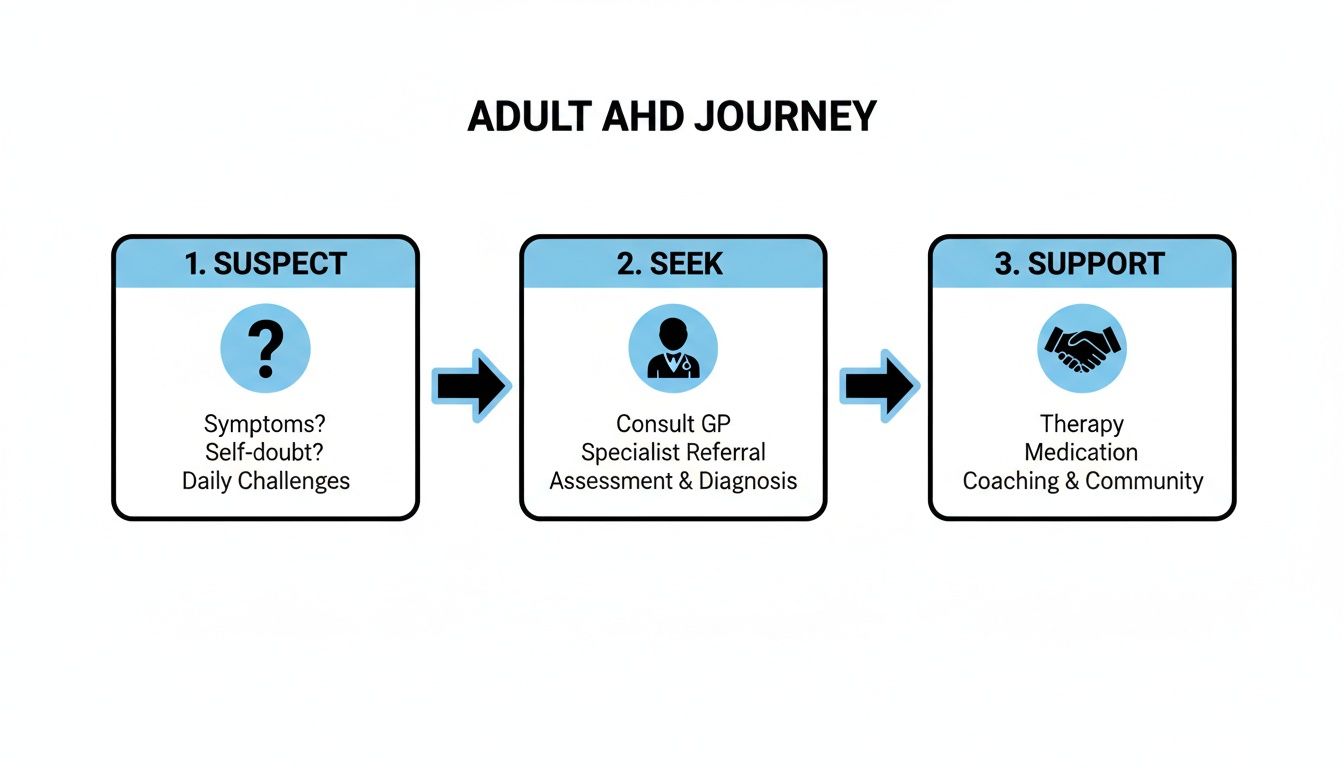
As you can see, it's a logical progression: it starts with you noticing the signs, moves on to getting a professional evaluation, and finally leads to working together on a support plan.
It's also worth noting that throughout this journey, specialists are on the lookout for other conditions. It’s quite common for adults with ADHD to also have traits of Autism Spectrum Disorder (ASD), anxiety, or other mental health challenges. A good, thorough assessment will explore these overlaps to make sure the support you receive is tailored to your complete needs, addressing your whole mental health profile, not just one condition.
How to Get Your GP Referral for an ADHD Test
For most people, the path to an NHS ADHD test starts with a chat at your local GP surgery. This first appointment is a really important step, but it’s completely normal to feel a bit nervous about it. The best thing you can do is go in prepared to talk openly about why you think you might have ADHD.
Try to see it less as a typical doctor's visit and more as a chance to share your story. Before your appointment, it’s a great idea to jot down your symptoms. But don't just stick to medical-sounding terms; think about real-life examples from your day-to-day that show how these challenges are affecting you.

Preparing for Your Appointment
To have a really productive conversation with your GP, having some clear examples ready is key. Think about specific times when your suspected symptoms have created difficulties. This gives your doctor a much clearer picture of the real-world impact.
It might help to organise your thoughts around these areas:
- Work or Study: Are you always up against deadlines? Do you find it impossible to finish projects or stay focused during meetings?
- Home and Daily Life: Does your home feel constantly disorganised or chaotic? Are you forever misplacing important things like your keys, phone, or wallet?
- Relationships: Have friends or family members ever mentioned that you seem forgetful, distracted, or a bit impulsive?
- Your Mental Health: How does all this make you feel? It's really common for adults with undiagnosed ADHD to also struggle with anxiety, depression, or emotional dysregulation because of these ongoing challenges. Mentioning this provides crucial context.
A brilliant tool to have in your back pocket is the Adult ADHD Self-Report Scale (ASRS). It's a simple checklist you can easily find online and fill out before you go. This helps put your experiences into a format that lines up with the diagnostic criteria, giving you and your GP a great starting point for the discussion. If you're curious about the different specialists you might see, you can learn who diagnoses ADHD in our detailed guide.
Understanding Your Right to Choose
If you're in England, you need to know about something called the 'Right to Choose' pathway. It’s an NHS initiative that gives you the option to select a different qualified healthcare provider for your assessment, provided they hold an NHS contract. The biggest benefit? It can seriously cut down your waiting time compared to sticking with your local service.
When you talk to your GP, you can specifically ask for a referral to a provider through the Right to Choose scheme. This gives you more control and can be the difference between waiting many months or, in some cases, several years for an assessment.
By gathering your examples, completing an ASRS form, and knowing about options like Right to Choose, you're doing more than just asking for help. You’re becoming an informed partner in your own healthcare, ready to have a constructive conversation that gets you the referral you need.
What Happens During the Clinical Assessment
The thought of a clinical assessment for an NHS ADHD test can definitely feel a bit daunting. But knowing what’s coming can make all the difference, helping you feel prepared rather than anxious. It’s not a test you can pass or fail; think of it more as a structured, in-depth conversation with a specialist—usually a psychiatrist or clinical psychologist—who is there to listen and understand your story.

Imagine the specialist is a detective trying to piece together a puzzle. They're looking for evidence of ADHD traits that aren't just happening now but have been part of your life since you were a child. This is a crucial part of the diagnostic process, because ADHD is understood as a lifelong neurodevelopmental condition.
The Diagnostic Interview
The heart of the assessment is the diagnostic interview. It’s a collaborative chat where the specialist will guide you through questions about all the different parts of your life, trying to build up a full, detailed picture.
You can expect the conversation to touch on:
- Childhood and School Days: They'll be curious about your behaviour at school, how you found concentrating, and what your academic performance was like. This is where old school reports can be absolute gold.
- Your Life Now: The discussion will naturally move into how potential symptoms impact your work, relationships, home life, and general wellbeing as an adult.
- Managing Emotions: You’ll likely talk about things like impulsivity, mood swings, or getting easily frustrated, as these are very common challenges for people with ADHD. They'll also explore any signs of anxiety or depression.
The specialist is looking for consistent patterns that match the diagnostic criteria in clinical manuals like the DSM-5 or ICD-11. It's their job to connect the dots from your childhood experiences to the difficulties you're facing today. For a more detailed look at the evaluation, you can find out more on how ADHD is tested in our complete guide.
Gathering a 360-Degree View
While your own experience is the most important part of the assessment, it's just one piece of the puzzle. To get a complete, 360-degree view, the clinical team needs to gather information from a few different sources. This helps them confirm that the challenges you're describing are noticeable to others and show up in different parts of your life.
Before your appointment, you'll likely be sent some detailed questionnaires to fill out about your symptoms. Crucially, the specialist will often ask for input from someone who knows you really well.
This could be a parent, a partner you've been with for a long time, or even a sibling. Their insights are so valuable because they can offer examples from a different angle, helping the clinician build a much more robust and accurate picture.
This comprehensive approach makes sure the assessment is as thorough as possible. It also helps rule out or identify other conditions that often go hand-in-hand with ADHD, like anxiety, depression, or even Autism Spectrum Disorder (ASD). ADHD rarely travels alone, so spotting these overlaps is key to creating a support plan that truly works for you. The end goal is to achieve clarity, so any diagnosis is accurate and points you toward the right help.
Navigating Long Waits and Potential Outcomes
So, your GP has made the referral. What comes next is often the hardest part of the entire process: the wait. It's a period filled with uncertainty and frustration, and being realistic about the timeline is crucial. The simple truth is that the NHS is under incredible pressure, which has created a massive bottleneck for ADHD assessments.
This backlog has really boiled down to two things. First, public awareness around adult ADHD and Autism has exploded, which is fantastic—it means more people are finally seeking the answers they deserve. But second, NHS mental health services are stretched incredibly thin, with nowhere near enough resources to handle this surge in demand.
The waiting times for an NHS ADHD assessment have become a genuine crisis. Frustratingly, there's no single national system for tracking this data, which makes it hard to get a clear picture. However, report after report shows people waiting anywhere from several months to, in some parts of the country, several years. This is especially concerning when you consider that while ADHD is thought to affect 3–4% of UK adults, the vast majority are still undiagnosed, all adding to the pressure on services.
Understanding the Possible Outcomes
When your assessment day finally arrives, it’s good to go in knowing that a diagnosis isn't the only possible result. The specialist’s main job is to provide you with clarity, whatever that ends up looking like. Because the assessment is so thorough and often screens for other conditions, the outcome is tailored specifically to you.
There are three main possibilities following your assessment:
- A Formal ADHD Diagnosis: The clinician confirms that your symptoms and history meet the official criteria for Attention-Deficit/Hyperactivity Disorder.
- Diagnosis of a Different or Co-occurring Condition: It might be that your symptoms are a better fit for another diagnosis, like an anxiety disorder, or that you have co-occurring conditions. A common outcome is being diagnosed with both ADHD and Autism Spectrum Disorder (ASD).
- No Diagnosis: The specialist might conclude that while your struggles are real, they don't meet the specific clinical threshold for a formal diagnosis of ADHD or another condition.
Whatever the result, remember that it's a step forward in understanding yourself. For many, a diagnosis feels like a huge weight has been lifted—it finally gives a name to challenges they've faced their whole lives and can reframe past struggles through a new lens of self-compassion.
What Happens After a Diagnosis?
Getting a diagnosis isn't the finish line; it’s really the start of a new, more informed chapter. If you are diagnosed with ADHD, the conversation immediately turns to building a support plan, which is something you'll work on together with the clinical team.
The first step is usually psychoeducation—which is just a formal way of saying you’ll learn about what ADHD actually is, how it impacts your brain, and why you've found certain things so difficult. This knowledge by itself can be incredibly powerful, helping you look back on past experiences with a bit more self-compassion.
From there, you'll explore treatment options. After a diagnosis, getting to grips with the available ADHD in adults therapy treatment is key to managing the condition well. This might involve talking therapies like Cognitive Behavioural Therapy (CBT) or specialised ADHD coaching to build practical, real-world strategies.
Medication is also a major part of the treatment plan for many people. If it seems like a good fit for you, you'll start a process called titration. This is a careful, collaborative period where you work closely with a specialist to find the exact right type and dose of medication. It's not a quick fix and can take several weeks or even months to get just right. If you want to dive deeper into this specific stage, our article on the Psychiatry UK waiting time for titration might be helpful.
Comparing NHS vs Private ADHD Assessments
When you’re staring down the barrel of a long and uncertain wait for an NHS ADHD test, going private can start to look very tempting. It’s a big decision, and it really comes down to a trade-off between cost, speed, and the overall process. There's no one-size-fits-all answer, so getting to grips with what each path involves is the first step.
The biggest draw for the NHS route is, of course, the cost. It’s free at the point of service. That alone makes it the only viable option for many. You can be confident that the assessment will be thorough, adhering strictly to NICE guidelines, and any treatment that follows—including medication—is covered.
The elephant in the room, however, is the waiting time. It’s not an exaggeration to say that after your GP makes a referral, you could be waiting months, or in many areas, several years just to be seen. And the waiting doesn't always stop there; there's often a "hidden wait" for medication titration after diagnosis, which can tack on even more time.
The Private Assessment Pathway
This is where the private sector comes in. Its main advantage is speed. Instead of a multi-year wait, you can often get an assessment booked within a few weeks. For someone whose career, relationships, or mental health are really suffering, that speed can be absolutely life-changing.
Private clinics can also feel a bit more slick, often with more direct communication and dedicated admin support. But all this speed and convenience comes with a hefty price tag. An initial assessment can easily run into hundreds, if not thousands, of pounds.
The costs don't stop at the diagnosis. You will also have to pay for follow-up appointments and the private prescriptions for your medication, which can be expensive, often exceeding £100 per month.
Understanding Shared Care Agreements
If you're considering the private route, you need to know about Shared Care Agreements (SCAs). This is a potential arrangement where, once your dose and medication are stable, your private specialist asks your NHS GP to take over prescribing. If your GP agrees, your prescriptions then fall under the NHS, which dramatically cuts the long-term cost.
The key word here is if. A GP is under no obligation to accept a Shared Care Agreement. They might refuse if they have doubts about the quality of the private assessment, or if the practice simply has a policy against it. This is a real risk, as it could leave you funding expensive private prescriptions indefinitely or force you to go back to square one and join the NHS queue anyway.
You can explore the options for a private ADHD and Autism assessment on our website to see how different services work.
Ultimately, choosing between an NHS and a private ADHD assessment boils down to weighing up time against money. The NHS path is thorough and free but painfully slow. The private route offers speed but comes at a significant financial cost, with a degree of uncertainty about long-term care.
Common Questions About the NHS ADHD Test
Getting your head around the process for an NHS ADHD test can feel overwhelming, and it's completely normal to have questions. Let's walk through some of the most common ones to give you a clearer picture of what to expect.
Can I Get an NHS ADHD Test Without a GP Referral?
For the most part, you'll need a GP referral to start the process. Think of your GP as the gatekeeper to specialist NHS services. Their role is to have an initial chat about your symptoms, see how they stack up against the clinical guidelines, and then pass you on to the right mental health team for a proper evaluation.
There is one small exception, though. If you're a university student, it’s worth checking in with your uni's wellbeing or disability service. Some have their own established pathways for referring students, which can sometimes be a helpful alternative route.
What If My GP Refuses to Refer Me for an Assessment?
It’s incredibly frustrating when this happens, but don't lose hope. You are well within your rights to ask for a second opinion from another doctor, either at your current surgery or a different one entirely.
The key to a successful conversation is preparation. Try to go in with a symptom diary, a completed ASRS checklist, and even old school reports if they mention things like inattention or hyperactivity. If you can calmly explain the real-world impact these symptoms have on your job, relationships, and overall mental health, and gently reference the official NICE guidelines, it can make all the difference.
It's important to realise that the quality of ADHD care varies massively across the country. ADHD is still hugely underdiagnosed in the UK, with some figures suggesting only 1 in 9 adults who have the condition actually get a formal diagnosis. This "postcode lottery" means your experience can depend heavily on where you live. To see how stark these differences are, you can read more about the regional disparities in ADHD diagnosis on adhduk.co.uk.
Does an NHS Diagnosis Cover Co-occurring Conditions Like Autism?
A good ADHD assessment is never done in a vacuum; the specialist will be looking at your overall mental health. They're trained to recognise the signs of other conditions that often go hand-in-hand with ADHD, like anxiety, depression, and particularly Autism Spectrum Disorder (ASD). There's a huge amount of overlap between ADHD and autism traits, so it's not at all unusual for someone to have both.
If the clinician picks up on strong signs that suggest you might also be autistic, they won't diagnose it there and then. Instead, they'll make a note of it in their report and usually recommend you get a separate assessment for ASD. So, while you won't walk away with a dual diagnosis from the ADHD assessment itself, it's often the crucial first step to getting a complete picture of your neurotype and full mental health profile.
How Long Is the Actual Assessment Appointment?
People often picture a single, marathon "test," but it's more of a comprehensive evaluation. The main diagnostic interview—the part where you sit down and talk with the psychiatrist or specialist nurse—typically lasts anywhere from 90 minutes to three hours.
But remember, that's just one piece of the puzzle. The full process also involves filling out detailed questionnaires before your appointment, gathering information from someone who knows you well (like a parent or partner), and sometimes even follow-up conversations. The clinical team pulls all of this information together to build a detailed, accurate picture before reaching a conclusion.
At Insight Diagnostics Global, we understand that clarity is everything. If you are struggling with the uncertainty of long NHS waits and need clear answers sooner, our CQC-regulated online service provides expert-led assessments for ADHD, Autism, and a range of mental health conditions. Book your assessment with us today and take the next step toward understanding yourself.