

If you're reading this after a diagnosis, or while you're still waiting for one, you may already know the pattern. You miss a deadline you cared about. You forget an appointment even after promising yourself you wouldn't. You start the washing up, notice an email, then remember a bill, then realise you haven't eaten. By evening, you're exhausted and annoyed with yourself, even though you've been mentally “on” all day.
That experience often leads adults to ask the wrong question. They ask, “How do I stop being like this?” The more useful question is, “What support helps my brain work more reliably in daily life?”
That's where counselling for ADHD becomes useful. Not as a vague space to talk about being stressed, but as part of a practical treatment plan that helps you understand your patterns, reduce avoidable crises, and build systems that fit the way your mind works. In UK practice, that matters even more because support is often fragmented. People are commonly left waiting for assessment, medication review, or follow-up, while work, relationships and self-esteem continue to take the strain.
A solid diagnosis is the starting point. Without that, therapy can become too generic. You may be treated for “stress” when the actual issue is executive dysfunction, or for “low motivation” when the problem is untreated ADHD with anxiety, autism, sleep disruption, or all three together.
Understanding Why ADHD Management Goes Beyond Medication
You may already have noticed the pattern. Medication helps you focus for longer, yet the kitchen is still half-done, the work task still feels impossible to start, and one awkward email can knock your whole day off course. That does not mean treatment has failed. It means ADHD affects more than attention.
Medication can reduce distractibility, impulsivity and mental noise. For many adults, that relief is substantial. In clinic, though, I regularly see a second problem once symptoms ease. People can concentrate better, but they are still using the same coping methods that kept them afloat before diagnosis: last-minute panic, avoidance, perfectionism, overcommitting, or relying on a partner to hold daily life together.
Those patterns need treatment in their own right.
In UK practice, NICE guideline NG87 includes psychological and psychosocial support alongside medication for adults with ADHD. That matters because tablets do not teach planning, time management, emotional control, or recovery from years of self-criticism. They can create the conditions for change. They do not build the skills.
What medication helps with, and what it does not
A good response to medication often gives people a window of opportunity. You may find it easier to sustain attention, pause before acting, or filter background noise. That can be a major relief at work and at home.
What usually remains is the day-to-day machinery of living. Starting boring tasks. Breaking large jobs into steps. Switching between activities without losing momentum. Noticing when frustration is rising before it turns into an argument, shutdown, or a lost afternoon. Counselling is often where those problems are addressed properly, including through ADHD counselling options available online in the UK when local access is limited.
A simple rule helps here. Treat ADHD management as skill-building plus symptom relief, not symptom relief alone.
Why diagnosis needs to come first
Therapy is far more useful when it is based on a detailed assessment rather than a vague sense that something is wrong. Without that, adults are often offered generic support for stress, low mood or poor motivation, while the main driver is missed entirely.
A proper diagnostic assessment clarifies three things. First, whether ADHD is present. Second, whether something else is contributing, such as anxiety, depression, sleep problems, trauma, or autistic traits. Third, what type of support matches the underlying difficulty.
That distinction matters in practice. Someone whose main problem is time blindness and task paralysis needs a different counselling plan from someone whose ADHD shows up as emotional volatility in relationships. It matters even more when ADHD and autism overlap, because sensory overload, rigidity, social fatigue and burnout can all affect what therapy should focus on and how quickly change is realistic.
Counselling addresses the parts medication leaves behind
Many adults come to treatment carrying years of shame. They have been told they are careless, lazy, dramatic, unreliable, or not trying hard enough. Medication may reduce symptoms, but it does not correct that history. Counselling can help you recognise which difficulties belong to ADHD, which belong to anxiety or trauma, and which are habits built from years of compensating.
Physical stress matters too. If your system stays on high alert, planning tools and productivity advice often fail because your brain is busy scanning for threat, not organising Tuesday afternoon. Simple methods for balancing your nervous system can support counselling, especially if overwhelm, shutdown, irritability or chronic tension sit on top of ADHD.
The goal is not to become a different person. The goal is to function with less chaos, less guilt, and more predictability. For most adults, that takes more than a prescription.
What ADHD Counselling Actually Involves
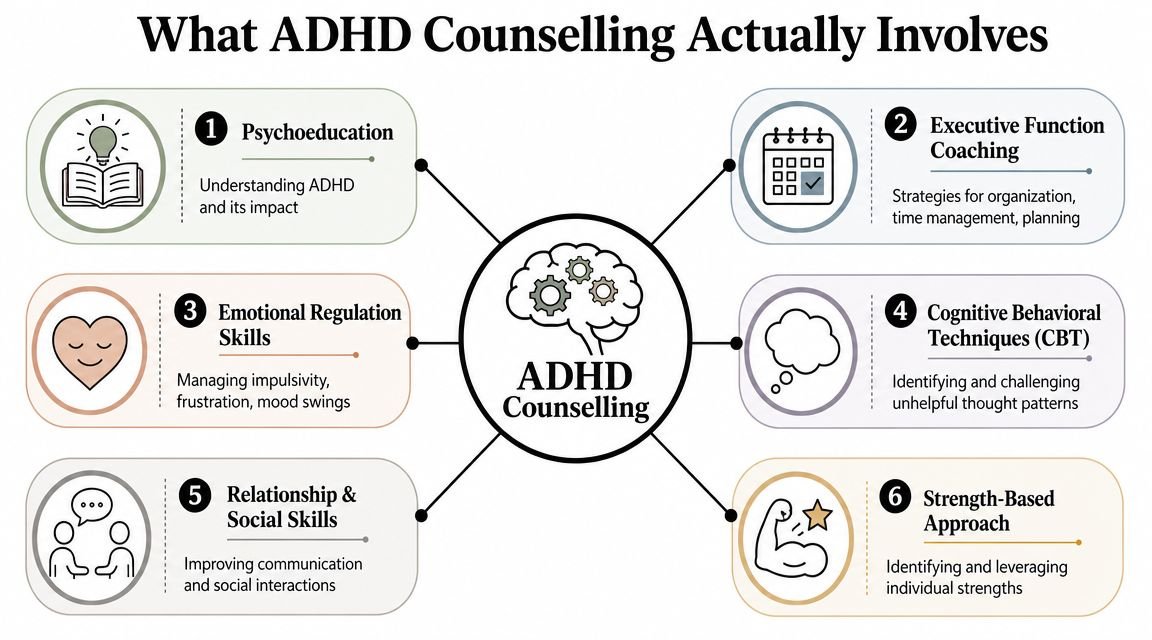
Good ADHD counselling is structured. It isn't just a weekly conversation about how hard things have been, although that may be part of it. The strongest evidence-based model is structured psychotherapy built on a full diagnostic work-up, and a major evidence review found that behavioural therapy was the only non-pharmacological intervention with a statistically significant effect in ADHD management in that review, with the focus on practical skills for executive dysfunction rather than supportive talk alone, as described in this evidence review on ADHD interventions.
The work is practical and present-focused
In clinic, effective counselling for ADHD usually targets three broad areas.
First, executive function. That means planning, prioritising, starting, sequencing and finishing. Therapy often involves taking a chaotic task and reducing it to the next visible action.
Second, emotional regulation. Adults with ADHD often describe quick frustration, shame after mistakes, sensitivity to criticism, and difficulty settling after conflict. Counselling teaches ways to slow reactions before they become consequences.
Third, self-understanding. Many people arrive thinking they are lazy, careless or weak-willed. Psychoeducation helps replace that moral interpretation with a clearer neurodevelopmental one.
What sessions often look like
A useful ADHD session usually sounds more concrete than generic therapy. You might review why you missed two deadlines, identify the point where task initiation failed, then create a smaller workflow for the coming week. You may also test a routine, review whether it worked, and adjust it.
Common pieces of work include:
- Task breakdown: Turning “sort my finances” into a sequence of small, timed actions.
- External memory systems: Putting commitments into one trusted place rather than relying on recall.
- Friction reduction: Removing avoidable steps between intention and action.
- Emotional recovery plans: Knowing what to do after a mistake so one slip doesn't become a lost week.
Good therapy for ADHD should feel like learning, practising and reviewing. If every session stays abstract, it may not be targeting the condition well enough.
Some adults also benefit from practical resources between sessions. For example, collections of productivity hacks for ADHD can be useful when they're treated as experiments rather than rules. The key is to test what your brain will use consistently.
If you're looking for structured support remotely, online counselling in the UK can make this kind of work more accessible, especially if travel, schedule changes or sensory demands make face-to-face appointments harder to sustain.
Comparing Therapeutic Approaches for Adult ADHD
Not all therapy models do the same job. Adults are often told to “try counselling” without anyone explaining what kind, for which problem, and with what expectation. That's where many people waste time.
The three models most adults encounter
CBT for ADHD is usually the most familiar. In this context, it isn't just about challenging thoughts. It also looks at behaviour patterns that keep you stuck, such as delaying tasks until panic takes over, avoiding admin because it feels mentally tangled, or assuming one bad day means total failure.
ADHD coaching is more future-focused and operational. It tends to centre on goals, accountability, routines and systems. Coaching can be very useful, but it doesn't replace therapy when trauma, depression, anxiety or severe emotional dysregulation are driving the problem.
DBT-informed therapy is often underused for ADHD adults who feel emotions intensely. If you swing quickly from frustration to anger, become flooded during conflict, or feel derailed for hours after perceived rejection, DBT-style skills can be extremely relevant.
ADHD therapy models compared
| Therapy Type | Primary Focus | Best For |
|---|---|---|
| CBT for ADHD | Thought patterns, avoidance, procrastination, practical behaviour change | Adults who struggle with task initiation, disorganisation, perfectionism, and negative self-talk |
| ADHD Coaching | Goal setting, accountability, routines, systems | Adults who understand their diagnosis but need help applying strategies consistently |
| DBT-informed Therapy | Emotion regulation, distress tolerance, interpersonal skills | Adults with strong emotional reactivity, conflict difficulties, or rejection sensitivity |
How to decide what fits
If your main problem is, “I know what to do but I don't do it,” CBT or coaching may help. If your bigger issue is, “One setback ruins my whole day and then I spiral,” DBT-informed work is often more useful.
If you also have autism, therapy needs further adjustment. Standard CBT can be too abstract or too reliant on broad verbal processing unless the therapist understands autistic communication, sensory load, monotropism, and burnout. In combined ADHD and autism presentations, structure matters even more.
A typical therapy fit might look like this:
- A professional who misses deadlines, avoids email, and feels constant dread about work may do well with CBT for ADHD.
- A student who understands ADHD well but can't maintain routines may benefit from coaching.
- Someone who becomes overwhelmed in relationships and reacts fast under stress may need DBT-informed skills first.
If you're specifically considering a more structured cognitive approach, CBT support in Birmingham is one example of the kind of service model to look for. The important part isn't location alone. It's whether the therapist applies CBT to executive dysfunction and real-life impairment, rather than offering generic anxiety management and calling it ADHD treatment.
The right question isn't “Which therapy is best?” It's “Which therapy targets the problem that causes most damage in my life right now?”
How Counselling and Medication Work Together
Medication and counselling aren't competing options. They do different jobs.

A simple way to think about it is hardware and software. Medication can improve the brain's hardware functions, such as attention regulation and impulse control. Counselling installs better software. It teaches routines, coping strategies, emotional skills and practical ways to manage daily demands.
That distinction matters because many adults expect medication to fix patterns that are learned responses to years of unmanaged ADHD. It may become easier to focus, but you might still overcommit, underestimate time, avoid boring tasks, or shut down when criticised.
What counselling can do before medication is sorted
This is especially relevant in the UK, where medication titration and specialist follow-up may take time. NICE guidance for adult ADHD recommends non-pharmacological treatment as part of a broader care plan, and counselling can still help during long waits by supporting emotional regulation, coping, organisation and shame reduction, as discussed in this practical review of counselling support during ADHD treatment delays.
That means therapy is not “second best” while you wait. It can stabilise things now.
Common benefits during this stage include:
- Reducing chaos: Creating a basic system for appointments, finances and medication reminders.
- Lowering shame: Understanding that repeated difficulties have a clinical explanation, not a character flaw.
- Protecting work and study: Building stopgap strategies while formal prescribing is still pending.
For readers weighing whether medication should be part of their plan, ADHD medication support can help clarify what review, titration and monitoring usually involve.
A short overview can also help if you want the basics explained plainly before your next appointment:
Where combined treatment works best
Combined treatment is often strongest when each part informs the other. Medication may make it easier to pause, plan and follow through. Therapy then turns that extra mental traction into habits that last.
In practical terms, that can mean being able to use the calendar system you kept ignoring before. Or catching yourself earlier when a missed task starts spiralling into self-criticism and avoidance.
How to Choose the Right ADHD Therapist
A therapist can be warm, experienced and well-qualified, yet still not be the right person for ADHD work. The issue isn't kindness. It's whether they understand how neurodevelopmental conditions show up in adult life.
What to ask before you commit
Start with direct questions. You don't need to sound polished. You need useful answers.
Ask things like:
- Do you work with adults with ADHD regularly: You want familiarity with executive dysfunction, not occasional exposure.
- How structured are your sessions: If they can't explain how they work on planning, avoidance, routines or emotional regulation, be cautious.
- How do you assess for co-occurring conditions: Anxiety, depression, autism, sleep problems and substance use can all alter the therapy plan.
- What do you do if a client struggles to implement strategies between sessions: This question often reveals whether they understand ADHD realistically.
Signs of a good fit
A strong ADHD therapist usually does a few things early. They help you define functional targets. They don't interpret every missed homework task as resistance. They know that inconsistency is part of the presentation, not evidence that you don't care.
They're also able to work with complexity. If you have both ADHD and autism, they should understand that a missed deadline may involve executive dysfunction, perfectionism, sensory overload, and difficulty shifting attention, all at once.
If your therapist keeps framing ADHD difficulties as motivation problems, attitude problems, or a lack of insight, that's a warning sign.
Why the assessment quality matters
Therapy is more accurate when it starts from a thorough assessment. A full psychiatric evaluation should include symptom history, rating scales, collateral information where available, and review of co-occurring conditions. Without that foundation, the counselling plan can drift into generic stress management.
Consultant-led assessment is useful. If a psychiatrist has already clarified whether you're dealing with ADHD alone, ADHD plus autism, or ADHD with anxiety or mood symptoms, the therapist can target the work from the beginning instead of guessing.
That point is particularly important for adults who have spent years being misunderstood. Many have been told they are anxious, disorganised or emotionally unstable without anyone recognising the neurodevelopmental pattern underneath.
Navigating UK Access Routes to Counselling
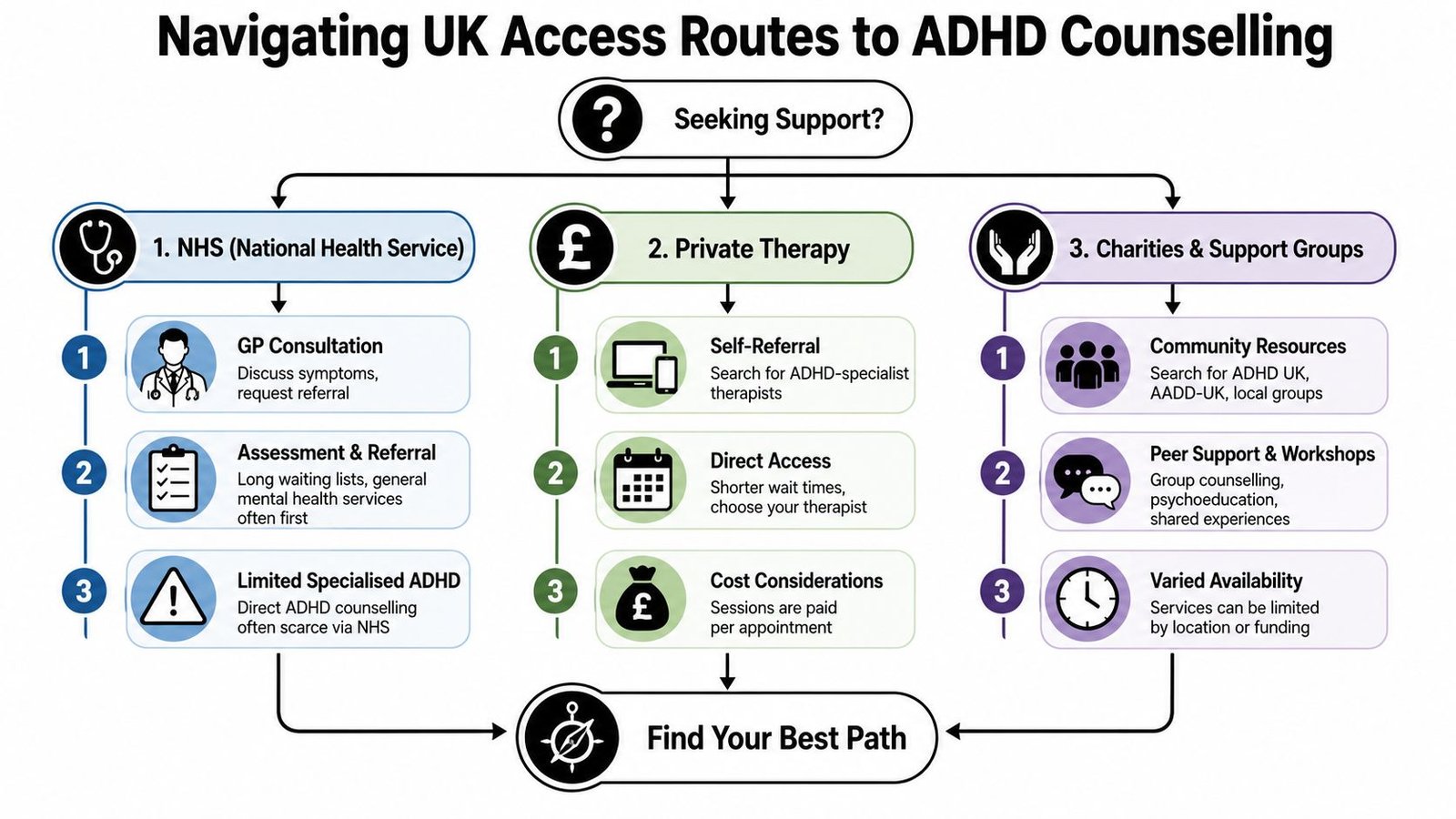
You get diagnosed, decide you want proper support, then hit the next problem. The route into counselling depends heavily on where you live, what you can pay, and whether anyone in your local service understands adult ADHD beyond a screening form.
NHS route
Many adults start with the NHS, and for good reason. It is the main funded route, but access to ADHD-specific counselling is inconsistent across the UK.
In practice, people are often directed first into general mental health services. That can help if anxiety, depression, sleep problems or stress are prominent. It does not always lead to therapy that is adapted for executive dysfunction, emotional dysregulation, or co-occurring autism. Some areas have clinicians with real experience in adult ADHD. Others do not.
Waits are a common aspect. Assessment delays often hold up the whole treatment plan, because counselling is much more focused once the diagnosis and wider formulation are clear.
Private and self-funded routes
Private care is usually faster. It also gives you more control over who you see and what kind of therapy you want.
That matters. A therapist may describe themselves as neurodiversity-informed and still offer fairly generic counselling that does little for time blindness, task initiation, shame cycles, or burnout. Ask direct questions about their experience with adult ADHD, autism, masking, and common co-occurring conditions. If they cannot explain how they adapt treatment, keep looking.
The trade-off is cost, and sometimes fragmentation. You may pay separately for assessment, medication reviews, and therapy, with each clinician working in a different service. Some adults accept that because speed matters. Others prefer a mixed route, using NHS funding where possible and paying privately for the parts they cannot access quickly.
If your local NHS pathway is slow or unclear, some people look into an NHS Right to Choose ADHD assessment pathway to get a clearer route into diagnosis before arranging counselling.
Charities, universities and peer support
These options are useful while you are waiting, and sometimes alongside formal treatment.
- Charities and support groups: often provide practical education, peer discussion, and signposting.
- University services: may offer short-term counselling, disability support, study adjustments, and help with funding applications.
- Workplace support: occupational health and employee assistance programmes can sometimes help with routines, workload adjustments, and communication strategies.
Use these supports for what they are good at. They can reduce isolation, give you language for what is happening, and make daily life more manageable. They are not a substitute for a proper diagnostic assessment and an individual treatment plan.
A realistic UK plan often uses several routes at once. You might be waiting for assessment on one pathway, starting counselling through another, and getting practical support from work or university at the same time.
Your First Step A Clear Path to Diagnosis and Support
If you're unsure where to begin, start with clarity. That means a full assessment before trying to force yourself into generic therapy that may miss the mark.
A proper diagnostic process for adults should do more than confirm or rule out ADHD. It should also consider autism, anxiety, depression, mood instability, sleep disruption and other factors that shape how treatment works in real life. That's the difference between a label and a usable clinical formulation.
What a clear pathway looks like
A consultant-led process is usually the most straightforward model.
Initial triage
Your history, current symptoms and practical concerns are reviewed first so the assessment is directed properly.Thorough psychiatric assessment
This includes a structured interview and detailed consideration of neurodevelopmental and mental health factors.Written diagnostic report
The report should explain the clinical reasoning clearly and set out treatment recommendations, not just name a diagnosis.Follow-up planning
This may include counselling recommendations, medication review, workplace adjustments, university support, or onward referrals.
Why this matters for counselling
Counselling is more effective when the therapist knows what they are treating. If your main drivers are ADHD and autistic burnout, the work will differ from counselling for ADHD with panic symptoms, or ADHD with longstanding depression.
That's why an assessment should answer practical questions such as:
- What are the main impairments: Work, study, relationships, self-care, or all of them.
- What co-occurring issues need parallel treatment: Anxiety, low mood, sleep or substance misuse.
- What support needs sequencing: Diagnosis first, then medication review, then targeted therapy, or the reverse if distress is urgent.
For adults who want a structured route, Insight Diagnostics Global offers consultant-led assessment for ADHD, autism and other mental health conditions, with triage, psychiatric evaluation, written reporting, and optional follow-up. According to the publisher information provided, assessments are usually scheduled within 7 working days and reports completed within 5 working days thereafter.
Don't wait for perfect certainty
Many adults spend too long trying to self-diagnose from social media, productivity advice, or years of feeling different. That often increases confusion. If the picture is complicated, and it often is, proper assessment saves time.
A diagnosis does not solve everything. But it gives the rest of treatment a direction. Without that, counselling can become supportive but unfocused. With it, support becomes far more precise.
Frequently Asked Questions About ADHD Counselling
How is counselling different if I have both ADHD and autism
The work usually needs to be more adapted and more concrete. Someone with both ADHD and autism may struggle with executive dysfunction, sensory overload, social fatigue, rigid coping patterns, and burnout at the same time. A therapist who only understands one side of that picture may misread the other.
In practice, therapy often needs clearer structure, less ambiguity, and more attention to environment. You may need support not just with planning and emotions, but with sensory demands, transitions, masking, and recovery time after social or work strain. Generic counselling often misses those interacting pressures.
Can counselling help with ADHD burnout
Yes, but only if burnout is recognised for what it is. This is a key underserved area, especially for university students and working adults. ADHD burnout is distinct from ordinary stress and often relates to chronic masking, overload and repeated failure experiences. Effective counselling should address workload redesign, boundary setting and executive function coaching, rather than treating it only as depression or anxiety, as discussed in this overview of ADHD therapies and burnout-related support.
That means useful counselling may involve reducing demands, dropping nonessential commitments, rebuilding basic routines, and changing how work is organised. It is not just venting about stress.
What if I don't get on with my first therapist
Then you change therapist. That is not a treatment failure.
A poor fit can happen because the therapist is too unstructured, too generic, unfamiliar with ADHD, or not someone you can think clearly with. If sessions leave you feeling blamed, over-explained to, or no more organised than before, review the fit early.
Try this approach:
- Name the issue first: Sometimes a good therapist can adjust if you say you need more structure or more practical work.
- Ask how they would change the format: Their answer tells you whether adaptation is possible.
- Leave if needed: You do not owe ongoing attendance to a therapist who doesn't understand your presentation.
The aim is not to find someone who agrees with everything you say. It is to find someone who can help you function better.
If you want a clear starting point, Insight Diagnostics Global offers consultant-led assessments for ADHD, autism and related mental health concerns in adults, with online and face-to-face options, written reports, and treatment recommendations that can guide counselling, medication review and wider support planning.