

You might be here because life has become harder to manage in ways that don't fit neatly into one label.
You're working, studying, parenting, or holding everything together from the outside, but privately you're wondering why concentration feels so effortful, why ordinary admin becomes overwhelming, why social situations drain you more than they seem to drain other people, or why anxiety and low mood keep returning despite your best efforts. Many adults reach this point and ask the same question: is this stress, burnout, depression, ADHD, autism, or some combination of them?
That uncertainty is one of the hardest parts. People often delay getting help because they think they should already know what is wrong. In practice, the opposite is true. A good assessment exists precisely because symptoms overlap, especially in adults.
Feeling Lost Your First Steps in Adult Mental Health
A common pattern goes like this. Someone first seeks help for anxiety, poor sleep, emotional exhaustion, or repeated work difficulties. They may have tried self-help, spoken to a GP, or had short-term counselling. Some improve a little. But the underlying picture still doesn't make sense. They keep missing deadlines despite trying hard. They feel chronically disorganised. Or they've spent years masking social confusion, sensory overload, or rigid routines that no one ever recognised as possible autism.
That confusion is not unusual. In England, the Adult Psychiatric Morbidity Survey found that 1 in 6 adults met criteria for a common mental health disorder in 2023, and more than 2 million people were in contact with NHS mental health, learning disability and autism services in a single recent year, showing that seeking support is part of mainstream healthcare rather than a niche issue (Adult Psychiatric Morbidity Survey context).

What usually helps first
The most useful first move isn't to chase a diagnosis online. It's to organise the problem clearly enough that a clinician can assess it properly.
- Write down your main difficulties: focus, impulsivity, shutdowns, panic, low mood, sensory sensitivity, sleep, relationship strain, work problems.
- Notice the time pattern: did this start recently, or have versions of it been present since childhood or adolescence?
- Separate symptoms from explanations: “I can't start tasks” is more useful than “I'm lazy”. “I dread meetings because I miss social cues” is more useful than “I'm just bad with people”.
Practical rule: if you're asking whether you need therapy, medication, workplace support, or a diagnosis first, you probably need an assessment before choosing the next step.
Why assessment matters early
Adults often arrive in mental health services after years of partial explanations. They may have been treated for anxiety when the main driver was untreated ADHD. They may have been told they are stressed when autistic burnout, sensory overload, or persistent social masking is central to the picture.
A proper assessment doesn't guarantee a diagnosis. It does something more important. It clarifies what is going on, what isn't, and what kind of help makes sense next.
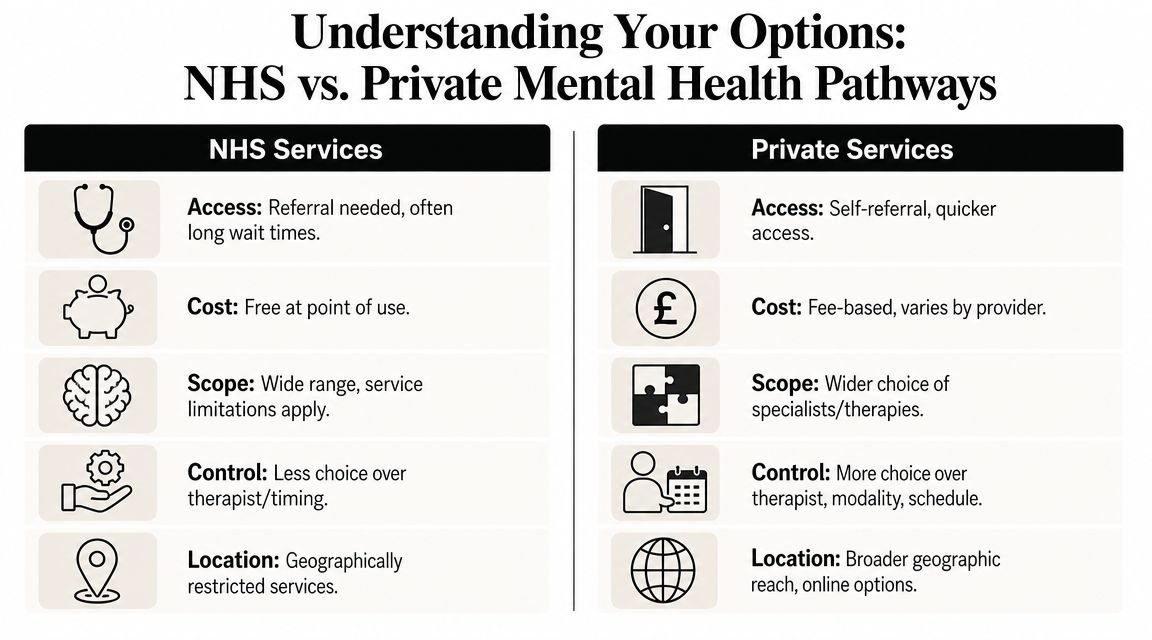
Understanding Your Options NHS vs Private Pathways
Once you decide to seek help, the next problem is access. In the UK, most adults move through one of three routes: the standard NHS pathway through a GP, a self-funded private pathway, or an NHS-funded Right to Choose route where that option applies.
The system can feel opaque because these routes are often discussed as if they are interchangeable. They aren't. They differ in speed, cost, flexibility, and how much control you have over who assesses you.
The NHS route through your GP
The standard NHS route usually starts with a GP appointment. Your GP may advise self-help, refer you to talking therapies, or refer onward to a specialist service if ADHD, autism, or another psychiatric condition seems likely.
This route is free at the point of use. That matters. But it also depends on local service thresholds, referral criteria, and waiting lists. The NHS Long Term Plan, published in 2019, committed to giving an additional 380,000 adults access to talking therapies and other community support each year by 2023/24, reflecting a broader shift towards earlier assessment and treatment (NHS Long Term Plan summary). In real life, that has increased demand on already stretched services.
Typical trade-offs include:
- Cost: no direct charge to the patient.
- Choice: limited. You usually can't choose the individual clinician.
- Timing: variable and often the hardest part.
- Geography: local commissioning arrangements shape what's available.
The private route
A private pathway is usually the fastest and most flexible option. You contact the provider directly, choose an appointment time, and pay for the assessment yourself or through health insurance if your policy covers it.
Private care works well when speed matters, when you want a specialist in adult ADHD or autism, or when your work, studies, or home life can't tolerate prolonged uncertainty. The downside is obvious. Cost sits with the patient unless insurance authorises it.
What patients often underestimate is the value of service design. A provider with clear admin processes, prompt reports, and well-organised follow-up is easier to work with than one that offers a quick first appointment but leaves you waiting for documentation. Behind the scenes, operational issues shape patient experience, which is why resources on revenue cycle management for mental health can be useful for understanding why billing, authorisation, and documentation systems matter in real clinics.
The Right to Choose route
For many adults, Right to Choose sits between NHS and private care. It is still NHS-funded, but it can offer access to an alternative provider rather than the standard local pathway. For patients exploring this route, a clear explanation of the NHS Right to Choose process helps clarify eligibility, GP involvement, and what documentation is usually needed.
If you think you may need an ADHD or autism assessment, don't ask only, “How fast can I be seen?” Ask, “Who will assess me, what report will I receive, and will it support the next stage of care?”
UK mental health assessment pathways
| Pathway | Access Route | Typical Wait Time | Cost to Patient | Provider Choice |
|---|---|---|---|---|
| NHS via GP | GP referral into local services | Variable | Free at point of use | Limited |
| Private | Self-referral or insurer authorisation | Usually quicker than NHS routes | Fee-based | Greater choice |
| Right to Choose | GP referral to an eligible provider | Variable, often used to avoid standard local waits | NHS-funded where applicable | More choice than standard local NHS routes |
What works best depends on urgency, finances, and whether you need broad mental health input or a specialist neurodevelopmental assessment.
The Assessment Process What to Expect
Many adults worry that an assessment will feel like an exam. It shouldn't. A good assessment is a structured clinical conversation that gathers evidence from multiple angles and turns confusion into a usable formulation.
When services are bottlenecked, quality matters even more. NHS data show that less than half of people with common mental disorders receive treatment, which is one reason a rapid, well-documented assessment from a qualified provider can help move onward care forward more efficiently (treatment gap summary).
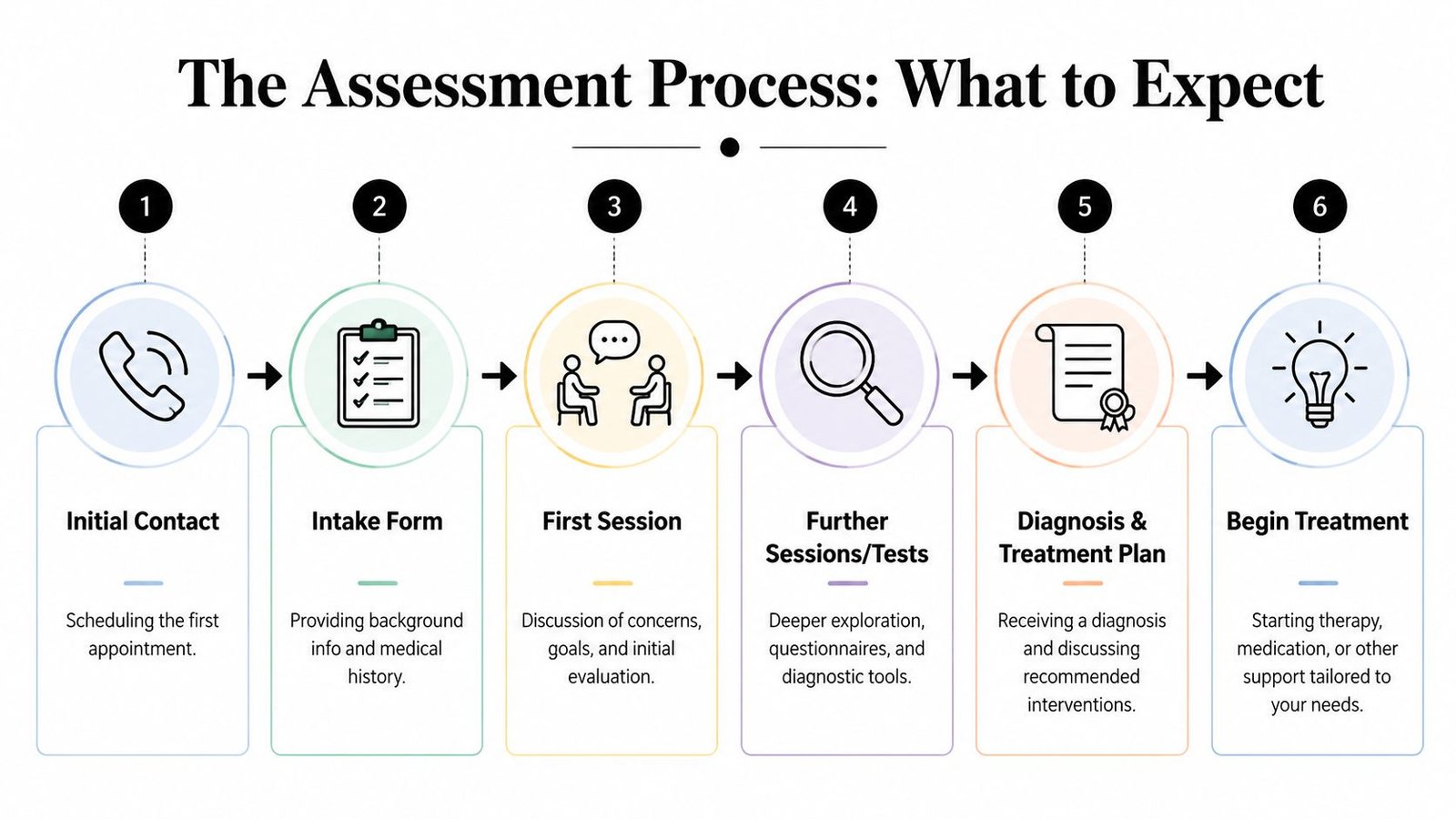
Step one and step two
The process usually starts before you meet the clinician.
Initial triage
You'll usually be asked what brings you for assessment and whether there are immediate risks, such as severe deterioration, self-harm thoughts, or substance misuse concerns that need urgent attention.Questionnaires and background forms
These forms matter. They provide a baseline picture of mood, anxiety, attention, developmental history, and functioning across work, education, relationships, and daily life.
Some adults rush this stage because it feels administrative. That's a mistake. A careful form often reveals the pattern that drives the whole consultation.
The main diagnostic interview
The core appointment is a detailed interview with a qualified clinician. In adult ADHD or autism work, this should go beyond current symptoms.
A proper interview usually explores:
- Current difficulties: attention, organisation, forgetfulness, sensory issues, emotional regulation, social communication, routines, burnout.
- Developmental history: what you were like as a child, at school, at home, and with peers.
- Mental health overlap: anxiety, depression, trauma, sleep problems, obsessive features, mood instability, and substance use.
- Functional impact: how symptoms affect work, study, money, relationships, parenting, and physical health routines.
For a fuller explanation of the components involved, this guide to what a mental health assessment includes is a useful practical reference.
The assessment is not there to catch you out. It is there to test different explanations until the most accurate one remains.
What a robust outcome looks like
A sound assessment doesn't end with “yes” or “no”. It should produce a coherent written report.
That report should usually answer these questions:
- What diagnoses are supported, if any
- What alternative explanations were considered
- What evidence supported the conclusion
- What treatment or support should happen next
For ADHD, next steps may include medication discussion, titration, coaching, psychological work, and workplace adjustments. For autism, the next steps may involve psychoeducation, sensory planning, communication support, and practical adjustments rather than medication.
What doesn't work is a vague one-off opinion with no clear reasoning, no written formulation, and no onward plan.
The Focus on ADHD and Autism in Adults
Adult ADHD and autism are frequently missed because they rarely present in a neat textbook form. By adulthood, many people have developed coping strategies that hide part of the picture. They may be high-achieving, articulate, and outwardly organised, yet privately exhausted by the effort required to stay afloat.
That's one reason adult presentations are so often mislabelled. ADHD can look like anxiety because the person is always tense, late, overextended, and worried about forgetting something important. Autism can look like depression because the person withdraws, feels chronically misunderstood, and becomes depleted by ordinary social and sensory demands.
Why overlap causes confusion
Demand for assessment is rising. NHS England reported 4.4 million people in contact with mental health services in 2023/24, and that rise partly reflects more adults seeking structured assessment for overlapping conditions such as ADHD, autism, and anxiety, where clear diagnostic pathways matter (mental health service demand and overlapping conditions).
The overlap matters clinically because symptoms don't arrive one at a time. An adult might have:
- longstanding inattentive ADHD with secondary anxiety
- autism with repeated burnout and social exhaustion
- both ADHD and autism, plus low mood from years of coping without support
- trauma or personality difficulties that complicate the picture further
What specialist assessment adds
Differential diagnosis is essential. In plain terms, this means working out which explanation best fits the full pattern rather than picking the first label that seems plausible.
A specialist in adult neurodevelopmental assessment should look for the distinctions. Is distractibility caused by ADHD, anxiety, poor sleep, or mood disorder? Are social difficulties rooted in autism, trauma, low confidence, or all three? Is emotional volatility impulsivity, chronic stress, or a broader personality pattern?
For adults who suspect attention difficulties, a practical overview of ADHD symptoms in adults can help them describe what they've been experiencing in more precise terms before assessment.
Many adults aren't “missing resilience”. They're trying to function without an explanation that fits.
What tends not to help
Generic reassurance rarely helps when neurodevelopmental conditions are in the background. Neither does jumping straight into treatment without diagnostic clarity.
What usually works better is this sequence: structured assessment, clear formulation, realistic support plan, then treatment matched to the actual problem. That may include medication. It may not. For some adults, the biggest shift comes from finally understanding the pattern and adjusting life around it intelligently.
How to Choose a Reputable Provider
You may be ready to book by this stage. That is often the point where people feel pressured to choose quickly, especially after months or years of wondering what is wrong. A fast appointment can be helpful, but the main question is whether the provider can give you a careful assessment that stands up to scrutiny and helps with treatment, work support, education evidence, or reasonable adjustments later.
When I advise adults who are choosing between NHS waiting lists, Right to Choose providers, and private clinics, I suggest starting with one practical question. Will this assessment still look credible in a year if medication is being considered, if a second opinion is needed, or if your symptoms turn out to be more complex than expected?
Start with these fundamentals
Check regulation first, then check the clinician. Brands can look polished online. What matters is who is assessing you, what their training is, and whether the service explains its process clearly.
A sensible checklist includes:
- CQC status: if the service is one that should be regulated in England, confirm that it is.
- GMC Specialist Register: if your assessment is with a consultant psychiatrist, verify that directly.
- Clarity about the assessor's role: know whether you are seeing a psychiatrist, psychologist, or another clinician, and what that means for diagnosis, prescribing, and follow-up.
- Clear pricing: the initial fee matters, but so do report fees, review appointments, prescription charges, and titration costs where relevant.
- A defined assessment method: you should be told how information is gathered, whether collateral history is requested, how complexity is handled, and what report you will receive.
Insight Diagnostics Global is one example of a consultant-led service offering adult assessments for ADHD, autism, and broader mental health concerns through psychiatrists on the GMC Specialist Register within a CQC-regulated service.
Questions worth asking before you book
Good providers answer direct questions plainly. Evasive answers usually tell you something useful.
Ask these before paying a deposit:
- Who will assess me, by name and profession?
- How long is the assessment, and is that usually enough for complex presentations?
- Will the report explain the clinical reasoning, including alternative explanations considered?
- If ADHD is diagnosed, is medication titration or ongoing prescribing available, or will that need to happen elsewhere?
- If autism is identified, will the report include practical recommendations for work and daily life?
- How do you assess overlapping problems such as anxiety, depression, trauma, sleep issues, or substance use?
If you are unsure how to check an individual clinician properly, this guide on how to find a psychiatrist sets out what to look for.
A short video can also help you see what a professional assessment service looks like in practice.
Warning signs
Be cautious if a service seems designed to sell certainty rather than assess you properly.
Warning signs include promises of a diagnosis without explaining the method, very vague language about qualifications, no clear report, no discussion of alternative explanations, or reluctance to answer basic questions about regulation and follow-up care. I would also be wary of providers who make ADHD or autism sound obvious after a brief screening call. Screening can point to a possibility. It does not replace a diagnostic assessment.
A reputable provider should make the process clearer, not more confusing. The aim is not just to get a label quickly. The aim is to get an assessment you can rely on.
Preparing for Your Mental Health Assessment
Preparation makes the appointment more useful and usually makes you feel calmer as well. You don't need to produce a perfect life summary. You just need to bring the information that helps the clinician see the pattern.
With 1 in 4 adults experiencing a mental health problem in any given year, and around 1 in 6 reporting a common disorder in any week, seeking an assessment is a normal and proactive step in managing health (adult mental health prevalence overview).
What to gather
- A short symptom timeline: when problems started, what got worse, and what triggered you to seek help now.
- Examples from daily life: missed deadlines, forgotten appointments, social misunderstandings, sensory overload, panic episodes, shutdowns.
- Childhood clues: school reports, comments from family, old patterns of inattentiveness, restlessness, rigidity, isolation, or difficulties with friendships.
- Medical information: current medication, previous treatment, therapy history, and any relevant physical health conditions.
What to write down beforehand
Some adults freeze in the room because they've spent years minimising their own difficulties. A simple note on your phone can help.
Include three things:
- what is hardest day to day
- what you're worried the problem might be
- what you want from the appointment
Bring specifics, not polished language. “I miss deadlines because I can't start tasks” is better than trying to sound clinical.
Questions to ask the clinician
Ask what diagnoses they are considering, what evidence supports or weakens each possibility, what happens after the report, and whether treatment, workplace adjustments, or further therapy are likely to help.
That turns the assessment into a collaborative process rather than something that happens to you.
Frequently Asked Questions and Crisis Support
What is the difference between a psychiatrist and a psychologist
A psychiatrist is a medical doctor who specialises in mental health. A psychologist is trained in psychological assessment and therapy. Both may assess mental health problems, but their roles differ. If medication might be part of treatment, a psychiatrist is often central to that process.
What if my GP seems dismissive
Go back prepared. Bring a concise summary of symptoms, impact, and why you are requesting assessment. If you are asking about ADHD or autism, explain the developmental pattern and the effect on work, study, or relationships. A clear written account is often more persuasive than a broad statement that you are struggling.
Do I need a diagnosis to get help
Not always. Some people benefit from therapy, occupational support, or practical adjustments before a formal diagnosis is completed. But when symptoms are longstanding, overlapping, or suggest ADHD or autism, diagnosis often helps because it shapes the right intervention.
What should a clinic tell me before I book
At minimum, you should receive clear information about appointments, assessor credentials, reports, fees, and what happens after assessment. If you want a useful example of the kind of practical FAQs patients often need before starting therapy or assessment, this page on essential client information is a good model of the right level of clarity.
If a service can't explain its process in plain English before you pay, be careful about trusting it with your care.
Crisis support
Assessment services for adults are not emergency services. If you are at immediate risk, feel unable to keep yourself safe, or believe someone else is at immediate risk, call 999 now.
If you need urgent mental health help but it is not a 999 emergency, contact NHS 111. If you need someone to talk to right away, contact Samaritans.
If you want a consultant-led route to clearer answers, Insight Diagnostics Global provides adult assessments for ADHD, autism, and broader mental health concerns, with online and face-to-face options, structured reports, and follow-up pathways where appropriate.