

When exploring how to get ADD medication in the UK, you're probably already tired. Tired of missing deadlines you meant to meet. Tired of starting five things and finishing none. Tired of feeling as if simple admin, emails, appointments, shopping, and routine tasks take far more effort than they seem to take for everyone else.
That experience is common in adults who later turn out to have ADHD. It can also overlap with anxiety, burnout, autism, low mood, sleep problems, and other mental health difficulties. Medication can help some people, but in the UK you don't get medication on the basis that the symptoms sound familiar. You need a proper diagnostic process, a safe prescribing plan, and in many cases a workable arrangement between specialist and GP.
The system is more complicated than commonly expected. It is still navigable.
Recognising the Need and Your First Steps
Many adults reach this point after years of compensating. They use alarms for everything, stay up late to catch up, rely on pressure to get started, and feel ashamed that ordinary life seems harder than it should be.
Sometimes the problem shows up most clearly as delay and avoidance rather than obvious hyperactivity. If that sounds familiar, this practical piece on ADHD and procrastination can help you recognise patterns that often get dismissed as laziness.

Start with the right question
The first useful question isn't “How do I get medication quickly?” It's “Do I have a clear, defensible ADHD assessment pathway?”
In the UK, medication is usually considered only after a diagnosis confirmed against DSM-5 or ICD-10 criteria. That matters because the treatment pathway is built on the assessment, not the other way round.
Two broad routes exist:
- NHS route: You speak to your GP and ask for referral into local ADHD services.
- Private route: You arrange an assessment directly with an independent specialist service.
- Right to Choose route: In parts of England, your GP may refer you to an alternative provider with NHS funding rather than your local service.
A rushed attempt to get medication without a solid diagnosis usually creates more delay, not less.
What to do this week
Keep the first step practical.
Write down your current difficulties
Focus on real-world impairment. Missed deadlines, unfinished tasks, poor time management, impulsive spending, driving errors, relationship strain, or repeated job problems are more useful than saying you “struggle to focus”.Check whether symptoms are longstanding
ADHD isn't diagnosed on a bad month. Clinicians look for a pattern across time.Book a GP appointment
Ask specifically to discuss possible adult ADHD and referral options.Use a screener only as a prompt
A quiz can help you organise your thoughts, but it doesn't diagnose ADHD. If you want a structured starting point, this adult ADD quiz can help you prepare for a more formal conversation.
The people who move through this process most effectively aren't the ones who sound most distressed. They're the ones who arrive organised, specific, and realistic about the path ahead.
Preparing for Your ADHD Assessment
You finally get an assessment appointment after months of waiting, then spend half the session trying to remember examples you knew mattered. That is common, and it is avoidable. The people who tend to get the clearest assessments are not the people who sound most overwhelmed. They are the ones who bring specific, ordinary evidence from different parts of life.
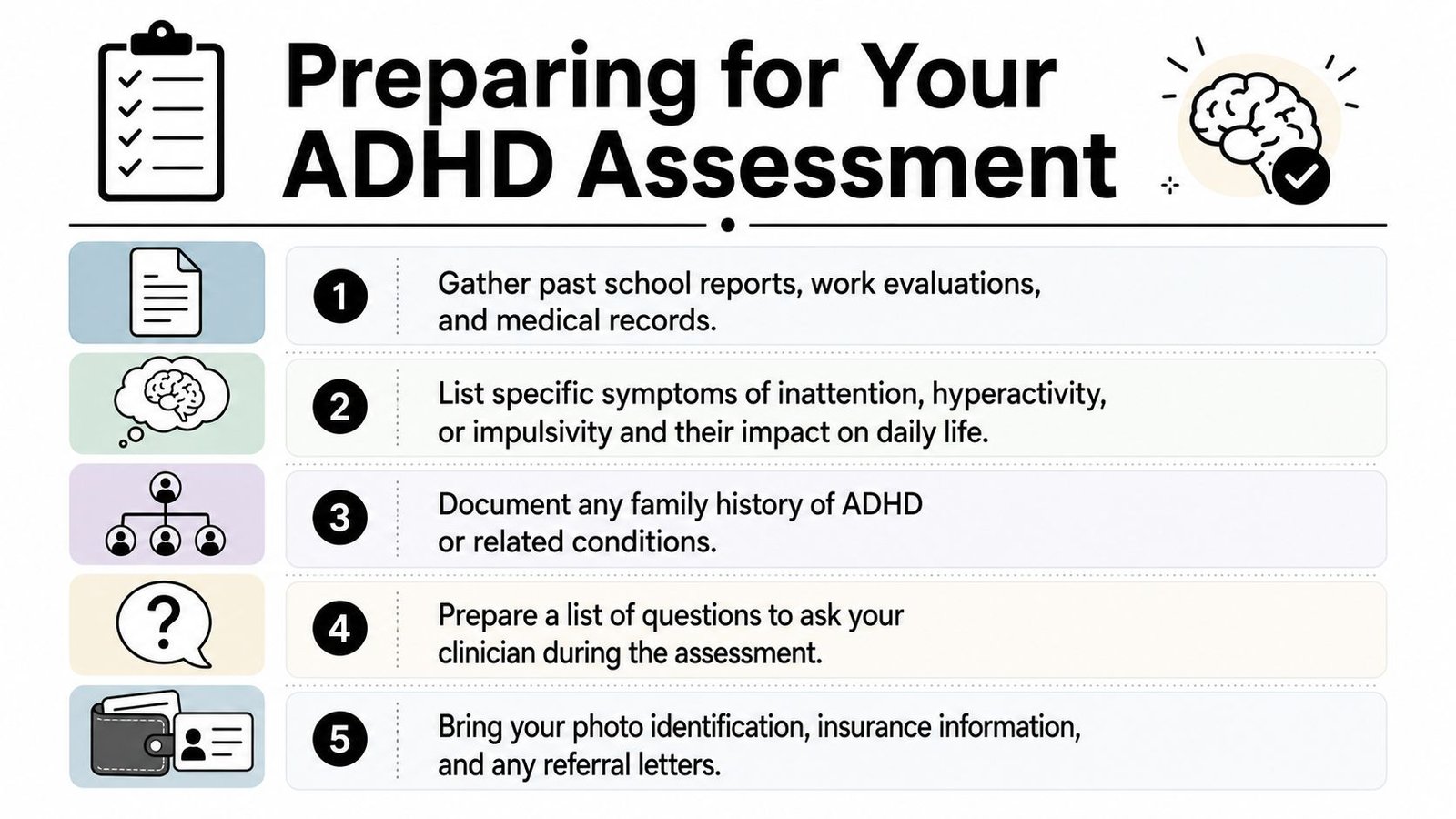
Gather the material a clinician actually needs
An ADHD assessment is not a memory test. It is a clinical review of patterns across time, settings, and level of impairment. Bring anything that helps show that pattern clearly.
School evidence
Old reports often contain useful details, even when ADHD was never mentioned. Comments about distractibility, careless mistakes, excessive talking, unfinished work, poor organisation, or inconsistent performance can help establish a childhood history.Work and adult functioning examples
Bring concrete examples from employment, study, or home life. Missed deadlines, repeated lateness, difficulty finishing admin, poor follow-through, impulsive decisions, or recurring performance concerns are more useful than saying you “struggle to focus”.A symptom diary
Write down recent examples from day-to-day life. Include what happened, how often it happens, and the consequence. Cover attention, impulsivity, disorganisation, forgetfulness, emotional regulation, driving, finances, relationships, parenting, or study where relevant.Collateral history
A parent, sibling, partner, or someone who knew you well when you were younger may be asked to comment. That can be particularly helpful if your own childhood recall is patchy.Mental and physical health history
Bring a list of past diagnoses, medication, substance use, sleep problems, and any medical issues such as blood pressure concerns or heart symptoms. This matters for diagnosis and may matter later if medication is considered.
If you want a clearer sense of the topics clinicians usually cover, this guide to mental health assessment questions asked in appointments can help you organise your notes before the consultation.
Why detail matters
ADHD overlaps with several other conditions. Anxiety, depression, trauma, autistic burnout, poor sleep, substance use, thyroid problems, and chronic stress can all affect concentration and motivation. A proper assessment sorts out whether ADHD is the best explanation, whether something else is primary, or whether both are present.
That is why vague answers slow things down.
“Poor concentration” is a symptom. It is not a diagnosis. A specialist is looking for persistence, impairment, developmental history, and evidence that symptoms affect more than one area of life.
Prepare for the practical questions, not just the diagnostic ones
Patients often prepare for the diagnosis and forget to prepare for what comes after. In UK practice, that can create problems later.
If you are considering private assessment, ask in advance whether the service provides medication titration, physical health monitoring, follow-up reviews, and a clear handover letter for your GP. If they do not, you may end up with a diagnosis but no realistic prescribing route. If your aim is eventual NHS prescribing under a Shared Care Agreement, check early whether your GP practice is open to shared care with that provider. Some practices will only consider shared care from services they recognise locally, and some decline it altogether.
Shortages also matter. If medication is discussed later, there may be periods when your usual prescription is hard to obtain. It helps to ask how the clinic handles supply problems, whether they can advise on alternative formulations, and who is responsible for updating the prescription plan if stock changes. That applies on both NHS and private pathways.
How to speak to your GP or assessor
Keep it brief and specific. A structured summary works better than a long account that loses the main points.
I've had longstanding problems with attention, organisation, task completion, and impulsivity that affect work and daily life. I have examples from childhood and adulthood, and I'd like to discuss referral for an adult ADHD assessment. If medication is appropriate later, I also want to understand the likely prescribing route and whether shared care would be possible.
That gives the clinician something they can work with. It also shows that you understand the process well enough to ask the right questions early.
Navigating Your Assessment Options NHS vs Private
You speak to your GP, explain the pattern clearly, and leave with a referral form in motion. Then the practical question arrives. Do you join the local NHS queue, ask for Right to Choose, or pay privately to be seen sooner?
That decision shapes more than the assessment date. It affects who can prescribe later, who manages titration, whether your GP may agree to a Shared Care Agreement, and how resilient your plan is if medication shortages disrupt supply.
The three routes in plain terms
Standard NHS care suits patients who need the lowest-cost route and can wait for a local service. If your area has a well-functioning adult ADHD team, this can be the simplest long-term setup because assessment, titration, and follow-up may sit within one NHS pathway. The drawback is delay, and in some areas the wait is long enough to affect work, study, finances, or family life.
Right to Choose is often the most underused option. Your GP refers you to an alternative NHS-funded provider rather than your local service, provided the referral meets the scheme criteria in England. It can shorten the route to assessment without private fees, but patients still need to check what happens after diagnosis. Some providers assess promptly but have slower titration capacity, and your GP still needs to understand the referral process. For a practical explanation of the referral route, see this guide to NHS Right to Choose for ADHD.
Private assessment gives the most control over timing, appointment choice, and clinician access. It is often the quickest route, but speed is only useful if the clinic also offers a realistic prescribing pathway, physical health monitoring, and clear communication with your GP. A private diagnosis on its own does not guarantee NHS prescriptions later.
UK ADHD Assessment Pathways Compared
| Factor | Standard NHS Pathway | NHS Right to Choose | Private Pathway (e.g., Insight Diagnostics) |
|---|---|---|---|
| How you start | GP referral to local NHS service | GP referral to alternative NHS-funded provider | Self-referral or direct booking with independent provider |
| Speed | Often the slowest | Often faster than local NHS route | Usually the fastest |
| Upfront cost to patient | Usually no direct assessment fee | Usually no direct assessment fee | Self-funded unless covered by insurer |
| Choice of provider | Limited | More choice than standard local route | Highest level of choice |
| Control over appointment timing | Low | Moderate | High |
| Medication follow-up logistics | Usually integrated if service capacity allows | Can still involve waits for titration or follow-up | Depends on provider and later shared care arrangements |
| Main risk | Long queue | Administrative complexity and variable follow-up | GP may not agree to shared care later |
How to choose based on your real constraint
Choose the route that solves your actual problem.
If cost is the limiting factor, the NHS route or Right to Choose usually makes more sense than paying privately and then struggling to fund follow-up. If delay is causing clear harm, such as disciplinary issues at work, academic failure, unsafe driving, or worsening mental health, a private route may be justified if you can also cover titration and review appointments. If your main concern is getting onto a funded pathway without waiting locally, Right to Choose is often the best balance.
I advise patients to test the plan backwards. Before booking anything, ask: Who will prescribe if ADHD is diagnosed? Who will monitor blood pressure, pulse, weight, and response to treatment? Will my GP consider shared care once titration is stable? What happens if my usual medication is unavailable for six weeks?
Those questions matter because the weak point is rarely the assessment itself. It is the handover.
Shared care and shortages are where plans succeed or fail
A Shared Care Agreement means the specialist starts treatment and the GP may take over repeat prescribing once the dose is stable, if the practice agrees and the paperwork is acceptable. Some GPs are comfortable with this. Some will only accept shared care from providers they know. Some decline completely. Patients should ask their GP practice early, not after paying for an assessment.
Medication shortages add another layer. If methylphenidate or lisdexamfetamine supply becomes unreliable, you need a prescriber who can review alternatives promptly and document a safe change. On an NHS pathway, that may depend on local service capacity. On a private pathway, it may depend on how quickly the clinic can issue revised prescriptions and communicate with your GP. This is one reason a cheap assessment with thin follow-up can become expensive later.
For clinicians and practice teams who want broader insights on prior authorization for healthcare professionals, that administrative perspective is useful, even though UK ADHD prescribing follows a different system.
A fast appointment helps. A workable prescribing plan helps more.
The Diagnostic and Prescription Process Explained
You attend an assessment expecting a yes-or-no answer. Instead, the appointment often feels more like a detailed clinical interview about your life course, current functioning, health, and risk. That is appropriate. ADHD diagnosis in adults is rarely made safely from a short symptom checklist alone.
A sound assessment usually covers childhood history, education, work patterns, relationships, driving, sleep, substance use, family history, physical health, and other conditions that can overlap with or mimic ADHD, including anxiety, depression, autism, trauma-related symptoms, and personality difficulties. Questionnaires and reports from a partner, parent, or school records can help, but they support the diagnosis rather than replace clinical judgement.
What happens after diagnosis
A diagnosis does not automatically lead to medication on the same day. The prescriber must decide whether medication is appropriate, check physical health information such as blood pressure, pulse, weight, and relevant medical history, and consider risks including cardiac issues, substance misuse, pregnancy, or possible bipolar symptoms. In some cases, further information is needed before treatment starts.
If medication is suitable, the specialist usually starts prescribing and reviews the early response. For patients using a private assessment and hoping to move prescriptions to the NHS later, the practical question is whether the GP will enter a Shared Care Agreement after the dose is stabilised. That decision sits with the GP practice. It is not guaranteed, even with a clear diagnosis and a well-written specialist letter.
This is the point many patients underestimate. The assessment can be excellent, but the prescribing plan can still stall if follow-up is weak, communication is poor, or the GP is unwilling to share prescribing responsibility. I advise patients to judge clinics on the quality of their aftercare as much as the quality of the diagnostic interview.
What a safe prescribing pathway looks like
A workable pathway is usually straightforward on paper.
The specialist diagnoses ADHD, confirms there is no obvious reason medication should be avoided, starts treatment, adjusts the dose over follow-up appointments, and sends clear updates to the GP. If the patient is stable and the practice agrees, the GP may take over repeat prescriptions under shared care while the specialist continues periodic review.
That handover is where private and NHS care meet. It is also where delays, confusion, and extra cost often arise.
Three steps improve the chances of a smooth process:
Get clarity on the prescribing plan before you book
Ask who prescribes after diagnosis, how often follow-up is provided, whether titration is included in the fee, and what happens if your GP declines shared care.Use a service that can support ongoing prescribing, not only assessment
A diagnosis without reliable follow-up leaves patients in a weak position. This guide to private prescription support in the UK is useful if you want to understand how prescribing continuity works in practice.Expect practical checks, not just a prescription
Good care includes baseline physical observations, medication counselling, review of side effects, and prompt documentation to your GP and pharmacy.
Supply problems also need to be planned for. If your prescribed stimulant is out of stock, the question is not merely where else to look. The question is who can review an alternative quickly, confirm an equivalent strategy is clinically appropriate, and issue updated paperwork without avoidable delay. Patients on split pathways often struggle here because the assessor, titration prescriber, GP, and pharmacy are not working from the same plan.
Administrative hurdles can also confuse patients who use insurance-backed care. If you are dealing with insurer rules or approval processes, this explainer on insights on prior authorization for healthcare professionals gives useful background on why approvals can slow access even when treatment appears straightforward.
A short overview can help if you want to see how clinicians frame the process in practice.
Among private options, Insight Diagnostics Global offers adult ADHD assessment, medication titration, and ongoing monitoring. That joined-up model matters because prescribing is usually safer and easier when diagnosis, dose adjustment, and review sit within one clinical pathway rather than being divided across disconnected services.
Medication Titration and Ongoing Management
Getting the prescription is not the finish line. It's the start of a structured trial.
The biggest mistake patients make is expecting the first tablet, first dose, or first week to tell the whole story. It often doesn't. Good titration is methodical. It aims for useful symptom control with manageable side effects, not a dramatic feeling of transformation on day one.
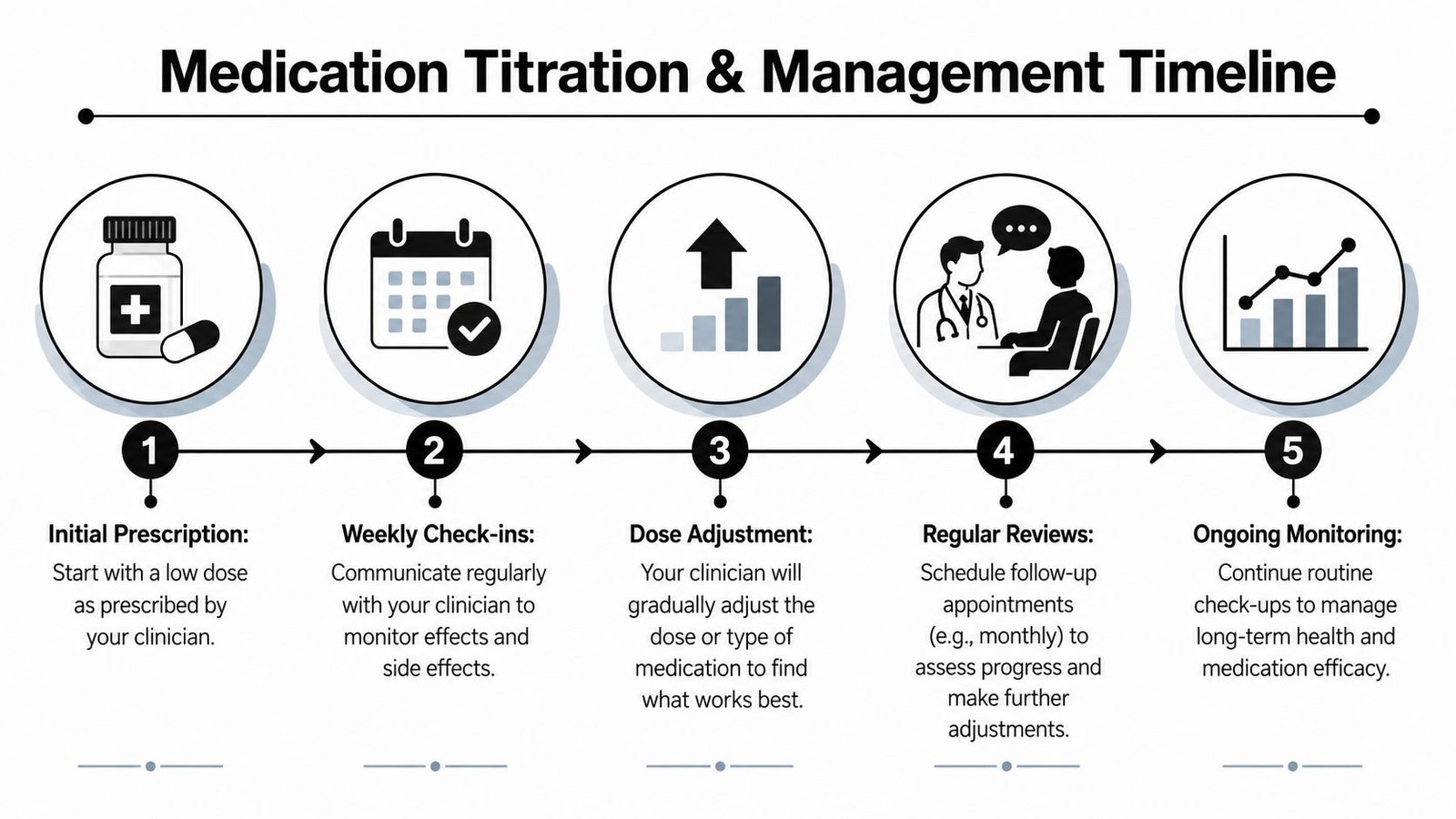
How titration usually works
Guidance summarised by CHADD medication management describes titration as a structured process. Medication is usually started at a low dose, increased gradually, and response is reviewed at 3 to 7 day intervals until benefit is achieved. Once stable, follow-up usually shifts to every 1 to 3 months initially and then annually.
That schedule tells you something important. Prescribing ADHD medication is not guesswork, but it is personalised. The right dose for one person may be too little or too much for another.
What to track between reviews
Don't rely on a vague sense of “I think it's helping”.
Track concrete markers such as:
Task completion
Are you finishing work you would normally avoid or abandon?Impulse control
Are you interrupting less, spending less impulsively, or making fewer snap decisions you regret?Emotional regulation
Are you less reactive, less easily overwhelmed, or less likely to swing from intention to shutdown?Sleep and appetite
These often shape whether a medication is workable over time.Timing of effect
Record when you take it, when it starts working, and when it seems to wear off.
Practical rule: Bring data, not just impressions, to titration reviews.
What works better than chasing a perfect feeling
The benchmark isn't euphoria. It's improved functioning.
Some people feel calmer. Some feel no obvious sensation but subtly start doing ordinary tasks with less friction. Others find the first medication isn't the right one and need a different formulation, timing adjustment, or dose change.
What helps most is consistency. Take medication exactly as prescribed, keep notes, attend reviews, and report side effects early rather than stopping suddenly without discussion unless you've been told to do so for safety reasons.
Overcoming Common Barriers and Next Steps
Two problems derail people most often. The first is a GP who won't enter into shared care. The second is having a prescription but being unable to get the medication dispensed.
If your GP declines shared care, don't waste weeks in angry back-and-forth. Ask for the reason in plain terms. Is it practice policy, lack of confidence in the provider, local commissioning issues, or concern about monitoring responsibilities? Once you know that, you can decide whether to remain under specialist prescribing, seek a different GP practice if appropriate, or ask the specialist service whether they can continue prescribing and review.
When the pharmacy says it's unavailable
Shortages are not a minor inconvenience in ADHD care. They interrupt a treatment plan that often depends on consistency.
Independent guidance on shortages notes that limited access can persist and recommends contacting the prescriber immediately so a plan can be made, as explained by Right as Rain on ADHD medication shortages. In practice, that usually means asking about alternative pharmacies, possible temporary treatment plans, or whether a formulation change is clinically appropriate.
If your medication can't be dispensed, contact the prescriber first. Don't improvise with leftovers, irregular dosing, or unadvised substitutions.
The next move that matters
If you're still at the beginning, book the GP appointment and start gathering evidence.
If you're choosing between NHS and private care, decide based on follow-up logistics, not only assessment speed.
If you've already been diagnosed, ask one direct question: who is responsible for prescribing, monitoring, and solving problems if supply or shared care fails?
That is the practical core of how to get ADD medication in the UK. Diagnosis, prescribing, titration, and continuity all matter. Patients who understand that usually move through the system with less delay and less frustration.
If you want a consultant-led route for adult ADHD, autism, or broader mental health assessment, Insight Diagnostics Global offers online and face-to-face assessments, diagnostic reporting, and ADHD medication titration with ongoing monitoring for adults aged 18 and over. It's not a crisis service, so if you need urgent help contact 999 or NHS 111.