

You may be reading this after months or years of asking yourself the same questions. Why do ordinary conversations leave you drained? Why does work feel manageable until the routine changes, then suddenly impossible? Why have other people seemed to receive a social instruction manual you never got?
For many adults, the search for an adult autism diagnosis near me starts in exactly that place. Not with certainty, but with a growing sense that a long-standing pattern might finally have a name. Sometimes the trigger is burnout. Sometimes it is an ADHD assessment that raises wider neurodevelopmental questions. Sometimes it is a child's diagnosis that makes a parent recognise their own lifelong traits.
A careful diagnosis isn't about reducing you to a label. It's about building a clinically grounded understanding of how your mind works, where your difficulties come from, and what support may help next. As a Consultant Psychiatrist working with adult neurodevelopmental assessment, I'd encourage you to think less about finding the nearest clinic and more about finding a service that understands adult presentation properly, including masking, overlap with ADHD, anxiety, depression, trauma, and the practical realities of adult life.
Feeling Lost? You Are Not Alone in Seeking an Adult Autism Diagnosis
A common story goes like this. Someone has managed for years by being organised, over-preparing, copying other people socially, and pushing through exhaustion. From the outside they may look capable. Inside, they're constantly calculating.
Then something changes. A new job. A breakup. University pressure. Parenting. Menopause. Burnout. The strategies that held everything together stop working, and the person types “adult autism diagnosis near me” into Google late at night, half hoping for an answer and half afraid of what they'll find.

That search is more common for a reason. The Office for National Statistics reported that 1.1% of people in England and Wales identified as autistic in 2021, a figure that likely still misses many undiagnosed adults, which helps explain why adult assessment demand has become so visible in the UK according to this overview of diagnosing autism in adults.
Why adults often reach this point late
Many adults weren't missed because they had no autistic traits. They were missed because their traits were explained away.
A bright student may have been called shy. A meticulous employee may have been praised for being thorough without anyone noticing the cost. A woman who copied social behaviour may have been seen as anxious rather than autistic. An adult with both autism and ADHD may have had one part of the picture recognised while the other remained hidden.
A late diagnosis doesn't mean the traits are new. It often means your coping strategies were strong enough to hide how much effort life has been taking.
Diagnosis is a doorway, not a verdict
The practical routes in the UK usually fall into three broad options:
- NHS assessment: Referred through your GP or local pathway.
- Private assessment: Self-funded, with more control over timing and provider choice.
- Right to Choose: For eligible patients in England, an NHS-funded route through an approved provider.
Clinically, the important point is this. Adult autism assessment should help you understand both whether autism is present and what else may be happening alongside it, including ADHD and mental health difficulties. That fuller picture matters far more than a quick screening score.
NHS vs Private vs Right to Choose Explained
The route you choose affects waiting time, cost, flexibility, and who assesses you. It shouldn't affect the core clinical standard. A proper adult autism assessment still needs to be thorough.
NICE guidance makes that especially relevant in the UK because autistic adults should receive a full assessment, yet access varies sharply by area since services are organised locally. That local variation is one reason many adults start exploring private and Right to Choose routes when NHS waits become difficult, as noted in this discussion of adult autism diagnosis pathways and local service variation.
The three routes in plain English
NHS is free at the point of use. You usually start with your GP, who refers into a local adult autism service or related secondary-care pathway. The trade-off is that your local area determines what happens next. Some areas have clearer systems than others.
Private gives you speed and choice. You select the clinic, book directly, and usually move through the process faster. The trade-off is cost. You also need to be sure the service is clinically sound, because “private” doesn't automatically mean “high quality”.
Right to Choose sits between the two for many people in England. If you're eligible, your GP can refer you to an NHS-funded provider outside your immediate local pathway. For patients facing long local waits, this can be a practical alternative. If you want a clearer overview of how this works, Insight has a useful guide on NHS Right to Choose for mental health assessments.
UK autism diagnosis pathways compared
| Pathway | Cost | Typical Timeline | Choice of Provider |
|---|---|---|---|
| NHS | Free at the point of use | Varies by local service | Usually limited to local pathway |
| Private | Self-funded | Usually faster than NHS | High |
| Right to Choose | NHS-funded for eligible patients in England | Often used to avoid local delays | More choice than standard local NHS route |
What works and what doesn't
What works is matching the pathway to your actual needs.
- Choose NHS if cost is the main constraint and you can tolerate waiting.
- Choose private if speed, scheduling flexibility, or a specific specialist matters most.
- Choose Right to Choose if you want an NHS-funded route but don't want to depend entirely on your local service.
What doesn't work is choosing on convenience alone.
If a clinic advertises heavily but can't explain who diagnoses, how developmental history is gathered, or what the report includes, that's a warning sign. The best route is the one that gets you to a credible, adult-focused assessment, not only the first available appointment.
Practical rule: Don't ask only “How soon can they see me?” Ask “Who will assess me, what is their adult autism experience, and what happens after the report?”
Finding a Specialist You Can Trust
The search for an adult autism diagnosis near me often leads to a primary focus on geography. In practice, clinician quality matters more than postcode. A nearby service with weak adult expertise is less useful than a properly structured in-person or remote assessment with the right specialist.
Check the professional and the service
Start with the basics, then go beyond them.
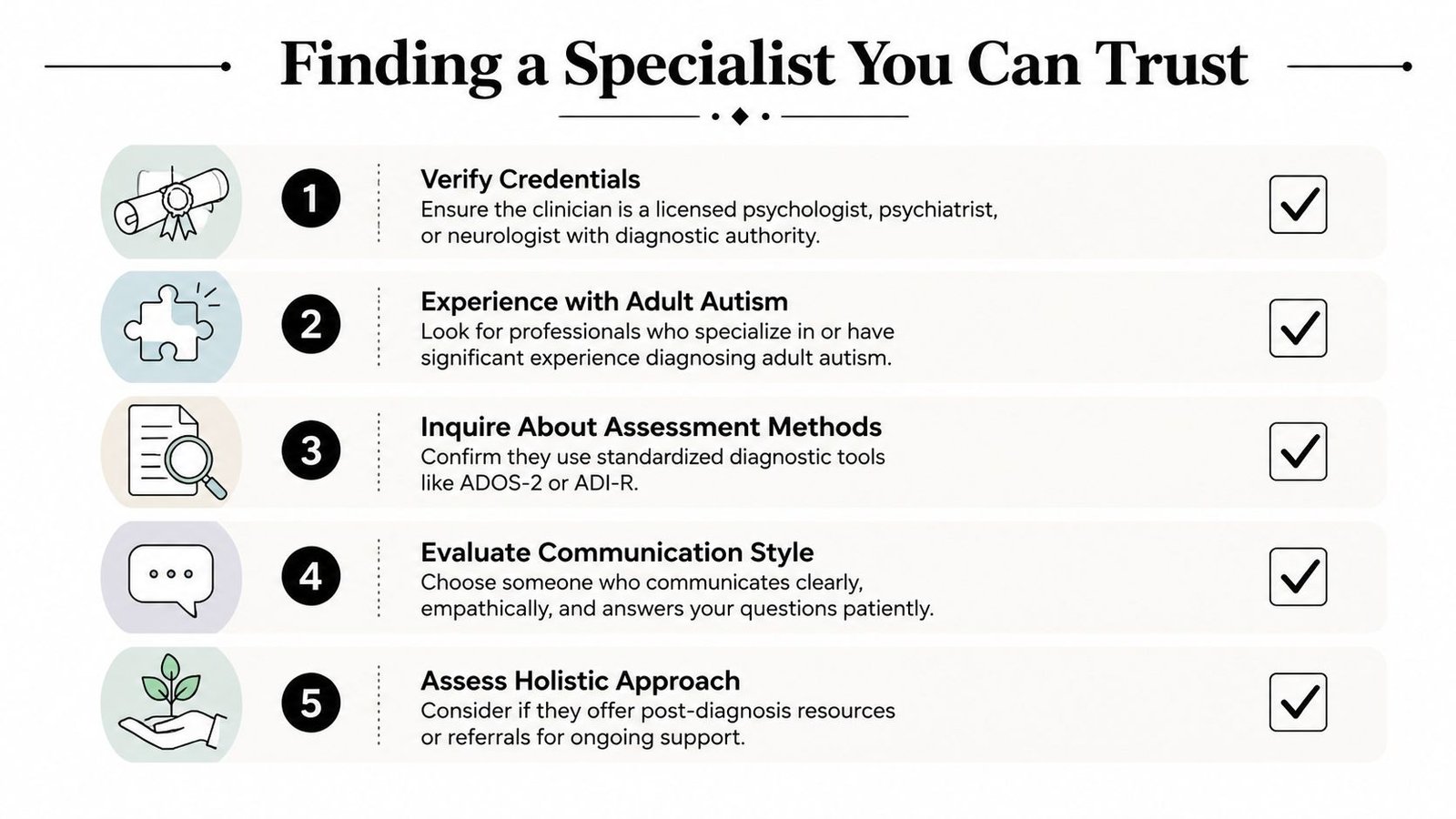
A service should be able to tell you:
- Who diagnoses: For example, a psychiatrist or psychologist with appropriate diagnostic authority.
- How the service is regulated: In the private sector, CQC regulation matters.
- Whether adult neurodevelopment is a genuine specialty: Not an occasional add-on to a general clinic.
- How they handle overlap: Autism rarely appears in a vacuum. ADHD, anxiety, depression, OCD traits, trauma history, and personality factors can complicate the picture.
If you need help understanding what makes a psychiatrist suitable for this work, this article on how to find a psychiatrist is a sensible starting point.
Ask better questions before you book
I'd suggest asking direct questions such as:
- Do you assess adults regularly: Adult presentations differ from child presentations.
- How do you evaluate masking: Many late-diagnosed adults have learned to camouflage traits.
- Do you assess for co-occurring ADHD and mental health conditions: This is essential in real clinical practice.
- What collateral information do you use: Developmental history often comes from family, records, or both.
- What does the final report include: You need evidence, reasoning, and recommendations, not a one-line conclusion.
A clinic with a mature workforce often shows it in other ways too. Teams that recruit experienced psychiatrists remotely tend to understand how to deliver specialist care flexibly across regions. For doctors curious about how these services are evolving, WeekdayDoc has a useful look at remote psychiatry jobs, which also gives patients a sense of why remote specialist access has expanded.
The right specialist notices what others miss
NICE-aligned assessment quality depends on a detailed process that includes developmental history, current social communication, restricted or repetitive patterns, and co-occurring conditions such as ADHD. It also matters that clinicians don't dismiss autism merely because someone is articulate, employed, or outwardly sociable, as outlined in this summary of quality adult autism diagnostic practice.
That is where specialist judgement matters. An experienced clinician looks for the structure beneath the surface. They notice rehearsed social responses. They ask about recovery time after interaction. They explore sensory load, routine dependence, rigidity under stress, and the difference between appearing competent and feeling chronically overwhelmed.
What to Expect During Your Autism Assessment
The assessment process feels less intimidating when you know what each stage is for. A strong service will explain the steps clearly before you attend, not leave you guessing.
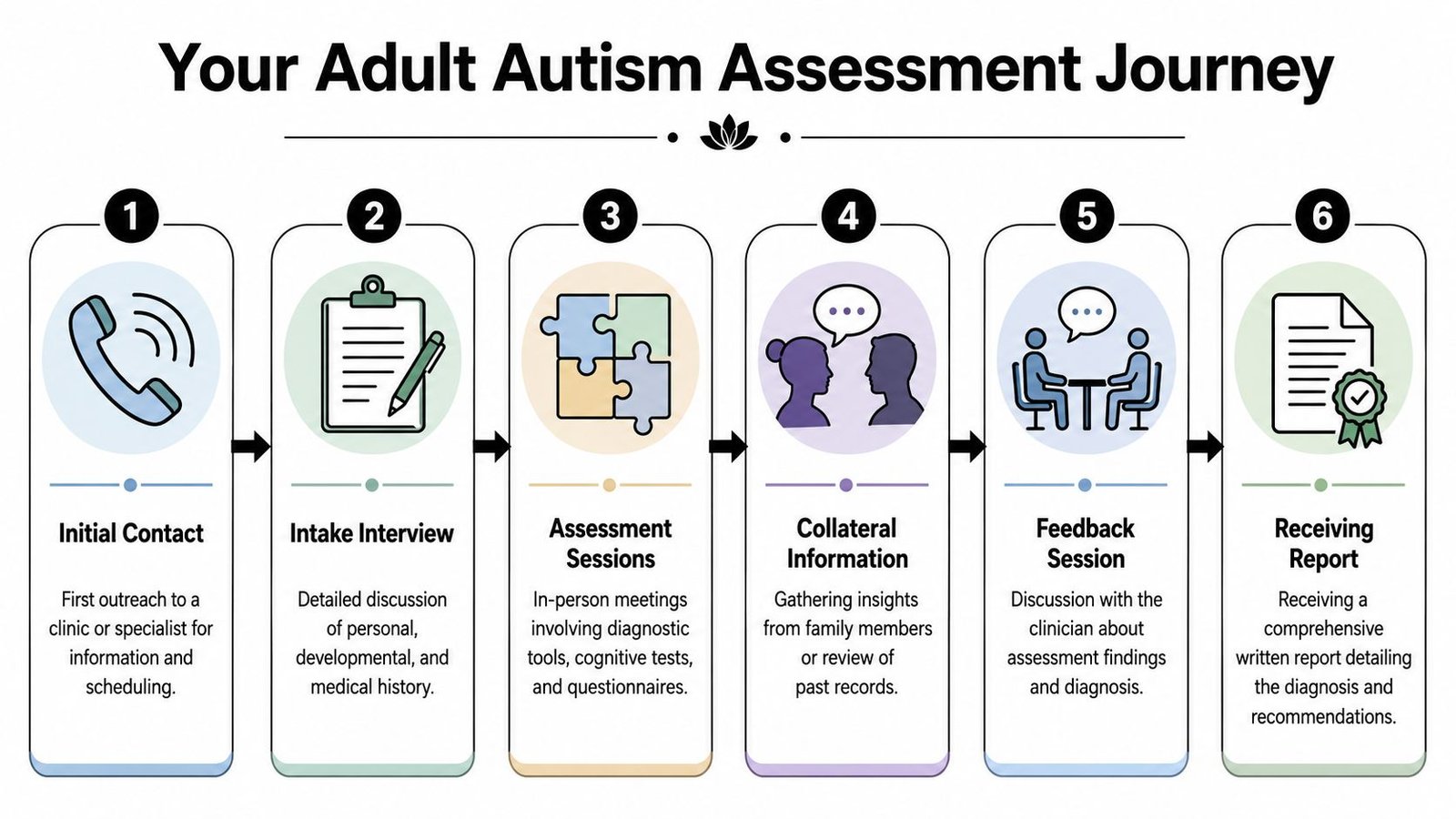
First contact and intake
The first stage is usually administrative, but it still matters. You'll make an enquiry, confirm whether the service assesses adults, and complete intake forms.
Those forms aren't box-ticking for its own sake. They help the clinician identify the right scope for assessment. If there are also concerns about ADHD, anxiety, depression, mood instability, trauma, or burnout, that shapes the interview.
For adults considering an independent route, one example is autism assessment for adults, where the process is consultant-led and set out before booking. Insight Diagnostics Global, for example, provides adult assessments online and face to face, and states that appointments are usually scheduled within seven working days with reports completed within five working days thereafter. That kind of transparency is useful because it helps patients plan rather than chase updates.
The assessment appointment itself
Most adults fear they'll be tested in a way that feels artificial. In reality, a good assessment is a structured clinical conversation.
You'll usually be asked about:
- Childhood patterns: Friendships, play, routines, communication style, sensory sensitivities.
- Adult life: Work, study, relationships, daily living, fatigue, coping strategies.
- Current traits: Social communication differences, need for sameness, focused interests, sensory experiences.
- Strengths and costs: Not only what's hard, but what you do well and what effort it takes.
You may be invited to bring notes. I encourage that. Many adults leave key examples out if they rely on memory in the moment. A short list of real situations is often more helpful than trying to sound clinically polished.
Bring examples of what happens on a bad day, not only what happens when you are coping well. Diagnosis depends on pattern, not performance in one appointment.
Developmental history and collateral information
Adult diagnosis often turns on life history. NICE CG142 expects a multi-source diagnostic process, not a single questionnaire. That means developmental history, current features, and active consideration of differential diagnoses and co-occurring conditions all matter, as described in this review of adult autism assessment quality under NICE CG142.
If possible, a parent, sibling, long-term partner, or old records can help fill gaps. That said, incomplete childhood information doesn't automatically stop an assessment. Many adults don't have ideal records, and some have no family member able to contribute. A competent clinician works with what is available rather than abandoning the process because the history isn't neat.
Feedback and report
After the interview and any supporting review, you should receive a feedback discussion and a written report.
A proper report should explain:
- What evidence was considered
- How the diagnostic conclusion was reached
- What alternative explanations were considered
- What practical recommendations follow
If your report only states “meets criteria” or “does not meet criteria” with little reasoning, it hasn't done enough. The report is not just for your records. It often becomes the document you use in work, education, healthcare, and future treatment planning.
Making Sense of Your Diagnosis Report and Planning What Is Next
Many people imagine the report is the finish line. Clinically, it's the point where the information becomes useful.
A diagnosis can bring relief, grief, anger, validation, sadness, or all of them in a single week. That is normal. Some people feel they've finally found the missing explanation. Others start reviewing their whole life through a different lens and need time to adjust.
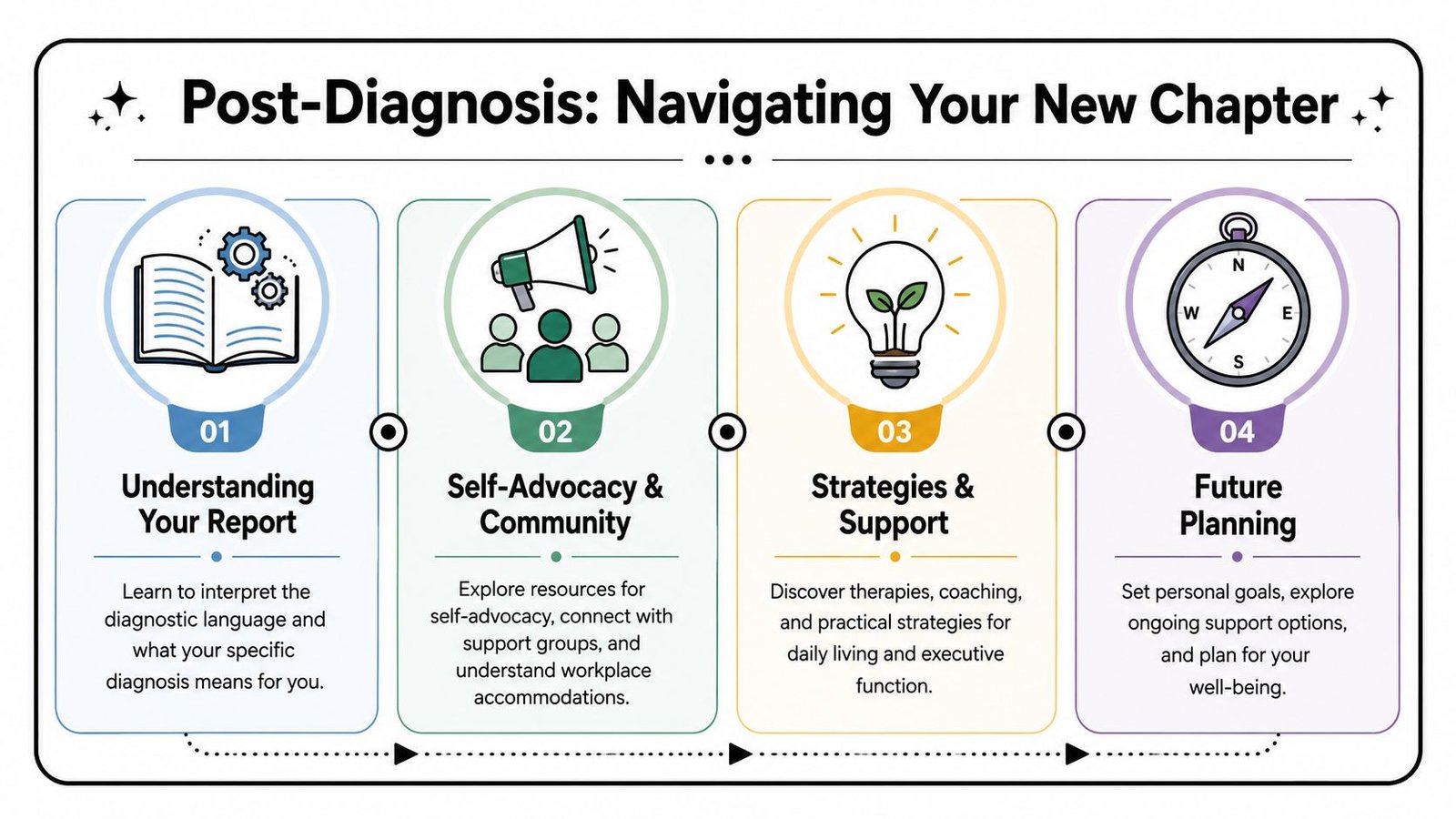
What a useful report should help you do
A strong report doesn't just say what you have. It explains what that means in daily life.
Look for these elements:
- Clear diagnostic reasoning: Why the clinician reached the conclusion they did.
- Functional impact: How traits affect work, study, relationships, routines, and stress tolerance.
- Co-occurring picture: Whether ADHD, anxiety, depression, trauma, or other issues also need attention.
- Personalised recommendations: Adjustments, support options, therapy directions, and self-management strategies.
This matters because many autistic adults still struggle to access practical support after diagnosis. The National Autistic Society highlights difficulties with workplace adjustments and other help, which is why post-diagnostic planning matters as much as the diagnosis itself, as summarised in this discussion of post-diagnosis support needs for autistic adults.
Turning diagnosis into practical support
A report can be used to support conversations about:
- Workplace adjustments: Changes to communication, environment, scheduling, or supervision style.
- University support: Evidence for disability services and learning adjustments.
- Therapy choices: Work with clinicians who understand autism and don't force neurotypical expectations.
- Daily-life strategies: Sensory planning, pacing, routines, and burnout prevention.
If you're trying to understand what support pathways may exist more broadly, including adjacent needs, this guide on how to find learning disability assistance in the UK can help you think through support navigation in practical terms.
Don't ignore the emotional part
Some people receive a diagnosis and immediately start advocating for themselves. Others go quiet. Both responses make sense.
Clinical reality: Information is only useful when you've had time to absorb it. Don't force yourself to become an expert on your own diagnosis in the first 48 hours.
I often advise patients to do three things first. Read the report once. Highlight the parts that feel accurate. Then book a follow-up or discussion if anything is unclear.
For a fuller sense of how this phase can unfold, this article on what happens after autism diagnosis is helpful. The aim isn't to leave with a label and no map. The aim is to leave with language, evidence, and a workable plan.
Your Path to Clarity and Self-Understanding
If you've been searching for an adult autism diagnosis near me, you may already be carrying years of doubt. Many adults come to assessment after a long period of minimising their own difficulties because they were able to function, at least from the outside. Functioning, though, isn't the same as thriving.
The right assessment brings clarity to patterns that may have shaped your education, career, relationships, self-esteem, and mental health for a long time. It should also respect complexity. Adult autism can overlap with ADHD, anxiety, depression, trauma responses, and burnout. That's why rushed, checklist-style assessments often leave people more confused, not less.
You don't need to choose the “perfect” route in theory. You need a route that is realistic for you and leads to a thorough evaluation. For some people, that's the NHS. For others, it's Right to Choose. For others, private assessment offers the fastest path to answers. What matters most is that the clinician understands adult presentation and can translate the diagnosis into practical next steps.
It's also worth remembering that support doesn't stop at the diagnostic boundary. Many adults benefit from autism-informed counselling as they process identity, relationships, and self-advocacy after diagnosis. If you want an example of how therapy can be adapted for autistic experience, this resource on specialized autism counselling in Kelowna illustrates the broader principle well, even though support systems differ by country.
If you're considering assessment, go in with honest expectations. The process may answer your question directly. It may also uncover a more layered picture. Either way, good assessment reduces confusion and increases direction.
If you are in crisis, or you feel at immediate risk, contact 999 or NHS 111 for urgent support. A diagnostic clinic is not a crisis service.
If you're ready to explore a structured adult autism or ADHD assessment, Insight Diagnostics Global offers consultant-led evaluations for adults, online and face to face, with clear triage, detailed reports, and follow-up options to help you turn diagnostic clarity into practical support.