

Considering a private ADHD assessment in Manchester often means you're already carrying a lot. You may be missing deadlines despite trying hard, feeling constantly mentally noisy, or wondering why ordinary admin, organisation, and focus seem harder for you than for other people. Many adults arrive at assessment after years of self-criticism, burnout, or being told they're anxious, disorganised, lazy, or “not trying”.
A proper assessment should bring clarity, not more confusion. As a Consultant Psychiatrist, I'd make one point early: the value of assessment isn't just speed. It's whether the process is thorough enough to answer the right question. Is this ADHD, autism, anxiety, a mood problem, trauma-related difficulty, personality factors, sleep disruption, substance use, or a combination? That distinction matters because good treatment depends on getting the formulation right.
Why Consider a Private Assessment in Manchester
For many adults in Manchester, the issue isn't whether they want help. It's whether they can afford to wait for it.
In England, the wider NHS backlog has become a major reason people look privately for specialist assessment. By March 2024, 7.57 million people were waiting for treatment, and 3.14 million had already waited more than 18 weeks for a first appointment or treatment pathway milestone, as outlined in this review of post-pandemic waiting times and access pressures. For adults trying to hold down work, complete university deadlines, manage parenting, or recover from repeated burnout, long uncertainty can be very disruptive.
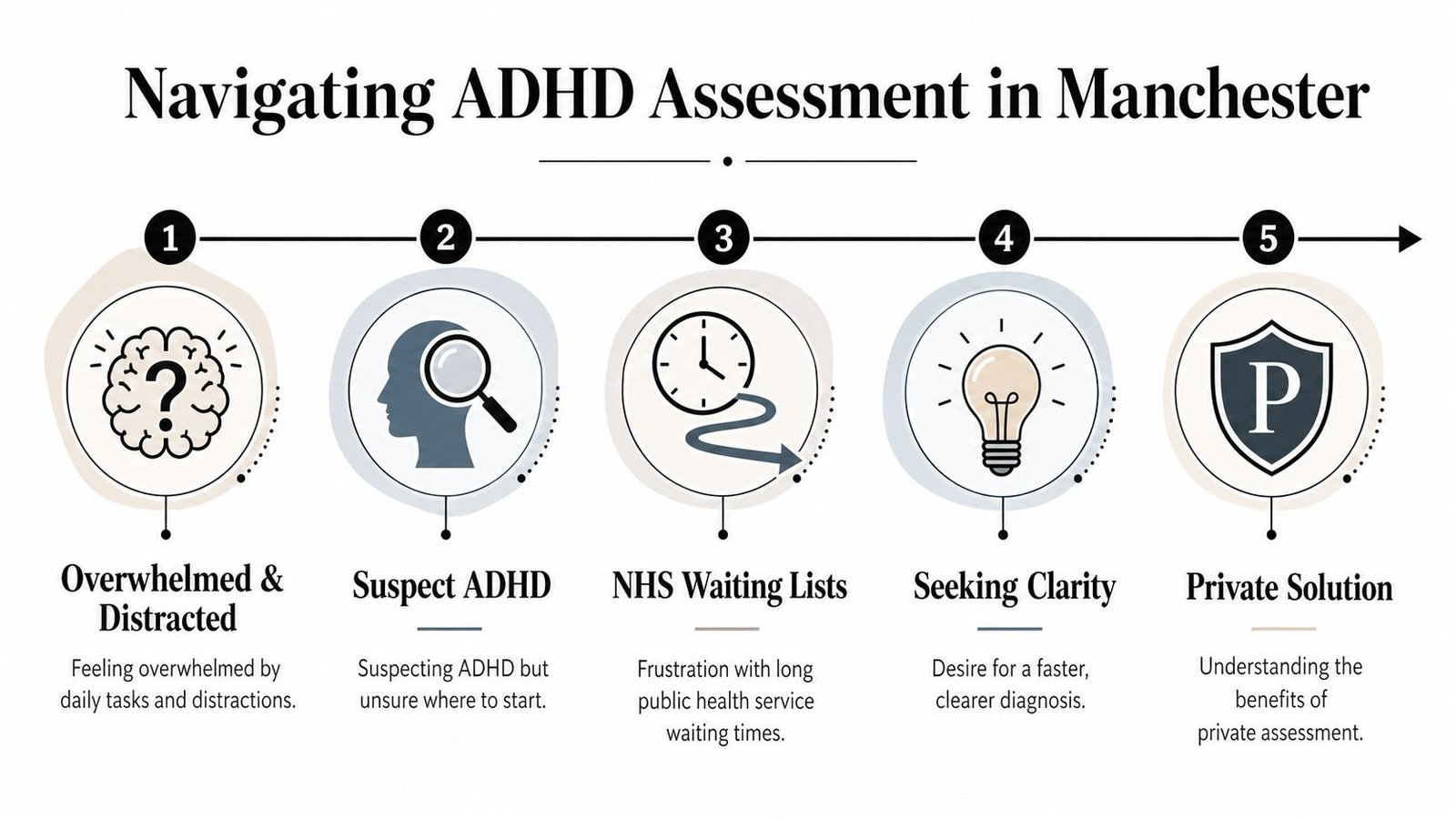
When waiting is the real problem
People usually don't seek a private ADHD assessment in Manchester because they want something fashionable or convenient. They seek it because they need a clear answer while life is still moving.
That might mean:
- Workplace pressure where concentration, time management, and follow-through are affecting performance
- University demands where deadlines, revision, and note-taking have become unmanageable
- Emotional strain where repeated underperformance has started to affect confidence, mood, or relationships
- Practical urgency where someone needs documentation to discuss support with a GP, employer, or university
A long wait can turn a clinical question into a life problem.
Why a quick screening isn't enough
ADHD diagnosis in adults shouldn't be reduced to an online checklist. The clinical standard is much higher than that. A proper diagnosis requires a full clinical, developmental, and psychiatric history, not a brief symptom screen alone. That is one reason private services in Manchester often emphasise consultant-led assessment and written reports rather than “tests”.
If you're comparing options, it also helps to recognise how healthcare services present themselves online. Some clinics communicate clearly and transparently, while others rely on marketing language that says little about clinical depth. For readers interested in how healthcare providers present trust, clarity, and patient information online, these effective healthcare marketing strategies are a useful reference point.
A sensible next step is to read what a local adult pathway should include before you book. This guide to an ADHD assessment for adults near me is helpful if you want to compare what “fast” means against what “thorough” should mean.
The Insight Diagnostics Difference A Consultant-Led Approach
The single most important part of any ADHD assessment is the clinician making the diagnosis. Not the website. Not the questionnaire. Not the speed of booking.
NICE states that diagnosis should be made by a trained specialist using a detailed clinical and psychosocial assessment, developmental history, and collateral evidence, with symptoms present in multiple settings and causing significant impairment. That benchmark is summarised in this discussion of private ADHD assessment standards in Manchester. In practice, that means a checklist can support the process, but it can't replace specialist judgement.

What consultant-led actually means
A consultant-led assessment should do more than count symptoms. It should examine context, pattern, onset, impairment, and alternative explanations.
That includes asking:
- When did these difficulties begin and do they go back to childhood?
- Where do they show up at work, at home, in education, in relationships?
- What else could explain them such as anxiety, depression, sleep problems, autistic traits, trauma, or substance use?
- What evidence supports the history from school reports, family observations, or other collateral information?
This is where psychiatric training matters. Adults rarely present with a neat textbook picture. Some have obvious inattentive symptoms but also significant anxiety. Others come seeking ADHD and leave with a more accurate understanding of autism, mood disorder, personality structure, or a mixed picture.
Why superficial online tests often fall short
Many people have completed online “ADHD tests” before seeing a specialist. These can be useful as prompts to seek help, but they aren't diagnostic tools in themselves.
A thorough assessment needs formulation. It needs someone to weigh the evidence, ask what fits and what doesn't, and explain the conclusion in language that is clinically sound and practically useful. This is especially important when you need a report that a GP can review and act upon.
Practical rule: If a service can tell you the outcome before it has taken a developmental history, explored impairment across settings, and considered other diagnoses, that isn't a proper assessment.
At Insight Diagnostics Global, that consultant-led model is central. The service offers adult psychiatric assessments delivered by GMC Specialist Register psychiatrists within a CQC-regulated framework, and this overview of a psychiatric assessment in the UK helps explain what that level of review should involve.
Your Assessment Journey Explained Step-by-Step
Uncertainty often makes assessment feel more daunting than it needs to be. Most adults cope better once they understand the sequence and what the clinician is looking for.
A strong private pathway is not merely about booking quickly. Its practical advantage is that it can move from referral to diagnosis and then to treatment-ready documentation without unnecessary delay. Services in Manchester that provide reports within about 5 working days and include medication titration support can reduce the bottleneck that often appears when a GP is asked to review specialist recommendations, as discussed in this overview of ADHD assessments in Manchester and the GP handoff process.
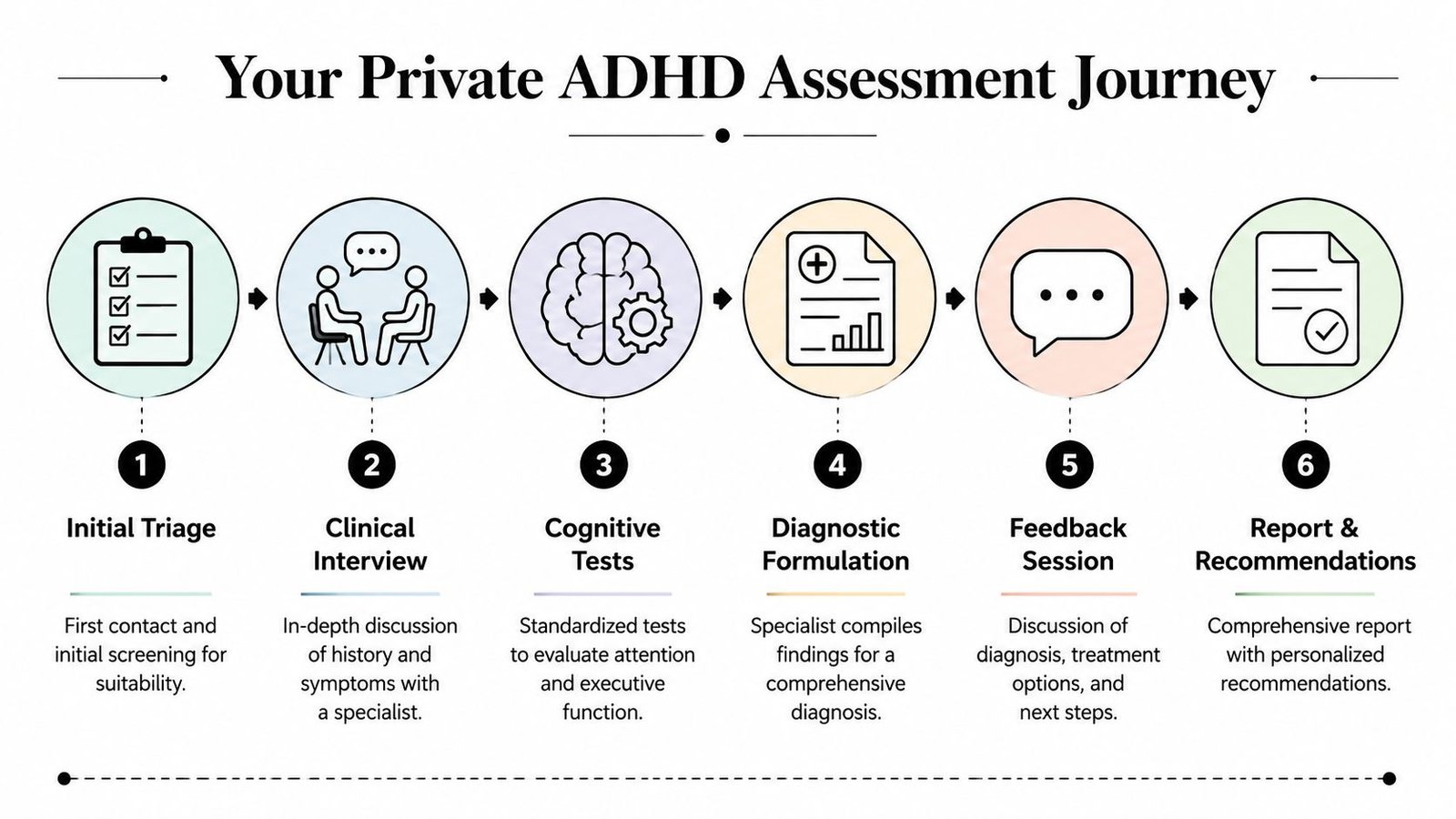
Step one to three
Initial triage
This is the first filter. It helps determine whether a full ADHD assessment is appropriate, whether another psychiatric assessment is needed first, or whether there are risk issues that need a different route.Clinical history
This is the core of the process. Expect detailed questions about childhood, school, work, relationships, organisation, emotional regulation, and previous mental health care.Collateral information
Where possible, it helps to include information from someone who knows you well, or records that give a picture of earlier functioning. ADHD isn't diagnosed on present-day frustration alone.
Step four to six
The middle and later stages are about formulation rather than ticking boxes.
- Structured tools and rating scales may be used to improve consistency
- Differential diagnosis is considered carefully
- Feedback should explain not only whether ADHD is present, but why that conclusion was reached
- Written reporting should be clear enough for practical use with GPs, universities, or employers where appropriate
- Treatment discussion should cover more than medication alone
Good assessment feels organised from the patient side because the clinician is doing the difficult thinking in the background.
A useful way to prepare is to gather examples before the appointment. Bring notes on patterns of inattention, impulsivity, disorganisation, and emotional overload across different settings. If you have school reports, prior diagnoses, or a record of mental health treatment, those can be useful as context.
For a broader sense of what a full psychiatric review involves before and during diagnosis, this guide on what is a mental health assessment is a helpful primer.
Understanding the Scope of Assessment ADHD Autism and Beyond
Adults often come for ADHD assessment with a very specific question. “Do I have ADHD?” That's understandable, but in practice the better clinical question is often wider. “What best explains the pattern of difficulties I've had across my life?”
Overlap is common
ADHD and autism can overlap in ways that aren't obvious at first glance. Executive functioning problems, sensory strain, social exhaustion, rigidity, overwhelm, and burnout can all appear in different combinations. Anxiety and depression can then sit on top of that picture and make it harder to recognise the original neurodevelopmental pattern underneath.
A careful psychiatrist doesn't treat these as separate checklists. The job is to work out what belongs where.
For example:
- ADHD may look like anxiety when a person is constantly late, underprepared, and worried about the consequences
- Autism may look like social anxiety when the underlying issue is social processing difference rather than fear alone
- Low mood may follow years of unmanaged neurodevelopmental difficulty rather than being the sole explanation
- Personality factors may complicate the picture without explaining the full developmental history
Differential diagnosis matters
Diagnostic integrity becomes essential. If someone receives an ADHD label when the main problem is trauma, mood instability, autism, or a mixed presentation, treatment may be delayed or misdirected.
In consultant practice, the aim isn't to force one diagnosis. It's to produce the most accurate formulation. Sometimes that confirms ADHD clearly. Sometimes it identifies autism alongside ADHD. Sometimes it shows that the person's concentration problems are secondary to another mental health condition.
The most useful diagnosis is the one that explains the pattern properly, not the one that is quickest to give.
If you're trying to understand how overlapping conditions affect assessment quality, this article on comorbidities with ADHD gives a good overview of the complexity involved.
Navigating Costs Funding and Right to Choose
Cost matters. It's often the first practical question people ask, and it should be discussed plainly.
Manchester's private market now has visible benchmarks. One local service directory lists a private ADHD and autism assessment at £600 with “No waiting list”, while another Manchester provider advertises ADHD assessments starting from £595, with written reports delivered within 5 working days, according to this Manchester service listing. That tells you something important. Private ADHD assessment in Manchester is now a defined clinical service with stated fees and timelines.
Cost is only one part of the decision
A lower price isn't automatically poor value, and a higher fee doesn't automatically mean a better assessment. The important question is what the fee includes.
Look for clarity on:
- Who assesses you and whether they are a consultant psychiatrist or another clinician
- What the report includes and whether it is detailed enough for GP review
- Whether follow-up is available if treatment, medication advice, or clarification is needed
- How the service handles GP communication if shared care is later discussed
Funding Your Private ADHD Assessment
| Pathway | Who Pays? | Typical Speed | Key Consideration |
|---|---|---|---|
| Self-funding | You pay directly | Usually fastest to arrange | Check exactly what is included in the assessment and report |
| Private insurance | Your insurer may cover some or all costs, subject to authorisation | Depends on approval and provider terms | Confirm eligibility, psychiatric cover, and required pre-authorisation |
| Right to Choose | NHS-funded through an eligible pathway | Variable | Availability depends on pathway rules, referral route, and provider participation |
Right to Choose can be useful for some patients, but it isn't the same as ordinary private self-pay access. It depends on NHS referral processes and provider eligibility. Insurance can help, but you still need to confirm what your policy covers, whether psychiatry is included, and whether authorisation is required in advance.
When comparing clinics, ask for the practical details in writing. Good services answer these questions directly.
After the Diagnosis Treatment Medication and Ongoing Support
A diagnosis is a starting point. The next question is what you do with it.
For some adults, the answer is largely explanatory. The diagnosis helps them understand a long-standing pattern, approach work differently, seek university support, or make changes at home. For others, the main priority is treatment, particularly if symptoms are affecting safety, job performance, or emotional stability.

What happens next in practice
A sensible follow-up plan usually includes three parts.
First, the diagnosis is explained clearly. Patients should understand why ADHD was diagnosed, whether autism or another condition is also relevant, and what the report means in ordinary daily life.
Second, treatment options are discussed. That may include medication, psychological strategies, environmental changes, coaching-style support, sleep work, or adjustments in education or employment.
Third, the GP interface is considered. This matters more than many people expect. If a specialist starts treatment, the quality of the report and monitoring plan affects whether ongoing collaboration with the GP is straightforward or difficult.
Medication isn't the whole story
ADHD medication can be very helpful for some adults, but it should sit inside a broader treatment plan. Prescribing also requires monitoring, review, and clear documentation.
Manchester listings show a wide private price range, from about £550 to £1,695, and that makes one issue especially important. The better question isn't which clinic is cheapest. It's what is included, and whether the assessment is thorough enough to support ongoing care, as discussed in this overview of Manchester ADHD clinic pricing and assessment quality.
Clinical judgement matters most after diagnosis, not least. A rushed report may create more problems when treatment decisions begin.
Many adults also benefit from hearing the post-diagnosis process explained in plain language. This short video gives a useful overview of what ongoing support can involve.
A good service stays involved long enough to make the diagnosis usable. That means follow-up, monitoring where needed, and documentation that supports rather than obstructs the next stage of care.
Frequently Asked Questions About Private ADHD Assessments
Do I need a GP referral to book an assessment
Often, no. Many private services accept self-referral. That said, it's still useful to involve your GP, especially if you may later want medication management or shared care.
Is a private ADHD diagnosis recognised by employers and universities
What usually matters is the quality of the assessment and report. A thorough specialist report is far more useful than a brief screening result when you need practical support, adjustments, or formal documentation.
How long does the assessment appointment take
That varies by service and complexity. A proper adult assessment is detailed. If a clinic presents diagnosis as something that can be settled in a very brief appointment, be cautious.
What is the difference between an ADHD screening and a full diagnostic assessment
A screening checks whether ADHD may be worth assessing further. It does not establish diagnosis on its own. A full diagnostic assessment considers developmental history, impairment across settings, collateral evidence, and alternative explanations.
Can ADHD and autism be assessed together
Sometimes, yes. That depends on the service and the clinical question. In many adults, it's important to consider both, especially where social communication differences, sensory issues, rigidity, or lifelong burnout are part of the picture.
What should I prepare before the appointment
Bring examples from daily life, any previous mental health records, and ideally evidence that helps show a longer developmental pattern. Old school reports, family observations, or notes about work and study difficulties can all help.
If you're looking for clear, consultant-led assessment rather than a quick online label, Insight Diagnostics Global provides adult ADHD, autism, and broader mental health assessments with structured reporting, follow-up options, and online or face-to-face pathways. If you're in crisis or need urgent support, use NHS 111 or call 999.