

You may be reading this after another missed deadline, another forgotten appointment, or another argument that started with “Why can't I just get organised?” For many adults, the question isn't academic. It's personal. They've held things together for years, often well enough that nobody noticed how much effort it took.
Then they try an online quiz. The result says ADHD is possible. Relief appears first, then doubt. Was that meaningful, or just a well-written checklist?
That uncertainty is exactly where good clinical work matters. In the UK, online ADHD testing for adults can be a useful starting point, but its true value comes from understanding which online routes are clinically sound, which are only marketing, and what a proper diagnosis requires.
Is It ADHD Navigating the Path to an Adult Diagnosis
You get through the working day by sprinting on urgency, then miss the dentist appointment you booked months ago. You can produce excellent work in a crisis, yet still leave emails unanswered, bills unpaid, and simple admin hanging over you for weeks. By the time many adults start asking about ADHD, they are not chasing a trend. They are trying to explain a pattern that has followed them for years.
I hear this often in clinic. A person has managed to look capable from the outside while relying on last-minute pressure, long hours, masking, and self-criticism to stay afloat. Then life gets fuller. Work loses structure, relationships demand consistency, children arrive, or burnout strips away the coping strategies that used to keep things together.
At that point, an online screener can be a reasonable place to start. It may help you recognise experiences that fit ADHD more closely than “laziness” or “poor motivation” ever did. If you are trying to put words to what has felt confusing for years, this guide to signs of ADHD in adults can help you identify the patterns worth discussing with a clinician.
Why self-recognition helps, but doesn't settle it
Self-recognition matters. It often prompts the first serious conversation.
Diagnosis is a different task. In UK practice, the question is not only whether the symptoms sound familiar. The clinician must work out whether the pattern is consistent with ADHD, whether it began early in life, whether it causes meaningful impairment now, and whether another explanation fits better.
That distinction matters because adult ADHD overlaps with several other conditions and life experiences. Anxiety can look like poor concentration. Depression can reduce motivation and slow thinking. Trauma can affect memory, organisation, sleep, and emotional regulation. Autism, sleep disorders, substance use, thyroid problems, and long-standing stress can also complicate the picture. A quiz cannot sort that out reliably.
The ASRS v1.1 is widely used as a screening tool and can be helpful for triage or monitoring symptoms over time. It is not a stand-alone diagnostic test. In a consultant-led service, especially one working to CQC-regulated standards, rating scales are only one part of the picture. Essential clinical work is in the interview, the developmental history, and the careful consideration of alternative explanations.
Many adults don't need a faster quiz. They need a slower, more careful conversation with the right clinician.
What anxious adults usually need most
Most adults seeking online ADHD assessment are not looking for a label to collect. They want a clear, defensible answer. They want to know whether the lifelong difficulty with attention, organisation, impulsivity, restlessness, or emotional control is ADHD, and whether treatment is likely to help.
One of the commonest situations I see is this. Someone completes several online screeners, reads about ADHD late into the night, and arrives half-convinced. During a proper assessment, the story becomes clearer. Sometimes the evidence strongly supports ADHD. Sometimes the main driver is anxiety, trauma, sleep deprivation, or autistic traits with executive functioning difficulties. Good assessment protects patients in both directions. It reduces missed ADHD, but it also reduces the risk of the wrong diagnosis.
That is why clinically sound online assessment has value. It can widen access and shorten the path to specialist review, but only if the standard remains the same as a careful face-to-face psychiatric assessment. The goal is not speed alone. The goal is diagnostic accuracy, practical clarity, and a treatment plan you can trust.
What a Clinically Valid ADHD Assessment Involves in the UK
A familiar scenario in clinic is this. An adult has completed a few online ADHD quizzes, recognised themselves in the answers, and now wants to know whether that really amounts to a diagnosis. In the UK, it does not. A clinically valid ADHD assessment is a specialist psychiatric assessment carried out to NICE standards, with enough depth to decide whether ADHD is present, whether something else explains the symptoms better, or whether both are going on at once.
That distinction matters. In a CQC-regulated, consultant-led service, the standard for an online assessment should match the standard expected in any careful adult psychiatric assessment. The format can be remote. The clinical method cannot be superficial.
The parts that should always be there
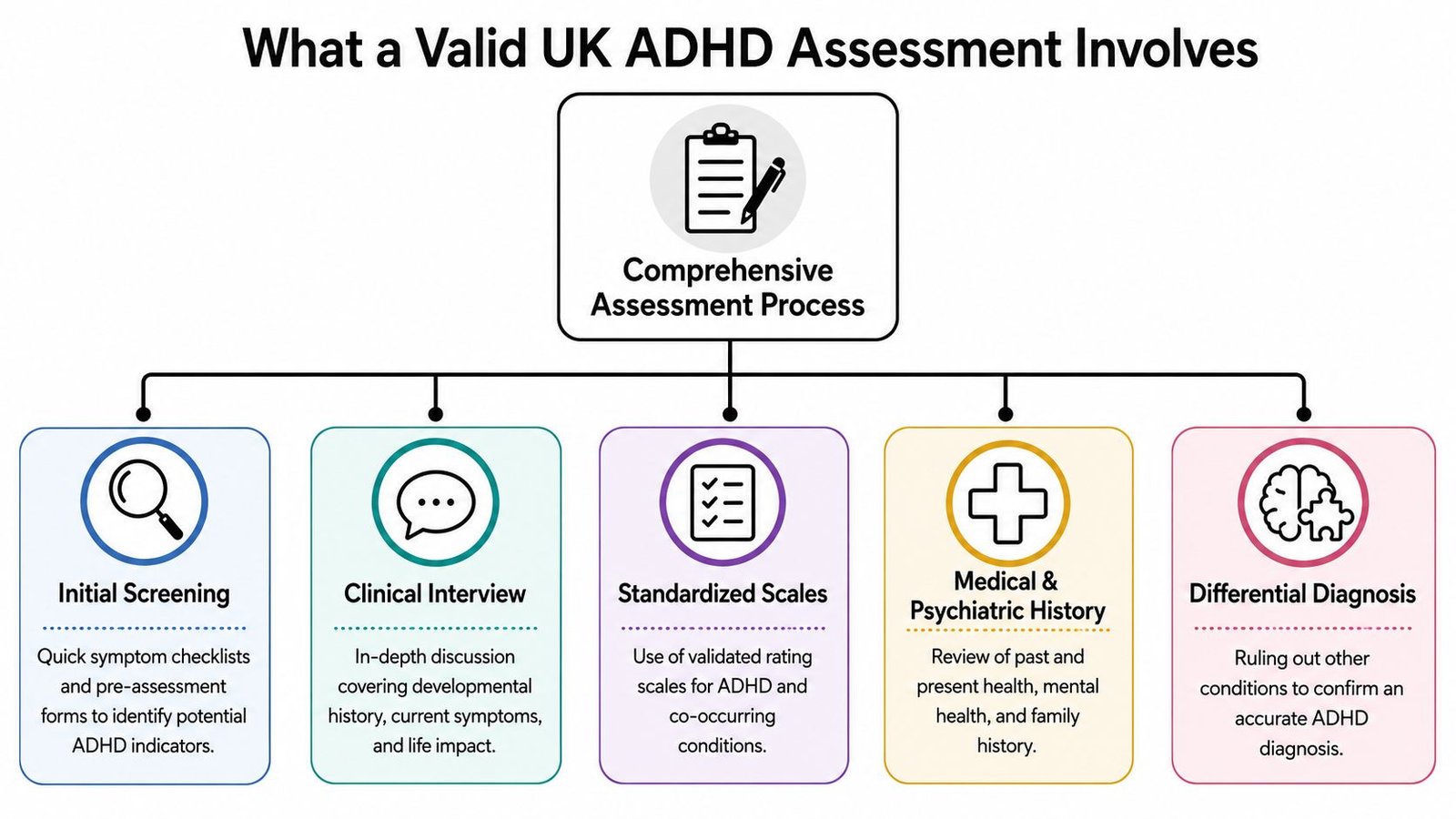
A proper adult ADHD assessment in the UK usually includes several strands of evidence, not a single score or short questionnaire.
- A detailed clinical interview covering current symptoms, day-to-day examples, and the settings in which difficulties appear.
- Developmental history because ADHD begins in childhood, even if it was missed at the time.
- Validated rating scales to structure symptom review, not to replace clinical judgement.
- Collateral information from a parent, partner, sibling, old school reports, or other records where available.
- Review of mental health and medical history so attention problems are considered in context.
- Assessment of impairment at work, in study, in relationships, at home, and with everyday organisation.
If you want a plain-language overview of the steps, this guide to how ADHD is tested is a useful companion.
Why childhood history and impairment matter
Many adults are caught off guard by the amount of time spent on childhood history. There is a good reason for that. ADHD is a neurodevelopmental condition, so the clinician has to establish that the pattern did not start only in adult life after stress, poor sleep, burnout, or another illness developed.
Childhood evidence does not have to mean a neat school record saying "ADHD". Often it is indirect. A history of losing things, drifting off, forgetting instructions, underperforming despite ability, emotional impulsivity, or needing much more supervision than peers can all help build the picture. In high-achieving adults, family structure, intelligence, or a very controlled school environment may have masked the difficulties for years.
Impairment carries equal weight. Relating strongly to ADHD content online is common. Diagnosis requires something more specific. The symptoms need to cause persistent functional problems across more than one area of life.
Differential diagnosis decides whether the diagnosis is trustworthy
A critical part of assessment is differential diagnosis. That means examining whether ADHD is the best explanation for the symptoms, one part of the explanation, or the wrong explanation.
Adults can present with poor concentration for many reasons. Chronic anxiety can look like inattention. Trauma can produce restlessness and emotional volatility. Depression can slow thinking and motivation. Sleep disorders, substance use, autistic traits, thyroid problems, and medication effects can all complicate the picture.
This is why short online tests have limited value. They can flag possible ADHD. They cannot reliably sort ADHD from overlapping conditions or measure the full clinical context. A careful specialist assessment can.
Clinical rule: The more your symptoms overlap with stress, trauma, anxiety, depression, or sleep problems, the more important a full specialist assessment becomes.
Good psychiatry is careful here. Rushed diagnosis creates problems later, especially when treatment decisions depend on getting the formulation right. I often tell patients that a useful assessment is not one that confirms ADHD at any cost. It is one that gives a defensible answer and a treatment plan that makes sense.
That need for clinical rigour is part of a wider issue in healthcare quality. The same concerns about standards and credibility appear in the debate on medical recertification, where the key question is not whether something happens online, but whether the process is rigorous enough to trust.
Online vs In-Person ADHD Assessments A Clinical Comparison
The most useful comparison isn't “digital versus traditional”. It's well-run specialist assessment versus superficial assessment. The medium matters less than the method.
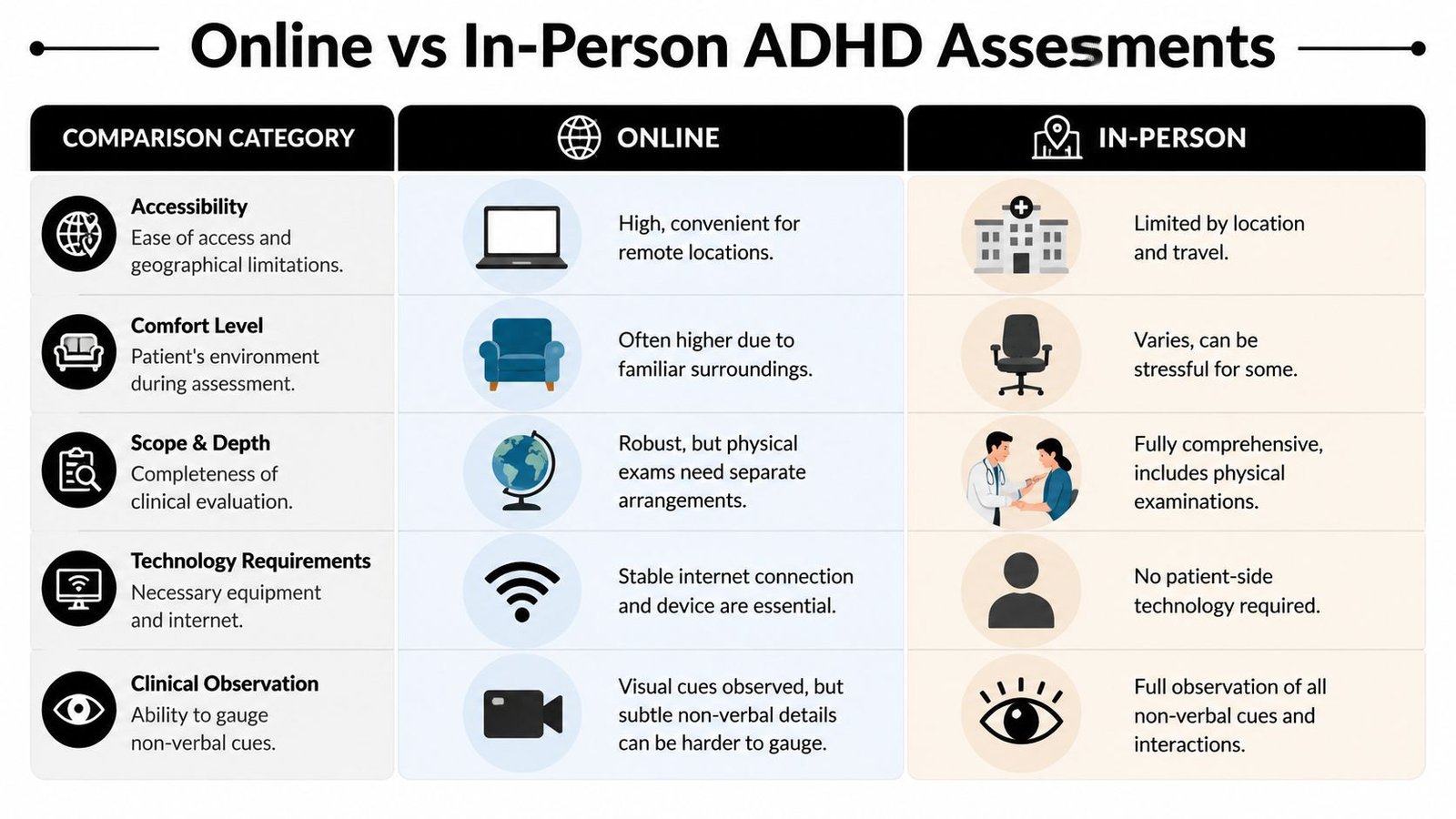
For many adults, online appointments are easier. They reduce travel, remove geographic barriers, and let people talk from a familiar environment. Some patients think more clearly at home than they do in a clinic waiting room. Others find in-person contact grounding and easier for sustained conversation.
Where online assessments work well
Online ADHD testing for adults works best when the provider is running a full psychiatric assessment rather than offering only a self-report result. Remote assessment can be clinically sound when the interview is thorough, the records are reviewed properly, and the clinician gathers collateral information where needed.
Evidence from a validation study of an online asynchronous ADHD assessment found 78% agreement with in-person clinical interview and 94.9% positive predictive value, supporting the reliability of well-structured online pathways when conducted by specialists, according to this validation study on online ADHD assessment.
That doesn't mean every online service is equivalent. It means online care can be rigorous when it is built around specialist clinical judgment rather than automation.
If you're weighing digital mental health routes more broadly, this overview of an online mental health assessment in the UK helps place ADHD assessment in the broader telepsychiatry context.
What in-person still offers
Face-to-face assessment has some practical strengths. The clinician can observe the full interaction in the room, and some patients communicate more naturally in person. If a physical examination or additional medical review is needed, logistics may also be simpler.
Here's the important point though. A weak in-person assessment is still weak. A careful online assessment is still careful.
This short video gives a useful overview of remote ADHD assessment in practice.
The real question to ask
Don't ask only whether the appointment is online or in person. Ask these questions instead:
| Format issue | Better question |
|---|---|
| Online appointment | Who is assessing me, and what are their specialist credentials? |
| In-person appointment | Will they take a full developmental history and consider other diagnoses? |
| Fast turnaround | Is the speed coming from efficiency, or from cutting corners? |
Healthcare education has faced similar arguments about whether remote formats can maintain standards. If you're interested in that broader professional debate, this discussion of the debate on medical recertification offers a useful parallel. Delivery format can change. Standards still have to hold.
How to Choose a Trustworthy Online ADHD Provider in the UK
The safest way to choose a provider is to think like a careful buyer of healthcare, not a desperate shopper for a diagnosis. If a service markets certainty before meeting you, that's a warning sign.
A key reason for specialist oversight is that self-report screeners can over-identify ADHD when symptoms overlap with anxiety, depression, trauma, and sleep loss. A positive online result should lead to structured clinician-led assessment rather than serve as confirmation, as explained in this overview of why ADHD screeners need clinical follow-up.
What to check before you book
Look for the essential criteria first:
- Regulation. Check whether the service is CQC-regulated if it is operating as an independent healthcare provider in England.
- Medical leadership. Confirm that the assessment is carried out by a Consultant Psychiatrist or another appropriately qualified specialist, and check GMC registration where relevant.
- Specialist experience. Adult ADHD is not generic mental health triage. It helps if the clinical team regularly assesses neurodevelopmental conditions, including autism and personality complexity where presentations overlap.
- Transparent pathway. You should be told what the assessment includes, what happens after diagnosis, and what support is available if ADHD is not confirmed.
- Clear pricing and policies. Fees, follow-up arrangements, cancellation terms, and report delivery should be easy to find and understand.
For people searching specifically for specialist-led remote care, this guide to finding a psychiatrist online in the UK is a sensible place to compare what providers offer.
Red flags that should make you pause
Some warning signs are obvious once you know what to look for.
- Guaranteed diagnosis language. No reputable clinician can promise a diagnosis in advance.
- Instant prescription claims. Medication should follow a proper diagnostic process and medical review, not a sales funnel.
- No named clinical team. If you can't tell who is assessing you, don't proceed.
- Quiz-only pathways. A brief form with an autogenerated result is not the same as an adult ADHD assessment.
- No interest in childhood history or alternative explanations. That suggests the service is not applying proper diagnostic standards.
A trustworthy provider is willing to tell you “not ADHD” if the evidence points elsewhere.
Key questions for your potential ADHD provider
| Question to Ask | Why It Matters |
|---|---|
| Who will assess me, and what are their qualifications? | You need to know whether the clinician has the training to diagnose adult ADHD properly. |
| Is the assessment consultant-led? | Senior psychiatric oversight matters when symptoms are complex or overlapping. |
| Will you take a developmental history? | Without this, the diagnostic process is incomplete. |
| Do you gather collateral information when needed? | Third-party history can strengthen accuracy, especially when childhood recall is patchy. |
| How do you assess for anxiety, depression, trauma, autism, burnout, or sleep-related causes? | Differential diagnosis is central to good ADHD care. |
| What does the report include? | A meaningful report should explain the reasoning, not just give a yes or no answer. |
| What happens after diagnosis? | Ongoing care matters, including follow-up, medication discussions, and practical recommendations. |
| What happens if ADHD is not diagnosed? | A good service still helps clarify next steps. |
A practical standard
If the provider's process sounds lighter than what an NHS specialist clinic would be expected to do, be cautious. Convenience is valuable. Clinical shortcuts are not.
The Assessment Journey Timelines Costs and Pathways
When adults finally decide to seek help, they usually want two things at once. They want the process to move quickly, and they want it to be thorough. Those aims can sit together, but only if the pathway is organised properly.
The pressure on access is real. NHS England reported 196,100 people waiting for an ADHD assessment in March 2024, up from 172,300 a year earlier, which helps explain why many adults look for faster regulated alternatives, including Right to Choose routes, as noted in this summary of ADHD waiting list pressure and online pathways.
The usual stages
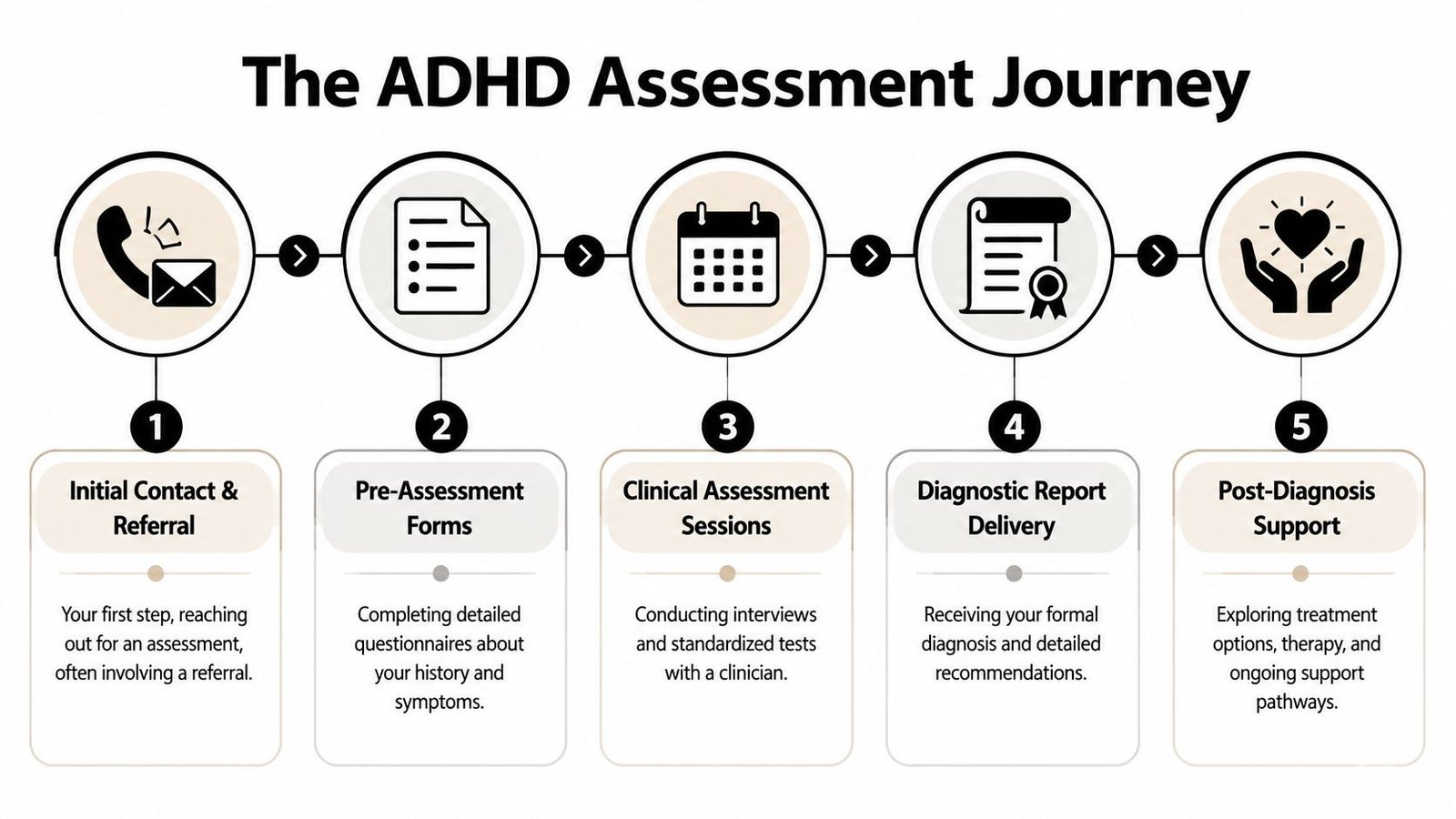
Most assessment journeys follow a recognisable sequence:
Referral or self-enquiry
You contact the provider directly, speak to your GP, or explore whether Right to Choose applies in your case.Pre-assessment paperwork
This often includes symptom questionnaires, background forms, and consent documents.Clinical assessment
The specialist reviews your history, current functioning, and possible alternative explanations.Diagnostic report
You receive a written opinion with reasoning and recommendations.Follow-up care
If ADHD is diagnosed, treatment planning begins. If it is not, the report should still guide next steps.
Private, Right to Choose, and insurance
The UK pathways are different enough that it helps to separate them clearly.
- Private self-funding offers the most direct route. You choose the provider and book directly. The trade-off is cost.
- Right to Choose can be a valuable option for eligible NHS patients in England who want assessment through an approved provider rather than waiting in their local pathway. It still requires paperwork and GP involvement, so it isn't instant, but it can be a practical route.
- Private medical insurance may cover consultation costs depending on your policy and authorisation requirements. Patients usually need to check this in advance with their insurer.
The administrative side matters more than is often realized. If you're interested in the healthcare systems perspective on how access, coding, and payment processes affect behavioural health services, this piece on strategies to boost behavioral health revenue gives a useful view of why service pathways can become complicated behind the scenes.
Timelines and cost expectations
Timelines vary by provider. Some services are heavily backlogged. Others are more responsive. It's reasonable to ask direct questions about booking delays, report turnaround, follow-up availability, and medication pathways before committing.
Cost also varies, and readers should be wary of prices that seem unrealistically low for consultant-level psychiatric work. A proper ADHD assessment takes time before, during, and after the appointment. The clinician isn't only speaking to you. They are reviewing forms, weighing differential diagnoses, and writing a defensible report.
Fast access is helpful. Fast access without depth usually creates problems later.
After the Diagnosis Understanding Your Treatment and Support Options
A diagnosis is not the finish line. It's the point at which the work becomes more targeted. Good post-diagnostic care should help you understand what ADHD means in your life, what it doesn't explain, and what support is likely to help.

Medication is one option, not the whole plan
For some adults, medication makes a substantial difference to focus, task initiation, impulse control, or mental clutter. But it should be introduced carefully, with proper monitoring and a realistic discussion of benefits, side effects, and expectations.
Medication does not teach planning, undo years of self-criticism, or automatically solve workplace overload. It can create the conditions for change. It doesn't replace the work of change.
Non-medication support often determines long-term outcome
Adults often need a combination of practical and psychological support. That can include:
- Psychoeducation so you understand how ADHD affects attention, emotion, motivation, and daily routines.
- CBT or other therapy for anxiety, low mood, perfectionism, or shame that has built up around years of struggle.
- ADHD coaching or skills work focused on routines, prioritisation, time management, and task structure.
- Workplace or university adjustments where formal documentation supports reasonable accommodations.
- Support for co-occurring conditions if autism, anxiety, depression, or trauma are also part of the picture.
Why follow-up matters so much in women and high-masking adults
A key challenge in adult ADHD is symptom masking, particularly in women and high-functioning individuals. A thorough assessment and follow-up plan must account for this, because NICE requires evidence of impairment across settings, which simple screeners cannot capture, as discussed in this review of online ADHD testing and masking presentations.
That matters after diagnosis as well as before it. Some adults appear “successful” on paper while privately spending enormous effort to stay afloat. Follow-up care needs to account for the cost of compensation, not just the appearance of coping.
The aim isn't to make you fit a stereotype of ADHD. It's to understand how your version of it affects your actual life.
If ADHD isn't diagnosed
This can still be a useful outcome. Many adults come for assessment because they are exhausted, foggy, disorganised, and emotionally depleted. If the clinician concludes that burnout, depression, trauma, sleep disturbance, or another condition is driving the picture, that is not a dead end. It's direction.
A good assessment should reduce uncertainty, not just assign a label.
Your Questions About Online ADHD Testing Answered
Can an online ADHD test diagnose me on its own
No. An online screener can suggest that ADHD is worth assessing, but it cannot independently verify childhood onset, cross-setting impairment, or whether another condition explains the symptoms better. A valid diagnosis needs a specialist-led clinical assessment.
Is an online diagnosis valid in the UK
It can be, if the diagnosis is made through a proper specialist assessment rather than a quiz or automated report. The issue isn't whether the appointment happens by video. The issue is whether the clinical process is thorough, consultant-led where appropriate, and properly documented.
What if my online screener says ADHD but the specialist says no
That happens, and it doesn't mean your difficulties aren't real. Screeners are designed to pick up possible ADHD traits. They are not designed to rule out overlap with anxiety, low mood, trauma, sleep problems, autism, or burnout. A negative diagnosis can still be clinically valuable because it points treatment in the right direction.
Can adults with jobs, degrees, or families still have ADHD
Yes. High achievement does not exclude ADHD. Many adults compensate through intelligence, structure, fear of failure, or relentless overwork. The question isn't whether you've achieved things. It's what it costs you to maintain them.
Are women more likely to be missed by simple online tools
They can be. Adults who mask, internalise symptoms, or present without obvious external hyperactivity may not fit the stereotype reflected in public ADHD content. That's one reason a careful developmental history and nuanced follow-up matter.
Is Right to Choose worth exploring
For many adults in England, yes. It can offer a practical alternative when local waiting times are long. The process does depend on eligibility, GP cooperation, and provider arrangements, so it's worth checking the details early rather than assuming it will be straightforward.
What should I prepare before an assessment
Bring concrete examples. Think about school years, work patterns, missed deadlines, emotional regulation, finances, relationships, driving, household organisation, and how you manage routine tasks. If possible, gather old reports or speak to a parent, sibling, or someone who knew you in childhood.
What if I'm worried I'm “making it up”
That fear is extremely common. Most adults seeking assessment have spent years minimising their difficulties, not exaggerating them. A proper assessment isn't there to catch you out. It's there to establish, carefully and fairly, what best explains your experience.
Should I choose speed or thoroughness
Choose thoroughness first, then look for efficiency within that. The right assessment should feel organised and responsive, but it should never feel rushed in the diagnostic sense.
If you want a consultant-led route for adult ADHD, autism, and wider mental health assessment, Insight Diagnostics Global offers online and face-to-face care for adults in the UK through CQC-regulated, GMC specialist-led pathways, with structured assessments, clear reporting, and follow-up options including ADHD medication titration and ongoing monitoring.