

University life can unravel. You miss one deadline because you couldn't get started, avoid a seminar because the room felt impossible, stop opening emails because each one looks like another demand, and then start wondering whether you're just disorganised, lazy, oversensitive, or not cut out for the course.
For many students, that isn't the full picture. ADHD, autism, anxiety, depression, burnout, panic, sensory overwhelm, sleep disruption, and other mental health difficulties can all show up as academic problems first. You may know something is off but not know what to call it. You may also have hit the most frustrating part of the process already, which is that universities often ask for evidence at exactly the point when you're least able to organise it.
Student disability support exists to remove barriers, not to make you prove you're struggling hard enough. The challenge is that support works best when you know what to ask for, what evidence matters, and how the university process runs in real life.
Starting University and Feeling Overwhelmed
A common pattern looks like this. A student arrives at university bright, capable, and motivated. In school, they got through by cramming, masking, staying up late, or relying on structure that other people created for them. At university, that scaffolding disappears. Lectures move faster, deadlines land together, group work gets messy, and nobody notices when you stop coping.
If you have ADHD, the pressure often shows up as missed steps rather than lack of effort. You mean to start the reading, then spend hours frozen. You know the essay brief, but can't break it into parts. You want to attend, but your sleep, focus, and anxiety are all over the place. If you're already trying practical strategies for coping with ADHD, that can help day to day, but it doesn't replace formal support when your difficulties are affecting study.
Autistic students often describe a different kind of overload. The work itself may be manageable, but the environment isn't. Unclear instructions, noisy teaching spaces, sudden timetable changes, group tasks with no structure, and pressure to socialise can drain energy before the academic part even starts. Students with mental health conditions may feel a third version of the same problem, where concentration, motivation, attendance, and confidence all drop at once.
You don't need to wait until you're failing to ask for help.
The hardest part is often uncertainty. Are you dealing with a study skills issue, a mental health issue, a neurodevelopmental condition, or all three? That confusion is normal. What matters now is moving from vague concern to a practical plan.
Your Rights and the Types of Support Available
The legal starting point in the UK is the Equality Act 2010. Universities and colleges must make reasonable adjustments for disabled students, and disability is a protected characteristic under that law. The scale of need is no longer marginal either. The number of UK higher education students who declared a disability rose from 297,000 in 2014/15 to 514,000 in 2022/23, and disabled students made up 16% of all students in 2022/23, according to policy analysis drawing on HESA data.
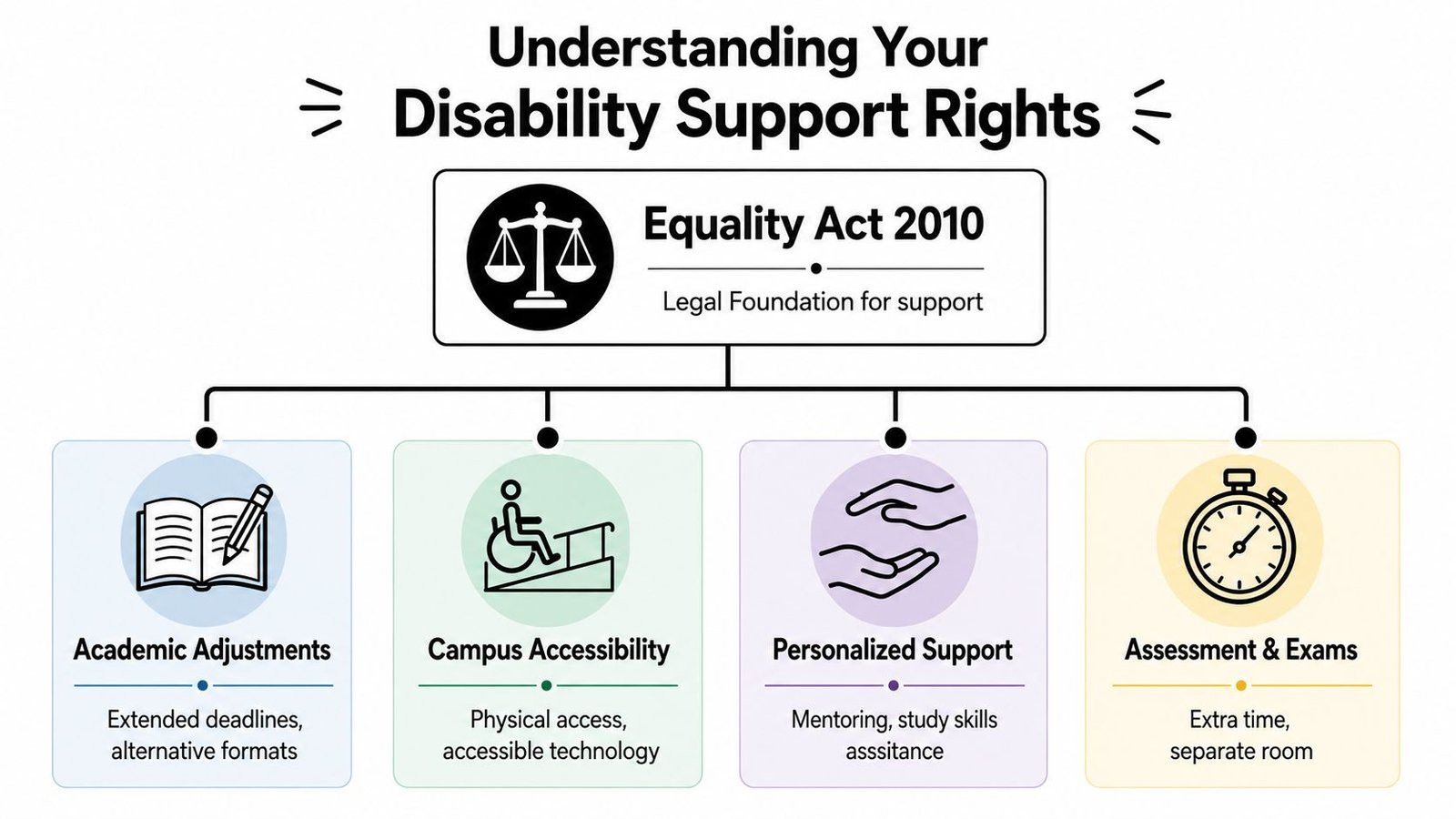
That matters because student disability support isn't a favour. It's part of how a university is expected to run. If your ADHD, autism, long term mental health condition, sensory impairment, mobility issue, chronic illness, or learning difficulty puts you at a substantial disadvantage, the institution should consider adjustments that reduce that disadvantage.
What reasonable adjustments usually look like
The phrase sounds legalistic, but the practical version is straightforward. A good adjustment changes the way you access teaching, assessment, communication, or campus systems. It doesn't usually change the academic standard you're expected to meet.
Support often falls into four broad categories:
Academic adjustments. These can include extra time in exams, rest breaks, alternative assessment arrangements, deadline flexibility where policy allows, lecture recording access, or receiving materials in advance. For ADHD students, the biggest gains often come from reducing time pressure and making instructions more explicit. If you want a plain-English overview of what that can include, reasonable adjustments for ADHD gives useful examples.
Practical support. This may include mentoring, specialist study skills support, note-taking support in some settings, or help planning workload. For autistic students, practical support may also include communication adjustments and more predictable contact routes.
Campus accessibility. Some students need physical access changes. Others need digital accessibility, quieter rooms, or reliable routes to services without phone-heavy systems.
Assessment and exam arrangements. These often become urgent first because that's where barriers become visible fast.
What support doesn't do
Support isn't a guarantee that university will feel easy. It won't remove every stressful part of higher education, and it can't fix a course design that is chaotic in every module. But it can stop the institution from adding avoidable barriers.
Practical rule: Ask for adjustments based on how your condition affects study, not on what you think the university is willing to offer.
A strong request sounds like this: "I struggle to process verbal instructions in busy seminars, so I need written follow-up and access to slides in advance." That is much easier for a disability adviser to act on than "I have autism, please help."
The Key to Access Evidence and Diagnosis
Most universities can offer some initial guidance without much paperwork. Individualized, durable support usually depends on evidence. That is where many students get stuck.
The honest answer is that long term support is much easier to secure when the university has formal documentation that explains your condition, how it affects day to day functioning, and what adjustments are likely to help. For ADHD and autism in particular, a detailed diagnostic report is often the document that turns a vague conversation into an actual support plan.
Why diagnosis matters in practice
Many students don't arrive at university with a clear label. They know they are struggling, but the pattern is blurred. It might look academic from the outside, while feeling neurological or psychological from the inside. The overlap is real. Attention problems can come from ADHD, anxiety, depression, sleep problems, trauma, burnout, or a mix of factors. Social exhaustion can reflect autism, social anxiety, masking, or mental health strain.
That uncertainty is one reason the boundary between university support and clinical support is so difficult. Many students are unsure whether their difficulties are academic, neurodevelopmental, or mental-health related, and recent reporting has highlighted long waits for NHS assessment, which makes timely coordination harder. A clear diagnosis is often needed to organise the right help, especially for ADHD, autism, or burnout, as noted in this overview of the boundary between disability support and clinical support.
A proper report does more than confirm a label. It should explain functional impact. For example:
- Attention and executive function problems may affect planning, initiation, organisation, working memory, and time management.
- Autistic traits may affect sensory processing, social communication, tolerance of change, and fatigue after masking.
- Mental health conditions may affect attendance, concentration, memory, pacing, and exam performance.
Universities make better decisions when that impact is described clearly.
What counts as useful evidence
The best evidence usually has three parts:
- A clear diagnosis or clinical formulation
- An explanation of how the condition affects study
- Recommendations that can be translated into adjustments
If your current paperwork only says "struggles with concentration" or "reports anxiety", the disability team may need more. They aren't trying to be obstructive. They need enough detail to justify changes to teaching, assessment, or service delivery.
A strong assessment also helps outside the university. It can support conversations about Disabled Students' Allowances, treatment planning, medication review where relevant, and referrals for follow-up care. If you want to understand the clinical side before pursuing formal evidence, this guide to what a mental health assessment involves gives a clear starting point.
The trade off students face
The most difficult decision is often whether to wait for an NHS route or seek private assessment. That choice is personal and often financial. But from a student disability support perspective, timing matters. Waiting months while your attendance drops, assignments pile up, and exam arrangements remain undecided can carry a real academic cost.
The right report doesn't just describe you. It helps the university act.
If you're pursuing assessment, ask one practical question before you book anything: will the final report be detailed enough for university disability evidence and related applications? A short letter is rarely as useful as a thorough diagnostic document.
Navigating Disabled Students Allowances DSA
University support and Disabled Students' Allowances are connected, but they aren't the same process. A lot of students assume one application covers both. It doesn't.
DSA is a funding route designed to cover disability related study costs. It matters because disabled graduates are less likely to achieve a first or 2:1 than non-disabled graduates, with a 7 percentage point gap, and DSA is one of the central tools intended to help reduce that disadvantage through specialist equipment and support, according to national reporting on students with disabilities in higher education.
What DSA can help fund
DSA is meant for study related support rather than general living costs. Depending on your needs, it may help with:
- Specialist equipment such as software or hardware that makes reading, writing, planning, or organisation easier
- Non-medical helper support such as mentoring or specialist study skills support
- Extra travel costs where disability makes your normal travel arrangements unsuitable
For students with ADHD or autism, the most useful support is often the combination of practical human support and the right technology. One without the other can fall flat.
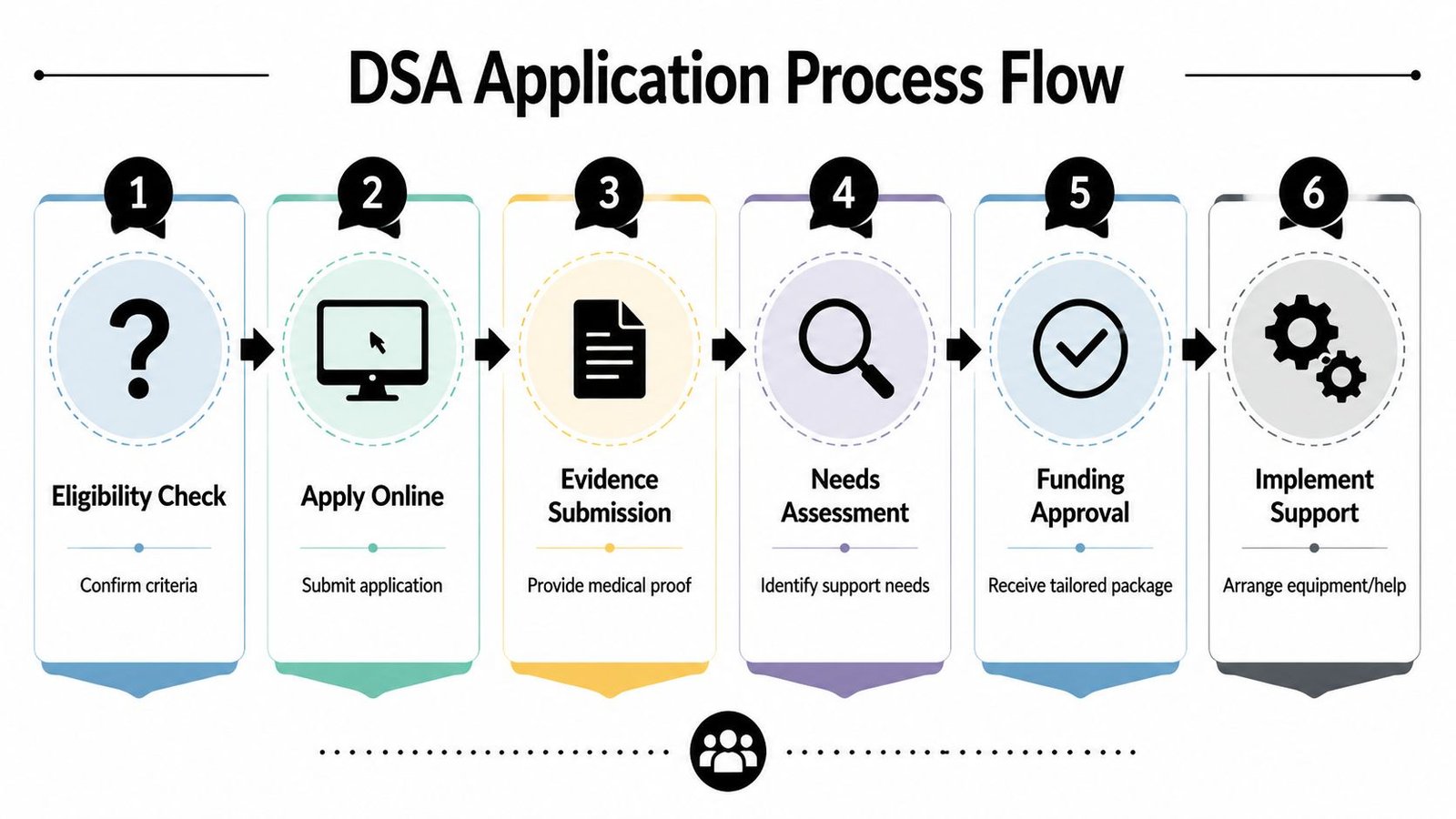
How the process usually unfolds
The process is easier when you treat it as a sequence, not a single form.
| Step | What to do | Why it matters |
|---|---|---|
| Evidence | Gather your diagnostic report or other accepted medical evidence | Weak evidence slows everything down |
| Application | Submit your DSA application through the relevant student finance route | This starts the formal process |
| Needs assessment | Attend the assessment and describe your actual study barriers | This shapes what support is recommended |
| Implementation | Follow up on equipment, training, and support arrangements | Approval alone doesn't put support in place |
Students often underestimate the needs assessment. That conversation is where you should be concrete. Don't just say you "find uni hard". Say, for example, that you lose track of multi-stage tasks, miss verbal detail in lectures, can't tolerate crowded exam halls, or burn out after seminars and need asynchronous ways to review content.
If you want an example of the kind of documentation students often prepare alongside applications, this mental health assessment PDF guide is a useful reference point.
What works best at the assessment stage
Bring examples from real study situations. Think in modules, placements, deadlines, and revision periods. Assessors can only recommend support based on barriers they can see.
A short checklist helps:
- Describe one bad week clearly. Name the tasks that broke down.
- Explain what you've already tried. That shows what isn't enough on its own.
- Separate symptoms from consequences. For example, distractibility leads to missed reading, which leads to rushed essays.
Your Universitys Disability Service Pathway
Once you have evidence, the university's internal system matters just as much as the diagnosis itself. Student disability support is only effective when it runs as a workflow. Referral, needs evaluation, trial use of assistive technology, plan development, implementation, periodic review, and transition planning all matter because missing one stage can leave a student with support that looks good on paper but doesn't work in daily study, as discussed in this piece on how disability support must be operationalised as a workflow.

First contact matters more than it should
Many disability services still make access harder than it needs to be. A study of college and university disability websites found that only 4% allowed students to book counselling appointments by email or phone, which creates a barrier for students with anxiety or executive function difficulties, according to this research on accessibility gaps in disability support websites.
That gives you a useful advocacy point. If the online form is inaccessible, the phone route is difficult, or the webpage is vague, say so plainly. You can write:
I am requesting an accessible contact route because my condition makes the current booking method difficult to use.
That is a reasonable thing to ask for.
The practical pathway most students follow
Most university processes look roughly like this:
Find the right team
Search for disability service, inclusion team, accessibility service, or student support. If the website is unclear, contact the students' union advice service and ask for the direct route.Make the referral or self-disclosure
Send your evidence and ask for a meeting. If you don't yet have full documentation, ask whether interim adjustments are available while assessment is in progress.Attend the needs meeting
This is where detail matters. Bring examples from lectures, labs, placements, libraries, exams, and group work. Explain what happens before, during, and after the barrier. "I miss deadlines" is less useful than "I understand the task but can't start until panic kicks in."Agree a support plan
Universities may call it a support plan, learning support plan, inclusion plan, or something similar. Read it carefully. Make sure it says what staff should do, not just what you struggle with.Check implementation
Ask who receives the plan, whether tutors are expected to acknowledge it, and what happens if a department doesn't follow it.
What to ask for in the meeting
The best meetings are specific. Consider asking:
- Teaching access. Slides in advance, recorded sessions where available, written instructions after verbal briefings.
- Assessment access. Extra time, rest breaks, smaller room, flexibility around attendance-linked penalties where appropriate.
- Communication access. Email contact instead of calls, clear written follow-ups, named point of contact.
- Environment access. Quiet study options, sensory considerations, accessible route planning.
For students with visual access needs, practical navigation tools can make the campus day less draining. Resources on technology for the visually impaired are useful when discussing what independent access should look like beyond the classroom.
Ask how and when your plan will be reviewed. Support that isn't reviewed often becomes outdated by mid-term.
Real-World Scenarios and Self-Advocacy Tips
Support plans make sense on paper. The actual test is whether they still work in week seven, during revision, after a timetable change, or when your symptoms flare.
Students with ADHD, autism, and mental health conditions often need support adjusted mid-term because needs fluctuate. That matters because support isn't a one-time fix, and persistent outcome gaps show that existing arrangements do not always translate into equal results, as reflected in this discussion of why fluctuating needs require responsive support.
Alex with ADHD during dissertation season
Alex is bright and engaged in seminars. Staff assume he's fine because he speaks well and understands the material. The problem starts when work becomes self-directed. He leaves the dissertation until the pressure is severe, then works in bursts, misses supervisor emails, and loses track of admin steps.
What helps him isn't generic advice to "manage time better". It is a support package that matches the failure points:
- extra time in timed assessments where appropriate
- regular specialist study support focused on planning and task breakdown
- written follow-up after supervision meetings
- permission to use assistive software that supports reading and drafting
- one clear contact route when he misses an administrative email chain
The trade-off is that Alex still has to engage. Student disability support doesn't replace his responsibility to attend meetings or submit work. But when the university makes expectations visible and structured, his actual ability becomes easier to demonstrate.
Ben with autism in a high-sensory course
Ben understands the subject well but struggles with unpredictability. Group work is chaotic, seminar discussion moves fast, and some teaching rooms are noisy enough that he leaves exhausted before he can think clearly. He also finds it hard when instructions change verbally without written confirmation.
His plan works when it includes concrete changes:
| Barrier | Unhelpful response | Helpful adjustment |
|---|---|---|
| Sensory overload in teaching spaces | "Try your best to attend" | Access to quieter spaces where possible and materials in advance |
| Fast verbal instruction | Repeating the same explanation louder | Written summary after class |
| Group work stress | Telling him collaboration is part of life | Clear roles, predictable structure, and alternative ways to show contribution where justified |
Ben's support works because it targets environment and communication, not just exams.
Self-advocacy without burning out
You don't need to become confrontational to advocate for yourself. You do need a system.
- Keep records. Save emails, meeting notes, support plans, and any examples of missed adjustments. If a tutor forgets an agreed arrangement, follow up in writing.
- Use plain language. "My plan says I should receive slides in advance. I haven't received them for the last two seminars. Please can this be corrected before next week."
- Ask for review early. If your attendance, concentration, sleep, or sensory tolerance drops, don't wait for the term to collapse.
- Escalate in the right order. Tutor first, then module lead, then disability adviser or student support manager if needed.
A support plan should be live. If your symptoms change, the plan may need to change too.
Frequently Asked Questions About Student Support
Can I get support if I don't have a formal diagnosis yet
Sometimes, yes. Many universities can offer interim support if you explain your difficulties clearly and show that assessment is pending. That may include temporary teaching adjustments, an initial adviser meeting, or short-term flexibility while evidence is being gathered.
Be realistic, though. Interim support is often narrower than a full disability plan. Long-term arrangements and DSA usually require stronger evidence. If you're waiting for assessment, tell the university that directly and ask what can be put in place now rather than after diagnosis.
A useful email is short and factual:
I am currently seeking formal assessment for difficulties affecting concentration, organisation, attendance, and academic functioning. Please advise what temporary support is available while evidence is pending.
I'm an international student. Can I still use university support and DSA
University support and DSA are not identical in eligibility terms. Most universities will still consider internal disability support for international students because the issue is access to study on that course. DSA has more specific funding rules, so eligibility can be different.
The practical step is to separate the questions. Ask the disability service what support the university can provide directly, then ask student finance or the relevant funding team whether you meet the criteria for DSA. If you don't, ask whether the university has hardship, accessibility, or assistive technology routes that can help fill gaps.
Will my disability appear on my degree certificate
No. Your degree certificate does not state that you received student disability support, had a diagnosis, or used adjustments.
Universities do share relevant adjustment information with staff who need it to implement support, but that isn't the same as public disclosure. In practice, the goal is usually to communicate the adjustment, not the diagnosis. If confidentiality worries you, ask one direct question at your disability appointment: who will see what information, and in what form?
What if my tutor doesn't follow the support plan
Start with a calm written reminder and attach the relevant part of the plan if needed. Many failures come from oversight, not hostility. If the issue continues, contact your disability adviser and ask them to intervene.
Keep the focus on implementation. Avoid turning the first message into a long argument about rights. A concise note usually works better: the adjustment is in my plan, it has not been applied, and I need it in place by a specific date.
What if I still don't know whether this is ADHD, autism, burnout, or anxiety
That uncertainty is one of the most common reasons students delay seeking help. You don't need to solve the diagnosis question alone before reaching out. Start two tracks at once. Ask the university what temporary support is available, and seek a proper clinical assessment so the picture becomes clearer.
If your difficulties are affecting deadlines, concentration, attendance, sleep, sensory tolerance, or your ability to manage university life, that is enough reason to act now.
If you're trying to make sense of ADHD, autism, burnout, or broader mental health difficulties while keeping your studies on track, Insight Diagnostics Global offers consultant-led assessments for adults aged 18 and over. The service provides structured evaluations, clear reports, and follow-up options that can help you move from uncertainty to evidence you can use when speaking to your university. If you're in crisis or need urgent help, use emergency services, call 999, or contact NHS 111.