

You've just had an appointment, finally got some answers about ADHD or autism, and then your doctor says a sentence like, “We'll need to titrate the medication.” That word can stop people in their tracks.
Most patients don't hear titrate in everyday life. They hear it after a diagnosis, when they're already taking in a lot of new information, and it can sound far more technical than it really needs to be. Some people even look it up and end up reading about chemistry experiments instead of medication.
That confusion is common. A 2025 NHS Right to Choose patient education survey found that 78% of UK adults seeking ADHD medication titration research the term online, and 65% can't distinguish between the clinical process and the laboratory technique. If that happened to you, you're not behind. You're having a very normal reaction to an unclear word.
For people coming through psychological assessment and treatment for ADHD, autism, and other mental health concerns, it helps to translate the language into something practical. Leading with extensive experience, top, leading Consultant Psychiatrists in neurodevelopmental and personality disorder work, including Dr Sai Achuthan, focus on making these processes understandable, not mysterious.
Your Doctor Said Titrate What Now
When patients ask me what does titrate mean, they're rarely asking for a textbook definition. They usually want to know three things.
Are you changing my medication slowly? Is that normal? And does it mean something is wrong with me if there isn't an instant perfect dose?
The reassuring answer is simple. Titration means adjusting medication in a careful, gradual, personalised way so we can find the dose that helps most and causes the fewest problems. It's a safety process, not a sign of failure.

Why the word causes so much confusion
The trouble is that titration has two meanings. One belongs in a lab. The other belongs in a clinic.
In medicine, especially in ADHD care, titration means starting at a lower dose and adjusting over time based on how your body and mind respond. In chemistry, titration refers to a method for measuring concentration in a solution. Both uses involve precision, which is why the same word exists in both places, but they are not the same experience at all.
Practical rule: If your clinician says “we'll titrate your medication”, they mean dose adjustment, not a lab procedure happening to you.
That matters if you've recently been diagnosed and are deciding what treatment might look like next. If you want a patient-friendly overview of the practical steps after diagnosis, this guide on how to get ADHD medication can help place titration in the wider treatment pathway.
What titration is trying to achieve
The aim isn't to get to the highest dose. It's to get to the right dose for you.
That may mean going up. It may mean staying low. It may mean reducing a dose if side effects start to outweigh the benefit. For adults with ADHD, and for some people receiving treatment linked to broader mental health care, that individual tailoring is one of the most important parts of safe prescribing.
If you remember one sentence, let it be this: titration is a structured process for finding your best fit, not a test you can pass or fail.
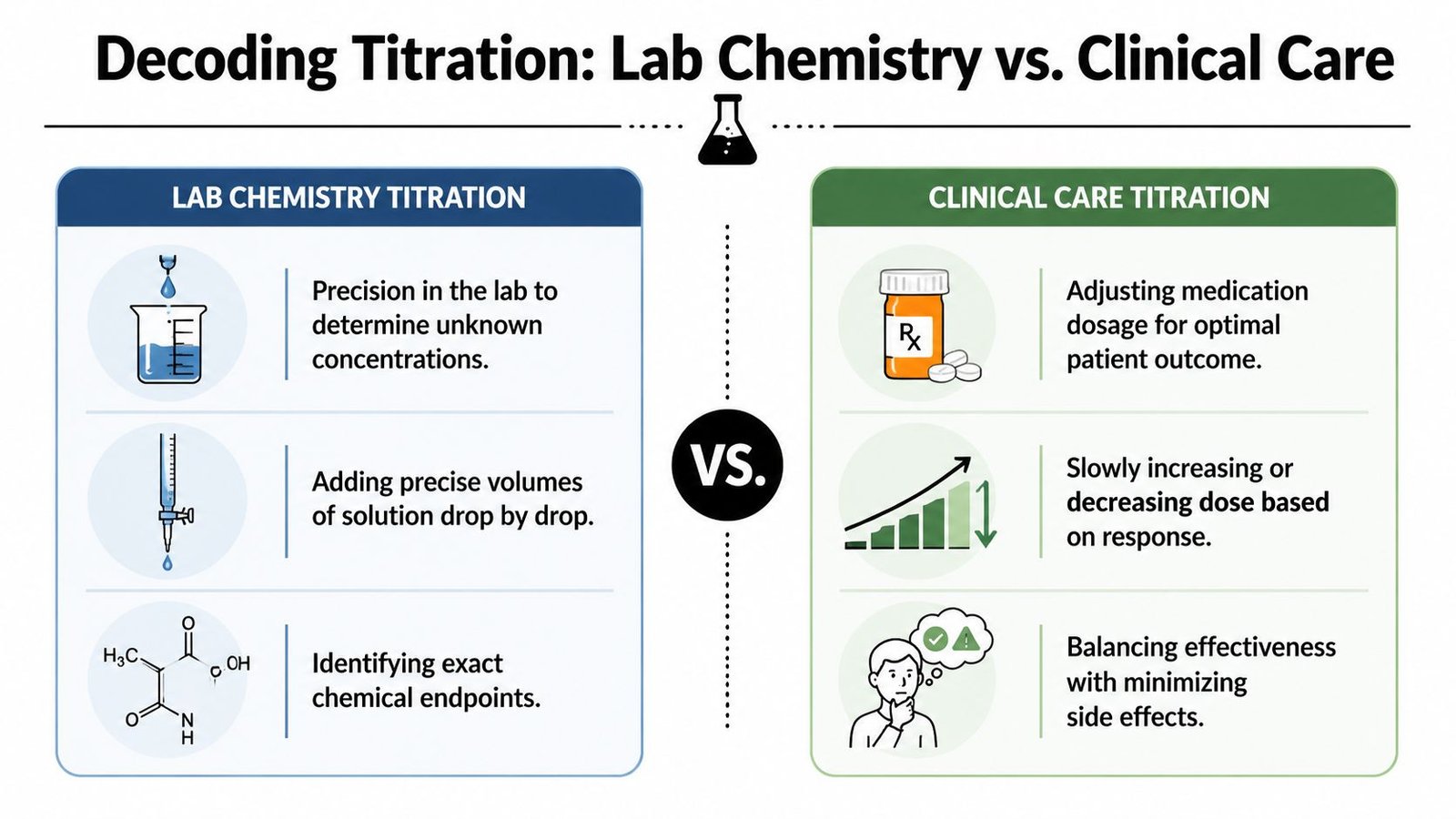
Decoding Titration Lab Chemistry vs Clinical Care
The quickest way to answer what does titrate mean is to separate the two versions of the word.
In a chemistry lab, titration is about measurement. Someone adds a liquid carefully, often drop by drop, until a reaction shows that the concentration of a substance can be calculated. It's about identifying an endpoint with precision.
In clinical care, the endpoint isn't a colour change in a beaker. It's a point where a real person is functioning better and tolerating the treatment well.
What lab titration means
Think of school science. A measured amount of one solution is added to another until a precise reaction point is reached. The purpose is analytical. You're trying to discover something exact about a substance.
That's why you may see the word in manufacturing, chemistry education, or medicine leaflets that discuss how drugs are tested or prepared. It belongs to quality control and analysis.
What clinical titration means
Clinical titration is much more personal. According to a scientific review of drug titration, drug titration is a patient-centred approach used to personalise medication doses, optimising therapeutic benefit while minimising the risk of adverse effects. The core principle is to start at a lower dose and increase it gradually until symptom relief occurs or a specific laboratory value is met.
That definition matters because it replaces the fear-inducing idea of “trial and error” with something more accurate. This is guided adjustment.
A simple comparison helps:
| Setting | What titration is for | What gets adjusted | What counts as success |
|---|---|---|---|
| Lab chemistry | Measuring concentration | Liquid volume in a controlled reaction | Reaching the correct endpoint |
| Clinical care | Personalising treatment | Medication dose over time | Good symptom control with tolerable side effects |
“In the clinic, titration is less like a chemical test and more like tailoring. The dose has to fit the person.”
That's especially important in ADHD prescribing, where two people with the same diagnosis can respond very differently to the same medicine. If you want another plain-language explanation of the term from outside the ADHD context, you can learn about titration with PepFlow. It's useful because it reinforces the idea that titration is a process of careful adjustment, not guesswork.
If you're also weighing up common ADHD medication options, this comparison of methylphenidate vs lisdexamfetamine can make the conversation with your prescriber easier.
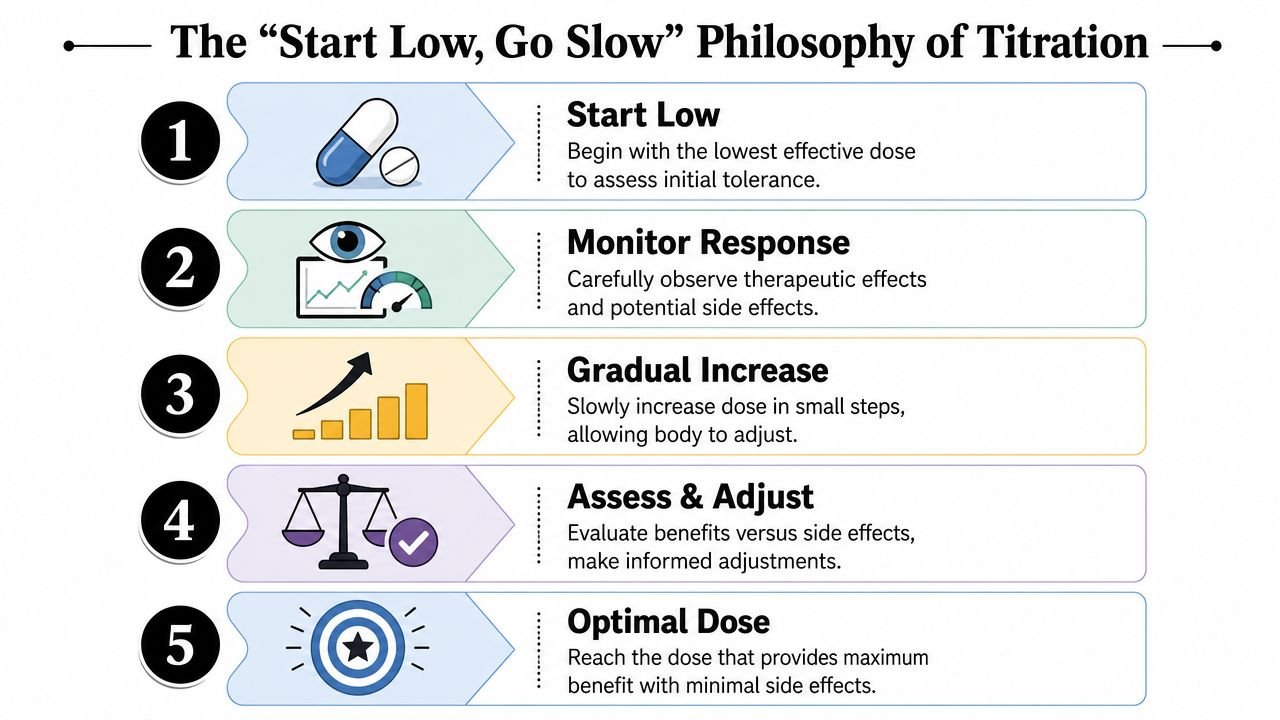
The Start Low Go Slow Philosophy of Titration
Good titration follows a principle clinicians often summarise as start low, go slow. That phrase isn't about being cautious for the sake of it. It's about getting you to the most helpful dose as safely as possible.
Many medications used in mental health and ADHD care can help a great deal, but they can also cause side effects if the dose is too high for a particular person, or if it's increased too quickly. Your nervous system, appetite, sleep, pulse, blood pressure, and daily functioning can all respond differently from someone else's.
Why lower is often the safest place to begin
Starting low gives your clinician a clear view of two things. First, whether the medication is tolerated. Second, whether there are early signs that it may help.
A clinical explainer on titration describes titration as a strategy to limit potential side effects by allowing time to assess individual body reactions, often starting with a low dose and raising it every couple of weeks until the target dose is achieved or side effects occur. It also notes that this gradual approach is safer for medicines that not everyone can tolerate at a full dose.
That's exactly why many ADHD prescriptions don't begin at the dose someone might eventually stay on. Jumping straight in at a stronger dose may create unnecessary side effects and make it harder to tell what your body is tolerating.
The sweet spot clinicians are looking for
Patients often assume the “best” dose means the strongest effect possible. In real life, that's not how we judge success.
We're looking for a sweet spot. A dose where symptoms improve in a meaningful way, while appetite, sleep, mood, physical comfort, and day-to-day functioning remain acceptable. If benefit improves but side effects become too intrusive, the dose may be too high. If side effects are minimal but there's no meaningful improvement, the dose may be too low.
That's why titration is a balancing exercise.
A good result is not “I can feel the medication strongly.” A good result is “I'm functioning better, and the trade-offs are manageable.”
Here's a simple way to understand it:
- Too low: You may notice little or no benefit.
- Too high: You may feel overstimulated, uncomfortable, or unable to sustain the dose.
- Just right: You notice clearer gains in attention, regulation, organisation, or consistency without feeling unwell.
A short visual explanation can help if you're a more visual learner:
Why patience matters during this stage
The hardest part of titration for many adults is emotional rather than medical. After waiting for assessment, answers, and treatment, you want certainty quickly. The slow pace can feel frustrating.
But this slower approach gives you something valuable. It allows your clinician to distinguish between a temporary adjustment effect, a meaningful improvement, and a sign that the dose or medication needs changing. That's good psychiatry.
In neurodevelopmental care, where ADHD often overlaps with anxiety, sleep difficulties, sensory sensitivity, or burnout, gradual changes are often easier for patients to observe and report clearly. That makes the final treatment decision more accurate.
Your ADHD Medication Titration Journey Explained
By the time titration begins, practical details are often sought. What happens first. How often the dose changes. How long the whole thing usually lasts. What your clinician is monitoring.
In UK clinical practice for ADHD, Psychiatry UK explains that medication titration typically takes 12 to 16 weeks on the NHS to reach an optimised dose, with an average duration of 14 weeks, while private patients often experience a slightly faster timeline of approximately 12 weeks. During this period, clinicians monitor blood pressure, pulse, weight, and height to support safe prescribing, and dose adjustments are commonly made every 1 to 3 weeks.
What the first stage usually involves
Before the first prescription is started, the clinician needs a safe baseline. That often includes your physical observations, current symptoms, previous medication history, and anything relevant in your mental or physical health background.
You may be asked about:
- Daily routine: When you need symptom control most, such as work hours, study time, driving, or parenting.
- Existing health factors: Sleep problems, anxiety, appetite issues, cardiac history, or other medications.
- Goals for treatment: Better focus, less impulsivity, steadier mood, improved task completion, or reduced overwhelm.
These details matter because titration isn't just about the medicine. It's about matching treatment to your real life.
What the middle phase often looks like
Once medication begins, dose changes are usually incremental. Your clinician reviews how you're responding, then decides whether to continue, increase, reduce, or occasionally switch approach.
A simple example schedule can show the shape of the process. This is illustrative only. It is not a prescribing instruction.
| Week | Dose | Clinician Check-in Focus |
|---|---|---|
| Week 1 | Low starting dose | Baseline tolerance, appetite, sleep, early effects |
| Week 2 to 3 | Possible small increase | Focus, restlessness, pulse, blood pressure |
| Week 4 to 6 | Further adjustment if needed | Duration of benefit, side effects, daily functioning |
| Week 7 to 9 | Review of pattern | Whether gains are consistent and tolerable |
| Week 10 to 12 and beyond | Fine-tuning or stabilising | Best balance of benefit and side effects |
This stage can feel repetitive, but repetition is useful. A dose that seems fine for two days may be less suitable over two weeks. A medication that feels subtle at first may turn out to be effective once the timing and dose are right.
Clinical perspective: Titration works best when the patient reports what daily life actually feels like, not what they think the doctor wants to hear.
What counts as progress
Progress isn't always dramatic. Sometimes it looks like starting tasks with less friction. Sometimes it's finishing more of what you begin. Sometimes partners, friends, or colleagues notice that you're less reactive or less scattered before you do.
Your clinician is trying to answer questions such as:
- Is your concentration improving?
- Are you less mentally exhausted by ordinary tasks?
- Is the medicine lasting long enough for your day?
- Are side effects mild, acceptable, or disruptive?
- Do physical checks remain reassuring?
If you're wondering how quickly benefits are usually noticed once treatment starts, this article on how long ADHD medication takes to work may help frame expectations.
Why some journeys take longer than others
Two people can start titration in the same week and finish at different times. That doesn't mean one is doing better than the other.
One person may reach a stable dose quickly. Another may need smaller increases because of appetite changes, sleep disruption, sensitivity to medication, or uncertainty about whether the benefit is strong enough. Some people need a medication change before they reach the right fit.
For autistic adults, or for people with both ADHD and broader mental health needs, that slower pace can be especially helpful. It gives you more room to distinguish medication effects from sensory overload, routine changes, anxiety, burnout, or masking fatigue.
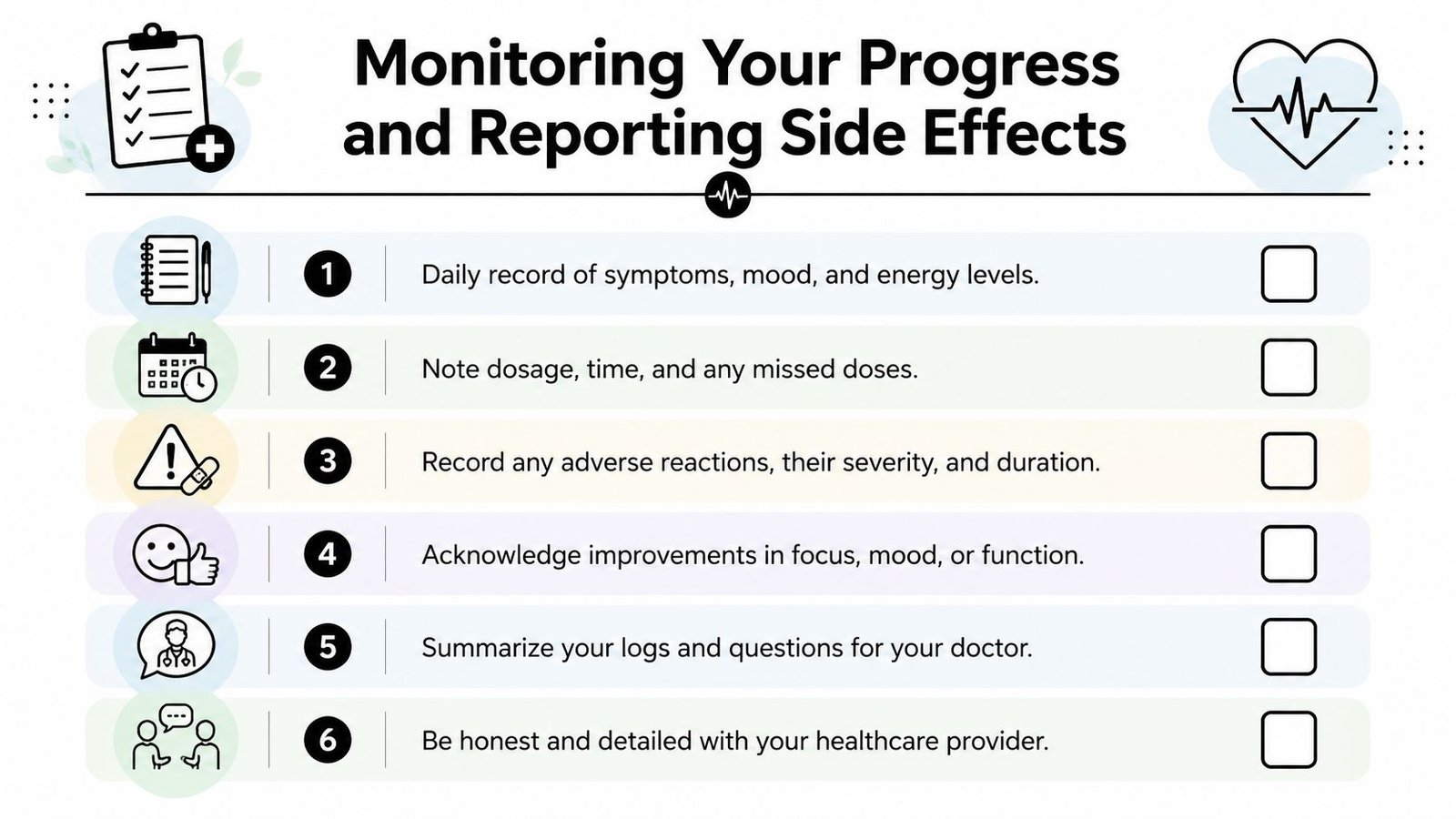
Monitoring Your Progress and Reporting Side Effects
Titration isn't something that happens only in the doctor's room. It happens in your working day, your sleep pattern, your appetite, your mood, your relationships, and your routine. That means your observations are clinically useful.
Access to diagnosis and treatment is still a major issue. A 2025 analysis of UK GP records found that only 0.32% of adults had a diagnosed ADHD condition, suggesting that approximately 1 in 9 people with ADHD in the UK remain undiagnosed. For those who do receive a diagnosis, getting treatment right really matters.
What to track each day
You don't need a complicated spreadsheet. A notebook, phone note, or simple daily template is enough if you use it consistently.
Try logging these areas:
- Dose details: What you took, what time you took it, and whether you missed or delayed a dose.
- Positive effects: Better focus, less procrastination, calmer thinking, improved emotional control, or clearer task switching.
- Physical changes: Appetite, sleep onset, dry mouth, headaches, nausea, pulse awareness, or feeling “too wired”.
- Emotional shifts: Irritability, anxiety, flatness, rebound symptoms later in the day, or improved steadiness.
- Functioning: Work output, household tasks, studying, driving, time management, and conversations.
The best logs are concrete. “Felt weird” is understandable, but “took dose at 8 am, focused well until lunchtime, appetite reduced, headache by 4 pm” gives your clinician something usable.
What kind of feedback helps most
Patients sometimes worry they need to report things perfectly. You don't. You just need to be specific enough for patterns to emerge.
These examples are more useful than vague summaries:
| Less helpful | More helpful |
|---|---|
| “It isn't working.” | “I can focus better for part of the morning, but by early afternoon I'm losing the effect.” |
| “Side effects are bad.” | “My appetite drops at lunch and I'm struggling to eat until evening.” |
| “I feel odd.” | “About an hour after the dose I feel tense and jittery, then it settles.” |
Bring both positives and negatives. If you report only problems, the dose may seem worse than it is. If you report only benefits, your clinician may miss something important.
If you want a broader safety perspective on how medicine effects and adverse events are tracked in practice, this practical pharmacovigilance guide offers helpful background in plain language.
For a focused patient guide on common problems and what they can mean, this overview of ADHD medication side effects is worth reading before your next review.
How to make your next appointment easier
Before each check-in, summarise your notes into a few lines:
- What improved.
- What became harder.
- When the medication seemed to start working.
- When it seemed to wear off.
- Any side effect that felt persistent or concerning.
That short summary often tells a psychiatrist far more than a general statement like “I'm not sure”. Uncertainty is fine, but examples make it easier to decide whether to hold the dose, move it, or reconsider the plan.
Essential Titration FAQs and When to Call Your Clinician
Patients usually ask the same practical questions once titration is under way.
How will I know we've found the right dose
You'll usually notice that the benefits are consistent enough to matter in ordinary life, and the side effects feel tolerable rather than disruptive. You shouldn't need to feel dramatic internal changes for the treatment to be working. Often the strongest sign is better function.
What if I miss a dose
Follow the advice your prescriber gave for that specific medication. Don't automatically double the next dose. Different medicines have different instructions, and timing matters.
Can I drink alcohol during titration
Ask your own prescriber, because the safe advice depends on the medication, your health background, and how you've been responding so far. During early titration, it's often wise to be cautious because alcohol can make it harder to judge what the medication itself is doing.
Is it normal to have mild side effects at first
It can be. Some early effects settle as your body adjusts. Others don't, and that's why monitoring matters. Report anything persistent, bothersome, or unexpected rather than waiting and hoping it will disappear.
When should I contact my clinician sooner than planned
Don't wait for the next routine review if you have:
- Marked side effects: Symptoms that feel intense, escalating, or hard to tolerate.
- Physical concerns: Significant changes that worry you, especially if they involve your heart rate, blood pressure, or general physical wellbeing.
- Mental health deterioration: Worsening anxiety, low mood, agitation, or any sharp change in how safe or stable you feel.
- Confusion about the plan: Uncertainty about dose timing, missed doses, or whether to continue.
If something feels significantly wrong, contact your prescribing team promptly. If it feels urgent or severe, seek urgent medical help rather than waiting for a scheduled psychiatric review.
Titration is at its best when it feels collaborative. You bring lived experience. Your clinician brings prescribing expertise. Together, you work towards a dose that supports concentration, regulation, and daily life without asking your body to tolerate more than it should.
If you're looking for consultant-led support for adult ADHD, autism, and wider mental health assessment and follow-up, Insight Diagnostics Global offers online and face-to-face care with structured evaluations, clear reports, optional follow-up, and ADHD medication titration and monitoring. It's a practical option for adults who want a thorough, compassionate pathway after diagnosis.