

You may be here because life has started to feel harder than it looks from the outside. You get through work, meetings, messages, family demands, maybe university deadlines too. Then you crash. Social situations leave you wrung out. Small changes derail your whole day. You’ve been told it’s stress, anxiety, burnout, depression, maybe ADHD. Part of that may be true. But many adults reach this point and start asking a different question. Is there an underlying neurodevelopmental reason why everything takes so much effort?
That question is often the beginning of an autism assessment. In practice, adults rarely arrive saying, “I think I meet diagnostic criteria.” They arrive saying, “I’ve always felt out of step,” or “I can perform well, but I can’t sustain it,” or “I copy everyone else and then I’m exhausted.” If you recognise yourself in that, you’re not overthinking it. You’re trying to make sense of a pattern.
As a consultant psychiatrist working across autism, ADHD, mental health, and psychological assessment, I’ve seen how often the full story gets missed when clinicians focus only on burnout, only on mood, or only on surface-level coping. The most useful assessments take the whole picture seriously. That includes developmental history, current functioning, co-occurring ADHD, anxiety, depression, and sometimes personality difficulties that can look similar from a distance but need a very different formulation.
Is It Burnout or Something More An Introduction
A common adult presentation goes like this. Someone has held it together for years by being organised, careful, perfectionistic, and socially observant. Colleagues think they’re coping. Friends may describe them as quiet, intense, sensitive, or “a bit private”. Then work gets busier, relationships become more demanding, or routine falls apart. What looked like resilience starts to look like collapse.

They may report shutdown after meetings, intense distress around uncertainty, sensory overwhelm in open-plan offices, or a lifelong sense of studying social rules rather than intuitively knowing them. Some have already been treated for anxiety or depression and found the explanation only partly fits. Others have ADHD traits as well, which can complicate the picture further.
Why more adults are asking the question now
In the UK, clearer legal and clinical frameworks have helped more people seek answers. A major milestone was the Autism Act 2009 and the later development of statutory autism guidance in UK services. That same overview notes that 79% of children with autism are diagnosed after entering primary school, with 28% diagnosed during secondary school, which tells us something important. Late recognition isn’t unusual. It has been built into the system for years.
For adults, that delay often means reaching assessment after a long period of self-doubt. By then, the person may have collected several labels but still not feel understood.
Many adults don’t need convincing that they’re struggling. They need a careful explanation for why the struggle has been so persistent and so specific.
Burnout isn’t a diagnosis
Burnout is real, but it doesn’t explain everything. It describes a state of depletion. It doesn’t tell you why ordinary social demands, sensory environments, transitions, or unstructured communication may have always felt unusually taxing.
That’s where the phrase ASD diagnosis criteria UK becomes relevant in a practical sense. It isn’t about fitting yourself into an internet checklist. It’s about understanding whether your lifelong pattern aligns with a recognised neurodevelopmental profile, and whether that profile also overlaps with ADHD or other mental health needs that deserve proper treatment in their own right.
Understanding the Core ASD Diagnosis Criteria
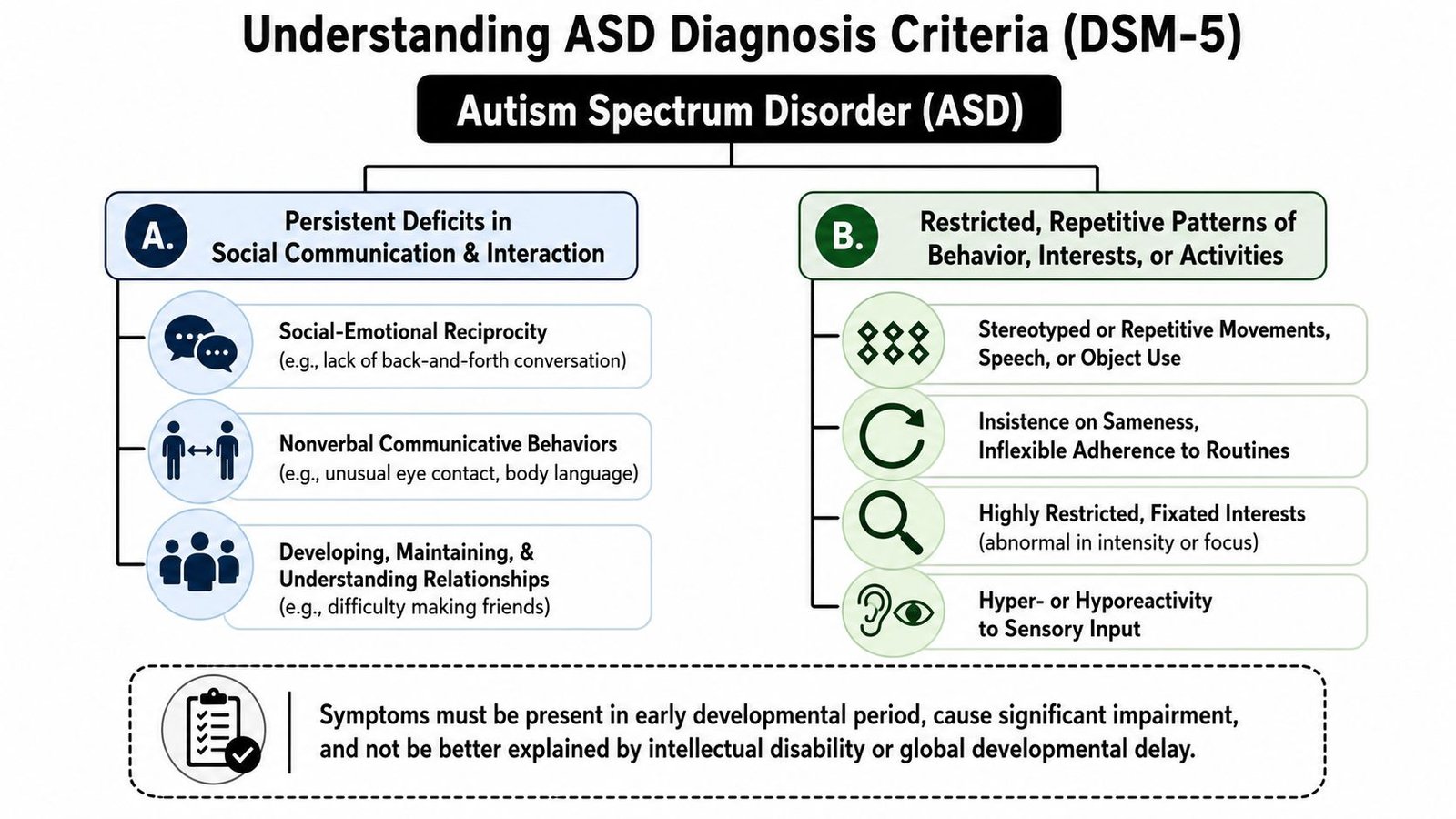
In the UK, autism diagnosis is anchored in the DSM-5 framework. The National Autistic Society’s overview of criteria and tools used in UK autism assessment states that a person must show persistent deficits across all three areas of social communication and interaction, plus at least two of four restricted or repetitive behaviour areas, with symptoms present in early development and causing clinically significant impairment.
Criterion A social communication and interaction
Criterion A has three parts. In practice, all three need to be explored.
- Social-emotional reciprocity. This is the back-and-forth part of interaction. Some adults can talk fluently but still struggle with timing, spontaneity, or knowing how much to say. Others find conversation easier when it’s factual, structured, or about a special interest.
- Nonverbal communication. This includes eye contact, facial expression, gesture, tone, and reading other people’s signals. Adults often tell me they learned these skills by observation rather than instinct. They can do it, but it feels effortful.
- Developing and understanding relationships. This can involve difficulty maintaining friendships, confusion about social expectations, or finding group dynamics opaque. It may show up as having very few close relationships, or repeatedly misreading what others mean.
A key point here is that autism doesn’t require social indifference. Many autistic adults crave connection. The difficulty lies in the processing, not the desire.
Criterion B restricted and repetitive patterns
Criterion B requires at least two areas.
| Area | How it may look in adult life |
|---|---|
| Repetitive speech, movement, or use of objects | Repeating phrases, pacing, fidgeting in a regulating way, rigid ways of arranging things |
| Insistence on sameness | Distress when plans change, needing known routines, strong preference for predictability |
| Highly focused interests | Deep, absorbing interests that bring expertise, comfort, and structure |
| Sensory differences | Overwhelm from sound, light, texture, smell, or, for some people, reduced sensitivity in certain areas |
Clinical reality: adults often minimise these traits because they’ve built workarounds. The workaround matters, but the underlying pattern matters more.
Criterion C and D matter just as much
The formal framework also requires that signs were present in the early developmental period and that they cause clinically significant impairment. This is why clinicians ask about childhood, school, friendships, play, routines, and family observations.
What doesn’t work is judging autism only by how someone appears in a single appointment. Many adults have spent years rehearsing normality. Good assessment looks underneath performance.
The Official UK Assessment Pathway Explained
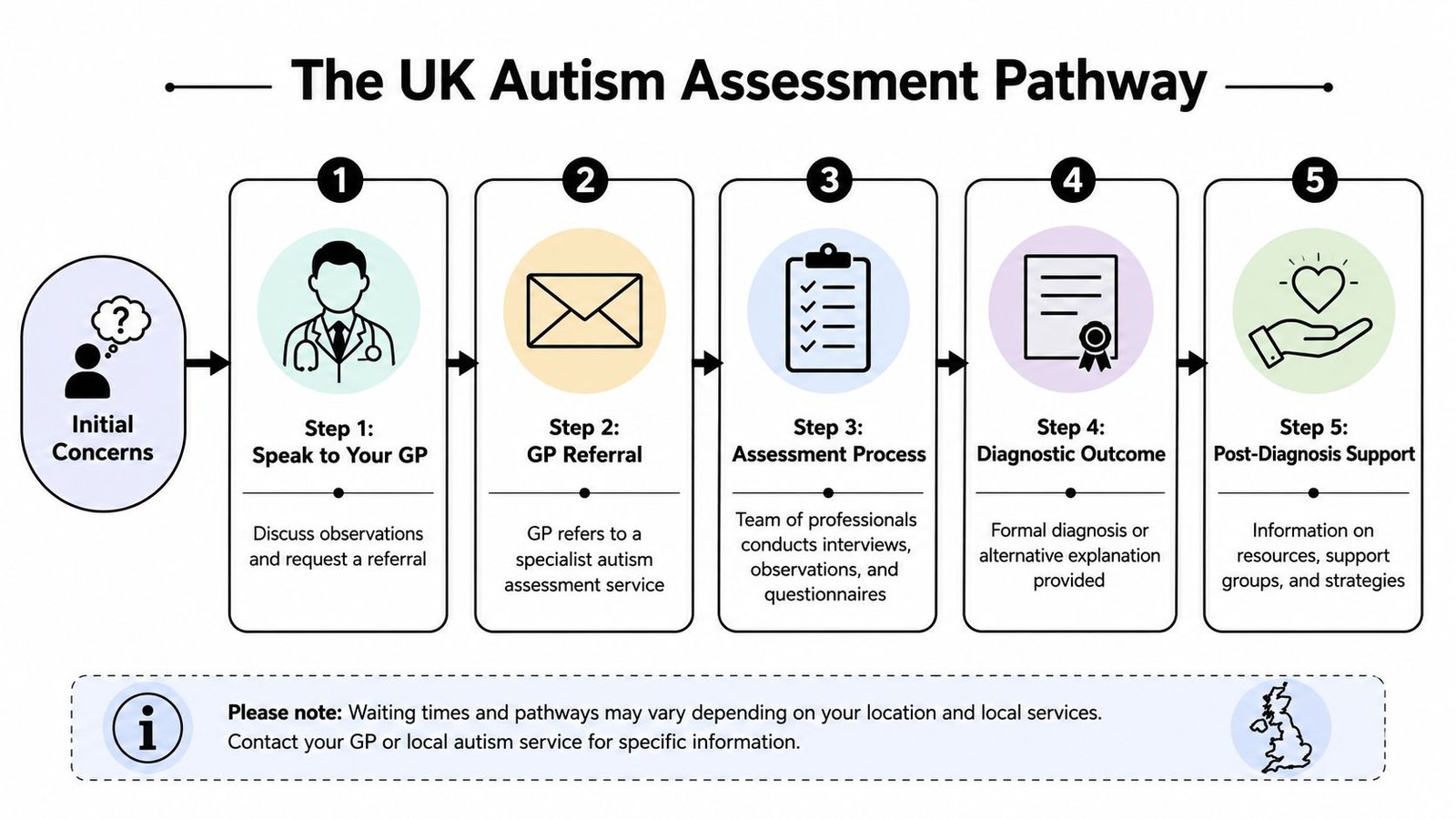
The formal pathway usually starts with your GP. That first conversation goes better when you bring examples rather than broad statements. “I think I’m autistic” is valid, but “I’ve always struggled with social reciprocity, sensory overload, and rigid routines, and this affects work and relationships” gives the clinician something concrete to act on.
What happens after a GP referral
England’s national framework describes two levels of assessment. In the NHS England national autism assessment pathway guidance, a standard autism assessment includes a clinical interview, behavioural observation, and integration of developmental history. An enhanced autism assessment adds validated tools and broader analysis of the person’s presentation.
That distinction matters. Some adults have a straightforward neurodevelopmental history. Others have overlapping ADHD, trauma, mood symptoms, personality factors, or a very masked presentation. They often need the enhanced level of clinical formulation.
A useful overview of the process is below.
What a multidisciplinary assessment means in real life
People often hear “multidisciplinary” and imagine a confusing parade of professionals. It’s more structured than that. The UK framework expects autism assessment to be triage-driven and clinically integrated. Depending on age and service setup, this may involve psychiatry, psychology, speech and language input, occupational therapy, or paediatrics.
For adults, the practical components often include:
- Developmental history drawn from you and, where possible, someone who knew you early in life
- Clinical interview focused on current functioning, patterns across time, and alternative explanations
- Observation and tools used to add depth, not replace judgement
- Functional impact review covering work, relationships, study, daily living, and mental health
Right to Choose and self-advocacy
Many adults also ask about Right to Choose. The exact route depends on where you live and what services your GP can refer to, but the principle is simple. You don’t always have to accept the default local pathway if another commissioned service is available. Ask directly what options exist.
If your first referral stalls, that doesn’t mean your concerns weren’t valid. It often means the pathway is complicated.
What works is persistence plus good documentation. What doesn’t work is assuming the clinician can infer your developmental story from your current level of masking.
NHS vs Private Diagnosis A Practical Comparison
For some people, the NHS route is the right fit. For others, private assessment is more realistic because they need answers sooner, need more scheduling flexibility, or want a senior clinician to hold the whole picture from the outset. The trade-off isn’t merely free versus paid. It’s about pace, complexity, continuity, and confidence in the formulation.
NHS vs Private ASD Assessment at a Glance
| Factor | NHS Pathway | Private Pathway (e.g., Insight Diagnostics) |
|---|---|---|
| Cost to patient | Usually funded through the NHS | Self-funded or sometimes covered through eligible insurance arrangements |
| Waiting period | Can be lengthy and variable by area | Often quicker and easier to schedule |
| Referral route | Usually starts with GP referral | May allow direct self-referral, depending on service |
| Assessment structure | Can be robust, but service models vary locally | Often more flexible in appointment format and timing |
| Clinician continuity | You may see more than one professional across the pathway | Often easier to have one lead clinician overseeing the assessment |
| Complex presentations | Good services manage complexity well, but capacity pressures can narrow scope | Consultant-led services may offer more time for differential diagnosis |
| ADHD and mental health overlap | May require separate pathways or additional referrals | Can sometimes be integrated more efficiently within one service |
| Post-diagnostic follow-up | Support varies by locality | Often clearer if the provider also offers follow-up consultations |
When the NHS pathway works well
The NHS route can work very well if your local service is well organised, your GP referral is detailed, and your presentation is recognised early. It also matters if you are happy to wait and your immediate priority is formal recognition rather than urgent workplace or university adjustments.
The downside is variability. Two people in neighbouring areas can have very different experiences. Some are assessed promptly and thoroughly. Others spend months trying to clarify where the referral even sits.
When a private route makes sense
Private assessment is often worth considering if delay is increasing distress, if you need documentation for work or study sooner, or if your presentation includes several overlapping possibilities. Adults with possible autism, ADHD, anxiety, depression, trauma history, or longstanding interpersonal difficulties often benefit from psychiatrist-led formulation because someone needs to weigh what belongs to what.
The quality of the clinician is more important than the label “private”. A fast appointment is useful. A superficial assessment isn’t.
The best pathway is the one that gives you a defensible, carefully reasoned answer. Not just a quick one.
Navigating Diagnosis Nuances for Adults and Women
Adult autism rarely looks like an online stereotype. Many adults have jobs, relationships, and articulate self-awareness. Those strengths don’t rule autism in or out. They mean the clinician has to look beyond clichés.
Masking can hide the pattern
Masking, sometimes called camouflaging, is the effort to copy socially expected behaviour in order to fit in, avoid criticism, or reduce misunderstanding. Adults may study facial expressions, rehearse scripts, suppress stimming, force eye contact, or mirror other people’s tone. Over time, this can become so automatic that the person no longer knows what feels natural.
The clinical problem is obvious. If the assessment only looks at visible behaviour in the room, a heavily masked adult may appear “too social” or “too capable” to be autistic. That’s a poor conclusion if the effort involved has been immense and unsustainable.
Why women are missed more often
The Ambitious about Autism discussion of the gender gap in autism notes that girls are diagnosed 1.8 years later than boys on average, and that depression or anxiety often overshadows autistic traits. That pattern continues into adulthood. Women are often treated repeatedly for the emotional consequences of chronic misunderstanding before anyone asks whether the underlying neurodevelopmental picture has been missed.
In practice, women may present with:
- Social imitation that looks fluent but feels scripted
- Intense but socially acceptable interests that don’t fit the old stereotype
- Exhaustion after interaction, rather than obvious social withdrawal
- Self-criticism and anxiety arising from years of trying to get it right
Autism, ADHD, and mental health overlap
Autism and ADHD commonly overlap in real clinical work. One person may need routine but also struggle to sustain it. They may crave predictability and still miss deadlines. They may dislike interruption yet live in constant cognitive clutter. If you assess only one condition, the final picture may be incomplete.
The same goes for mental health. Repeated low mood may reflect chronic invalidation. Anxiety may be amplified by sensory overload or social processing demands. Some people have genuine personality disorder features, but others have been given that label when the core issue was misunderstood autism with trauma or emotional burnout layered on top.
What works is differential diagnosis. What doesn’t work is forcing every difficulty into a single category.
How to Prepare for Your Autism Assessment
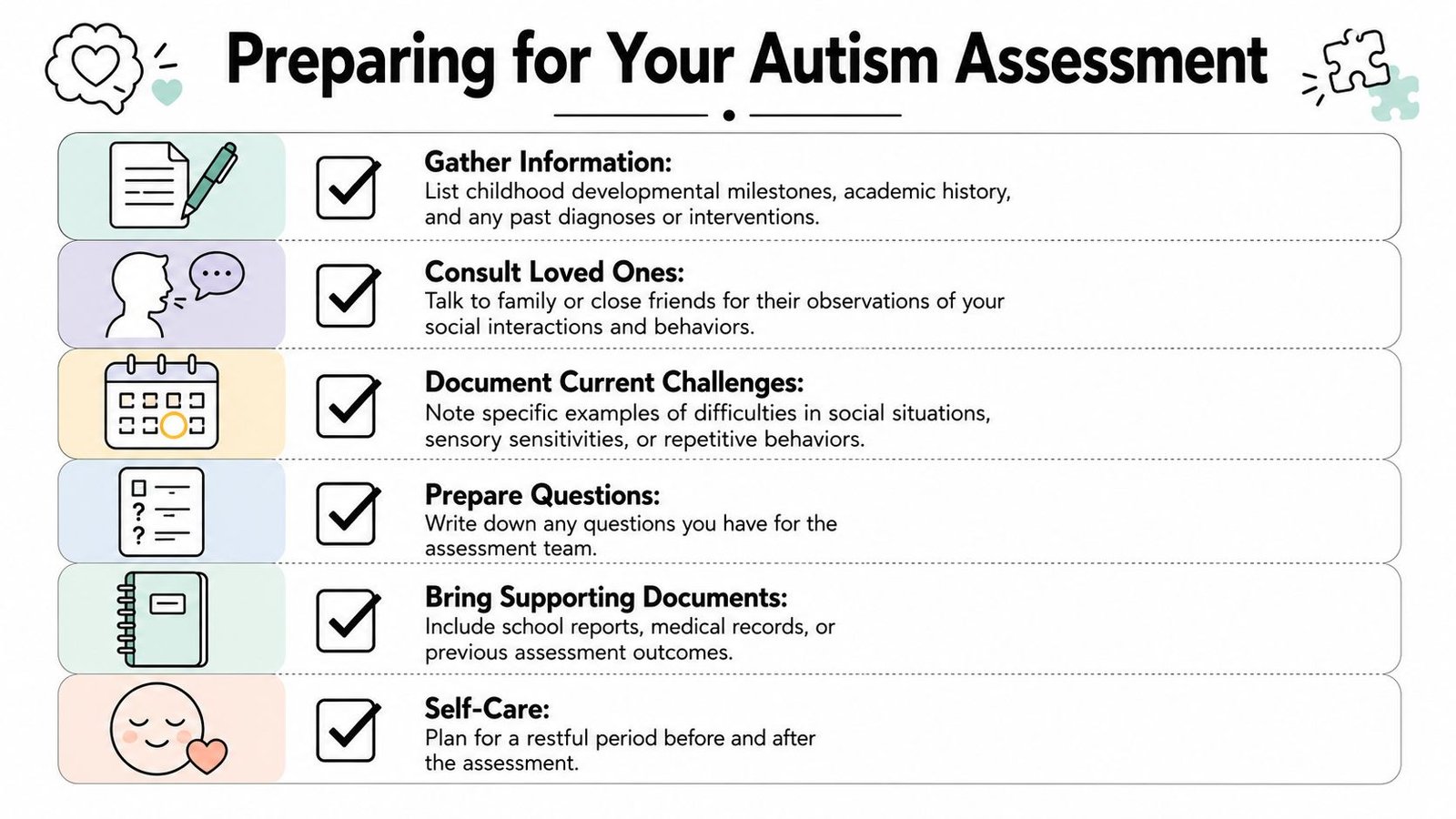
Preparation doesn’t mean rehearsing the “right” answers. It means bringing enough real-world evidence that the clinician can understand you accurately. The best assessments are collaborative. They work better when you arrive with examples, history, and a sense of what has been difficult across your life, not only this month.
What clinicians need to build a sound picture
The SIGN 145 guideline for autism assessment states that specialist assessment should include history-taking, clinical observation or assessment, and wider contextual and functional information. That mirrors what good adult assessment requires in practice.
Bring what helps the clinician see patterns across time.
- Childhood history. School reports, descriptions of friendships, sensory sensitivities, routines, unusual interests, speech or language patterns, and any early concerns.
- Current examples. Specific situations where communication, change, sensory input, or executive functioning become difficult.
- Mental health background. Past diagnoses, therapy experiences, medication history, and what did or didn’t help.
- Collateral information. If possible, ask a parent, sibling, partner, or long-term friend what they’ve noticed.
If your GP is making the referral, it can help to build a perfect referral form so key developmental and functional details aren’t left out. A well-structured referral often leads to a smoother assessment journey.
Practical ways to organise your thoughts
A simple method works best. Write notes under three headings.
Then
What were you like as a child, teenager, and young adult? Think about school, play, friendships, routines, sensitivities, and whether you felt different.Now
Where do difficulties show up today? Work meetings, relationships, commuting, food, noise, change of plans, emails, multitasking, burnout.Cost
What does it take to keep going? Masking, exhaustion, recovery time, avoidance, shutdown, anxiety, or conflict.
Don’t minimise because you’ve coped. Coping methods are part of the clinical evidence.
How to make the day easier
Try not to over-schedule the day before or after the appointment. If assessments leave you drained, plan recovery time. Bring written notes if you tend to go blank under pressure. If you suspect ADHD as well, say so directly. It’s far better for the clinician to explore overlap than to miss part of the picture.
Your Diagnosis and What Comes Next
A diagnosis often brings relief, but relief isn’t the only reaction. Some people feel validated immediately. Others need time to reprocess their past through a new lens. Both responses are normal.
What matters most is what you do with the information. A good diagnosis gives you language for your experiences, a framework for self-advocacy, and a basis for practical changes. It can help you request reasonable adjustments at work or university, communicate needs more clearly in relationships, and make better sense of burnout patterns.
Useful next steps after diagnosis
- Read your report carefully and highlight the parts that describe you most accurately.
- Ask about post-diagnostic support if it isn’t offered automatically.
- Review workplace or university adjustments such as quieter environments, clearer written instructions, predictable scheduling, or flexibility around communication methods.
- Look at co-occurring conditions. If ADHD, anxiety, depression, trauma, or sleep problems are also present, they still need treatment.
- Connect with autistic community perspectives so the diagnosis becomes lived understanding, not just paperwork.
A diagnosis is not a verdict on your limitations. It’s an explanation. Used well, it can reduce shame, sharpen treatment planning, and make daily life more sustainable.
If you want a clear, consultant-led route to assessment, Insight Diagnostics Global provides online and face-to-face evaluations for adults aged 18 and over across autism, ADHD, and wider mental health needs. The service is CQC regulated, led by psychiatrists on the GMC Specialist Register, and designed to give you a thorough diagnostic report with personalised treatment and support recommendations. If you’ve been stuck between burnout, ADHD, autism, and anxiety and need a careful answer rather than another vague impression, it’s a sensible next step.