

In the UK, psychologists cannot prescribe medication. If you’re looking for a psychologist that can prescribe medication, the direct answer is no, and the safest next step is to understand why, who can prescribe, and how to reach the right assessment and treatment pathway for ADHD, autism, and mental health concerns.
If you’re reading this, you may already have spent hours trying to work out whether you need a psychologist, a psychiatrist, your GP, or a specialist clinic. Many adults come to this question when they’re exhausted, struggling to focus, wondering about ADHD or autism, or trying to make sense of anxiety, burnout, low mood, emotional dysregulation, or long-standing relationship and personality difficulties.
That confusion is understandable. In practice, people aren’t just asking about a job title. They’re asking who can assess them properly, who can diagnose, who can prescribe if medication might help, and who will take their concerns seriously.
From the perspective of consultant-led psychiatric practice, that distinction matters a great deal. For neurodevelopmental conditions and broader mental health work, good care often involves both psychological assessment and medical oversight. Those are related roles, but they aren’t the same role.
Focus on Autism and ADHD and mental health alongside psychological assessment is where many patients need the clearest guidance, especially when symptoms overlap. At the consultant level, that means careful diagnostic thinking, practical risk assessment, and a treatment plan that fits the person rather than a label. In complex presentations involving neurodevelopmental conditions and personality disorder features, experienced clinicians such as Dr Sai Achuthan, a leading Consultant Psychiatrist working in neurodevelopmental and personality disorder assessment, illustrate the depth of expertise that patients often need when the picture isn’t straightforward.
The Search for Clarity in Mental Health Care
Many people arrive at mental health services carrying several questions at once. Am I dealing with ADHD, autism, anxiety, trauma, depression, personality difficulties, or some mixture of them? Do I need therapy, medication, formal assessment, or all three? And if I’ve found someone online who sounds qualified, can they prescribe?
The UK system can feel fragmented because different professionals do different jobs, and patients are often expected to decode that themselves while already under strain. That’s one reason the current environment feels so difficult to understand. The UK government’s Independent Review into mental health conditions, ADHD and autism states that NHS services have never fully met the population’s needs in an individualized, personalised, or timely way, with systemic gaps in care delivery and access.
Why patients get stuck
A common pattern is this. Someone recognises symptoms in themselves, starts researching ADHD or autism, then discovers terms like clinical psychologist, counselling psychologist, psychiatrist, ADHD specialist, therapist, and prescriber. The words sound close enough to be interchangeable. They aren’t.
That matters because a wrong assumption can delay care. You may book an appointment expecting diagnostic authority, medication advice, or titration support, then realise the professional you saw doesn’t offer that part of the pathway.
Good mental health care starts with role clarity. When patients know who assesses, who diagnoses, and who prescribes, decisions become much less overwhelming.
A useful way to organise your thinking
Before booking anything, it often helps to separate your needs into three lanes:
- Assessment needs: Are you seeking clarity about ADHD, autism, or another mental health condition?
- Treatment needs: Are you looking for therapy, medication, or a combined plan?
- Practical needs: Do you need NHS care, Right to Choose, private access, insurance authorisation, or faster appointments?
For a broad overview of how mental health evaluations are usually structured, Orange Neurosciences’ assessment guide is a useful plain-English resource. It won’t replace UK-specific advice, but it can help you understand what a proper assessment is trying to achieve.
Psychologist vs Psychiatrist The UK Prescribing Divide
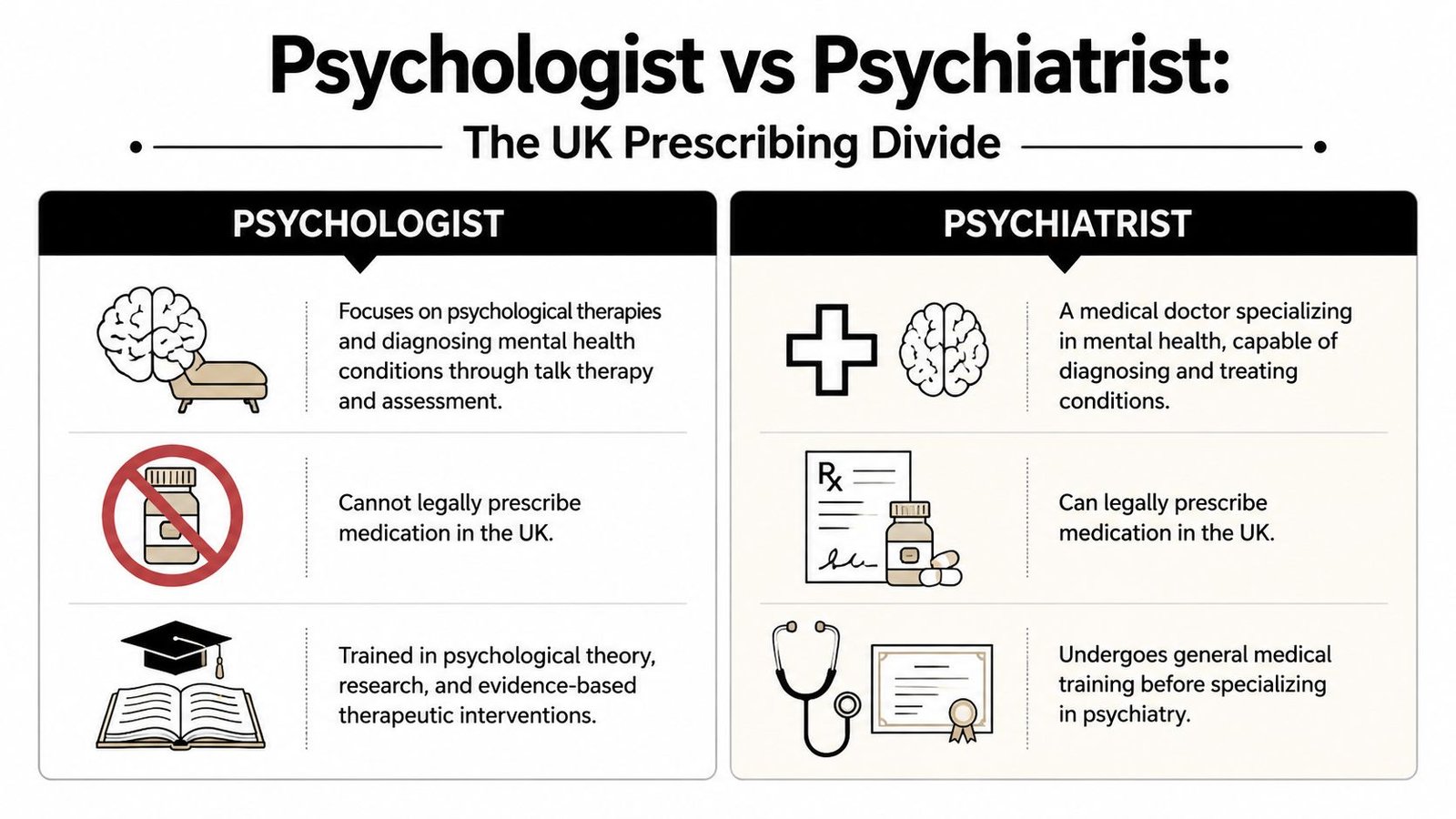
The cleanest way to answer the prescribing question is to compare the roles directly. Both psychologists and psychiatrists work in mental health. Both may assess complex conditions. Both may be highly experienced. But in the UK, they do not have the same legal authority.
What a psychologist does
A clinical psychologist or counselling psychologist typically focuses on psychological formulation, structured assessment, and therapy. That can include cognitive testing, diagnostic interviews, behavioural analysis, trauma work, personality assessment, and evidence-based psychological treatment.
For many patients, psychologists are central to care. They’re often the right professionals for in-depth therapy, nuanced psychological understanding, and certain forms of assessment. In ADHD and autism work, psychological input can be very valuable, especially where masking, trauma, emotional regulation, or functional impact need detailed exploration.
What they cannot do in the UK is prescribe medication. The British Psychological Society has made clear that psychologists are currently legally prohibited from prescribing, and that any change would require legislation from Parliament plus extensive post-qualification training within a multi-disciplinary team, which they currently cannot grant, as outlined in this British Psychological Society discussion on prescribing rights.
What a psychiatrist does
A psychiatrist is a medically trained doctor who specialises in mental health. That matters because diagnosis and treatment sometimes require medical judgement as well as psychological understanding. A psychiatrist can assess symptoms in the context of physical health, medication effects, risk, co-occurring conditions, and the possible need for prescribing.
In practice, that makes psychiatrists especially important when patients are asking questions such as:
- Could medication help me?
- Is this ADHD, bipolar disorder, anxiety, trauma, autism, or more than one thing?
- Are my symptoms being worsened by sleep problems, substance use, physical illness, or another prescribed drug?
- Do I need ongoing monitoring if treatment starts?
Why the legal divide exists
The issue isn’t whether psychologists are skilled. Many are exceptionally skilled. The issue is that prescribing carries legal, medical, and governance responsibilities. It involves understanding indications, contraindications, side effects, physical monitoring, interactions, and follow-up systems.
A short comparison helps:
| Role | Main focus | Can prescribe in the UK | Typical contribution |
|---|---|---|---|
| Psychologist | Therapy and psychological assessment | No | Formulation, testing, therapy |
| Psychiatrist | Medical diagnosis and mental health treatment | Yes | Diagnosis, medication, monitoring |
Practical rule: If you think medication may be part of your care, you need a prescribing professional involved early, even if a psychologist also plays an important part.
Who Legally Prescribes Mental Health Medication
Once you know that psychologists can’t prescribe, the next question is usually who can. In UK practice, there are a few lawful routes, but they aren’t interchangeable.

Under the Human Medicines Regulations 2012, prescribing psychotropic drugs is restricted to medically qualified professionals such as psychiatrists and specific non-medical prescribers, which legally excludes psychologists, as explained in this overview of UK prescribing restrictions.
The GP as first contact
For many adults, the GP is the starting point. A GP can listen to your concerns, consider whether symptoms suggest ADHD, autism-related difficulties, anxiety, depression, or another mental health condition, and decide whether referral is appropriate.
GPs can prescribe some mental health medications within their competence and shared care arrangements. But for complex first presentations, especially where neurodevelopmental assessment is being considered, the GP’s role is often to open the pathway rather than complete the whole process.
The Consultant Psychiatrist as specialist prescriber
A Consultant Psychiatrist is usually the most appropriate professional for complex diagnosis and specialist medication planning. That includes situations where symptoms overlap, where risk needs careful management, or where you may have more than one condition at the same time.
This is particularly relevant in adult services for:
- ADHD assessment and medication decisions
- Autism assessments where mental health conditions overlap
- Mood instability and emotional dysregulation
- Personality disorder assessment
- Diagnostic uncertainty
When patients ask me what works best in complicated cases, the answer is usually consultant-led assessment. Not because every case needs medication, but because every complex case needs someone who can evaluate whether medication is indicated, whether it is safe, and whether another explanation fits better.
A clinician with deep neurodevelopmental and personality disorder expertise, such as Dr Sai Achuthan, brings that level of specialist judgement. That sort of senior input is often what turns a confusing story into a coherent treatment plan.
Other non-medical prescribers
There are also specific non-medical prescribers, such as some nurses and pharmacists, depending on their qualifications and scope of practice. They can play an important role in established treatment pathways.
But there’s a trade-off. For an initial complex diagnosis, they usually aren’t the professional patients should rely on as the sole source of diagnostic clarity. Their strength is often in structured prescribing within defined systems, rather than in untangling a broad and uncertain diagnostic picture from the start.
Why the Confusion A Look at Prescribing Psychologists Abroad
The phrase psychologist that can prescribe medication didn’t come from nowhere. It exists because in some countries, especially parts of the United States, specially trained psychologists can prescribe under certain legal frameworks.
That’s why patients in the UK often find mixed information online. They’re reading material written for a different healthcare system and assuming it might apply here.
What happens in the United States
The United States is the primary country where specially trained psychologists can prescribe medication, and that practice began in New Mexico in 2002, according to this overview of the US prescribing psychologists movement. The same source notes that, as of 2025, approximately 350 licensed prescribing psychologists practise nationwide in the US.
These psychologists don’t gain prescribing authority by default. They must complete additional training in clinical psychopharmacology. In the jurisdictions where this model operates, the route includes a doctoral degree, an independent practice licence, a postdoctoral master’s level qualification such as an MSCP, supervised practice, and passing the PEP-2 examination. The same source also gives a concrete example from New Mexico, where the law requires 450 hours of didactic instruction, a 400-hour supervised practicum, and supervised care for 100 patients.
Why that doesn’t apply in the UK
This overseas model explains the search term, but it doesn’t change the UK legal position. UK patients sometimes assume that because the role exists elsewhere, a private provider here may offer the same arrangement. That isn’t how the law currently works.
The question is reasonable. The assumption is the problem. A role that exists in parts of the US does not create prescribing authority in the UK.
The practical takeaway is simple. If you live in the UK and need assessment for ADHD, autism, or another mental health condition, and medication may be part of the plan, you need a lawful UK prescriber in your pathway.
Your Practical Pathways to Assessment and Medication
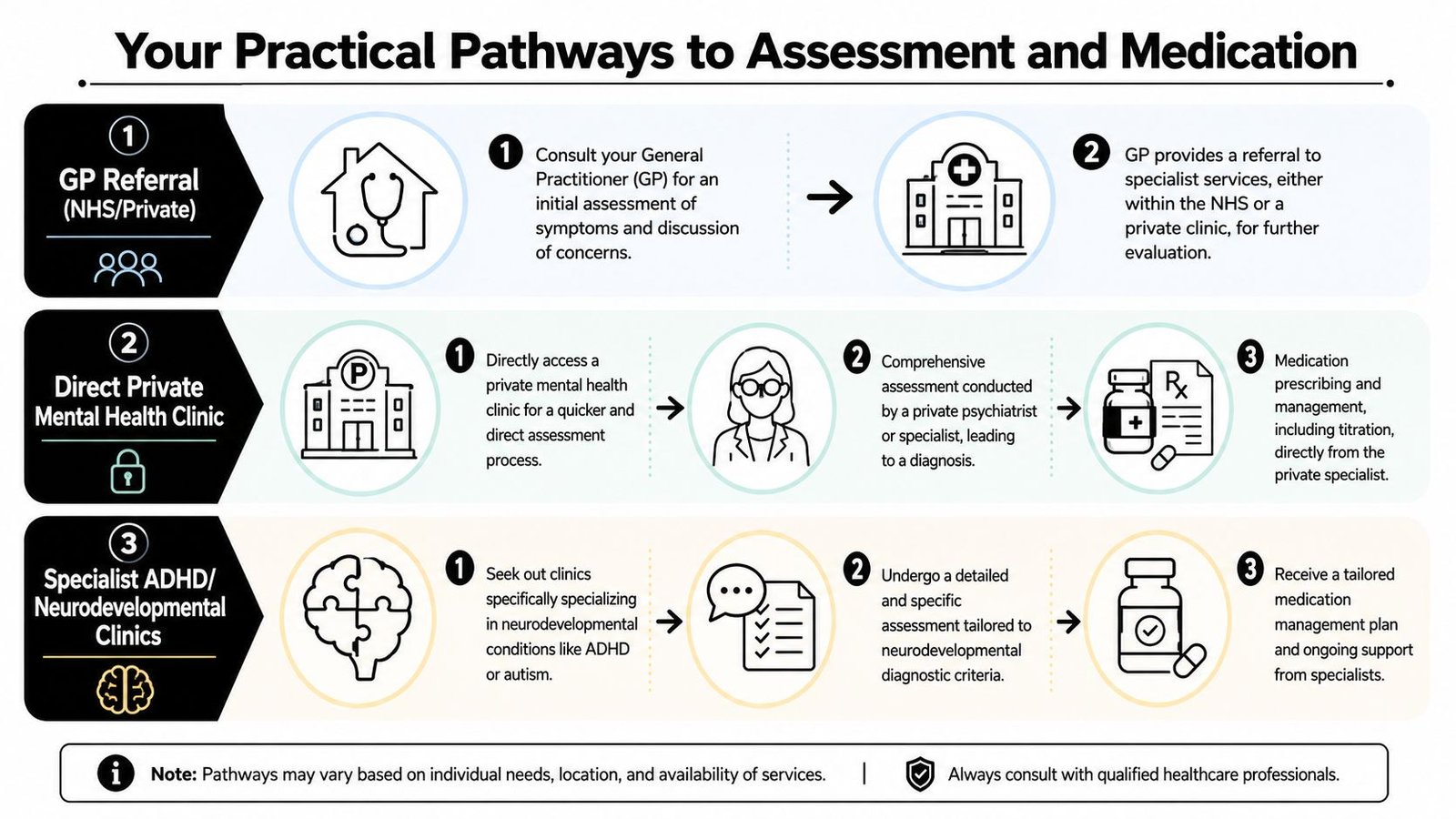
Once you know who can prescribe, the next issue is access. Most patients don’t need more theory at this point. They need a route they can use.
For ADHD in particular, diagnosis in the UK must follow a full specialist assessment. NICE states that ADHD should be diagnosed by a specialist psychiatrist, paediatrician, or other appropriately qualified healthcare professional with training in ADHD, based on a full clinical and psychosocial assessment that includes behaviour across different domains, developmental and psychiatric history, and observer reports, as set out in the NICE ADHD recommendations.
Route one through your GP
The standard route is to book a GP appointment and explain your concerns clearly. If ADHD, autism, or another significant mental health issue seems likely, your GP can refer you into specialist assessment services.
This route is often right when you want care to sit within the NHS from the outset. It can also be a sensible starting point if you’re unsure whether your symptoms are primarily mental health, neurodevelopmental, physical, or mixed.
Route two through Right to Choose in England
If you’re in England, Right to Choose may widen your options. Under this scheme, adults seeking ADHD assessment must be formally referred by their GP to a provider. The referral can’t be self-initiated, and the patient should bring a covering letter to the GP and a completed ASRS form to confirm symptom consistency, according to Psychiatry UK’s Right to Choose guide.
The key point is that RTC still starts with the GP. Patients often miss that and assume they can book themselves in. They can’t.
Route three through private specialist care
The private route is usually the fastest and most flexible. It’s often the best fit when:
- You need clarity quickly: Work, study, parenting, or burnout may make a long wait unrealistic.
- Your presentation is complex: Overlap between ADHD, autism, anxiety, trauma, mood symptoms, and personality traits needs a senior diagnostic eye.
- You want continuity: Assessment, prescribing, and follow-up are easier when one team manages the full process.
Private care isn’t automatically better. But it often works better for people who need timely access, consultant involvement, and a more direct route into treatment if medication becomes appropriate.
The Assessment and Titration Process Explained
Patients are often less anxious once they know what happens after referral or booking. Assessment and treatment are rarely a single appointment followed by an instant prescription. Good practice is more deliberate than that.

What a proper assessment looks like
A strong neurodevelopmental or psychiatric assessment usually involves a detailed clinical interview, developmental history, review of current symptoms, functional impact, and screening for overlapping conditions. In adults, that often means looking beyond the headline complaint.
Someone may ask for ADHD assessment because they struggle with focus. During the interview, it may become clear that anxiety, trauma, sleep disruption, autistic traits, depression, substance use, personality structure, or burnout are also relevant. That doesn’t invalidate the concern. It improves the accuracy of the final opinion.
What happens if medication is appropriate
If ADHD medication is recommended, the next phase is often titration. Titration means carefully adjusting treatment to find a dose that helps symptoms while keeping side effects and physical risks under close review.
NHS Grampian guidance states that baseline checks before starting include medical and drug history, height, weight, blood pressure, and pulse, with weekly monitoring of blood pressure, pulse, and symptoms of somnolence and sedation during dose titration, as detailed in the NHS Grampian ADHD prescribing guideline.
That tells you something important. Prescribing isn’t just writing a script. It’s an ongoing clinical process.
Clinical reality: The safest medication plans are not rushed. They’re monitored, adjusted, and reviewed against both benefits and side effects.
What tends to work well
A few patterns consistently help patients during titration:
- Consistent monitoring: Blood pressure, pulse, symptoms, sleep, appetite, and side effects all matter.
- Honest feedback: If a medication helps focus but worsens anxiety, your prescriber needs to know.
- Realistic expectations: The first dose isn’t always the right dose, and the first medication isn’t always the right medication.
What doesn’t work is expecting medication alone to answer every difficulty. For many adults, the best outcomes come when prescribing is paired with practical support, psychoeducation, therapy, coaching, or workplace and study adjustments.
Navigating Your Journey to the Right Support
By this point, the core distinction should be much clearer. In the UK, a psychologist plays a valuable role in assessment and therapy, but not prescribing. A psychiatrist brings the medical authority to diagnose in complex cases, prescribe where appropriate, and monitor treatment safely.
For ADHD, autism, and broader mental health work, the right question usually isn’t just “who can prescribe?” It’s “who can assess my situation properly, explain the options clearly, and stay responsible for treatment if medication is part of the plan?”
Questions worth asking before you book
When speaking to any service or clinician, ask practical questions such as:
- Who will assess me? Ask whether the assessment is led by a psychiatrist, psychologist, or another qualified clinician.
- Can this service diagnose ADHD or autism in adults? You want clarity on scope, not assumptions.
- If medication is recommended, who prescribes and monitors it?
- What follow-up is included? Assessment without follow-up can leave patients stranded.
- How do you manage overlapping conditions? This matters if you suspect anxiety, depression, trauma, or personality difficulties alongside neurodevelopmental concerns.
A safety point that matters
There is also a governance reason why UK discussions about prescribing rights remain cautious. The British Psychological Society’s proposal states that if psychologists were ever granted prescribing rights, they would need to work within a multi-disciplinary team or practice network to ensure safe governance, meaning independent practitioners working in isolation would not meet the required safety standard, as set out by the British Psychological Society prescribing rights proposal.
That principle applies more broadly. Safe prescribing depends on structure, supervision, monitoring, and clear responsibility.
If a service seems vague about who diagnoses, who prescribes, and who follows you up, treat that as a warning sign.
When to seek urgent help
Specialist assessment services are not crisis services. If you’re at immediate risk, feel unable to keep yourself safe, or believe someone else is in danger, use urgent support instead. Call 999 in an emergency, or contact NHS 111 for urgent mental health help.
For non-emergency concerns, it’s reasonable to slow down, ask better questions, and choose a pathway that matches your needs. That usually means looking for thorough assessment, lawful prescribing where needed, and joined-up follow-up rather than a quick label.
If you want a consultant-led route for adult ADHD, autism, and broader mental health assessment, Insight Diagnostics Global offers online and face-to-face care for adults aged 18 and over, with structured evaluations, clear triage, diagnostic reports, and optional follow-up including ADHD medication titration and monitoring. The service is CQC regulated, staffed by psychiatrists on the GMC Specialist Register, and designed for people who want timely, thorough, clinically grounded support. It isn’t a crisis service, so for emergencies call 999 or contact NHS 111.