

You may be sitting with a familiar problem. You’ve read about ADHD or autism in adults, too much of it feels uncomfortably accurate, and yet the route to getting properly assessed seems opaque, slow, and full of terms nobody has explained clearly.
That uncertainty can be exhausting. Many adults reach this point after years of struggling at work, masking in social settings, burning out repeatedly, or being treated for anxiety and depression without anyone stepping back to ask whether an underlying neurodevelopmental condition could be shaping the whole picture.
A triage mental health assessment is often the first formal step into care. It isn’t the diagnosis. It isn’t the full answer. It’s the point where a service decides how urgent your needs are, whether there are immediate risks, and which pathway you should enter next. Once you understand that, the system starts to make more sense.
Dr Sai Achuthan, a leading Consultant Psychiatrist with extensive experience in neurodevelopmental and personality disorder assessment, would recognise this crossroads immediately. Adults often arrive knowing something is wrong, but not knowing how to explain it in a way the system can act on. That’s where clarity matters.
Feeling Stuck Before You Even Start
Many adults delay seeking help because they assume they’ll be dismissed, or because they can’t tell whether their difficulties “count” as serious enough. That’s especially common with ADHD and autism, where the problems may look ordinary from the outside but feel relentless from the inside.
You may have held down a job, finished a degree, or kept family life moving. That doesn’t mean things are easy. It may mean you’ve spent years compensating at a very high cost.
A major reason this matters is that many adults with ADHD still haven’t been identified. According to ADHDUK’s summary of a study of 9 million UK GP records from January 2025, only 0.32% of adults have a diagnosed ADHD condition in the UK, which equates to 1 in 9 of those with ADHD, indicating that 89% remain undiagnosed.
What people often get wrong at this stage
The first mistake is waiting until life becomes unmanageable. You don’t need to be in absolute crisis before asking for an assessment.
The second is assuming triage is a test you can fail. It isn’t there to judge your worthiness. It’s there to decide what kind of service should see you, and how quickly.
The third is going into contact with a GP or mental health team with only a vague statement such as “I think I might have ADHD”. That may be true, but on its own it gives the clinician very little to work with.
Practical rule: Before you ask for help, write down what is happening in real life. Missed deadlines, sensory overwhelm, chronic disorganisation, social confusion, emotional dysregulation, shutdowns, burnout, relationship strain. Specific examples move the conversation forward.
What changes once you understand triage
Once you stop expecting triage to deliver a diagnosis, the process becomes less frustrating. Its job is narrower than often perceived. It sorts, prioritises, and directs.
That matters because the NHS has to separate several different needs at once:
- Immediate risk
- General mental health support
- Specialist neurodevelopmental assessment
- Community or psychological services
If you’re concerned about ADHD, autism, or both, triage is usually the doorway, not the destination.
What Is a Triage Mental Health Assessment
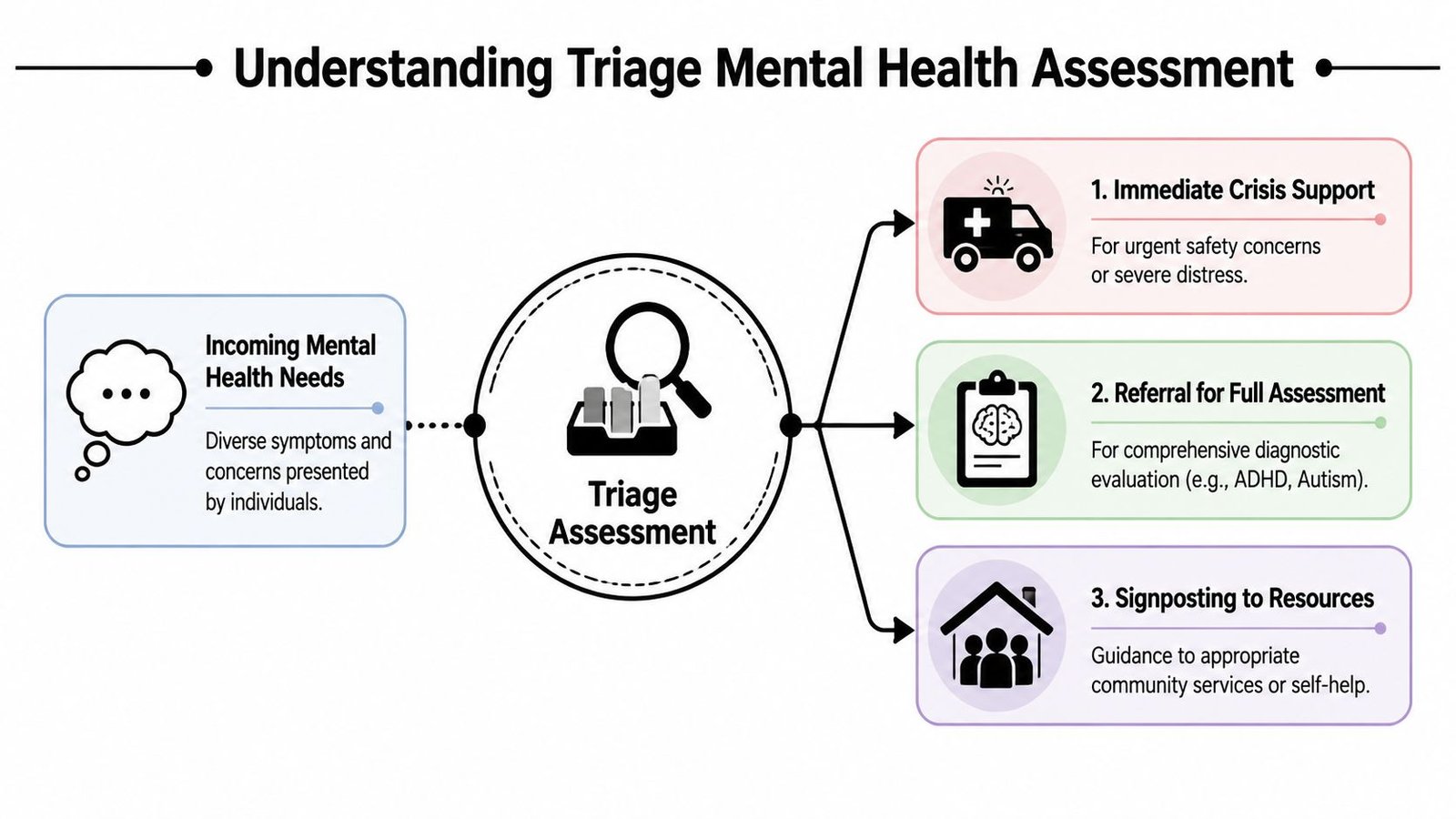
Think of triage as the sorting office of mental health care. A sorting office doesn’t open the parcel, inspect every detail, and decide the final outcome. It checks what’s arrived, how urgent it is, and where it needs to go next.
That is exactly how a triage mental health assessment works in practice. It is a brief clinical screening used to assess urgency, risk, and the most appropriate pathway.
What triage is designed to do
The NHS does not use triage primarily to diagnose ADHD or autism. It uses triage to answer three immediate questions:
- Are you safe right now
- How urgent is the problem
- Which service is most suitable
That distinction matters. Someone can have longstanding ADHD traits and also be in acute distress, or they can have autistic burnout without presenting as a crisis. Triage tries to separate current clinical urgency from longer-term diagnostic questions.
The framework behind it
In the UK, the UK Mental Health Triage Scale is the core framework used across NHS services to guide urgency decisions. The UK Mental Health Triage Scale website describes it as the foundational clinical tool, developed in 2015, used across NHS services to determine clinical urgency and guide triage decisions. The same source notes that initial assessments for new referrals to specialist mental health services cost £326 million in 2018 to 2019, which underlines why good triage matters operationally as well as clinically.
A well-run triage process creates consistency. Different clinicians may have different styles, but they should still be working to the same core purpose. The assessment should identify who needs urgent intervention, who needs a full specialist assessment, and who would be better served by another route.
Triage should leave you with a clearer next step. If it leaves you only with confusion, the process hasn’t done its job well.
Why the first contact can still feel clunky
Triage often happens by phone, under time pressure, and with limited prior information. That can feel unsatisfactory for adults who’ve spent years trying to explain layered neurodevelopmental difficulties. It’s one reason good intake systems matter. If you want a plain-English overview of how structured intake improves what clinicians receive before an appointment, Formzz’s patient intake software guide is a useful read.
A triage call is brief by design. It should identify enough to route you safely. It won’t usually explore developmental history in the depth required for an ADHD or autism diagnosis.
Triage Compared to Full Assessments and Crisis Support
Patients often use three very different terms as if they mean the same thing. They don’t. Triage, full diagnostic assessment, and crisis support serve different purposes, involve different levels of detail, and lead to different outcomes.
Mental Health Service Comparison
| Feature | Triage Assessment | Full Diagnostic Assessment (ADHD/ASD) | Crisis Support |
|---|---|---|---|
| Primary aim | Decide urgency, risk, and pathway | Establish whether ADHD, autism, or another condition is present | Manage immediate severe risk or acute deterioration |
| Depth | Brief screening | Detailed developmental and psychiatric assessment | Focused emergency intervention |
| Typical focus | Current concerns, safety, service routing | Childhood history, symptom pattern, functional impact, differential diagnosis | Safety, containment, urgent treatment planning |
| Outcome | Referral, signposting, or discharge | Diagnostic opinion and recommendations | Immediate support, urgent review, or emergency escalation |
| Best used for | Starting the pathway | Getting diagnostic clarity | Situations that can’t wait |
Why triage isn’t meant to answer everything
A triage clinician may recognise that ADHD or autism is possible. They may even think it is likely. That still doesn’t make triage a diagnostic appointment.
The role is narrower. The clinician needs to work out whether you require urgent help, whether a neurodevelopmental referral is appropriate, and whether another service should be involved first. That’s one reason triage can feel unsatisfying to adults who arrive hoping finally to be understood in depth.
The difference is built into how these services function. Enhanced triage protocols in the UK have enabled the diversion of nearly 40% of patients from inpatient units to more appropriate outpatient or community services, as reported in this ScienceDirect article on mental health triage practice. That tells you what triage is for. It is a routing and risk-management tool, not a diagnostic endpoint.
What a full ADHD or autism assessment adds
A proper diagnostic assessment looks at pattern, persistence, and history. It asks whether the traits were present earlier in life, whether they appear across settings, what else might explain them, and what support is likely to help.
That process is necessarily more detailed than triage. It also has to address overlap. Adults may present with anxiety, depression, trauma symptoms, obsessive traits, or personality-related difficulties that complicate the picture. Good assessment does not force everything into a neurodevelopmental explanation. It tests competing explanations carefully.
If your triage call feels brief, that doesn’t mean the clinician is dismissing you. It usually means they’re doing a different job from the one you need for diagnosis.
When crisis support is the right service
Crisis support is for a different clinical picture. If someone is at immediate risk, severely deteriorating, unable to stay safe, or experiencing extreme distress that needs urgent intervention, a crisis team or emergency service is the right route.
That’s why triage questions can seem abrupt. Clinicians need to identify whether the person in front of them needs a specialist assessment pathway, routine mental health care, or immediate crisis input.
The Triage Process for ADHD and Autism Explained
For most adults, the triage process starts with a referral from a GP or another service. Sometimes it follows repeated contact with primary care because anxiety, burnout, low mood, or functional collapse keeps returning.
What the first questions are usually about
The call or appointment usually begins with a simple clinical question: why are you seeking help now?
That matters more than many people realise. A clinician needs to know not only what you suspect, but what has changed. Have work demands increased. Has a relationship broken down. Have you become unable to keep up with daily tasks. Have sensory difficulties become harder to manage. Have you reached burnout.
You’ll often be asked about:
- Current difficulties such as concentration, impulsivity, sensory overload, social strain, sleep, emotional regulation, or shutdowns
- Daily functioning including work, study, money, household tasks, and relationships
- Mental health symptoms such as anxiety, depression, panic, obsessive thinking, or trauma-related symptoms
- Risk issues including self-harm thoughts, suicidal thoughts, self-neglect, or vulnerability
Why risk questions come first
Adults looking for ADHD or autism assessment sometimes feel thrown by direct questions about self-harm or safety. They may think, “That’s not why I’m here.”
But risk assessment has to come first. A service cannot responsibly place someone on a routine pathway without checking whether there is something more urgent happening alongside the diagnostic question.
That doesn’t mean your neurodevelopmental concerns are being ignored. It means the clinician is following the correct order.
What clinicians are listening for
They are listening for pattern, severity, and fit. Not fit in the sense of whether you seem articulate enough or distressed enough, but fit in the sense of whether your presentation matches the service’s threshold and remit.
A typical triage clinician may ask whether these traits go back to childhood, whether school reports reflected difficulties, whether family members noticed social or attention-related problems, and whether your symptoms occur across more than one setting.
The strongest answers are concrete. “I struggle with executive function” is less helpful than “I miss appointments unless I set multiple alarms and still lose track of time.”
The possible outcomes
A triage appointment usually ends in one of several ways.
One possibility is referral on to a specialist neurodevelopmental pathway for fuller ADHD or autism assessment. Another is signposting to psychological support, primary care follow-up, or a different mental health team if the main problem appears elsewhere. Some people are discharged with advice if the service does not think the criteria for that pathway are met.
Often, many adults feel disappointed. They expect triage to confirm what they’ve suspected for years. Instead, they receive a holding position, a referral, or advice to gather more evidence. That can feel deflating, but it is common.
The practical point is this. Triage decides the lane. The lane is not the finish line.
How to Prepare for Your Assessment Journey
Preparation changes the quality of the conversation. It helps at the GP stage, it helps in triage, and it matters even more in a specialist assessment.
For autism in particular, preparation is important because a large proportion of people may still be missed. Exploratory projections suggest that 59% to 72% of autistic people in England remain undiagnosed, according to this published analysis in PMC. Adults who can describe their history clearly are often in a stronger position to go through the process.
Build your evidence before the appointment
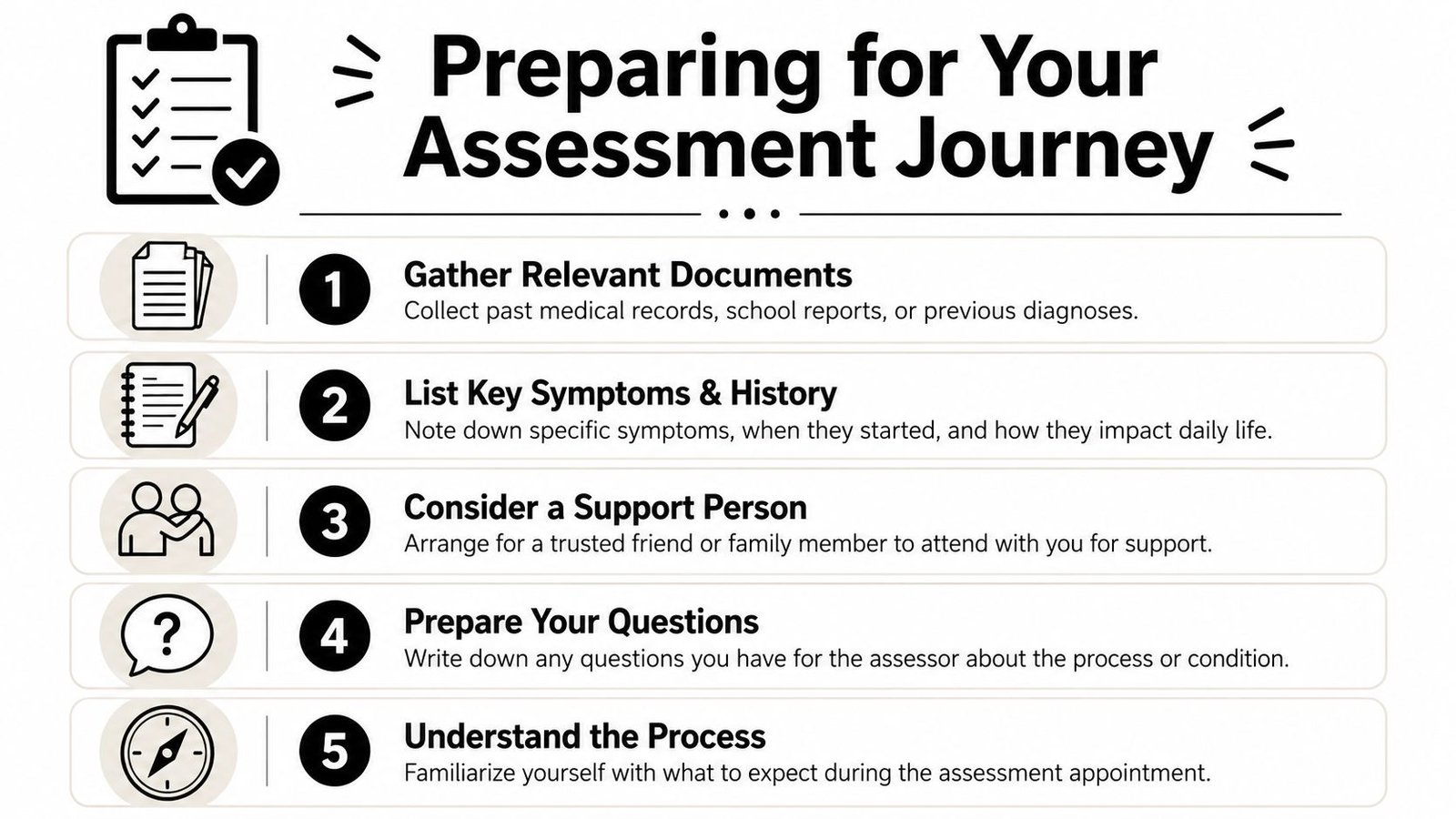
Start with documents. School reports can be surprisingly helpful, especially if they mention distractibility, poor organisation, daydreaming, social difficulties, rigidity, uneven performance, or behaviour that was labelled quirky, oppositional, or immature.
Then write a short summary of current problems. Keep it factual. Avoid broad labels if you can’t illustrate them.
Useful material includes:
- Examples from work or study such as missed deadlines, inconsistent output, disciplinary issues, overwhelm in meetings, or needing excessive recovery time
- Examples from home such as unpaid bills, clutter, unfinished tasks, routine disruption, sensory strain, or frequent conflict over organisation
- Social patterns including misunderstandings, masking, difficulty reading tone, friendship instability, or exhaustion after interaction
- Mental health overlap like anxiety, low mood, burnout, or emotional volatility that may sit on top of a neurodevelopmental pattern
Prepare what you want to say to your GP
Many referrals go nowhere because the first conversation is too general. A short script helps.
Try to cover three points:
- What you suspect
- Why you suspect it
- How it impairs your functioning
For example, instead of saying, “I think I might be autistic”, say that you’ve had longstanding social communication difficulties, sensory overwhelm, rigid routines, and burnout, and that these problems affect work and daily life. That gives the GP a clinical reason to refer.
Clinical advice: Bring examples from both childhood and adulthood. Neurodevelopmental assessments depend on lifespan patterns, not just what is happening this month.
Make the appointment easier on yourself
Some adults communicate better when they don’t have to improvise. That’s common, not a flaw.
A few simple adjustments can help:
- Write notes in advance so you don’t forget key examples
- Take a support person if that helps you stay organised or remember details
- List your questions about waiting times, referral route, and next steps
- Mention communication needs if phone calls, busy waiting rooms, or short-notice appointments are difficult for you
Good preparation doesn’t guarantee a smooth pathway. It does reduce the chance that important details get lost in a rushed conversation.
Your Next Steps After Triage in the UK
Once triage is complete, most adults want one thing above all else. A realistic answer to “what happens now?”
The answer depends on which pathway is open to you, how long you can wait, and whether you want to pursue NHS, Right to Choose, or private assessment.

The standard NHS route
If triage supports referral to a specialist neurodevelopmental service, you may then enter a waiting list for a full assessment. This is the route many adults assume they have to accept without question.
The difficulty is delay. The NHS pathway can move very slowly, especially for autism assessment. In December 2023, the number of patients in England with an open referral for suspected autism reached 172,022, and 79% of those waiting over 13 weeks had not yet received a first appointment, according to the Nuffield Trust’s analysis of autism and ADHD waiting lists.
Those figures matter because waiting is not neutral. While people are waiting, they are still trying to work, study, parent, manage relationships, and make sense of recurrent burnout or distress without diagnostic clarity.
Right to Choose
For many adults in England, Right to Choose is the most important route they haven’t been properly told about. If your GP agrees to refer you and the provider meets the relevant requirements, you may be able to choose a provider outside your local area rather than remain on a local NHS waiting list.
This option can be particularly helpful if your local pathway is heavily delayed. It also gives some patients access to a more structured assessment process than they have found locally.
Right to Choose still requires administration, referral paperwork, and eligibility checks. It isn’t an instant shortcut. But for the right patient, it can be a more efficient route into a proper diagnostic assessment.
Private assessment
Private assessment is usually the fastest route for adults who need clarity quickly. That may matter if you are in occupational difficulty, at university, struggling with repeated mental health treatment that has not explained the full picture, or trying to decide whether medication, workplace adjustments, or specific support should be explored.
Private care should still be rigorous. Speed is useful only if the assessment is clinically sound, developmentally informed, and written up in a report that helps with treatment and support planning.
A proper adult ADHD or autism assessment should involve a detailed history, careful consideration of overlap with other psychiatric conditions, and a clear explanation of the conclusions reached. If that isn’t happening, speed alone is not an advantage.
For adults considering the broader emotional impact of finally entering assessment, it can also help to read lived experiences from people who have gone through anxiety-focused support and recovery. This short video may be a useful pause point.
What to look for in an assessment service
Choose the pathway that gives you both access and quality. In practical terms, that means checking:
- Clinical leadership by experienced Consultant Psychiatrists
- Relevant expertise in adult ADHD, autism, and overlapping mental health conditions
- Clear reports with diagnosis, formulation, and recommendations
- Follow-up options if treatment, medication, or further support is needed
- Regulatory standards such as CQC oversight where applicable
Adults often focus only on getting seen quickly. I understand that urgency. However, the objective is not merely to be assessed. It is to be assessed well.
Taking Control of Your Mental Health Journey
The most useful way to think about a triage mental health assessment is as the gatekeeper step. It decides urgency and direction. It does not settle the whole question.
That distinction can save you a lot of frustration. If you know what triage is for, prepare your history properly, and understand the routes available after it, you’re in a stronger position to advocate for what you need.
There is also value in hearing from people who have engaged with mental health services and found a route that felt human, not just administrative. If you want that perspective, Anxiety Rewired testimonials via Testimonial offer a useful reminder that progress often begins when people finally find the right fit.
If you suspect ADHD or autism, don’t minimise it because you’ve coped for years. Adults often cope right up until they can’t. Getting clear on your pathway now can spare you years of avoidable confusion later.
If you want a consultant-led route to answers, Insight Diagnostics Global provides online and face-to-face assessments for adults aged 18 and over, including ADHD, autism, and broader mental health evaluations. The service is CQC regulated, led by psychiatrists on the GMC Specialist Register, and offers clear triage, thorough assessments, detailed reports, and optional follow-up. Assessments are typically arranged within seven working days, with reports usually completed within five working days after assessment. It is a strong option for adults seeking clarity sooner, whether through self-funding or a structured referral route. Insight Diagnostics Global is not a crisis service. For emergencies, call 999 or contact NHS 111 for urgent support.