

You’ve probably landed here the way many adults do. You’ve had stretches of low mood, bursts of energy that don’t quite feel typical, periods of irritability, poor sleep, or a sense that your mind moves faster than the people around you. You type a few symptoms into a search bar, find a mood disorder questionnaire online, answer a handful of questions, and then sit with the result wondering whether you’ve just identified something important or frightened yourself unnecessarily.
That uncertainty is common.
In practice, online screeners can be useful, but they need to be handled carefully. They can point towards a pattern worth taking seriously. They can also oversimplify complex presentations, especially when bipolar symptoms overlap with ADHD, Autism, trauma, burnout, anxiety, or personality difficulties. That overlap matters, because many adults who search for mood answers are also trying to understand focus, sensory overwhelm, emotional regulation, and long-standing neurodevelopmental differences.
I often encourage people to treat an online screener as a note-taking exercise rather than a verdict. If your main concern is loss of drive, executive dysfunction, or difficulty getting started, practical behavioural supports can help while you pursue proper assessment. Some people find Kohru’s motivation strategies useful for understanding the day-to-day difference between feeling unmotivated, burnt out, or mentally overloaded.
Your First Step in Understanding Your Mood
A common pattern goes like this. Someone has been treated for depression, but something still doesn’t fit. Their sleep shifts dramatically. They have phases of being unusually driven or irritable. Friends comment that they seem like a different person at times. Then they try a mood disorder questionnaire online because it feels quick, private, and easier than explaining all of this to a GP.
That first step isn’t wrong. It’s often sensible.
The problem starts when the screener result gets treated as a diagnosis. A positive result can create alarm. A negative result can create false reassurance. Neither is a safe conclusion on its own.
What people are usually asking
When adults use the MDQ online, they’re rarely asking one narrow question. They’re often trying to answer several at once:
- Is this bipolar disorder: or is it stress, trauma, exhaustion, or the aftermath of poor sleep?
- Is this ADHD: where restlessness, impulsivity, distractibility, and variable energy can look deceptively similar?
- Is this Autism-related burnout: where overwhelm, shutdowns, and emotional strain can be misread as mood instability?
- Do I need help now: or am I overreacting to something everyone experiences?
Those are sensible questions. A short screener can’t answer all of them.
A useful online questionnaire should move you towards a better clinical conversation, not replace one.
Why the distinction matters
In UK practice, adults often present with a mixture of mental health and neurodevelopmental concerns rather than a neat single diagnosis. That’s why a careful psychological assessment or psychiatric assessment matters. It looks at timing, pattern, severity, context, and function.
That’s also where the experience of leading Consultant Psychiatrists matters, particularly when the differential includes neurodevelopmental and personality disorder features alongside mood symptoms. Clinicians such as Dr Sai Achuthan work in exactly that overlap, where a rushed conclusion causes more confusion than clarity.
What Is the Mood Disorder Questionnaire
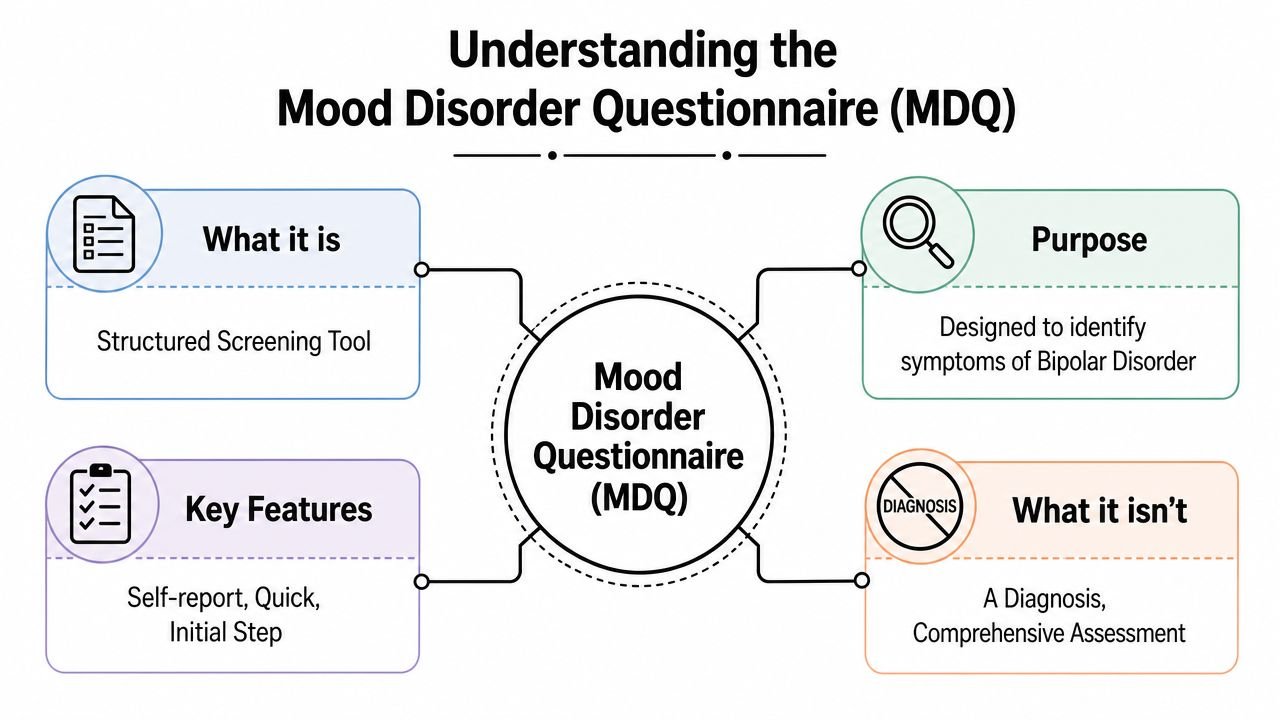
A common scenario in clinic is this: someone completes an online bipolar quiz late at night, sees a “positive” result, and arrives worried they have a settled diagnosis. That is not what the Mood Disorder Questionnaire, or MDQ, is designed to do in UK practice. It is a screening tool used to identify whether a pattern of past experiences could justify a proper psychiatric review.
That distinction matters. An online MDQ can raise a sensible question. It cannot deliver a formal diagnosis, and it has no legal or clinical standing equivalent to an assessment by a regulated psychiatrist working within a CQC-registered service.
How the MDQ is built
The MDQ is a self-report questionnaire that asks about lifetime experiences associated with mania or hypomania, such as increased energy, needing less sleep, racing thoughts, irritability, confidence, and distractibility, as outlined in NovoPsych’s MDQ overview.
A standard positive screen depends on three parts being present together:
| MDQ requirement | What it means |
|---|---|
| 7 or more symptoms | You endorse at least seven symptom experiences |
| Symptoms occurred together | The experiences happened in the same period |
| Moderate or serious impact | The pattern caused noticeable problems in daily life |
People often miss the second and third parts. The questionnaire does not only count isolated traits. It is asking whether several symptoms clustered together and whether that cluster affected work, relationships, judgment, spending, sleep, or day-to-day stability.
What the MDQ can and can’t do
Used properly, the MDQ can help spot a bipolar-spectrum pattern that deserves closer examination. It cannot tell you why that pattern appears in your answers.
In practice, several different problems can look similar on a short screener. ADHD can involve impulsivity, variable energy, and distractibility. Autism-related burnout can bring overwhelm, shutdown, irritability, and reduced tolerance for stress. Trauma, substance use, antidepressant effects, sleep deprivation, and some personality patterns can also complicate the picture. A questionnaire cannot sort those apart reliably.
This is the trade-off. Online screening is quick and accessible, but speed comes at the cost of clinical context.
Practical rule: Treat an online MDQ result as a prompt for careful assessment, not as a verdict.
That approach is safer in both directions. It reduces false reassurance after a negative result, and it reduces unnecessary alarm after a positive one.
How to Interpret Your MDQ Screening Results
You complete an online MDQ late at night, the score looks “positive,” and the next question is obvious. Does this mean bipolar disorder?
The practical answer is no. It means your pattern of answers deserves closer clinical attention. A positive result places you in a group that may need a proper psychiatric review. A negative result lowers suspicion, but it does not settle the matter, especially if your history includes recurrent depression, patchy periods of unusually high energy, risky decisions, or sleep changes that never felt dramatic enough to mention.
What the UK validation study adds
The MDQ is useful because it can identify patterns that merit further assessment, and UK research supports that role. In the UK validation study of the MDQ, the questionnaire showed good sensitivity for bipolar I and bipolar II, with good specificity at the best cut-off in that sample when the supplementary questions were excluded. The same paper noted that bipolar II was identified more effectively when those supplementary items were dropped.
That matters in practice. Bipolar II is often the form people miss, partly because hypomania may be experienced as feeling sharper, more sociable, or more productive rather than obviously unwell.
What those accuracy terms mean for you
Sensitivity refers to how well a screener picks up people who may have the condition. Specificity refers to how well it avoids flagging people who probably do not.
For an individual person, that means two things. A positive MDQ can still turn out to reflect something else after proper assessment. A negative MDQ can still miss a clinically relevant bipolar-spectrum history.
This is the trade-off with online screening. It is fast and accessible, but it strips away context.
Why scores need interpretation, not guesswork
In clinic, I do not treat an MDQ score as the answer. I treat it as one piece of evidence.
A score becomes more meaningful when it is set alongside the story of your symptoms. Did the change come in clear episodes, or has it been present for years? Was there a reduced need for sleep with sustained energy, or simple insomnia with exhaustion the next day? Did your speech, spending, confidence, libido, irritability, or judgement change enough for other people to notice? Those details often matter more than the raw total.
The online format can also distort results in both directions. Some adults under-report because the “up” periods felt enjoyable, useful, or normal by comparison with depression. Others over-identify with broad traits such as being talkative, impulsive, or creative, even when those traits were not episodic and did not reflect hypomania.
When a negative screen should not reassure you too quickly
A negative result deserves caution if your life shows a repeating pattern that still needs explanation.
That includes depressive episodes that keep returning, bursts of energy with unusually little sleep, abrupt changes in confidence or irritability, or periods where work, relationships, money, or decision-making shifted in a way that was out of character. Online tools are especially likely to miss subtler bipolar II presentations and more complex histories.
If the score and your lived experience do not match, your history carries more weight than the questionnaire.
How to use the result well
Use the MDQ result as a record to bring into a clinical discussion. The most helpful next step is to note a few specifics before any assessment:
- Episode pattern. When did the changes start, how long did they last, and did they come in distinct phases?
- Sleep and energy. Did you need less sleep and still function well, or were you tired and wired?
- Impact. What changed at work, at home, financially, socially, or sexually?
- Other explanations. Were substances, antidepressants, trauma, ADHD, autism-related stress, or prolonged sleep loss part of the picture?
Used this way, the MDQ helps organise the right questions. Used as a verdict, it often creates either false reassurance or unnecessary alarm.
Why Online Screeners Are Not a Diagnosis
A common UK scenario is this. Someone completes an online MDQ late at night, gets a positive result, and by morning is wondering whether they now “have bipolar.” Another person gets a negative result and decides the question is settled. In clinical practice, neither conclusion is safe.
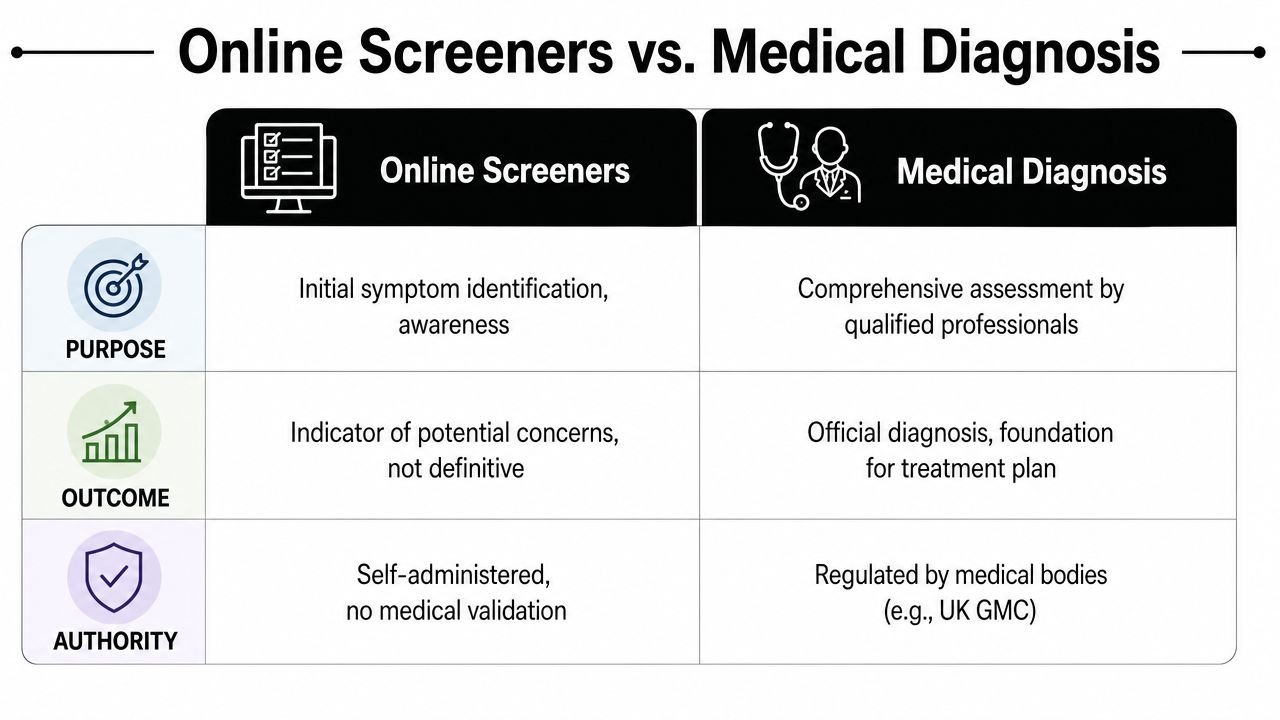
An online screener sits at the very start of the process. It helps identify whether your history deserves closer assessment. It does not create a medical diagnosis, and it does not replace one.
What a diagnosis actually requires in the UK
In the UK, a formal psychiatric diagnosis has legal and clinical weight because it comes from an appropriate medical assessment, documented by a qualified clinician working within regulated standards. Services are expected to meet professional and regulatory requirements. A website questionnaire does not meet that threshold, however polished it appears.
According to Insight Diagnostics Global, the practical position is clear. The MDQ is a triage instrument. A diagnosis requires a psychiatrist to assess symptom pattern, duration, severity, functional impact, risk, and alternative explanations.
That distinction matters because labels have consequences.
Why a quiz cannot answer the hard questions
The difficulty is not just “Do these symptoms exist?” The difficulty is what they mean.
Similar answers can point in very different directions. Reduced sleep may reflect hypomania, anxiety, grief, stimulant use, shift work, or prolonged stress. Racing thoughts may occur in bipolar disorder, ADHD, trauma states, or severe anxiety. Irritability can be part of a mood episode, but it can also follow burnout, depression, autism-related overload, or relationship conflict.
A psychiatrist tests those possibilities by asking follow-up questions, checking chronology, and looking for contradictions. Online tools cannot do that with enough depth to support a formal diagnosis.
Where people run into problems
Trouble starts when a screening score is treated as if it were a medical verdict. That can lead to false reassurance, unnecessary alarm, or delays in getting the right help.
A self-completed questionnaire is usually not enough for decisions such as:
| Situation | What usually matters |
|---|---|
| Private insurance | A formal diagnosis with clinician documentation |
| Right to Choose pathways | A referral route and assessment by the appropriate service |
| University or workplace support | A detailed clinical report rather than self-screen results |
| Treatment decisions | A reasoned differential diagnosis and full history |
Insurers such as Vitality or Aviva may ask for formal diagnostic evidence. GPs, employers, and universities usually need the same. If you are trying to organise practical next steps outside healthcare as well, tools that simplify your service appointments may help with logistics, but they do not change the clinical standard required for diagnosis.
A completed screener can be useful evidence to bring to an appointment. It is rarely enough to support an official decision on its own.
Why this distinction matters so much in adults
Adults who search for a mood disorder questionnaire online are often trying to make sense of a mixed picture, not one isolated symptom cluster. Concentration problems, impulsivity, unstable relationships, chronic low mood, sensory strain, alcohol use, trauma, and sleep disruption can overlap in ways that are easy to misread online.
This is why I advise patients to treat an MDQ result as a prompt, not a verdict. The primary task is to work out whether the pattern is episodic, developmental, situational, substance-related, or part of another mental health condition entirely. Only a proper psychiatric assessment can do that reliably.
The Path to a Full Psychiatric Assessment
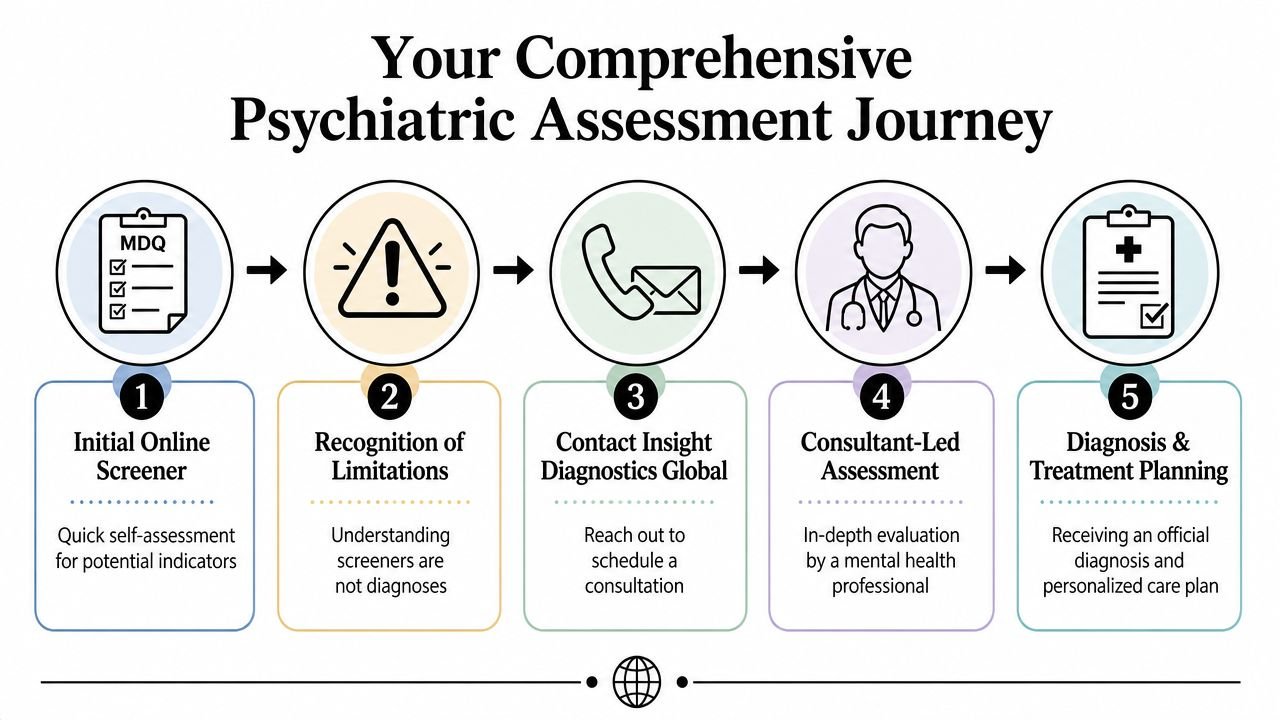
An online MDQ can raise a sensible question. It cannot settle it.
In clinic, the task is to work out whether periods of high energy, irritability, reduced sleep, overspending, impulsive decisions, or racing thoughts reflect bipolar disorder, another mental health condition, substance effects, a neurodevelopmental presentation, or a response to stress. That judgment depends on pattern, timing, severity, and context. It also depends on whether symptoms come in distinct episodes or have been present more continuously across adult life.
What a full psychiatric assessment usually covers
A psychiatrist is not looking for one answer from one form. The assessment usually brings together several parts of the history so the result is clinically defensible and useful outside the appointment as well.
That often includes:
- A detailed clinical interview about mood changes, sleep, anxiety, activity levels, behaviour, substance use, trauma, and risk
- Episode mapping to establish whether symptoms are episodic, how long they last, and what happens between episodes
- Developmental and family history to see whether ADHD, Autism, bipolar disorder, or other patterns are more likely
- Functional impact across work, relationships, study, finances, and day-to-day stability
- Differential diagnosis so similar presentations are separated carefully rather than grouped together too quickly
- Collateral information where appropriate, such as reports from a partner or relative, because insight during high mood can be limited
This is also where UK clinical reality matters. A diagnosis that may affect treatment, employment documentation, insurance evidence, or occupational health decisions should come from a regulated medical assessment, not from an anonymous online quiz result.
Why a regulated assessment matters in practice
In the UK, a formal psychiatric diagnosis is a clinical act. It carries legal, professional, and prescribing consequences. A CQC regulated service and a psychiatrist on the GMC Specialist Register are accountable for how that diagnosis is reached, recorded, explained, and followed up.
That standard protects patients.
It reduces the risk of false reassurance after a low score and unnecessary alarm after a high one. It also matters because bipolar disorder can be over-suspected online in adults whose main difficulties are ADHD, trauma, emotionally unstable personality traits, alcohol misuse, sleep deprivation, or severe anxiety.
Why access can still be difficult
The wider system remains under pressure. Reporting in The BMJ described long NHS waits for autism assessment in England, with large numbers of people still waiting for specialist review. The broader point is familiar across adult mental health services. Delays make mixed presentations harder to sort out, especially when a person has been trying to explain years of overlapping symptoms in short GP appointments.
Adults may arrive convinced they have a mood disorder. After proper assessment, some do. Others turn out to have a neurodevelopmental condition, a trauma-related presentation, recurrent depression without hypomania, or more than one condition at the same time. That is why careful psychiatric assessment adds value. It gives a reasoned formulation, not just a label.
What experienced consultant input adds
Experienced consultant psychiatrists examine the whole picture, including whether apparent mood elevation is true hypomania, stress-driven overactivity, or longstanding impulsivity. That distinction changes treatment.
For people arranging assessments around work, family, or study, practical admin still matters. Some patients use tools that simplify your service appointments so logistics are easier to manage, but the clinical standard remains the same. A formal diagnosis still depends on a regulated psychiatric assessment, documented properly and reached through clinical judgment.
Your Assessment Journey with Insight Diagnostics Global
Adults often delay assessment because they expect the process to be confusing, slow, or impersonal. A well-run service should be the opposite. It should be clear, consultant-led, and organised enough that you know what happens next.
What happens after first contact
A good starting point is triage. That means clarifying what you’re seeking help for. Sometimes a person arrives worried about bipolar disorder but the history points more towards ADHD. Sometimes they ask for an ADHD assessment and it becomes clear that mood episodes, trauma, or personality factors also need careful review.
At Insight Diagnostics Global, adults aged 18 and over can access online and face-to-face, consultant-led mental health services with structured assessments covering ADHD, Autism, and wider mental health conditions, alongside psychological assessment where needed. The service is CQC-regulated and staffed by psychiatrists on the GMC Specialist Register.
Timelines and what they mean for patients
The service information states that assessments are usually scheduled within seven working days, with reports completed within five working days thereafter, based on the clinic’s published process on the Insight Diagnostics Global website. For many adults, that speed matters because uncertainty itself becomes part of the distress.
What matters more than speed, though, is the quality of interpretation. Your online screener result can be useful, but only as one part of the intake story. It helps the psychiatrist understand what prompted concern. It doesn’t determine the answer in advance.
Why this matters for ADHD and Autism as well
The diagnostic gap in the UK remains substantial. Only 1 in 9 adults with ADHD has a formal diagnosis, and up to 72% of autistic adults may be undiagnosed, according to ADHD UK’s summary of the diagnostic gap. In practice, that means many adults live for years with a partial explanation. They may be told they are anxious, depressed, moody, lazy, disorganised, or overreactive when the underlying picture is broader.
A thorough assessment helps sort that out. It can identify:
- Primary neurodevelopmental conditions such as ADHD or Autism
- Mood disorders that need separate treatment planning
- Co-occurring issues such as anxiety, depression, or personality-related difficulties
- Practical recommendations for treatment, support, medication review, and follow-up
The right assessment doesn’t just give you a label. It gives you a map.
That’s what most adults are looking for when they first search for a mood disorder questionnaire online.
If you want a clear next step after an online screener, Insight Diagnostics Global offers consultant-led assessments for adults seeking clarity around ADHD, Autism, bipolar spectrum concerns, and broader mental health difficulties. The service is CQC-regulated, delivered by psychiatrists on the GMC Specialist Register, and designed to provide thorough evaluation, robust reports, and personalised treatment recommendations without the uncertainty of relying on an online quiz alone.