

You may be reading this late at night, after a difficult incident, or after weeks of wondering whether what’s happening is “serious enough” to ask for help. You may be looking for yourself, for your partner, for your son or daughter, or for a university student who has said something worrying. You may also have been told you need a self harm assessment and feel frightened by the phrase.
A good assessment isn’t a test. It isn’t a moral judgement. It isn’t a gatekeeping exercise to decide whether you are “bad enough” or “not bad enough”. It is a careful clinical conversation that tries to understand what has been happening, what the self-harm means in your life, what increases risk, and what helps keep you safe.
That matters because self-harm sits close to wider mental health risk. In the UK, almost half (49%) of young people who died by suicide between 2014 and 2016 had a history of self-harm, according to a UK-wide consecutive case series published in The British Journal of Psychiatry. That is one reason self-harm assessment has become such an important part of mental health care.
In practice, the most useful assessments don’t look only at the act itself. They also look at mood, anxiety, burnout, trauma, relationships, sensory stress, impulsivity, and the possibility of underlying neurodevelopmental conditions such as ADHD or autism. In many adults, especially those who have spent years masking or compensating, that missing context changes everything.
Dr Sai Achuthan’s work as a leading Consultant Psychiatrist in neurodevelopmental and personality disorder presentations reflects a point many experienced clinicians now recognise. If you assess self-harm without understanding autism, ADHD, and mental health together, you can miss the underlying driver of distress.
Your First Step Towards Understanding Self Harm
When people hear the term self harm assessment, they often expect interrogation. They worry they’ll be asked blunt questions, judged for their coping, or pushed into decisions before they feel ready.
A competent clinician does the opposite. They slow the process down enough to understand what happened, when it started, what was going on around it, and what the behaviour was doing for you in that moment. Sometimes self-harm is linked to suicidal thinking. Sometimes it is not. Sometimes it is a way of regulating unbearable tension, expressing emotional pain, interrupting numbness, or coping with sensory and interpersonal overwhelm.
What the appointment is really for
The first step is simple. The clinician tries to answer four practical questions:
- What has been happening: The pattern, frequency, context, and recent concerns.
- What does the self-harm mean for this person: Relief, punishment, communication, release, or something harder to name.
- What else is going on: Depression, anxiety, trauma, alcohol or drug use, relationship strain, burnout, ADHD traits, autistic overwhelm, or personality difficulties.
- What will improve safety now: Not in theory, but in the next day, week, and month.
That last point matters. An assessment should leave you with more clarity than you had when you arrived.
Practical rule: If an assessment makes you feel reduced to a label instead of understood as a person, it has probably missed something important.
Why seeking help is a strength
People often delay assessment because they feel ashamed. They tell themselves they should have managed it alone, that it was “only once”, or that asking for help will create more trouble than it solves.
Clinically, delay usually makes things harder. Self-harm thrives in secrecy. Once a pattern becomes private and repetitive, it often becomes more embedded.
A good assessment breaks that isolation. It creates a space where someone can say, plainly and without performance, “This is what I’ve been doing, this is what I feel before it happens, and this is what I need help understanding.”
If you are seeking help for someone else, the same principle applies. You do not need to arrive with the right words. You only need enough concern to start the conversation.
What a Self Harm Assessment Actually Involves
Most self harm assessments are carried out by a mental health professional such as a Consultant Psychiatrist, psychologist, community psychiatric nurse, or another clinician trained in psychosocial assessment. The setting may be face to face or online, depending on the service and the urgency.
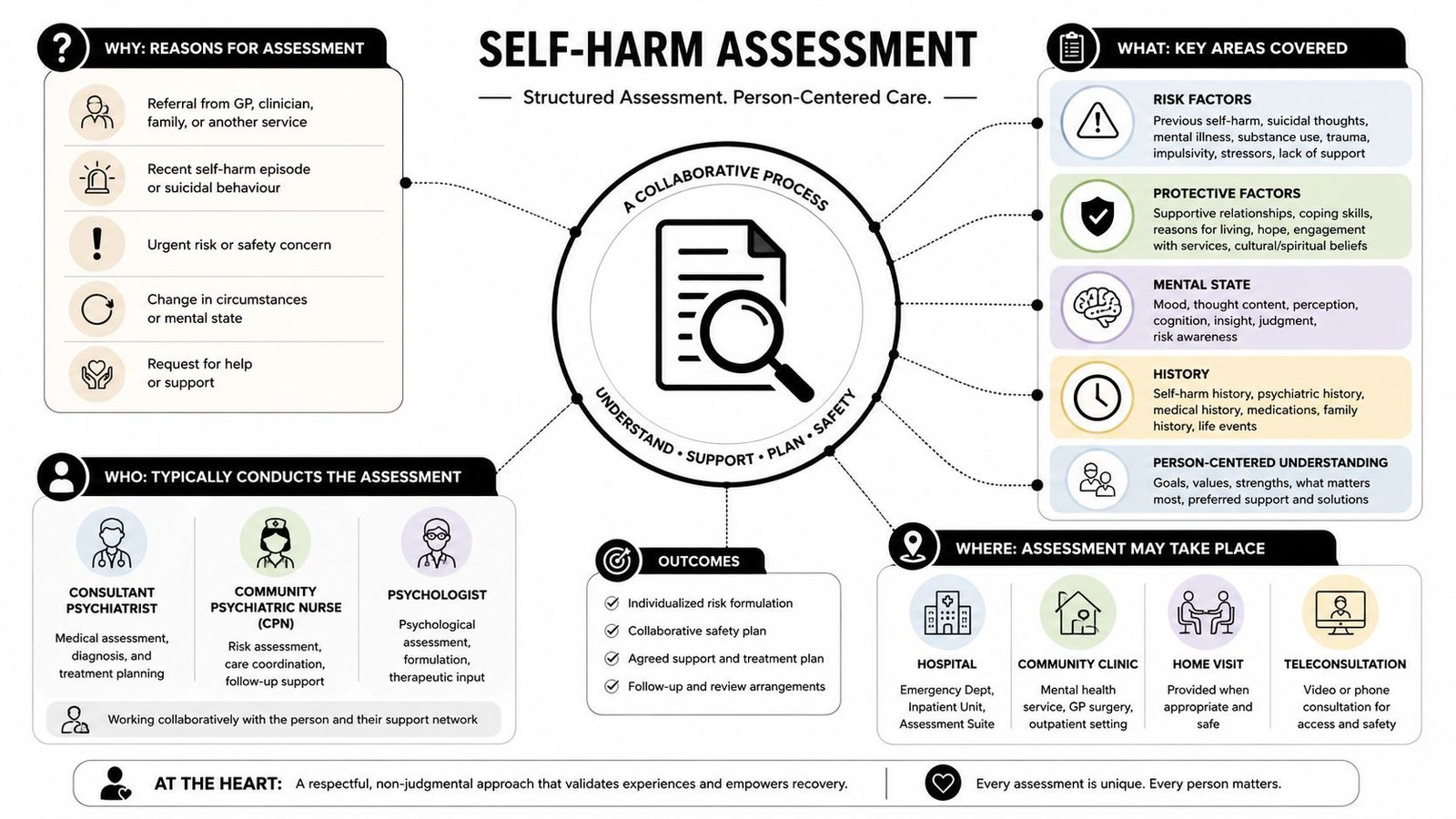
The easiest way to understand it is to think of the clinician as gathering the whole story, not just one scene. If someone only asks, “Did you harm yourself?” and “Are you suicidal?”, they are hearing the headline but not the article. Good care depends on the rest of the detail.
The modern UK approach
In the UK, the old idea of giving someone a score and predicting future behaviour from a checklist is no longer the standard clinicians should be using. The 2022 NICE guidelines (NG225) advise against using risk assessment tools or scales to predict future self-harm, and recommend a thorough psychosocial assessment instead, as set out in this Oxford Health and NICE-aligned clinician guide.
That shift matters because people don’t live in tick boxes. Two people can present with superficially similar behaviour for completely different reasons. One may be acting in the context of severe depression and active suicidal intent. Another may be overwhelmed by autistic shutdown, sensory distress, and chronic exhaustion. A simple score won’t separate those realities well enough to guide care.
What usually happens in the conversation
A structured assessment often includes:
Immediate safety
The clinician checks what is happening now. Are there current injuries, suicidal thoughts, access to means, intoxication, or immediate risks that need urgent action?Recent events
They ask what led up to the episode or episodes. This might include conflict, rejection, academic pressure, work stress, sensory overload, loneliness, or sudden change.Mental health review
Mood, anxiety, sleep, trauma symptoms, eating patterns, concentration, impulsivity, and any previous support are explored.Personal context
Living situation, relationships, caring responsibilities, work or study pressures, and past experiences often matter as much as symptoms.
A good self harm assessment should feel organised, but not mechanical.
What it should not feel like
It should not feel like someone is trying to force you into “low”, “medium”, or “high” risk in the first ten minutes. It should not ignore your own explanation of what was happening. And it should not stop at “come back if it gets worse”.
The strongest assessments combine structure with curiosity. That combination is what turns a distressing disclosure into the start of a useful plan.
Key Questions and Components of the Assessment
Many people are most anxious about the questions. That’s understandable. If you’ve hidden self-harm, talking about it can feel exposing. If you’ve never had a psychiatric assessment before, you may worry that every answer will be interpreted in the worst possible way.
In reality, the questions are there to build a risk formulation, not to assign a label. NHS England guidance requires mental health professionals to use the Three Ps framework, meaning Presenting problem, Protective factors, and Precipitating factors, to create a shared understanding rather than a crude risk category, as described in this NHS England guidance summary from the University of Manchester site.
Presenting problem
This is the part people usually expect. The clinician asks about the self-harm itself and the emotional state around it.
Typical areas include:
- What happened: What did you do, when did it happen, and did you need medical help?
- What was in your mind at the time: Were you trying to die, stop thoughts, reduce tension, punish yourself, or show distress?
- What happened before and after: What did you feel just before, and what changed afterwards?
- How often this has happened: Was this first time, occasional, or part of a longer-standing pattern?
These questions help distinguish impulse, planning, repetition, intent, and function. That is clinically important because support is different if self-harm is primarily linked to suicidal intent, chronic emotional dysregulation, or overload states.
Protective factors
This part often surprises people. Clinicians aren’t only listening for danger. They also need to understand what helps.
A protective factor may be a person, a responsibility, a belief, a routine, a pet, a future plan, or a skill that interrupts the cycle. The question is not “Why haven’t you done worse?” The question is “What helps you hold on?”
Here is a simple way to consider it:
| Area | What a clinician may ask | Why it matters |
|---|---|---|
| Relationships | Who knows when you’re struggling? | Isolation increases concern |
| Daily structure | What helps you get through the day? | Routine can reduce escalation |
| Reasons for safety | What stops you acting on urges? | These become part of planning |
| Help-seeking | Who could you contact early? | Early support is more protective than late crisis action |
Precipitating factors
This is often where the assessment becomes most useful. The clinician looks for the pressures that increase risk right now.
That may include:
- Recent stressors: conflict, grief, break-up, exams, work pressure, housing instability
- Changes in mental state: worsening depression, panic, agitation, hopelessness, dissociation
- Overload states: sensory strain, social exhaustion, sleep disruption, burnout
- Substances or impulsivity: alcohol or drugs can reduce inhibition and worsen judgement
The question behind every precipitating factor is, “What pushes this person closer to harm, and how can we spot it earlier next time?”
A thoughtful self harm assessment makes those links visible. Once you can see the pattern, safety planning becomes much more realistic.
The Crucial Link Between Self Harm ADHD and Autism
Generic self-harm guidance often misses a clinical reality I see repeatedly. For many neurodivergent people, self-harm cannot be understood properly without understanding how their brain processes emotion, stress, sensory input, and social demand.
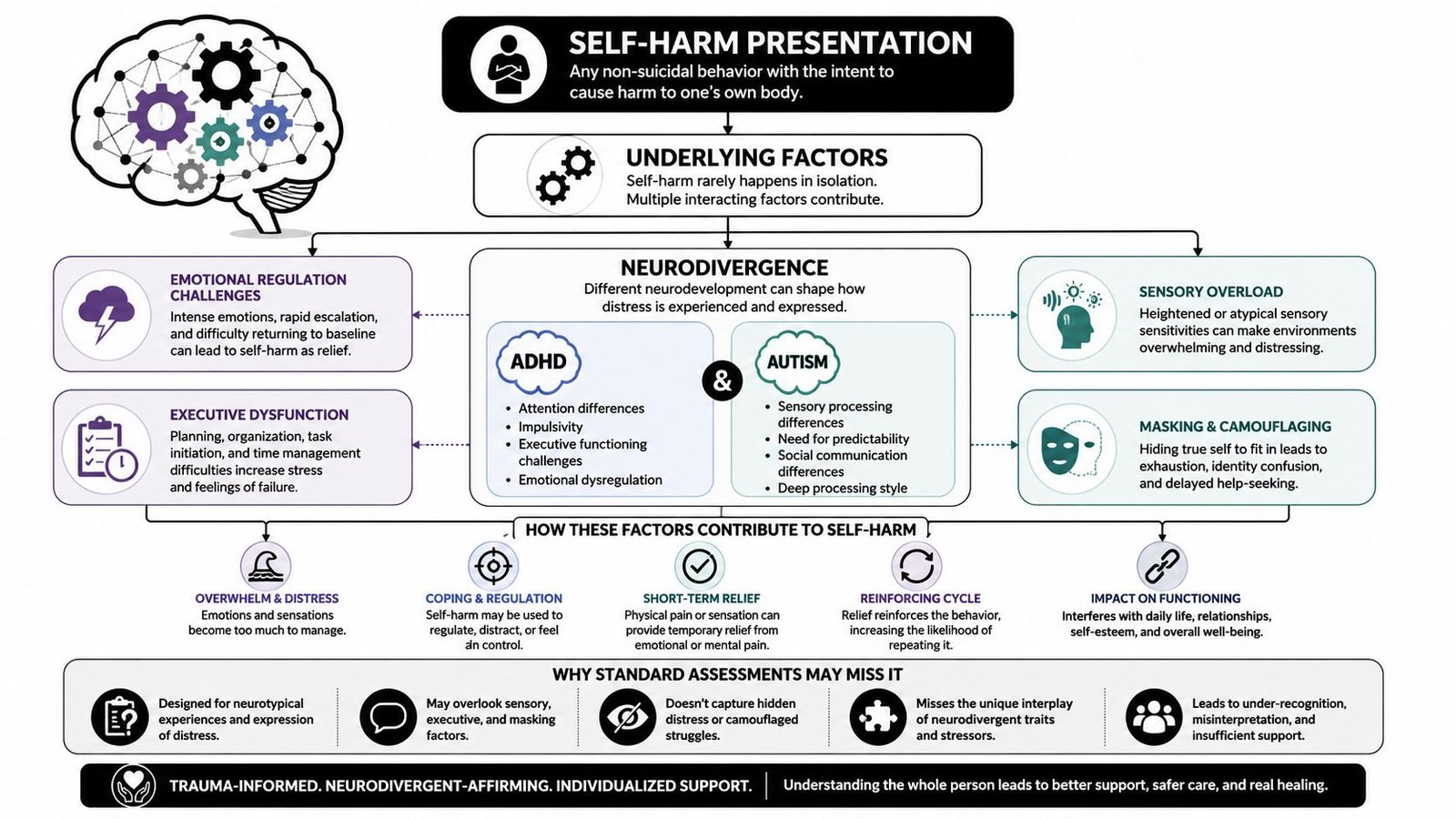
In ADHD, the picture may include impulsivity, fast escalation of distress, rejection sensitivity, frustration intolerance, and difficulty creating pause between urge and action. In autism, the pathway may look different. Sensory overload, shutdown, burnout, alexithymia, rigid coping patterns, or years of masking can leave someone at a breaking point long before anyone around them notices.
Why a generic assessment can miss the point
If a clinician asks only standard risk questions and ignores neurodevelopmental factors, the assessment may misread the behaviour.
Examples include:
Impulsivity being mistaken for unpredictability alone
In ADHD, the issue may be poor inhibition under emotional load, not a planned wish to die.Silence being mistaken for low risk
In autism, a person may struggle to describe internal states in conventional language, especially under pressure.Repeated crises being read as non-compliance
In both ADHD and autism, chronic overwhelm may reflect unmet needs, not lack of motivation.
This is one reason specialist psychiatric assessment matters. A clinician with experience in neurodevelopmental conditions, including consultants such as Dr Sai Achuthan, is more likely to recognise when self-harm sits inside a wider picture of undiagnosed ADHD, autistic burnout, personality vulnerability, or overlapping mental health disorders.
The diagnosis gap matters
In the UK, only 0.32% of adults have a formal ADHD diagnosis, representing just 1 in 9 people with the condition, according to ADHD UK’s summary of diagnosis rate data. That means many adults presenting with self-harm, emotional dysregulation, or repeated mental health crises may still be carrying unrecognised neurodevelopmental needs.
When those needs are missed, treatment can become frustrating for everyone. The person may be told they are not using strategies properly, when the underlying issue is that the strategy doesn’t fit their cognitive profile, sensory needs, or executive functioning difficulties.
What a better assessment looks for
A neurodivergence-informed self harm assessment often explores:
- Pattern of overload: sensory stress, transitions, masking, social depletion
- Executive function: disorganisation, procrastination, missed appointments, difficulty initiating help
- Emotional regulation: explosive distress, internal pressure, delayed recovery after conflict
- Developmental clues: long-standing attention difficulties, social differences, rigidity, burnout history
If ADHD or autism is part of the picture, treatment usually needs to widen beyond crisis management. That may include diagnostic assessment, environmental adaptations, medication review where appropriate, psychological therapy adapted to neurodivergent communication styles, and practical support around study, work, or daily structure. If medication is being discussed as part of wider ADHD care, this guide to essential ADHD medication information can help people understand the options and terminology before they speak with a prescriber.
How Clinicians Create a Collaborative Safety Plan
The best outcome of a self harm assessment is not a score. It is a plan the person can use.
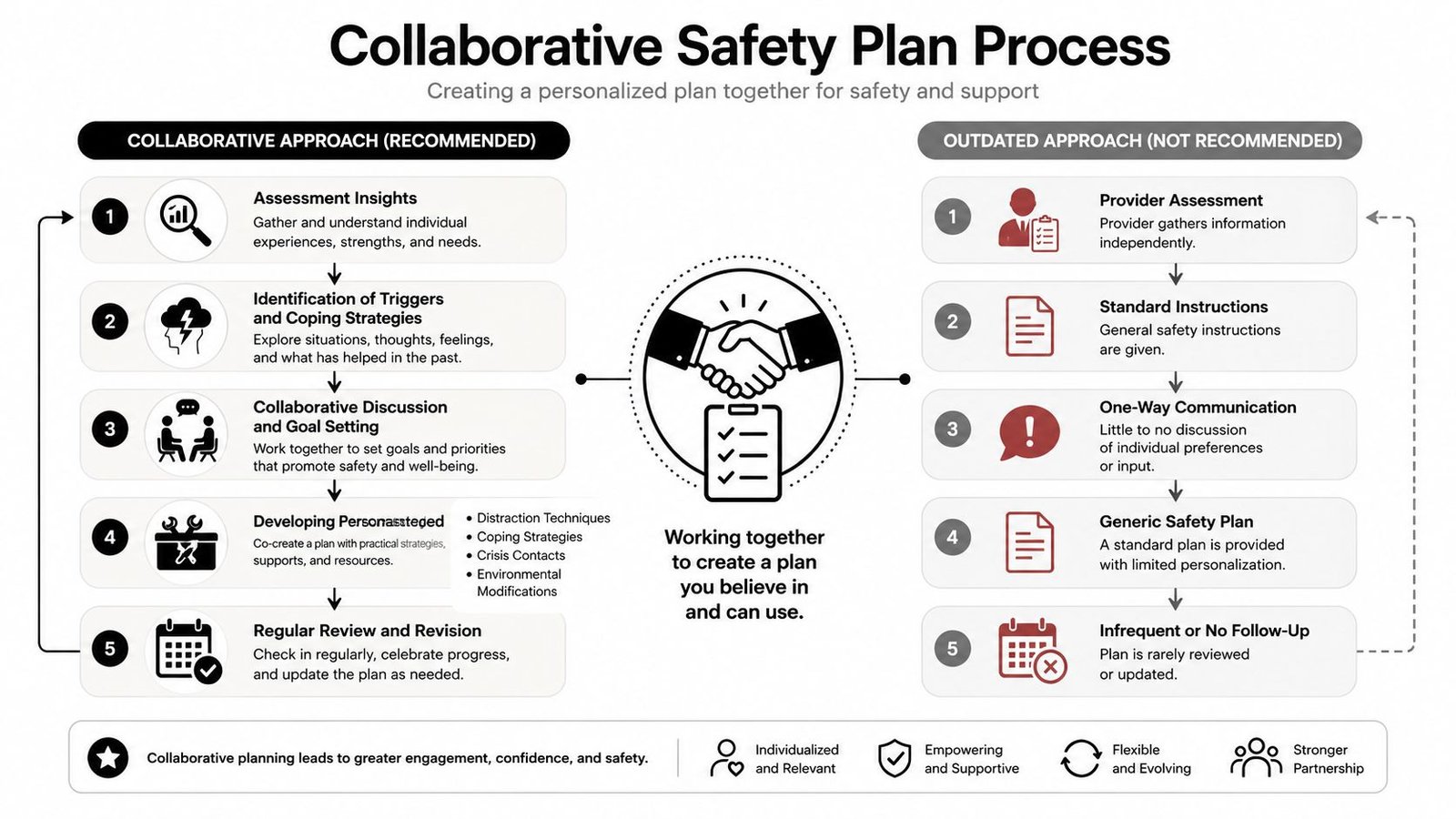
That sounds obvious, but services still vary. Despite national guidance, the outdated practice of placing people into high, medium, or low risk categories continues in some settings, as highlighted in the HSSIB interim bulletin on mental health inpatient care. The problem with categories is simple. They can create false reassurance, or needless alarm, without telling the person what to do at the moment they most need help.
What a useful safety plan includes
A collaborative plan is specific. It translates clinical understanding into practical steps.
Common components include:
- Warning signs: The person’s early indicators that things are worsening, such as agitation, numbness, pacing, withdrawing, not sleeping, or increased urges.
- Internal coping steps: Things that lower intensity enough to create time and distance from self-harm.
- Social support: Names of trusted people, and exactly what kind of contact helps.
- Professional help: Which service to contact, when, and under what circumstances.
- Environment: Changes that reduce immediate access to means or high-risk situations.
It is much easier to use a plan that says, “When I notice X, I will do Y and contact Z,” than one that says, “Seek help if required.”
Collaboration matters more than paperwork
Safety plans fail when they are written for the patient rather than with the patient. A clinician may think a strategy is sensible, but if it is unrealistic in the person’s actual life, it won’t be used.
A safety plan should fit the person on their worst day, not impress the clinician on a good day.
For example, if someone is autistic and cannot tolerate making phone calls under stress, “call this number” may not be the first step. A better plan may start with text-based support, a pre-written message to a trusted contact, or a very concrete sequence of actions in a quieter environment.
The same is true for ADHD. If working memory and impulsivity are part of the problem, the plan has to be short, visible, and immediate. Long verbal instructions are rarely enough.
Later in the process, many people find it helpful to see how collaborative safety planning is explained in practice:
What doesn’t work well
A weak assessment outcome usually sounds like one of these:
“You’re low risk today.”
That may describe a moment. It does not guide the next difficult evening.“Come back if things escalate.”
If the person knew exactly when and how to seek help, they might not be stuck.“Use coping skills.”
Which skills, in what order, and how early?
A good self harm assessment leaves behind something more useful than reassurance. It leaves a map.
Preparing for Your Assessment and Understanding Confidentiality
Preparation doesn’t need to be elaborate. You do not need to organise your life into a neat timeline before the appointment. This can be challenging, particularly when experiencing distress.
A few notes can help. Writing down recent incidents, changes in mood, what tends to trigger urges, and what has helped even slightly can make the conversation easier. If you suspect ADHD or autism may be relevant, note the patterns you’ve noticed over time. Think about emotional overwhelm, concentration, sensory issues, social exhaustion, impulsive reactions, or chronic burnout.
A simple way to prepare
You might bring or note:
- Recent concerns: self-harm episodes, suicidal thoughts, major stressors, changes in sleep or appetite
- Current treatment: medication, therapy, GP input, university support, previous mental health care
- Questions you want answered: whether you need urgent support, what type of therapy fits, whether neurodevelopmental assessment is relevant
- Practical details: who supports you, whether you can attend alone, and whether online or face to face feels easier
If you freeze in appointments, say so early. That is useful clinical information, not an inconvenience.
What stays private and what may need action
Confidentiality is often one of the biggest worries, especially for adults who fear loss of control. The general rule is that your assessment is private. Clinicians do not share information casually.
What usually stays in the room:
- Your history and feelings
- Your account of self-harm
- Sensitive personal details
- Questions about diagnosis and treatment
What may require action:
- Immediate and serious risk to your life
- Immediate and serious risk to someone else
- Situations where the law or safeguarding duties require disclosure
In those situations, clinicians should usually explain what they are concerned about, what they need to do, and why. The aim is still safety, not punishment.
If you are worried about confidentiality, ask directly: “What would stay confidential, and in what circumstances would you need to share information?”
Why some adults choose private assessment
Some people seek private assessment because they need more flexibility, shorter waits, or a clinician with particular expertise in adult ADHD, autism, personality difficulty, or complex mental health presentations. For adults considering a consultant-led service, it is sensible to look for CQC regulation, GMC Specialist Register psychiatrists, transparent pathways, and clear follow-up arrangements.
That matters most when self-harm may sit inside a broader diagnostic picture. You want an assessment that can hold complexity, not one that narrows it too soon.
Finding Urgent Help and Planning Your Next Steps
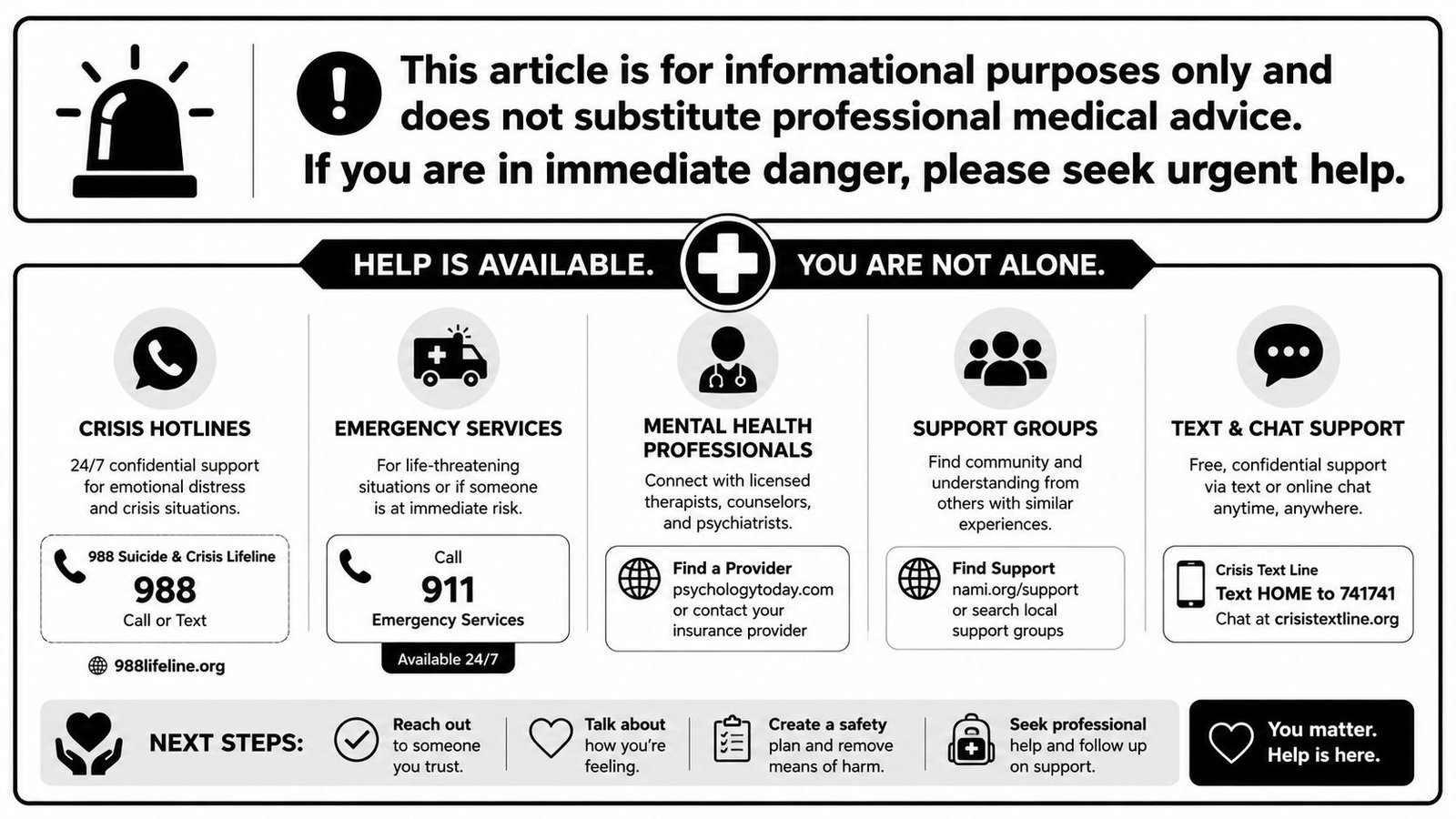
This article is for informational purposes only and does not substitute professional medical advice. If you are in immediate danger, please seek urgent help.
If self-harm is active, escalating, or linked to suicidal thoughts, don’t wait for a planned assessment.
UK urgent help options
- Emergency help: Call 999 if there is immediate danger or a serious injury.
- Urgent NHS support: Contact NHS 111 and choose the mental health option if you need urgent advice.
- Samaritans: Call 116 123 for emotional support at any time.
- Shout: Text SHOUT to 85258 for text-based crisis support in the UK.
- Local crisis team: If you are already under mental health services, use your local crisis number or care plan contacts.
A self harm assessment is still one of the most constructive next steps when the situation is not an immediate emergency. Done well, it helps you understand the behaviour, identify what is driving it, and build a plan that makes sense in real life. That is especially important when ADHD, autism, burnout, or long-standing diagnostic uncertainty may be part of the picture.
Planned assessment services can help with understanding and treatment planning. They are not crisis services. If the risk feels immediate, use urgent NHS or emergency support first.
If you’re looking for a consultant-led adult assessment that considers self-harm in the wider context of ADHD, autism, and mental health, Insight Diagnostics Global offers online and face-to-face evaluations for adults aged 18 and over. The service is CQC-regulated, led by psychiatrists on the GMC Specialist Register, and provides structured assessments, clear reports, personalised recommendations, and optional follow-up. It is designed for planned care rather than emergencies, so if you need immediate help, contact 999 or NHS 111 first.