

If you're looking at private psychiatrists in Northern Ireland, you're probably already tired of waiting, chasing updates, and trying to work out whether your symptoms are “serious enough” to justify paying for help. That uncertainty is exhausting. It's even harder when the questions involve ADHD, Autism, anxiety, low mood, burnout, or a wider mental health picture that doesn't fit neatly into one box.
Many adults come to private care after months or years of trying to manage on their own. Some need a formal psychological assessment for work, university, or day-to-day functioning. Others need a consultant psychiatrist to look at the full clinical picture, especially when neurodevelopmental traits sit alongside depression, anxiety, trauma, or personality difficulties. In practice, what helps most is a service that is clear, regulated, and clinically structured from the start.
Navigating Mental Health Support in Northern Ireland
Northern Ireland patients often arrive at private services after a long period of uncertainty. They may have spoken to a GP, tried brief support, or been told that an assessment is possible but not soon. That delay matters when concentration is affecting work, when sensory overload is affecting relationships, or when chronic stress has tipped into burnout.
The wider service context helps explain why so many people are now exploring private psychiatrists in Northern Ireland. Public services are under strain, and many adults need a route that gives them an actual appointment, a thorough assessment, and a written outcome they can use.
Why people are turning to private routes
A regulated private pathway isn't only about speed. It's about access to a consultant psychiatrist who can assess ADHD, Autism, mental health conditions, and psychological functioning together, rather than treating each concern in isolation.
That matters because adults rarely present with one clean problem. They may describe poor focus, emotional dysregulation, panic symptoms, sleep disruption, mood swings, long-standing social difficulties, or patterns that suggest personality vulnerability. A good psychiatric assessment sorts out what belongs where, what needs treatment now, and what evidence is needed for a reliable diagnosis.
Private care is most useful when it adds clarity, not just convenience.
Readers who want a grounded overview of adult pathways may find this guide to adult mental health services useful, especially if they're trying to distinguish urgent support, routine assessment, and longer-term treatment.
There's also a practical lesson here for clinics and patients alike. Clear information reduces friction. The same principle shows up in strong healthcare SEO strategies, where patients are better served when services explain assessment scope, regulation, and next steps plainly instead of relying on vague marketing language.
What a good private service should feel like
The right service should feel organised from the first contact. You should know:
- Who you're seeing. A named consultant psychiatrist, not an anonymous rota.
- What is being assessed. ADHD, Autism, general psychiatric symptoms, or a combination.
- What the report is for. Clinical treatment, workplace support, university evidence, or shared-care discussions with a GP.
- What happens after diagnosis. Medication review, psychological recommendations, follow-up, or onward referral.
When those points are clear, private psychiatry becomes far less opaque. It becomes a practical route to answers.
Understanding the Role of a Private Consultant Psychiatrist
A consultant psychiatrist is a medical specialist. That sounds obvious, but it's one of the most important distinctions in this area. A counsellor, therapist, or coach may offer valuable support, but they don't provide the same level of medical diagnosis, risk assessment, prescribing authority, or formal psychiatric report.
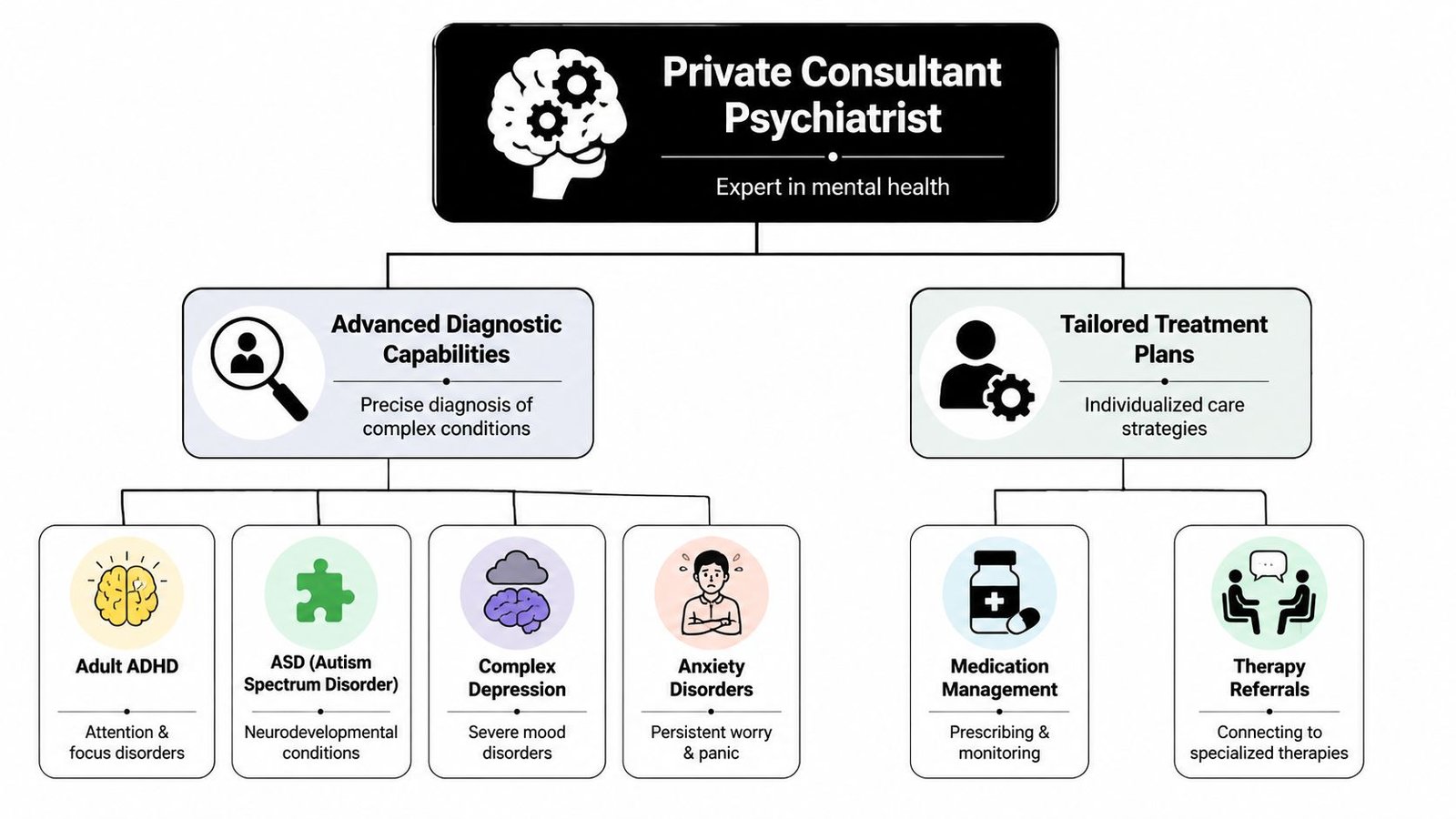
What a consultant psychiatrist actually does
For adults seeking help with ADHD, Autism, or broader mental health concerns, the consultant psychiatrist's role usually includes:
- Diagnostic formulation. They don't just list symptoms. They decide whether those symptoms fit ADHD, ASD, anxiety, depression, a personality disorder, trauma-related difficulty, or a different explanation.
- Medical assessment. They consider sleep, substance use, medication history, physical health, and risk.
- Treatment planning. That may involve medication, monitoring, psychoeducation, therapy referral, occupational adjustments, or further investigation.
- Formal reporting. A robust report is often what makes the assessment useful outside the appointment itself.
Why specialist experience matters
This is especially important in neurodevelopmental work. Adult ADHD and Autism can overlap with each other and with other psychiatric conditions. A rushed or poorly structured assessment often creates more confusion than certainty.
Dr Sai Achuthan is a leading Consultant Psychiatrist in Ireland specialising in neurodevelopmental disorders including ADHD and Autism, as well as personality disorders, and is registered on the GMC Specialist Register and works to UK clinical standards for assessment and diagnosis. That combination of specialist focus and recognised registration is exactly what adults should look for when choosing a clinician.
A consultant with this background is better placed to answer difficult questions such as:
- Is this lifelong ADHD, or concentration problems caused by anxiety and burnout?
- Is this Autism, social anxiety, or both?
- Are emotional regulation problems part of ADHD, trauma, or a personality disorder pattern?
- What needs treatment first?
Clinical reality: the most helpful diagnosis is the one that stands up to scrutiny after the appointment, not the one that feels quickest in the room.
For readers who want a fuller explanation of scope and responsibilities, this article on what a consultant psychiatrist does is a useful companion.
What private psychiatric care is not
It isn't a casual opinion service. It shouldn't be a short conversation followed by a label. And it shouldn't rely only on a questionnaire without detailed developmental, psychiatric, and functional history.
Private psychiatry works well when it combines medical expertise, structured psychological assessment, and careful reasoning. That's what gives a diagnosis weight.
Private Psychiatry Versus the NHS in Northern Ireland
For many adults, this isn't an abstract comparison. It's a practical decision about how long they can keep struggling before they get assessed.
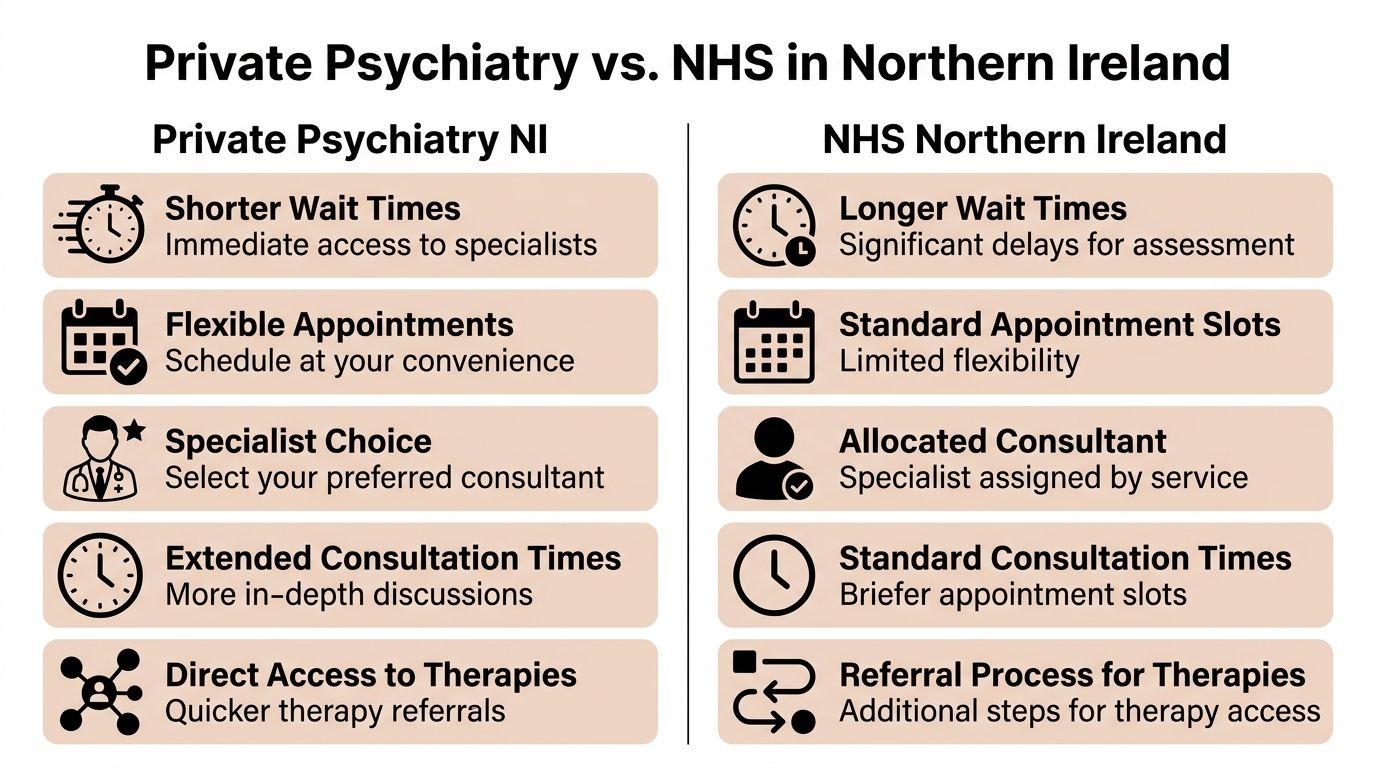
Why the NHS pathway feels so difficult
The pressure on psychiatric services in Northern Ireland is severe. Reporting on the region's psychiatric workforce described a 31% vacancy rate for consultant and specialty psychiatrist posts, and linked that shortage to adult ADHD and autism assessment waits that often exceed three years in Northern Ireland, which is one reason many adults seek private care (reporting on the Northern Ireland psychiatric workforce crisis).
That context matters because long waits are not usually the result of one poor referral or one unhelpful receptionist. They reflect system capacity. If senior posts are unfilled, the bottleneck affects assessment, diagnosis, medication review, and continuity.
Side-by-side trade-offs
The NHS route still has strengths. It can be appropriate when cost is the deciding factor, when care needs to sit fully within public services, or when a person is willing and able to wait. Private care changes different variables.
| Pathway | Main advantage | Main limitation | Best fit |
|---|---|---|---|
| NHS Northern Ireland | Lower direct cost to the patient | Delays, less choice over specialist, less flexibility | People who can wait and want care fully within NHS structures |
| Private psychiatry | Faster access, direct consultant choice, more flexibility | Self-funding or insurance admin | People who need timely assessment, formal reports, or specialist expertise |
Private care is often most useful when the question is complex. For example, an adult may need a consultant psychiatrist rather than a narrow screening service because they're trying to understand ADHD traits alongside trauma, depression, or personality-related difficulties.
Where Right to Choose fits
Some patients also ask about Right to Choose. The details can be confusing, especially in Northern Ireland, where pathways don't always mirror arrangements elsewhere in the UK. The principle is that some patients may request assessment through an NHS-referred specialist private provider, but eligibility and practical availability depend on the route open to them.
If you're considering that option, this explainer on the NHS Right to Choose mental health pathway can help you prepare the right questions before speaking to your GP.
If you need a diagnosis for employment, study, medication planning, or day-to-day functioning, the key question isn't whether private care is “better” in general. It's whether waiting is clinically workable for you.
How to Choose the Right Private Psychiatrist for You
The private sector is more manageable when you know what to check. The strongest providers are usually straightforward about their clinicians, methods, reports, and regulation. The weaker ones tend to be vague.
Start with regulation and registration
The first check is the clinician. If you're seeking a formal diagnosis for ADHD, Autism, or a broader psychiatric condition, look for a psychiatrist on the GMC Specialist Register.
The second check is the clinic itself. Regulation matters because it tells you there is external oversight of safety, governance, record keeping, and clinical processes. In practical terms, that gives patients more confidence that the service is accountable.
Private clinics regulated by the CQC, like Insight Diagnostics Global, provide GMC Specialist Register-registered psychiatrists who produce structured, auditable reports for ADHD and Autism, helping ensure diagnoses are reliable for insurance and statutory support, including providers such as Vitality and Aviva (discussion of regulated private diagnostic services).
Questions worth asking before you book
A good clinic should answer these clearly:
- Who completes the assessment. Is it a consultant psychiatrist, a psychologist, or a mixed pathway?
- How is the diagnosis made. Are structured interviews and developmental history used, or is the process mostly questionnaire-based?
- What does the report include. Diagnosis, differential diagnosis, recommendations, and evidence for accommodations should be clear.
- Will the report support next steps. That might include university support, work adjustments, insurance queries, or discussions with your GP.
What often doesn't work well
Some adults book based on speed alone and then discover the assessment wasn't detailed enough to be useful. Others choose a provider without checking whether the report is clinically sound.
Watch for warning signs:
- Minimal detail about methods. If there's no explanation of how ADHD or Autism is assessed, be cautious.
- Unclear credentials. You should be able to verify the psychiatrist's standing.
- Promises that sound too neat. Real assessments involve nuance, especially when symptoms overlap.
- No mention of follow-up. Diagnosis without a plan leaves many patients stuck.
A strong private psychiatrist doesn't just tell you whether you meet criteria. They explain why, what else was considered, and what to do next.
Decoding Services Costs and Insurance Authorisation
Cost is one of the first practical questions people ask, and rightly so. Private psychiatry is easier to plan for when prices are transparent and the pathway is explained before booking.
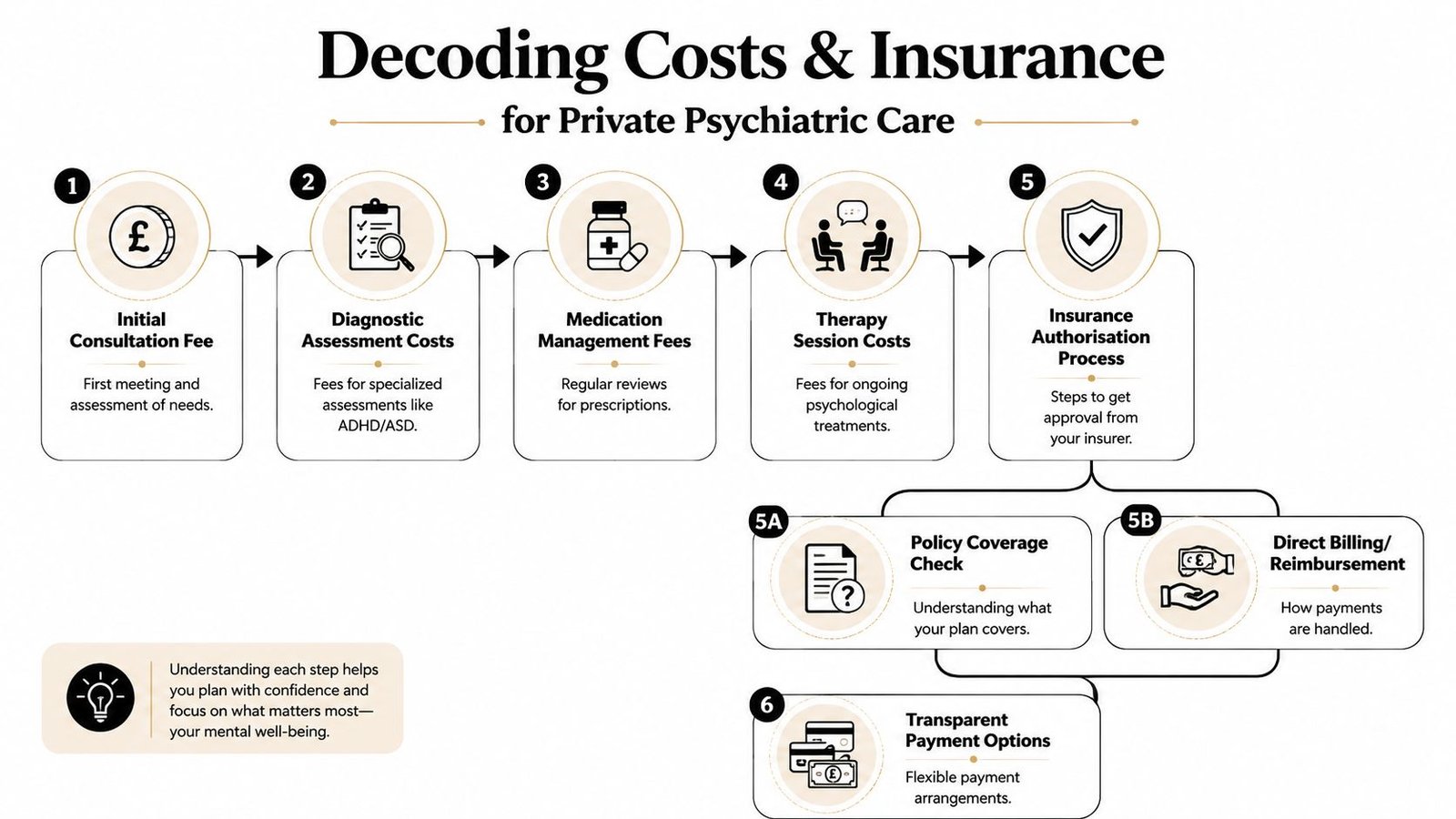
What a full ADHD assessment usually includes
A proper adult ADHD diagnostic pathway in Northern Ireland is not just one conversation. A pathway that satisfies NICE-guided standards typically includes a structured interview such as DIVA-5, informant scales, and a detailed report, with overall costs in private Northern Ireland clinics typically ranging from £869 to £1,200 (adult ADHD assessment pathway and cost range).
Some clinics break that down into staged fees. One published example in Northern Ireland uses an Initial Consultation at £49, a Full Assessment at £495, and a Diagnosis and Report at £325, totalling £869, with medication support at £289 per month for three months if clinically appropriate (private ADHD pricing pathway).
Typical Private Psychiatry Service Costs in NI (2026)
| Service | Typical Cost Range | What's Usually Included |
|---|---|---|
| Adult ADHD diagnostic pathway | £869 to £1,200 | Structured interview, rating scales, analysis, diagnostic report |
| Staged ADHD pathway example | £49, £495, and £325 | Initial consultation, full assessment, diagnosis and report |
| Medication support example | £289/month for three months | Ongoing prescribing support and monitoring where appropriate |
Insurance authorisation in plain terms
If you have private health insurance, the main step is getting authorisation before the appointment. That usually means contacting your insurer, confirming whether psychiatric assessment is covered, and obtaining an authorisation code if required.
Common points to check with insurers such as Aviva or Vitality include:
- Whether neurodevelopmental assessment is covered. Some policies treat ADHD and Autism differently from general psychiatric consultations.
- Whether you need a GP referral. Many insurers still ask for one.
- Whether the clinician or clinic must be recognised by the insurer. Regulation and specialist registration are therefore important.
- How payment works. Some insurers settle directly, while others reimburse after you've paid.
For a more detailed breakdown of what patients are usually paying for, this guide to private mental health assessment costs is a practical starting point.
Payment tip: ask for the exact components of the fee before booking. Assessment, report writing, follow-up, and medication review aren't always bundled together.
Preparing for Your Private Psychiatric Assessment
The best preparation is simple, not elaborate. You don't need to perform your symptoms or arrive with perfect notes. You do need enough information to help the psychiatrist understand the pattern across your life.

Before the appointment
Private ADHD and Autism assessments in Northern Ireland often use recognised tools such as the DIVA alongside a detailed psychiatric and developmental history (overview of evidence-based private assessment tools). That means the psychiatrist is looking for more than a list of current complaints. They're building a timeline.
Useful preparation often includes:
- School information. Old reports, comments about attention, behaviour, social interaction, or academic inconsistency.
- A symptom summary. Brief notes on focus, impulsivity, sensory issues, routines, burnout, mood, sleep, or emotional regulation.
- Family perspective. If someone knows you well, their observations can help, especially for developmental history.
- Current treatment details. Medication, therapy, GP input, or previous mental health diagnoses.
What the interview usually feels like
A well-run assessment should feel structured but collaborative. The psychiatrist will usually move between your current concerns and your history, looking at childhood patterns, education, work, relationships, mental health, and functioning.
If ADHD is part of the picture, they may ask about forgetfulness, organisation, procrastination, restlessness, impulsive decision-making, and how those patterns show up across different settings. If Autism is being considered, they may ask about sensory sensitivity, social communication, routines, masking, and exhaustion after social contact.
The process can feel detailed. That's a good sign.
After the interview
The psychiatrist's work continues after the appointment. They review the material, consider differential diagnoses, and decide whether the evidence supports a formal diagnosis. A robust report should explain the reasoning, not just state a conclusion.
Private adult ADHD assessments in Northern Ireland are commonly described as a two-hour initial interview followed by independent analysis and, where indicated, further investigations, using structured tools such as DIVA-5, informant scales like ADHD-RS-5, and self-report measures to meet NICE NG200 criteria and support shared-care discussions with NHS GPs (details of the private ADHD diagnostic process).
Many patients worry they'll “say it wrong”. In practice, the psychiatrist's job is to make sense of the history with you, not to catch you out.
Frequently Asked Questions About Private Psychiatry in NI
Is a private diagnosis recognised?
Often, yes, if the assessment has been done properly by the right clinician in a regulated setting. Recognition matters for practical reasons. Adults may need evidence for university disability support, workplace accommodations, occupational health, or insurance documentation.
A report carries more weight when it is structured, medically reasoned, and written by a consultant psychiatrist with the right registration. That's why the choice of clinic matters as much as the decision to go private.
Can private care still be necessary if I want NHS involvement later?
Yes. In Northern Ireland, the system remains under pressure. The post-pandemic period saw an approximately 20% decline in accepted mental health referrals compared with pre-2019 levels, and in March 2025 only 52 of 79 senior psychiatrist posts were filled permanently, creating a major bottleneck for timely diagnosis (Northern Ireland Audit Office mental health findings).
That's one reason many patients use private assessment to get diagnostic clarity now, then work with their GP or other services for longer-term management where appropriate.
Will my GP agree to shared care?
Sometimes, but not automatically. Shared care depends on the GP, the medication involved, local prescribing arrangements, and the quality of the assessment documentation. A strong private report improves the conversation, but it doesn't force an agreement.
Do private assessments only cover ADHD and Autism?
No. Good private psychiatric care often addresses the wider picture, including anxiety, depression, mood instability, trauma-related symptoms, and personality difficulties. That broader view is often what makes the diagnosis useful.
For readers interested in how service providers communicate trust and credibility online, some of the same principles appear in authentic marketing insights. Patients respond to clarity, realism, and transparency. Clinical services should do the same.
If you want a regulated, consultant-led route to ADHD, Autism, and broader adult mental health assessment, Insight Diagnostics Global offers online and face-to-face care for adults aged 18 and over. The service is CQC-regulated, led by psychiatrists on the GMC Specialist Register, and built around structured assessments, clear reports, and practical next steps for treatment and support.