

Nearly 964,000 workers in Great Britain experienced work-related stress, depression, or anxiety in 2024/25, the highest level since annual recording began in 2001/02, according to the Health and Safety Executive’s latest stress data. That number changes how burnout vs depression should be discussed. This isn’t only a question of feeling overworked. It’s a question of whether someone is dealing with strain that may improve with rest and workplace change, or a clinical condition that needs formal assessment and treatment.
For many adults, the confusion starts subtly. Work becomes harder. Concentration slips. Evenings feel flat. A weekend helps a bit, then Monday resets everything. For adults with ADHD or autism, that pattern can be harder to decode because sensory overload, executive dysfunction, masking, and chronic effort can make ordinary work stress feel relentless long before anyone uses the word burnout.
That’s why this distinction matters. In the UK, the line between burnout and depression affects diagnosis, sick leave conversations, treatment pathways, and whether a person needs a psychological or psychiatric assessment rather than another attempt to “push through”.
Introduction to Workplace Strain
A common UK story goes like this. Someone is doing well on paper, meeting deadlines, replying late into the evening, and telling themselves they’re only tired because work has been busy. Then cynicism creeps in. Small tasks start to feel heavier than they should. Home stops feeling restorative because the mind never fully leaves work behind.
That experience is widespread enough that it has become a public health signal, not just a private struggle. Yet many adults still ask the wrong question. They ask whether they’re coping badly, when the better question is whether their symptoms are still tied to work or have spread across the rest of life.
Burnout often hides inside competence. People keep functioning long after their mental state has changed.
Careful comparison proves useful. If exhaustion lifts with rest, boundaries, and environmental change, burnout may be the better fit. If low mood, loss of pleasure, or hopelessness continue across work, home, relationships, and leisure, depression becomes more likely. Adults who want a practical starting point can review workplace stress management strategies for UK adults before deciding whether self-management is enough.
Understanding Burnout and Depression
The single most important UK-specific fact is this. Burnout is not a medically diagnosed condition in the UK, while depression is, a distinction that changes both treatment pathways and statistical tracking, as outlined by Mental Health UK’s guide to burnout.
That sounds technical, but it has real consequences. If a person presents with burnout-like symptoms, the response often centres on workload, boundaries, leave, recovery time, and occupational change. If that same person meets criteria for depression, clinicians move into a different framework involving formal mental health assessment and structured treatment.
Why the UK distinction matters
Burnout sits in an occupational frame. Clinicians and employers usually understand it as a response to sustained stress, especially when symptoms such as exhaustion, detachment, and cynicism cluster around work. Depression sits in a medical frame. It can affect mood, thinking, sleep, energy, motivation, and functioning across every part of life.
That difference is easy to miss because the early overlap is genuine. A person may feel tired, irritable, foggy, and emotionally blunted in both states. The critical issue is where the symptoms are anchored.
- Burnout tends to be situational: symptoms cluster around work demands, work identity, or ongoing role strain.
- Depression tends to be pervasive: symptoms spread into family life, hobbies, self-care, and a person’s sense of self.
- Burnout may improve with relief from pressure: a reduction in demands or time away can help.
- Depression usually needs clinical treatment: rest alone often doesn’t resolve it.
The symptom map is not symmetrical
Mental Health UK notes that burnout symptoms often centre on work-related stressors and may improve with rest, while clinical depression involves pervasive negative thoughts about life both at work and at home. It also highlights a point many people don’t realise. Suicidal thoughts are not a feature of burnout.
That’s the part most generic discussions miss. Burnout and depression overlap, but they don’t carry the same clinical weight. When someone says, “I can’t enjoy anything anymore,” or “I feel this way even when I’m away from work,” they may have crossed from occupational strain into a depressive state.
Clinical implication: UK services can support burnout, but only depression moves into a recognised diagnostic and treatment pathway.
For adults who also suspect ADHD, autism, or another neurodevelopmental factor, the distinction gets even more important. What looks like simple overwork may well be the interaction of unmanaged neurodivergent needs and an emerging mood disorder.
Diagnostic Criteria and Key Differentiators
The fastest way to clarify burnout vs depression is to compare features side by side. The point isn’t to self-diagnose from a table. It’s to notice which pattern your symptoms fit most closely.
| Symptom | Burnout | Depression |
|---|---|---|
| Exhaustion | Common, often linked to work demands | Common, across life domains |
| Cynicism or detachment | Common, especially about work | May occur, but not usually work-specific |
| Reduced effectiveness | Often felt in job performance | Can affect work, home, and basic daily tasks |
| Improves with rest or time away | Often can | Often doesn’t fully resolve |
| Loss of pleasure in previously enjoyable activities | Not a defining feature | Core feature |
| Suicidal thoughts | Not a feature | Can occur |
| Context | Situation-specific | Pervasive and global |
The two clearest clinical boundaries
A highly practical UK clinical rule is this. Anhedonia, the inability to feel pleasure, is a core feature of clinical depression but not burnout. Suicidal ideation appears only in depression, as explained in this UK clinical comparison of burnout and depression.
If you still enjoy friends, hobbies, food, music, exercise, or quiet time when work pressure eases, burnout remains plausible. If those things feel emotionally empty too, depression moves higher on the list.
Burnout vs Depression Diagnostic Checklist
Use this checklist as a thinking tool, not a final verdict.
- Ask where the symptoms live: If they mostly appear before work, during work, or when thinking about work, burnout is more likely.
- Check what rest does: If sleep, annual leave, or fewer demands help meaningfully, that points toward burnout.
- Notice pleasure, not just mood: Depression often shows up as absence of enjoyment, not only sadness.
- Look for self-worth collapse: Burnout usually says, “This job is too much.” Depression often says, “I’m no good.”
- Take suicidal thoughts seriously: Those thoughts require urgent clinical attention. They are not part of burnout.
Why clinicians don’t stop at symptom overlap
A person can look “burnt out” and still be clinically depressed. That’s why good assessment goes beyond buzzwords. Clinicians consider symptom duration, scope, severity, whether functioning has declined outside work, and whether warning signs such as hopelessness or anhedonia are present.
They also assess whether another condition may be shaping the picture. ADHD can produce chronic overwhelm, task paralysis, emotional dysregulation, and shame around performance. Autism can bring sensory fatigue, social exhaustion, and shutdown after prolonged masking. Without that context, adults can be mislabeled as experiencing stress when the issue is more layered.
A useful rule is to track whether your distress is attached to a role or attached to your whole life.
That distinction often decides whether someone needs workplace adjustment, a depression assessment, or a broader neurodevelopmental evaluation.
Causes and Risk Factors with Neurodivergent Context
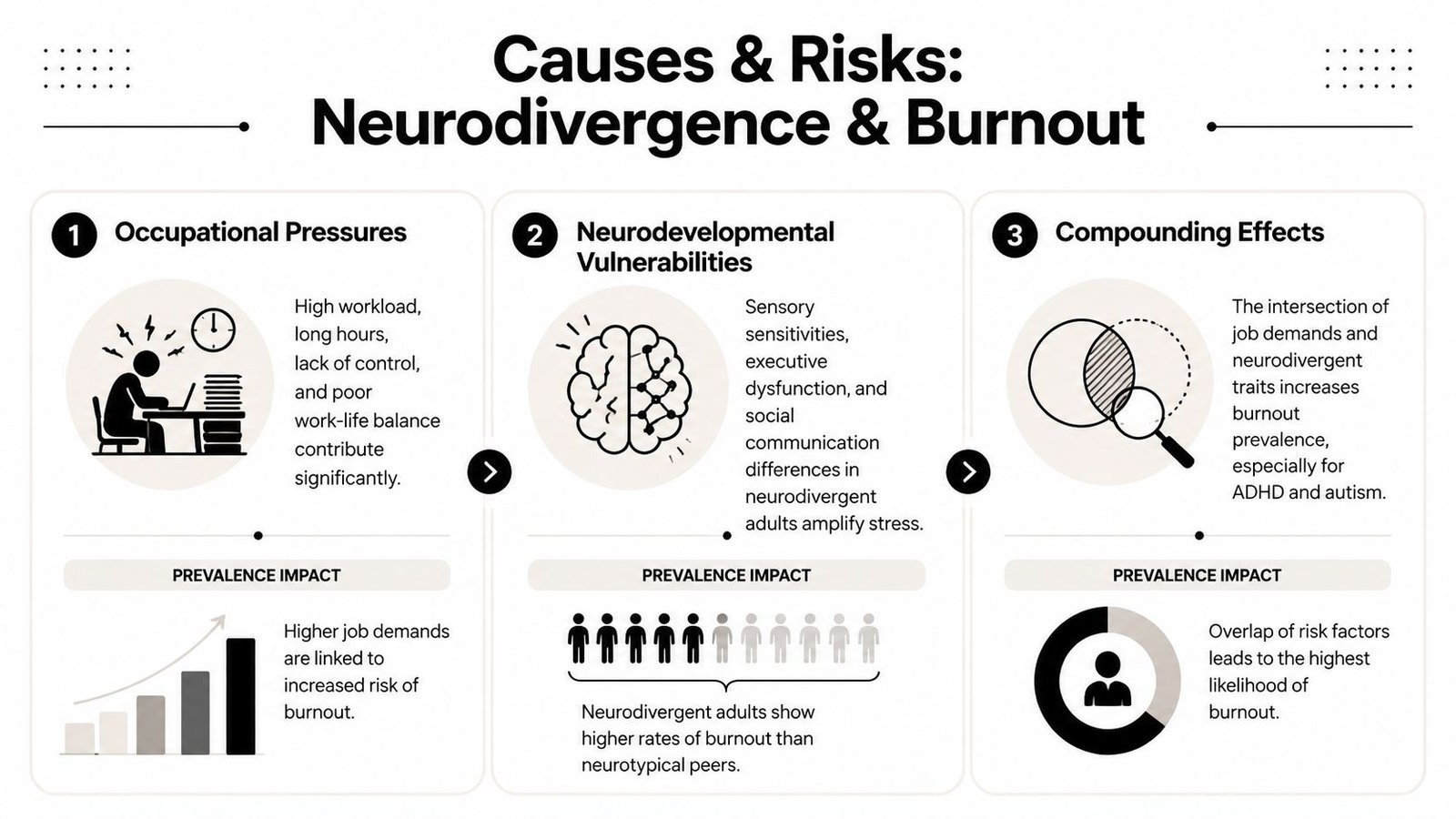
Burnout doesn’t emerge in a vacuum. It usually develops where sustained demands exceed a person’s available recovery, control, and support. For neurodivergent adults, that mismatch can start earlier and intensify faster because the effort required to maintain ordinary performance may already be unusually high.
Why ADHD and autism change the picture
ADHD affects an estimated 3 to 4% of UK adults, and around 15% of the total population is neurodivergent, according to UK neurodiversity statistics gathered here. That means a substantial number of adults trying to interpret burnout symptoms are doing so through a brain profile that may already make work harder to regulate.
In practice, the risks don’t look abstract. They look like missed deadlines caused by executive dysfunction, sensory overload in open-plan offices, chronic lateness linked to time blindness, social depletion after masking, or perfectionism that develops after years of being misunderstood. Those factors can create a form of strain that resembles depression from the outside.
The overlooked compounding effect
The usual burnout discussion focuses on workload and long hours. That’s incomplete for neurodivergent adults. The more revealing question is whether the workplace matches the person’s processing style.
Consider the compounding pattern:
- Sensory demand: noise, interruptions, bright lighting, and constant switching can drain autistic adults rapidly.
- Executive demand: planning, prioritising, task initiation, and sustained organisation can overtax adults with ADHD.
- Social demand: meetings, ambiguity, office politics, and masking consume energy that never appears on a job description.
- Identity demand: adults who’ve spent years “performing normality” may not notice how depleted they are until mood drops sharply.
The clinical distinction between burnout and depression can become slippery. A neurodivergent person may say, “I’m exhausted all the time,” but the true driver could be unrecognised autism, untreated ADHD, chronic masking, an emerging depressive episode, or all four at once.
Adults trying to spot early changes can review early signs of burnout in day-to-day life and compare them against their own work, sensory, and cognitive load.
Autism and access barriers
The autism dimension deserves separate attention. The NHS notes that around 70% of autistic people have at least one mental health condition, and access to support can be difficult when services are not adapted for autism, as set out in this NHS England update on learning disability and autism.
That matters because a standard mental health conversation may miss autistic burnout, sensory exhaustion, shutdown, or communication differences. In those cases, timely psychological assessment can prevent a long period of misinterpretation, especially when someone has spent years being treated only for stress.
Assessing Symptoms and Recognising Red Flags
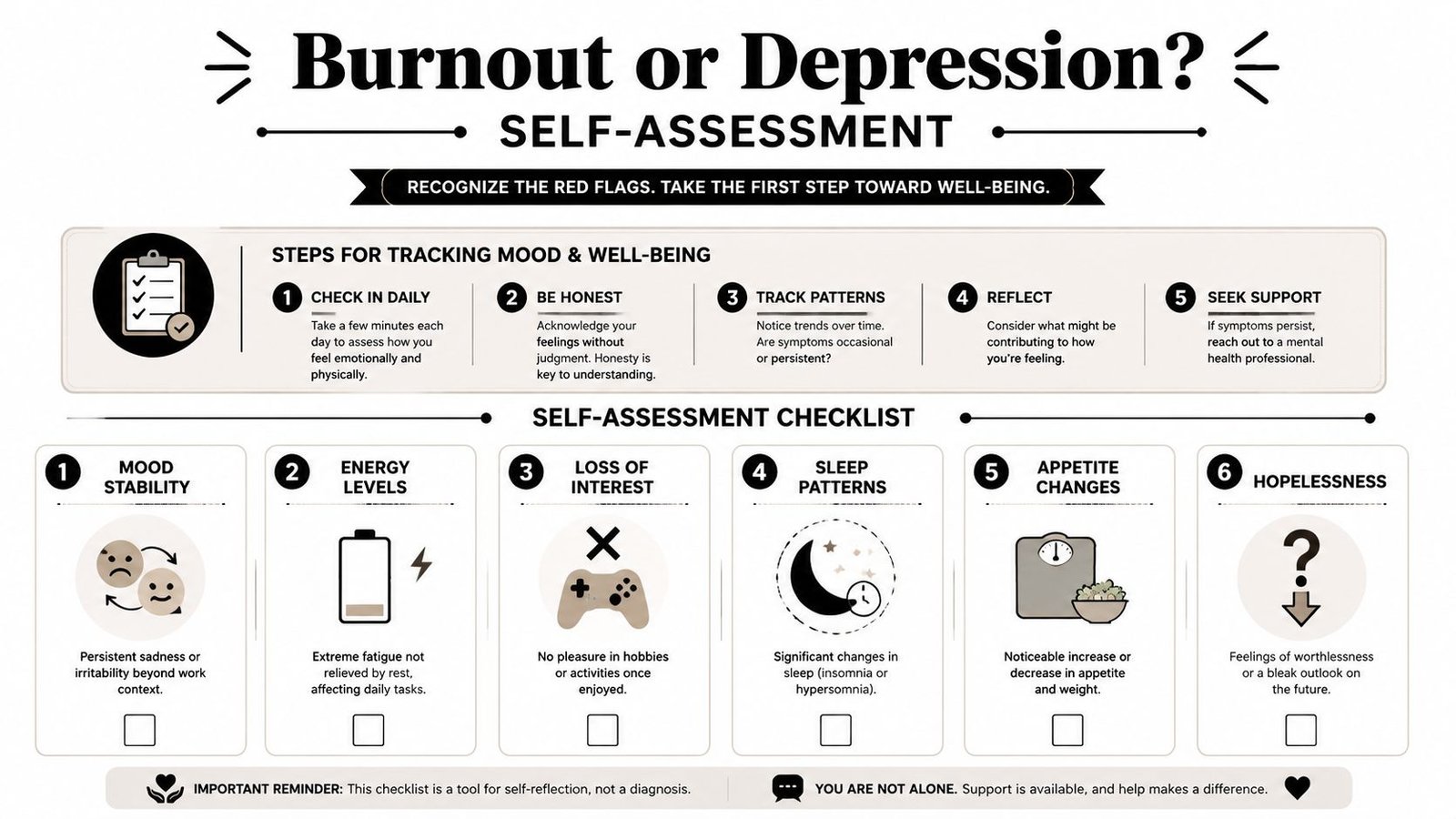
Self-assessment works best when it is structured. A common practice is to judge oneself by how productive they were this week. That’s a poor test. The better approach is to track pattern, spread, and recovery.
Start with a seven-day symptom log
Write down what happens in four domains: work, home, body, and enjoyment. You’re looking for location and consistency.
- Track mood by context: note whether low mood appears only around work or stays present on evenings and days off.
- Record energy response to rest: did sleep, a quiet day, or reduced demand help, or did exhaustion remain unchanged?
- Check interest and pleasure: did you still enjoy music, gaming, cooking, exercise, sex, family time, or conversation?
- Observe cognitive changes: problems with concentration can occur in burnout, depression, ADHD, and anxiety, so note when and where they appear.
- Watch body rhythms: changes in sleep or appetite can signal a broader mood disorder.
- Notice language about yourself: frustration with work differs from pervasive worthlessness.
The red flags that need escalation
In a UK study of healthcare workers, 46% of those screening positive for burnout also screened positive for depression, showing a strong relationship between the two states in high-pressure settings, as reported in this PLOS Global Public Health study. The practical lesson is simple. Don’t assume “it’s only burnout” once symptoms start broadening.
Use these red flags as a threshold for professional review:
- Symptoms spread beyond work: weekends, relationships, and hobbies feel equally flat.
- Rest stops helping: time off no longer restores even partial energy or interest.
- Pleasure disappears: favourite activities feel emotionally blank.
- Hopelessness appears: the future feels bleak, not just the job.
- Thoughts of death or self-harm emerge: this requires urgent support through emergency or crisis services.
If your symptoms no longer make sense as a response to work alone, you need assessment, not just resilience strategies.
Adults who want a structured screening step can use a mood disorder questionnaire online as a starting point, while remembering that questionnaires guide discussion rather than replace clinical judgement.
A practical interpretation rule
If your notes show “better away from work, worse near work,” burnout is still a reasonable hypothesis. If the record shows “low everywhere, even with rest,” depression becomes harder to dismiss.
For neurodivergent adults, add one more layer. Ask whether overwhelm follows sensory input, task switching, masking, or social demand. That information often reveals whether the central issue is occupational burnout, mood disorder, unmet neurodevelopmental need, or a combination.
Treatment Approaches and Practical Recommendations
Treatment should match the problem. That sounds obvious, yet many adults use depression strategies for burnout or burnout strategies for depression and then conclude nothing works. The distinction matters because the mechanisms differ.
When burnout is the better fit
Burnout improves when the source of chronic strain is reduced and recovery becomes real rather than symbolic. A day off won’t do much if the job remains structurally unmanageable.
Useful responses include:
- Boundary repair: reducing after-hours work, limiting constant availability, and creating separation between work and recovery time.
- Task redesign: clarifying responsibilities, lowering overload, and changing workflows that create avoidable friction.
- Environmental adjustment: for neurodivergent adults, this may mean quieter working conditions, fewer interruptions, clearer instructions, or remote flexibility.
- Recovery that restores: rest, sleep regularity, movement, and social contact matter when they are protective rather than performative.
When depression is the better fit
Depression usually needs formal clinical care. In UK practice, that may involve psychological therapy, psychiatric review, medication, or a combination, depending on severity and history. If symptoms include anhedonia, global low mood, hopelessness, or suicidal thoughts, self-help alone isn’t enough.
Treatment planning becomes more nuanced when ADHD or autism is also present. A depressed adult with untreated ADHD may struggle to follow through on therapy homework, routines, or sleep structure because executive dysfunction remains active. An autistic adult may need adaptations in communication style, sensory setting, and pacing to benefit fully from treatment.
Treatment rule: if workplace changes help, keep building those. If symptoms remain global, shift toward clinical assessment and evidence-based depression care.
Matching interventions to the real driver
A practical way to think about it is to separate interventions into two lanes.
| Situation | More useful first steps |
|---|---|
| Work-centred exhaustion and cynicism | Workload changes, boundaries, leave, coaching, therapy focused on stress |
| Global low mood and loss of pleasure | GP review, psychiatric assessment, therapy, discussion of medication |
| Suspected ADHD with chronic overwhelm | Neurodevelopmental assessment, practical supports, structured treatment planning |
| Suspected autism with masking and sensory fatigue | Autism-informed assessment, environmental adjustments, adapted psychological support |
Neurodivergent adaptations matter
Generic advice can backfire if it ignores neurodivergent needs. “Get organised” isn’t treatment for ADHD. “Take more breaks” isn’t enough if sensory overload is the central problem. Better recommendations are specific:
- For ADHD: external structure, task chunking, realistic scheduling, and specialist review where symptoms have been longstanding.
- For autism: sensory planning, reduced masking demands, clearer communication, and support that recognises shutdown or overload rather than misreading them as disengagement.
- For both: remove moral judgement from productivity. Strain often comes from mismatch, not lack of effort.
Some adults also explore adjunctive options while staying under clinical supervision. For example, those interested in broader symptom-management discussions can explore CBD for depressive symptoms as a background resource, though it shouldn’t replace assessment or established treatment for depression.
When to move beyond self-management
Ask for formal help if your symptoms are escalating, if function is slipping across several areas of life, or if you can’t tell whether the main issue is burnout, depression, ADHD, autism, or overlap between them. That’s especially important when years of “coping” have concealed the underlying pattern.
For some adults, the biggest treatment breakthrough isn’t a medication or a technique. It’s discovering that what looked like repeated burnout was in fact untreated ADHD, autistic masking, a depressive episode, or a layered combination that needed proper assessment.
When to Seek Specialist Assessment at Insight Diagnostics Global
A specialist assessment becomes useful when your symptom picture is mixed, prolonged, or hard to interpret. That includes adults who feel exhausted and low but can’t tell whether they are dealing with depression, neurodivergent burnout, ADHD-related overwhelm, autism-related masking fatigue, or a personality pattern affecting stress tolerance and relationships.
Leading with extensive experience, consultant-led adult assessment is where psychiatry adds real value. This is especially relevant when the clinician can evaluate both mental health and neurodevelopmental conditions rather than treating them as separate silos. Dr Sai Achuthan is known for work in neurodevelopmental and personality disorder assessment, which matters when symptoms don’t fit neatly into one label.
Why timing matters
For autism in UK community services, the average wait from referral to diagnosis is 2 years and 2 months, while for ADHD it is 2 years and 5 months, according to the Children’s Commissioner report on neurodevelopmental waiting times. Against that backdrop, a consultant-led service that can schedule assessments within seven working days changes the risk profile for adults who are deteriorating while they wait.
This isn’t only about speed. It’s about preventing further misattribution. Someone waiting years for ADHD or autism assessment may continue to be treated as merely stressed, unmotivated, or depressed without anyone examining the underlying pattern carefully enough.
Who should consider a specialist route
A specialist assessment is particularly worth considering if any of these apply:
- Your symptoms overlap: exhaustion, low mood, executive dysfunction, sensory overload, and emotional collapse are all present.
- Previous treatment hasn’t clarified things: you’ve had support for stress or depression, but the core difficulty remains unexplained.
- You suspect lifelong traits: attention problems, social communication differences, rigid routines, masking, or chronic overwhelm predate the current episode.
- You need a formal diagnostic report: for treatment planning, workplace adjustments, academic support, or insurance processes.
Adults wanting to understand how psychiatric evaluation can distinguish depressive illness from severe stress can review what to expect from a psychiatrist for depression.
What a high-quality adult assessment should include
The strongest assessments don’t chase a single label. They examine developmental history, symptom pattern, context, functional impact, co-occurring conditions, and risk. They also consider whether depression needs stabilisation before occupational or neurodevelopmental planning can be addressed properly.
That’s where consultant psychiatrists add depth. They can decide whether the right next step is mood treatment, ADHD medication titration, autism-informed support, further psychological evaluation, or a combined plan.
Recommended Next Steps for UK Adults
If you’re stuck in the burnout vs depression question, take a staged approach.
First, monitor your symptoms for a short, defined period. Track whether distress is limited to work or shows up across home life, enjoyment, sleep, and self-worth. Don’t rely on memory alone. Patterns are easier to see in writing.
Second, review your practical load. If the issue looks work-centred, make immediate changes where you can. Reduce avoidable demands, protect recovery time, and involve your GP or employer if function is slipping. If the issue looks global, seek a depression assessment rather than trying to out-rest it.
Third, consider whether ADHD or autism could be part of the picture. This matters if concentration problems, sensory overload, masking, social exhaustion, or lifelong patterns of overwhelm have always been present. Delayed recognition often keeps adults cycling through repeated episodes of apparent burnout.
A simple decision path helps:
- If symptoms are work-linked and improve with rest: start with workplace and lifestyle interventions.
- If symptoms remain broad and persistent: speak to a GP or psychiatrist about depression.
- If the picture includes lifelong attentional, sensory, or social differences: ask about ADHD or autism assessment.
- If you’re in crisis or having thoughts of self-harm: use urgent NHS support, call 999 in an emergency, or contact NHS 111 for immediate advice.
Private assessment can also be relevant if you are using Right to Choose pathways, need faster clarity for work or university, or require authorisation-based cover through health insurance.
If you need clarity on whether you’re dealing with burnout, depression, ADHD, autism, or overlap between them, Insight Diagnostics Global offers consultant-led adult assessments online and face to face. The service is CQC-regulated, designed for adults aged 18 and over, and built around thorough psychiatric evaluation, clear diagnostic reporting, and personalised recommendations rather than guesswork.