

Feeling overwhelmed by mental health support resources is a very common place to land in the UK. You might be waiting for a GP appointment, trying to decide whether your anxiety needs structured therapy, or wondering if years of burnout, missed deadlines, and sensory overload point more towards ADHD or Autism than “just stress”. The right route depends on what you need right now, and the wrong route can waste weeks or months.
That’s why this guide keeps the focus practical. If you need urgent support, some options are built for immediate listening and de-escalation. If you need assessment and treatment, other services are designed for structured triage, diagnosis, and follow-up. And if you’re trying to understand whether a neurodevelopmental difference is behind the pattern you’ve lived with for years, the pathway is different again.
In England, mental health need is widespread and long-lasting. Mind’s 2024 Big Mental Health Report says 1 in 5 adults, 20.2%, are living with a common mental health problem, with a higher rate in women at 24.2% than men at 15.4% (Mind’s 2024 Big Mental Health Report). The same report also notes that in 2023–24 there were 2.8 million referrals to adult community mental health services in the UK, of which 2.4 million were accepted, representing around 1.7 million people (Mind’s report). Those figures explain why referral routes, triage, and clear next steps matter so much.
1. Insight Diagnostics Global
Insight Diagnostics Global is the strongest option if you’re an adult who needs a fast, clinically rigorous assessment for ADHD, Autism, anxiety, depression, or related concerns. It’s consultant-led, regulated by the CQC, and staffed by psychiatrists on the GMC Specialist Register, which gives it a clear advantage for people who want specialist oversight rather than a generic intake chat. The clinic also offers online and face-to-face appointments, which helps if travel, work, or sensory overload makes in-person access hard.
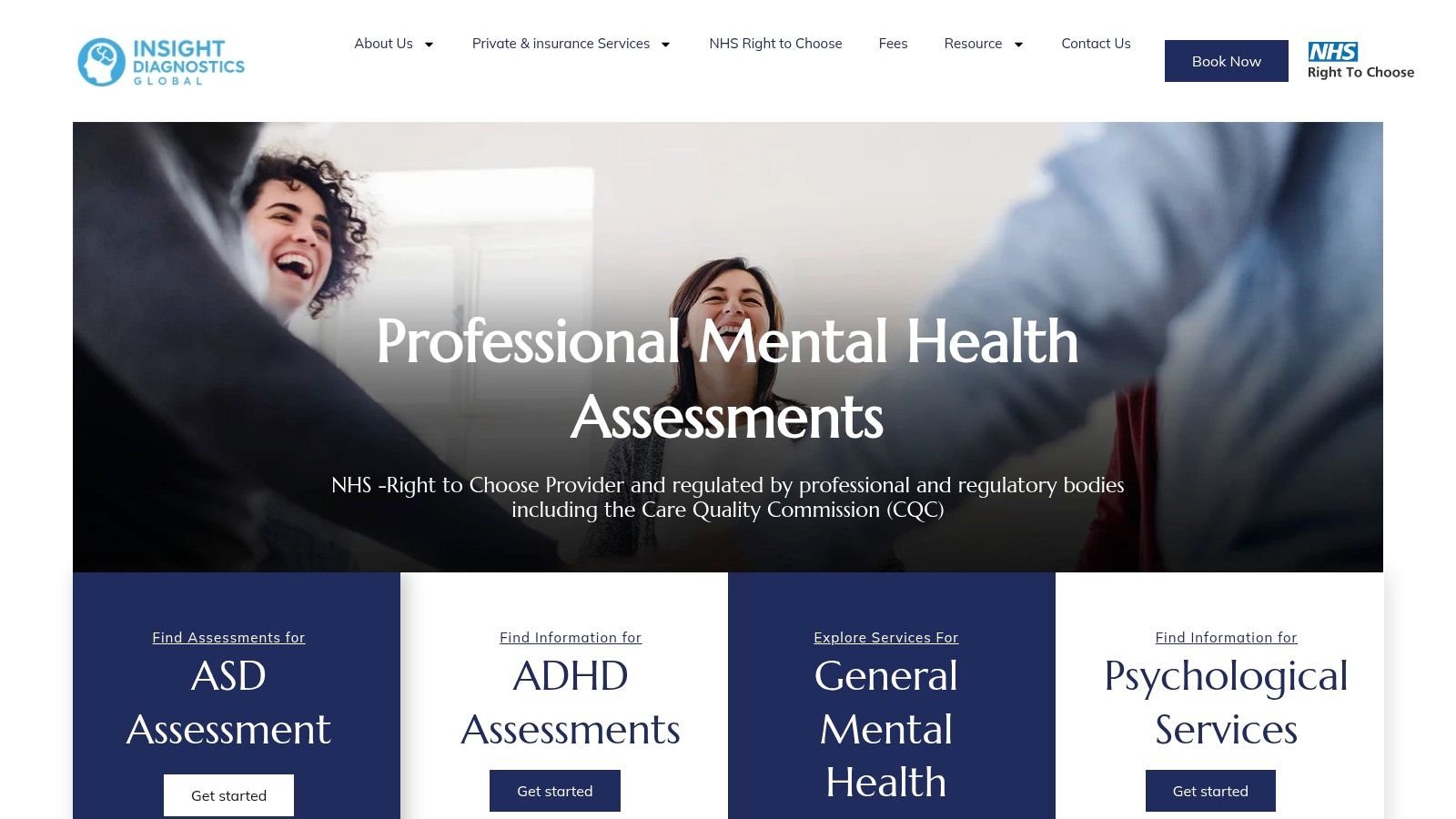
The practical appeal is speed and structure. Assessments are usually scheduled within seven working days, and diagnostic reports are completed within five working days after that. For people stuck on a long waiting list, or for those using Right to Choose or insurance authorisation, that predictability can make the difference between staying in limbo and finally getting a clear plan.
What works well here
- Fast, predictable access: The timeline is short enough to suit adults who’ve already spent months second-guessing symptoms.
- Structured diagnostic pathway: You get triage, thorough interviews, detailed reports, and personalised treatment or support recommendations.
- Ongoing support where needed: ADHD medication titration and monitoring are available, which matters if diagnosis is only the first step.
- Flexible delivery: Online or face-to-face appointments suit different levels of capacity, privacy, and travel tolerance.
Practical rule: If you suspect ADHD or Autism and want a specialist opinion, choose a service that does more than name the condition. You need a report that helps with treatment, workplace adjustments, university support, or NHS onward care.
The trade-off is simple. This is not a crisis service, so emergencies still need 999 or NHS 111. It’s also primarily a private, self-funded, or insurer-authorised route for adults 18+, so the financial side and insurer approval can limit access for some people. For a closer look at the broader service pathway, the clinic’s mental health assessment services overview is the most relevant starting point.
2. NHS Talking Therapies
If you are dealing with anxiety, depression, PTSD, OCD, or phobias, NHS Talking Therapies is often the first structured route to try. In England, many adults can self-refer online, which saves a GP appointment if you already know you need psychological help rather than another round of general advice. The service is designed for common mental health problems, so it is a better fit for targeted treatment than for questions about whether ADHD or Autism may have been missed earlier in life.
Its main advantage is access. The service is free at the point of use, and the NHS has put real weight behind digital contact, with the NHS App reaching 33.6 million registered users by March 2024 and logging over 375 million logins in 2023/24 (NHS digital usage data). For many adults, that level of digital familiarity makes it easier to complete forms, receive updates, and keep track of appointments without adding another layer of stress.
You can usually expect options such as CBT, counselling, guided self-help, group programmes, and, in some areas, digital or video-based therapy. For someone trying to sleep better, reduce spiralling thoughts, or get back to work without waiting for specialist psychiatry, that can be enough to make steady progress.
Where it helps, and where it doesn’t
- Best for: Anxiety, depression, and other common presentations where protocol-led therapy is a good fit.
- Not ideal for: Complex neurodevelopmental questions, high-risk presentations, or symptoms that need diagnostic clarification after years of uncertainty.
- Watch for variation: Waiting times and treatment formats differ by area, so one local service may feel much easier to use than another.
- Use alongside GP care: If symptoms are layered, a GP can help you decide whether Talking Therapies, secondary care, or both is the right next move.
The limit is that Talking Therapies is not meant to do everything. It can help a great deal, but it still has a defined scope and local variation. If your main concern is whether you have lived with undiagnosed ADHD or Autism for years, a specialist assessment is usually a more direct next step than low-intensity therapy on its own. For adults comparing NHS, charity, and private routes, the guide to mental health services for adults gives useful context alongside the NHS pathway.
3. Mind
Mind is one of the most useful mental health support resources when you are trying to understand your rights, your options, and what to do next. The national charity provides plain-English information on conditions, self-care, treatment, and practical issues, and its Local Minds add a local layer that can include counselling, peer support, groups, and community-based services. That mix matters because many adults need both clear information and a real person to speak to.
Mind’s guidance also fits the reality of demand in the UK. Its 2024 report notes that 1.91 million people in England were known to be in contact with or referred to a secondary mental health service, and 604,861 adults with a severe mental illness were in contact with secondary mental health services (Mind’s 2024 report). For anyone trying to make sense of the system, that level of demand helps explain why local services can feel stretched and why practical navigation support is so useful.
The main strength of Mind is that it helps you think beyond a single appointment. If you need help understanding a referral, reading about your rights, or finding local support that is not a crisis line, it fills a real gap. For neurodivergent adults, that can include practical information about the support that comes after a diagnosis, not just the label itself.
Mind works best when you need guidance, advocacy, and a stepping stone into the system, not when you need immediate clinical intervention.
The limits are straightforward. Service availability varies by Local Mind, some services may carry fees, and it is not a 24/7 emergency option. That makes it more useful for steady problem-solving than for urgent distress. If you are comparing private therapy routes and online counselling options, the online counselling UK guide helps set out the differences more clearly.
4. Samaritans
Samaritans is one of the clearest choices if what you need right now is a calm human voice. It’s freephone 24/7 on 116 123 from any UK phone, and the service is built around confidential, non-judgemental listening rather than therapy, diagnosis, or referral. That distinction matters, because some people don’t need a treatment plan in the next ten minutes, they need to get through the next hour safely.
The value here is immediacy. There’s no need to explain your life perfectly, and you don’t need to be “bad enough” to call. If you’re feeling suicidal, ashamed, panicked, or just unsafe with your own thoughts, Samaritans is there to keep the conversation open and grounded.
The practical limits are just as important. Webchat is being expanded, but it isn’t universally available yet, and it can have limited slots. The service also doesn’t function as a diagnostic pathway or a handoff into clinical treatment, so people looking for longer-term support will still need to connect with a GP, NHS service, or specialist provider afterwards.
Use it when the goal is containment, not diagnosis
- Call when you need to talk now: You don’t need a perfect explanation, just enough to start.
- Expect listening, not direction: The focus is emotional support, not clinical advice.
- Use it before escalation: It’s often most useful before distress turns into action or crisis.
If you’re navigating self-harm thoughts as part of a wider mental health picture, the self-harm assessment guide can help you think about what a more structured clinical response looks like. Samaritans and a specialist assessment serve different purposes, and both can be useful in the same week.
5. Shout 85258
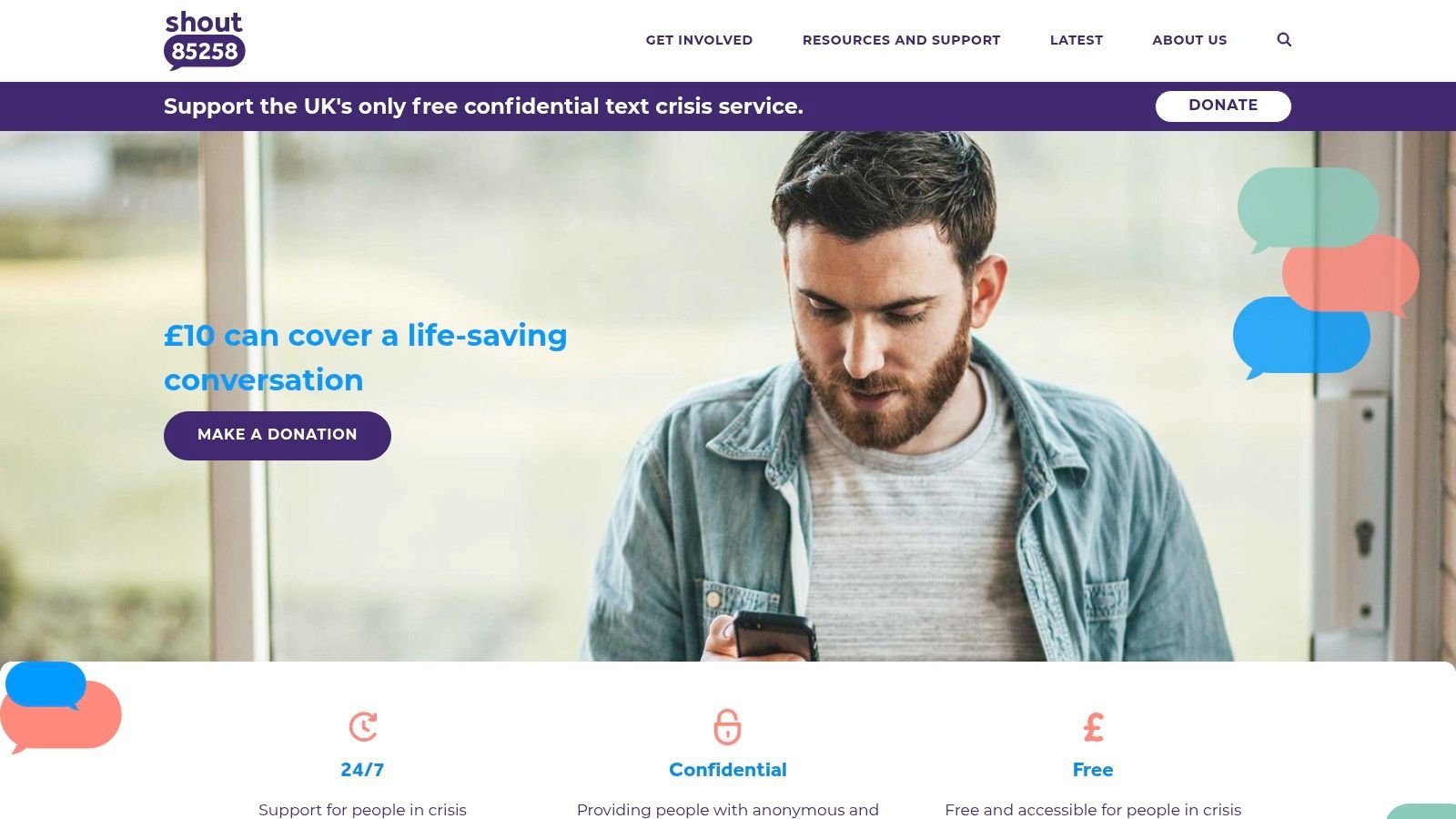
A text conversation can be the easiest first step when speaking out loud feels too hard. With Shout, you text SHOUT to 85258 in the UK and get connected to trained volunteer responders who can listen without judgement, help steady the moment, and point you toward the next useful step. For someone on a bus, at work, or in a shared flat, that privacy can make the difference between reaching out and staying silent.
The appeal is practical as much as emotional. It is free, confidential, and available around the clock, so it suits people who feel anxious on the phone or who cannot make a call safely or discreetly. The trade-off is that volunteer-led text support is still a live queue, so waits can be longer at busy times.
It also has clear limits. Shout is designed for immediate containment and emotional support, not for diagnosis or longer-term treatment planning, and severe crisis situations may need a faster safeguarding response than text can provide. If someone is in immediate danger, emergency services come first.
If you’re too distressed to explain everything, start with one sentence. That is enough for a responder to begin helping.
Keep it saved for the moments when speaking feels like too much.
- Private access: A text can be safer than a call when other people are nearby.
- Low effort: You do not need to hold a conversation out loud.
- Immediate signposting: Responders can help with next steps, not just reassurance.
Shout does not replace therapy, diagnosis, or follow-up care. It works best as a bridge, helping someone stay steady long enough to decide whether the next step is a GP appointment, a charity helpline, or a specialist assessment. For readers who need broader support with anxiety symptoms, as noted earlier, the main mental health services guide sets out how text support fits into the wider pathway.
6. Rethink Mental Illness
A hospital discharge letter, a benefits form, and a question about the Mental Health Act can all land at once. Rethink Mental Illness is built for that kind of situation. Its Advice and Information Service covers mental health law, the Mental Health Act, benefits, rights, employment, and carer support, so it is useful when the problem is practical, legal, and emotionally difficult at the same time. For adults dealing with severe mental illness, family advocacy, or disagreement about care planning, that mix can be more useful than a general helpline.
The charity’s strength is that it does not leave the conversation at explanation. In some areas it also delivers local services, including advocacy, supported housing, and groups, so advice can connect to hands-on support. That matters if someone needs help understanding a discharge plan, wants to challenge a decision, or is trying to support a relative through a difficult period. I find that this matters most when a person is caught between services and needs someone who understands how the system works.
The trade-off is clear. Rethink is not a 24/7 crisis line, so it will not suit someone who needs immediate emotional containment late at night or in a fast-moving crisis. Local provision also varies, which means the practical help available in one area may be very different from what is available elsewhere. For someone who is trying to work through detention, repeat crises, or a long paper trail of service contact, that gap matters.
Best use cases for Rethink
- Rights and law: When you need a plain answer on what the system can and cannot do.
- Carer support: When you are supporting someone else and need clear information for yourself.
- Local advocacy: When you need help speaking up in care settings or during discharge planning.
Rethink fits adults whose mental health journey has already involved the sharper edges of the system. It is usually more useful than a general charity when the question is about legal status, care rights, or how to challenge a decision. It is not the first place I would send someone in an acute crisis, but it is a strong place to start when the problem is complicated and you need practical guidance as well as support.
7. SANE
SANE suits the kind of evening where things feel heavier once the rest of the world has gone quiet. SANEline is open 16:00 to 22:00 daily, 365 days a year, and the charity also offers a Call-Back service, email support, and Textcare. That mix matters because adults do not always want the same kind of contact, and a difficult night does not always call for the same response.
The service feels more focused than many general helplines. For persistent distress, loneliness, or thoughts that keep returning after dark, a phone conversation can help, but so can planned one-way texts or a written message when speaking live feels too hard. That can be a better fit for people who want contact without having to hold a full back-and-forth conversation.
The trade-off is the limited live window. SANE is not a 24/7 crisis service, and Textcare needs advance notice, so it works better for support you can arrange than for a sudden emergency. In practice, that makes it a complement to other resources rather than a replacement for them.
SANE can also suit people who already know their difficult hours. If evenings are when your thoughts get louder, the service gives you something steady to use before a situation tips into a bigger problem.
What to expect
- Evening coverage: Better suited to the hours when many people feel most alone.
- Multiple formats: Phone, call-back, email, and text-based support.
- Planned support: Textcare works well when you want ongoing encouragement rather than one-off contact.
If your distress keeps coming back but is not always at a crisis point, SANE can sit between a crisis line and therapy. It offers human contact without pretending to provide long-term clinical care. For people who want a clearer picture of how support differs from assessment, the adult mental health services guide explains the adult pathway in practical terms.
8. CALM
A late-night spike in suicidal thoughts needs a different response from routine low mood. CALM, the Campaign Against Living Miserably, is built for that moment. Its helpline and live webchat run daily from 17:00 to 00:00, 365 days a year, so it is a practical option when the evening feels harder than the day, or when you are worried about someone else and need to act quickly.
Its specialist focus is the reason many adults use it. CALM centres suicide prevention, so the support is shaped for people in or near a painful moment rather than for general mental health education. That can make the conversation feel more targeted and less generic. It also offers resources on bereavement by suicide, which matters because that kind of loss often needs a different response from standard grief support.
There is a clear trade-off. CALM is not available around the clock, so if the risk starts outside its hours you need another route straight away. It is also not a place for ongoing therapy, diagnosis, or treatment planning. If you are looking at the longer path into NHS care, charity support, or private assessment for concerns such as ADHD or autism, CALM can help with the immediate moment, but it will not replace the next stage of care.
Why it stands out
- Specialist focus: Suicide prevention sits at the centre of the service.
- Two access routes: Phone and webchat let you choose the format that feels easier to use.
- Useful follow-on materials: Bereavement support and guidance for people supporting others are part of the offer.
CALM is strongest when someone needs focused support before things tip into an emergency. It gives you an evening safety net with a clear brief, and it can buy time to decide what to do next. For adults who need more structured mental health care after the immediate moment has passed, it is a bridge rather than a destination.
9. Anxiety UK
Anxiety UK suits adults whose main difficulty is anxiety and who want help that stays focused on that problem. The charity provides information, programmes, support groups, and access to approved therapists, including CBT and counselling. That focus matters because anxiety disorders often need a different conversation from general counselling, especially when the goal is to reduce avoidance, panic, or constant worry rather than to talk broadly about stress.
The route is more structured than casual signposting and less expensive than many private options. Membership is around £40 a year, and member session fees are commonly in the £20 to £60 range, which can make specialist therapy more reachable if you are paying yourself. It is still a cost, and it can sit awkwardly alongside household bills or other care needs, but it gives adults a clearer path into targeted support than starting from scratch in the private market (Anxiety UK).
There are limits, and they matter. You usually need membership to access the lower fees, therapist availability can vary, and where you live can still shape what is available to you. If you need diagnosis, medication review, or a wider assessment because anxiety may sit alongside depression, ADHD, or Autism, therapy alone will not cover the full picture.
For some adults, that trade-off is acceptable because the problem is clear and the waiting list for local provision feels too slow.
Best fit, and what to watch for
- Best fit: Adults with clear anxiety symptoms who want targeted therapy and structured programmes.
- Financial trade-off: Lower costs than many private pathways, but not free.
- Availability caveat: Access still depends on therapist capacity and location.
If you already know anxiety is the main issue and you want to begin treatment sooner, Anxiety UK can be a practical step rather than a placeholder. If your symptoms are broader, or you suspect ADHD or Autism is part of the picture, the better approach is to use anxiety support alongside assessment, so you are not treating one part of the problem in isolation.
10. Student Minds
Student Minds, through Student Space, fits students in higher education whose mental health is getting mixed up with deadlines, transitions, loneliness, or burnout. The online hub offers student-specific advice, signposting, and contact routes by email, phone, text, and webchat in partnership with services such as The Mix. That matters because student distress often brings practical problems as well as emotional strain, and those problems can be hard to separate when you are trying to keep up with study.
What Student Minds does well is present support in student language. If you are trying to keep up with work, move between home and campus, or ask for extensions and support plans, the resources are built around those situations. It is also free and national, so you do not have to depend entirely on what your university happens to provide in-house.
The limits are clear. It is not a 24/7 clinical service, and it is aimed at students rather than the wider adult population. If you are in immediate danger, or if you need assessment for long-standing neurodevelopmental questions, you still need a different route.
The service is especially relevant for students who wonder whether “burnout” is hiding something else. Academic pressure can mask ADHD, Autism, depression, or anxiety, and the support conversation often needs more than stress-management tips.
Student support works best when it reduces the friction around asking for help, not when it tries to replace clinical care.
For students who need both emotional support and a clearer diagnostic picture, Student Space can sit alongside a GP referral or a specialist assessment. If the issue is more than workload, it is worth acting on that sooner rather than later.
10 Mental Health Support Resources Comparison
| Service | Core offering & credentials | Access & timelines | Price & value | Best for / USP |
|---|---|---|---|---|
| 🏆 Insight Diagnostics Global | Consultant‑led diagnostic assessments (ADHD, ASD, mood disorders). CQC‑regulated; psychiatrists on GMC ★★★★★ ✨ | Online or face‑to‑face; triage → assessment usually ≤7 working days; reports within 5 working days | 💰 Transparent paid packages; accepts private pay, insurers & NHS Right to Choose | 👥 Adults 18+; self‑funders/insured seeking fast, rigorous assessment ✨ |
| NHS Talking Therapies (NHS mental health services) | Evidence‑based treatments (CBT, counselling) via NHS pathways ★★★★ | Self‑referral or GP; digital & face‑to‑face options; wait times vary by area | 💰 Free at point of use | 👥 Adults in England with common mental health problems; scalable NHS care |
| Mind (national charity + Local Minds) | National info hub, helplines, local peer support & counselling ★★★★ ✨ | Online resources + local service access; availability varies by Local Mind | 💰 Mostly free; some local services may charge | 👥 Anyone seeking information, advocacy or community‑based support |
| Samaritans | 24/7 confidential listening (phone); non‑judgemental emotional support ★★★★★ | Immediate phone access (116 123); webchat expanding | 💰 Free | 👥 People in distress or suicidal crisis needing immediate listening support |
| Shout 85258 (Give Us A Shout) | 24/7 text‑based emotional support by trained volunteers ★★★★ ✨ | SMS text “SHOUT” to 85258; typically quick but can peak | 💰 Free | 👥 People who prefer discreet/text help or can’t speak aloud |
| Rethink Mental Illness | Advice on severe mental illness, rights, benefits & local services ★★★★ | National advice lines + local services; opening hours vary | 💰 Free guidance; some local services may charge | 👥 People affected by severe mental illness, carers needing specialist advice |
| SANE (SANEline, Textcare, Call‑Back) | Out‑of‑hours emotional support (phone, call‑back, email, Textcare) ★★★★ | SANEline 16:00–22:00 daily; call‑back & text options; email support | 💰 Free | 👥 Those needing specialist evening support or scheduled text support |
| CALM (Campaign Against Living Miserably) | Suicide‑prevention helpline & webchat with trained staff ★★★★ | Live phone/webchat 17:00–00:00 daily | 💰 Free | 👥 People at risk of suicide or supporting someone at risk (evening focus) |
| Anxiety UK | Anxiety‑focused info, programmes & discounted therapy via membership ★★★★ ✨ | Membership + access to approved therapists; waits depend on capacity | 💰 Membership (~£40/yr) + session fees (typ. £20–£60) | 👥 Adults with anxiety seeking specialised programmes & faster private therapy |
| Student Minds (Student Space) | Free student‑focused hub, confidential support & signposting ★★★ | Online Student Space; partnership helplines/webchat hours vary | 💰 Free | 👥 Higher‑education students needing tailored wellbeing resources |
Choosing the Right Support for You
Finding the right mental health support is personal, and the best option changes depending on how urgent the situation is, what kind of problem you’re facing, and how much structure you need. If you’re in crisis, use a 24/7 option like Samaritans or Shout. If you need evidence-based therapy for a common mental health problem, NHS Talking Therapies is a strong first step. If you need rights advice, local advocacy, or condition-specific guidance, Mind or Rethink may be more helpful. If evenings are the hardest time, SANE or CALM can offer a steadier bridge.
For adults who suspect ADHD or Autism, the decision is different again. Therapy can help with distress, coping, and functioning, but it doesn’t replace specialist assessment when the core question is diagnostic. That’s where a consultant-led service like Insight Diagnostics Global can be especially useful, because it combines triage, structured interviews, diagnostic reporting, and follow-up recommendations in a pathway designed for adults who need clarity, not just reassurance.
The UK system is still shaped by demand, referral pathways, and waiting lists. Mind’s figures on community referrals and secondary care contact show how much pressure sits on public services (Mind’s 2024 report and Mind’s Big Mental Health Report), and that’s exactly why choosing the right route matters. The wrong route doesn’t mean you’ve failed, it usually means the service was never built for your specific need.
If you’re unsure, start with the one that matches the problem most closely. Crisis first, therapy for common symptoms, specialist assessment for ADHD or Autism, and rights or advocacy support when the system itself is part of the problem. That’s usually the shortest path to something that helps.
If you need a fast, consultant-led assessment for ADHD, Autism, anxiety, depression, or related concerns, Insight Diagnostics Global offers a structured private pathway for adults across the UK. Visit Insight Diagnostics Global to review their assessment services, transparent packages, and follow-up options, and decide whether their online or face-to-face care fits the support you need right now.