
When most people think of ADHD, they picture distractibility or boundless energy. But that’s only half the story. A huge, often overlooked, part of living with neurodivergence is the way it shapes your emotional world. For individuals with ADHD, often co-occurring with Autism, this connection, known as emotional dysregulation, means feelings hit harder, surface faster, and are much more difficult to manage. It's a fundamental piece of the adult ADHD and Autism puzzle.
The Emotional Amplifier of Neurodivergence
Living with ADHD and Autism can feel like your emotions are wired to an amplifier with a broken volume knob. A minor setback that someone else might brush off—a delayed train, misplaced keys—can unleash a tidal wave of anger or despair. This isn't a personality flaw or a simple lack of willpower; it’s a direct consequence of how the neurodivergent brain processes information and regulates itself.
These intense, sudden emotional shifts aren't your fault. They come from neurological differences in the brain's executive function system—the part that acts as a control centre for our impulses and feelings. In an ADHD brain, this system works differently, allowing emotions to flood in without the usual checks and balances. The result? Reactions that can feel completely out of proportion to the actual situation.
More Than Just a Bad Mood
Many adults with ADHD and Autism navigate a landscape of challenging emotional patterns, often without realising they're directly connected to their neurology. Recognising these traits for what they are is the first step towards self-compassion and finding what actually helps.
Some of these common, but frequently misunderstood, experiences include:
- Emotional Whiplash: Your mood can pivot from happy and engaged to irritable or despondent in a flash, sometimes for no clear reason at all.
- Rejection Sensitivity: A hint of criticism or the fear of being left out can feel like a deep, physical wound, causing intense pain that sticks around long after the moment has passed.
- Constant Overwhelm: The demands of daily life and sensory input can quickly build up, leading to a state of mental and emotional overload where it feels impossible to think straight.
The table below helps illustrate the gap between how these behaviours might look to others and what’s really going on inside.
Common Emotional Experiences in Adults with ADHD
| Observable Behaviour | Underlying ADHD-Related Emotional Experience | What It Feels Like |
|---|---|---|
| Snapping or overreacting to minor problems. | Low frustration tolerance and emotional impulsivity. | "I just hit a wall. The anger came out of nowhere and I couldn't stop it." |
| Abruptly withdrawing from a conversation. | Feeling overwhelmed or hurt by perceived criticism. | "One comment made me feel completely worthless. I had to get out of there." |
| Seeming overly enthusiastic or "too much." | Intense positive emotions and difficulty modulating them. | "When I'm excited, my whole body is buzzing. I can't contain it." |
| Crying easily over small disappointments. | Heightened emotional sensitivity and rapid mood shifts. | "It feels like my sadness has no skin. Everything gets in." |
Understanding this internal reality is key to bridging the gap between perception and the lived experience of ADHD.
Emotional dysregulation isn't a footnote to the ADHD diagnosis—it's a headline. It profoundly impacts daily life, relationships, and a person's sense of self, moving far beyond the classic narrative of hyperactivity and inattention.
From Self-Blame to Self-Awareness
If you have ADHD or Autism, you’ve probably spent years being told you’re "too sensitive," "overly dramatic," or that you "just need to calm down." It's easy to start believing it. That kind of constant criticism often leads to a deep sense of shame and a habit of blaming yourself.
It's time to reframe that thinking. These intense ADHD and emotions aren't a choice; they are a neurological reality.
Here in the UK, where it’s estimated that 3-4% of adults have ADHD, this emotional side is finally getting the recognition it deserves as a core feature. Yet, a shocking 80% of adults with the condition may still be undiagnosed, meaning millions are wrestling with these feelings without knowing why. You can read more on this in a recent study on ADHD prevalence.
Realising there’s a neurological reason for your emotional experience isn't an excuse. It’s an explanation—one that unlocks the door to self-acceptance and effective support. If any of this sounds painfully familiar, taking a preliminary emotional dysregulation test could be an illuminating first step.
Why Your Brain's Emotional Controls Feel Different
If you have ADHD, you’ve probably felt like your emotional dial is turned up way higher than everyone else's. It’s not a weakness or a character flaw; it’s just how your brain is built. The powerful link between ADHD and emotions comes down to neurology.
Think of it like this: your brain has an emotional control room. In a neurotypical brain, this room has a calm, organised manager and solid filters that help process feelings appropriately. In an ADHD brain, that manager is often overwhelmed and the filters are flimsy, letting every emotion flood in at full strength.
This control room is mainly housed in your prefrontal cortex. This part of the brain is responsible for "executive functions"—the skills that help us manage impulses, plan ahead, and keep our emotions in check. For people with ADHD, this area often has different wiring and development, which makes it much harder to hit the brakes when a strong feeling suddenly takes over.
The Role of Brain Chemistry
On top of the brain’s structure, its chemical messengers—neurotransmitters—play a massive part in regulating our emotions. When it comes to ADHD, two key players are dopamine and norepinephrine.
- Dopamine: You might know this as the "reward chemical." It’s essential for motivation, focus, and feeling pleasure. When dopamine levels are out of whack, it can be tough to feel satisfied, leading to a constant hunt for something stimulating that can really affect your mood.
- Norepinephrine: This chemical helps with alertness and attention, and it also manages the body's fight-or-flight response. An imbalance here can make it difficult to stay calm under pressure, making emotional reactions feel much more intense and volatile.
When these neurotransmitters aren't communicating properly, the brain simply can't manage its own emotional traffic. It’s the biological reason why your feelings can seem so overwhelming and unpredictable at times.
This diagram shows how heightened sensitivity, intense feelings, and a fear of rejection are all tangled together in the ADHD brain.
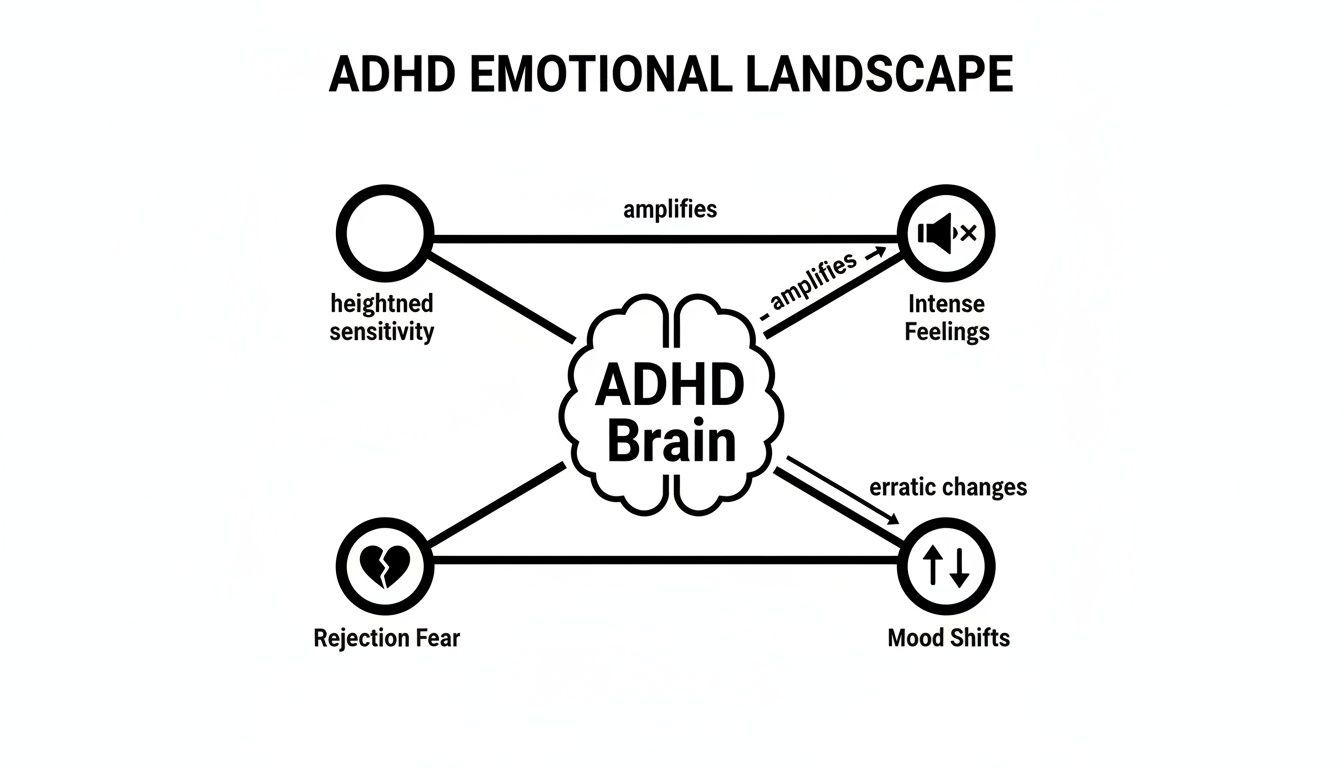
As you can see, these emotional challenges aren't separate issues. They’re all interconnected parts of the same neurological experience.
Understanding Rejection Sensitive Dysphoria
One of the most intense and often misunderstood emotional experiences for adults with ADHD is Rejection Sensitive Dysphoria (RSD). This goes way beyond just being afraid of rejection. It's an extreme, painful emotional reaction to the perception of being criticised, rejected, or letting someone down.
Rejection Sensitive Dysphoria is an intense, almost physical pain that erupts when someone with ADHD feels they have fallen short of expectations—their own or someone else's. It's a neurological reaction, not an overreaction.
The science behind RSD points back to the same emotional systems. The brain's limbic system, especially a part called the amygdala, can become hyper-reactive to social cues. A slight change in someone's tone of voice or a delayed text message can be interpreted by the brain as a serious threat, triggering a sudden, crushing emotional downturn that can feel like a physical blow.
This sensitivity can have a huge impact on your relationships and self-worth. It might make you a chronic people-pleaser, desperate to avoid any hint of criticism, or it could make you withdraw from social situations entirely to avoid the risk of getting hurt. Recognising RSD as a genuine neurological phenomenon is the first step toward managing it. This emotional pain is very real and can be complicated, especially when trauma and ADHD overlap.
Once you understand the neurological reasons behind your emotional experiences, you can start to see them differently—not as personal failings, but as symptoms of a condition that can be managed. This shift in perspective is the first real step toward building self-compassion and finding the right support.
The Overlap of ADHD, Autism, and Mental Health
The world of neurodivergence is rarely neat and tidy. For so many people, ADHD doesn’t exist in a vacuum; it often shares a complex, overlapping relationship with Autism Spectrum Disorder (ASD) and other mental health conditions like anxiety and depression. Understanding this comorbidity is crucial for seeing the full picture of an individual's emotional and psychological world.
When conditions like ADHD and Autism show up together, they create a completely unique neurotype with its own blend of strengths and challenges. The impulsivity and emotional intensity of ADHD can clash with the autistic need for routine, sensory predictability, and structured communication. This internal conflict can be incredibly disorienting, making things like social interactions and emotional regulation feel like a constant uphill battle.
Imagine, for instance, craving the novelty and excitement that your ADHD brain thrives on, while at the same time feeling intensely overwhelmed by the sensory overload and social unpredictability that disrupts your autistic need for a calm, structured environment. This constant push-and-pull is draining and can lead to burnout and a feeling of being perpetually misunderstood—not just by others, but by yourself.
The Hidden Toll of Masking
Living with undiagnosed neurodivergence often means spending years, sometimes a whole lifetime, masking. This is the conscious or subconscious effort to hide neurodivergent traits just to fit in with neurotypical expectations. It’s like being a method actor in a play where you were never given a script, forcing you to constantly improvise by watching and mimicking everyone else.
This constant performance is mentally exhausting and takes a huge emotional toll. For an AuDHD individual, it might mean suppressing stims, forcing eye contact that feels painful, or faking social engagement when you're overwhelmed. It can lead to a deep sense of identity confusion and complete burnout, as you're continually pushing down your authentic self. Over time, this masking is a direct contributor to developing secondary mental health conditions like anxiety and depression.
Diagnosis isn't about getting a restrictive label; it's about finally getting the user manual for your own brain. It brings the clarity you need to stop blaming yourself for neurological differences and start building a life that genuinely supports who you are.
Understanding the real reason behind your emotional struggles is the first step toward true self-acceptance and finding support that actually works. It helps you change the question from "What's wrong with me?" to "How is my brain wired, and what do I need to thrive?"
The Undiagnosed Burden in England
The emotional weight of living without answers is a serious public health concern. In England, a massive diagnostic gap means countless people are trying to manage the intense link between ADHD and emotions without ever knowing its source. This lack of recognition has profound consequences for their mental health.
The data from NHS England paints a stark picture: while an estimated 2.5 million people in England might have ADHD, the vast majority have never been diagnosed. Among adults, about one in twenty (5.8%) think they might have ADHD, but only a tiny fraction—just 1.8%—have a formal diagnosis. This leaves millions of undiagnosed individuals grappling with emotional dysregulation, perfectionism, and people-pleasing behaviours, often mistaking these neurological traits for personal failings. You can explore more about ADHD statistics and their impact in the UK.
Recognising this overlap is absolutely crucial. Symptoms that look like standalone anxiety or depression may actually be rooted in the chronic stress of trying to navigate a world that wasn't built for your neurotype. This is precisely why a comprehensive assessment that considers both ADHD and Autism in adults is so vital. It ensures the support you get addresses the whole person, not just isolated pieces of the puzzle.
Effective Treatments For Emotional Regulation In ADHD
Realising that the intense emotional rollercoaster of ADHD is neurological can be a huge relief. Better yet, it means there are effective, evidence-based treatments designed to work with your brain, not against it. A combination of the right medication and specialised therapy offers a powerful way forward, paving the path to greater emotional stability and control.

The key takeaway here is one of hope. You don't have to be at the mercy of constant emotional volatility. The right support can help you turn down the volume on that internal emotional amplifier, giving you the space to respond to life with more calm and intention.
How Medication Supports Emotional Stability
ADHD medication does so much more than just improve focus; for many, it's genuinely life-changing for emotional regulation. By addressing the brain's neurochemical imbalances, these treatments essentially fortify your "emotional command centre," giving you back a sense of control over your reactions.
In the UK, two main types of medication are typically used:
- Stimulants: These work by making key neurotransmitters like dopamine and norepinephrine more available. Think of it as improving the signal strength between different parts of the brain, strengthening your ability to pause, think, and manage an impulse before an emotion completely takes over.
- Non-Stimulants: These medications work more gradually, often by increasing norepinephrine levels. They can provide a smoother, more consistent effect on emotional regulation throughout the day, helping to take the edge off irritability and sudden mood swings.
Finding the right medication and dosage is always a careful, collaborative process with your specialist.
The goal of medication isn't to numb your feelings or change your personality. It's to reduce the neurological static, so your true emotions can come through more clearly and with less overwhelming intensity.
This process, known as medication titration, involves starting on a low dose and making small, incremental adjustments under the close guidance of a psychiatrist. It's a partnership, really—all about finding the precise balance that gives you the most benefit with the fewest side effects. This ensures the treatment is perfectly aligned with your unique brain chemistry.
Building Skills With Therapy and Coaching
If medication helps adjust the brain's hardware, then therapy provides the software—the practical skills you need to navigate daily emotional challenges. For ADHD and Autism, standard therapy often falls short; you need an approach that understands the executive function difficulties and sensory needs at the core of the conditions.
ADHD-informed Cognitive Behavioural Therapy (CBT) is especially effective. It helps you pinpoint the thought patterns that trigger those intense emotional responses, like the all-or-nothing thinking that's so common in Rejection Sensitive Dysphoria (RSD). From there, you learn to challenge these thoughts and develop healthier, more balanced ways of seeing situations.
Specialised ADHD coaching also plays a vital part. A coach works with you to build practical strategies for managing everything from emotional overwhelm to time blindness. They help you create systems and routines that reduce the daily stress that so often acts as a trigger for emotional dysregulation.
While these direct interventions are key, exploring other wellness avenues can also be supportive. For those exploring natural health options, a guide on the best supplements for stress and anxiety might offer additional perspectives on managing emotional challenges. It is also worth exploring non-pharmaceutical options, and you can learn more by reading our guide on how to treat ADHD without drugs.
The demand for effective ADHD care has shot up recently. An analysis showed that between April 2019 and March 2024, ADHD prescriptions in England saw a staggering 66% overall increase. This surge highlights just how much awareness has grown, and it underscores the urgent need for accessible, high-quality assessment and treatment. You can discover more insights about the rise in ADHD prescriptions on bmjgroup.com.
Ultimately, a comprehensive, consultant-led assessment is the crucial first step. It provides the clarity needed to build a personalised treatment plan that truly works for your brain, combining the right medical support with the right therapeutic strategies to help you reclaim your emotional well-being.
Practical Strategies for Managing Daily Emotional Intensity
While clinical treatments provide a crucial foundation, navigating the day-to-day peaks and troughs of ADHD and emotions also demands a practical toolkit. The secret is finding strategies that work with your neurodivergent brain, not against it. This is about building a personalised support system that embraces flexibility and sensory needs, not chasing some neurotypical ideal of emotional control.
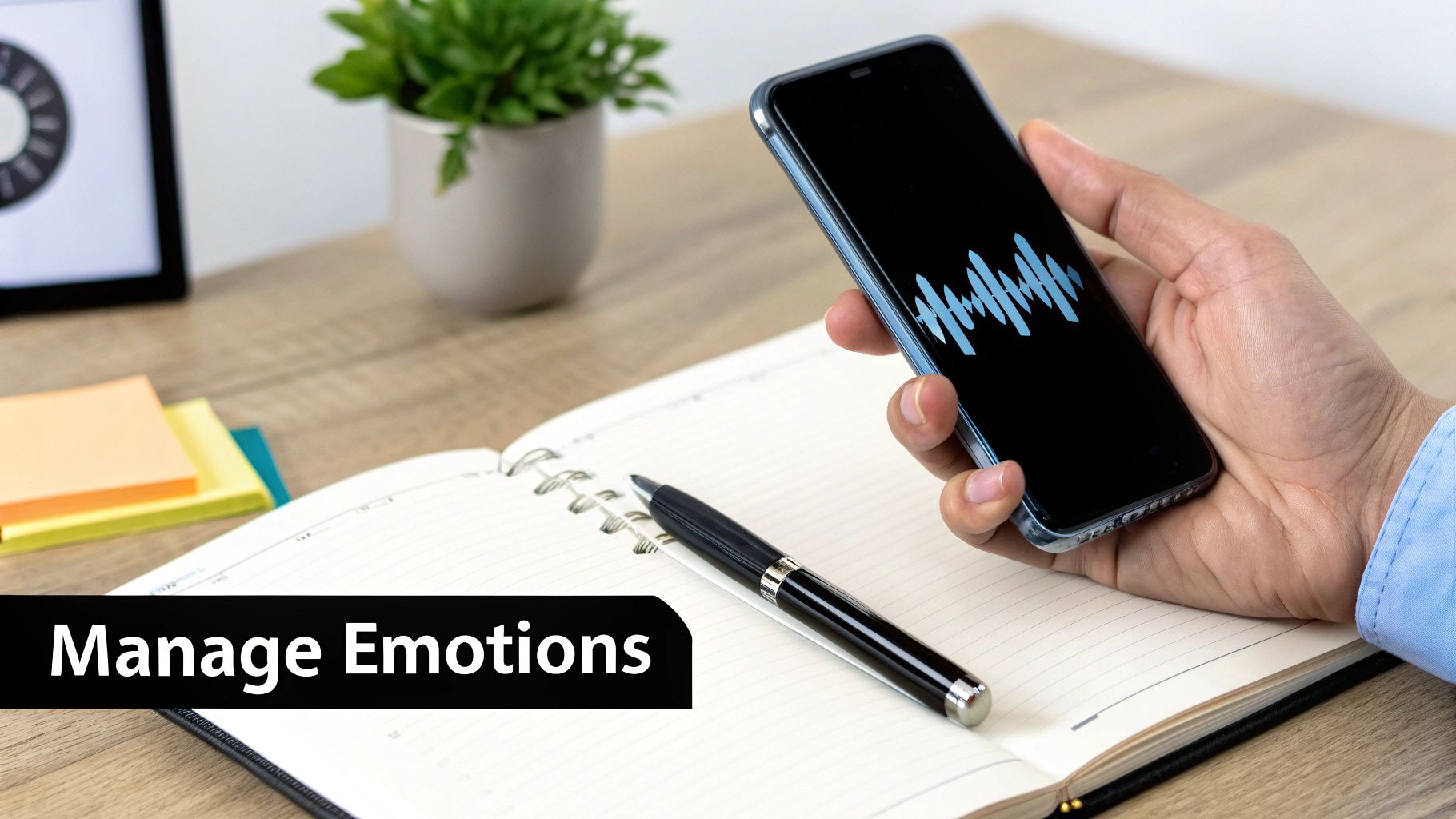
Real emotion management isn’t about bottling things up. It's about creating just enough space between a trigger and your reaction to make a conscious choice. Your most important tool here is self-compassion; the goal is to experiment and find what actually sticks for you.
In-the-Moment Tools for De-escalation
When a huge wave of emotion crashes over you, you need simple, actionable tools to find your footing. The last thing an overwhelmed ADHD brain can handle is some complex, multi-step process. The 'STOPP' method is a fantastic, easy-to-remember technique for creating that vital pause.
Here's how it works:
- S – Stop: Whatever you’re doing, just stop. Freeze.
- T – Take a breath: Focus on one single, slow, deep breath. This simple physical act can interrupt your brain’s fight-or-flight alarm.
- O – Observe: What’s actually happening? Notice the feeling and the thoughts racing through your mind, but without judging them. Just see them.
- P – Pull back: Try to get some perspective. Is this thought a fact or just an opinion? How might someone else see this?
- P – Practice what works: What’s the most helpful thing to do right now? That could be walking away, using a grounding technique, or calmly saying what you need.
This method won’t solve the problem instantly. That’s not the point. It’s about hitting the brakes on an emotional spiral, giving your thinking brain (the prefrontal cortex) a chance to catch up with your initial gut reaction.
Externalising Your Internal Chaos
One of the toughest parts of having ADHD is trying to hold all those overwhelming thoughts and feelings inside your head, where they just swirl around and get bigger. Getting them out into the physical world can instantly reduce their power.
Your brain isn’t a storage device; it’s a processing unit. Forcing it to hold onto every overwhelming thought and emotion is like running too many programs at once—eventually, the system crashes. Externalising is like closing those extra tabs.
This doesn't mean you have to sit down and write pages in a diary, which can feel like a monumental task. Try these more ADHD-friendly alternatives instead:
- Voice Notes: Grab your phone and just talk. Record yourself venting or working through your feelings. It's fast, there's no writing involved, and you can process things as they come.
- Bullet Journaling: Forget perfect paragraphs. Use bullet points, doodles, or mind maps to quickly get the key thoughts and feelings out of your head and onto paper.
- A "Brain Dump" Jar: Write down worries or intense feelings on little slips of paper and physically put them in a jar. This symbolic act can feel like you’ve actually removed them from your mind.
The whole point is to reduce the mental load you’re carrying, which frees up precious energy.
Using Your Body to Regulate Your Mind
The link between physical movement and emotional regulation is incredibly powerful, especially for the ADHD brain. That pent-up emotional energy often shows up as physical restlessness, and if you can channel it constructively, it provides an immediate release.
When you feel frustration or anxiety building, physical activity acts like a pressure release valve. It helps burn off excess cortisol (the stress hormone) and gives you a boost of mood-stabilising brain chemicals like dopamine and endorphins. And no, this doesn't require a full-blown gym session.
Think in terms of "activity snacks":
- A brisk 10-minute walk around the block.
- Doing 20 jumping jacks or press-ups.
- Putting on your favourite high-energy song and just dancing for three minutes.
By building a toolkit of these simple, accessible strategies, you can start to navigate the daily reality of ADHD and emotions with more confidence and self-compassion.
Your Path to an Accurate Diagnosis and Support
Realising that your intense emotions might be connected to ADHD or Autism is a huge breakthrough. The next, and often most crucial, step is to get clarity through a professional assessment. It can feel like a big decision, but it’s really just a structured conversation designed to give you the answers you need to move forward.
Taking that first step is often the hardest part. It’s natural to worry about what a diagnosis might mean, but think of it less as a label and more as a user manual for your brain. It provides vital context for your experiences, replacing years of confusion or self-blame with a clear, neurological explanation.
What to Expect From an Assessment
A proper, in-depth assessment for ADHD and Autism isn’t just a checklist or a quick online quiz. It's a comprehensive exploration of your life, your challenges, and your unique strengths, all guided by a specialist consultant who understands neurodiversity. The goal is to build a complete picture of you.
The journey usually follows a few key stages:
- Initial Chat: This is where you get to share your story and your concerns. It’s a two-way discussion where you can ask questions and get a feel for the process, making sure you're comfortable and informed from the very beginning.
- In-depth Interviews: Using trusted, gold-standard diagnostic tools, a psychiatrist will talk with you about your childhood, school days, work life, and current struggles. It’s a deep dive, but it's essential for an accurate picture.
- Your Diagnostic Report: After the interviews, you'll receive a detailed report. This document doesn't just give you a yes or no; it summarises all the findings, confirms any diagnoses, and offers personalised recommendations for treatment, support, and even workplace accommodations.
A consultant-led diagnosis gives you more than a conclusion; it gives you a roadmap. It opens the door to effective treatment, provides the evidence for necessary workplace adjustments, and offers the validation you need to build a life that truly works for you.
Why a Private Online Service Might Be Right for You
Here in the UK, waiting lists for specialist NHS services can be incredibly long. Private online clinics like Insight Diagnostics Global offer a much faster and more convenient way to get expert help, without ever compromising on clinical quality.
Choosing an online assessment means you can speak with a specialist psychiatrist from your own home, often within a week. This removes the stress and time of travel and lets you have these important conversations in a space where you feel safe and comfortable.
Ultimately, a rigorous, professional diagnosis is the key that unlocks everything else—from an effective treatment plan to the reasonable adjustments you’re entitled to at work. It allows you to stop guessing and start building a future based on a genuine understanding of how your brain works.
Frequently Asked Questions About ADHD and Emotions
When you're trying to make sense of ADHD, your emotions, and your mental health, it’s only natural to have a lot of questions. Let’s tackle some of the most common ones to give you a bit more clarity and practical guidance.
Can You Have Emotional Dysregulation Without ADHD?
Yes, absolutely. Emotional dysregulation isn't exclusive to ADHD; it can also be a key part of other conditions like Autism, Borderline Personality Disorder (BPD), or complex trauma. The real difference is why it's happening.
With ADHD, those intense emotional spikes are tied directly to how your brain’s executive functions work. Imagine your brain has a "braking system" in its prefrontal cortex. In an ADHD brain, that system sometimes struggles to apply the brakes, meaning emotions can shoot from zero to a hundred without the usual pause or internal filter. In Autism, it might be more related to sensory overload or a breakdown in processing social cues, leading to a meltdown or shutdown. When both are present, these triggers can overlap and intensify the experience.
How Can I Explain My Emotional Reactions to Others?
Trying to put your emotional experience into words for someone else can feel incredibly difficult, but a good analogy can work wonders. You could try explaining it to a partner or a friend like this: "Think of my brain's emotional volume knob as a bit faulty. It can get cranked up to full blast in an instant, and it takes me a lot longer to get it turned back down again."
Another way to frame it could be: "When I have a really big reaction, it’s not always about the thing we're talking about—it's more about how my brain is wired. If you can just give me a moment to hit pause and process, it helps me get back on track so we can talk properly." This helps shift the conversation from blame to a shared understanding of what you need.
A late diagnosis is not an endpoint; it's a starting point. It offers the profound relief of self-understanding, providing a new lens through which to view your past and a solid foundation on which to build your future.
Will Medication Change My Personality?
This is a really common and completely valid fear. The aim of ADHD medication is never to flatten your personality or numb you out. Instead, it’s about helping your brain regulate itself more effectively. A good way to think of it is like tuning a radio—it turns down the background static so you can finally hear the music clearly.
What medication can do is reduce that feeling of being on an emotional rollercoaster, ease irritability, and give you that crucial moment to think before you react. Many people report that instead of changing who they are, it actually allows their true, calmer self to finally come through from under all that emotional noise.
Is a Late ADHD or Autism Diagnosis Still Worthwhile?
Without a doubt. Getting diagnosed as an adult can be genuinely life-altering. It provides a coherent explanation for a lifetime of challenges that you might have previously written off as personal failings or character flaws.
That validation alone is incredibly powerful. It gives you permission to let go of years of shame or self-blame and start treating yourself with compassion. More than that, a diagnosis unlocks the door to treatments, workplace accommodations, and coping strategies that are designed to work with your brain, not against it. It empowers you to build a future that truly works for you.
If these challenges sound all too familiar and you’re ready for some answers, the expert team at Insight Diagnostics Global is here to help. Our consultant-led online assessments for ADHD and Autism can provide the clarity you need to move forward with confidence. Learn more about our services and book your consultation at https://insightdiagnostics.co.uk.