
When we talk about Attention Deficit Hyperactivity Disorder (ADHD) in adults, we're looking at a persistent pattern of challenges with focus, organisation, and impulse control that genuinely affects day-to-day life. This is so much more than just being a bit forgetful now and then; it's a lifelong neurodevelopmental difference that often co-occurs with other conditions like autism and needs proper understanding and support.
Understanding ADHD Beyond Childhood Stereotypes
Let's be honest, when most people hear "ADHD," the image that springs to mind is a little boy bouncing off the walls in a classroom. This stereotype isn't just old-fashioned—it's actively harmful. It leaves countless adults, especially those who also have autistic traits, feeling unseen and questioning their own experiences because ADHD doesn't just disappear when you turn 18.
A much better way to think about adult ADHD is to see it through the lens of executive functions. Picture an air traffic control tower in your brain. It’s in charge of organising thoughts, planning your day, managing emotions, and keeping you focused on the task at hand. In a typical brain, that system runs things pretty smoothly.
But for a brain with ADHD, the controllers are incredibly bright and creative, yet they get easily distracted by every little blip on the radar. This can cause mental traffic jams, crossed signals, and delayed take-offs, even when you're trying your absolute hardest to stay on course. It’s crucial to understand this isn't a flaw in your character or a lack of willpower; it’s simply how your brain is wired.
Why Symptoms Look Different in Adulthood
As we get older, life gets a lot more complicated. A child's life is mostly structured by parents and teachers, but adults are expected to juggle careers, relationships, household chores, and finances all on their own. This surge in responsibility can completely overwhelm the coping strategies that might have just about worked during younger years.
The obvious hyperactivity we associate with childhood often turns inwards for adults. That kid who climbed the furniture might now be an adult who experiences:
- An intense internal restlessness that makes it almost impossible to truly relax.
- A constant craving for stimulation, which makes routine tasks feel painfully boring.
- Subtle fidgeting, like tapping a pen during a meeting or bouncing a knee under the desk.
- Talking a mile a minute or struggling to let others finish their sentences.
Understanding this shift is the first step toward recognition. Many adults spend decades feeling like something is fundamentally 'off' without realising their daily struggles with deadlines, organisation, and emotional regulation are classic adhd symptoms in adults.
Realising that these challenges come from a neurological difference—which may also include autistic traits—can be life-changing. It offers a new way to make sense of past difficulties and provides a solid foundation for seeking a proper diagnosis and finding strategies that actually work. The journey starts not with self-blame, but with informed self-awareness.
How Core ADHD Symptoms Show Up in Adult Life
The classic picture of ADHD is often a child who can’t sit still. But what happens when that child grows up? The core traits—inattention and hyperactivity-impulsivity—don't just disappear; they change their costume. In adulthood, these symptoms often become more subtle, more internalised, and much harder for others (and even yourself) to spot, especially when they overlap with traits from other neurodivergent conditions like autism.
It's crucial to understand that these aren't character flaws like laziness or carelessness. They are the direct result of a differently wired brain trying to cope with the complex demands of modern adult life. The disruptive student might become the adult who’s quietly drowning in missed deadlines, chronic disorganisation, and a constant, nagging feeling of being overwhelmed.
And this isn't a niche problem. It’s estimated that around 3 million people across the UK have ADHD. While many are diagnosed as children, research shows that about 65% continue to experience symptoms that significantly impact their lives well into adulthood. This puts the adult prevalence rate at around 4.4%, highlighting just how many people are navigating these challenges, often without knowing why. You can find more detailed data on ADHD incidence in the UK to see the full picture.
The Reality of Adult Inattention
For an adult, inattention is so much more than just getting distracted in a boring meeting. It's a relentless, daily struggle to direct and sustain your focus, and it can have a ripple effect across every part of your life. Imagine your brain is a browser with 50 tabs open at once, all playing different videos—that’s what trying to focus can feel like.
This constant mental battle often shows up in ways like:
- Missing the details: Overlooking a crucial instruction in a work email or making small, careless mistakes that force you to double-check everything you do.
- Chronic disorganisation: Your home or workspace is in a perpetual state of chaos, not because you don't try to tidy it, but because creating and sticking to a system feels impossible.
- Constantly losing things: The daily, frustrating hunt for your keys, wallet, phone, or important documents becomes a stressful routine.
- Struggling to listen: You find yourself zoning out during conversations, even with people you care about, and then feel a pang of guilt for not remembering what was said.
- Avoiding "big" tasks: You put off projects that need sustained mental effort, not because they’re too hard, but because the very act of focusing on them feels physically and mentally exhausting.
For many adults with ADHD, inattention feels like trying to tune into a specific radio station while all the other stations are blaring at full volume in the background. The mental energy required just to find the right frequency is immense, often leading to burnout.
This hidden effort is why an adult with ADHD might feel completely drained after a standard day at the office. Their brain has been working overtime just to keep up with what's expected.
Hyperactivity and Impulsivity in Adulthood
The classic image of hyperactivity—a child literally bouncing off the walls—is rarely how it looks in adults. That boundless physical energy tends to turn inward, transforming into a persistent feeling of internal restlessness. It’s like having a motor inside you that you can’t switch off.
Similarly, childhood impulsivity, like blurting out answers in class, evolves. In adults, it can manifest as making hasty decisions with serious, long-term consequences. This constant internal pressure to act now can make it incredibly difficult to ever feel truly calm or settled.
The shift from childhood to adult symptoms can be dramatic. Recognising these new patterns is the first step toward getting a clear picture of what’s going on.
Childhood vs Adult ADHD Symptom Presentation
| Symptom Category | Common Presentation in Childhood | Common Presentation in Adulthood |
|---|---|---|
| Hyperactivity | Constantly running, jumping, or climbing on things. Unable to stay seated. | An internal feeling of restlessness; an inability to relax. Fidgeting (e.g., tapping a pen, shaking a leg). |
| Impulsivity | Blurting out answers in class. Interrupting others frequently. Difficulty waiting for their turn. | Making rash decisions (financial, career, relationships). Speaking without thinking. Finishing others’ sentences. |
| Restlessness | Getting up from their seat when expected to remain seated. | Feeling bored very easily; needing constant stimulation. Frequently changing jobs, hobbies, or plans. |
This internal drive for stimulation can also lead to risk-taking behaviours or jumping into huge projects without thinking them through. Impulsivity might show up as overspending on a whim, abruptly quitting a perfectly good job, or ending relationships without much thought.
It's not a lack of judgement; it's a profound struggle to hit the pause button between an impulse and an action. Understanding these updated manifestations is key to recognising the true impact of ADHD symptoms in adults and finding the right path forward.
The Critical Overlap Between ADHD and Autism
ADHD doesn't exist in a vacuum. In fact, it shares a significant and often confusing overlap with Autism Spectrum Condition (ASC), which can create a pretty complex picture for many of us. It’s actually quite common for an adult to suspect they have one condition, only to find out through a proper assessment that they have traits of both.
Think of it like this: ADHD and autism are two different operating systems that can run on the same computer. Both systems might glitch on a similar task, like a social conversation, but the underlying reason—the “code” causing the problem—is completely different. Getting to the bottom of this is vital, because understanding your unique wiring is the first step toward getting the right kind of support.
For example, an adult with ADHD might find themselves constantly interrupting people. This isn't rudeness; it's often driven by impulsivity and a genuine fear that they'll forget their brilliant thought if they wait their turn. On the other hand, an autistic adult might struggle in that same conversation because they have a hard time reading non-verbal cues like tone of voice or body language, making it tricky to judge the right moment to jump in.
Distinguishing Hyperfocus from Special Interests
One of the biggest points of confusion is the intense, laser-like focus seen in both conditions. From the outside, they can look almost identical, but what’s happening on the inside is very different. This is a great way to understand the core distinction between the two.
An adult with ADHD will often experience hyperfocus. This is an all-consuming state of concentration on something new, interesting, or stimulating. At its core, it’s largely driven by the brain's hunt for dopamine, the chemical that makes us feel rewarded.
- It comes and goes: Hyperfocus can be a real superpower, but it's often fleeting. You might dive headfirst into a topic for a few weeks, learn everything you can, and then suddenly lose all interest as you move on to the next exciting thing.
- It’s about getting things done: It often feels amazing for productivity, but the catch is that it’s nearly impossible to direct it towards boring but necessary tasks (like doing your taxes).
- You lose all track of time: When you're in a state of hyperfocus, hours can feel like minutes. This often leads to accidentally skipping meals, staying up way too late, and neglecting other responsibilities.
In contrast, an autistic person often has special interests. These are deep, passionate, and long-lasting areas of focus that become a core part of their identity and well-being.
A special interest isn't just a hobby. It's a fundamental part of how an autistic person engages with the world. It brings structure, joy, and a way to regulate anxiety, often lasting for years or even a lifetime.
The nature of these interests is typically more systematic and detailed. While an ADHD hyperfocus might mean binge-watching an entire TV series, an autistic special interest might involve memorising every line of dialogue, cataloguing character arcs, and researching the production history down to the tiniest detail. If you want to explore this further, our guide can help you understand more about what autism spectrum disorder is in adults.
Why a Dual Diagnosis Matters
For a long time, clinical guidelines actually prevented doctors from diagnosing someone with both ADHD and autism. Thankfully, that’s changed, and it's now widely recognised that the two conditions show up together very frequently. Research suggests that between 30% and 80% of autistic people also have ADHD, and many people with ADHD have autistic traits.
Getting a clear and accurate diagnosis—or dual diagnosis—is so important. Without it, you might get support for one condition that is completely ineffective, or even makes things worse, for the other. For instance, strategies for managing ADHD-related executive dysfunction won’t do much to help with the sensory sensitivities or social communication differences that come with autism.
Untangling these threads really requires a specialist assessment that looks at the whole picture. By understanding the distinct and overlapping traits of ADHD and autism, you can gain much clearer insight into your personal challenges and strengths. This is what truly paves the way for effective, personalised support that actually works for you.
Navigating the Path to an Adult ADHD Diagnosis
Getting a formal diagnosis for adult ADHD can feel like a monumental task, but understanding the steps involved makes the whole journey feel much less daunting. The entire process is carefully structured to build a complete picture of you, ensuring that any conclusion is both thorough and accurate, especially if you suspect you may have overlapping conditions like autism.
It all starts with that first, often difficult, step: recognising the patterns in your own life and deciding to speak to someone. This usually means a chat with your GP, who acts as the first point of contact. They'll listen to your concerns, help rule out any other potential causes for your symptoms, and talk you through the options for a specialist assessment.
From there, the referral can take you down one of two main routes: the NHS path or seeking a private assessment. Both lead to the same destination, but the timelines and specific processes can vary. Your GP can give you a better idea of what to expect from each, helping you decide which is right for you.
What to Expect From a Specialist Assessment
Once you’re referred to a specialist, the assessment itself is a deep dive into your life, both now and in the past. This isn't just a quick chat or a simple tick-box exercise; it's a comprehensive evaluation designed to understand your unique neurodevelopmental profile. What clinicians are looking for is a persistent pattern of ADHD symptoms in adults that has been present since you were a child and affects different areas of your life.
To build this detailed picture, they use a few key methods:
- Structured Clinical Interviews: These are in-depth conversations where a psychiatrist will ask very specific questions about your symptoms, the challenges you face, and how they impact you at work, at home, and in your relationships. They will also explore traits related to common co-occurring conditions like autism.
- Rating Scales and Questionnaires: You, and sometimes your partner or a close family member, will be asked to fill out standardised forms. This helps the specialist to quantify the frequency and severity of your symptoms in a more objective way.
- Developmental History: The clinician will want to explore your childhood to find evidence of ADHD traits before the age of 12. If you happen to have any old school reports, they can be incredibly insightful. Comments like "daydreams a lot" or "is disruptive in class" can be very telling.
This infographic shows the common journey of someone identifying overlapping neurodivergent traits, starting with recognising ADHD symptoms and then understanding how they might connect with conditions like autism.
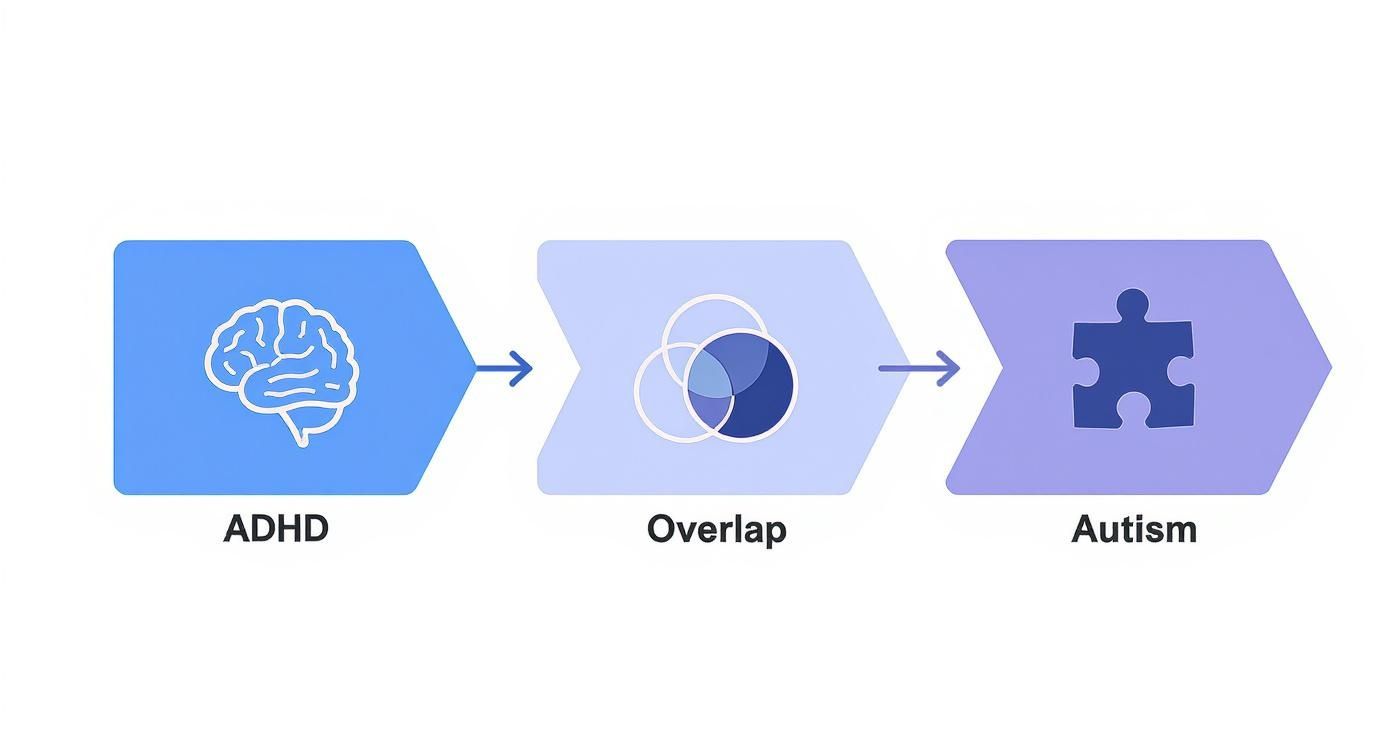
The diagram really highlights why a full assessment is so crucial for untangling the complex relationship between different neurotypes.
Understanding Diagnosis Rates and Pathways
For a long time, ADHD was diagnosed far more often in children than in adults, and much more in boys than in girls. Data from UK primary care in 2018 showed adult diagnosis rates were around 0.74% for men but only 0.2% for women, which points to a significant gender gap in recognition. This often happens because women's symptoms, and those in individuals with co-occurring autism, can be less disruptive and more internalised, making them easier to miss. You can delve into more of the data on ADHD diagnosis and treatment in UK primary care for the full picture.
The goal of an assessment is not to label you, but to provide clarity. It’s about understanding the 'why' behind your struggles so you can finally access the right support and strategies for your specific neurotype.
Ultimately, the process is designed to reduce the anxiety that often comes with seeking help. By demystifying each stage, you can go into your assessment feeling more confident and prepared. Whether you’re exploring an NHS referral or considering a private evaluation, knowing what the journey involves is the first step. You can find out more about what a private mental health assessment online involves to help you prepare.
Building Your Toolkit for Managing Adult ADHD
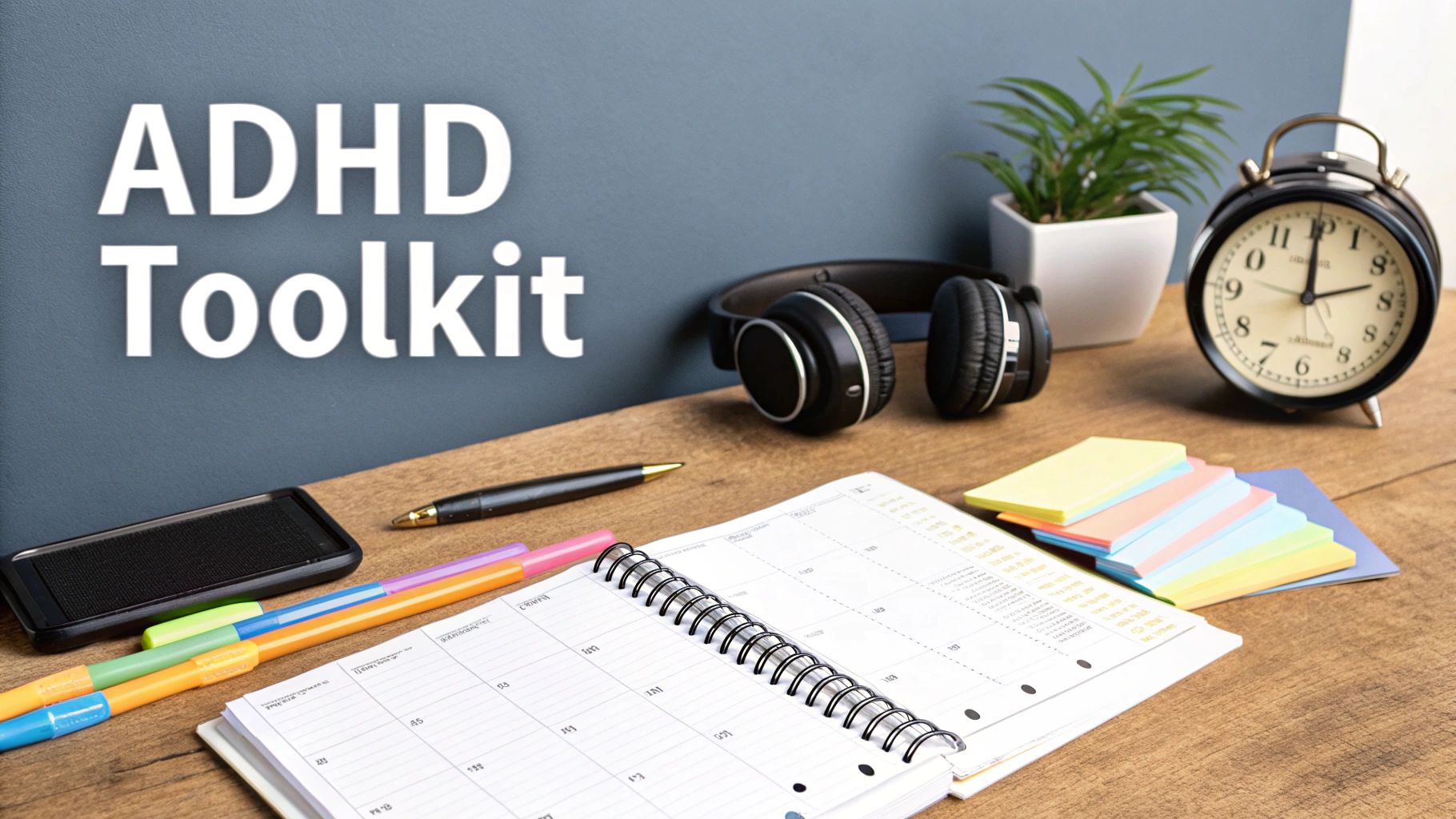
Getting an ADHD diagnosis isn’t the end of the road; it’s the beginning of a much clearer path forward. Think of it as finally getting the right instruction manual for your brain. It’s your chance to start working with your unique wiring, not constantly fighting against it. This is where the real work begins: building a personal toolkit of strategies, supports, and systems that help you thrive.
Managing ADHD symptoms in adults is rarely about finding one magic bullet. It’s more like building a custom support system, piece by piece. For many, medication is a crucial part of this toolkit, while for others, the focus is on behavioural strategies and therapy. For those with co-occurring autism, strategies must be adapted to accommodate sensory needs and social communication styles.
The need for this support is massive. In England alone, it's estimated that 2.5 million people have ADHD, with about 1.6 million of them being adults over 25. But here’s the problem: while around 5.8% of adults think they have ADHD symptoms, only 1.8% actually have a formal diagnosis. That's a huge gap in care. You can learn more about the landscape of adult ADHD in England and the growing demand for support.
The Role of Medication in ADHD Management
For many adults, medication is a cornerstone for managing the core symptoms of ADHD. A good analogy is putting on prescription glasses for the first time. It doesn't change who you are, but it suddenly brings the world into sharper focus, making everything much easier to navigate. ADHD medications work by fine-tuning the levels of key neurotransmitters in the brain, like dopamine and norepinephrine, which are vital for attention and impulse control.
There are two main types of medication prescribed for adult ADHD:
- Stimulants: These are the most common and often most effective option. They work by making those key brain chemicals more available, which can dramatically improve focus, reduce impulsivity, and help quieten that constant internal restlessness.
- Non-Stimulants: These are a fantastic alternative for people who don't respond well to stimulants or have other health conditions that make them unsuitable. They work in a different way but can still provide significant help with concentration and managing emotions.
Finding the right medication and the right dose is a careful, collaborative process called titration, always overseen by a specialist. It’s a journey to find what gives you the most benefit with the fewest side effects.
Powerful Non-Medical Strategies and Systems
Medication can be a game-changer, but it’s almost never the whole picture. The most successful management plans always include practical, real-world strategies that provide the external structure the ADHD brain often craves. These systems are like scaffolding, supporting your brain’s executive functions so you can get things done more effectively.
This is where lasting change really takes root—consciously building habits and creating an environment that compensates for challenges with organisation, time perception, and just getting started on tasks. For those with co-occurring autism, this also means creating sensory-friendly environments and predictable routines.
The goal isn't to force your brain to become neurotypical. It's about creating a supportive ecosystem around you where your ADHD and autistic brain has the best possible chance to succeed on its own terms.
Here are a few powerful strategies to pop into your toolkit:
- Task Chunking: Break down those huge, overwhelming projects into tiny, manageable steps. Instead of a to-do list item that just says "clean the kitchen," your list becomes "clear the counters," then "load the dishwasher," then "wipe the surfaces." This kills the overwhelm and gives you a clear path forward.
- Visual Timers: "Time blindness" is a classic ADHD trait where you just can't feel time passing. A visual timer makes this abstract concept tangible by showing you the time literally disappearing. They’re brilliant for staying on task and managing transitions between activities.
- Externalising Your Brain: Your working memory can be a bit like a leaky bucket, so stop relying on it. Get everything out of your head and into external tools—digital calendars, to-do list apps, sticky notes, whiteboards. This frees up so much mental energy for actual thinking.
These are great starting points, but if you're looking for more, our guide on how to manage ADHD without medication dives into even more strategies you can put into practice.
The Importance of Therapy and Coaching
Beyond practical systems, specialised therapies give you the mental and emotional tools to navigate life with ADHD. ADHD-informed therapy goes way beyond just managing symptoms; it gets to the heart of the challenges and thought patterns that come with the condition.
Cognitive Behavioural Therapy (CBT), for example, is incredibly effective for adults with ADHD. It helps you catch and reframe that negative self-talk that comes from a lifetime of feeling "lazy" or "disorganised." It also gives you practical frameworks for beating procrastination and getting a handle on your emotions. When working with autistic individuals with ADHD, CBT must be adapted to be more direct and concrete.
ADHD coaching is another fantastic resource. A good coach is a partner who helps you set realistic goals, design systems that actually work for you, and holds you accountable. They truly understand the unique hurdles of the ADHD brain—and ideally the AuDHD (Autism+ADHD) brain—and can help you play to your strengths.
By mixing and matching these elements—medication, practical systems, and therapeutic support—you can build a robust, personalised toolkit that empowers you to not just cope, but to genuinely thrive.
Your Questions About Adult ADHD Answered
It's completely normal to have a lot of questions when you start exploring adult ADHD. As you begin to see parallels between your own life and the traits of the condition, especially in relation to autism, you'll naturally want clear, reliable answers. Here, we'll tackle some of the most common questions we hear.
The aim is to clear up any confusion and help you feel more informed as you figure out what to do next. Getting to grips with adult ADHD is a process, and good information is the best place to start.
Can I Develop ADHD as an Adult?
This is probably one of the most frequently asked questions, but the simple answer is no. You don't suddenly develop ADHD as an adult. By its very nature, ADHD is a neurodevelopmental condition, meaning it starts in childhood as the brain is developing.
For a formal diagnosis, a specialist will need to see clear evidence that symptoms were causing problems before the age of 12. So, why do so many people only get diagnosed later in life? It’s usually down to one of two things: either they built clever coping strategies in their younger years that hid the signs, or life just got too demanding. Juggling a career, raising a family, and managing finances requires a level of organisation that can finally overwhelm the coping mechanisms that once worked.
Is It ADHD or Just Anxiety and Stress?
It’s incredibly easy to mix these up. On the surface, the signs—that constant restlessness, an inability to focus, feeling perpetually overwhelmed—can look almost identical. The real difference, though, is about timing and consistency.
Anxiety and stress tend to be situational. They flare up in response to specific pressures and often calm down once the trigger is gone. The challenges of ADHD symptoms in adults, on the other hand, are chronic. They’re a constant thread running through all areas of your life—work, home, and relationships—and have been there in some form since you were a child.
It's worth noting that chronic stress can absolutely pour fuel on the fire, making ADHD symptoms much worse. But even in calmer periods, the underlying ADHD traits will still be there. A specialist will carefully unpick this during an assessment.
What Is Rejection Sensitive Dysphoria?
Rejection Sensitive Dysphoria (RSD) is a term used to describe an extreme emotional reaction to perceived criticism or rejection. While it isn't an official diagnostic criterion in the DSM-5, clinicians and people with ADHD recognise it as a profoundly painful and very real part of the condition. For those who also have autism, this can be compounded by difficulties in interpreting social cues, leading to more frequent feelings of rejection.
For someone with ADHD, this can feel like a sudden, intense emotional blow that feels completely out of proportion to the actual event. It's thought to be a severe form of emotional dysregulation—a core, but often overlooked, aspect of ADHD. This intense response is linked to how the ADHD brain processes emotions and interprets social signals.
Can I Have Both ADHD and Autism?
Yes, absolutely. It's actually very common for ADHD and Autism Spectrum Condition (ASC) to exist together, creating a unique neurodivergent profile. For many years, diagnostic rules made it difficult, if not impossible, to get a dual diagnosis.
Thankfully, the official diagnostic manual (the DSM-5) was updated in 2013, finally allowing clinicians to diagnose both conditions in the same individual. This was a huge step forward in acknowledging the complex reality many people live with. A comprehensive assessment is crucial here, as a specialist can carefully separate the traits of each condition to see if you meet the criteria for one or both. Getting this right is the key to finding support that truly fits you.
At Insight Diagnostics Global, our consultant-led team provides thorough, CQC-regulated online assessments for adults seeking clarity on ADHD, autism, and other mental health conditions. If you're ready to understand your unique wiring and explore the right support for you, we are here to help. Find out more about our services at https://insightdiagnostics.co.uk.