

You might be dealing with this right now. You can do the job, you may already be doing the job, but the workplace keeps draining energy you need for the work itself. A noisy office, vague instructions, back-to-back meetings, a manager who mistakes overwhelm for attitude, or a recruitment process that collapses because nobody made basic adjustments.
That's where Access to Work can matter. For autistic adults, and for people with ADHD and mental health needs alongside neurodevelopmental differences, it can be the difference between constantly coping and working well. The difficulty is that the system often expects evidence at exactly the point many people are still waiting for assessment.
Psychological assessment demonstrates its practical value, not just its diagnostic utility. In work-related cases, a thorough report can help translate lived difficulties into specific adjustments, support requests, and an evidence trail that employers and Access to Work can act on. In consultant-led services with extensive experience, adults are often looking for clarity across Autism, ADHD and mental health together, particularly where presentations overlap. That's why some seek assessment through leading Consultant Psychiatrists with neurodevelopmental and personality disorder expertise, including Dr Sai Achuthan.
Understanding Access to Work and Why It Matters
A common pattern looks like this. Someone starts a new role, tries to mask through induction, then hits problems that weren't visible on paper. The office is too loud. Instructions are verbal and inconsistent. Small changes in routine create disproportionate stress. Performance starts to look uneven, even though the underlying issue is fit, not capability.
Access to Work is a government grant scheme designed to fund practical support for disabled people in work, or moving into work. It isn't a favour from an employer. It's one of the few mechanisms built to reduce the gap between what a person can do and what a badly designed workplace makes difficult.
Why the need is so obvious
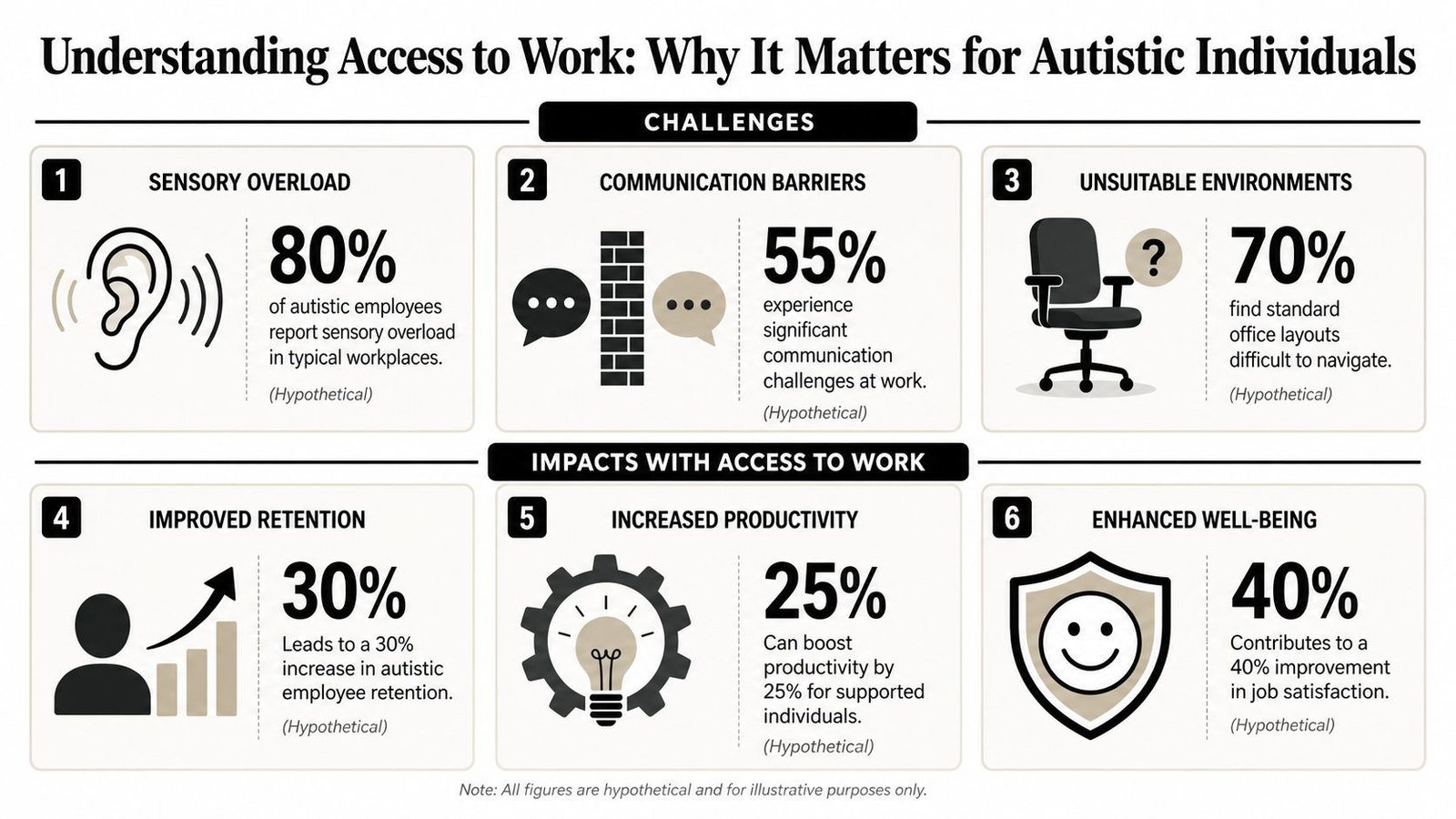
The employment picture makes the problem hard to ignore. In the UK, only around 30% of working-age autistic adults are in employment, the lowest rate of any disabled group, compared with 53.5% for all disabled people. The Buckland Review presents this as a structural barrier to work, not a lack of ability, and links it to employer attitudes, misunderstanding, and lack of adjustments during recruitment and employment in The Buckland Review of Autism Employment.
That's the key shift. If your work problems are being caused by sensory load, executive functioning strain, communication mismatch, or unmanaged anxiety around an inaccessible environment, the answer isn't “try harder”. The answer is support that matches the barrier.
Practical rule: If a workplace task is possible only when you're using unsustainable energy, that's a support issue.
For some people, the most effective change is simple. Written instructions. A quieter desk. Fewer unexpected calls. For others, the support needs are broader, especially when Autism overlaps with ADHD, burnout, anxiety or depression. If that's your position, it helps to understand how workplace adjustments can overlap across conditions, as set out in this guide to reasonable adjustments for ADHD at work.
What Access to Work is really for
It can support things an employer may not know how to provide on their own, or may be slow to organise without external structure. In practice, that often includes:
- Specialist equipment that reduces sensory or organisational friction
- Human support such as coaching or a support worker
- Travel support where public transport or commuting barriers are part of the problem
- Communication and planning tools that make the role sustainable
The point of access to work autism support isn't to prove you're struggling enough. It's to identify what lets you work on a fair basis.
Checking Your Eligibility and Preparing Your Evidence
Eligibility sounds simple until evidence becomes the sticking point. Many autistic adults can describe the barriers they face very clearly, but they still get stalled because they don't yet have a formal diagnosis or a report detailed enough to support a funding decision.

The diagnosis timing paradox
This is the problem I see most often. You need workplace support now, or before a job offer disappears, but the evidence process moves far more slowly than the employment process. As of September 2024, over 204,000 people in England were waiting for an autism assessment, a 25% annual increase, with waits going far beyond the NICE 13-week guideline, as described in this report on England's growing autism and ADHD assessment waiting lists.
That delay matters because Access to Work often works best early. It's much easier to stabilise a job when support is in place before probation problems, burnout, or conflict with a manager start to build.
What evidence usually helps most
The strongest evidence isn't just a label. It's a report that connects diagnosis to day-to-day work barriers and then to practical recommendations.
A useful report usually does three things well:
- Explains the condition clearly so a non-clinical decision-maker can understand it
- Links symptoms to work impact such as sensory overload, communication mismatch, time blindness, fatigue, shutdown, or anxiety
- Sets out concrete recommendations that can become adjustment requests
That's why a rapid private assessment can be strategically important, not because private is automatically better, but because timing matters. If you're stuck in the gap between suspected Autism or ADHD and a live work crisis, a consultant-led assessment can close that gap quickly enough to be useful.
A clear explanation of what clinicians look for can help before you apply. This overview of ASD diagnosis criteria in the UK is useful if you're trying to understand what kind of evidence is likely to carry weight.
The report isn't only there to confirm a diagnosis. It should function as a work document.
What to gather before you start
Before applying, pull together a small evidence pack. Keep it practical, not exhaustive.
- Identity and work details such as your National Insurance number, contact details, workplace address, and manager details if relevant
- Clinical evidence including a diagnostic report, assessment summary, or other relevant medical documentation
- Barrier notes written in plain language. List what happens, when it happens, and what would reduce it
- Examples from real work such as struggling with open-plan noise, losing track of multi-step verbal tasks, or becoming overwhelmed by sudden schedule changes
Later in the process, it also helps to have a short written summary that says: “These are the barriers, this is the impact on work, and these are the supports I'm requesting.”
A short explainer can also help if you're discussing assessment and work needs with family or an employer first.
Navigating the Application A Practical Walkthrough
The application goes more smoothly when you stop thinking like a claimant and start thinking like a translator. Your job is to translate clinical information and lived difficulty into practical workplace needs.
Start with barriers, not labels
Writing “I'm autistic” or “I have ADHD” won't usually do enough on its own. Start with what happens at work.
For example:
- Instead of saying you have sensory difficulties, say that open-plan office noise reduces concentration, increases stress, and makes calls or focused tasks harder to complete.
- Instead of saying you struggle with executive functioning, say that task switching, prioritising competing demands, and tracking deadlines become unreliable without external structure.
- Instead of saying you have anxiety, say that unpredictable meetings, unclear expectations, or sudden changes in workflow trigger distress and reduce your ability to perform consistently.
That framing gives Access to Work something usable.
Turn your report into requests
A diagnostic report often contains phrases people leave too vague. Don't. Convert each recommendation into something fundable or discussable.
Here's the pattern that tends to work:
Name the barrier
“I become overwhelmed in noisy environments and lose concentration when multiple conversations happen around me.”State the work effect
“This affects accuracy, attention, and my ability to complete detailed tasks.”Link to the support
“I'm requesting noise-reducing equipment and, where possible, a quieter workspace.”
Another example for ADHD:
- “I have difficulty organising multi-stage work without written structure.”
- “This leads to missed steps and higher cognitive load.”
- “I'm requesting digital planning support and coaching around task management.”
If you're applying with overlapping needs, this guide to ADHD Access to Work support can help you think through how to describe executive functioning and attention barriers in a way decision-makers can understand.
Keep every request tied to a task. The more directly it connects to doing the job, the stronger it usually is.
What to prepare before the form or phone call
A short checklist helps because application calls can move quickly.
- Work basics including your job title, hours, employer name, and work address
- Your role demands such as meetings, client contact, writing, analysis, travel, shift changes, or admin
- The top three barriers that create the most disruption
- Support ideas you already know would help, even if you're unsure whether they'll be funded
- Your report summary with two or three recommendations written out clearly
Phrasing that usually works better
Some wording gets results more often because it is specific. Compare these:
| Weaker phrasing | Stronger phrasing |
|---|---|
| “I struggle in the office.” | “Background noise and visual distraction in the open-plan office reduce concentration and increase stress during focused work.” |
| “I need help with organisation.” | “I need structured support for prioritising, planning and tracking deadlines across multiple tasks.” |
| “Communication is hard.” | “I process information better in writing and need clear written follow-up after meetings.” |
The goal in access to work autism applications is clarity. Not drama. Not perfect legal language. Clear links between barrier, impact, and support.
What Support Can You Actually Get Real Workplace Examples
People often know they need help but don't know what to ask for. That's where a good diagnostic report earns its keep. It gives you language for support that can continue after recruitment, not disappear once the job starts.
The risk of that drop-off is real. In discussion of the post-diagnosis abandonment gap, researchers highlight the need to use diagnostic recommendations to negotiate sustained support, which matters because 48% of autistic workers report bullying and 51% report discrimination in this context of unmet needs and fading adjustments in this analysis of post-diagnosis support and workplace barriers.
Support is wider than equipment
A lot of people assume Access to Work only pays for items. In practice, the most useful support is often a mix of environment, tools, and human help.
Here are the kinds of examples that come up most often in work settings involving Autism, ADHD, and related mental health strain:
| Support Category | Specific Example | What It Helps With |
|---|---|---|
| Environmental support | Quieter workspace or changes to seating location | Sensory overload, distraction, fatigue |
| Equipment | Noise-cancelling headphones | Auditory overload in open-plan offices |
| Coaching | Specialist work coaching | Planning, prioritising, communication, routines |
| Software | Digital task-management or scheduling tools | Organisation, deadlines, task switching |
| Communication support | Written instructions after meetings | Processing information, memory, clarity |
| Travel support | Help with difficult journeys to work | Distress, unpredictability, sensory strain |
| Team support | Autism or neurodiversity awareness training | Misunderstanding, conflict, preventable friction |
What works better than generic adjustment lists
Generic lists are a starting point. They're not enough on their own. The strongest support plans are based on your actual work pattern.
If your role involves deep focus, your support may need to centre on sensory control and protected concentration time. If your role is fast-moving and administrative, support may need to focus on task sequencing, reminders, and reducing the cognitive cost of switching. If mental health has been affected by prolonged masking or workplace stress, then regular review points and clearer communication may matter as much as equipment.
A helpful way to think about it is to build an autism design guide for your work. Not a formal legal term in every setting, but a practical document that says what your environment, communication, and routines need to look like for you to function well.
Support that only works at interview stage isn't enough. Retention depends on what happens in month two, not just week one.
Examples that are often worth discussing
For sensory strain
Ask for a fixed desk in a lower-traffic area, permission to use headphones, reduced exposure to hot-desking, and written notice of environmental changes where possible.For ADHD-related executive functioning difficulties
Ask for planning software, external coaching, written task breakdowns, and fewer last-minute priority shifts unless genuinely necessary.For communication mismatch
Ask for agendas in advance, written follow-up after meetings, clearer deadlines, and a named point of contact for clarification.For stress and mental health deterioration linked to inaccessible work
Ask for predictable check-ins, reduced ambiguity around expectations, and adjustments that reduce cumulative overload rather than only responding after crisis.
If work pressure is already feeding anxiety or burnout, these workplace stress management strategies can help you separate what's a support need from what's an unsustainable workload.
After You Apply Assessment Appeals and Renewals
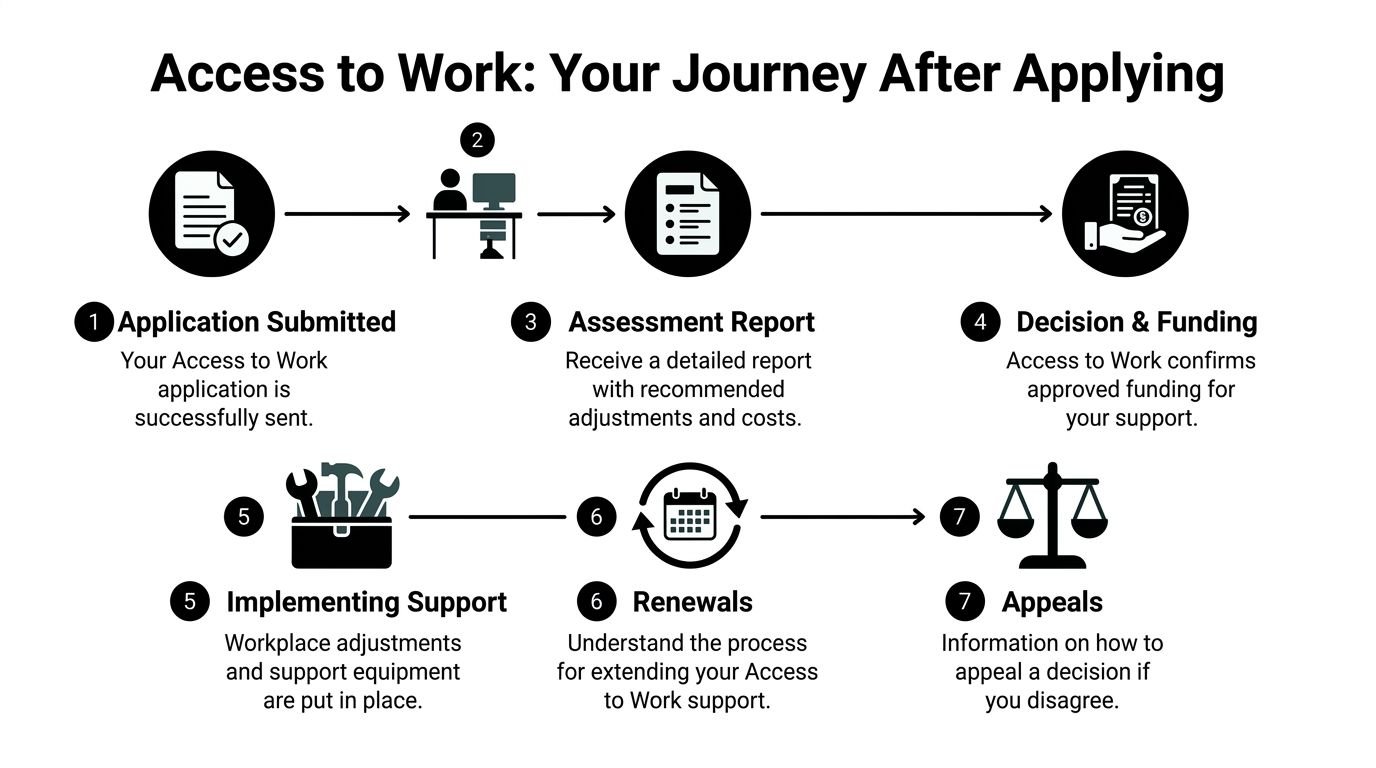
Submitting the application is only the start. Many people feel a second wave of anxiety when they hear there may be an assessment. In practice, this stage is usually most useful when you treat it as a structured conversation about how you work best.
How to approach the workplace assessment
The assessor needs detail. Broad statements can lead to broad recommendations, and broad recommendations are harder to implement.
Before the assessment, write down:
- What your hardest tasks are
- Which environments make them worse
- What support you've already tried
- What has helped, even informally
- What your report recommends
Bring examples from ordinary working days. “I miss information when instructions are only verbal.” “I shut down when meetings are moved with no notice.” “I need written priorities when multiple deadlines collide.” Those are much easier to act on than “I find work stressful”.
If the decision misses the point
Not every decision is right first time. If support is refused, reduced, or framed too narrowly, ask for the reasoning in writing and compare it against the evidence you provided. Then respond to the mismatch.
A good challenge usually does three things:
- It points to the specific part of the decision you disagree with.
- It links back to the evidence already submitted.
- It explains the work impact if the support isn't provided.
Keep the tone factual. The issue isn't whether your needs are real. The issue is whether the decision accurately understood them.
If a recommendation was in your report but didn't make it into the final support package, raise that directly.
Think beyond the first approval
Needs change. Jobs change. Managers change. Support that worked in one role may not fit another. Renewals are easier when you keep a record of what the funded support helped with.
That longer-term view matters because workplace disadvantage doesn't disappear once someone is hired. Autistic adults in the UK face the largest pay gap among disability groups, are often overqualified for their roles, and 43% of UK autistic people who have been employed say they lost a job due to autism-related discrimination, as outlined by the National Autistic Society in its coverage of The Buckland Review and autism employment barriers.
Renewals tend to go more smoothly if you can show which barriers remain, which support is still effective, and what now needs adjusting.
Common Questions About Access to Work for Autism
Can I apply if I'm self-employed or freelance
In many cases, yes. The key issue is still the work barrier and the support needed to do the work. If you're freelance, be ready to explain your work pattern clearly and show how the support relates to paid work activity.
Do I need to tell my employer
Often, some level of employer involvement becomes necessary if support is going to be implemented at work. But that doesn't mean you need to disclose every detail of your health history. Keep the conversation focused on barriers and adjustments unless there's a reason to share more.
Will it affect PIP, Universal Credit, or other benefits
Access to Work is generally discussed as separate from means-tested benefit calculations, but benefit situations can be complex. If you're worried about interactions with other support, it's sensible to check your current position before final decisions are made.
How long does it take
Timelines vary. Some people move through quickly. Others wait longer for contact, assessment, or implementation. The practical lesson is to apply as early as you can and keep copies of everything you send.
What if I'm waiting for an autism or ADHD assessment
This is one of the hardest positions to be in. If your work situation is urgent, don't wait passively. Gather existing medical evidence, document your barriers, and look at whether faster assessment is necessary because employment support depends on it.
Can I ask for support for Autism, ADHD and mental health together
Yes, and you should if that reflects your reality. Many adults don't fit into neat boxes. Sensory overload, executive functioning problems, anxiety, depression, burnout, trauma history, or personality-related difficulties can overlap in ways that affect work differently from any single label on its own.
What if my manager says they've already made reasonable adjustments
That doesn't automatically end the conversation. Employer adjustments and Access to Work can sit alongside each other. If current changes aren't enough, explain what barrier remains and why more targeted support is needed.
What should I do before my first conversation with Access to Work
Prepare a one-page summary with:
- Your role and main duties
- Your top work barriers
- Examples of when those barriers show up
- The support you think would help
- Key recommendations from any report you have
That one page often makes the whole process easier because it stops you having to think on the spot while stressed.
Is a diagnosis enough on its own
Usually not. A diagnosis opens the door, but a detailed explanation of impact is what helps move things forward. The stronger your evidence links condition, barrier and support, the better.
If you need clear diagnostic evidence for workplace support, Insight Diagnostics Global offers consultant-led assessments for adults covering Autism, ADHD and a wide range of mental health conditions, with online and face-to-face options. Their service is CQC-regulated, reports are designed to be clinically sound and practical, and assessments are led by psychiatrists on the GMC Specialist Register, including specialists such as Dr Sai Achuthan in neurodevelopmental and personality disorder work. For adults trying to bridge the gap between long waiting lists and urgent employment needs, that kind of structured assessment can give you something concrete to use.