

You may be holding everything together on the outside. You answer emails, remember birthdays, keep work moving, sort school forms, appear capable in meetings, and still end many days feeling defeated by things that look small to everyone else. The washing stays half-done. The tabs stay open. The deadline gets met, but only after panic, shame, and a night of exhaustion. Then you wonder whether you're lazy, disorganised, anxious, burnt out, or not coping as well as other people seem to.
Many women arrive at assessment carrying years of self-doubt rather than certainty. They've often been told they're too sensitive, too chaotic, too intense, too forgetful, or too hard on themselves. Some have already been treated for anxiety or depression. Some have wondered about Autism and ADHD and mental health difficulties together, especially when sensory overload, social fatigue, masking, or emotional dysregulation are part of the picture. In clinical work alongside psychological assessment, that pattern is common.
A careful diagnostic process can be clarifying. That matters when the question isn't just “Do I have ADHD?” but “Why has life felt harder than it looks, even when I try so hard?” With extensive experience in neurodevelopmental and personality disorder assessment, leading Consultant Psychiatrists such as Dr Sai Achuthan approach that question with nuance, not stereotypes.
More Than Just Overwhelmed The Reality of ADHD in Women
She is the woman who turns up prepared and apologises anyway. Her diary is full. Her mind is fuller. She can run a team, support a family, and still lose an afternoon to avoidance because one email feels impossible to start. She looks high-functioning. Internally, she feels as though she is forever catching up with a life that never stops moving.
This is one reason ADHD in women gets missed. The old picture was a disruptive, hyperactive boy who couldn't sit still in class. Many adult women don't recognise themselves in that image, and many clinicians historically didn't either. Instead, women often describe chronic overwhelm, internal restlessness, forgotten tasks, emotional reactivity, and relentless self-criticism.
That pattern is far from rare. In England, 14.9% of women screened positive for possible ADHD, compared with 12.4% of men, while only 1.8% of all adults had a formal diagnosis, according to the Adult Psychiatric Morbidity Survey 2023/24. For many women, the issue isn't lack of symptoms. It's lack of recognition.
What overwhelm often looks like clinically
ADHD doesn't always announce itself as obvious hyperactivity. In women, it may look like this:
- Relentless compensation that keeps life moving, but at a high emotional cost
- Overthinking simple tasks until they become paralysing
- Anxiety around routine demands because forgetting something feels inevitable
- Shame after small mistakes that seem to confirm a private story of failure
- Cycles of overperforming and collapse that get labelled as burnout
Many women don't come to clinic saying, “I think I have ADHD.” They come saying, “I don't understand why everything feels harder for me than it seems to for everyone else.”
Why this matters
If you've spent years believing your difficulties are moral rather than neurological, accurate assessment can be immensely relieving. It doesn't remove responsibility, but it does replace blame with explanation. That's often the turning point.
ADHD in women symptoms deserve to be understood in context. The context includes school, work, relationships, hormones, sensory load, masking, and the mental effort of appearing fine.
Understanding the Hidden Symptoms of Female ADHD
The clearest way to understand female ADHD is to stop looking only at the visible tip. Think of an iceberg. The part above the water is what people expect to see. Fidgeting, interrupting, impulsive behaviour. The larger mass sits underneath. That hidden section often contains the experiences women describe in clinic.
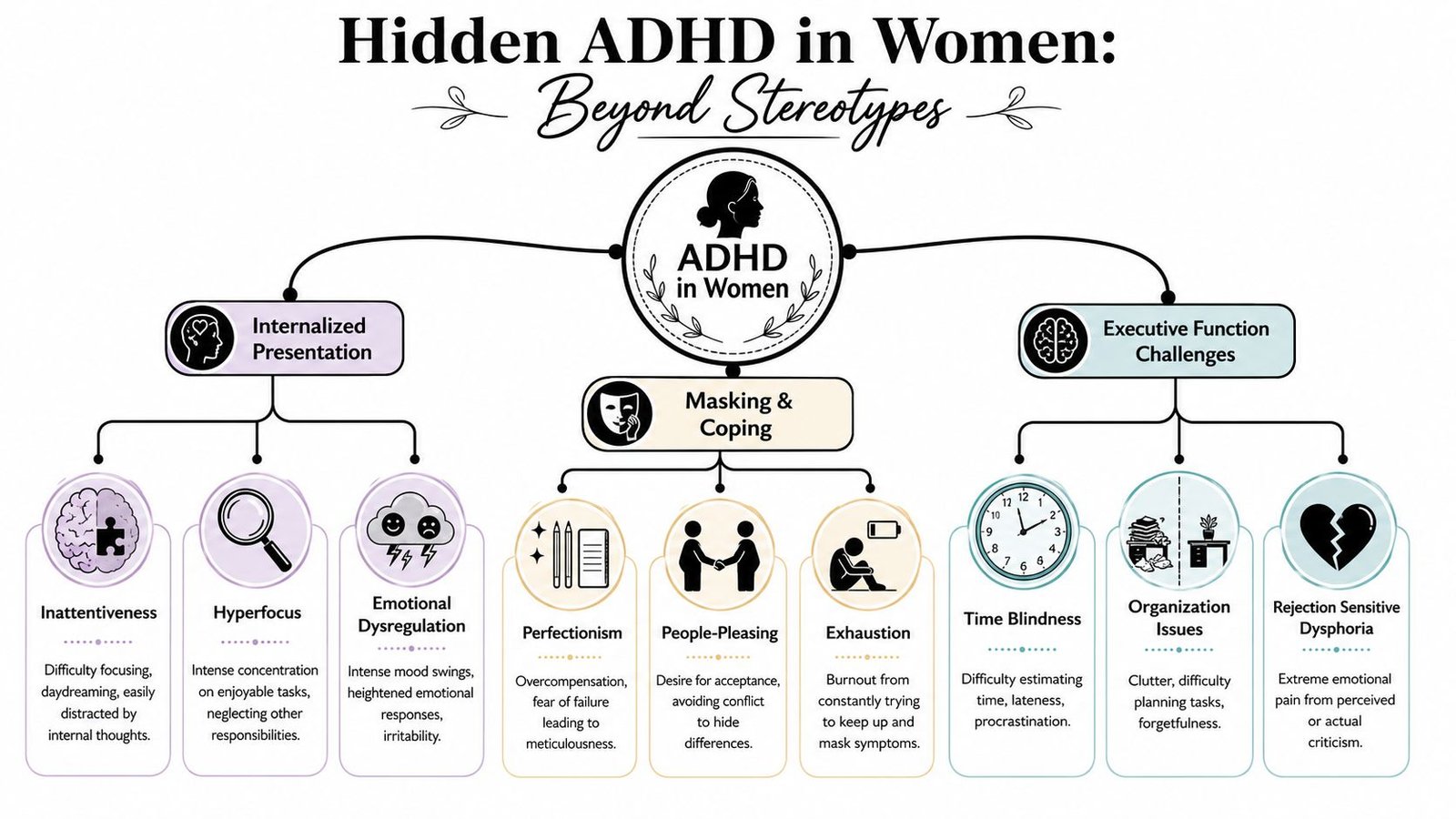
The hidden part of the iceberg
Below the surface, ADHD in women symptoms often include:
- Internal restlessness rather than visible overactivity. Your body may be still while your mind races.
- Inattentiveness that feels like drifting, blanking, losing the thread, or hearing words without absorbing them.
- Time blindness that makes routine planning unreliable, even when you care immensely about being on time.
- Hyperfocus on interesting tasks, followed by near inability to start the dull but necessary ones.
- Emotional dysregulation that brings fast, intense reactions, then embarrassment for reacting so strongly.
- Rejection sensitivity where mild criticism can feel piercing and disproportionately painful.
These aren't character flaws. They're patterns of attention, regulation, and executive functioning.
Masking often delays diagnosis
Many women learn to camouflage difficulties early. They become organised on the outside because disorganisation feels dangerous. They overprepare. They people-please. They stay late. They rely on perfectionism as a survival strategy. From a distance, this can look impressive. Up close, it's exhausting.
This is why burnout and anxiety are such common alternative labels. UK data shows women are typically diagnosed 5 to 10 years later than men, and only 12% of UK women with ADHD receive a diagnosis before age 30, often because internal restlessness and chronic overwhelm are mistaken for anxiety or depression, especially when masked by perfectionism. That finding is discussed in The Lost Girls and why ADHD in women is so often missed.
What works and what doesn't
Some coping strategies help. Others keep the appearance of functioning while driving distress.
| Hidden pattern | What often doesn't work | What tends to help |
|---|---|---|
| Forgetting tasks | Relying on memory alone | External reminders, visible cues, one trusted capture system |
| Time blindness | Telling yourself to “try harder” | Timers, transition alerts, reducing steps between intention and action |
| Emotional overwhelm | Self-criticism after every reaction | Naming triggers, pausing, regulation strategies, tailored therapy |
| Perfectionist masking | Doing everything at the last minute under pressure | Breaking work into starts, not just deadlines |
| People-pleasing | Saying yes to avoid guilt | Clear limits, written follow-up, reduced decision load |
Practical rule: If a strategy only works when you're anxious enough, it isn't a sustainable strategy.
The symptom women often miss in themselves
The most overlooked issue is often not distractibility. It's the constant effort of compensation. Many women don't realise how much energy they spend trying to appear calm, competent, and consistent. They assume everyone is this tired.
That's why the phrase “ADHD in women symptoms” matters clinically. It points away from stereotype and towards lived experience. Not every woman with ADHD presents the same way, but many share the same hidden burden. They've been coping for years. Coping, however, isn't the same as thriving.
A Practical Checklist for Recognising ADHD in Daily Life
Clinical terms are useful, but most women recognise themselves in moments rather than labels. They notice the unopened post, the half-finished online form, the panic before a meeting, or the odd combination of capability and chaos. A practical checklist is often more revealing than a symptom list.
Common Signs of ADHD in Women A Daily Life Checklist
| Life Area | You Might Experience… | Instead of the Stereotype of… |
|---|---|---|
| Home and life admin | Doom piles, laundry that stalls halfway, unopened parcels, forgetting what you walked into the room to do | Obvious hyperactivity |
| Home and life admin | Feeling unable to relax because your mind keeps scanning unfinished tasks | “Just being stressed” |
| Home and life admin | Starting multiple organising systems and abandoning them when they become hard to maintain | Laziness or lack of discipline |
| Work and study | Doing well in bursts but struggling to begin routine tasks | Lack of ambition |
| Work and study | Missing deadlines you care about because the task never feels “real” until it's urgent | Carelessness |
| Work and study | Reading the same paragraph repeatedly without taking it in | Poor intelligence |
| Work and study | Performing best under pressure, then crashing afterwards | Being dramatic |
| Social and relationships | Interrupting because you're afraid you'll lose the thought | Rudeness |
| Social and relationships | Feeling physically present but mentally absent in conversation | Not caring |
| Social and relationships | Replaying criticism for hours or days | Being oversensitive |
| Emotional life | Big shame after ordinary mistakes | “Low confidence” in isolation |
| Emotional life | Swinging between overcommitting and withdrawing | Moodiness without context |
At home and in the unseen workload
The domestic side of ADHD often gets dismissed because much of it is private. Nobody sees the cupboard you opened and forgot to finish sorting. Nobody sees the bills you meant to pay after making tea, then lost track of. Women are often carrying a heavy mental load already, so ADHD can blend into the background as “not coping well enough”.
Signs worth noticing include:
- Task friction where small chores feel oddly hard to start
- Visual clutter tolerance problems where mess becomes both overwhelming and invisible
- Serial restarting of planners, calendars, storage systems, or routines
- Rest without recovery where sitting down doesn't switch your brain off
If structure is hard to maintain, simple external systems can help. Some women benefit from practical systems for busy professionals that reduce decision fatigue and make work more visible rather than relying on memory.
At work when you seem capable but feel scrambled
It is common for many women to confuse ADHD with imposter syndrome. They know they're intelligent. They may even be highly successful. Yet they still miss details, avoid administrative tasks, underestimate time, or produce excellent work only after immense strain.
Watch for patterns such as:
- Needing urgency to activate focus
- Avoiding tasks that are unclear, repetitive, or emotionally loaded
- Losing time in research, planning, or perfectionism
- Struggling to shift between tasks even when you know what matters most
In relationships and social situations
ADHD can affect connection in subtle ways. You may care sincerely and still forget to reply. You may listen hard and still drift. You may want calm conversations and still react intensely if you feel criticised or misunderstood.
If your relationships are marked by “You're too much” and “You never seem settled”, it's worth asking whether regulation and attention are part of the picture, not just emotion.
A checklist isn't a diagnosis. But if these experiences feel uncomfortably familiar across settings and over time, they deserve a proper assessment rather than another round of self-blame.
Untangling ADHD from Anxiety Depression and Autism
Misdiagnosis rarely happens because someone is careless. It happens because symptoms overlap. A woman arrives exhausted, tense, unable to focus, emotionally reactive, and ashamed of how behind she feels. Anxiety seems plausible. Depression seems plausible. Sometimes a mood disorder or personality difficulty is considered. Sometimes Autism is part of the query too. The task is to identify the root pattern.
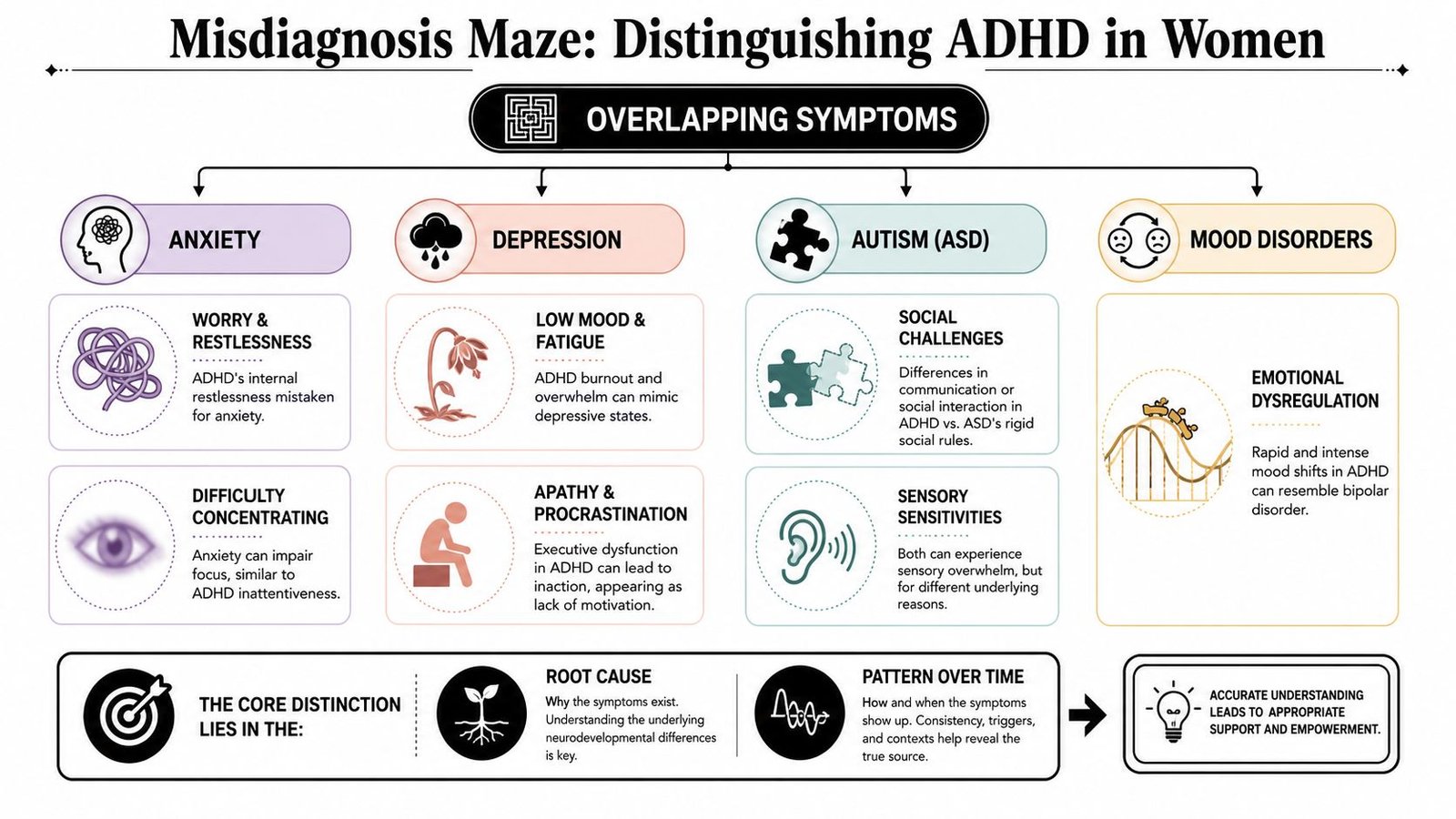
Why anxiety and depression are common detours
Roughly 50% of women with ADHD are first misdiagnosed with anxiety or depression, delaying access to appropriate support by an average of 5 to 10 years compared to men, as outlined by the ADHD Centre's overview of ADHD in women. That makes clinical sense. Untreated ADHD can produce real anxiety. If you're frequently late, forgetful, overwhelmed, and trying to prevent mistakes, worry becomes a coping style. Depression can also follow years of perceived underachievement and emotional exhaustion.
The key question is not just “Is there anxiety?” It is “What is driving it?”
Root cause matters more than surface similarity
A useful way to think about this is roots and branches.
- ADHD as a root can produce branches that look like anxiety, low mood, burnout, low self-esteem, social avoidance, and emotional volatility.
- An anxiety disorder as a root tends to centre fear, apprehension, and avoidance even when executive demands are modest.
- Depression as a root more often brings a persistent reduction in drive, pleasure, and energy that isn't fully explained by attentional overload.
This distinction is why a broad mental health review matters. If you'd like a deeper look at how conditions can overlap rather than compete, this piece on comorbidities with ADHD is a helpful starting point.
Where Autism fits into the picture
Autism and ADHD can coexist, and in many women the question isn't one or the other. It's whether both are present. There can be overlap in sensory sensitivity, social fatigue, masking, executive functioning difficulties, and burnout. The difference often sits in the pattern.
ADHD tends to involve inconsistency of attention and regulation. Autism often brings a more enduring difference in social communication, sensory processing, and preference for predictability. In practice, the distinction is rarely made by a single symptom. It is made by the developmental history and the overall profile.
Hormones complicate the picture further
Hormonal changes can intensify emotional and attentional symptoms, which is one reason women may be treated for mood problems first. For women trying to make sense of mood shifts around midlife, Lila's tips for perimenopause mood can be a useful companion resource alongside formal assessment.
A previous diagnosis isn't necessarily wrong. It may simply be incomplete.
Good assessment doesn't force every difficulty into one box. It asks what started first, what persists across contexts, what changes with stress or hormones, and which diagnosis best explains the full picture.
How ADHD Symptoms Evolve Through a Womans Life
A woman's ADHD rarely looks identical at 15, 25, and 45. The underlying neurodevelopmental pattern may be stable, but the demands placed on it change. Hormones matter too. That is why many women say, with total sincerity, “I managed before, but now everything has fallen apart.”
Teenage years and early adulthood
In adolescence, the struggle is often hidden inside effort. A girl may revise late, forget homework details, lose items, or drift in lessons, yet still scrape through because she's bright and frightened of letting people down. The social environment can be bruising. Emotional sensitivity, rejection fears, and friendship instability often get interpreted as personality rather than neurodevelopment.
At university or in early work, the scaffolding drops away. Freedom sounds positive until nobody is structuring your time. Deadlines become self-managed. Laundry, rent, revision, meals, and relationships all compete at once. The woman who looked fine at school may suddenly feel unable to regulate ordinary life.
Career, parenting, and the mental load
Adult responsibilities expose executive strain quickly. Careers reward planning, prioritising, follow-through, and sustained attention to boring but important tasks. Parenting adds a second layer of cognitive load. Many women can cope with one demanding role. They struggle when every role requires simultaneous remembering, organising, and emotional regulation.
Clinically, this is the stage where many women say they hit a wall. They don't become less capable. Their compensatory systems stop covering the gap.
Hormonal shifts can amplify symptoms
Hormones deserve specific attention because they change the intensity of ADHD symptoms across the menstrual cycle and through perimenopause. Emerging UK data reports that 45% of women experience a 30% to 60% increase in inattention and emotional dysregulation during the luteal phase or perimenopause, and a 2025 UK study found 29% of women with late-diagnosed ADHD were initially treated for depression or anxiety due to hormone-linked symptom spikes, as described in this guide on late diagnosis in UK women.
That helps explain why some women seek help for the first time in their forties or fifties. They may report feeling foggy, reactive, scattered, forgetful, or unlike themselves. Some worry about burnout. Some worry about dementia. Some have been treated repeatedly for mood symptoms without anyone mapping the timing of those changes against hormones.
For women navigating that phase, information on menopause and ADHD can help frame the right questions before assessment.
What tends to help across the lifespan
Different stages need different supports:
- Teen years often need recognition, school support, and reducing shame early.
- Student and early career years benefit from external structure and realistic workload planning.
- Parenting years call for simplification, delegation, and reduced perfectionism.
- Perimenopause and menopause require careful history-taking so hormonal change doesn't hide ADHD or vice versa.
No woman is “too successful” or “too late” for ADHD to be relevant. Symptoms often become visible when life becomes less forgiving.
Your Path to Clarity Seeking an ADHD Assessment
For many women, the hardest part is not the assessment itself. It is deciding they're allowed to ask for one. They worry they're overreacting. They worry they've just read too much online. They worry someone will say, again, that they're stressed.
That hesitation is understandable. At the same time, demand for adult assessment has grown sharply. There has been a 400% rise in people seeking an ADHD diagnosis since 2020, and while professional diagnosis rates for men and women are now equal at 1.7% in the UK, women are still often diagnosed much later after inattentive symptoms were missed in childhood, according to this report on ADHD in women and girls.
A structured assessment exists to answer the question carefully, not to dismiss it.
Early in the process, some people find it useful to complete an adult ADHD test online as a preliminary reflection tool. It isn't diagnostic, but it can help organise your thoughts before speaking to a clinician.
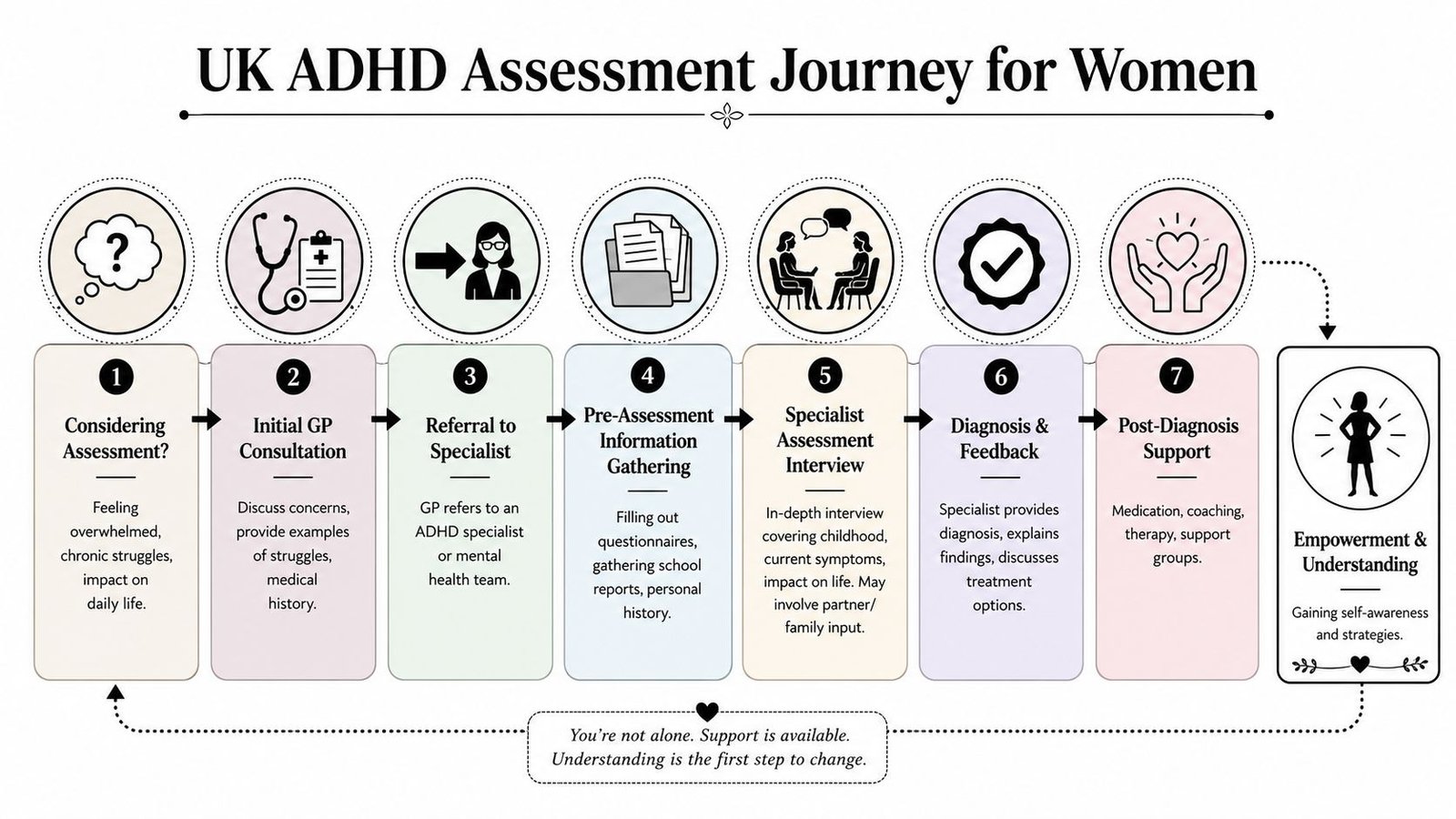
When it's time to seek help
An assessment is worth considering when difficulties are persistent, not occasional, and when they affect more than one part of life. Common signs include chronic disorganisation, repeated overwhelm, problems sustaining attention, relationship strain, underperformance relative to ability, and a long history of feeling that ordinary life takes unusual effort.
It's especially important to seek proper review if:
- Past treatment hasn't explained the full picture
- You've been labelled anxious, burnt out, or depressed repeatedly without lasting clarity
- You suspect both Autism and ADHD may be relevant
- Hormonal shifts seem to worsen attention and emotional regulation
- The cost of coping is becoming too high
What a good assessment actually involves
A proper ADHD assessment for an adult woman should be detailed, developmental, and clinically sceptical in the best sense. It should not be a quick checklist and a rushed conclusion.
A thorough process usually includes:
- A detailed history of childhood, education, work, relationships, daily functioning, and mental health.
- Structured symptom review, often using recognised tools such as the DIVA based approach or equivalent clinician-led frameworks.
- Collateral information where possible, such as comments from a parent, partner, or someone who knows your long-term patterns.
- Screening for overlap and alternatives, including anxiety, depression, Autism Spectrum Disorder, trauma, mood disorders, and personality factors.
- A feedback discussion that explains not only the outcome, but why that conclusion was reached.
Good assessment doesn't ask whether you can perform. It asks what it costs you to perform.
This short overview may also help you see the process in a more human way:
UK routes to assessment
There are several realistic pathways in the UK, each with trade-offs.
| Route | What it offers | Main trade-off |
|---|---|---|
| GP referral through local NHS services | Lower direct cost to the patient | Waiting times can be long |
| Right to Choose pathway | Access to an alternative provider through the NHS route in eligible cases | Administrative steps can be confusing |
| Private self-funded assessment | Faster access and flexible appointments | Direct financial cost |
| Insurance-funded route | May reduce personal cost if authorised by your policy | Approval processes vary |
What to prepare before your appointment
You don't need perfect evidence. You do need examples.
Bring or note down:
- School memories or reports if available
- Examples from work or home that show patterns, not isolated incidents
- Previous diagnoses or treatments
- Questions about medication, therapy, coaching, or accommodations
- Any pattern linked to your menstrual cycle, pregnancy, or perimenopause
The aim is clarity. Whether the conclusion is ADHD, Autism, both, another condition, or a combination, the value lies in understanding the pattern accurately and finally having a route forward.
Navigating Life After an ADHD Diagnosis
A diagnosis can bring relief, grief, anger, vindication, or all four in the same week. Many women feel seen for the first time. Many also mourn the years spent blaming themselves. Both reactions are normal.
The useful question after diagnosis is not “How do I become a different person?” It is “How do I build a life that fits the brain I have?”
The treatment toolkit
Support works best when it is practical and layered. Medication can help some adults with attention, impulsivity, and mental noise. When prescribed, it usually involves careful titration and follow-up rather than a single dramatic fix. Therapy also matters, especially when years of criticism have left anxiety, shame, and avoidance patterns behind.
Helpful options often include:
- Medication review and titration when appropriate and medically safe
- ADHD-informed CBT or counselling to address shame, routines, and emotional patterns
- Coaching or skills work focused on time, planning, task initiation, and accountability
- Workplace or study adjustments that reduce unnecessary executive load
For women who want structured emotional support alongside practical strategies, guidance on counselling for ADHD can be a good place to start.
What usually works better than trying harder
The most effective changes are often unglamorous. They reduce friction.
- Externalise tasks instead of keeping them in your head
- Shrink the start of hard tasks so beginning feels possible
- Use visible systems rather than beautifully complex systems
- Plan for transitions because switching tasks is often the hidden challenge
- Protect sleep and recovery because exhaustion magnifies every symptom
Some women also explore sleep-supporting habits once they understand how much poor rest worsens focus and emotional regulation. If sleep is a persistent issue, this guide to magnesium and ADHD sleep may offer useful general context to discuss with your clinician.
The goal isn't perfect consistency. It's reducing the daily penalty your brain pays for ordinary tasks.
What doesn't help
A few approaches tend to backfire:
- Overcomplicated planners that require constant maintenance
- Shame-based motivation that depends on panic
- Comparing yourself to neurotypical systems and assuming failure means weakness
- Treating diagnosis as the whole solution rather than the start of targeted support
A diagnosis does not erase difficulty. It does make the difficulty intelligible. That changes treatment, self-talk, relationships, and expectations. It lets you stop forcing yourself through methods that were never designed for the way you process attention, emotion, and time.
ADHD in women symptoms often make sense only in retrospect. Once named properly, they become far easier to work with. Clarity creates options. Self-understanding creates room. For many women, that is the point at which life stops feeling like a private struggle and starts becoming manageable.
If you're looking for a clear, consultant-led route to assessment, Insight Diagnostics Global provides online and face-to-face evaluations for adults across ADHD, Autism Spectrum Disorder, and broader mental health concerns. The service is CQC regulated, led by psychiatrists on the GMC Specialist Register, and offers structured assessments, detailed reports, treatment recommendations, and optional follow-up including ADHD medication titration and monitoring. If you've been living with chronic overwhelm, burnout-like symptoms, or years of uncertainty, it's a credible place to seek clarity.